At the Ferrari dealership in Manhattan, the marketing director laughed at my battered station wagon
Part 2
The man standing in front of me was Matteo Rossi, a senior executive from Ferrari who had flown in from Italy for a series of private meetings.
I had known him for years.
I just hadn’t expected to see him there.
I shook his hand.
“Matteo.”
His grip tightened.
“You disappeared.”
“I needed to.”
His eyes softened for a moment.
Then he looked around the showroom.
“I see.”
Maya was still staring at me.
“Dad?”
I turned toward her.
“There’s something I should have told you.”
Before I could continue, Victoria stepped forward.
Her face had gone completely pale.
“Chairman?”
Matteo looked at her.
“Yes.”
She swallowed.
“Chairman of what?”
Matteo didn’t answer immediately.
Instead, he looked at Maya.
“Your father never told you?”
Maya shook her head slowly.
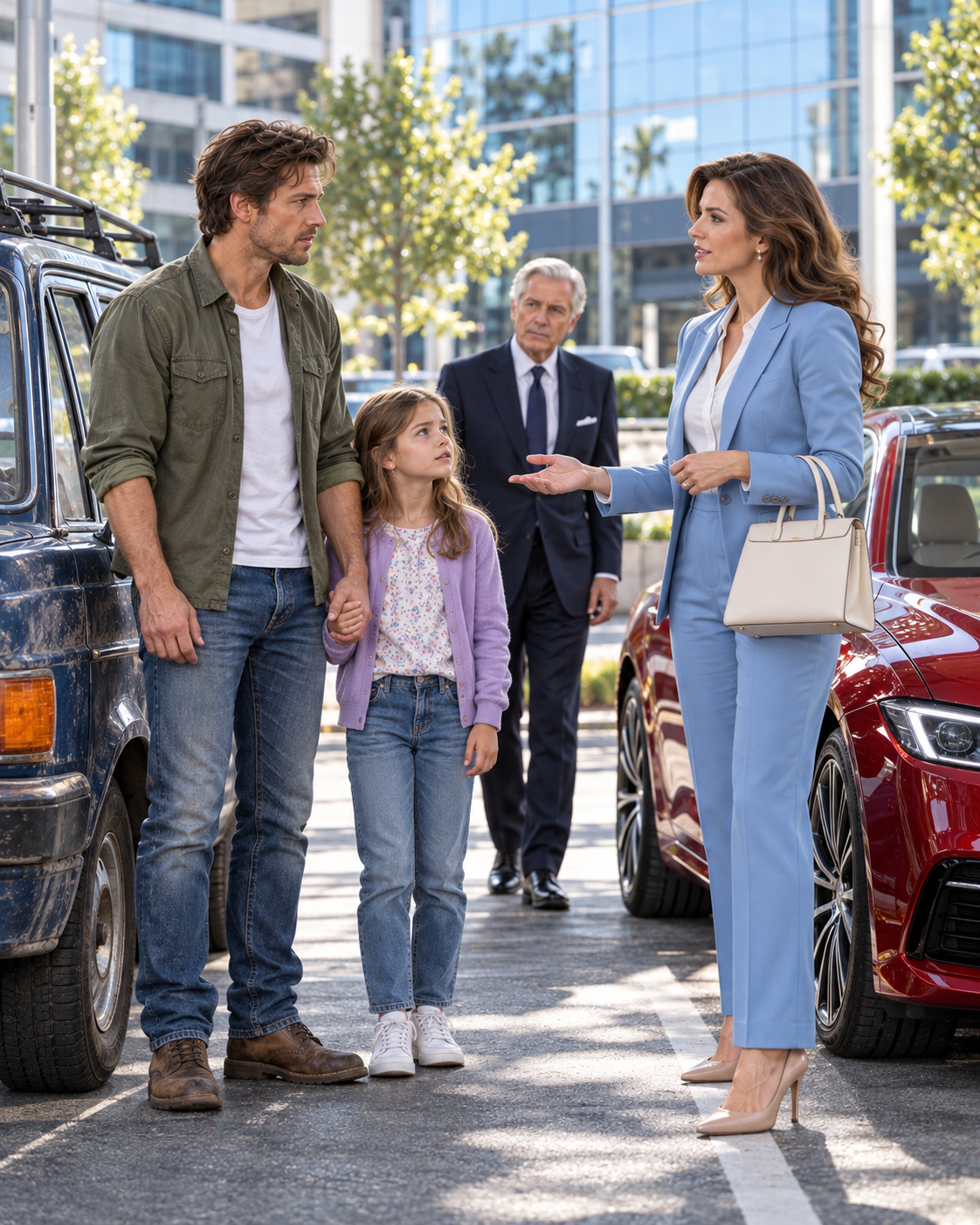
I closed my eyes for a second.
“No.”
Twenty years earlier, before Maya was born, I had been an automotive engineer obsessed with one idea.
I believed performance vehicles could be built on a modular architecture that was lighter, stronger, cheaper to adapt, and safer than the platforms dominating the industry.
Most people told me it wouldn’t work.
So I built it myself.
I spent years testing prototypes, breaking components, redesigning structures, and sleeping beside computer screens.
Eventually, one company took a chance on my work.
Then another.
Then another.
What started as one experimental platform became the foundation for an entire generation of high-performance vehicles.
Licensing agreements followed.
Investments followed.
Then came Vance Automotive Technologies.
I never intended to build an empire.
I simply built something that worked.
Over time, my ownership stake became enormous.
Eventually, I became the largest independent shareholder in the company.
But money never changed the way I lived.
My wife, Claire, used to tease me about that.
She would point at my expensive watch and then point at my twenty-year-old sneakers.
“You can build a billion-dollar company,” she once told me, “but apparently you can’t buy decent shoes.”
I laughed every time.
Then she died.
And after she was gone, the entire world became strangely quiet.
Board meetings stopped mattering.
Awards stopped mattering.
Cars stopped mattering.
I stepped away from the company and handed operational control to people I trusted.
I kept only enough involvement to protect Maya’s future.
Then I went home.
I cooked dinner.
I helped with homework.
I fixed broken faucets.
I learned how to braid my daughter’s hair badly enough that she eventually started doing it herself.
I became a father first.
Everything else became background noise.
Now Matteo stood in front of me with half the showroom watching.
“You never sold your controlling interests,” he said.
“No.”
“You never resigned from ownership.”
“No.”
“You simply stepped away.”
“Yes.”
Victoria stared at me as though she were looking at a stranger.
Matteo turned toward everyone.
“Ladies and gentlemen, Lucas Arthur Vance is not merely a former engineer.”
He paused.
“He is the founder of the Vance modular performance platform, the largest independent shareholder in Vance Automotive Technologies, and one of the principal architects behind some of the most successful performance platforms of the last two decades.”
Nobody spoke.
Maya’s mouth fell open.
“Dad, you did all that?”
I looked at her.
“I did some things.”
She laughed nervously.
“Some things?”
For the first time that morning, I smiled.
Matteo reached into a leather folder.
“There is more.”
He removed a sealed document.
“The board voted this morning.”
My stomach tightened.
“I told them I wasn’t interested in returning.”
“They knew.”
“Then why?”
“Because the industry is changing.”
He placed the document in my hands.
“And because they believe nobody understands the engineering, the business, and the responsibility better than you.”
I opened it.
The resolution was formal.
It appointed me chairman of a newly formed global automotive technology group created through a strategic partnership between Vance Automotive Technologies and several international manufacturers.
The room remained silent as I read it.
For years, I had avoided the spotlight.
Now the spotlight had found me anyway.
Maya touched my arm.
“Are you going back?”
I looked at her.
“I don’t know.”
She nodded slowly.
Then she whispered, “Mom would know what to say.”
That sentence broke something inside me.
I looked down at the floor.
For three years, I had trained myself not to cry in public.
But grief doesn’t disappear because you become good at hiding it.
Matteo lowered his voice.
“Claire believed you would return when the time was right.”
I looked at him sharply.
“How do you know that?”
He smiled sadly.
“She told me.”
The room disappeared for a moment.
All I could see was Claire sitting at our kitchen table years earlier, drinking coffee and telling me I was wasting my life hiding from something I had created.
I had forgotten those words.
Or maybe I had simply buried them.
Victoria stepped toward me.
Her confidence was gone.
“I owe you an apology.”
I looked at her.
She struggled to meet my eyes.
“I judged you by your clothes, your car, and the way you looked.”
She swallowed.
“I was wrong.”
I nodded.
“Yes, you were.”
Her face tightened.
“I am sorry.”
I believed she meant it.
So I accepted it.
But I wasn’t finished.
“Just remember something.”
She waited.
“Never judge a person’s worth by what they drive.”
Her eyes lowered.
“The car outside might be worth less than one of the tires on the vehicles in this showroom.”
I glanced through the glass.
“But it carried my wife home from the hospital.”
Maya became very still.
“It carried my daughter to school every morning.”
I took a breath.
“And when life was at its worst, that ugly old car never once asked me to pretend I was someone else.”
Nobody laughed.
Nobody looked away.
Matteo finally broke the silence.
Then he smiled.
“There is one more thing.”
He handed Maya a small red box.
She opened it.
Inside was a tiny model Ferrari.
Her eyes widened.
“For the future engineer,” Matteo said.
Maya looked at me.
“Can I keep it?”
I smiled.
“Absolutely.”
For the first time that day, everyone laughed.
And somehow, the laughter felt human again.
Part 3
We left the showroom about twenty minutes later.
I carried the board resolution under my arm.
Maya carried the tiny Ferrari with both hands as though it were priceless.
Outside, our station wagon waited exactly where we had left it.
Dusty.
Dented.
Unimpressed.
Maya opened the passenger door.
It stuck halfway.
She slammed it once.
Nothing.
She slammed it again.
The door finally closed.
She looked at me.
“You know, Chairman Vance, this is not exactly a chairman’s car.”
I laughed.
“No, it isn’t.”
I turned the key.
The engine coughed.
It rattled.
It shook.
Then, after a stubborn second, it came alive.
Maya buckled her seat belt.
She looked down at the little Ferrari model in her lap.
Then she looked at me.
“Why are we still driving this?”
I knew what she was really asking.
If I had money.
If I had power.
If I could buy anything in that showroom.
Why had I chosen this?
I rested my hands on the steering wheel.
“Because it still runs.”
She rolled her eyes.
“Dad.”
I smiled.
“Because your mother rode in this car.”
Her expression softened.
“Because you learned to read in the back seat.”
She looked toward the rear window.
“Because we drove it through the worst winter of our lives.”
I swallowed.
“And because being important doesn’t mean you have to look important.”
Maya was quiet for a long time.
Then she asked, “Are you really going to be chairman?”
I looked at her.
“I think so.”
“Does that mean things are going to change?”
I thought about the resolution sitting beside me.
About the boardrooms waiting for me.
About the engineers who still remembered my name.
About the company I had built and abandoned.
“Some things will.”
She smiled.
“Will you buy a new car?”
I started the engine again.
“No.”
She laughed.
“Why not?”
“Because this one still runs.”
We pulled away from the dealership.
In the rearview mirror, the glass building became smaller.
The polished cars disappeared behind us.
So did Victoria’s judgment.
So did the laughter.
So did the version of me who had spent years believing that walking away from success meant I had failed.
Maya rested the tiny Ferrari on the dashboard.
It bounced gently with every bump in the road.
I looked at it and thought about Claire.
She had always told me that success was not the size of the room you entered.
It was the number of people who felt safer because you were there.
I finally understood.
I hadn’t been hiding because I was ashamed of who I was.
I had been protecting what mattered most.
There was a time when I wanted the world to know what I had built.
Then I became a husband.
Then I became a widower.
Then I became a father.
And somewhere along the way, I realized that the greatest thing I had ever built wasn’t an engine, a platform, or a company.
It was the life sitting beside me.
Maya leaned her head against the window.
“Dad?”
“Yeah?”
“Mom would be proud of you.”
My hands tightened around the steering wheel.
For a moment, I couldn’t speak.
Then I nodded.
“I hope so.”
The old engine growled beneath us.
The paint still peeled.
The door still rattled.
The dashboard still had a crack running across it.
Nothing about the car had changed.
But something inside me had.
For years, I had believed I needed to prove that walking away from wealth didn’t make me weak.
That wearing old clothes didn’t make me unsuccessful.
That driving an ugly car didn’t make me less valuable.
That morning finally taught me I had never needed to prove any of it.
People will always measure what they can see.
They will judge the jacket.
The shoes.
The car.
The house.
The title.
But character is built in places nobody photographs.
It is built beside hospital beds.
At kitchen tables.
During sleepless nights.
In the quiet moments when nobody is watching.
And when Maya reached over and placed her hand on mine, I knew exactly what mattered.
Not the chairman’s title.
Not the company.
Not the money.
Not the cars waiting behind showroom glass.
Just my daughter.
Just the promise I had made to her mother.
Just the road ahead.
The station wagon disappeared into the afternoon traffic, coughing and rattling like it always had.
And for the first time in years, I didn’t care who saw me driving it.
Because I finally understood something money had never been able to teach me.
A person does not become valuable when the world recognizes their name.
They become valuable in the moments when they choose love, dignity, and loyalty even when nobody recognizes them at all.