At the F/A-18 ready room in Lemoore, Lieutenant Tyler Ross laughed as he called me a librarian in front of the squadron
Part 2
Fallon felt different from Lemoore.
The desert stretched beneath the aircraft like an endless sheet of brown metal, and the mountains seemed close enough to touch until you realized how violently distance could deceive you.
At Fallon, nobody cared about the jokes from Lemoore.
Nobody cared about who had been popular.
Nobody cared about my perfect grades.
The instructors cared about one thing.
Could I win when the aircraft stopped being a classroom and became a problem moving at hundreds of knots?
The answer came sooner than I wanted.
Our first major dogfight began clean.
At least, that was what I thought.
I had studied the scenario.
I knew the geometry.
I knew what the instructor wanted to see.
I entered the merge with confidence.
For approximately twelve seconds, I believed I had control.
Then I lost it.
One decision.
One hesitation.
One fraction of a second where I chose the expected move instead of reading the aircraft in front of me.
The instructor got behind me.
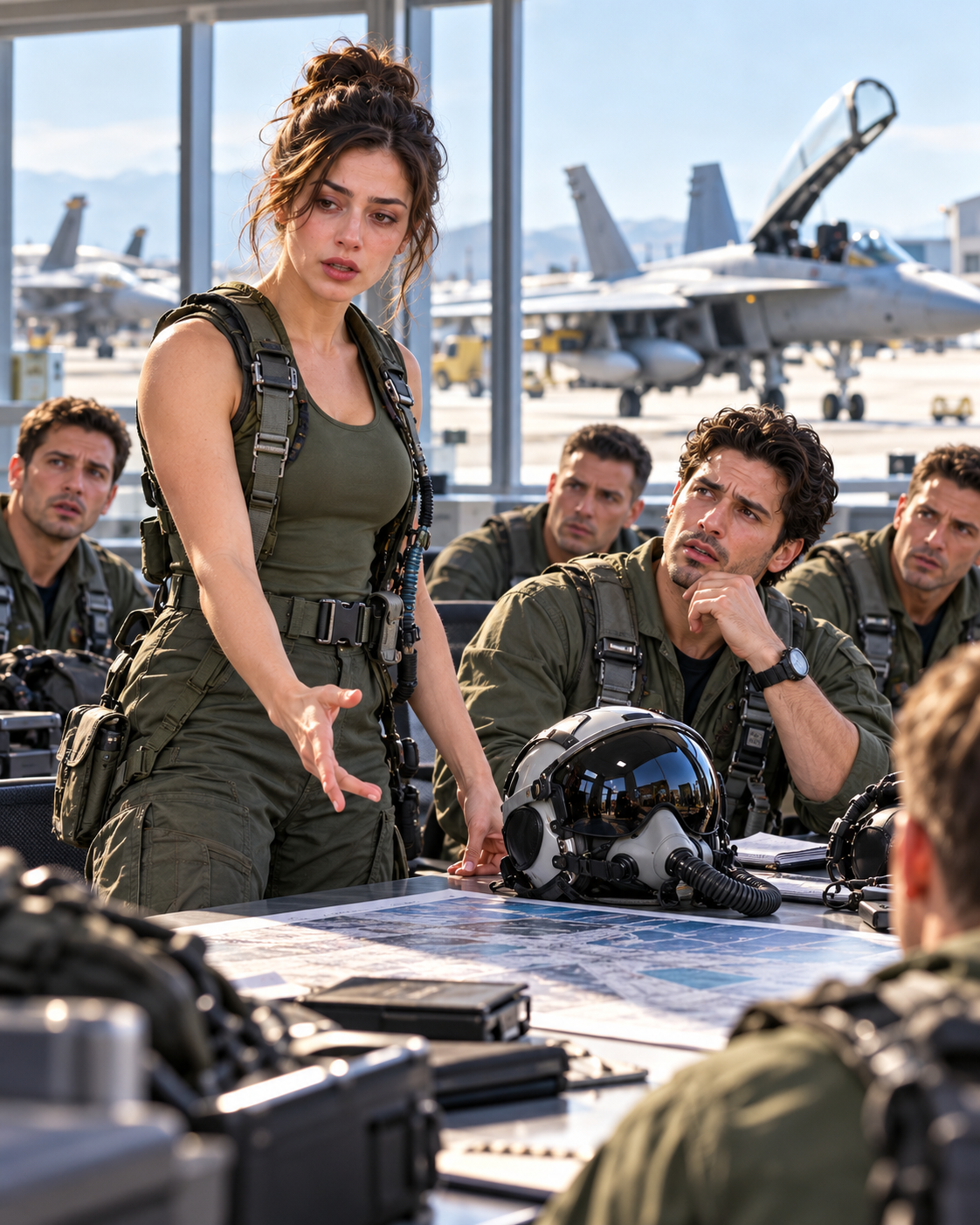
“Fox two.”
My screen flashed.
Dead.
I had been shot down.
Nobody said anything for a few seconds after we landed.
I walked into the debriefing room expecting criticism.
I got something worse.
Silence.
The instructor played the tape.
There I was.
Confident.
Precise.
Then wrong.
He froze the frame.
“Tell me what happened.”
I stared at the screen.
“I saw the threat too late.”
“Why?”
I hesitated.
“Because I was flying the plan instead of the fight.”
The instructor nodded.
“Again.”
We watched it.
Then again.
Then again.
By the fourth replay, I hated the sound of my own voice.
By the seventh, I had stopped defending myself.
By the eleventh, I could see the exact moment I lost.
It was not dramatic.
There was no spectacular mistake.
There was only a tiny shift in geometry that I had ignored because I trusted my expectation more than the evidence in front of me.
That realization hurt more than being shot down.
After the session, I stayed behind.
The instructor was gathering his notes when I spoke.
“Can we run it again?”
He looked at me.
“You already watched it eleven times.”
“I know.”
“Why?”
“Because I don’t want to remember losing.”
He waited.
“I want to understand it.”
He sat back down.
We spent another hour dissecting the engagement.
At one point, he drew a line across the board.
“Your problem isn’t aggression.”
I watched the marker move.
“It’s trust.”
“Trust in what?”
“Your own ability to adapt.”
That sentence stayed with me.
For the next four days, I rebuilt the fight.
Not the aircraft.
Not the mission.
My thinking.
I stopped trying to become the pilot I thought the instructors wanted.
I started listening to what the fight was actually telling me.
Havoc watched some of the preparation from the doorway.
He didn’t interrupt.
Viper joined me one evening.
Grizzly arrived the next morning.
None of them gave me advice.
They simply watched.
On the fourth day, I flew the rematch.
The merge came.
The geometry changed.
My opponent tried the same trap.
This time, I saw it.
I did not force the plan.
I let the aircraft tell me where the fight was going.
I adjusted.
I waited.
Then I took the shot.
“Fox two.”
The screen flashed.
My opponent was dead.
The room went quiet.
Back on the ground, the instructor removed his helmet and stared at me.
“That’s the pilot I was looking for.”
I nodded.
I didn’t celebrate.
I couldn’t.
I was still thinking about the first fight.
Because the victory did not erase the loss.
It gave the loss meaning.
From then on, everything changed.
I stopped chasing perfection.
I chased awareness.
Every sortie became a conversation between me and the aircraft.
Every mistake became evidence.
Every correction became another layer of discipline.
The other pilots began noticing.
Not because I talked more.
Because I started seeing things sooner.
During one briefing, Havoc pointed at my diagram.
“Why did you leave that gap?”
I answered.
“Because I want them to think it’s an accident.”
He stared at me.
Then he grinned.
“That’s evil.”
Viper leaned over the table.
“No.”
She looked at the diagram.
“That’s patient.”
Grizzly gave a low chuckle.
“Same thing, sometimes.”
The weeks became a blur of sorties, debriefs, failures, corrections, and long nights.
I learned that elite flying was not about being fearless.
It was about being honest enough to admit when fear had changed your decision.
It was about understanding that confidence could be useful until it became blindness.
It was about knowing when to trust instinct and when instinct needed to be challenged.
By the final week, the instructors had stopped treating me like an unknown.
They started treating me like a problem they wanted to solve.
That was the greatest compliment I had received.
Then came the final evaluation.
The engagement was complex.
Multiple aircraft.
Changing geometry.
Limited information.
A narrow window for the decisive move.
I remember the desert below me.
I remember the vibration through the controls.
I remember the sound of my own breathing.
Then everything slowed.
Not literally.
My mind simply stopped wasting motion.
I saw the fight.
I saw the trap.
I saw the opening.
I made the turn.
The aircraft responded.
The solution appeared.
And I took it.
When we landed, nobody cheered.
That wasn’t how Fallon worked.
We simply walked inside.
The instructor looked at the tape.
Then he watched it again.
He said nothing.
The next morning, I was called into the briefing room.
My final evaluation tape was playing on the screen.
I watched myself execute the maneuver.
Then the instructor paused it.
“We’re keeping this.”
I thought he meant for records.
He shook his head.
“No.”
He pointed at the screen.
“This is going into the instructional material.”
I felt something tighten in my chest.
Not pride.
Something deeper.
Because I remembered the girl sitting beside her father in that yellow crop duster, staring at the horizon while the fields disappeared beneath the wings.
I remembered every four a.m. simulator run.
Every missed night out.
Every time someone had assumed silence meant insecurity.
I realized none of those moments had been wasted.
They had been building toward this.
The final graduation night was supposed to be lighthearted.
The instructors usually roasted the students.
They mocked callsigns.
They replayed embarrassing radio calls.
They exposed mistakes.
Everyone expected laughter.
But when the lead instructor walked to the whiteboard, the room became strangely quiet.
He picked up a marker.
He looked at me.
Then he wrote one word.
PHANTOM.
No explanation.
No joke.
No sarcasm.
Just the word.
I stared at it.
Across the room, Havoc leaned back slowly.
Viper looked down.
Grizzly smiled.
The instructor capped the marker.
“You don’t have to be loud to be dangerous.”
Nobody laughed.
Nobody needed to.
For the first time, I understood what the callsign meant.
A phantom was not invisible because it was weak.
It was invisible because people looked for the wrong thing.
The loudest aircraft was not always the most dangerous.
The most confident pilot was not always the most aware.
Sometimes the person you barely noticed was the one who had spent years learning exactly how to disappear into the fight.
That night, after everyone left, I stood alone in front of the whiteboard.
I touched the word with two fingers.
Phantom.
It felt heavier than any title I had ever earned.
Because it was not a reward for being the best.
It was a reminder of what I had survived becoming.
The next morning, we flew back to Lemoore.
I expected the ready room to feel different.
It did.
Havoc was the first to approach me.
He stopped a few feet away.
For once, he had nothing clever to say.
He looked uncomfortable.
Then he held out a cup of coffee.
“Truce?”
I took it.
“Truce.”
He smiled.
“Good.”
Viper pulled out the chair beside her.
“This one’s yours.”
Grizzly walked past us and gave a single nod.
Nothing more.
Nothing less.
But I understood.
I had entered the squadron as someone nobody noticed.
I returned as someone nobody underestimated.
Still, as I sat there listening to the familiar noise of the ready room, I realized something unexpected.
I had not won because they finally respected me.
I had won because I had learned not to need their respect in the first place.
That lesson would follow me much farther than Fallon ever could.