At the Civic Arts Center gala, my husband smirked as his mistress wore my late grandmother’s garnet brooch before hundreds of donors
# Part 2
On Friday evening, the Civic Arts Center glowed with warm light spilling through its enormous glass doors, and donors arrived beneath a banner honoring Dorothy Castellane, the woman whose name had become synonymous with quiet generosity across three generations of families in need.
I stood near the entrance in a midnight-blue gown, welcoming physicians, public health researchers, university leaders, and longtime supporters whose contributions had funded scholarships, maternal health programs, and community clinics in neighborhoods that had once been overlooked.
My husband moved through the room like a man born to occupy its center, shaking hands and accepting compliments while the Meridian Wellness logo appeared on the event screens, and whenever someone praised our partnership, he slipped an arm around my waist as though his affection were another item he had arranged for display.
Then Chloe walked in.
She wore a champagne-colored dress that caught the light every time she moved, and around her neck lay a delicate gold chain that drew the eye toward the unmistakable garnet brooch pinned just below her collarbone.
For one suspended second, I saw my grandmother’s hands fastening that same brooch on the morning of her eightieth birthday, her fingers steady despite the tremor she had begun hiding from the rest of us.
She had worn it at hospital openings, scholarship ceremonies, and the last gala she attended before her illness made public appearances impossible, always telling me that beautiful things were meant to carry memories rather than announce importance.
Chloe noticed me looking and smiled with the confident sweetness of someone who believed she had already won a competition the other woman did not know she was in.
“Isn’t it beautiful?” she asked, touching the garnets with one finger, and I realized she had chosen to wear the brooch somewhere it could not be mistaken for a casual accessory or a private gift kept out of sight.
“It belonged to my grandmother,” I replied, keeping my voice low enough that the nearby conversation continued without interruption, “and it is listed in the trust’s collection inventory.”
Her smile faltered for less than a second before she tilted her head and answered, “Julian told me you gave it to him years ago, before you two decided to separate.”
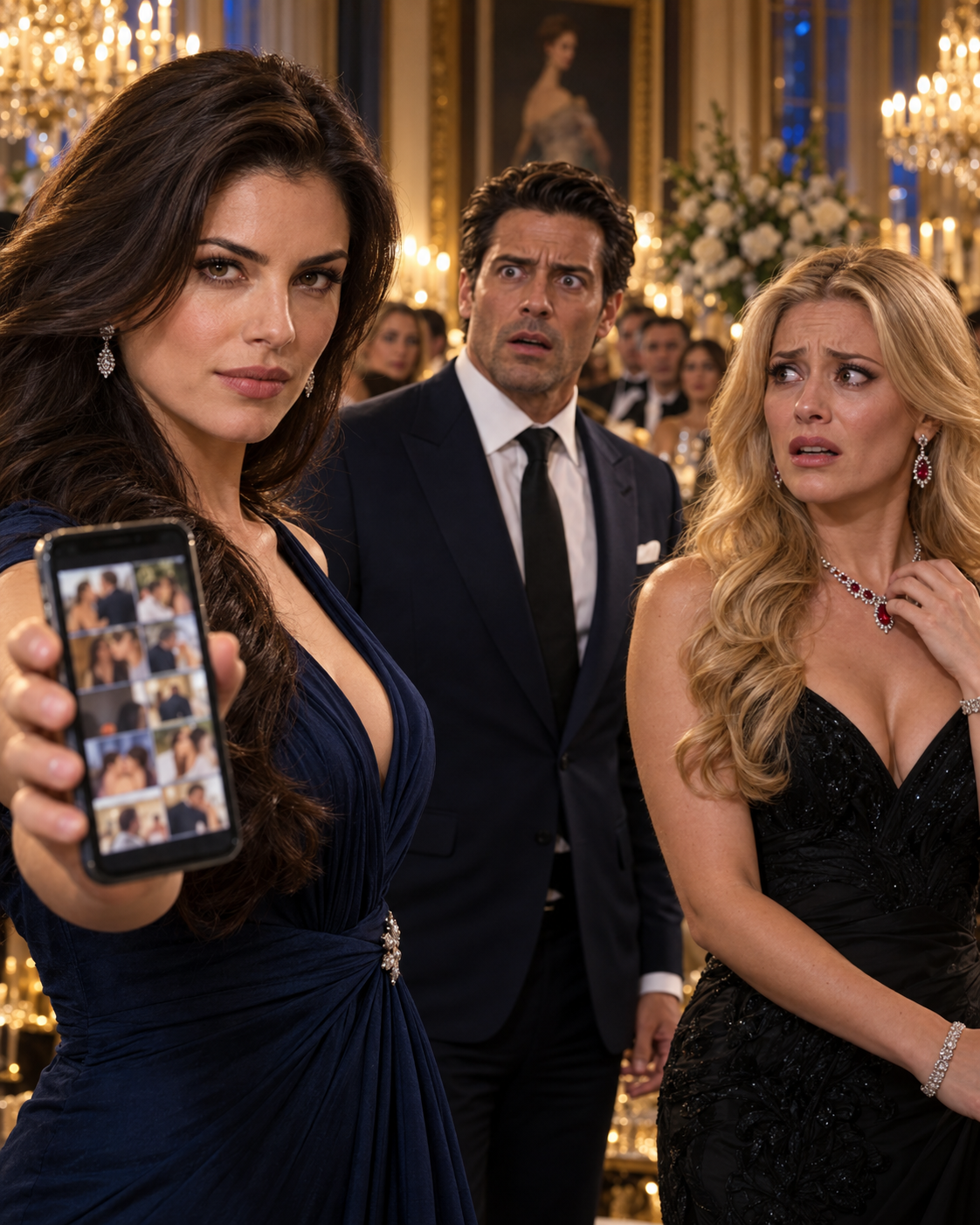
I looked at her carefully, not because I doubted what she had said, but because I could hear the fragile structure of a lie beginning to collapse beneath its own weight.
“Julian and I are married, and we have not separated,” I told her, “and I have never given him or you permission to take that piece from the estate.”
She glanced toward the reception desk, where the trust’s attorney stood speaking with two board members, and then back at me, her confidence thinning into something that resembled alarm.
Before she could respond, I explained that the brooch had been formally recorded in the estate inventory, that its unauthorized removal had been documented, and that the recovery notice required its return to the trust while the circumstances were reviewed.
“I would rather resolve this quietly,” I added, “but if you decide to leave wearing it, counsel will have to document that choice and pursue the appropriate recovery process.”
It was not a threat delivered for the pleasure of watching her frightened; it was the simple statement of a boundary that should never have needed to be explained at a charity gala.
Chloe looked past me toward Julian, who had finally noticed us and was pushing through the crowd with the strained smile he wore whenever a situation began escaping his control.
“What’s going on?” he demanded, arriving beside her and directing his question at me rather than at the woman wearing the missing heirloom.
“Your wife is making a scene over a gift,” Chloe said, but the speed with which she spoke betrayed the uncertainty now working behind her eyes.
I did not raise my voice or explain our marriage to the room, because the brooch did not need a performance to establish where it belonged, and neither did I.
“The attorney is available to verify the inventory,” I said, turning slightly toward him so that Julian could see the board chair approaching, “and you can explain the gift claim to the trust’s counsel if you believe the documentation is incorrect.”
For several seconds, Julian stared at me as though he were searching for the familiar expression of hurt he knew how to dismiss, but I gave him nothing except the calm expectation that he would deal with the facts in front of him.
The board chair, Margaret Hale, introduced herself to Chloe and asked whether she would be willing to return the brooch while the ownership question was reviewed, explaining that the trust had an obligation to safeguard its collection regardless of anyone’s personal intentions.
Chloe’s cheeks turned pale as the surrounding conversation softened and the nearest guests began to notice the small circle of people gathering beside the reception desk.
“I didn’t know,” she whispered, reaching behind her neck with fingers that had suddenly become clumsy, and when the clasp released, the brooch rested in her palm like a piece of her confidence she could no longer carry.
She placed it on the velvet-lined property tray the attorney had brought from the administrative office, signed a brief acknowledgment of its return, and watched as he documented the handover in the presence of two witnesses.
Julian leaned toward me, his voice low and sharp enough to cut through the music.
“You could have handled this privately,” he said, his face reddening as he glanced at the guests who had begun to look away with conspicuous care.
“I tried to handle the truth privately,” I answered, “but you brought the consequences into a room full of people who trusted us.”
For the first time that evening, he had no polished response ready, and as Chloe stepped away from him, I saw something shift in her expression that looked less like jealousy than the dawning realization that she might have been used.
The gala continued because the musicians kept playing and the servers carried trays between the tables, but the night had changed in a way that could not be reversed by turning the volume up.
At dinner, Julian resumed his practiced charm, introducing Meridian Wellness executives to donors and explaining how corporate resources could strengthen the foundation’s public health initiatives, while I sat beside Margaret Hale and waited for the tribute to begin.
When the room darkened, the large screens behind the stage filled with photographs of my grandmother at vaccination clinics, school health drives, hospital openings, and scholarship ceremonies, her silver hair catching sunlight in images that had survived decades of careful storage.
The narrator spoke about Eleanor’s belief that philanthropy was not a way to purchase admiration but a responsibility to leave places and people better than one had found them, and for the first time all evening, I felt something other than anger moving through my chest.
Then the final slide appeared.
It showed the East Reading Room at Hawthorne Crest, uncropped and unmistakable, with the official trust inscription visible above the mantel and the original catalog number printed on the archival caption beneath the photograph.
The image was not one of Chloe’s posed portraits, and it contained no accusations, names, or dramatic declarations, only the room exactly as it had been documented during the trust’s inspection, with its protected furnishings and the inscription that established whose property it was.
The photograph had been selected from the official architectural archive as part of a brief presentation about the estate’s future, but its inclusion had been approved by the board chair only after counsel confirmed that the image could stand as an accurate record without exposing private correspondence or turning the tribute into a personal attack.
I had not needed to place Julian’s face on the screen or tell the audience what he had done, because the room itself carried the story, and the people who knew the estate understood why its appearance mattered.
Across the table, Julian stopped moving, his glass hovering halfway to his mouth, while the executive beside him leaned forward to read the inscription and the board chair quietly closed the folder in front of her.
The applause that followed the tribute was sincere, but beneath it, conversations had already begun between the trust’s counsel, its independent directors, and the representatives of Meridian Wellness who now understood that their proposed sponsorship had become entangled with an unresolved conflict.
Before the last guests left, Margaret Hale informed Julian that his co-chair responsibilities were suspended pending review, and the company’s sponsorship would not proceed while the board examined whether its relationship with him could compromise the foundation’s independence.
He tried to follow me into the corridor, but I kept walking until we reached the quiet service entrance, where the distant sounds of the gala faded behind a closed door.
“You wanted to humiliate me,” he said, the words coming out with a mixture of disbelief and fury, as though my refusal to protect him had been a betrayal greater than anything he had done to me.
I turned toward him beneath the dim corridor light, carrying my evening bag in one hand and feeling the old reflex to soften the truth rise inside me before I let it pass.
“No, Julian,” I said, “I wanted you to understand that the world you borrowed from me was never yours to control.”
He looked at me for a long moment, and for the first time in eleven years, he seemed unable to find the version of me he had prepared himself to defeat.
# Part 3
By Monday morning, Meridian Wellness had withdrawn its sponsorship proposal, and the company’s board had opened its own review after learning that its co-chair had used a family connection to the trust in ways that could create reputational and governance concerns.
The foundation did not accuse Julian of a crime in public, nor did I ask anyone to turn my marriage into a spectacle, but the partnership was formally dissolved once the board determined that its credibility depended on maintaining clear boundaries between private interests and charitable work.
Julian came home that evening carrying no flowers, no apology, and none of the easy warmth he used when he wanted to make a difficult conversation disappear, and he stood in the kitchen where he had once kissed my forehead before going to meet his lover.
“You’ve destroyed everything I’ve built,” he said, setting his keys on the counter with enough force to make them ring against the stone.
I looked at him and thought of all the evenings I had spent rearranging my own needs to accommodate his deadlines, his ambitions, and his belief that the people who loved him should absorb the costs of his decisions.
“I didn’t create the records,” I answered, “and I didn’t put the brooch on Chloe’s dress or tell you that a charitable trust was yours to use whenever you felt like it.”
He began explaining that he and Chloe had been together for months, that our marriage had been unhappy long before the photographs, and that he had intended to tell me once he had worked out the right way to manage the situation.
His words arrived in the careful sequence of a business presentation, each one designed to shift responsibility away from the action and toward the circumstances he claimed had made the action inevitable.
When I asked whether he had told Chloe that we were separated, he looked away, and when I asked whether he had told her the brooch was mine to give, he rubbed both hands over his face without answering.
The silence gave me more truth than his explanations ever could, because it revealed that he had not merely hidden his choices from me; he had constructed a different reality for each person he wanted to keep close.
I had once imagined that discovering infidelity would be the most painful thing that could happen to a marriage, but I learned that a deeper wound comes from realizing how often someone has relied on your love to keep you from questioning what they do.
For eleven years, Julian had treated my patience as an endlessly renewable resource, convinced that every disappointment would be followed by forgiveness and every violation would become smaller if he waited long enough.
That night, I asked him to stay elsewhere while the attorneys addressed the separation, the financial arrangements, and the questions surrounding his unauthorized use of the estate, and when he protested that I could not simply remove him from his own home, I reminded him that the home and the trust were separate matters requiring separate legal treatment.
He left with a suitcase and a furious promise that I would regret turning private trouble into professional consequences, but the door closing behind him sounded less like an ending than the first quiet moment in years when I could hear myself think.
Over the following weeks, the lawyers worked through the details with the steady precision of people who understood that anger was not evidence and that evidence required care even when the truth was painful.
The trust secured the estate records, completed an inspection of the affected rooms, and confirmed that the brooch had been returned to secure storage, while the board reviewed the access arrangements to ensure that no administrator’s personal relationships could again be used to bypass its protections.
Julian and I negotiated a legal settlement covering the terms of our separation, the division of our marital assets, and the practical obligations that had to be resolved before either of us could move forward.
I did not demand that he be erased from every room in which we had once been happy, because memory could not be managed like a property inventory, and the years we had shared were neither entirely false nor worth pretending they had never mattered.
What I refused to do was continue confusing the existence of good memories with an obligation to endure present harm, or mistake the pain of leaving for proof that leaving was wrong.
Then, several weeks after the gala, a message arrived from Chloe.
“I owe you an apology,” she wrote, and beneath those five words was a long explanation that seemed to have taken her several attempts to finish.
She admitted that Julian had told her our marriage was over in everything but name, that I had agreed to a separation, and that he possessed the right to use Hawthorne Crest whenever he wished because the estate was effectively his family property.
He had described the brooch as a gift he received through our marriage and encouraged her to wear it to the gala, telling her that doing so would finally force me to stop pretending our relationship was still intact.
“I thought I was walking into a situation everyone understood,” Chloe wrote, “and I let myself believe the version of the story that made what I was doing easier to accept.”
I read the message twice, feeling no triumph in her confession, only a familiar ache at the thought of how easily Julian had used different lies to make different people serve the same purpose.
She asked whether I would ever forgive her, and whether there was anything she could do to repair the harm she had helped cause.
I did not absolve her of responsibility or pretend that she had been unaware of the obvious pain her choices could inflict, but I also understood that humiliation alone rarely teaches people to become more honest.
“The truth of Hawthorne Crest belongs to the legal record, regardless of what Julian told either of us,” I replied, “and what you choose to learn from this is something you will have to decide for yourself.”
I set the phone aside without waiting for another message, because forgiveness was not a performance I owed anyone, and peace could not depend on whether the people who hurt me eventually understood why.
By the beginning of spring, the settlement had been finalized, the remaining legal matters had been resolved, and Julian’s name no longer appeared beside mine on the personal documents that once seemed to define the future I was supposed to want.
I moved through the weeks without the dramatic relief I had imagined, discovering instead that healing was made of ordinary decisions: making coffee for one, sleeping through the night, and planning a weekend without checking whether another person’s ambition might swallow it.
At the trust, the board approved a new chapter for Hawthorne Crest, transforming the estate into a residency program for women pursuing public health fellowships, with protected study rooms, modest residential suites, and space for visiting researchers to develop projects serving communities that had long gone without adequate care.
The first time I walked through the renovated East Reading Room, the morning light fell across the wooden floor in the same long bands I remembered from my childhood, but the room no longer felt like a shrine guarded against change.
A desk stood beneath the window for a fellow researching maternal health access in rural counties, while another room held shelves of public health journals, community reports, and the beginning of a small archive honoring the women whose work my grandmother had spent her life supporting.
I placed Eleanor’s garnet brooch in a secure display case beside its historical record, not because I wanted to preserve the humiliation of what had happened, but because the object deserved to return to the story it had carried before Julian tried to make it a prop in his own.
On the day the first residents arrived, I watched a young physician unload two suitcases from her car while another fellow stood near the front steps speaking nervously into her phone, explaining to someone that she had finally found a place where she could concentrate on the work she had been afraid to pursue.
Their uncertainty reminded me of the woman I had been before I learned that composure could become another cage when everyone around you mistook it for consent.
That afternoon, I walked alone through the rooms, touching neither the furniture nor the photographs, and found myself remembering my grandmother’s voice from long before illness had made her words softer.
She had once told me that a legacy was not the beautiful building people photographed or the family name carved into stone, but the lives that became possible because someone had taken responsibility for protecting it.
I finally understood why those words had mattered so much to her, and why losing the marriage I had spent eleven years trying to preserve did not mean I had lost the future I was meant to build.
Julian had believed that power belonged to the loudest person in the room, the man who could charm a board, command a conversation, or make another human being doubt the truth she had witnessed with her own eyes.
He had failed to understand that power could also look like a woman sitting alone at three forty-seven in the morning, saving photographs one by one, checking dates, reading documents, and refusing to let the first wound become an excuse for a second mistake.
The lake was silver beneath the late afternoon sky when I stepped onto Hawthorne Crest’s stone terrace, and the wind carried the scent of pine and cold water across the gardens my grandmother had planted with her own hands.
For the first time since the album arrived, I thought of those fifty-three photographs without feeling the old sharpness in my chest, because they no longer defined the worst thing that had happened to me.
They marked the moment I stopped mistaking silence for safety, loyalty for self-erasure, and the ability to endure pain for an obligation to keep enduring it.
I had once believed that strength meant remaining calm enough to keep everyone else comfortable, but now I knew that genuine composure was the freedom to face the truth without allowing someone else’s dishonesty to dictate what I did next.
Behind me, the windows of Hawthorne Crest glowed with the warmth of a house returning to its purpose, and inside, women I had never met were beginning the difficult, hopeful work of building lives that would someday help other people survive their own difficult beginnings.
Julian had spent eleven years trying to make me smaller so he could look larger, only to discover that a patient woman with a folder full of evidence could protect what mattered without surrendering her dignity to the fight.
I stood overlooking the lake until the light faded from the water, no longer waiting for an apology, a confession, or the satisfaction of seeing him understand what he had lost.
Some victories arrive with applause, and others arrive quietly, when the door closes on the life that hurt you and opens onto a future you no longer need permission to enter.
As darkness settled over Hawthorne Crest, I finally felt the weight of my grandmother’s legacy not as something I had to defend against the world, but as something I was free to carry forward.