At the charity gala in downtown Chicago, a powerful executive laughed at my grease-stained hands and called me Eleanor Sterling’s embarrassing
I read the note three times before the words began to make sense.
The celebration continued outside my office, where Chloe was laughing with my apprentices and Eleanor was accepting congratulations from customers who had watched our little garage grow into something real.
For one beautiful second, I considered crumpling the paper and throwing it away.
I wanted to believe the woman holding my hand had never hidden anything that could hurt us.
But the photograph lay on my desk, unmistakable.
Eleanor was standing beside Michael Bennett, the local investor who had financed my expansion, outside a hotel downtown.
The date printed on the back was three months before Michael had ever approached me.
And beneath the photograph, someone had written another sentence.
“Your business wasn’t the only thing they discussed.”
I slipped the photograph into my jacket and walked outside.
Eleanor saw my face immediately.
“Daniel, what’s wrong?”
I looked at the woman who had sat through Chloe’s spelling tests, cheered at freezing soccer games, and kissed me for the first time in my kitchen while a pot of pasta boiled over behind us.
“I need to ask you something.”
Her smile disappeared.
“All right.”
“Did you know Michael Bennett before he offered to invest in my shop?”
She paused.
It lasted less than a second, but I noticed.
“Yes,” she said quietly. “I knew him professionally.”
“How long?”
“Several years.”
I felt the photograph pressing against my chest.
“Why didn’t you tell me?”
“Because I didn’t think it mattered to your investment.”
“Then why did someone leave this under my office door?”
I showed her the picture.
The color drained from her face.
For the first time since I had known her, Eleanor looked genuinely frightened.
“Where did you get that?”
“That’s not an answer.”
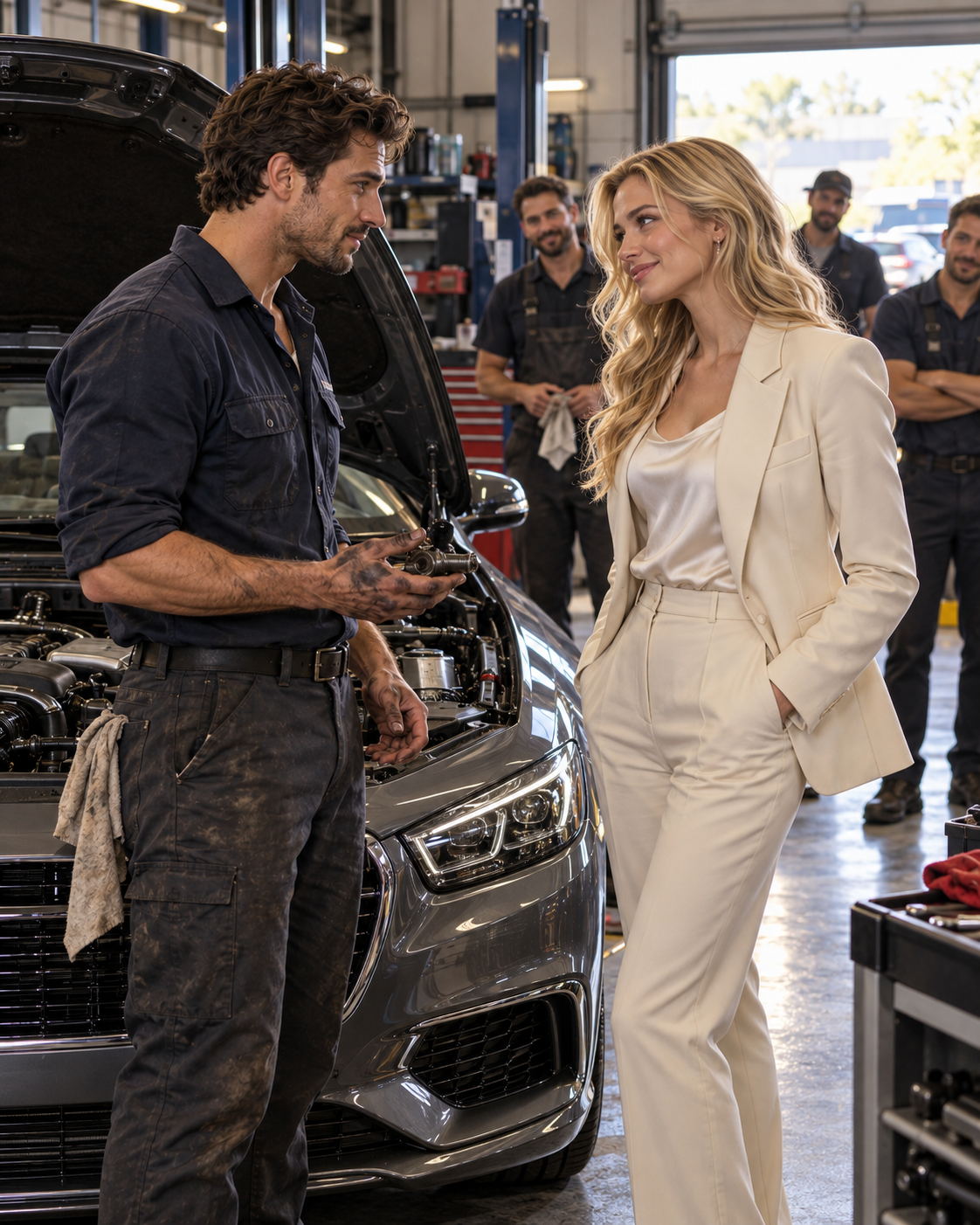
She glanced toward the celebration, then back at me.
“Daniel, please. Not here.”
I had spent years convincing myself that trust meant giving someone the benefit of the doubt.
Now I wondered whether I had mistaken silence for peace.
“Tomorrow morning,” I told her. “My house. No explanations over the phone, and no more half-truths.”
She nodded slowly.
“I’ll be there.”
That night, Chloe fell asleep with the ribbon from the opening ceremony wrapped around her wrist.
I sat beside her bed, watching the moonlight move across her blanket.
She had already lost one version of a family when her mother and I divorced.
I had promised myself I would never let anyone make her feel abandoned again.
And now I was terrified that, in trying to build something beautiful, I had unknowingly placed her in the middle of a game played by people with far more power than I possessed.
The next morning, Eleanor arrived carrying no designer handbag, no assistant, and no practiced smile.
She stood on my porch in a simple navy sweater, looking exhausted.
“I should have told you everything from the beginning,” she said.
I stepped aside.
“Then start talking.”
She sat at my kitchen table, the same table where Chloe had once spread crayons across her financial reports while Eleanor patiently helped her draw a horse.
“Michael approached me last year,” she began. “He wanted to invest in independent repair businesses and create a regional network of reliable garages.”
I frowned.
“Then why did he choose me?”
“Because I mentioned your shop.”
The words landed harder than I expected.
“You recommended me?”
“I told him about your work ethic, your honesty, and the fact that you were trying to build something without anyone handing it to you.”
“So the opportunity wasn’t really mine.”
“No.” Her eyes filled with tears. “The opportunity was real, Daniel. But I opened the door that brought it to you.”
I pushed my chair back.
“You let me believe I had done it entirely on my own.”
“I wanted you to have the opportunity. I didn’t want you to feel indebted to me.”
“Do you hear yourself?” I asked. “You made a decision about what I could handle without asking me.”
She lowered her head.
“You’re right.”
Her agreement left me with nowhere to direct my anger.
I had expected excuses, perhaps even a reminder of everything she had done for us.
Instead, she sat quietly and allowed me to be hurt.
Then she explained the part she had feared telling me.
Michael had originally intended to invest in a chain of repair facilities that would compete with large national service centers.
He had rejected several established businesses because their owners were unwilling to train apprentices or guarantee transparent pricing.
When Eleanor mentioned me, he asked to meet.
But before he could arrange it, Harrison Vance discovered their conversations.
Harrison had been working with another investment group that wanted to acquire independent garages, consolidate them, and eventually sell the network to a national corporation.
He viewed Michael’s plan as a threat.
“He learned that Michael was interested in your business,” Eleanor said. “Then he began asking questions about you.”
“What kind of questions?”
“Whether you had debts. Whether your divorce had left you financially vulnerable. Whether you would accept money without examining the conditions.”
I stared at her.
“And Chloe?”
Eleanor swallowed.
“Harrison found out that you were raising her alone. He believed that financial pressure would make you easier to influence.”
The kitchen seemed to grow colder.
“Influence me into doing what?”
“Signing a long-term agreement that would have given his investment group control over your business.”
I remembered the gala, Harrison’s mocking smile, and the fear that had flashed across his face when Eleanor defended me.
“He was trying to make me feel small.”
“Yes.”
“Why?”
“Because people who believe they’re unworthy are easier to control.”
For several moments, neither of us spoke.
Then I asked the question that mattered most.
“Did you know about Harrison’s plan when you recommended me?”
“No. I discovered it later, after Michael’s investment agreement had already been signed.”
“And you didn’t tell me.”
“I was gathering evidence. My lawyers advised me not to confront him until we understood how far it went.”
“You could have told me enough to protect myself.”
“Yes,” she whispered. “I could have.”
There was no clever explanation that could undo the damage.
Eleanor had helped create an opportunity that changed my life, but she had also withheld information that might have changed how I approached it.
Her intentions had been loving.
Her decision had still been wrong.
I stood and walked to the window.
Outside, Chloe was riding her bicycle in the driveway, calling to our elderly neighbor about a missing training wheel she had already outgrown.
That ordinary sound reminded me what I needed to protect.
“I want Michael’s original proposal, every version of the agreement, and any correspondence involving Harrison,” I said.
Eleanor nodded.
“I’ll get them.”
“No. I’ll request them myself.”
She looked at me.
“Daniel, I’m not trying to take control.”
“Then let me have it.”
She accepted that without protest.
For the next two weeks, I did what I should have done from the beginning.
I hired an independent attorney, reviewed every clause of my investment agreement, and requested a full accounting from Michael.
I discovered that the deal was legitimate, but it contained an option that could give the investment group a substantial ownership stake if I failed to meet certain growth targets.
The clause wasn’t hidden, exactly.
It was buried beneath pages of financial language that I had rushed through because I was afraid the opportunity might disappear.
My attorney explained that the targets were achievable, but the terms were unnecessarily restrictive.
Michael agreed to renegotiate them.
When we met in his office, I placed the revised contract on the table.
“I appreciate what you’ve done for me,” I told him. “But I won’t sign anything that gives someone else control over the future of my shop.”
Michael studied me for a long moment.
“Fair enough.”
I expected resistance.
Instead, he smiled.
“That is precisely why I wanted to work with you.”
He explained that he had suspected Harrison was interfering, but he had needed proof before taking action.
The photograph, he said, had not come from him.
He believed someone inside Sterling Industries had sent it to me.
That evening, I returned home to find Eleanor waiting on the porch.
She didn’t try to kiss me.
She didn’t ask whether I had forgiven her.
“I heard you renegotiated the agreement,” she said.
“I did.”
“I’m glad.”
I studied her face.
“There’s something I need you to understand. I don’t want a relationship where I have to wonder whether the truth is being managed for my own good.”
“I understand.”
“And I don’t want you to rescue me.”
She nodded, tears shining in her eyes.
“I never wanted you to feel that way.”
“Wanting something and making it happen are different things.”
She looked down at her hands.
“You’re right.”
I sat beside her.
“I love you, Eleanor. That’s what makes this so difficult.”
She turned toward me, but I raised a hand before she could speak.
“I need time. And if we’re going to build a future, we build it with the truth, even when the truth makes us uncomfortable.”
“I can do that,” she whispered.
For the first time in weeks, I believed she might.
But the story wasn’t over.
Three days later, Eleanor called me from her office.
Her voice was tight.
“Harrison has called an emergency board meeting.”
“What does that have to do with us?”
“He intends to accuse Michael of manipulating company contacts for personal gain. He claims I used Sterling Industries’ resources to secure preferential treatment for someone I’m romantically involved with.”
I closed my eyes.
“Me.”
“Yes.”
“Can he prove it?”
“He has documents, but they’re incomplete and misleading.”
“Then tell the truth.”
“I will.”
She hesitated.
“Daniel, there’s something else. He has requested a review of every charity partnership and investment referral I’ve made during the past year.”
I understood immediately.
The gala had been more than a social event.
Harrison had watched Eleanor defend me in public, and he had seen an opportunity to turn her compassion into a weapon.
If he could convince the board that she had abused her position, he could weaken her authority and strengthen his own.
“When is the meeting?” I asked.
“Friday morning.”
“I’ll be there.”
“You don’t have to put yourself through that.”
“I’m not going because you need saving,” I said. “I’m going because someone is trying to turn my life into evidence for a lie.”
On Friday, I entered Sterling Industries’ headquarters wearing the same dark suit I had worn to the gala.
My hands were clean, but they still carried the faint scars of years spent working with tools.
Harrison sat at the head of the conference table, surrounded by executives who looked uncomfortable but unwilling to challenge him.
When he saw me, he smiled.
“Well, look who decided to join the adults.”
I pulled out a chair.
“I’m here to discuss the investment agreement and the allegations involving my business.”
“Your business,” he repeated, amused. “A business that might never have existed without Ms. Sterling’s personal intervention.”
“That’s true,” I replied. “She told Michael about me. She didn’t sign my contract, negotiate my prices, or build my shop.”
I placed the independently reviewed agreement on the table.
“And I brought the records showing exactly what happened.”
Harrison’s expression tightened.
My attorney had helped me assemble a timeline of meetings, proposals, and revisions.
It showed that Eleanor had introduced Michael to my business but had never participated in the negotiations.
It also showed that Harrison’s investment group had approached Michael before my agreement was finalized, proposing terms that would have given them control of the network.
The room grew quiet as the documents circulated.
Harrison leaned forward.
“These records prove nothing about your relationship with Ms. Sterling.”
“They prove that my investment was legitimate,” I said. “My relationship is personal. My business agreement is contractual. If you believe there’s evidence of wrongdoing, present it.”
Eleanor sat at the opposite end of the table, her expression steady.
For once, she didn’t answer for me.
She let me speak.
Then Michael entered carrying a sealed folder.
“I believe the board should also examine these communications,” he said.
Inside were emails showing that Harrison had tried to pressure him into abandoning the investment network.
One message suggested that independent garage owners could be persuaded to sell cheaply if they were made to feel financially insecure.
Another referred to my business as an ideal test case.
Harrison’s face went pale.
“Those messages have been taken out of context.”
Michael placed a second folder on the table.
“Then you should have no trouble explaining the complete correspondence.”
The board called for a recess.
Outside the conference room, Eleanor found me standing beside a window overlooking the city.
“You didn’t have to do that,” she said.
“Yes, I did.”
She looked at me with an expression I had never seen before: not admiration, not gratitude, but something quieter.
Respect.
“I should have trusted you with the truth sooner.”
“Yes,” I said. “You should have.”
She accepted the answer.
Then she reached for my hand.
I let her hold it.
Inside the room, the board eventually voted to suspend Harrison’s authority pending an independent investigation.
No dramatic confession followed.
No one applauded.
Power rarely surrendered itself in a single cinematic moment.
But for the first time, Harrison could no longer hide behind his title.
And Eleanor had defended her integrity without trying to control the outcome for me.
The weeks that followed were difficult.
Investigators reviewed the correspondence, and the board introduced stricter rules governing investment referrals and conflicts of interest.
Harrison eventually resigned before the investigation concluded.
Michael continued working with me under the revised agreement, and my business grew steadily rather than recklessly.
At home, Eleanor and I began again.
Not from the beginning, because we could never return to the innocence we had before the photograph.
We began from the truth.
She told me when work was overwhelming her.
I told her when I felt intimidated by her world.
We disagreed about money, privacy, and how much time she spent answering emails during dinner.
Sometimes we got it wrong.
But we stopped treating difficult conversations as threats to our relationship.
One Saturday, Eleanor came to our house carrying a stack of math worksheets.
Chloe greeted her at the door.
“Are you still coming to my school presentation?”
Eleanor knelt to her level.
“Would I miss it?”
Chloe considered this.
“Dad says grown-ups make promises they can’t always keep.”
Eleanor looked at me before answering.
“Your dad is right. That’s why I’m going to do everything I can to be there, and if something changes, I’ll tell you honestly.”
Chloe seemed satisfied.
Then she took Eleanor’s hand and led her toward the kitchen.
I watched them disappear around the corner, feeling something loosen in my chest.
My daughter didn’t need a perfect family.
She needed people who showed up, admitted their mistakes, and made the effort to repair what they had damaged.
Months later, on the anniversary of the second garage opening, I took Eleanor back to the little workshop where we had first met.
The roof still leaked in one corner.
The coffee was still terrible.
I had considered renovating the place, but some part of me wanted to preserve the room where my life had changed without my realizing it.
Eleanor stood beside the old workbench, running her fingers over a dent in the metal.
“Do you remember what you said to me that first evening?” she asked.
I smiled faintly.
“I said you were too beautiful for a poor mechanic.”
“And what do you think now?”
I took her hands.
“I think I was afraid that if you saw all of me, you’d eventually decide I wasn’t enough.”
She squeezed my fingers.
“And now?”
“Now I know I don’t have to be enough for everyone. I just have to be honest with the people I love.”
Her eyes filled.
“I love you, Daniel Carter.”
“I love you, too.”
I had bought a ring several weeks earlier, not because I wanted to prove anything to Eleanor or her colleagues, but because I had finally understood that choosing someone was different from trying to deserve them.
I reached into my pocket.
Before I could speak, the garage door rattled.
Chloe burst inside, breathless, holding a folded piece of paper.
“Dad! Eleanor! You have to see this!”
I slipped the ring back into my pocket and crouched beside her.
“What happened?”
She unfolded the paper.
It was a drawing from school, three people standing beneath a bright yellow sun.
Me.
Chloe.
Eleanor.
Above us, in uneven handwriting, she had written, “MY FAMILY.”
Eleanor covered her mouth.
Chloe looked between us, suddenly uncertain.
“Is that okay?”
I pulled her into my arms.
“That’s more than okay, sweetheart.”
She hugged us both, and for a moment the whole world seemed to fit inside that little garage.
Then I stood, took Eleanor’s hand, and drew a breath.
“There was something I wanted to ask you.”
Her eyes widened.
“Daniel…”
I lowered myself onto one knee.
“I can’t promise you a life without hard days, and I can’t promise that I’ll never be afraid of losing you. But I can promise that you’ll never have to guess whether I’m telling you the truth, and I’ll never ask you to make yourself smaller so I can feel bigger.”
Tears rolled down her cheeks.
“Will you marry me?”
She laughed through her tears and nodded.
“Yes. Of course, yes.”
Chloe screamed so loudly that one of my apprentices came running from the office, convinced someone had injured themselves.
When he saw Eleanor’s hand over her mouth and me kneeling on the concrete, he burst out laughing.
For the first time in my life, I didn’t care who was watching.
I didn’t think about my bank account, my old truck, or the fact that Eleanor could buy almost anything I owned without checking her balance.
I thought about the woman who had come to my garage with a broken SUV and stayed long enough to learn the names of my fears.
I thought about the little girl who had taught me that love was not measured by the size of a house or the price of a birthday present.
And I thought about the man I had been when I whispered that I wasn’t good enough.
He had worked hard, raised his daughter, and done his best.
He had simply confused being humble with being unworthy.
A year later, we married in a small garden behind our home.
There were no television cameras, no extravagant displays, and no executives making speeches about power.
There were our friends, my apprentices, Eleanor’s colleagues, and Chloe standing between us as our flower girl.
When the ceremony ended, she hugged Eleanor and whispered something that made us both laugh.
Later, while the guests danced beneath strings of warm lights, Eleanor and I stood at the edge of the garden.
“Do you ever regret choosing this life?” I asked.
She leaned against my shoulder.
“Which part?”
“The mechanic. The small house. The soccer games and spelling tests.”
She looked up at me.
“Daniel, I spent years sitting in rooms where everyone wanted something from me. Here, people love me even when I have nothing useful to offer.”
I kissed her forehead.
“And you?”
She smiled.
“I think I finally found somewhere I don’t have to prove I’m worth loving.”
Across the garden, Chloe was showing my oldest apprentice how to dance, laughing every time he stepped on his own feet.
I realized then that the greatest thing Eleanor and I had built wasn’t a business, a marriage, or even a second garage.
It was a home where nobody had to earn the right to belong.
Years earlier, I had believed wealth separated people into those who deserved love and those who should be grateful for whatever scraps they received.
Now I knew better.
Money could open doors, buy opportunities, and soften the sharp edges of an uncertain life.
But it could not purchase honesty, manufacture loyalty, or make a child feel safe in the arms of someone who refused to show up.
Those things were built slowly, through ordinary choices made when nobody was watching.
And sometimes, the person who changed your life wasn’t the one who rescued you.
Sometimes, it was the person who saw you clearly enough to remind you that you had never needed rescuing in the first place.
A few weeks after our wedding, I found the original photograph tucked inside the folder my attorney had returned.
I had never learned who sent it.
The investigation had uncovered Harrison’s scheme, but no one could prove who had left the envelope beneath my office door.
I placed the photograph in a drawer and thought that was the end of it.
Then, one rainy evening, Chloe came into the kitchen carrying a second envelope.
It had arrived by mail without a return address.
“Dad,” she said softly, “this has your name on it.”
I opened it.
Inside was a photograph of Eleanor standing outside my garage on the day we first met.
She was looking through the window at me, where I stood helping a young apprentice repair an engine.
On the back, someone had written a single sentence.
“Ask Eleanor why she recognized your name before she ever brought you that SUV.”
My heart stopped.
Because I suddenly remembered something Eleanor had said months ago, something I had dismissed as an ordinary remark.
She had told me she almost never drove herself anywhere.
Yet she had arrived at my little garage alone, on a rainy Tuesday, with a broken vehicle and my business card already in her glove compartment.
I looked toward the living room, where Eleanor was helping Chloe choose a book.
The woman I loved had built a life with me, stood beside me when everything was at risk, and never asked me to become someone else.
But now I was holding a photograph that suggested our story had begun long before that rainy afternoon.
I folded the note carefully and slipped it into my pocket.
Then I walked into the living room and sat beside her.
“Eleanor,” I said, trying to keep my voice steady, “there’s something about the day we met that I need you to explain.”
She looked at me.
And for the first time since I had known her, the woman who had faced boardrooms, accusations, and powerful men without flinching seemed unable to find a single word.