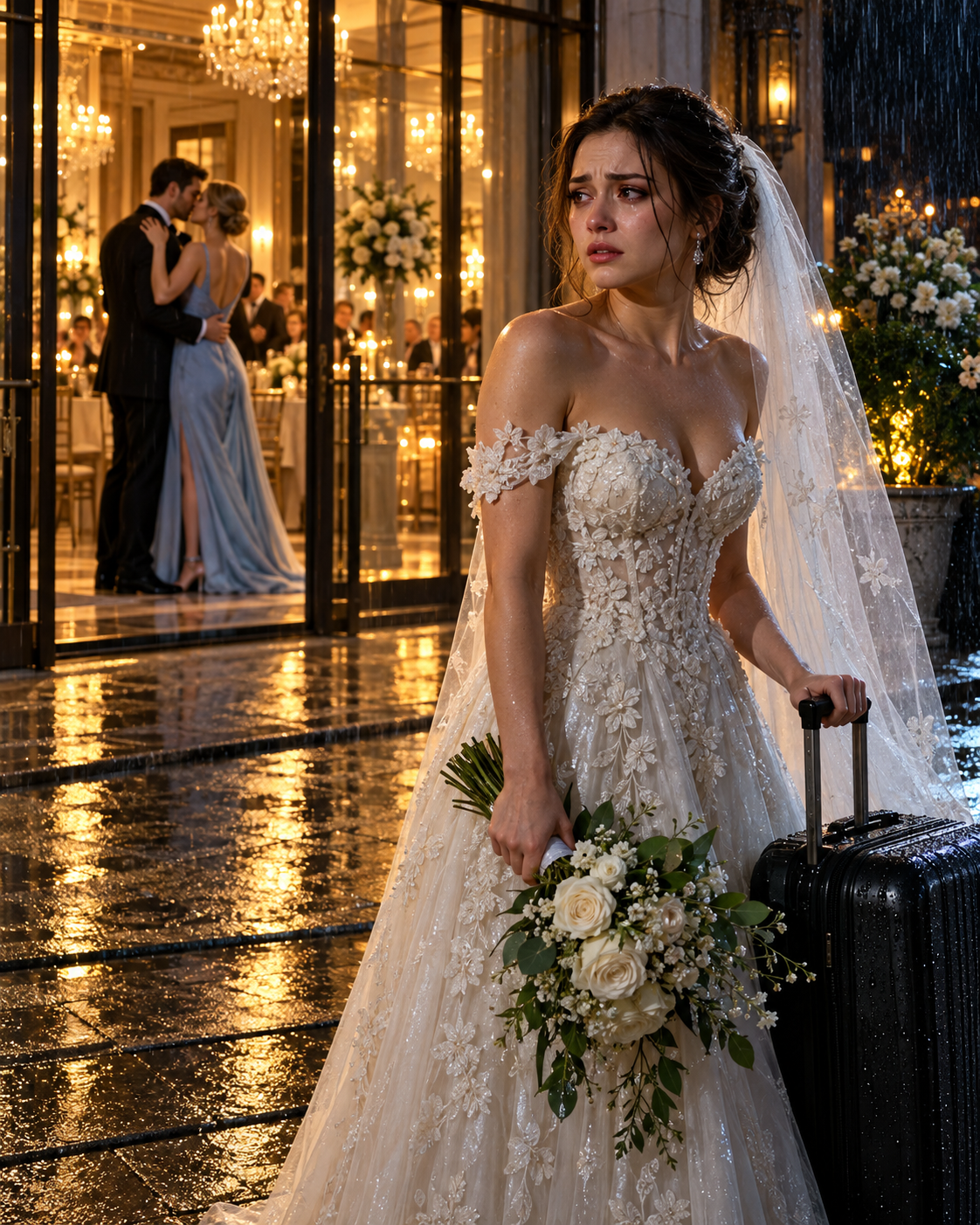
At the Boston Whitmore Hotel, my fiancé left me in a bridal sedan for FIVE humiliating hours while two hundred guests waited
For several seconds, I stood beside the sedan with my phone pressed against my ear, listening to my father breathe.
“What do you mean, it isn’t a bank?” I finally asked.
“I mean the property contribution the Whitmores promised our company may not be what they claim it is.”
Behind me, the hotel’s front doors opened and closed as guests began leaving, carrying wedding favors they had no reason to keep.
I could still hear William shouting my name from somewhere inside.
For the first time that afternoon, I wasn’t tempted to turn around.
“I’m coming,” I told my father.
Natalie gathered my train, helped me into the car, and instructed the driver to head for Bennett Urban’s headquarters in the Seaport District.
As the hotel disappeared behind us, I watched my reflection tremble in the window.
I had imagined my wedding day a thousand times, but never the moment when I would drive away alone, still wearing my engagement ring, with mascara drying on my cheeks and a future I no longer recognized waiting somewhere ahead.
Natalie handed me a bottle of water.
“You don’t have to make every decision today,” she said gently.
“I already made the biggest one.”
“Leaving William?”
“Leaving the idea that I have to earn the right to be treated decently.”
She squeezed my hand.
Neither of us said anything else until we reached my father’s office.
Robert Bennett was waiting in the conference room with our general counsel, Maya Chen, and Daniel Reece, the company’s chief financial officer.
There were no flowers, no champagne, and no sympathetic speeches.
There was a thick file on the table.
My father rose when I entered, then stopped when he saw the wedding dress.
“Oh, sweetheart.”
For a moment, I was his daughter again instead of the executive responsible for a development project worth hundreds of millions.
I let him hug me.
Then I pulled back, wiped my eyes, and sat down.
“Show me.”
Maya opened the file to a property report marked with yellow tabs.
“Pier 19 was valued at sixty-eight million dollars as part of the Whitmore contribution,” she explained. “But the title records reveal an undisclosed debt attached to a key parcel, along with an option agreement that could transfer control of that parcel to a separate holding company.”
“Who owns the holding company?”
Daniel slid a page toward me.
“Northline Holdings.”
The name meant nothing to me.
My father leaned forward.
“Northline is controlled by a trust administered through the Whitmore family office.”
I read the report twice, searching for a sentence that would make the documents less disturbing.
The Whitmores had presented Pier 19 as the foundation of their contribution, but a critical section of the land had already been pledged against a private loan.
Worse, the option allowed Northline to acquire that parcel for a fraction of its projected future value if certain conditions were triggered.
Without that parcel, the planned access road and utility corridor would become complicated, expensive, and potentially impossible to complete on schedule.
“Why would they structure it this way?” I asked.
Maya folded her hands.
“We don’t yet know whether the intent was to conceal a default risk, create leverage over the project, or both.”
I stared at the signature beneath the option agreement.
William Whitmore.
The document had been executed four months earlier.
Four months ago, William had taken me to dinner after a long board meeting, kissed my forehead, and promised that we would spend our lives building something better than the families that raised us.
Four months ago, I had believed him.
“Does Grandpa Arthur know?” I asked.
“His office received a copy of the disclosure schedule,” Daniel said. “We haven’t established whether he reviewed it personally.”
That distinction mattered.
Arthur had always treated me with warmth, even when William spoke about my independence as though it were an irritating habit.
I wanted to believe the old man had been kept in the dark.
I also knew that wanting something to be true didn’t make it true.
Maya turned to another document.
“There is more.”
The next page was a draft amendment to our joint venture agreement.
At the top, someone had written CONTINUITY AND GOVERNANCE PROTOCOL.
My name appeared beside William’s.
The proposed terms would give William temporary voting authority over certain Bennett Urban decisions if our companies entered a governance dispute.
They would also restrict either party from disclosing sensitive project information without joint approval.
The amendment had not been signed.
At the bottom was a handwritten note instructing the legal team to arrange an execution copy for our wedding reception.
I felt the room tilt.
“He planned to put this in front of me tonight.”
“That’s what the correspondence suggests,” Maya said.
“Why didn’t he send it through the normal legal process?”
“Because you would have had time to review it, obtain independent advice, and refuse it without an audience.”
The cruelty of that answer struck deeper than his public humiliation.
William had not merely expected me to forgive him.
He had expected the shame of canceling a wedding in front of hundreds of people to make me easier to control.
He had turned love into a deadline and embarrassment into a negotiating tactic.
My father took the document from me before my hands could crumple it.
“Claire, listen carefully,” he said. “We are not going to retaliate because your engagement ended. We are going to protect this company, its employees, and the people who trusted us with their money.”
“I understand.”
“If the project survives, it must survive on honest terms.”
I looked at Maya.
“What can we do right now?”
She explained that our agreement allowed Bennett Urban to suspend the next funding disbursement while independently verifying disputed contributions and investigating material misrepresentations.
It did not give us permission to seize Whitmore assets or declare fraud before the evidence was reviewed.
The distinction was important.
I didn’t want to punish the construction workers, the engineers, or the families who had attended public meetings because they hoped Pier 19 would become a place where they could live and work.
I wanted to know whether the project had been built on a foundation of lies.
“Send the formal notice,” I said. “Freeze no more than the agreement permits, preserve every record, and bring in an independent forensic team.”
Daniel nodded.
“And schedule an emergency investment committee meeting for tomorrow morning,” I added. “No private negotiations with William, and no exceptions because of our personal history.”
My father studied me for a moment.
“You know they’re going to make this ugly.”
“They already did.”
Within twenty minutes, the notice had been drafted.
Within forty, it had been reviewed by outside counsel.
By the time I finally removed my wedding shoes and changed into clothes Natalie had fetched from my apartment, the Whitmore family had sent eleven messages, four calls, and one sharply worded letter from its general counsel.
William’s first text was furious.
“You are embarrassing both families. Call me immediately.”
The second arrived less than a minute later.
“You can’t let a private disagreement threaten Pier 19.”
The third was different.
“Claire, please. I never wanted today to happen this way.”
I stared at the message until the screen dimmed.
Then I set the phone down without replying.
That evening, videos from the hotel began appearing online.
Someone had recorded me standing before the ballroom doors, saying there would be no wedding.
Someone else had captured William reaching for my arm while I stepped away.
The clips were short, missing everything that had happened during the five hours before them.
By midnight, strangers were calling me unstable, privileged, heartless, and courageous, sometimes within the same comment thread.
I refused to issue a statement.
The truth did not become stronger when shouted at people who had already decided what they wanted to believe.
At 1:17 a.m., Natalie knocked on the guest-room door at my father’s house.
“Jessica is downstairs.”
I sat up.
“Why?”
“She says she has something for you.”
For a moment, the old pain returned so sharply that I could barely breathe.
I pictured Jessica behind the hotel window, her fingers intertwined with William’s, while I sat outside in a car wearing a dress I would never wear again.
“I don’t want to see her.”
Natalie nodded and started to close the door.
“Wait.”
I looked down at my engagement ring.
“Give me five minutes.”
Jessica was standing in the living room when I went downstairs, still wearing the same cream dress from the wedding.
Without the hotel’s chandeliers and the crowd watching her, she looked less like a rival and more like a woman who had spent the night fighting with herself.
She held a manila envelope against her chest.
“I know you have every reason to hate me,” she said.
“I don’t have the energy to hate you.”
Her eyes filled with tears, but I refused to mistake tears for remorse.
“Then let me explain what happened.”
“You had five hours.”
“I know.”
“William had five hours to come downstairs. You had five hours to remember I was a person.”
She looked at the floor.
“I told him to end this months ago.”
I gave a bitter laugh.
“You were holding his hand.”
“I know how it looked.”
“How it looked?”
The words came out louder than I intended.
“You stood beside the man I was supposed to marry while he left me outside like an appointment he didn’t want to keep.”
She flinched.
For several seconds, neither of us spoke.
Then she placed the envelope on the table.
“William asked me to help persuade you to accept the continuity amendment.”
I glanced at the envelope but didn’t touch it.
“He told me you were considering transferring some voting authority because you wanted to reduce your workload after the wedding,” she continued. “I believed him at first.”
“And later?”
“Later, I saw the actual draft.”
Her voice dropped.
“It wasn’t temporary in the way he described it. The provisions were broad enough to give him significant influence over decisions he couldn’t otherwise control.”
I crossed my arms.
“So you helped him prepare it.”
“Yes.”
She didn’t offer an excuse.
“I wanted to believe that if you stepped aside, things between William and me might finally be different.”
There it was.
The small, ugly truth that hurt more than any corporate document could.
For years, Jessica had been the story William told whenever he wanted me to feel replaceable.
And I had been the obstacle in the story she wanted to believe about herself.
“I was wrong,” she said. “But being wrong doesn’t make what I did harmless.”
I looked at her for a long time.
“What changed?”
She swallowed.
“William told me that after the amendment was signed, he would lead the project, and I would become his strategic adviser. Then I read a financial schedule that listed the additional costs of acquiring the Northline parcel, costs he had assured me were already covered.”
She opened the envelope.
Inside were printed emails, meeting notes, and a spreadsheet linking Northline’s administrator to the Whitmore family office.
“I started asking questions,” she said. “He told me I didn’t understand the deal. Then he removed my access to the project files.”
“Why bring these to me?”
“Because I helped him hide the risk, and because yesterday he told me you would eventually come back once the embarrassment wore off.”
I felt something harden behind my ribs.
“He said that?”
“He said you were too invested in the wedding, the project, and his family to walk away from all three.”
Jessica looked directly at me.
“He never believed you would choose yourself.”
I wanted to tell her that she had no right to deliver that sentence as though it were a gift.
Instead, I picked up the envelope.
“I can’t promise this will protect you.”
“I know.”
“And I won’t promise to forgive you.”
“I don’t expect you to.”
For the first time, I believed at least one thing she had said.
Maya arrived before sunrise, reviewed the material, and immediately directed our outside investigators to preserve the relevant records through proper legal channels.
Some of the emails were significant, but they were not proof of every suspicion we had.
Jessica agreed to provide a formal statement and make herself available to counsel.
By nine that morning, the emergency investment committee was seated in Bennett Urban’s boardroom.
The view stretched across Boston Harbor, where ferries moved through a pale morning mist and cranes stood like enormous silhouettes against the skyline.
I wore a dark navy suit.
My wedding dress hung in a garment bag in the back of my car.
I had not decided what to do with it.
William arrived with his father, Charles Whitmore, and two corporate attorneys.
He looked exhausted, but his suit was immaculate and his expression carried the familiar confidence of a man accustomed to entering rooms where everyone moved aside for him.
He paused when he saw me at the head of the table.
“You’re actually doing this,” he said.
“Good morning, William.”
He pulled out a chair.
“Let’s not pretend yesterday wasn’t emotional for both of us.”
“It was emotional for me. It was strategic for you.”
His jaw tightened.
Charles intervened before William could answer.
“We understand there are concerns about a property agreement. We can resolve those concerns without turning an ordinary financing issue into a public crisis.”
Maya placed the relevant documents on the screen.
“An undisclosed encumbrance and a related-party option affecting a critical parcel are not ordinary financing issues.”
Charles leaned back.
“The company has substantial assets.”
“Then it should have no difficulty verifying them,” I replied.
William turned toward me.
“You’re using your authority to get revenge.”
“No,” I said. “I’m using my authority to discover whether our agreement has been honored.”
He gave a humorless smile.
“You always have to make yourself the smartest person in the room.”
For years, that sentence would have made me defend myself.
I would have explained how hard I’d worked, how many nights I’d spent reviewing contracts, how carefully I’d learned to separate emotion from judgment.
This time, I simply looked at him.
“I don’t need to prove I’m smart to you anymore.”
The silence that followed was almost unbearable.
Daniel presented a clear breakdown of the discrepancies.
The Whitmores had disclosed some borrowing against other assets, but the specific encumbrance on the critical parcel had not been properly reflected in the contribution schedule.
The Northline option created a second problem because its potential exercise could interfere with the project’s agreed access arrangements.
Our independent review was still underway, and we made no accusation beyond what the documents supported.
But the funding pause was justified under the contract until the missing disclosures and title questions were resolved.
William’s attorney asked for a private recess.
The committee granted ten minutes.
The moment the doors closed, William came straight toward me.
“Do you understand what you’re doing to my family?”
“Yes.”
“You could collapse the entire development.”
“Then your family should have disclosed the risks before asking us to finance it.”
He lowered his voice.
“We can fix the paperwork. We can rewrite the amendment. You and I can still talk about what happened.”
I stared at him.
“Are you asking me to reconsider the wedding?”
“I’m asking you not to confuse business with heartbreak.”
“You used the wedding to put a business agreement in front of me that you knew I would reject if I had time to read it.”
His face changed.
For one unguarded second, I saw not regret but irritation that I had understood him.
“You were going to become part of my family,” he said. “We had to find a way to make decisions together.”
“Together doesn’t mean you get to decide for me.”
“Every successful family has a structure.”
“Then build one that doesn’t depend on humiliating the woman you’re asking to marry.”
He looked toward the door, where his father was waiting.
“You’re going to regret this.”
“Maybe,” I replied. “But I’ll regret it as myself.”
He left the room without another word.
When the committee reconvened, we approved a limited suspension of further funding pending independent review, required a corrected contribution schedule, and prohibited any transfer or amendment affecting the disputed parcel without the approvals specified in the joint venture agreement.
We also established a separate review team to assess how the project could continue without exposing its public commitments to unnecessary risk.
The Whitmores objected to every measure.
They also agreed to produce additional records.
That was the first crack in the wall.
Over the following days, the investigation uncovered more than the initial documents had shown.
Northline’s option had been negotiated by an entity ultimately connected to the Whitmore family trust, while the underlying property debt had been described internally as a problem the next funding round would make easier to manage.
Emails revealed that William had been pushing for a governance amendment at the same time he was assuring our team that no change in control was necessary.
There was no single document that proved every intention we suspected, and I refused to let anger turn gaps in the evidence into certainty.
But the pattern was unmistakable.
The amendment would have increased William’s control over the joint venture just as the Whitmores were seeking fresh capital to address problems they had not fully disclosed.
Our independent investigators documented the inconsistencies, and our lawyers began formal negotiations over a remedy.
Then Arthur Whitmore asked to see me.
He arrived at my office without his usual driver, carrying an old leather folder under his arm.
For the first time since I’d met him, he looked genuinely old.
“I owe you an apology,” he said.
I gestured toward the chair opposite mine.
“Which part?”
He accepted the question without protest.
“I knew Northline was connected to our family trust. I knew the property debt was a concern. I did not know the full terms of the continuity amendment until after the wedding was canceled.”
“Did you know William planned to leave me outside?”
Arthur’s eyes fell to the folder.
“I knew he wanted to make you understand that marriage to a Whitmore would mean accepting the family’s way of doing things.”
I let out a slow breath.
“So you knew enough.”
“Yes.”
The honesty hurt more than another polished denial would have.
Arthur opened the folder and revealed notes from meetings, an old project valuation, and a letter he’d written but never sent.
“William’s father and I have spent decades believing that control is the same as stability,” he said. “We built our company by making decisions before other people could challenge them.”
“And you expected me to learn that lesson by being humiliated.”
“No,” he said softly. “I expected you to accept it because I believed you loved him.”
I looked through the glass wall toward the busy office beyond us.
Employees were reviewing plans, preparing reports, and answering calls from contractors whose livelihoods depended on decisions none of them had made.
“People shouldn’t have to surrender their dignity to prove they love someone.”
Arthur nodded, and for a moment, he seemed to have no answer.
“I know that now.”
“Knowing it now doesn’t erase what happened.”
“No,” he said. “It doesn’t.”
He offered to support a restructuring that would place the disputed land contribution under independent review, require verified valuations, and remove unilateral control over the project’s critical decisions.
I told him to put the proposal in writing and submit it through counsel.
He looked disappointed, but he did not ask for special treatment.
That mattered, though it could not repair what had broken.
The story outside the boardroom continued to grow.
A business columnist called the canceled wedding a symbol of a feud between two powerful families.
A social media account posted a photograph of me leaving the hotel, my veil folded over one arm.
Someone described me as a woman who had thrown away a wealthy fiancé over a delayed ceremony.
I wanted to explain the missing title reports, the secret option, the amendment prepared for the reception, and the messages that had reduced my wedding to a negotiation.
Instead, our communications team issued one sentence confirming that the joint venture was under an ordinary contractual review and that I would not discuss private relationships publicly.
Then I returned to work.
The hardest part was not watching William lose influence.
It was learning how many small moments I had ignored because each one seemed too insignificant to justify the pain of confronting him.
The dinners where his family discussed my career as though it were a temporary inconvenience.
The meetings where William repeated my ideas after interrupting me, earning praise for the same words that had been dismissed from my mouth.
The afternoons when he apologized for embarrassing me, only to explain why I had forced him to do it.
I had called those things compromises.
Now I understood that a compromise required both people to give something up, while control demanded that only one person keep shrinking.
Three weeks after the wedding, Jessica’s formal statement helped investigators confirm that William had discussed using the reception to secure signatures on the amendment.
She also acknowledged her own role in preparing the meeting and withholding information from me.
Her cooperation was relevant, but it did not erase her choices.
When she called, I listened without promising that we could become friends.
“I thought being chosen by him would prove I was worth choosing,” she said.
I looked out at the harbor from my office window.
“Did it?”
“No.”
For the first time, I heard no competition in her voice.
Only grief.
“I am sorry, Claire.”
“I believe you.”
It was not forgiveness, but it was the truth I could offer.
Months passed before the joint venture reached a resolution.
The Whitmore family agreed to disclose the property’s outstanding obligations, restructure its contribution, and relinquish the disputed option through a negotiated settlement reviewed by both sides’ lawyers.
Northline’s involvement became subject to independent oversight, and William was removed from the project’s day-to-day negotiating authority while the governance review continued.
The final agreement did not make every suspicion a proven offense, nor did it give me the satisfaction of watching an entire family crumble.
It gave us a lawful path forward.
More importantly, it protected the development from being sacrificed to a private power struggle.
Bennett Urban brought in additional independent investment, negotiated new protections for the land, and set up a community advisory group to keep housing and public access central to the plan.
We had to revise the schedule, absorb unexpected costs, and answer difficult questions from partners who understandably wanted reassurance.
Some days, it felt as though the wedding had cost me more than a marriage.
It had cost me the comforting belief that love would eventually make every painful compromise worthwhile.
But on the days when the numbers refused to cooperate and the meetings stretched late into the night, I remembered why I had refused to turn away from the truth.
The people who would eventually live near Pier 19 deserved a project built on honest commitments.
Our employees deserved leadership that didn’t confuse loyalty with silence.
And I deserved a life in which I did not have to wait in a car for someone to decide when I could enter the room.
Nearly a year after the wedding that never happened, the first section of the waterfront project opened to the public.
The harbor walk curved past restored brick warehouses, young trees, and benches facing the water.
Families wandered along the new promenade while construction workers removed the final barriers from a public plaza.
I arrived alone, carrying no bouquet and wearing no ring.
My father was waiting near the entrance.
He stood beside a small plaque honoring the people whose work had made the project possible.
“You did it,” he said.
“We did it.”
He smiled, then looked at me with the quiet concern he’d carried since the day I called from the hotel.
“Do you ever wonder what your life would look like if you’d stayed?”
I watched a little girl run toward the water, her father calling her back before she reached the rail.
“Sometimes.”
“And what do you feel?”
I considered the question.
I still felt sadness when I remembered the man I had loved, the home we had planned, and the future I had once believed would unfold without asking me to choose between ambition and affection.
Leaving him had not made me immune to loneliness.
It had not made every decision easy or erased the memories that still appeared unexpectedly, often in the middle of an ordinary day.
But I no longer confused missing someone with making the wrong decision.
“I miss who I thought he was,” I told my father. “I don’t miss who I had to become to stay with him.”
My father slipped an arm around my shoulders.
We stood quietly until my phone vibrated.
William’s name appeared on the screen.
His message was brief.
“I saw the photographs of Pier 19. You built something remarkable. I wish I’d understood what mattered before I lost you.”
I read it twice, not because I was tempted to return, but because the words belonged to a man I had once imagined spending every birthday and every ordinary morning beside.
I could have answered.
I could have told him that understanding came too late, or that he had never lost me in a single dramatic moment.
He had lost me in every moment when he believed my love made my dignity negotiable.
Instead, I turned off the screen and slipped the phone into my pocket.
The sun was setting over the harbor, turning the glass buildings gold and the water a deep, bruised blue.
For years, I had believed that a successful life meant reaching a place where no one could abandon me, embarrass me, or make me question my worth.
Now I understood that safety did not come from finding someone powerful enough to protect me.
It came from refusing to hand another person the power to define me.
I never wore the wedding dress again.
I kept it in a box for a long time, unable to throw it away and unwilling to pretend it still meant what it once had.
Eventually, I donated it to a bridal charity, along with a note for the woman who might wear it next.
I wrote that no dress, promise, family name, or expensive celebration was worth losing the sound of your own voice.
I didn’t know who would read the note.
I only hoped she would remember it when the people around her told her to be patient with a cruelty that kept repeating itself.
Because love can survive disappointment, disagreement, and difficult seasons.
What it cannot survive forever is the belief that one person’s needs matter less simply because the other person has more money, more power, or a louder voice.
On my wedding day, William thought he was teaching me my place by leaving me outside for five hours.
He never understood that the moment I stepped out of that car, I stopped asking for permission to leave.
And sometimes, the most important beginning of your life doesn’t arrive with a ring, a vow, or a room full of people cheering your name.
Sometimes, it begins when the door opens, the truth finally becomes clear, and you decide that no matter how much it hurts, you will never again mistake being wanted for being loved.