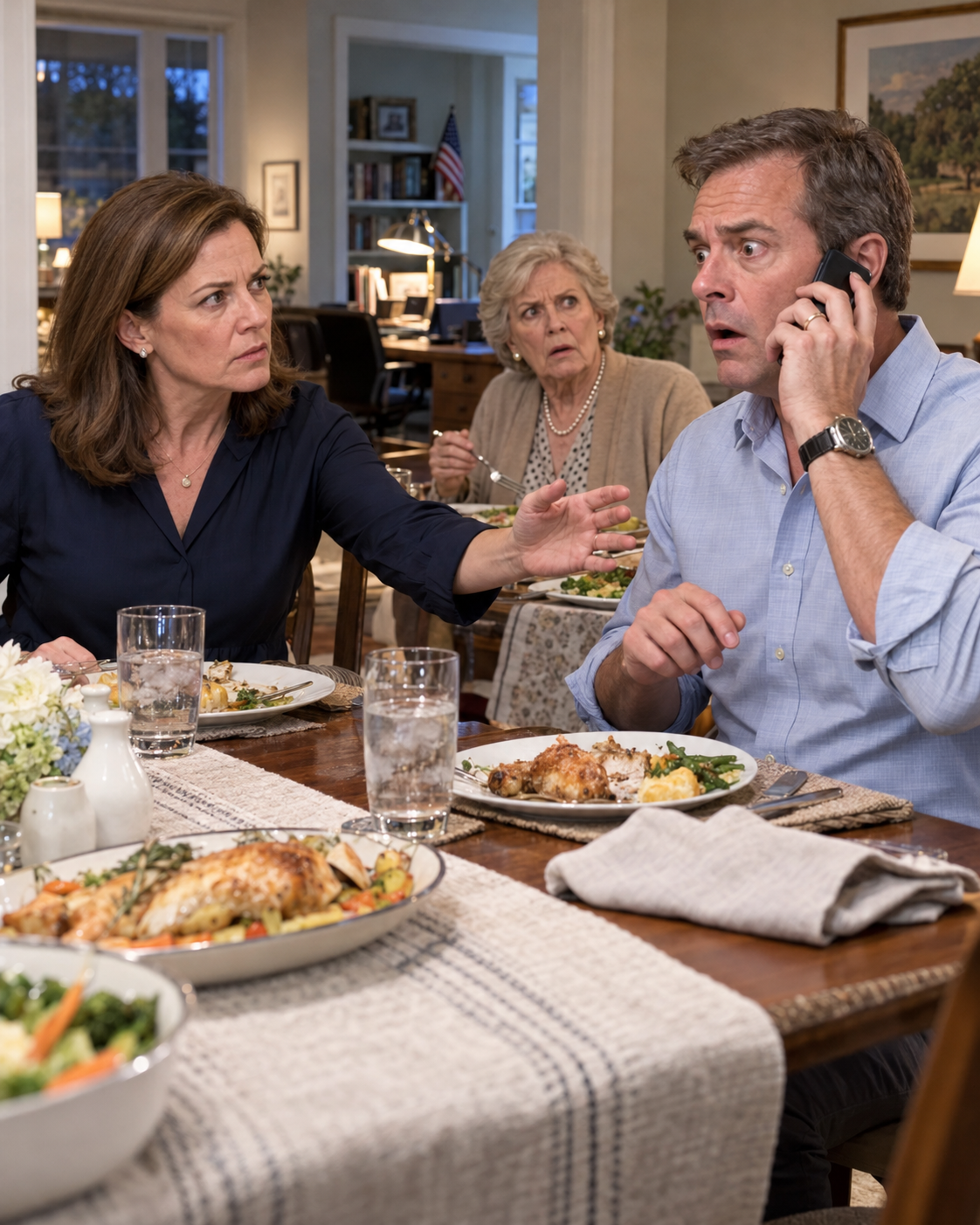
At Sunday dinner in our Virginia home, my husband snatched my military phone from my hand and sneered that I needed to learn RESPECT
Part 2
Richard discovered that I had spoken to an attorney two days later.
He came home carrying a leather portfolio, dropped it onto the kitchen counter, and stared at me as though I had committed an act of betrayal.
“You went behind my back.”
I was preparing coffee.
“I sought independent legal advice.”
“About your own husband?”
“About a financial guarantee carrying my forged signature.”
His jaw tightened.
“You could have come to me first.”
“I did. You told me it was complicated.”
He paced between the counter and the window, running one hand through his hair.
“The bank is making this into a bigger issue than it needs to be. They have lawyers involved, and now you’re adding another attorney to the situation.”
“The bank contacted me because my name appears on a guarantee I never signed.”
“You keep repeating that.”
“Because it remains true.”
He stopped walking.
For a moment, I thought he might finally tell me what had happened, not because he wanted to take responsibility, but because he had run out of ways to avoid it.
Instead, he lowered his voice.
“I need you to think about the consequences before you make this worse.”
I studied his face.
“Whose consequences?”
He did not answer.
That silence told me more than any confession could have.
Over the following days, the bank’s investigation moved forward through formal channels.
I supplied the documents requested by the investigators, answered questions about my signature, and confirmed that I had never approved the loan or authorized anyone to sign on my behalf.
I did not speculate about Richard’s motives.
I did not attempt to direct the investigation.
I simply told the truth and provided what I could substantiate.
Richard, meanwhile, became increasingly desperate.
His development project was nearly finished, but the company had accumulated debts that its projected rental income could not yet cover.
Without additional financing, he faced the possibility of losing the property and watching years of work collapse.
He began taking calls behind closed doors.
He stayed awake late into the night.
Sometimes I heard him whispering in his office, his voice strained as he promised people that everything would be resolved soon.
At breakfast, he acted as though nothing had changed.
At dinner, he complained that I had become cold.
And whenever I asked whether he had informed the investors that my guarantee was disputed, he found a new reason to change the subject.
Then he told me about the presentation.
A group of investors had agreed to meet in a hotel conference room near Washington, D.C., where Richard intended to secure the final funding necessary to keep the project alive.
He described the meeting as an opportunity to demonstrate that the company was financially stable and that its remaining difficulties were temporary.
“I want you there,” he said.
I looked up from the book I was reading.
“Why?”
“Because these people need to see that I have support.”
“Financial support?”
“Professional support. Personal support. They want to know the project has a credible future.”
I set the book down.
“Are you planning to tell them that I guaranteed the loan?”
He hesitated.
“I was going to explain that we are working through the details.”
“That isn’t an answer.”
He leaned forward.
“Your presence would help them feel confident. That’s all.”
I watched him carefully.
He was not asking me to attend as his wife.
He was asking me to stand beside him while strangers drew conclusions from my uniform, my career, and my silence.
He wanted my reputation to do the work that his paperwork could no longer do.
“No,” I said.
His expression hardened.
“You haven’t even heard me out.”
“I have heard enough.”
“You don’t understand what this means for me.”
“I understand exactly what it means for me.”
He stared at me with open disbelief.
For years, I had made it easy for him to believe that my boundaries were negotiable if he pushed long enough.
This time, I did not explain myself again.
He left the room, and I heard the front door close with enough force to rattle the glass.
That evening, Margaret arrived without warning.
She carried a covered dish and wore the worried expression of someone who had come to negotiate a peace agreement without asking whether the injured party wanted peace on those terms.
“I brought Richard something to eat,” she said, setting the dish on the counter.
Then she turned toward me.
“He tells me you won’t attend his investor meeting.”
“I won’t.”
“Why would you refuse to help him when you know how much is at stake?”
“Because he intends to use my presence to suggest that I support a guarantee I never authorized.”
Margaret pressed her lips together.
“You have always been a strong woman. You know how to handle difficult situations.”
“I do.”
“Then handle this privately.”
I felt a familiar ache in my chest.
It was the ache of recognizing an old pattern just as someone was trying to draw me back into it.
“Margaret, if Richard made a mistake, he needs to correct it.”
“Everyone makes mistakes.”
“Not everyone puts another person’s name on a financial guarantee without permission.”
Her eyes flashed.
“You are talking about my son as though he were a criminal.”
“I’m talking about a document.”
“That document could destroy everything he has built.”
I looked at the covered dish between us.
“And what about everything I have built?”
She had no answer.
Or perhaps she had one and did not want to say it aloud.
To Margaret, Richard’s company represented years of ambition and the promise of a successful future.
My career, my reputation, and my independence seemed like things that could be borrowed from without consequence because I was strong enough to recover.
She reached for my hand.
“Please. Think about the family.”
I gently withdrew it.
“I am thinking about the family. That is why I cannot help him lie.”
For the first time, Margaret looked at me not as the difficult daughter-in-law who had failed to make her son happy, but as a woman whose cooperation could no longer be assumed.
She left without taking the dish.
I stood in the kitchen long after her car disappeared down the street.
I remembered the early years of my marriage, when Richard would sit beside me after difficult assignments and tell me how proud he was of my service.
He had once admired my discipline.
He had once told friends that my integrity was the reason he trusted me with his life.
Somewhere along the way, he had begun treating those same qualities as resources he could exploit.
My reliability became an excuse for his carelessness.
My patience became permission for his contempt.
My reputation became a tool he believed he could use without asking.
The following morning, I received confirmation that the bank had scheduled its next formal review of the disputed guarantee.
My attorney advised me to continue cooperating and to avoid any statement that could be misunderstood as an endorsement of the project.
I followed that advice.
I also informed Richard, in writing, that I did not authorize him or anyone else to represent me as a guarantor, financial backer, or supporter of the loan.
He responded with a single sentence.
“You are choosing to destroy your own marriage.”
I read it twice.
Then I put the phone down.
I did not respond, because I finally understood that I could spend the rest of my life arguing with him about whether my refusal to be deceived was a betrayal.
Or I could accept that he had already made his choice.
The investor presentation was scheduled for Friday afternoon.
On Thursday night, Richard stood in the doorway of our bedroom while I prepared my clothes for the next day.
“I need you to come,” he said.
“I told you I wouldn’t.”
“Just sit in the room. You don’t have to say anything.”
“Then why do you need me there?”
His face tightened.
“Because people respect you.”
The honesty of that answer was almost worse than another lie.
He knew the value of my reputation.
He knew that people would see a decorated senior officer standing beside a businessman and assume she had examined the risks, understood the arrangement, and approved the project.
He wanted the appearance of my endorsement without the inconvenience of obtaining my consent.
“Richard, I will not let you use my service to mislead investors.”
He looked down at the clothes on the bed.
“You would really let everything fall apart over one document?”
I met his eyes.
“It is not one document. It is my name, my consent, and the truth.”
For a long moment, he said nothing.
Then he walked away.
I stayed awake after he went to bed, listening to the quiet house and the distant sound of cars passing along the road.
By morning, I had made a decision.
I would not attend as his wife standing silently beside him.
If I attended at all, it would be because I had a legitimate reason to correct a false impression about my involvement.
And if Richard created that impression in front of the investors, I would correct it in front of them.
No anger would be necessary.
No dramatic accusation would be required.
I would simply say what was true.
Friday arrived beneath a pale autumn sky.
I dressed in a dark civilian suit, placed the relevant correspondence in my bag, and drove toward Washington.
I had spent decades entering rooms where the stakes were high and the consequences uncertain.
But as I approached the hotel, my hands tightened on the steering wheel.
Not because I feared the investors.
I feared the finality of what I was about to do.
For years, I had believed that preserving a marriage meant protecting the person inside it from the consequences of his worst decisions.
Now I was beginning to understand that love without accountability could become a form of participation.
When I entered the hotel conference room, Richard was standing beside a large screen displaying architectural renderings of his development.
The room smelled of fresh coffee and polished wood.
Several investors sat around a long table, reviewing printed financial summaries.
Richard saw me and visibly relaxed.
“There she is,” he said, smiling too quickly. “I knew you’d come.”
I did not return the smile.
He introduced me to the group as his wife and spoke about my career with a pride I had not heard in months.
Then he began describing the project’s financial structure.
I listened carefully.
At first, he stayed within the boundaries of what the documents appeared to support.
Then he referred to the loan guarantee as evidence that the project had backing from a financially responsible household.
He mentioned my name.
He did not explicitly claim that I had signed the guarantee in that room, but he allowed the investors to look toward me as if my presence confirmed his statement.
One man nodded.
Another began asking questions about the stability of the arrangement.
Richard glanced at me, waiting for me to smile or offer some harmless remark that would reassure them.
I stood.
The room fell quiet.
“Before this discussion continues,” I said, “I need to correct an important misunderstanding.”
Richard’s smile disappeared.
I looked at the investors, not at him.
“I have never authorized or signed the loan guarantee being discussed. I do not personally back this loan, and my presence here should not be interpreted as an endorsement of the project’s financing.”
Nobody moved.
I kept my voice level.
“The bank is reviewing a document that bears my signature, but I did not sign it. I am cooperating with the formal investigation, and I cannot provide assurances about the loan.”
A man near the end of the table slowly closed his folder.
Richard stepped toward me.
“This is a private matter between my wife and me.”
I turned to him.
“It became a business matter when my name was used to support a financial obligation I never accepted.”
His face reddened.
I returned my attention to the investors.
“I wanted to make sure that everyone understood my position before making any decision based on the assumption that I had provided a guarantee.”
Then I sat down.
No one applauded.
No one needed to.
The room had changed, and everyone in it knew why.
Richard attempted to resume the presentation, but the questions that followed were different.
The investors wanted to know who had submitted the guarantee, what authority had been used, and whether the bank had verified the signature.
He answered some questions vaguely and others with visible frustration.
Eventually, the lead investor closed his notebook.
“We need to suspend this discussion until the financing has been independently verified.”
Richard looked at me as though I had personally reached across the table and pulled the foundation out from beneath his company.
I felt no satisfaction.
Only a heavy, aching certainty that the truth had finally entered a room where he had hoped to keep it outside.
As the investors began gathering their papers, Richard approached me.
“We need to talk.”
I looked at him.
“Yes,” I said. “We do.”
We left the conference room separately and met in a smaller hotel room Richard had reserved for the afternoon.
He closed the door behind us.
For several seconds, neither of us spoke.
Then he turned toward me, and the composure he had maintained in front of the investors finally broke.
“You had no right to humiliate me like that.”
I set my bag on the table.
“I corrected a false impression.”
“You could have waited.”
“For what?”
He opened his mouth, but the answer did not come.
I watched him struggle with the silence.
For once, I was not going to rescue him from
Part 3
Richard sank into a chair and pressed both hands against his face.
For the first time that afternoon, he looked less like a businessman fighting to save his company and more like a frightened man who had run out of people to blame.
“The project was supposed to work,” he said.
I remained standing.
“Tell me what happened.”
He lowered his hands.
“The financing fell apart six months ago. Two tenants withdrew, construction costs went up, and the bank refused to extend the credit line. I had contractors waiting for payment and investors threatening to pull out.”
He looked at the floor.
“I thought I could get through it if I bought myself a little time.”
“By using my signature?”
His eyes closed.
“I didn’t think it would go this far.”
I felt a terrible stillness settle over me.
“How did you obtain the signature?”
He swallowed.
“I copied it from a document you had signed before. I had someone prepare the guarantee, and I submitted it with the other paperwork.”
The room seemed to grow smaller.
I had known the truth was probably ugly.
I had not understood how calmly he could describe it once there was no one left to impress.
“You forged my signature,” I said.
“Yes.”
“And you did it without asking me.”
“Yes.”
“Then you let the bank believe I had accepted responsibility for your debt.”
He looked up at me, his eyes wet.
“I was trying to save everything.”
I sat across from him.
For a moment, I wanted to reach for his hand.
That instinct was old and powerful, built from years of loving him, defending him, and imagining that the frightened boy I sometimes glimpsed beneath his arrogance could still be reached if I chose the right words.
But I did not reach for him.
“Richard, you could have told me the company was failing.”
“You would have said no.”
The answer landed between us with devastating simplicity.
He knew I would not have agreed to the guarantee.
He had understood my answer before he forged my name, and he had decided that my refusal was an obstacle rather than a boundary.
“I might have helped you explore legitimate options,” I said. “I might have sat with you while you figured out what to sell, which creditors to call, and how to restructure the business. But you decided that my consent did not matter.”
“I was desperate.”
“I believe you.”
He looked up, surprised.
I continued before he could mistake compassion for forgiveness.
“But desperation explains why you were afraid. It does not excuse what you chose to do.”
He began to cry.
I had seen Richard cry before, usually when he felt cornered by circumstances he could not control.
This time, I could not tell whether he was grieving the damage he had caused or the future he was losing.
Perhaps even he could not separate the two.
“I never wanted to hurt you,” he whispered.
I looked at the man I had loved for so many years.
“Then why was my name the thing you were willing to risk?”
He had no answer.
We remained in that room for nearly an hour, discussing the facts rather than the excuses.
He admitted that he had known the guarantee would be material to the bank’s decision.
He admitted that he had allowed investors to believe my professional reputation supported the project’s financing.
He admitted that he had hoped my presence at the presentation would prevent anyone from asking too many questions.
I did not promise to protect him.
I did not tell him what he wanted to hear.
When he finally asked whether I would withdraw my complaint and tell the bank that the matter had been a misunderstanding, I felt the last fragile piece of my old marriage fall away.
“No,” I said.
His expression changed.
“After everything we’ve been through?”
“Because of everything we’ve been through.”
He stared at me.
“You would let the investigation continue?”
“I will tell the truth. The bank and the appropriate authorities will decide what follows.”
“You know what this could do to me.”
“Yes.”
“And you still won’t help me?”
“I will not lie for you.”
His face hardened again, the tears disappearing behind anger.
“So that’s it. Thirty years of marriage, and you choose paperwork over me.”
I stood and picked up my bag.
“No, Richard. You chose a forged signature over my trust. I am choosing not to pretend those are the same thing.”
I left the room without looking back.
Outside, the hotel lobby was busy with people coming and going, carrying briefcases and coffee cups, talking about schedules and ordinary problems.
The world had not stopped because my marriage was breaking apart.
That realization was both cruel and comforting.
I drove home beneath a darkening sky.
When I entered the house, Margaret was waiting in the living room.
Richard must have called her.
She stood as soon as she saw me, her face tight with indignation.
“How could you do that to him?”
I put my keys on the table.
“Good evening, Margaret.”
“Don’t speak to me like that. He told me what happened at the hotel. You embarrassed him in front of everyone.”
“He misrepresented my involvement in a financial guarantee.”
“He was trying to save his company!”
“He admitted that he forged my signature.”
Margaret flinched, but only briefly.
Then she lifted her chin.
“He made a terrible mistake. He is your husband. If you destroy him now, what kind of wife does that make you?”
I looked at her for a long moment.
I thought about the woman who had sat at our dinner table while Richard snatched my phone.
I thought about how quickly she had defended his demand for respect while ignoring his refusal to respect me.
And I thought about how often she had asked me to preserve the family by swallowing the truth.
“Margaret, I have spent years being the person who keeps things together. I have done it at work, and I have done it at home. But keeping something together is not the same as making it healthy.”
Her eyes filled with tears.
“He’s my son.”
“I know.”
“You don’t understand what this will do to him.”
I felt my own eyes begin to burn.
“Perhaps not. But I understand what it has already done to me.”
She shook her head.
“Families forgive each other.”
“Forgiveness cannot make a forged signature legitimate. And it cannot require me to lie to a bank.”
For the first time, her anger faltered.
She looked around the living room, at the framed photographs on the shelves and the furniture we had chosen together.
The life she wanted to protect was still visible everywhere.
But the trust that had once held it together was gone.
“Please,” she whispered. “Can’t you handle this quietly?”
I wanted to tell her that I had tried.
I had handled Richard’s contempt quietly.
I had handled the loneliness quietly.
I had handled the constant pressure to apologize for the demands of a career I had spent my life earning.
I had handled the small humiliations because each one seemed easier to endure than the argument that might follow.
But the guarantee had forced me to confront the cost of that silence.
“I will not make this more public than it needs to be,” I said. “I will not spread rumors or punish him for the sake of punishment. But I will cooperate with the investigation, and I will not change my statement to protect his reputation.”
Margaret stared at me, searching for the familiar opening through which she might persuade me to surrender.
This time, there was none.
She left shortly afterward.
I watched her walk down the front path and wondered whether she understood that I was not asking her to stop loving her son.
I was asking her to stop confusing love with permission.
In the weeks that followed, the bank’s investigation continued.
I provided the requested documents, answered follow-up questions, and worked through my attorney to ensure that my statements were accurate and properly recorded.
I made no attempt to interfere with the process because of my rank, and I did not invoke my service as a weapon against Richard.
My position did not make me the judge of his conduct.
It made it even more important that I allow the evidence to speak for itself.
The bank confirmed that the guarantee was disputed and treated the matter as a potential case of fraud.
Richard’s company lost the financing it had hoped to secure.
Some investors withdrew from the development, while others waited for the legal and financial issues to be resolved before deciding whether any part of the project could be salvaged.
There were difficult conversations about money, property, and the future of our marriage.
There were also days when I missed him so intensely that the grief felt physical.
I missed the man who had once waited for me at the airport after a long assignment.
I missed the way he used to leave coffee beside my briefcase when I had an early morning meeting.
I missed the private jokes that no one else understood, the ordinary routines, and the quiet certainty that someone would be beside me when I came home.
The hardest truth was that none of those memories had become false.
They were real.
So was the man who had forged my signature.
Love did not erase one fact because the other had once brought me happiness.
For a while, I kept expecting to wake up and discover that I had misunderstood everything.
I would remember Richard standing in the hotel room, admitting what he had done, and wonder whether there was still a version of the future in which we could repair the damage.
Then I would see the copy of the guarantee in my files.
I would remember the moment he took my phone at dinner, not as an isolated act of disrespect, but as the beginning of a clearer understanding of how he viewed my boundaries.
He had believed that he could decide when my responsibilities mattered, when my consent was necessary, and when my reputation could be used to protect his ambitions.
The forged signature was not the first betrayal.
It was the first one I could no longer explain away.
My attorney helped me understand the legal options available to me, and I began making practical decisions about our finances and our living arrangements.
I did not make those decisions out of revenge.
I made them because trust had been replaced by uncertainty, and I could not build a safe future on uncertainty alone.
Richard sent messages asking to talk.
Some were apologetic.
Others accused me of abandoning him at the moment he needed me most.
One night, he wrote, “I thought you would stand by me no matter what.”
I stared at the words for a long time before replying.
“I stood by you through difficulties you told me about. You made a choice that required my silence and put my integrity at risk. I cannot stand beside that choice.”
He did not respond.
Months later, the formal process was still moving through its necessary stages, and the consequences of his actions remained his responsibility.
I could not predict the final outcome, and I did not try to control it.
I had learned that accountability was not the same as vengeance.
It was the willingness to let facts be examined without bending them to protect the person who had caused the harm.
One evening, I sat alone in my study with the bank’s formal declaration in front of me.
The house was quiet.
The same desk stood beneath the window, the same shelves held the books and records I had accumulated over a lifetime, and the duty phone rested in its proper place.
For a moment, I remembered the Sunday dinner that had begun this unraveling.
Richard’s hand closing around my phone.
Margaret sitting frozen at the table.
The president’s voice cutting through the room with a single sentence.
At the time, I had thought the most humiliating part of the evening was watching my husband discover that he could not command every person he encountered.
I understood now that the real humiliation had been much quieter.
It was the years I had spent allowing someone I loved to make me feel that my boundaries were unreasonable.
I picked up my pen.
The declaration asked me to state, clearly and formally, whether I had signed or authorized the guarantee.
I wrote that I had not.
I described the facts to the best of my knowledge, identified the records I had supplied, and affirmed my willingness to cooperate with the investigation.
My hand remained steady.
When I reached the final page, I paused before signing my name.
For most of my life, my signature had represented responsibility.
It appeared on orders, evaluations, and documents connected to decisions that affected the lives and careers of others.
It was never merely a mark on a page.
It was a promise that I stood behind what I had authorized.
Richard had taken that promise and tried to make it serve a purpose I had never accepted.
Now, with the declaration in front of me, I was taking it back.
I signed.
The pen moved across the paper, leaving the familiar line of ink that no one else had the right to create in my name.
I placed the document in its folder and sat quietly for a moment.
I did not feel triumphant.
I felt sad, exhausted, and strangely free.
I understood that doing the right thing would not restore my marriage to what it had been.
It might not restore Richard’s business, repair Margaret’s opinion of me, or protect me from the grief of losing the future I had imagined.
But it would allow me to live with the one person whose trust I could not afford to lose: myself.
The next morning, sunlight spilled across the kitchen table where we had eaten that Sunday dinner.
I made coffee for one and stood by the window, watching a neighbor walk a dog along the sidewalk.
The world looked ordinary.
For years, I had believed that strength meant enduring more than other people could endure.
I had carried that belief into my marriage, confusing patience with virtue and silence with peace.
But real strength was not the ability to absorb every injury without complaint.
It was the courage to recognize when endurance had become complicity, and to stop before the damage reached even further.
I still believed in loyalty.
I believed in keeping promises, standing beside people through hardship, and offering compassion when someone was afraid.
But loyalty could not mean surrendering the truth.
It could not mean allowing another person to spend the reputation I had earned, or to turn my love into a signature beneath a promise I had never made.
I did not know whether Richard would ever fully understand that distinction.
I did not know whether Margaret would forgive me for refusing to protect the family image she valued so deeply.
Those answers belonged to them.
My responsibility was simpler, and far more difficult.
I had to live honestly with the choices I made.
I finished my coffee, returned to the study, and placed the signed declaration with the records prepared for the bank.
Then I closed the folder.
For the first time in years, the silence in my house did not feel like a punishment I had to endure.
It felt like space in which I could begin again.
I had spent nearly thirty years learning how to hold steady when the world demanded everything from me.
At last, I had learned that I did not have to surrender myself to prove that I could stand beside someone else.
And when I finally looked at my reflection in the darkened window, I no longer saw a woman wondering how much more she could endure.
I saw a woman who had remembered her own name, and what it meant to sign it.