At Sunday dinner in Millstone Creek, Missouri, my mother looked me straight in the eyes and called me a selfish son
For several seconds, nobody moved.
The clock above the kitchen doorway ticked so loudly that I could hear each second breaking against the silence.
Dad followed Mom’s gaze toward the hallway, where the door to their bedroom stood half-open.
“What is it, Valerie?” he asked.
She rubbed her palms against her jeans, leaving damp streaks on the fabric.
“I didn’t know how to tell you.”
“Then start telling us now.”
Mom looked at me, and something in her expression made my stomach tighten.
“Jonathan, the money wasn’t the only thing I took.”
I felt the room tilt around me.
“What does that mean?”
She closed her eyes.
“I used your name.”
At first, I didn’t understand.
Then she explained that when the mortgage company began sending overdue notices, she had used an old document containing my personal information to open a credit account.
She had told herself it was temporary, that she would pay it off before I ever discovered it.
But the account had grown, and when the money from the donations ran short, she had opened another.
My fingers went numb against the laptop.
“How many accounts?”
“Two.”
“How much?”
She couldn’t look at me.
“About twelve thousand dollars.”
Aunt Loretta pushed her chair away from the table.
“Jesus, Valerie.”
Mom flinched, but I barely heard my aunt.
All I could think about was the small apartment I rented, the money I had carefully saved, and the future I had been trying to build without asking anyone for help.
I had spent years checking my credit, saving for a home, and refusing unnecessary purchases because I wanted to be financially independent.
My mother had quietly placed a weight around my neck while telling everyone I was thousands of miles away, dying.
“Did you sign my name?” I asked.
She nodded.
“Did you pretend to be me?”
Another nod.
I stood up so abruptly that my chair struck the wall.
“You didn’t just tell people I was sick, Mom; you made decisions that could follow me for years.”
“I know.”
“No, you don’t know.”
My voice cracked on the last word, and that frightened me more than shouting would have.
“I spent three years wondering why my family stopped calling, and you were sitting here collecting money because they thought I was suffering.”
She began to cry harder.
I wanted her tears to mean something, but I couldn’t tell whether she was grieving what she had done or simply terrified that she had been caught.
Dad walked to the window.
He had worked maintenance at a local manufacturing plant for nearly thirty years, taking overtime whenever it was offered and coming home with grease beneath his fingernails.
He was the kind of man who repaired a leaking roof himself rather than pay someone else, who wore the same winter coat until the zipper finally gave up, and who had never once asked his children to rescue him from a problem he had created.
When he turned around, his face was pale.
“I worked every Saturday last winter because you told me the house was almost paid up,” he said.
Mom looked down.
“I thought I could fix everything.”
“You let me work myself sick while you lied to my face.”
“I was ashamed.”
Dad laughed once, without humor.
“You think I haven’t been ashamed? You think I’ve never opened a bill and wondered how we’re going to make it through the month?”
He gestured toward the table.
“I would have faced this with you. I would have sold the truck. We would have downsized. We would have done something.”
His voice broke.
“But you made sure none of us could help you honestly.”
That was when I understood that the worst part of Mom’s deception wasn’t the money.
It was the way she had transformed every opportunity for love into an opportunity for manipulation.
She had been surrounded by people willing to help her, but she had been too frightened to let them see the truth.
Instead, she had invented a son who needed saving.
Grandpa Ansel slowly removed his glasses and wiped them with a napkin.
“Every month, I sent money because I thought my grandson was fighting to live,” he said.
Mom reached toward him.
“Please, Grandpa.”
He pulled his hand away.
“Don’t call me that right now.”
She recoiled as though he had struck her.
I had never heard Grandpa speak to anyone like that, not even when Uncle Baird accidentally backed his truck into Grandpa’s fence.
For a moment, I almost felt sorry for her.
Then I remembered the Christmas morning I had spent eating cereal alone in my apartment because I believed my family had forgotten to invite me.
I remembered my birthday, when I had checked my phone throughout a fourteen-hour workday and received only a message from a coworker.
I remembered calling Mom to ask whether she thought I should come home for Thanksgiving, and hearing her say the family needed space.
The family hadn’t needed space.
They had been mourning me.
“Why did you tell them I was in Australia?” I asked.
Mom stared at the tablecloth.
“Because you were always traveling, and nobody knew exactly where you were.”
“So you turned my job into your alibi.”
“I didn’t plan all of it.”
“Then tell me what you planned.”
She swallowed.
“The first time I told Grandpa you were having medical problems, I only needed enough money to stop the mortgage company from sending another notice.”
“Was there ever a snake?”
“No.”
“Was there ever a hospital?”
“No.”
“Was there ever a doctor?”
She shook her head.
Every answer stripped another piece from the life I had believed I understood.
Aunt Loretta began gathering the printed donation records, her hands trembling as she sorted them into piles.
“I gave you twenty-eight hundred dollars,” she said quietly.
Mom whispered that she remembered.
“I was saving for a new furnace. I kept putting it off because you told me Jonathan’s treatment couldn’t wait.”
“I’m sorry.”
“You should be.”
Uncle Baird leaned forward, his expression hardening.
“And the fundraiser I organized through the church?”
Mom nodded.
“That money was supposed to go directly toward his rehabilitation.”
“I know.”
“People donated because they believed a young man was suffering.”
“I know!”
Her sudden outburst startled everyone.
For the first time that evening, Mom’s grief turned into anger.
“You think I don’t know what I did? You think I haven’t spent every night wondering when someone would find out?”
Dad stared at her.
“Then why didn’t you stop?”
She looked around the table, and her voice dropped to a whisper.
“Because every time I thought about telling the truth, I imagined everyone looking at me the way you’re looking at me now.”
No one answered.
Her explanation didn’t excuse anything, but it finally revealed the fear beneath the performance.
Mom had lost her job years earlier after repeated absences and a dispute with her supervisor.
She had told us she was leaving voluntarily, that the hospital was restructuring, and that she had already begun searching for something better.
In reality, she had struggled to find steady work and had hidden the rejection letters, the overdue bills, and the embarrassment of watching Dad carry most of their expenses.
At first, the lie had been a shortcut around one painful conversation.
Then it had become a wall.
Every new donation required another medical update, every missed holiday required another explanation, and every question about my recovery forced her to invent another detail.
She had trapped herself inside a story that depended on keeping the people who loved her from discovering the truth.
“I was scared,” she said.
“I was ashamed, and then I was scared all the time.”
I looked at her across the table.
“So you made me disappear.”
She started crying again.
“I never wanted that.”
“But you did it anyway.”
Those words settled over the room, and nobody tried to soften them.
Dad returned to his chair and asked me to close the laptop.
I hesitated.
“Why?”
“Because we’re going to talk about what happens next, not spend another hour staring at what she did.”
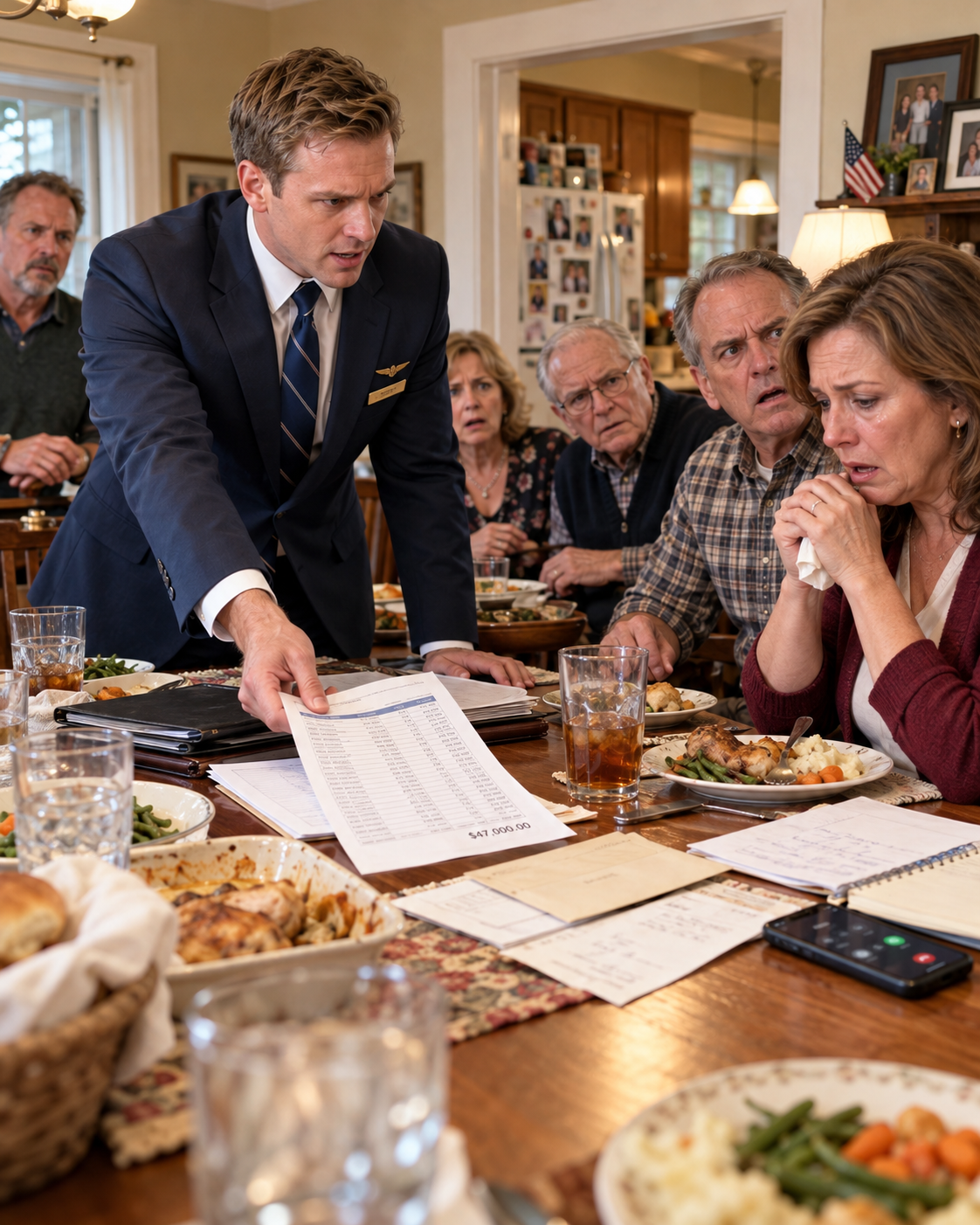
I closed it, though the total remained burned into my memory.
Forty-seven thousand, three hundred and eighty-six dollars.
It was more money than I had ever seen in one place, and nearly every dollar represented somebody else’s sacrifice.
Grandpa had delayed repairs on his old pickup.
Aunt Loretta had postponed replacing her furnace.
Uncle Baird had worked extra shifts at the hardware store.
Other relatives had sent smaller amounts, trusting that every contribution would help me walk again, speak again, or return to a life that had never been interrupted.
Dad took a long breath.
“Nobody is leaving here pretending this can be fixed with an apology.”
Mom nodded.
“We’ll repay every cent.”
“How?” Uncle Baird asked.
She opened her mouth and closed it again.
The truth was that she couldn’t repay forty-seven thousand dollars, not with her current income, not while the mortgage and credit-card balances remained outstanding, and certainly not if the money had already disappeared into bills.
I had prepared the spreadsheet because I wanted the family to see the evidence, but I hadn’t prepared myself for the practical question of what came after the truth.
So we began with what we knew.
We separated verified donations from amounts that still needed to be checked.
I created a second spreadsheet to track each contribution, the date it was received, and any records showing where the money had gone.
Aunt Loretta offered to contact the relatives who had organized the fundraiser.
Uncle Baird volunteered to help Grandpa review his bank statements.
Dad insisted that the mortgage and credit-card accounts be examined by someone independent.
Mom agreed to provide the statements and documents, although every time we asked for another record, she looked as though she were being asked to surrender a piece of herself.
Then I said something I had been holding back since I walked through the door.
“I want my identity protected, and I want the accounts closed properly.”
Mom nodded quickly.
“I’ll do whatever you need.”
“I need you to understand that I may have to report what happened.”
Her face went white.
“Jonathan, please.”
“I haven’t decided everything yet, but I won’t lie to protect you.”
Dad looked at me, and I saw the pain in his eyes, but he didn’t ask me to change my mind.
That was the first moment all evening when I felt he was truly standing beside me rather than trying to hold the family together at any cost.
“I won’t ask you to,” he said.
Mom covered her face.
The dinner ended without anyone touching the food.
Outside, the Missouri evening had turned cold, and the porch light cast a pale circle over the steps.
Grandpa walked me to my car, moving slowly with one hand resting against the railing.
“I should have called you,” he said.
I shook my head.
“You believed Mom.”
“I believed her because I wanted to believe I could help you.”
He looked toward the dark road.
“I suppose that was part of the problem.”
I put my arm around his shoulders.
“You didn’t do anything wrong by loving me.”
He leaned against me for a moment, and I felt the tremor in his breath.
“I missed three birthdays,” he whispered.
“You didn’t know.”
“That doesn’t give me the time back.”
Neither of us spoke for a while.
Before he went inside, he squeezed my hand and asked whether I would come for breakfast the following Sunday.
I promised I would.
It was a small promise, but it felt more honest than anything that had been said around the dinner table.
The following morning, I called my bank and explained that I suspected someone had opened accounts using my personal information.
They helped me begin a formal review, place additional protections on my credit, and document the accounts I didn’t recognize.
I also contacted the relevant credit bureaus and began the process of disputing the fraudulent information.
It was exhausting work.
Every phone call required me to repeat the same explanation, and every explanation forced me to hear how unbelievable my own life sounded.
My mother had told people I was dying in Australia while using my identity in Missouri.
For days, I felt as though I were living two lives: the ordinary one where I went to work, packed my uniform, and answered passenger questions with a smile, and the private one where I was learning how much damage could hide behind a familiar voice.
At work, my colleagues noticed that something was wrong.
One evening, my friend Marcus found me sitting in the crew lounge, staring at a cup of coffee that had gone cold.
“You look like you’ve been awake for a week,” he said.
“Almost.”
He waited, knowing me well enough not to fill the silence.
Finally, I told him the truth.
He listened without interrupting, then shook his head.
“Man, I don’t even know what to say.”
“Neither do I.”
“Do you still love her?”
The question caught me off guard.
“She’s my mother.”
“That’s not what I asked.”
I stared down at my hands.
“Yes,” I said eventually.
“And I’m furious with her.”
Marcus nodded.
“Both can be true.”
I carried those words home with me.
For years, I had believed that loving someone meant giving them the benefit of the doubt, even when their behavior hurt me.
Now I was learning that love could survive the truth without pretending the truth didn’t matter.
Three days later, Mom came to my apartment.
She stood outside the door holding a grocery-store bag, her hair pulled back and her face drawn with exhaustion.
“I brought you something to eat,” she said.
I almost laughed at the ordinary tenderness of it.
After everything she had done, she had returned to the oldest language she knew: food, small gestures, and the hope that caring for someone might repair what words had broken.
I let her inside, but I didn’t hug her.
She placed the bag on my counter and pulled out a container of homemade chicken soup.
“I know you used to like this after long flights.”
“I still do.”
She looked relieved for half a second, then seemed to remember where she was.
“I talked to a lawyer.”
I turned toward her.
“About what?”
“About the accounts, the donations, and what I might be facing.”
She folded her hands.
“I’ve been told I need to preserve everything and cooperate with the investigation. I won’t ask you to change your statement.”
It was the first thing she had said that sounded like responsibility rather than fear.
“What else?”
“I applied for two jobs.”
“Good.”
“And your father and I are discussing selling the house if we can’t make the payments.”
I felt a familiar ache, but I didn’t offer to rescue her.
She had made decisions that could affect my financial future, and I wasn’t going to become the person who covered every consequence because watching her struggle hurt.
Mom seemed to understand.
“I don’t expect you to fix this,” she said.
“Then don’t ask me to.”
She nodded, wiping her eyes.
For a while, we sat at my small kitchen table without speaking.
Then she told me that she had kept a box in her bedroom containing the printed medical updates she had sent to the family.
“I couldn’t throw them away,” she said.
“Why?”
“Because I was afraid that if I destroyed them, it would mean I had finally admitted what I’d done.”
I stared at her.
“Have you admitted it now?”
She looked down.
“I’m trying.”
I wanted to believe her, but trust wasn’t something I could hand back because she had finally found the right words.
Before she left, she asked whether I would visit Dad that weekend.
“I’ll be there Sunday morning,” I said.
She stood near the door, holding her purse against her chest.
“Jonathan, I need you to know that I never stopped loving you.”
I felt my eyes burn.
“Then why did you make everyone believe you had lost me?”
She had no answer.
After she left, I ate the soup alone at my kitchen counter.
It tasted exactly as I remembered, and that somehow made the betrayal worse.
The next several weeks were filled with difficult conversations.
Some relatives were angry enough to cut Mom off completely.
Others believed she deserved a chance to make things right, provided she stopped lying and accepted the consequences.
A few called me privately to apologize for believing the story without contacting me directly.
I told them they didn’t owe me an apology for caring about someone they thought was suffering.
But I also told them how much it had hurt to feel forgotten.
Aunt Loretta cried when I explained that I had spent Christmas alone.
“I thought you were too sick to talk,” she said.
“I know.”
“I should have tried harder.”
“We all should have talked to each other.”
It wasn’t entirely true, because the responsibility for the deception belonged to Mom, but it was true that silence had made the lie easier to maintain.
We had all accepted secondhand explanations instead of reaching across the distance between us.
The difference was that Mom had deliberately created that distance.
At the family’s next meeting, she brought a folder containing her financial statements, a list of outstanding debts, and a proposed repayment plan.
She had secured temporary work through a cleaning contractor and agreed to direct a portion of her earnings toward reimbursing the relatives who had donated money.
The amounts would be small, and the process would take years, but the plan was a beginning.
She also agreed to cooperate with the review of the accounts opened in my name.
There would be no quick forgiveness, no magical return to the family we had been before.
There were questions about legal responsibility, the handling of the donations, and whether any of the money could be recovered.
Those questions needed honest answers, even when the answers were uncomfortable.
Dad decided to remain in the house for the time being, but he made it clear that their marriage would need more than promises to survive.
“I love you,” he told Mom during one difficult conversation.
“But I can’t spend the rest of my life wondering which parts of our life are real.”
Mom cried, but this time she didn’t argue.
She began seeing a counselor through a local community program, and Dad went with her occasionally, though he made no promises about their future.
I visited on Sundays, as I had promised Grandpa.
At first, the meals were painfully quiet.
Then small pieces of our family began returning.
Uncle Baird told a ridiculous story about a customer who had tried to return a hammer because it had made a hole in the wall.
Aunt Loretta brought her famous apple pie.
Grandpa asked me about my routes and listened as I described the places I had seen, no longer imagining me lying in a foreign hospital.
One Sunday, he handed me a small envelope.
Inside was a photograph of me at age seven, sitting on his porch with a plastic airplane in my hand.
On the back, he had written, For my grandson, who was always meant to fly.
I had to excuse myself to the bathroom before I cried.
The photograph reminded me that my life had existed long before Mom’s story and would continue long after it.
Months passed, and the family slowly learned how to speak more honestly.
Mom didn’t become a different person overnight.
There were days when she slipped into defensiveness, days when shame made her quiet, and days when I struggled to look at her without remembering the spreadsheet.
But she kept working, kept attending counseling, and kept making payments according to the plan.
Whenever she wanted to apologize, I asked her to show me what she had done differently.
Slowly, her apologies became less frequent and her actions more consistent.
I learned that forgiveness wasn’t a door I had to open just because someone stood outside asking.
It was a possibility I could approach at my own pace, without surrendering the boundaries that kept me safe.
Then, almost a year after the Sunday dinner, I returned home from a long flight and found a letter waiting in my mailbox.
There was no return address.
Inside lay a photocopy of an old bank statement, a handwritten note, and a receipt bearing Mom’s signature.
The statement showed a transfer made shortly before the first fundraiser.
The amount was $6,500, sent to an account I didn’t recognize.
Beneath it, someone had written, Ask your mother where the first payment really went.
I read the note three times.
The repayment records we had gathered accounted for much of the money Mom admitted spending, but there had always been gaps.
She had claimed the first donations went toward overdue mortgage payments, and the bank records had seemed to support at least part of that explanation.
This document suggested there was something else.
I called Dad.
He came to my apartment within twenty minutes, his face tightening as he examined the papers.
“Where did you get this?”
“It was in my mailbox.”
“Does your mother know?”
“I haven’t asked her.”
Dad studied the signature.
For the first time in months, the familiar exhaustion returned to his eyes.
“I thought we were finally getting somewhere,” he said.
“So did I.”
We agreed not to accuse anyone until we could verify the account and the transfer.
The next morning, I contacted the bank and began asking the questions I had learned to ask when something didn’t add up.
By the end of the week, we had confirmed that the transfer was real, though we still couldn’t establish who ultimately controlled the receiving account.
When I showed Mom the statement, she went completely still.
For a moment, I thought she was going to deny everything again.
Instead, she sat down and pressed both hands against her mouth.
“I wondered when that would come out,” she whispered.
My heart began pounding.
“What does that mean?”
She looked at me, tears filling her eyes.
“The first money wasn’t for the mortgage.”
“Then what was it for?”
She stared at the statement for a long time before finally answering.
“I was paying someone back.”
“Who?”
Mom shook her head, unable to speak.
I leaned forward.
“Mom, I need the truth, even if it changes everything.”
She reached into her purse and took out a second envelope, worn along the edges as though she had carried it for months.
“I should have given you this a long time ago.”
Inside was a letter addressed to her, dated several weeks before she first told Grandpa I had been injured in Australia.
The handwriting was unfamiliar, but the final line made my stomach turn.
If you don’t repay what you owe, your family will learn what really happened before Jonathan disappeared from their lives.
I looked up at her.
“I never disappeared.”
Mom began to cry.
“I know.”
Outside, a car passed through the wet street, its headlights sliding across the wall.
For the first time, I wondered whether my mother’s lie had begun with desperation alone, or whether someone had helped her build it, encouraged her to keep going, and waited until the damage was too great to undo.
I held the letter between my fingers, feeling the paper tremble.
“Who sent this?”
Mom opened her mouth, but before she could answer, her phone lit up on the table.
A new message appeared from an unknown number.
She glanced at it, and every trace of color vanished from her face.
I reached for the phone.
“Jonathan, don’t.”
But I had already seen the message.
You were warned not to show him the letter.
I looked at my mother, and she looked back at me with the same terrified expression she had worn the night she begged me not to ruin everything.
Only this time, I wasn’t standing in a grocery store wondering what she meant.
This time, I knew the truth was still unfolding, and whatever waited beyond that message had been hiding in our family long before I ever put on my airline uniform.