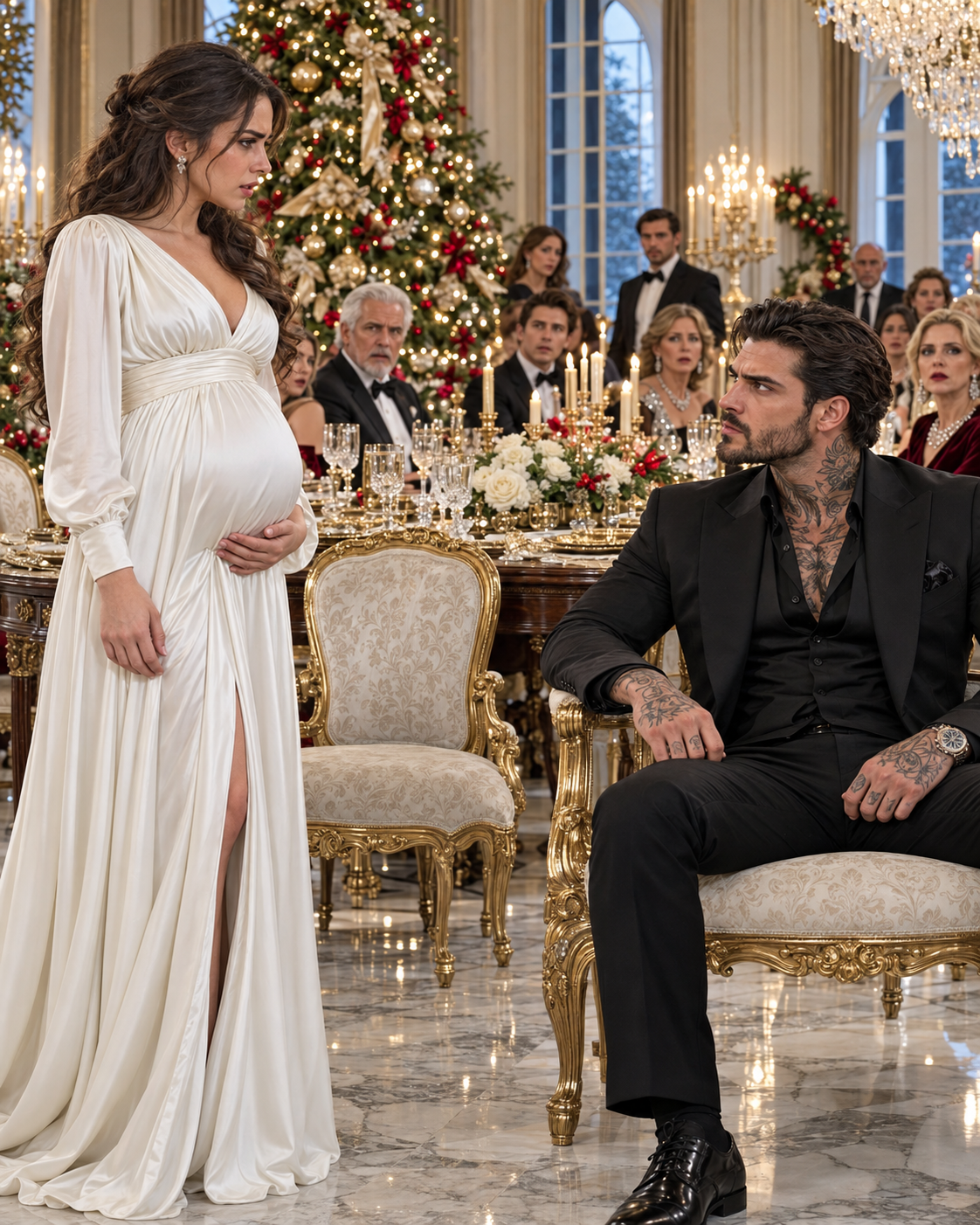
At our family’s Christmas dinner in a mansion outside Boston, my husband Julian publicly announced a future
Julian read the message again, as though staring at it long enough might force the words to become something harmless.
I watched his thumb hover over the screen.
“Call the police,” I said.
His eyes lifted to mine.
For a second, he looked like the man I had married, the man who used to laugh at burnt pancakes and dance with me in our kitchen when nobody was watching.
Then the syndicate leader returned.
“That would expose everyone connected to the organization.”
“Our house is in that photograph, Julian. Our unborn child has been threatened. I don’t care who gets exposed.”
He put the phone down.
“You think I don’t understand what’s at stake?”
“I think you understand exactly what’s at stake for you, and you’re still learning to understand what’s at stake for us.”
The words landed between us like a door slamming shut.
He walked to the window and examined the driveway, where two guards stood beneath the falling snow. I had once found their presence reassuring. Now every uniform, every camera, every locked gate felt like evidence that our life had become a beautiful prison.
“Stay here tonight,” he said. “Don’t leave the house without telling me.”
I stared at him.
“Are you protecting me or ordering me?”
His shoulders sagged.
“I don’t know anymore.”
That frightened me more than his anger ever had.
The next morning, Julian summoned the senior captains to the estate, but I refused to remain upstairs while men debated the future of my child.
I walked into the conference room wearing a plain gray dress, one hand resting against my stomach, and placed a copy of the proposed charter at the center of the table.
Several men exchanged looks.
One of them, Victor Hale, a broad-shouldered captain with silver hair and a permanent expression of contempt, leaned back in his chair.
“This is a family matter, not a governance meeting.”
“Then why did your organization appoint my unborn son without consulting his parents?”
His jaw tightened.
“Bloodline has always mattered.”
“Bloodline is a fact. It isn’t consent.”
A younger captain glanced down at the charter, but Victor laughed softly.
“You want us to surrender a century of tradition because you’re frightened?”
“No,” I said. “I want you to stop confusing tradition with entitlement.”
Julian stood at the head of the table, silent.
I turned toward him.
“You promised our children would never belong to this organization. You made that promise before you knew whether we would have a son or a daughter. Were those words only meant to comfort me until the day your power felt threatened?”
His face tightened, and I saw several captains notice the wound beneath his composure.
“I made the promise because I believed I could give you a different life,” he said.
“And when you discovered you might lose control, you decided our son could pay the price.”
Nobody moved.
Then Orion Basset cleared his throat.
“The charter deserves consideration,” he said. “An organization that survives only because one child carries its future is not stable. It is merely waiting for the next crisis.”
Victor turned toward him.
“You would dismantle the succession system now?”
“I would replace uncertainty with rules that apply to everyone.”
For the first time, the room divided visibly, not between allies and enemies, but between men who wanted a future they could control and men who were beginning to understand that control was not the same as stability.
Julian called the meeting to a recess before the argument became a shouting match.
When the others left, he remained beside the table, staring at the empty chairs.
“You shouldn’t have had to stand in there alone,” he said.
“No,” I replied. “I shouldn’t have had to stand in there at all.”
He flinched.
I wanted to soften the words. I wanted to touch his arm and remind him that we had once been happy in ways that had nothing to do with money, power, or fear.
But every time I imagined reaching for him, I saw the document with our son’s name printed beneath the word HEIR.
Love could explain why I wanted to forgive him.
It could not make the betrayal disappear.
That afternoon, Declan came to see me privately.
He looked worse than he had in the garage, with dark circles beneath his eyes and a cut across one knuckle.
“There’s something you need to know about the original document,” he said.
I felt my stomach tighten.
“Julian signed it. I saw his signature.”
“He did,” Declan replied. “But he wasn’t the one who circulated copies.”
He placed a thin folder on the table.
Inside were photocopies of the succession declaration, each bearing the same seal. Several had been sent to different captains weeks before I found the envelope.
A handwritten note appeared on the final page.
A leader without an heir is a leader without a future.
“Who wrote that?”
“We’re still trying to establish it.”
I looked at the dates.
The first copy had been distributed nearly a month before Julian admitted the rivals were applying pressure.
Someone had anticipated the conflict, and someone wanted the organization to believe that my unborn son was the only acceptable answer.
“Why would anyone want this?”
Declan hesitated.
“Because a child cannot challenge the people who claim to protect him.”
The room seemed to tilt around me.
If Julian’s declaration had been intended to quiet the captains, someone else had turned it into a weapon. A baby who could not speak had become the center of a power struggle because every faction believed they could shape his future before he was born.
“Does Julian know?”
“Not yet.”
“Then tell him.”
Declan nodded, but he did not leave.
“There’s another problem. Victor has been meeting privately with representatives from the rival faction.”
I looked at him.
“Are you certain?”
“I saw them enter the same hotel on three separate nights. I can’t prove what they discussed.”
It was not proof, but it was enough to make the fear in my chest sharpen.
That evening, Julian and I sat across from each other at the kitchen table, the charter between us.
I told him everything Declan had shared.
He listened without interrupting, then rubbed his face with both hands.
“Victor has spent twenty years arguing that the organization needs a clear successor,” he said. “If he’s working with the rivals, he may be using our son to divide the council.”
“Or to make you desperate enough to give him whatever he wants.”
Julian stared at the signature on the old declaration.
“I signed this because I thought it would prevent a war.”
“Did you ask yourself who would benefit if everyone believed the war depended on our baby?”
His expression changed.
For the first time, he seemed to see the document not as a solution, but as an opening someone else could exploit.
“I have to confront him.”
“You have to do more than confront him. You have to stop making decisions alone and calling them necessary.”
He looked at me for a long time.
Then he pushed the charter toward me.
“Tell me what accountability looks like to you.”
The question was so unexpected that I could not answer immediately.
I had imagined him arguing, defending himself, demanding that I trust him because he had finally changed the document.
Instead, he was asking me to define the difference between an apology and a promise that could be tested.
“First, the charter must be binding,” I said. “Not a temporary gesture you can reverse when you’re frightened. Second, no child becomes a designated successor simply because of their birth. Third, the council cannot operate outside the law and use our family as a shield for its crimes.”
His face hardened at the last sentence, but he did not interrupt.
“And fourth,” I continued, “our son will grow up knowing the truth about his father. Not every secret, not details meant to frighten a child, but the truth that power has consequences and love does not excuse them.”
Julian looked down at his hands.
“I don’t know how to give him the childhood you want.”
“You start by refusing to take it away before he has one.”
For a long moment, neither of us spoke.
Then he nodded.
The following day, Orion arranged a formal council session at a private office in downtown Boston. The meeting was supposed to settle the charter and determine whether the old succession declaration would be withdrawn.
I insisted on attending.
Julian objected at first, then stopped himself.
“You have every right to be there,” he said.
It was a small sentence, but I heard how much it cost him.
When we arrived, Victor was already seated at the conference table. He wore a dark suit and a silver tie, and he greeted Julian with the easy confidence of a man who believed the outcome had already been decided.
His gaze moved to me.
“You’re making this more complicated than it needs to be.”
“No,” I said. “I’m refusing to let you make it simple at my child’s expense.”
Orion opened the meeting by presenting the charter, which established shared governance, documented succession procedures, and a formal mechanism for resolving disputes without automatically transferring authority to a family member.
The first two captains supported it.
The third demanded revisions.
Victor rejected it outright.
“This organization has survived because its members understand loyalty,” he said. “You cannot replace loyalty with paperwork.”
“Loyalty without accountability is obedience,” Orion replied. “And obedience without trust eventually becomes rebellion.”
Victor’s face darkened.
He turned to Julian.
“If you sign this, you weaken your own position. Every rival will see it as an admission that you no longer control your people.”
Julian remained still.
“I am admitting that no single person should be able to decide the future of everyone else without limits.”
Victor gave a short, disbelieving laugh.
“And what happens when the council disagrees? What happens when your son is old enough to lead and finds out you gave away his birthright?”
I felt my baby shift beneath my ribs.
Julian noticed my hand move and looked at me before answering.
“Then my son will know he was never born owing this organization his life.”
The room went silent.
For one fragile moment, I believed we might be finished with the old declaration.
Then Victor placed a black folder on the table.
“You may want to reconsider,” he said. “Because this isn’t the only document Julian signed.”
My husband went utterly still.
Victor opened the folder and slid a second page across the polished wood.
It was a private agreement dated three weeks before the succession declaration. It authorized a temporary transfer of financial control to a committee if Julian became incapacitated or was forced to step aside.
Julian scanned the page, his expression turning colder with every line.
“I never signed this.”
Victor leaned back.
“Your signature says otherwise.”
Julian examined the bottom of the document.
The signature was convincing, but the final stroke curled in the wrong direction. I had watched him sign hundreds of documents. I knew that detail because I had once teased him about how he always finished his name as though he were underlining a threat.
“This is a forgery,” he said.
Victor’s smile disappeared.
“You should be careful about making accusations.”
“And you should be careful about assuming I don’t recognize my own signature.”
The room erupted into overlapping arguments.
Orion ordered everyone to remain seated, while Declan, who had been waiting outside, entered with a sealed envelope from the organization’s records office.
He handed it to Orion.
Inside were the original copies of the disputed agreements, along with a record showing when each had been received and by whom.
The succession declaration was authentic.
The transfer agreement was not.
The record indicated that the forged agreement had been submitted by an intermediary connected to Victor’s office.
Victor stood abruptly.
“This is a setup.”
“Then stay and explain it,” Julian said.
Victor glanced at the door.
Two council members moved to block his path, not threatening him, but making it clear that leaving would only deepen the suspicion.
For several seconds, I thought the confrontation might turn violent.
Instead, Orion placed both hands on the table.
“No one will settle this with threats. The documents will be examined independently, and any suspected criminal conduct will be referred to the proper authorities.”
Victor stared at him as if he had spoken a foreign language.
“You would bring outsiders into our affairs?”
“We have spent too long pretending that secrecy makes us untouchable,” Orion replied. “It doesn’t.”
Julian signed the charter that afternoon.
Three captains signed with him, followed by Orion and two others who had initially remained undecided. The remaining members agreed to a review period, during which the old succession declaration would have no governing force.
It was not a complete victory.
Some men left the room refusing to accept the changes, and others signed only because they feared being isolated.
But for the first time, the organization had a written limit on the authority Julian had once believed he must possess without question.
Outside the office, the winter air struck my face.
Julian walked beside me without touching me.
“Is this enough?” he asked.
I looked at him.
“It’s enough to begin. It isn’t enough to erase what happened.”
He nodded, accepting the answer without bargaining.
That evening, we returned to the estate, where the Christmas tree still stood in the corner of the living room. Its lights reflected against the windows, and beneath it sat the small wooden cradle Julian had assembled months earlier.
I had watched him sand its edges by hand, carefully smoothing every corner so our son would never be hurt.
I remembered thinking that a man who took so much care with a piece of wood would surely know how to protect a child.
Now I understood that tenderness and control could live in the same person, and that love did not automatically teach someone how to surrender power.
Julian stood beside the cradle.
“I built this before I knew what kind of father I would be,” he said.
“You still get to decide what kind.”
He swallowed.
“I want him to be proud of me.”
“Then give him something better than an empire to be proud of.”
His eyes filled, though no tears fell.
“I don’t know if I can become the man you need.”
“I can’t make that decision for you.”
He reached toward me, then stopped before touching my hand.
“I am sorry.”
This time, he did not follow the apology with an explanation, a defense, or a demand for forgiveness.
I let the words remain between us.
Outside, snow drifted across the garden, covering the footprints left by the guards and softening the sharp edges of the world.
For several weeks, the estate grew quieter.
The council reviewed its procedures, independent advisers examined the disputed documents, and the allegations against Victor moved into a formal investigation. Julian began stepping back from decisions that could be handled collectively, even when it frustrated him to wait for other people’s agreement.
He made mistakes.
Once, he dismissed a question from Orion before realizing he had done exactly what he had promised to stop doing. Another time, he tried to cancel an appointment I had made with my doctor because he believed the route was unsafe.
I confronted him immediately.
“You don’t get to turn every fear into an order.”
He closed his eyes, then called the driver and asked him to follow my instructions instead.
It was not dramatic.
It was not enough to repair everything.
But it was the first time I saw him recognize a mistake before I had to force him to admit it.
As the weeks passed, I began to understand that our marriage would not be saved by one courageous speech or one signed document. If it survived, it would survive through hundreds of small choices, made when no council was watching and no one was applauding.
Then, in late January, the independent review uncovered something neither of us had expected.
The forged transfer agreement had been prepared using confidential information from inside Julian’s private office. The person who submitted it had also received copies of the succession declaration before most of the captains knew it existed.
Victor was implicated, but the evidence suggested he had not acted alone.
Someone close enough to our family had helped him.
Julian told me the news in the kitchen, where I was folding the tiny clothes we had finally begun preparing for our son.
For several seconds, I could hear nothing but the quiet hum of the refrigerator.
“Who?” I asked.
“We don’t know yet.”
I set down the little blue shirt in my hands.
“Do you think it was someone in the house?”
“I think someone used my trust to get access to information that should never have left my office.”
He looked exhausted, older than he had a month earlier.
“I want to tell you something,” he said. “When I signed the original declaration, I thought I was choosing the safest future for our son. I didn’t ask whether it was the right future. I only asked whether it would keep the people around me from turning against us.”
“And now?”
“Now I know that fear can make a terrible decision look like the only decision.”
I studied him, searching for the man who had once promised me a different life.
I could see pieces of that man returning, but I could also see the damage he had done, and I knew that love would not allow me to pretend otherwise.
“Then remember that when you’re afraid again,” I said. “Because you will be.”
He nodded.
“I will.”
In February, our son arrived on a cold, rain-soaked morning, several weeks earlier than expected.
The hospital room was filled with the soft beeping of monitors and the muted voices of nurses. Julian stood beside my bed, holding my hand with a gentleness that seemed almost unfamiliar after everything we had endured.
When our baby finally cried, Julian broke.
He bowed his head over the tiny bundle in my arms, and the tears he had resisted for months slipped down his face.
“He’s so small,” he whispered.
I looked at our son, at his curled fingers and tightly shut eyes, and felt a love so fierce that it frightened me.
“He isn’t yours to command,” I said softly. “He’s ours to protect.”
Julian nodded, unable to speak.
For the first time, I believed he understood the difference.
We named him Noah.
The name belonged to no captain, no bloodline, and no secret agreement. It was simply the name we had chosen for a child who deserved to begin his life without carrying the weight of his father’s fears.
Julian held him for nearly an hour, barely moving.
Then his phone vibrated on the bedside table.
He ignored it once.
It vibrated again.
When he finally checked the screen, the warmth disappeared from his face.
I watched him carefully.
“What is it?”
He looked at Noah, then at me.
“Orion says the council has approved the charter,” he replied. “But someone has delivered a sealed envelope to the office. It contains a copy of the original succession declaration, with a new signature beneath it.”
“Whose signature?”
Julian did not answer immediately.
He turned the phone toward me.
The name at the bottom was mine.
For a moment, I could not breathe.
I had never signed that document. I had never agreed to make our son an heir, and I had certainly never given anyone permission to imitate my handwriting.
Julian called Orion and put the phone on speaker.
“Don’t touch anything else,” he ordered, then stopped himself and took a breath. “Please preserve the envelope and contact the independent investigators.”
Orion agreed.
After the call ended, Julian sat beside me, holding Noah with one arm while his other hand trembled against the mattress.
“Someone wants you to believe I signed it,” he said.
“No,” I replied. “Someone wants us to believe we still have to fight each other.”
His eyes met mine.
We had spent months learning how fear could turn love into suspicion, how a promise could become a weapon, and how easily a family could be divided by people who profited from its pain.
I looked down at our son.
He had no idea what his name meant to the men who wanted power. He knew only the warmth of my arms and the steady rhythm of a heartbeat that had carried him through every argument, every sleepless night, and every moment when I had wondered whether love could survive the truth.
I kissed his forehead.
“No one gets to decide his life for him,” I whispered.
Julian placed his hand over mine.
This time, he did not promise that he could control what happened next.
He promised that he would face it with me, that he would not hide behind his authority, and that if the truth implicated someone he loved, he would not bury it to protect his reputation.
I wanted to believe him.
But trust, I had learned, was not a door that opened because someone knocked. It was a house rebuilt one honest choice at a time.
Outside the hospital window, the rain finally stopped.
A thin strip of sunlight appeared between the clouds, illuminating the sleeping face of our son.
For one quiet moment, the future felt like something we could still choose.
Then my phone lit up with a message from an unknown number.
There was no greeting, no explanation, only a photograph of Noah sleeping in my arms, taken from somewhere inside the hospital.
Beneath it were nine words.
YOU SAVED HIM FROM THE THRONE, BUT NOT FROM US.
I stared at the screen until the letters blurred.
Julian rose slowly, his expression changing as he read the message over my shoulder.
For the first time, I did not ask him to tell me everything would be fine.
I asked him to tell me the truth.
And as he reached for his phone to call the investigators, I understood that the real test of our family had never been whether we could defeat the people who wanted to control our son.
It was whether we could build a life in which fear would never again be allowed to make our choices for us.
Noah stirred against my chest, his tiny hand closing around my finger.
I held on.
Whatever came next, he would grow up knowing that his future was not a debt, his name was not a weapon, and love was never supposed to be the price of obedience.