At Nellis Air Force Base in Nevada, my commanding officer watched me disappear from radar and calmly told my squadron
For three long seconds, I couldn’t breathe.
Leo Dawson had been beside me in the sky when my aircraft died, his voice the only human sound in a cockpit full of failing systems.
He had sounded frightened then, but fear was something I understood.
Betrayal was different.
“Tell me where you are,” I said into the radio.
“I’m at the command facility,” he whispered. “They brought me back after your aircraft disappeared from radar.”
“Who did?”
“The colonel’s people.”
A metallic clang sounded behind his voice, followed by muffled footsteps.
“Leo, listen carefully,” I said. “Are you alone?”
“No.”
The answer came so quietly that it hurt more than a shout.
I lowered myself beside the terminal and peered through a gap in the shed’s warped wooden wall.
The desert beyond the tower looked empty, but I knew better than to trust an empty landscape.
“Then don’t say anything you wouldn’t want them to hear.”
“I have to tell you something,” he replied. “Before they take me somewhere else.”
I closed my eyes for a moment.
“Go ahead.”
“Thomas Brooks installed the hardware. I saw him do it.”
Thomas.
Our veteran chief mechanic had once stayed fourteen hours after a night shift to help me troubleshoot an aircraft fault, then insisted I take the next morning off because I looked exhausted.
He had known my wife’s name.
He had attended the memorial when my younger brother died.
For a moment, the desert seemed to tilt beneath me again.
“Why?” I asked.
“I don’t know everything. I heard him arguing with Pendelton in the maintenance hangar. They mentioned Icarus, the satellite window, and a list of pilots.”
“A list?”
Leo swallowed audibly.
“Your name was at the top.”
I pressed the radio against my forehead.
The worst part wasn’t that someone wanted me dead.
It was that people I had trusted had apparently discussed my death as if it were another item on a maintenance schedule.
“How did you get involved?” I asked.
“I found a discrepancy in the maintenance logs. I thought I could fix it quietly, so I copied the files. Pendelton found out.”
“And now?”
“Now he says if I don’t help locate you, he’ll charge me with espionage and make sure my family loses everything.”
I understood then why Leo sounded so young.
He wasn’t defending the colonel because he believed in him.
He was trying to survive a man who knew exactly where to apply pressure.
“Listen to me,” I said. “You haven’t lost yourself yet. Don’t let him decide who you become.”
A burst of static swallowed his reply.
Then another voice came through the channel.
“Captain Mercer, you have five minutes to surrender the Icarus device.”
Victor Kane.
I turned toward the doorway, drawing my pistol.
“You’re a long way from the runway, Kane.”
“Not as far as you think.”
I heard footsteps outside.
“You’ve had a difficult afternoon,” he continued, his voice almost conversational. “Your aircraft is destroyed, your command has disowned you, and your only ally is sitting in a building full of people who believe you’re a traitor.”
“Is that supposed to convince me?”
“No. It’s supposed to save you from making another bad decision.”
I looked at the module on the terminal.
“Did you know the colonel was going to kill me?”
There was a pause.
“Orders came from above my pay grade.”
“That’s not an answer.”
“It’s the only one you’re getting.”
I heard gravel crunch beneath boots.
Kane was close.
He continued speaking as though we were two men negotiating a business deal.
“Give me the module, and I’ll arrange transport out of Nevada. New identity, new life. You won’t have to think about Pendelton again.”
I almost laughed.
A new life purchased with the silence of everyone who had died before me.
“How many pilots?” I asked.
His silence answered before he did.
“More than you know.”
I moved toward the back of the shed.
The terminal had an old service port, a battered communications handset, and a paper label that identified the unit as part of a decommissioned military relay network.
I didn’t need to understand every component.
I needed one clean transmission.
The Icarus module contained telemetry showing when the override had activated, which systems it had disabled, and which authenticated command had initiated the sequence.
If the records were intact, the evidence could expose the conspiracy.
But the device also contained a digital lock.
Three failed attempts, according to the faded technical markings, would erase its stored keys.
I couldn’t afford to guess.
“Kane,” I called, “if Pendelton is so certain I’m dead, why are you here?”
“Because your aircraft went down with a classified component aboard.”
“And because you know what happens if it reaches the wrong people.”
“Captain, you don’t know what you’re standing in the middle of.”
“Then explain it.”
Another pause.
When Kane spoke again, the warmth had disappeared from his voice.
“Icarus wasn’t built to kill pilots. It was built to disable aircraft remotely when they became security risks. Your colonel decided to use it for something else.”
“Who authorized the original system?”
“I don’t know.”
“Who paid for the black-market hardware?”
“I don’t know that either.”
“You’re either a terrible liar or a very expensive coward.”
The footsteps stopped.
“Five minutes are over,” he said.
A shadow crossed the gap in the wall.
I ducked as gunfire ripped through the shed, tearing splinters from the doorframe.
I fired twice toward the muzzle flashes and moved behind the terminal.
The sound inside the tiny room was deafening.
A round struck the metal casing inches from my shoulder, sending fragments into my cheek.
I crawled to the back wall and kicked loose a warped maintenance hatch that opened into a narrow drainage channel.
Before climbing through, I grabbed the module and the radio.
The channel smelled of rust, dust, and something long dead.
I crawled until the gunfire sounded distant, then emerged behind a crumbling concrete foundation.
Kane’s men were moving toward the shed.
I had perhaps thirty seconds.
I ran toward the base of the communications tower, where a steel service ladder climbed into the skeletal structure.
The tower had been abandoned for decades, but the old relay equipment remained connected to a buried power conduit.
I climbed until my arms trembled, then stopped at a platform beneath a weather-beaten antenna assembly.
From there, I could see the mining station in the distance.
Two helicopters stood beside the ruined buildings.
One was preparing to lift off.
The other had its doors open, and several armed men were unloading equipment.
Kane’s team was larger than I had expected.
A voice crackled from my radio.
“Captain Mercer, I know you’re listening.”
Pendelton.
His voice was calm, almost disappointed.
“I gave you every opportunity to walk away from this.”
I gripped the radio until my injured hand throbbed.
“You gave me an aircraft designed to fail.”
“I gave you a mission. You made a series of poor decisions.”
“You murdered two pilots.”
“They died in training accidents.”
“Just like I was supposed to.”
A soft sigh came over the channel.
“You were a promising officer, Mercer. That’s what makes this unfortunate.”
The words hit harder than they should have.
Some foolish part of me had wanted him to deny everything, to reveal that there was still some explanation that could make the last few hours less monstrous.
Instead, he sounded like a supervisor discussing a disappointing employee.
“What did those pilots discover?” I asked.
“Nothing that concerns you anymore.”
“Then why kill them?”
“Because they confused access with authority.”
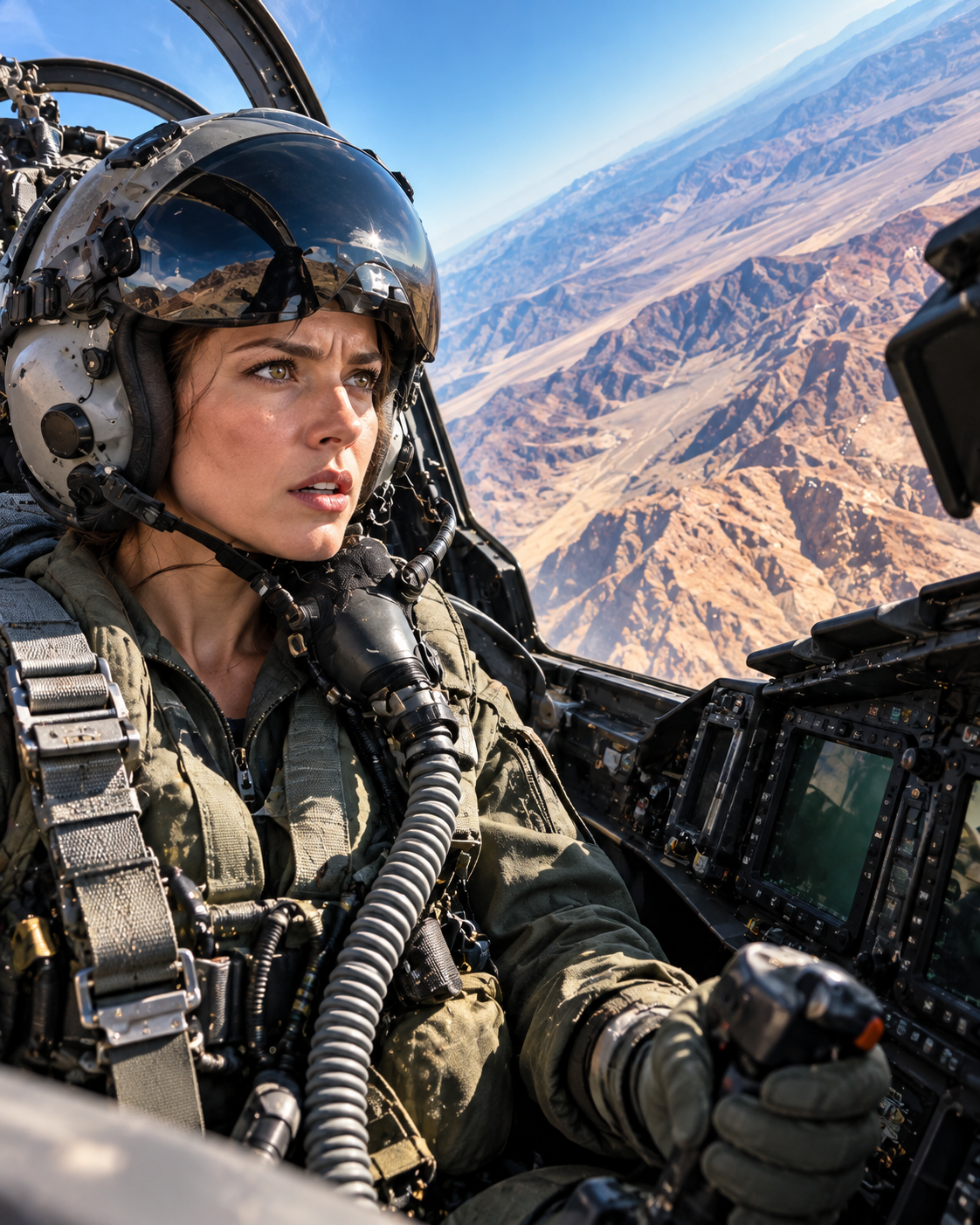
I looked across the desert, where the wreckage of my F-35 still smoked beside the cracked runway.
“No, Colonel,” I said. “They confused loyalty with trust.”
For the first time, his voice sharpened.
“Where is the module?”
I cut the transmission.
My hands were shaking.
Not because I was afraid of dying, though I was.
I was afraid that Pendelton had understood something about me that I had spent my career denying: I had always believed that following the rules and serving honorably would protect me from people who had abandoned both.
The military had given me purpose after my brother’s death.
It had taught me discipline when grief made the world feel shapeless.
And now I was learning that the uniform could be used to hide the very people who betrayed everything it represented.
I forced myself to focus.
The tower’s relay cabinet contained a small emergency battery and a connection diagram faded almost beyond recognition.
The Icarus module had a diagnostic interface.
The old terminal below could read its telemetry, but the encrypted transmission required a valid authentication key.
I searched the module’s exterior for a service label.
Nothing.
Then I remembered the maintenance report that had disappeared three weeks earlier.
I had managed to photograph one line before the file was erased.
A reference number.
Not a password, but an authorization record.
I took the small notebook from my flight suit and found the number written beside a sketch of the module.
The photograph had been incomplete, but the record number was enough to establish which archived maintenance file I needed.
I returned to the relay shed through the drainage channel, moving slowly while I listened for the search team.
The gunfire had stopped.
That frightened me more than the shooting.
Inside, the terminal still glowed faintly.
I connected the module and entered the record number.
A prompt appeared.
AUTHENTICATION REQUIRED.
Below it was a second line.
SECONDARY AUTHORIZATION: WINGMAN VERIFICATION.
I stared at the screen.
Leo.
I opened the radio channel again.
“Leo, I need you to listen carefully.”
“I’m here.”
“The module requires a second authorization. It’s tied to the aircraft’s mission record. Can you access your flight logs?”
“I can try.”
“Don’t access anything from the command terminal if Pendelton is watching.”
“I have a copy of my preflight data on a portable drive.”
“Where?”
“In my locker.”
“Can you get it?”
“I think so.”
A distant door slammed over the radio.
Then Leo whispered, “They’re moving me.”
“Don’t fight them. Stay alive.”
“Captain, there’s something else.”
“What?”
“The colonel told Kane that the satellite window isn’t just for sending data. He said once it closes, the whole system resets, and every trace of the override disappears.”
I glanced at the terminal.
The module’s diagnostic screen showed a countdown to the next scheduled synchronization.
Twenty-seven minutes.
If the window closed before I transmitted, the evidence might become almost impossible to authenticate.
“Then we have twenty-seven minutes,” I said.
“No,” Leo replied. “You have twenty-seven minutes. I’m coming to you.”
“Absolutely not.”
“You taught me that a wingman doesn’t abandon his lead.”
“This isn’t a training exercise.”
“I know.”
His voice trembled, but he continued.
“You also told me courage isn’t doing whatever you’re ordered to do. It’s knowing what matters enough to risk disobeying.”
I had no answer.
“Leo, if you come out here, Pendelton will come after your family.”
“He already threatened them.”
“And if you help me, he may never stop.”
“Then I’d rather give him something real to be afraid of.”
The channel went silent.
I looked down at the module.
For the first time since my aircraft had gone dark, I felt something other than fear.
Hope.
It was a dangerous thing, but it was also the only reason I could imagine surviving the next twenty minutes.
I began copying the diagnostic records to the terminal’s removable storage.
The screen filled with timestamps, system identifiers, and command signatures.
One entry stood out.
The override had been initiated using Pendelton’s authenticated command credentials.
Another record showed the installation of the black-market hardware, signed by Thomas Brooks.
A third entry listed a payment authorization linked to a private defense contractor.
The name was unfamiliar, but the transaction had been approved through a restricted procurement account.
This was bigger than one corrupt colonel.
I copied everything.
Then the terminal beeped.
REMOTE CONNECTION DETECTED.
The screen flickered.
A new message appeared.
UNAUTHORIZED ACCESS WILL RESULT IN DATA PURGE.
Pendelton had found me.
I yanked the module free, but the terminal began deleting the temporary files.
“No,” I whispered.
I reached for the removable storage.
The progress indicator had already passed halfway.
Outside, an engine roared.
Through the broken window, I saw one of the helicopters lifting from the mining station.
Kane had located the tower.
I shoved the storage device into my flight suit and disconnected the terminal’s communications cable.
The screen went black.
For one terrible moment, I thought I had lost everything.
Then a small green indicator on the removable storage device blinked.
The copied telemetry was still there.
I had the evidence, but I still lacked the authentication required to make it credible to the people who could stop Pendelton.
A shadow moved across the doorway.
I raised my pistol.
“Don’t shoot!”
Leo stepped into the shed with both hands raised, his face streaked with dust and sweat.
He carried a small portable drive.
For a moment, I simply stared at him.
He had disobeyed a direct order, crossed a restricted desert installation, and walked into a place where armed men were hunting us.
He looked terrified.
He also looked determined.
“You came,” I said.
“I said I would.”
I lowered my weapon.
He handed me the drive.
“I copied my flight telemetry before they confiscated my equipment. It records the moment your aircraft disappeared from the formation.”
“Does it show the command source?”
“Not directly. But it proves your systems failed before you made any emergency maneuver.”
I nodded.
“That’s enough to corroborate the module’s records.”
We connected the drive to the terminal.
The screen remained black for several seconds before the old equipment sputtered back to life.
The authentication prompt returned.
Leo entered his mission identifier and a verification sequence from his portable log.
A warning appeared.
SECONDARY AUTHORIZATION ACCEPTED.
Then another line followed.
EVIDENCE PACKAGE READY FOR TRANSMISSION.
Leo let out a breath that sounded almost like a sob.
“Are we going to make it?”
I looked at the countdown.
Nine minutes.
“We’re going to try.”
I initiated the transmission.
The terminal began sending the evidence through the old relay network toward a military communications gateway.
A progress bar crawled across the screen.
Ten percent.
Twenty.
Thirty.
Then the lights went out.
A gunshot cracked outside.
Leo dropped to the floor as a round punched through the wall.
“They’re here!” he shouted.
I pulled him behind the terminal and fired toward the doorway.
Kane’s team answered with a burst that shattered the remaining window.
The transmission bar froze at forty-two percent.
I looked at the dead screen.
“No, no, no.”
I slammed the terminal’s side panel open.
The relay battery had failed.
Without power, the transmission would never finish.
Leo crawled toward the back wall.
“There has to be another source.”
I remembered the tower’s emergency power cabinet.
It was outside, exposed, and probably watched.
I also remembered the abandoned mining station’s generator building.
If its old power line still connected to the tower, we might be able to restore the relay.
“We need the generator,” I said.
Leo looked at the doorway, where shadows moved behind the smoke.
“How far?”
“Far enough.”
He gave a short, frightened laugh.
“That’s not an answer.”
“It’s the only one I have.”
We slipped through the drainage channel as Kane’s men entered the shed.
The desert air hit us like the open door of an oven.
We ran low across the rocks toward the mining station, using the ruined structures for cover.
Behind us, Kane shouted orders.
A helicopter circled overhead, its searchlight sweeping across the ground.
Leo stumbled.
I caught his arm.
“Keep moving.”
“I’m trying.”
“I know.”
We reached the generator building and found its door chained shut.
I struck the rusted lock with the butt of my pistol until the metal gave way.
Inside, the air smelled of oil and dust.
The generator was old, but a handwritten maintenance tag indicated that the unit had been preserved for emergency use.
I checked the fuel gauge.
Nearly empty.
Leo searched the shelves and found a small reserve can.
Together, we filled the tank and worked the manual starter.
The engine coughed once, twice, then roared to life.
A row of ancient indicator lamps flickered.
Across the station, the communications tower blinked awake.
The transmission had resumed.
We stared at the portable receiver.
Fifty percent.
Sixty.
Outside, a vehicle engine approached.
Kane had anticipated the move.
“Go,” I told Leo. “Get to the service road and keep the drive safe.”
“I’m not leaving you.”
“That drive contains your evidence. If I go down, you still have something to prove.”
He shook his head.
“You don’t get to decide that I’m expendable.”
His words silenced me.
He was right.
For years, I had mistaken leadership for carrying every burden alone.
I had thought protecting people meant keeping them at a distance from danger, even when the truth was that distance left them powerless.
I looked at Leo and saw a young pilot who had every reason to run but had chosen to stay.
“Then we finish this together.”
We returned to the tower.
The receiver showed seventy-eight percent.
Kane’s men had surrounded the relay shed, but they hadn’t realized we were approaching from the opposite side.
We climbed the service platform and reached the communications cabinet.
Below us, Kane stepped into the open with his pistol raised.
“Captain Mercer!” he shouted. “The transmission is useless. Pendelton controls the receiving network.”
I looked at Leo.
His face had gone pale.
Kane smiled.
“Even if you get the data out, it’ll disappear before anyone can act on it.”
“Maybe,” I called back. “But then why are you so desperate to stop us?”
His expression hardened.
For the first time, he looked less like a professional soldier and more like a man who had realized his employer might abandon him.
The receiver beeped.
Ninety percent.
Kane raised his weapon.
I pushed Leo behind the cabinet as gunfire erupted.
The world became noise, metal, and splintering concrete.
I felt a sharp impact against my shoulder and fell against the railing.
Pain flared down my arm.
Leo grabbed the receiver before it could slide off the platform.
“Captain!”
“Keep it going!”
He turned back to the controls.
Ninety-five percent.
Kane climbed the lower ladder, one hand gripping the rail and the other holding his weapon.
I forced myself upright and aimed my pistol.
“Don’t do it,” I warned.
He kept climbing.
“You don’t understand,” he said. “Pendelton has people everywhere. He’ll bury this, and he’ll bury you with it.”
“Then he’ll have to bury the truth too.”
Kane paused.
For a moment, I saw uncertainty flicker across his face.
Then the receiver sounded.
TRANSMISSION COMPLETE.
The display changed.
EVIDENCE PACKAGE RECEIVED.
Below it appeared a confirmation identifier and the name of a secure military oversight office.
Leo stared at the screen.
“We did it.”
I wanted to believe him.
Then the radio crackled.
Pendelton’s voice filled the tower.
“Captain Mercer, the transmission has been received. You have no idea what you’ve just unleashed.”
I gripped the railing.
“I know exactly what I sent.”
“No,” he replied. “You sent evidence to people who have spent years protecting this program.”
My stomach tightened.
“What program?”
“The one that made Icarus possible.”
The channel went dead.
For several seconds, neither Leo nor I spoke.
We had exposed the attack, the hardware installation, and the command signatures.
But Pendelton’s final words suggested that the conspiracy reached beyond him, beyond Kane, perhaps beyond the entire command structure we had trusted.
A siren began wailing in the distance.
Then another.
Red lights flashed around the mining station as vehicles approached from the southern road.
Kane stopped climbing.
He looked at the receiver, then at me.
“Who did you send it to?”
I read the confirmation identifier again.
The recipient wasn’t the Pentagon’s general operations office.
It was an independent military inspector general’s secure evidence archive.
Someone had routed the transmission to an office designed to investigate misconduct within the armed forces.
For the first time that night, Kane lowered his weapon.
“They’ll come for everyone,” he murmured.
“That’s the idea.”
He stared at me as if he wanted to argue, but the words never came.
Then he climbed down and stepped away from the tower.
Leo watched him disappear into the darkness.
“Are we safe now?”
I looked at the lights approaching across the desert.
“I don’t know.”
It was the most honest answer I could give him.
The first vehicles arrived minutes later.
Armed personnel surrounded the station, but this time their uniforms bore recognizable military insignia.
An officer climbed the tower and ordered us to put our weapons down.
I obeyed.
My knees nearly gave way as the adrenaline drained from my body.
Leo caught me before I fell.
“I’m here,” he said.
For the first time since the cockpit had gone dark, I allowed myself to lean on someone else.
They took us to a secure medical facility before dawn.
Doctors treated my shoulder, stitched the cut on my forehead, and warned me that I had lost more blood than I realized.
Leo refused to leave the room.
He sat beside the bed with his flight jacket folded across his knees, staring at the floor.
When I finally woke after a brief, exhausted sleep, he was still there.
“Did they get the data?” I asked.
He looked up.
“The inspector general confirmed receipt. They’ve opened an investigation.”
“And Pendelton?”
“Relieved of command pending inquiry.”
I closed my eyes.
It wasn’t justice yet.
It was only the first crack in a wall that had stood for years.
Over the following weeks, investigators recovered the damaged aircraft, examined the Icarus module, and matched its records against Leo’s flight telemetry.
The evidence was difficult to deny.
Thomas Brooks eventually admitted that he had installed the unauthorized hardware under pressure from Pendelton, though investigators still had to determine the full extent of his involvement.
Financial records connected the procurement account to a private contractor that had received millions in classified funding.
Victor Kane and several members of his team were taken into custody after investigators established their role in the attempted recovery operation.
Pendelton denied ordering my death.
He claimed the remote override had been part of a legitimate security test that had malfunctioned.
But the telemetry showed the system had been activated while I was airborne, and communications recovered from the contractor’s equipment placed him in contact with Kane before the crash.
His defense began to crumble.
The investigation also uncovered evidence that the two previous pilot deaths had involved suspicious system failures linked to earlier versions of the same hardware.
Their families had been told that their loved ones had made fatal mistakes.
Now, for the first time, those families received answers that could be supported by evidence rather than official assurances.
I attended the memorial for both pilots.
Their names were engraved into a dark stone wall beneath the American flag.
I stood before the names for a long time, remembering how easily I might have become another line on that wall.
Leo stood beside me.
“Do you think it’ll change anything?” he asked.
I looked at the names.
“I think it has to.”
He nodded, but neither of us pretended that an investigation could undo what had happened.
A few months later, I returned to flight status after a long medical review.
The first time I walked into the hangar, the smell of aviation fuel brought back the moment my cockpit went black.
For a heartbeat, I was thirty thousand feet above the desert again, watching every display die while the ground rushed toward me.
Then I heard Leo behind me.
“Ready, Captain?”
I turned.
He wore the same nervous smile he’d worn before our first training sortie, but something in his expression had changed.
He no longer looked at me as if I had all the answers.
He looked at me as if he understood that leadership meant admitting when you didn’t.
“Ready enough,” I said.
We walked toward the aircraft together.
Pendelton’s trial was still months away, and the investigation into the contractor’s wider network remained open.
Some of the people named in the records had resigned.
Others had hired lawyers.
A few had disappeared behind sealed orders and classified hearings.
The system had begun to respond, but it had not yet revealed everything.
On the morning of our return flight, I found a plain envelope tucked beneath my locker door.
There was no return address.
Inside lay a single printed page containing a list of aircraft identification numbers.
Two belonged to the pilots who had died.
One belonged to my F-35.
The remaining numbers were unfamiliar.
At the bottom, someone had typed a short message.
ICARUS WAS NEVER THE ONLY SYSTEM.
I read it twice.
Then I checked the date printed in the corner.
The document had been generated three days earlier, after the module was recovered and the investigation began.
Someone still had access to information they shouldn’t have possessed.
Someone knew I had survived.
And someone wanted me to understand that the people we had exposed might only be the beginning.
Leo entered the locker room and found me standing motionless.
“What is it?”
I folded the page and slipped it into my pocket.
For a moment, I considered telling him everything immediately.
Then I remembered the terror in his voice when he had admitted that Pendelton was threatening his family.
I would not protect him by lying to him.
But I would not let fear make his decisions for him either.
“We have another problem,” I said.
He studied my face and nodded.
“Then we deal with it together.”
Outside, the Nevada sun climbed over the runway, bright and indifferent.
I looked toward the waiting aircraft and thought about the pilots whose deaths had been dismissed as mistakes, the mechanic who had compromised his oath, and the young wingman who had risked everything because he refused to let fear choose his future.
For years, I had believed courage meant climbing into a cockpit and trusting the people who stood behind me.
Now I understood that courage sometimes meant questioning the very people who demanded your loyalty.
The uniform mattered.
The mission mattered.
But neither mattered more than the lives entrusted to us, or the truth we were sworn to defend.
I placed the envelope inside my flight jacket and walked toward the runway with Leo at my side.
Somewhere beyond the desert, someone was watching.
And this time, I wasn’t going to mistake silence for safety.