At Nellis Air Force Base, Colonel Arthur Vance ordered military police to drag me out of a classified briefing
For one terrible second, nobody moved.
The message glowed above the briefing table, and the room’s ventilation system suddenly seemed louder than the fifty pilots breathing around me.
“Seal the room,” I ordered.
The nearest security officer hesitated, looking toward the door through which Arthur had disappeared.
I held up my black credential.
“Under executive authority, isolate the briefing network and preserve the transmission logs.”
That was enough.
The doors locked, the projector froze, and a communications specialist hurried toward the console while two security officers established a perimeter.
Lieutenant Eli Park, the youngest pilot in the front row, stared at the warning.
“What does Phase Two mean?”
“I don’t know yet.”
My answer made several people exchange uncomfortable looks.
They had just watched a supposedly dead pilot walk into their briefing, expose a decorated colonel, and take operational authority away from him.
Now they were being asked to trust someone who openly admitted she didn’t understand the message on her own screen.
I understood the hesitation.
A title wasn’t evidence, and a classified credential wasn’t a promise that the person holding it always told the truth.
“Listen carefully,” I said. “Nobody launches until we’ve independently verified the intelligence and determined whether this message represents an active threat.”
A major near the aisle raised his hand.
“Ma’am, Scarlet Anvil has an approved window. If we delay too long, we may lose the opportunity.”
“An approved window doesn’t make bad intelligence good.”
“Colonel Vance signed the plan.”
“And Colonel Vance’s credentials have just been revoked.”
I let that settle before continuing.
“If the operation is legitimate, we will execute a defensible plan. If it’s a trap, I will not send fifty pilots into it to protect somebody’s schedule.”
No one applauded.
No one needed to.
For the first time since I entered the room, the pilots began looking at the information instead of the person presenting it.
The communications specialist looked up from the console.
“The message was routed through a dormant mission-planning server, ma’am, but the original transmission predates today’s briefing.”
“How long?”
“Three months.”
He enlarged the access record.
“The message was configured to appear when a specific personnel file was opened using executive-level credentials.”
Mine.
The room became colder.
My credential hadn’t simply exposed Arthur’s false command record.
It had awakened something someone had deliberately left waiting.
“Can you identify the original sender?”
“Not from this terminal, ma’am.”
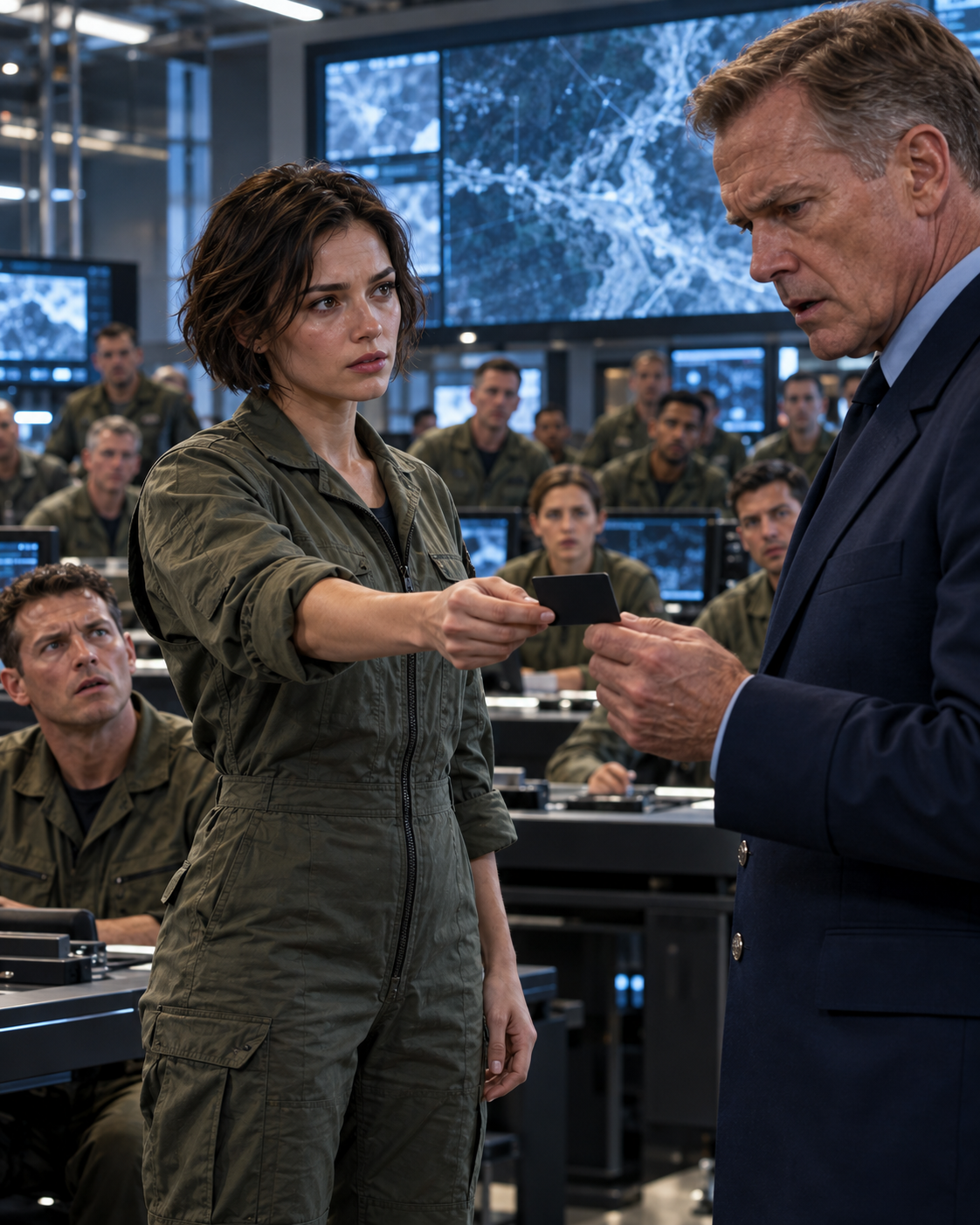
“Then preserve the logs and request the source records through the Directorate’s secure channel.”
The specialist nodded.
I walked toward the screen, feeling the memory of the mountains pressing close again.
Three months ago, I had still believed Operation Cobalt was a tragedy complicated by poor decisions, a falsified report, and one officer’s willingness to protect his career.
Now I wondered whether the report had been only one layer of a much larger operation.
The briefing room doors opened after the security team received confirmation from executive command.
Deputy Director Evelyn Shaw appeared on the secure video screen, her silver hair tied back, her expression as unreadable as ever.
She had been the first senior official to speak to me after the recovery team carried me out of the mountains.
She had offered me a choice then: return to an ordinary life under a new identity, or enter a program that would investigate the breach which had nearly killed me.
I chose the investigation.
For five years, that choice had cost me almost everything familiar.
“Captain Vance,” she said.
“Director.”
“I’ve received the alert. Explain the message.”
“We’re tracing its origin, but the authentication code appears to be connected to Operation Cobalt.”
Her eyes tightened.
“Do not assume the message is genuine simply because it uses an old code.”
“I don’t intend to.”
“And do not launch until your intelligence is verified.”
“That was already my order.”
For the first time, the slightest hint of approval crossed her face.
“Good. The Directorate has been reviewing a suspected compromise in the Scarlet Anvil planning process. The new warning strengthens that concern.”
“You knew the route could be compromised?”
“We had indications that some source material had been accessed without authorization, but we did not have enough evidence to suspend the operation outright.”
I felt anger rise, hot and familiar.
“So you allowed fifty pilots to assemble around a plan you couldn’t trust?”
“We received assurances that the inconsistencies were being corrected.”
“From whom?”
She paused.
“Colonel Vance’s command.”
I looked at Arthur’s empty chair.
Of course.
A system built on trust had allowed the man who falsified my death to certify the next mission.
“Director, I need full access to the unaltered intelligence package, including the original source records and every version of the flight assessment.”
“You will have it.”
“And I want an independent technical review before we make any operational commitment.”
“Approved.”
She leaned closer to her camera.
“Morgan, there is something else you should know. The original Cobalt investigation never established who changed the final flight plan.”
My mouth went dry.
“I thought Arthur was the source.”
“He falsified his report after the incident, and the evidence supports disciplinary action against him. But the earlier breach may have originated higher in the chain of command.”
The room seemed to narrow around me.
“Then he wasn’t the only person who knew what happened.”
“We have never been able to prove that he was.”
The call ended soon afterward, but her last sentence stayed in my mind.
I had spent five years chasing the person who left me behind.
Perhaps I had been so focused on Arthur that I had mistaken the most visible betrayal for the entire truth.
The technical review began immediately.
Two intelligence analysts who had not contributed to the original planning package examined the route data, while a separate security team compared its source material against independently held records.
The results were worse than I expected.
Parts of the threat assessment had been updated, but the route itself relied on a map layer that had not incorporated the newer information.
The discrepancy should have been caught before approval.
An earlier version of the plan showed the same risk clearly enough that even a non-specialist would have questioned why the final assessment omitted it.
The intelligence package also included an unexplained change in the stated purpose of the mission.
The original request emphasized locating and confirming a suspected communications relay.
The final briefing described the primary objective as a direct strike against a separate facility, using the canyon route Arthur had presented.
There was no signed amendment from the authority responsible for changing that objective.
“Who made the change?” I asked.
The analyst checked the audit record.
“Colonel Vance’s credentials were used to submit the revision.”
“Were they physically used at his workstation?”
“We can’t establish that yet. The access record confirms the credentials, not the person.”
I nodded.
That distinction mattered.
Arthur was accountable for the access assigned to him, but I would not accuse him of personally making every change until the evidence established it.
The analyst turned to another screen.
“There’s a second issue. The original relay-search request was attached to a restricted incident file that contains references to Operation Cobalt.”
“Can you open it?”
“Not from this network. It’s held in a separate evidence archive.”
I felt the old ache beneath my ribs.
“What kind of evidence?”
“We don’t know yet, but the archive’s index refers to flight telemetry and an unresolved emergency transmission.”
For years, I had carried a single memory of Cobalt: my aircraft shuddering as the warning tones rose, Arthur’s voice breaking across the radio, and the sudden silence after he told me he couldn’t return.
I had tried to reconstruct every moment, asking myself whether I had misheard him or misunderstood the danger.
Now there was a possibility that the official record wasn’t merely incomplete.
It had been deliberately separated from the information that could explain it.
I turned back to the pilots.
“Before anyone flies, I want you to know what we have established and what we haven’t.”
I summarized the intelligence discrepancies, the unresolved warning, and the need to verify the mission’s purpose.
I did not ask them to trust a classified story about my survival.
I asked them to examine the evidence.
Park studied the independent threat analysis.
“If the route is compromised, why was the objective changed?”
“We don’t know yet.”
“And if the warning is designed to frighten us away from the mission?”
“Then we verify that too.”
He looked around the room.
“Are we still going?”
“If the evidence supports a legitimate mission and the risks can be responsibly managed, yes. If it doesn’t, we stop.”
A veteran pilot seated beside him nodded slowly.
“That’s more than we got from Colonel Vance.”
It wasn’t praise so much as relief.
I knew how dangerous it was to promise certainty in circumstances where certainty didn’t exist.
Arthur had built his authority by speaking as if doubt were weakness.
I would not build mine the same way.
The review took another forty minutes.
The independent analysts confirmed that the original intelligence had been altered in ways that made the canyon route appear more acceptable than it was.
They also found indications that the change in mission objectives had been timed to conceal the importance of the communications relay.
At that point, we could justify suspending the original strike plan and requesting a revised authorization.
We could not yet prove that Scarlet Anvil had been designed to kill its own pilots.
That remained a possibility, not a finding.
But we did know the existing plan was unsafe and the source data was compromised.
I submitted a formal request for a revised mission focused on identifying the relay, preserving any relevant evidence, and preventing further exposure of the compromised information.
Director Shaw approved the change after an independent review.
The operation would proceed only under the revised plan, with explicit conditions for aborting if the intelligence failed to match what the pilots observed.
No objective was worth pretending the danger had disappeared.
When the briefing resumed, I stood in front of the same screen Arthur had used to show his route.
The black bracelet was gone with him, but I could still picture the engraved numbers.
884911KIA001.
A number had become a memorial, then a symbol of another man’s honor, and finally the evidence that the dead pilot was standing in front of him.
“I know some of you may be wondering whether the story I’ve told you is true,” I began.
“You are entitled to ask.”
A dozen faces lifted toward me.
“Five years ago, I survived an ejection and reached the extraction team with severe injuries. The Executive Directorate concealed my survival while it investigated the breach that endangered my flight.”
I let myself breathe before continuing.
“I cannot share every detail of that investigation, but the records relating to this mission will be made available through the appropriate secure channels.”
Park raised his hand again.
“Why didn’t you return to the Air Force sooner?”
The question struck closer than he knew.
“Because the people who controlled the evidence were still trying to determine who had compromised it, and revealing that I was alive could have destroyed the investigation.”
“That meant your family believed you were dead?”
I looked at him.
“Yes.”
Nobody moved.
There were parts of those five years I had never learned to speak about without feeling the old guilt.
My mother had died believing her daughter was buried somewhere beneath a foreign mountain.
My younger brother had stopped leaving messages after the first year because he couldn’t bear hearing his own voice ask for an answer that would never come.
I had attended none of their birthdays, weddings, or funerals.
The Directorate had told me the secrecy was necessary.
Sometimes it had been necessary.
That did not make the loss less real.
“I can’t give those years back to the people who loved me,” I said. “But I can make sure I don’t ask any of you to accept a preventable risk because a superior officer is afraid of being questioned.”
The room was silent for a different reason now.
Not everyone trusted me completely.
Trust was not something a screen could grant, and it was certainly not something a rank could demand.
But they began checking their equipment, confirming their roles, and preparing for the revised mission.
That was enough to begin.
I was assigned to lead the flight, with Park among the pilots under my command.
The Directorate had kept my flight qualifications current through classified evaluation work, though most of my recent assignments had involved testing systems and assessing compromised mission data rather than public combat operations.
I knew how to fly.
What I had not known until that day was whether I could do so again with the memory of Cobalt sitting in my chest like a second heart.
As I walked toward the hangar, a security officer approached with a sealed evidence bag.
Inside lay the black bracelet taken from Arthur during processing.
The engraved number shone through the transparent plastic.
“It’s part of the preliminary evidence inventory,” the officer said. “Investigators thought you should know it had been secured.”
I stared at it.
“Was it issued to him after the memorial?”
“Yes, ma’am. The record indicates it was presented as a remembrance of the missing pilot.”
I felt sick.
Arthur had worn it publicly while accepting honors for the mission that had made him famous.
He had turned my disappearance into a permanent prop in his story, allowing people to praise him for remembering a teammate while hiding the choices that had left that teammate to die.
“Keep it sealed,” I said.
The officer nodded.
I didn’t want it back.
A memorial should honor the person who was lost, not allow someone else to borrow their sacrifice.
At the hangar, the aircraft waited beneath harsh white lights.
The pilots were quieter now, checking their equipment and listening to the revised orders through their headsets.
Park approached me while the ground crew completed final checks.
“Ma’am, can I ask you something personal?”
“Go ahead.”
“When you were out there, after the ejection, did you really think you were going to make it?”
I looked at the aircraft’s dark canopy.
“No.”
He waited.
“I kept moving because stopping meant accepting that nobody was coming. I didn’t have enough strength to believe I would survive the next hour, let alone the next day.”
“What changed?”
“I found one more reason to move. Then another.”
Park nodded slowly.
“My father says courage is being certain you’re right.”
“Your father is wrong.”
The words escaped before I could soften them.
I saw his surprise and gave him a small, tired smile.
“Courage is admitting you might be wrong and checking anyway, especially when other people could pay for your mistake.”
He considered that, then climbed toward his aircraft.
When I took my place in the lead jet, the cockpit felt both unfamiliar and painfully familiar.
The switches, the display, and the hum of the systems brought back memories of a younger version of myself who believed skill and preparation could protect her from betrayal.
I fastened my harness and listened to the team complete its checks.
No one promised the operation would be easy.
No one claimed the threat had been eliminated.
For the first time in years, we were beginning a mission with a plan that openly acknowledged what we still didn’t know.
We launched after the authorization arrived.
As the formation climbed, the ground shrank beneath us until the base became a patch of concrete and lights surrounded by the desert.
My breathing settled.
There was a strange peace in the familiar rhythm of flight, but I did not mistake familiarity for safety.
The mission depended on verified information, disciplined judgment, and the willingness to change course if the situation differed from the assessment.
We were not going to chase certainty into a trap simply because the schedule said we should.
The first stage proceeded without incident.
Then Park’s voice came across the communications channel.
“Wraith, I have an unexpected return that doesn’t match the current assessment.”
My fingers tightened around the controls.
“Confirm what you’re seeing, and compare it with the independent picture.”
A moment passed.
“The source appears inconsistent.”
“Then don’t treat it as a confirmed threat or a confirmed target. Keep observing and report any change.”
The old Cobalt telemetry had contained an intermittent signal that the original investigators had never been able to explain.
The new return carried a similar irregular pattern.
It was not enough to prove a connection, but it was too important to ignore.
I requested a comparison against the mission’s independent records.
The response arrived within minutes.
The return did not match the expected profile of the facility we had been sent to examine.
Instead, it was consistent with a separate relay source that had not been included in the final objective description.
Someone had placed the wrong destination at the center of the mission.
I immediately ordered the formation to hold its planned safety boundaries while command reviewed the revised information.
Then I transmitted the discrepancy to the independent operations cell.
“We have a material mismatch between the approved target description and the observed source. Request authorization to suspend the proposed strike and continue identification only.”
The answer came back after a tense delay.
“Suspension approved. Continue only within the revised mission limits.”
It was not a dramatic order.
It did not sound like victory.
It was the decision that kept a questionable assumption from becoming an irreversible mistake.
We continued gathering information from a safe position while the independent analysts compared the new observations against the original records.
The unexpected source was linked to the communications relay mentioned in the Cobalt archive.
The relay’s activity had increased around the time our formation entered the area, but we could not establish its purpose from that behavior alone.
Then a faint signal appeared on a protected frequency.
It carried a fragment of the old emergency code associated with my missing aircraft.
For a moment, the cockpit disappeared around me.
I was back in the frozen mountains, hearing Arthur’s voice dissolve into static while the warning tones screamed through my headset.
Park called my name.
“Wraith, are you still with us?”
“Yes.”
My voice sounded steadier than I felt.
“Record that transmission through the approved channel and send it to the evidence team. Nobody follows an unverified signal.”
I would not let five years of grief make a decision for me.
The signal could be genuine, fabricated, or deliberately replayed to draw us toward the relay.
The only responsible path was to preserve it, verify it, and refuse to treat its emotional meaning as evidence of its technical origin.
The ground team confirmed that the relay was carrying data associated with an older mission archive.
They could not tell us precisely what the archive contained, but the reference matched the missing Cobalt telemetry.
We finally understood why the target description had been changed.
The proposed strike would have destroyed the very site that might contain evidence explaining how our original mission had been compromised.
Whether the change had been made to protect the archive, erase it, or hide its existence remained unproven.
But there was no justification for attacking a facility whose identity and purpose had not been properly established.
I requested a further suspension of the strike objective and a formal evidence-preservation operation.
This time, approval came quickly.
The formation maintained observation while the command team arranged for specialists to secure the records through a separate process.
No one had to invent a threat to justify protecting the evidence.
The discrepancy itself was enough.
As we prepared to return, a warning came from one of the aircraft in the formation.
Park’s flight systems had registered a fault that required him to follow the approved recovery procedure.
His voice was controlled, but I could hear the strain underneath it.
“Wraith, I’m seeing a persistent warning. I can maintain control, but I need to break from the planned return sequence.”
“Understood. Follow your emergency checklist and report your status. We’ll coordinate the necessary support.”
The memory of Operation Cobalt rose again, sharp enough to make my hands ache.
Five years earlier, I had been the pilot asking for help.
Arthur had heard me.
He had assessed the risk to himself and chosen to leave.
Now another pilot was reporting a problem, and I had a choice between treating the situation as an inconvenience or making sure the entire team followed the safety plan.
“Operations, this is Wraith. We have an aircraft requiring priority recovery support. Confirm available assistance and update the formation’s return authorization.”
The response was immediate.
Park followed the prescribed procedure, support was coordinated, and the remaining aircraft adjusted their return under the revised instructions.
The situation was serious, but no one panicked.
No one was told to hide the warning to protect a schedule.
No one was ordered to pretend the aircraft was fine.
We returned to base with the entire formation accounted for.
When my wheels touched the runway, I felt no triumph.
Only relief so profound that I had to sit still for a moment before climbing out.
Park was already on the ground when I reached the hangar.
He removed his helmet and looked at me with tired eyes.
“You changed the plan twice,” he said.
“The information changed twice.”
“Colonel Vance would have called that weakness.”
“Colonel Vance is under investigation.”
Park gave a brief laugh.
“Fair point, ma’am.”
Then his expression grew serious.
“I’m glad you were there.”
I shook his hand.
“So am I.”
The mission had not ended with a spectacular strike or a dramatic victory over an enemy formation.
It had ended with a compromised target identified, important evidence preserved, and fifty aviators brought back without anyone being asked to accept an unverified risk.
For me, that was success.
The evidence team’s work continued through the night.
Records recovered from the relay were compared against the original Cobalt material, with digital copies preserved under documented custody procedures.
The early findings confirmed that the final Cobalt mission package had been altered before launch and that the change had not been properly authorized.
They also showed that Arthur’s after-action report omitted a communication in which I requested assistance after my aircraft was damaged.
The missing transmission undermined his claim that my aircraft had disappeared before a recovery could be attempted.
It did not, by itself, explain who had changed the flight plan or why.
But it proved that the story used to justify his medal had not been complete.
When the investigators interviewed Arthur, he initially denied knowing about the altered information.
He claimed his decisions during Cobalt had been made under intense pressure and that he had believed returning for me would have endangered the remaining aircraft.
The new records contradicted parts of his statement.
Eventually, he requested a private meeting with me under the supervision of the investigative team.
I agreed, not because I expected an apology to heal anything, but because I wanted to hear what he would say when he could no longer rely on a room full of admirers.
He sat across from me in a plain interview room, his uniform stripped of the command insignia that had once made people straighten whenever he entered.
Without the decorations, he looked older.
For a long time, he studied his hands.
“Do you remember what you told me before Cobalt?” he asked.
I did.
I had tapped the black bracelet he later wore and told him that no medal mattered if we couldn’t bring the whole team home.
I had given him the bracelet before the operation, a small keepsake engraved with my pilot identification number, because he joked that he never remembered anyone’s paperwork.
It had been a private joke between wingmen.
He had turned it into a public memorial.
“I remember,” I said.
Arthur swallowed.
“When the mission went wrong, I was afraid.”
“So was I.”
“You don’t understand how quickly everything happened.”
“I understand that you heard me call for help.”
He looked up.
“I did.”
The admission hung between us.
“Why didn’t you come back?”
His eyes filled, but I could not tell whether it was shame or fear.
“I thought the rest of the flight would be lost if I turned around. I thought I could report what happened and let recovery handle it.”
“You reported that recovery was impossible.”
“I believed you were gone.”
“You didn’t know that.”
He pressed his hands against the table.
“No. I didn’t.”
The confession was smaller than I had imagined it would be.
Five years of investigation, secrecy, anger, and nightmares had led me to a man who had once been my trusted wingman, and all he could offer was the truth he should have told from the beginning.
“I could have admitted I made the wrong decision,” he said. “Instead, I wrote a report that made the decision look necessary. When the medal came, I told myself that meant the people reviewing it had agreed with me.”
“And the bracelet?”
He looked at the evidence photograph lying between us.
“People asked why I wore it. They said it showed I never forgot you.”
A long silence followed.
“I let them believe that.”
I could see the years of public praise in his expression, the way the story had become a shelter he no longer knew how to leave.
“You didn’t just abandon me in the mountains,” I said. “You made my death part of your reputation.”
Arthur closed his eyes.
“I know.”
“No, you know the words. I don’t think you understand the years.”
I told him about the family who had buried an empty grave in their hearts, about my brother’s unanswered messages, and about the birthdays I had missed because my survival was classified.
I told him that I had spent years wondering whether I had failed him, whether I had asked for help at the wrong moment, whether there had been anything I could have done differently.
He cried quietly, but I didn’t reach for him.
“I am sorry, Morgan.”
I believed he regretted what he had done.
I also knew regret could not restore a life that had already been lived.
“I don’t need you to make yourself suffer,” I said. “I need you to tell the investigators the truth, even when it destroys the version of yourself you’ve spent years defending.”
He nodded.
“I will.”
The investigation continued for months.
Arthur faced a formal review of his actions during Cobalt, the discrepancies in his report, and his role in approving the compromised Scarlet Anvil plan.
Other officials were investigated for their part in the mishandled intelligence and the failure to preserve essential records.
The evidence did not support every rumor that circulated after the briefing, and the investigators made that distinction clear.
Some questions remained unresolved, but the findings were no longer dependent on Arthur’s account alone.
His decorations did not protect him from the review, and his former command could no longer direct the evidence concerning him.
I gave my testimony, answered every question I could, and corrected errors when the official summaries oversimplified what had happened.
I did not ask the panel to punish Arthur because I hated him.
I asked them to judge what he had done, what he had reported, and what the records could prove.
There was a difference between accountability and revenge, and I had spent too long living inside the consequences of someone else’s refusal to recognize it.
In time, my personnel status was reviewed and my record corrected through the appropriate classified channels.
The designation KILLED IN ACTION no longer defined the whole of my service.
My survival was formally acknowledged to the people who needed to know, and my family was finally given the truth that had been withheld from them for years.
The reunion with my mother would never happen.
Neither would the conversation I had imagined having with my brother when he was still young enough to believe I might walk through the door.
I learned that grief did not disappear just because a secret ended.
Sometimes truth arrived late enough to become another kind of loss.
On the first evening I was permitted to visit my family without the restrictions that had shaped the previous five years, I stood outside my mother’s house for nearly ten minutes before knocking.
My brother opened the door.
For a moment, neither of us spoke.
He looked older than the last photograph I had seen, his face carrying the quiet weariness of someone who had spent years learning to live around an absence.
Then he stepped forward and held me so tightly that I could barely breathe.
“You’re real,” he whispered.
I closed my eyes.
“I’m here.”
He cried against my shoulder, and I cried with him, not because the pain had ended, but because neither of us had to pretend the other was gone anymore.
Later, we sat at the kitchen table while my mother’s untouched place remained empty in the room.
My brother placed an old photograph between us.
It showed the two of us standing beside a family car, my flight-school acceptance letter held triumphantly above my head.
“You were always going to be a pilot,” he said.
“I was always going to come home.”
He lowered his gaze.
“You did come home.”
I reached across the table and took his hand.
“Not soon enough.”
There was no answer that could make the years return.
We sat together until the light outside faded, learning that reunion could be both a beginning and a mourning.
When I returned to Nellis, the briefing room had been rearranged.
Arthur’s name was gone from the command board, and the route from Scarlet Anvil had been archived with the independent review findings.
The black bracelet remained in evidence storage, its number no longer serving as a prop in anyone’s speech.
Park was among the pilots preparing for a new training cycle.
He had written a note about the mission’s revised review process, recommending that the training program include a stronger emphasis on questioning contradictory intelligence and documenting concerns without fear of reprisal.
I read it and approved the recommendation.
Then I walked to the window overlooking the flight line.
The aircraft waited beneath the desert sun, each one carrying a pilot whose family expected them to return.
I thought about the day Arthur had stood at the front of the room and called sacrifice the price of command.
He had been right about one thing: difficult missions demanded difficult decisions.
But sacrifice was not a word a commander could use to excuse the harm he chose to impose on someone else.
Leadership was not measured by how confidently a person sent others into danger.
It was measured by whether that person accepted responsibility when the evidence showed the plan was wrong.
I would never be able to recover the years I had lost, and I would never know every reason Arthur had chosen to abandon me.
I no longer needed to invent an explanation that made the betrayal easier to bear.
The truth was enough: fear had shaped his decision, ambition had shaped his lie, and the people around him had allowed his reputation to stand where evidence should have been.
The lesson wasn’t that trust was foolish or that every superior officer should be treated as an enemy.
It was that trust had to leave room for questions, and loyalty could never require a person to deny what they could see with their own eyes.
A good pilot listened when a warning sounded.
A good commander listened when a subordinate raised a concern.
And a good team made it possible for the frightened person in the room to speak before a preventable mistake became a funeral.
I kept flying, though I stopped believing that survival was something one person could guarantee another.
We could prepare, verify, communicate, and take responsibility for our choices.
We could also refuse to abandon someone merely because turning back would cost us something.
That was what I wanted my callsign to mean now.
Wraith had once been the name attached to a dead pilot, a classified file, and a memory other people used to tell a convenient story.
I would not let it remain that way.
One evening, after the last briefing had ended, Park stopped beside me at the door.
“Captain, do you think you’ll ever stop thinking about Cobalt?”
I looked through the glass at the runway lights coming on against the dusk.
“No,” I said honestly. “But I don’t think about it the same way anymore.”
He waited.
“I used to think surviving meant proving I was strong enough to come back from the mountain. Now I think it means deciding what kind of person I’m going to be after I get home.”
Park nodded, then headed toward the flight line.
I remained by the door until the room was quiet.
Five years earlier, I had sent a final distress call into a sky that offered no answer, believing the person I trusted most had decided my life was expendable.
Now, when I looked at the pilots preparing to fly, I understood that the most important part of my return wasn’t the credential that restored my name or the authority that removed Arthur’s command.
It was the promise I made to the people in that room: that no one would be asked to mistake silence for consent, obedience for courage, or a decorated lie for the truth.
The mountains had taken five years from me, but they had not taken that choice.
And the next time a frightened voice called for help, I intended to be the person who turned back.