At Naval Air Station Lemoore, with an entire ready room watching, Lieutenant Commander Marcus Vane
Part 2
Fallon was different from Lemoore.
The desert seemed to stretch forever, and the mountains stood around the airfield like silent witnesses.
Nobody cared that I was quiet.
Nobody cared that I was small.
Nobody cared that Brian Miller once thought I had librarian energy.
At Fallon, the only thing that mattered was whether you could perform when the pressure arrived.
The advanced air combat detachment was brutal.
Every sortie exposed something.
A weakness in timing.
A flaw in geometry.
A tendency to turn too early.
A hesitation that lasted half a second too long.
The instructors noticed everything.
They were not cruel.
That almost made them worse.
They were precise.
They didn’t care about excuses because physics didn’t care about excuses either.
My first few days went well.
I was confident.
Maybe too confident.
Then came the defensive exercise.
Two aircraft against me.
One defensive setup.
One chance to survive the engagement.
I had studied scenarios like this for months.
I knew the geometry.
I knew the threat.
I knew what I was supposed to do.
But knowing the answer wasn’t the same as executing it.
The engagement began.
Everything happened faster than expected.
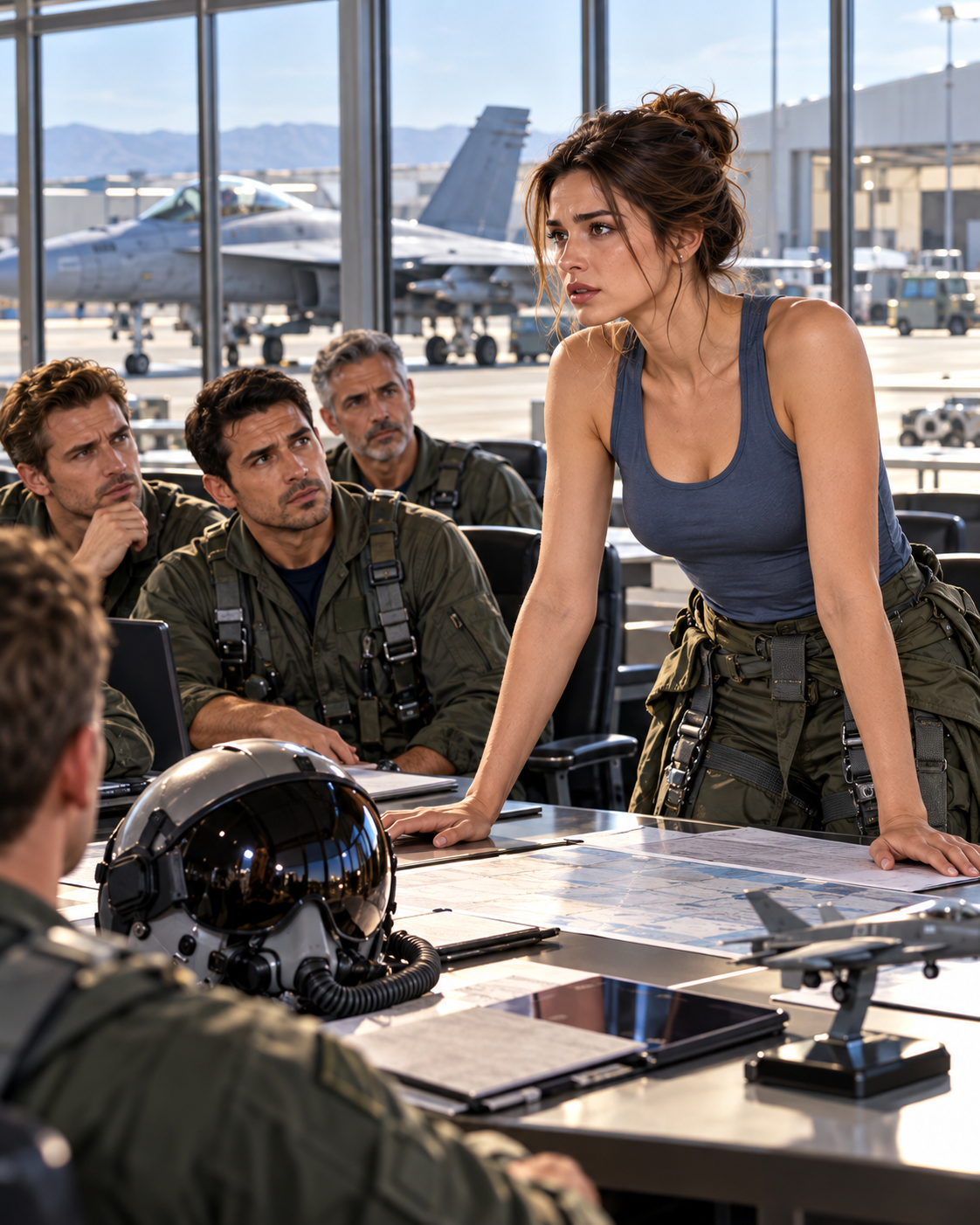
I made a decision.
Then, half a second later, I realized it was wrong.
That tiny mistake changed everything.
The geometry collapsed.
The opposing fighter gained the angle.
I tried to recover.
Too late.
The simulated gunfire came across my aircraft.
“Guns, guns, guns,” the instructor called.
I had been defeated.
Cleanly.
Publicly.
The cockpit went quiet.
When I returned to the debrief room, the instructor projected my gun-camera tape onto the screen.
My mistake appeared on the wall.
Frame by frame.
Again.
And again.
And again.
The instructor froze the video.
“There.”
He pointed.
“This is where you lost the fight.”
I stared at the screen.
A tiny movement.
A decision I had made without realizing how much it would cost.
The instructor looked at me.
“Why did you do that?”
I could have blamed the setup.
I could have blamed the timing.
I could have said I had expected something different.
Instead, I said, “I don’t know yet.”
He nodded.
“Then figure it out.”
The debrief ended.
Everyone left.
I stayed.
That night, I watched the tape eleven times.
Not once.
Not twice.
Eleven times.
The first few made me angry.
Then embarrassed.
Then confused.
By the seventh viewing, I stopped watching myself as the pilot who had failed.
I started watching the aircraft.
The angles.
The closure rate.
The distance.
The choices.
By the eleventh, I finally saw what I had missed.
My mistake hadn’t happened because I didn’t know the geometry.
It happened because I had become attached to the geometry I expected.
I was trying to force the fight into a shape that no longer existed.
That realization hurt.
Because it meant my failure wasn’t bad luck.
It was mine.
The next morning, I walked into the instructor’s office.
He looked up.
“You again?”
“Yes, sir.”
“What do you want?”
“Another frame-by-frame review.”
He leaned back.
“You’ve already had one.”
“I know.”
“And you still want another?”
“Yes, sir.”
He studied me.
Then he pointed toward the chair.
“Sit down.”
We went through the tape again.
This time, I asked questions.
Hard questions.
Questions that made me uncomfortable.
Questions about why I had chosen one line instead of another.
Why I had trusted one cue over another.
Why I had reacted instead of anticipating.
The instructor didn’t soften anything.
Neither did I.
When we finished, he said, “Now you know what happened.”
I nodded.
“Now fix it.”
Four days later, I flew the exact same scenario.
Same defensive setup.
Same kind of pressure.
Same basic geometry.
But this time, I didn’t fight the situation I wanted.
I fought the situation that existed.
The first threat moved.
I adjusted.
The second closed.
I changed the angle.
For one brief moment, the entire fight became quiet inside my head.
There was no fear.
No embarrassment.
No need to prove anything.
Only information.
I made the correct decision.
Then another.
Then another.
The engagement ended differently.
This time, I was the one who had the shot.
The instructor called it.
“Kill.”
I landed with my heart pounding.
Not because I had won.
Because I had finally understood something I had been too proud to admit.
Talent could get you into the fight.
Preparation could keep you alive.
But humility was what allowed you to learn from losing.
That night, I went back to the barracks and sat on the edge of my bed.
I thought about Brian.
I wondered whether he would have laughed if he had seen the first tape.
Then I realized I didn’t care anymore.
I wasn’t flying to silence Brian Miller.
I was flying to become someone I could trust.
And that distinction changed everything.
Part 3
The final evaluations arrived faster than I expected.
By then, the instructors knew my strengths.
They also knew exactly where I was vulnerable.
The last exercise was designed to test both.
It was complicated.
Fast.
Unforgiving.
There were moments when the situation seemed to turn against me.
But I had learned not to panic when the plan disappeared.
I adapted.
I listened.
I watched.
I trusted the aircraft.
I trusted my preparation.
And when the opportunity came, I took it.
The fight ended cleanly.
Flawlessly.
When the final debrief began, the lead instructor said almost nothing at first.
He simply played the tape.
The room watched in silence.
Then he rewound it.
He played one section again.
Then another.
Finally, he stopped the video.
“This,” he said, “is what we want pilots to understand.”
He looked around the room.
“She didn’t win because the setup was easy.”
He looked at me.
“She won because she learned from the moment she lost.”
Then he told me something I didn’t expect.
They were archiving my gun-camera tape as a masterclass example for future students.
I didn’t know what to say.
The tape that had embarrassed me four days earlier would now be used to teach other pilots how to solve the same problem.
I thought about that for a long time.
A failure had become a lesson.
The lesson had become a tool.
And the thing I had wanted most in those early months at Lemoore had quietly changed.
I no longer needed anyone to believe in me.
I had learned to believe in the work.
When I returned to Lemoore, everything felt strangely familiar.
The same hangars.
The same ready room.
The same tables where people had once laughed.
Brian saw me first.
He walked over.
For a moment, neither of us spoke.
Then he smiled.
“Hey, librarian.”
I laughed.
“Hey, Brian.”
He shook his head.
“I owe you an apology.”
“You don’t owe me anything.”
“I do.”
He looked down for a second.
“I thought quiet meant weak.”
I didn’t answer immediately.
Because once, I would have wanted him to understand how much those words had hurt.
But I didn’t need that anymore.
I simply said, “A lot of people make that mistake.”
Marcus Vane approached a few minutes later.
He stopped beside us.
“Bennett.”
“Sir.”
He gave me a small nod.
“I heard Fallon went well.”
“Yes, sir.”
He looked at Brian, then back at me.
“I was wrong about you.”
Those words meant more than I expected.
Not because Marcus had once doubted me.
Because admitting it meant he had learned something too.
I thanked him.
Then I walked outside.
The evening sun was dropping behind the hangars.
For a moment, the light turned the aircraft into silhouettes.
I stood there listening to the wind.
And suddenly I was fourteen again, standing beside my father’s crop duster in Idaho.
I could almost hear him telling me to listen.
That was when I finally understood what he had been trying to teach me all those years ago.
The sky doesn’t care how loud you are.
It doesn’t care how impressive you look.
It doesn’t care whether anyone believes you belong there.
It only responds to what you actually know, what you actually do, and how well you adapt when everything changes.
For years, I thought strength meant proving people wrong.
Fallon taught me something better.
Strength is being willing to look directly at the moment you failed and study it until it has nothing left to teach you.
Sometimes the most important victories happen where nobody is watching.
At four in the morning.
Inside a dark simulator.
In a library filled with old mishap reports.
Alone beside a jet after a bad sensor nearly fooled you.
Or sitting in front of a recording of your own worst mistake, watching it for the eleventh time because you refuse to let it become meaningless.
I never became the loudest pilot in the squadron.
I never needed to.
I learned that competence doesn’t announce itself.
It accumulates.
Quietly.
Hour after hour.
Mistake after mistake.
Until one day, when the moment finally comes, you don’t have to tell anyone you’re ready.
You simply are.
And whenever someone now mistakes silence for weakness, I remember the Idaho sky, my father’s old crop duster, and the lesson that followed me all the way into a fighter cockpit.
The strongest people I know were rarely the ones making the most noise.
They were the ones doing the work when nobody was looking.