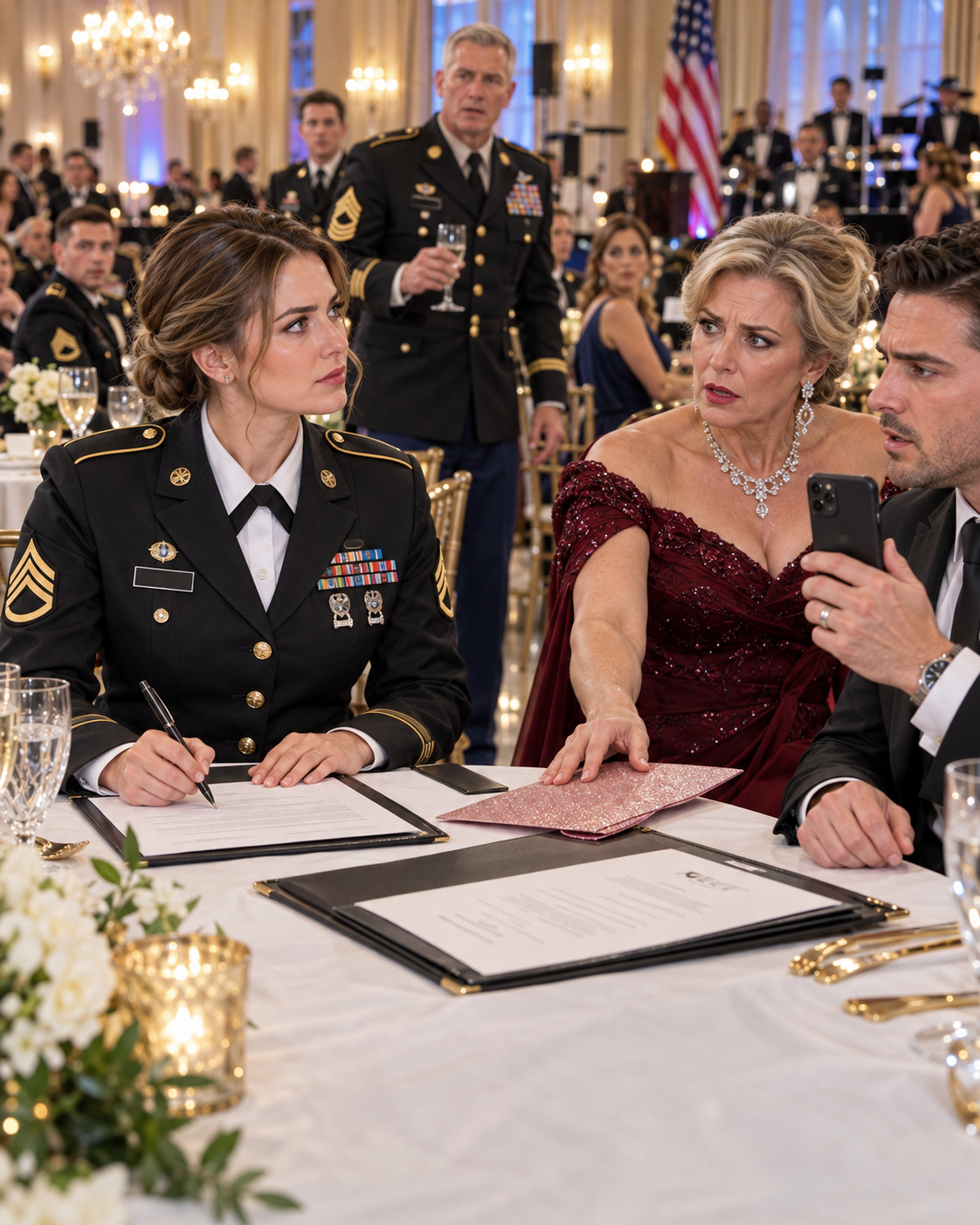
At my thirty-first birthday ball in downtown Dallas, my wealthy mother-in-law slid divorce papers across the white tablecloth
I read the message three times before the elevator reached the lobby.
My first instinct was to dismiss it as another cruel attempt to ruin my birthday, but something about the wording made my stomach tighten.
My husband had spent years pretending my military career was an embarrassing hobby, yet someone was claiming he had tried to sell information about it.
I stepped outside the hotel, where Dallas traffic hissed across the wet pavement, and called First Sergeant Michael Carter.
He answered on the second ring.
“Tell me you’re not calling to ask whether you should go back upstairs.”
“I’m not.”
“Good. Because if I have to come down there and drag you away from that family myself, I’m going to make a scene.”
Despite everything, I laughed.
Then I read him the message.
His amusement vanished.
“Don’t reply. Save the message and take screenshots. I’ll help you figure out who sent it, but you need to be careful about what you assume.”
“I know.”
“And Clara?”
“Yes?”
“Your new job offer is legitimate. I personally recommended you after the company contacted our transition program. Don’t let anyone convince you that you haven’t earned it.”
His words settled over me more warmly than my coat.
For seven years, I had measured my worth by how much I could carry without asking for help.
Perhaps that was why I had stayed with David so long.
I had mistaken endurance for love.
That night, I checked into a small hotel near the interstate rather than returning to the house we shared in Highland Park.
My phone lit up repeatedly.
David called twelve times.
Margaret sent a series of messages accusing me of embarrassing the family, disrespecting her son, and turning a private marital matter into a public spectacle.
Then David sent a text.
“Come home. We need to talk before you make a terrible mistake.”
I stared at the words.
For years, that sentence had been enough to make me reconsider every decision I had made.
This time, I put the phone facedown.
The next morning, I contacted a divorce attorney recommended by a fellow sergeant and gave her copies of the emails I had discovered.
She listened without interrupting as I described the pink envelope, the planned humiliation, and the financial documents I had quietly collected.
When I finished, she folded her hands.
“First, don’t sign anything else without legal advice. Second, a divorce doesn’t automatically entitle either spouse to everything the other owns, and the outcome depends on the law and the facts. We need to establish what’s yours, what’s marital property, and whether either party concealed assets.”
“I have bank statements, account records, and emails.”
“Excellent. Preserve the originals, too.”
I hesitated before showing her the unknown message.
Her expression became more serious.
“We should treat this separately from the divorce. If someone is alleging an attempt to sell your personnel records, we need evidence before making accusations.”
That afternoon, I moved my belongings into storage and began preparing for my new life in Austin.
I expected grief.
What I didn’t expect was relief so profound that it frightened me.
For the first time in years, I could choose what to eat without anticipating criticism, spend an evening reading without being mocked, and fall asleep without wondering which version of David would greet me in the morning.
Yet the message remained in my mind.
Why would David want my personnel records?
I had never discussed classified operations with him, and I had never possessed anything he could legitimately sell.
My military personnel file, however, contained years of assignments, training records, commendations, and details that could be sensitive if mishandled.
I called Carter again.
He arranged for me to speak with the appropriate military security office, where I provided the message and explained my concerns.
They made no assumptions and promised nothing dramatic.
They simply recorded the information and advised me not to investigate on my own.
Three days later, my attorney called.
“Clara, I’ve reviewed the financial documents you sent. Something doesn’t add up.”
She explained that several transfers had been made from a joint savings account over the preceding year.
The amounts were small enough to escape casual notice, but together they represented a significant sum.
The transfers went to an account I didn’t recognize.
“Did you authorize these?” she asked.
“No.”
“Do you know a company called Whitmore Strategic Consulting?”
I closed my eyes.
David had mentioned it months earlier, describing it as a business venture his mother was helping him establish.
He claimed it was an investment that would eventually provide us with financial security.
I had congratulated him.
I had even covered more of our household expenses while he said the business was getting started.
“I thought it was a legitimate company,” I whispered.
“It may be. But we need to determine whether marital funds were transferred into it and what happened afterward.”
My attorney requested records through the proper legal channels and instructed me not to contact David about the account.
For the first time, I understood that the divorce papers at the ball might not have been the beginning of their plan.
They might have been the final step in something that had been unfolding for months.
A week later, I drove to Austin for my first meeting with my new employer, Sentinel Defense Systems.
The office occupied a modern building on the edge of the city, surrounded by glass towers and live oak trees.
I wore a charcoal suit and carried the same black folder I had taken to the birthday ball.
My new supervisor, Rebecca Shaw, greeted me with a firm handshake.
“Sergeant Bennett, we’ve heard excellent things about your work.”
“Clara is fine.”
“Then welcome, Clara. Before we discuss your responsibilities, I want you to understand why we selected you.”
She opened a presentation showing a complex logistics network involving equipment maintenance, transport scheduling, and emergency supply coordination.
“We have brilliant engineers and experienced executives,” she said. “What we need is someone who understands what happens when a plan meets reality, when a delivery fails, a deadline collapses, or a team has to make decisions under pressure.”
I studied the diagrams.
I could see the weak points almost immediately.
“Your backup distribution route is too dependent on one regional warehouse,” I said. “If that site goes down, the entire eastern schedule becomes vulnerable.”
Rebecca smiled.
“That is precisely the kind of thinking we’re looking for.”
As the meeting ended, she handed me a welcome packet.
A company security officer waited outside her office.
“Ms. Bennett, could I speak with you briefly?”
My shoulders tightened.
He noticed.
“This is routine. We received an inquiry about your employment credentials, and we want to make sure our records are accurate.”
“From whom?”
“We can’t disclose the source yet, but the inquiry included a copy of your military service history.”
I felt the room grow colder.
“Was anything confidential requested?”
“Not that we can establish. The request was unusual, though, and our compliance team flagged it.”
I thought of the message.
Ask why your husband tried to sell them your personnel records.
“Has the inquiry been preserved?”
“Yes. Our legal department is reviewing it.”
I thanked him and returned to my car, where I sat for several minutes without starting the engine.
I had spent years believing that leaving the Army would allow me to separate my past from my future.
Now I wondered whether someone had followed me across that boundary deliberately.
That evening, Carter called.
“The security office has reviewed what you provided,” he said. “We haven’t established that your husband obtained or sold protected information. But we’ve found evidence that someone requested records they had no apparent reason to access.”
“Can they determine who?”
“They’re working on it. For now, don’t panic and don’t confront him.”
I promised I wouldn’t.
I meant it.
But two days later, David appeared outside my temporary apartment in Austin.
He stood beside his expensive SUV, wearing the navy suit he had worn to our wedding.
For a moment, I saw the man I had fallen in love with at twenty-four, the one who brought me coffee before early shifts and listened when I spoke about my soldiers.
Then I remembered the camera pointed at my face while his mother offered me divorce papers.
“What are you doing here?” I asked.
“We need to talk.”
“You could have called.”
“You wouldn’t answer.”
“That’s usually what happens when someone decides they no longer want to have a conversation.”
He flinched, then glanced toward the building entrance.
“Can we do this inside?”
“No.”
He looked genuinely surprised.
“Clara, you’re making me look like a monster.”
I almost smiled.
“You filmed your wife being humiliated on her birthday. You don’t need my help making yourself look like anything.”
His jaw tightened.
“Mom went too far. I know that.”
“You signed the papers.”
“I thought it would be cleaner.”
“Cleaner for whom?”
He rubbed his forehead.
“She believed you were holding me back. She thought if we ended things publicly, you’d be too embarrassed to fight over the finances.”
There it was.
Not an apology.
An explanation of the strategy.
I felt something inside me finally break free from the hope that he might have a better answer.
“Did you transfer money from our savings into Whitmore Strategic Consulting?”
His expression changed so quickly that I almost missed it.
“Who told you that?”
“My attorney found the transfers.”
“Those were business expenses.”
“Then you won’t mind documenting them.”
He took a step closer.
“Clara, please. This is complicated.”
“No. It’s a question with a straightforward answer. Where did our money go?”
He looked away.
For the first time, I saw fear behind his polished confidence.
“Mom said it was temporary. The business needed capital.”
“And the personnel records?”
His face went blank.
“What records?”
I watched him carefully.
The denial came too quickly.
“I received a message claiming you tried to sell my military records to my new employer.”
“That’s ridiculous.”
“Then you won’t mind cooperating with the investigation.”
His eyes hardened.
“You’ve changed.”
“No, David. I’m finally listening to myself.”
He stared at me for several seconds before turning toward his SUV.
“You’ll regret doing this.”
I stood still as he drove away.
My hands were shaking, but I didn’t chase him.
I went upstairs, locked the door, and called my attorney.
I told her exactly what had happened.
She instructed me to document the visit and avoid further direct contact.
Then she said something I would remember for the rest of my life.
“Clara, you are allowed to protect yourself without proving that the other person is a villain. The facts are enough.”
The following week, the truth began emerging in pieces.
David’s company had received transfers from our joint account, but the money had not been used entirely for legitimate business expenses.
Some had paid Margaret’s personal credit card bills.
Some had covered a luxury vehicle lease.
Other payments had gone to an outside consultant whose name appeared in the records associated with the inquiry into my military history.
The connection was not yet proof of a criminal scheme, but it was enough for our attorneys to request a deeper review.
Then the birthday video surfaced.
David had posted a short clip to a private social media group, expecting his friends to laugh at my reaction.
Someone had saved it.
In the video, Margaret could be heard saying, “Once she signs, we can move the remaining funds before she realizes what’s happening.”
David answered, “Just keep filming. She won’t make a scene in front of all those uniforms.”
My attorney watched it twice.
“Did you know they intended to move money after the divorce papers were signed?”
“No.”
“Then we preserve this. We do not edit it, embellish it, or publish it. Let the legal process establish what it means.”
For once, I didn’t want revenge.
I wanted my life back.
The video and financial records became part of the divorce proceedings. The court addressed the property division under the applicable law, and the disputed transfers were examined rather than dismissed as ordinary business expenses.
David’s attorney argued that the birthday incident had been a misunderstanding.
Margaret claimed she had only wanted to help her son begin a new chapter.
Neither explanation changed what the documents showed.
The court ultimately approved a settlement that protected the savings I could substantiate as my separate property, divided the marital assets according to the agreement, and required an accounting of the disputed transfers.
I didn’t receive every dollar I had ever contributed to our marriage, nor did I expect the law to turn heartbreak into a perfect calculation.
But I retained my own savings, secured my share of the marital property, and walked away without taking on David’s business obligations.
More importantly, I was no longer being pressured to sign away rights I didn’t understand.
The inquiry into the attempted records access continued separately.
The evidence established that an outside consultant had requested information about my service history after being contacted by someone connected to David’s business.
Investigators were still determining precisely what had been shared and whether any rules had been violated.
I refused to speculate publicly.
I had spent too many years carrying burdens that belonged to other people.
When the divorce became final, I sat alone in my Austin apartment with the signed decree on the kitchen table.
I expected to feel triumphant.
Instead, I felt grief for the woman who had tried so hard to be loved by people who treated her dignity as a bargaining chip.
I cried for the birthdays I had spent apologizing for working late, the holidays I had missed because a soldier needed supplies, and the countless times I had convinced myself that being understanding meant accepting cruelty.
Then I folded the decree and placed it in a drawer.
The next morning, I went to work.
Sentinel was demanding, the learning curve steep, and the consequences of mistakes serious.
But nobody mocked me for understanding supply chains.
Nobody treated my experience as a threat.
When I identified a weakness in a regional distribution plan, Rebecca asked me to lead the review rather than reminding me to stay in my lane.
For the first time in years, my competence didn’t have to survive an argument before it could be useful.
Six months later, I was asked to speak at a transition workshop for soldiers preparing to leave military service.
I almost declined.
I didn’t consider myself inspirational, and I had no desire to turn my marriage into a public confession.
But Carter called me that evening.
“Clara, those soldiers don’t need another speech about being fearless. They need to hear from someone who understands how frightening it can be to start over.”
So I went.
The room was filled with young men and women who had spent years defining themselves through rank, duty, and the people who depended on them.
Some worried they would never find civilian employers who understood their experience.
Others feared that leaving the military meant losing the only identity they had ever trusted.
I stood at the front of the room and looked at their faces.
“When I left the Army, I thought I had to prove my service was valuable to people who didn’t understand it,” I said. “Then I spent years trying to prove my value to someone who didn’t want to see it.”
Nobody moved.
“I learned that the right opportunity doesn’t require you to become smaller. And the right people don’t need you to hide the parts of yourself that make you strong.”
A young woman in the second row raised her hand.
“What if leaving means disappointing everyone who depends on you?”
I thought about David, Margaret, and the version of myself who had believed that walking away made her a failure.
“Sometimes people will be disappointed when you stop making their comfort your responsibility,” I said. “That doesn’t automatically mean you’ve done something wrong.”
After the workshop, several soldiers stayed to talk.
One young man admitted that he had been afraid to apply for a logistics position because he thought his military experience wouldn’t count.
I helped him translate his responsibilities into civilian terms, and we reviewed his résumé together.
As he left, he turned back.
“Thank you for making me feel like I haven’t wasted the last eight years of my life.”
I watched him disappear down the hallway.
For a moment, I couldn’t speak.
That was what I had needed someone to tell me when I was standing beneath those ballroom chandeliers, watching my husband prepare to turn my pain into entertainment.
My life had not been wasted.
My marriage had ended, but the woman who emerged from it was not a lesser version of the woman who entered.
She was simply no longer willing to disappear.
A year after my birthday, I received an envelope at my office.
There was no return address.
Inside was a printed copy of the photograph David had taken at the ball.
I was sitting beside Margaret, the pink envelope between us, my face calm while everyone around me waited for humiliation.
Someone had written a sentence across the bottom.
SHE WAS NEVER SUPPOSED TO WALK AWAY WITH THE TRUTH.
My pulse quickened.
Beneath the photograph was a short note claiming that one of the financial transfers had been authorized through a company account connected to a person whose name had never appeared in the divorce records.
The note included a date, an account reference, and a final warning.
ASK WHO BENEFITED AFTER DAVID LOST EVERYTHING.
I didn’t call David.
I didn’t confront Margaret.
I scanned the note, secured the original, and contacted my attorney and the appropriate investigators.
The information might have been genuine, misleading, or another attempt to pull me back into a life I had fought to leave.
I would let evidence decide.
That evening, I stood on my apartment balcony as the Austin skyline glowed against the darkening sky.
My phone rested on the railing beside me.
For years, I had believed strength meant holding everything together, even when the people around me were deliberately pulling it apart.
Now I understood that strength could also mean putting something down, stepping away, and refusing to let someone else’s cruelty become the story of your life.
I had signed the papers.
I had protected what was mine.
I had built a future that did not depend on David’s approval or Margaret’s permission.
Whatever the mysterious note meant, I would face it with clear eyes and people I trusted.
Then my phone vibrated.
An unknown number had sent one final message.
“Clara, you were right to leave him. But David wasn’t the one who planned your humiliation.”
I stared at the screen as the city lights flickered below.
Another message appeared.
“Ask Margaret why she chose your thirty-first birthday.”
For the first time in months, I felt the past reaching toward me again.
But this time, I didn’t mistake fear for an instruction to run.
I saved the messages, took a steady breath, and opened my contacts.
Whatever truth waited on the other side, I would meet it as the woman I had fought so hard to become—not as the wife they had tried to silence, but as someone who finally understood that her worth had never been theirs to decide.