At my sister’s engagement party on the Mendocino coast, my father raised his champagne glass and called me a COWARD
Part 2
The silence on the cliffs lasted only a few seconds, but I felt every one of them.
The photographer slowly lowered his camera, while Clarabel looked between Ethan and Miller as if they had suddenly begun speaking another language.
My father recovered first.
“This is ridiculous,” he said, forcing a laugh that sounded brittle even to him. “Alicia has always been good at collecting dramatic stories.”
Miller did not look at him.
“That scar wasn’t collected from a story.”
He stepped closer to me, his weathered face softening with something that looked painfully like recognition.
“I read the operational summary after Meridian. The report said one of the extraction operators held a compromised steel cable long enough for six men to escape a collapsing structure.”
He swallowed.
“The cable snapped back before the final extraction. The operator suffered a severe laceration but refused evacuation until the last man was clear.”
Ethan’s eyes remained fixed on my arm.
“That was you?”
I looked toward the ocean.
“I was doing my job.”
Miller shook his head.
“No, Major. You were doing more than the job required.”
Arthur stepped between us.
“Enough. This is a private family event, and I won’t have some military fantasy ruining my daughter’s engagement.”
Ethan turned toward him with a look that made my father stop speaking.
“Sir, you might want to be careful about calling a decorated operator a coward when you don’t know what she did.”
“Decorated?” Arthur repeated.
The word seemed to frighten him more than the scar.
I knew why.
Somewhere in the attic above us, beneath old boxes and discarded holiday decorations, lay a government citation he had spent years pretending did not exist.
I had never seen the original document, but I remembered the day a military representative had called our house to notify my father that I had been recommended for the Navy Cross.
I had been recovering from my injuries when the representative asked whether the family wished to receive the formal notification.
Arthur had answered the call.
He told me later that the military had made a mistake, that commendations were routinely exaggerated, and that I should concentrate on finding a sensible career.
I had believed he was simply embarrassed by my choices.
Now, watching the fear behind his anger, I wondered how much more he had hidden.
Miller took a slow breath.
“Tomorrow’s reception is going to be a very uncomfortable evening if you keep telling people what you’ve told us.”
Arthur’s jaw clenched.
“Are you threatening me?”
“No,” Miller replied. “I’m giving you a chance to stop lying.”
Then he turned and walked back toward the house.
Ethan followed, but not before looking at me one last time.
“I’m sorry,” he said.
I did not know whether he was apologizing for my father, for Clarabel, or for the fact that the truth had needed so long to find its way into the open.
I nodded, unable to trust my voice.
The reception was scheduled for that evening at a luxury venue overlooking the Mendocino coastline.
My father had invited business associates, investors, local officials, and people whose names appeared regularly in the society pages.
He wanted the engagement to become more than a family celebration.
He wanted it to become a statement about the Butler family’s influence, prosperity, and impeccable reputation.
By sunset, the reception hall glowed with golden light.
Servers moved between tables carrying champagne, and a string quartet played beneath enormous arrangements of white roses.
Clarabel wore a silver gown that shimmered whenever she moved, her engagement ring flashing under the chandeliers.
Arthur stood near the bar, surrounded by business partners who laughed at everything he said.
I arrived in a simple black dress, my military identification hidden in my handbag and my scar covered by a long sleeve.
I had considered staying away.
But I wanted to look Clarabel in the eyes one last time before deciding whether there was anything left between us worth saving.
For the first hour, I kept to the edges of the room.
Then Roger Hail found me.
Roger was one of my father’s most important real estate partners, a broad man with flushed cheeks, an expensive watch, and the unsteady confidence of someone who believed wealth made every opinion valuable.
He had already consumed enough alcohol to turn ordinary conversation into a performance.
“So you’re the famous soldier,” he said, looking me up and down.
“I’m Alicia.”
“Right. Arthur’s daughter who ran off to the military and then came home when things got difficult.”
I set my glass down.
“That’s not what happened.”
Roger chuckled.
“Don’t be sensitive. Your father told us all about it.”
Across the room, Arthur noticed the conversation but made no effort to intervene.
Instead, he approached with a smile that never reached his eyes.
“Roger, be nice. Alicia doesn’t always understand how these things sound to other people.”
Roger laughed louder.
“Well, I suppose the Army didn’t teach her much about business. Maybe she can explain how a grown woman ends up living off her father.”
The surrounding conversations began to fade.
I felt the room’s attention shifting toward us, one table at a time.
“I don’t live off my father,” I said.
Arthur raised his eyebrows.
“Then perhaps you can tell everyone what you do live on.”
I stared at him.
My military pay had supported me for years.
My savings had paid my bills.
And every dollar I had sent home had been given freely, without asking for anything in return.
Yet my father spoke as though my entire life were an invoice he had been forced to cover.
Roger leaned closer.
“Come on, sweetheart. If you were so brave, why aren’t you still serving?”
I felt the old scar beneath my sleeve begin to itch.
“That’s enough.”
“Or what?” he slurred. “You’ll run away again?”
Arthur lifted his champagne glass, drawing the attention of the guests gathered nearby.
“My daughter has always struggled with responsibility,” he announced. “Some people are simply not built to face the consequences of their choices.”
He paused, allowing the insult to settle.
“Alicia abandoned her unit and returned home expecting the rest of us to support her. Tonight, I ask everyone here to remember what family means, even when one member refuses to live up to it.”
For a moment, I could hear nothing but the blood rushing in my ears.
I thought of the six men beneath the collapsed structure at Meridian.
I remembered the heat rolling across my face, the metallic taste of smoke, and the cable burning through my glove.
I remembered a voice over the radio saying the structure was failing and that I needed to move.
I remembered answering, “Not until the last man is clear.”
And I remembered the moment the cable snapped, tearing across my forearm as the final operator stumbled into the extraction zone.
I had not run.
I had stayed until everyone else was out.
But the details were classified, and my father’s lies had turned my silence into an admission of guilt.
I could have shouted the truth.
I could have humiliated him in front of every person whose approval he had spent a lifetime purchasing.
Instead, I stood still, because I had spent too many years learning that anger could become another kind of trap.
Then a voice cut through the room.
“That’s enough.”
Commander Ethan Maddox stepped away from the head table.
He had removed his jacket, and his expression was so controlled that it made Roger’s drunken grin falter.
Ethan walked directly toward me.
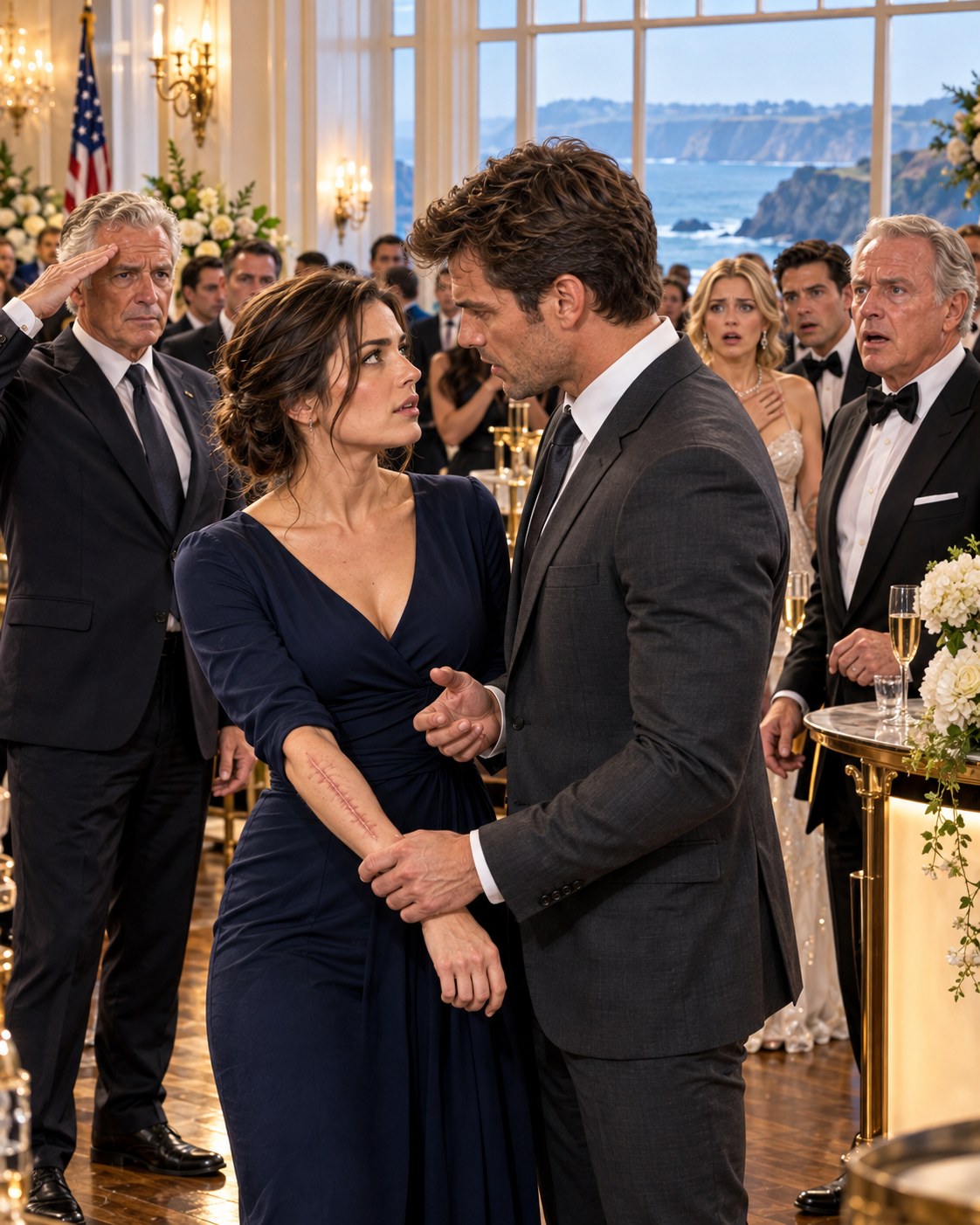
“Major Butler,” he said, “may I see your arm?”
I looked at him, confused.
He gently took my wrist, waiting until I gave a small nod before turning my forearm toward the light.
The scar emerged beneath the rolled edge of my sleeve, a jagged line of pale tissue that crossed the skin like a record of violence no photograph could capture.
Ethan stared at it.
Then he looked at my father.
“Do you have any idea who you’re talking about?”
Arthur scoffed.
“My daughter.”
“No,” Ethan replied. “You’re talking about the operator who saved six men during Operation Meridian.”
A murmur spread across the room.
Roger’s smile disappeared.
Clarabel stood frozen beside the engagement table, one hand gripping the edge of the cloth.
Ethan continued, his voice steady enough to carry to the farthest tables.
“Her call sign was the Black Panther. Her actions during that operation became part of a classified after-action report. The men she rescued walked away because she refused to leave them behind.”
Arthur’s face had gone gray.
“That is not possible.”
Ethan released my wrist carefully.
“It is.”
Miller appeared at his shoulder.
He had changed into his formal uniform for the reception, his decorations catching the light as he stepped forward.
The room quieted when he spoke.
“I was briefed on the Meridian operation by people who knew exactly what happened. Major Butler remained at the extraction point after the structure began collapsing. She held a failing steel cable under conditions that should have made the rescue impossible.”
His gaze swept across the guests.
“Six operators came out alive. Not five. Not four. All six.”
He turned toward me.
“She refused to be evacuated until every one of them was clear.”
For the first time that evening, my father’s carefully constructed story began to collapse in public.
But Miller was not finished.
“Her conduct was considered extraordinary. She was recommended for the Navy Cross.”
A glass slipped from someone’s hand and shattered against the floor.
Clarabel whispered, “The Navy Cross?”
Miller nodded.
“The formal recognition was submitted through the appropriate channels. I cannot speak to the details of the classified operation, but I can tell you this: no one who understands what happened would call that woman a coward.”
Arthur backed away from the bar.
Roger looked as though he wanted to disappear into the wallpaper.
I felt no triumph.
The truth had finally entered the room, but it did not erase the years I had spent believing that my father would never be proud of me.
It did not restore my bedroom, return my mother’s photograph, or undo the nights I had wondered whether I had somehow failed a family that seemed determined to make me feel unwanted.
Ethan turned toward Clarabel.
For a moment, I thought he might offer her a chance to explain.
Instead, he looked at the ring on her finger.
“Clarabel, I need you to tell me one thing,” he said. “Did you know your father was lying about Alicia?”
Her lips parted.
“I…”
“Did you know?”
She looked toward Arthur.
That single glance answered him.
Ethan slowly shook his head.
He took her hand, removed the engagement ring, and placed it on the table beside the untouched champagne.
“I’m sorry,” he said quietly. “I wanted to build a life with you. But I will not marry into a family that destroys one daughter to protect another.”
Clarabel’s face crumpled.
“Ethan, please. We can talk about this privately.”
“We had the opportunity to tell the truth privately,” he replied. “You chose not to.”
He stepped away from her.
And in the silence that followed, I understood that the evening had crossed a point from which none of us could return.
Part 3
Clarabel began crying, but her tears did not immediately move anyone.
They were not the quiet tears of a woman grieving something she had lost without understanding why.
They were desperate, frightened tears from someone watching a future she had assumed was guaranteed disappear in front of an audience.
“Ethan, you can’t do this to me,” she said, reaching for him.
He stepped back.
“I didn’t make this choice tonight, Clarabel. I made it when I realized you were willing to let your sister be humiliated so you wouldn’t have to confront your father.”
She looked at me with an expression that was almost hatred.
“You’re enjoying this.”
The accusation struck harder than I expected.
“No,” I said. “I’m not.”
“Everyone is looking at me because of you!”
I stared at her.
“For years, everyone looked at me because of the person Dad told them I was. I never asked for this.”
Arthur slammed his glass onto the bar.
“That is enough! This is my house, my family, and my daughter’s engagement. I will not allow a military misunderstanding to destroy everything we’ve built.”
Miller’s eyes narrowed.
“Then perhaps you should explain why your daughter was never told about her commendation.”
Arthur’s mouth opened, then closed.
I had spent years imagining what I would say if I ever had the chance to confront him about the money he had taken from me.
I had imagined anger, accusations, and the satisfaction of watching him struggle to defend himself.
Instead, I felt a strange exhaustion.
I reached into my handbag and withdrew a folded bank statement, its creases softened by years of being carried from one apartment to another.
I placed it on the table beside Clarabel’s abandoned engagement ring.
“This is why I came home wanting answers.”
Arthur stared at the paper.
“Put that away.”
“No.”
My voice was quiet, but it carried farther than I expected.
“Three years. That’s how long I worked at the diner to build my college fund. I served breakfast before sunrise, took evening shifts, and went home smelling like coffee and frying oil because I wanted to pay for my education without asking you for anything.”
I unfolded the statement.
The balance had been transferred out in a series of transactions I had never authorized.
The recipient account belonged to a business associated with Clarabel’s boutique.
“I discovered the missing money when I tried to pay my tuition deposit,” I continued. “You told me the bank had made a mistake. You said you would investigate it.”
Arthur’s eyes darted toward the guests.
“That money was needed temporarily.”
“For what?”
He said nothing.
I turned the statement so the people nearest us could read the dates and amounts.
“You took the savings I had worked for and used them to keep Clarabel’s boutique from failing. When I asked where my money had gone, you told me I wasn’t ready for college and should stop wasting my time on unrealistic dreams.”
Clarabel shook her head violently.
“Dad said it was a family loan!”
I looked at her.
“Did you ever ask whether I agreed to lend it?”
Her silence answered me.
For the first time, I saw something in my sister’s face beyond self-pity.
She was beginning to understand that the comfortable life she had enjoyed had been built, in part, from sacrifices she had never been asked to make.
Arthur reached for the statement.
I pulled it away.
“Don’t.”
His hand stopped in midair.
“You have no idea what was happening with the business,” he said. “Clarabel was desperate. We were facing a serious financial problem, and I made a decision to protect the family.”
“You protected her by stealing from me.”
“I was going to repay you.”
“When?”
He looked away.
I waited.
“When, Dad?”
He had no answer.
Miller glanced at the statement, then at Arthur.
“If this account is accurate, you need to deal with it properly. This isn’t something you can dismiss because you’re embarrassed.”
Arthur’s face reddened.
“You have no right to interfere in my family.”
Ethan, standing near the entrance, spoke without raising his voice.
“She had every right to expect honesty from you.”
Arthur turned on him.
“You were supposed to marry my daughter!”
“I was supposed to marry a woman I could trust.”
Ethan looked toward Clarabel, and the pain in his expression was unmistakable.
“I loved you. I wanted to believe the person I saw when we were alone was the person you were when no one important was watching.”
Clarabel reached for him again, but he shook his head.
“I can’t build a marriage on the idea that cruelty is acceptable as long as it happens to someone else.”
He removed his formal jacket from the back of a chair and handed it to Miller.
The older man gave me one final, respectful look.
“Major Butler, it was an honor to learn the truth from the person who lived it.”
Then he straightened, brought his hand to his brow, and saluted me.
The gesture was simple.
No speech.
No audience-directed performance.
Just a veteran acknowledging another service member whose sacrifice had been denied for too long.
Something inside my chest finally loosened.
I returned the salute.
Ethan stood beside his uncle and faced the room one last time.
“I came here tonight believing I was joining a family,” he said. “I’m leaving because I now understand what this family has been willing to do to one of its own.”
He walked toward the doors.
Miller followed.
Neither man looked back.
The room remained silent until the doors closed behind them.
Then everything Arthur had worked so hard to control began to unravel.
His business associates avoided his eyes.
Roger muttered something about needing fresh air and disappeared through a side corridor.
The guests who had laughed at my father’s jokes suddenly discovered urgent reasons to check their phones.
Some looked ashamed.
Others simply looked uncomfortable, as though the greatest tragedy of the evening were the inconvenience of witnessing it.
Clarabel sank to the floor beside the table, sobbing into her hands.
Her silver dress pooled around her like spilled water.
Arthur stood alone at the bar, one hand gripping the polished wood, his face slack with disbelief.
He had spent years teaching us that appearances were everything.
Now the room he had filled with people who admired his success was emptying around him, and not one of them could give him back the reputation he had destroyed himself.
I gathered my bank statement and slipped it into my handbag.
My hands were shaking, but I was no longer trying to hide it.
Arthur looked at me.
“Alicia, wait.”
I turned.
For the first time in my life, he seemed uncertain what to say to me.
“You don’t understand what I was trying to do.”
“I understand exactly what you did.”
“I was protecting your sister.”
“From what? The consequences of her own choices?”
His eyes flickered.
“You’ve always been strong. Clarabel needed more help.”
I felt a terrible sadness settle over me.
There it was.
The excuse beneath every insult, every unequal sacrifice, every moment he had chosen one daughter and called it love.
He had mistaken my ability to survive for proof that I did not need kindness.
He had assumed that because I could endure pain, he was entitled to give me more of it.
“I was your daughter too,” I said.
His mouth trembled.
“I know.”
“No, Dad. You knew my name. You knew where I slept. You knew how to call me when you needed something. But you never wanted to know what it cost me to become the person I am.”
He looked down at the bar.
I waited for an apology.
Not a justification.
Not a reminder of everything he had paid for when I was a child.
Not another explanation about why Clarabel had needed more.
Just an acknowledgment that what he had done was wrong.
But all he managed to whisper was, “I never thought it would go this far.”
I nodded slowly.
“Neither did I.”
Then I walked away.
I spent that night in the guest room, lying beneath unfamiliar sheets while the wind pushed against the windows.
Somewhere down the hall, I heard Clarabel crying.
Once, I nearly stood up and went to her.
The old instinct remained, stubborn and familiar: the desire to comfort my little sister, to tell her that everything would eventually be all right.
But I remembered the girl who had climbed into my bed during thunderstorms, trusting me to keep the monsters away.
I remembered the woman who had watched me lose my bedroom without protest, who had accepted my savings without asking where they came from, and who had remained silent while our father called me a coward.
I lay back down.
Love did not require me to keep rescuing someone who was willing to watch me drown.
Before dawn, I packed my duffel bag.
The coastal fog had rolled across the property, softening the edges of the house until it looked almost peaceful.
I folded my clothes, checked my documents, and placed my mother’s old photograph into the front pocket of my bag.
I had finally found it in a cardboard box beneath the staircase, wedged between discarded holiday decorations and an old lamp.
The frame was cracked.
The photograph was intact.
My mother had been smiling at the camera, her hand resting on my shoulder, her eyes warm with the kind of pride that never needed an audience.
I held the picture for a long moment before sliding it carefully into my bag.
When I reached the front entrance, Arthur was waiting.
He wore yesterday’s wrinkled shirt and looked as though he had aged years overnight.
“Alicia.”
I stopped, keeping my hand on the strap of my bag.
“I was wrong,” he said.
The words emerged slowly, as if each one had to fight its way past years of pride.
“I shouldn’t have said those things about your service. I shouldn’t have taken your money. I shouldn’t have let your room be turned into…”
He stopped, unable to finish.
I waited.
“I was under pressure,” he continued. “The business, Clarabel’s problems, everything happening at once. I thought you could handle it.”
“I always could.”
His eyes filled with tears.
“That’s why I thought you’d understand.”
I looked at him, and for a moment I saw the father I had spent my childhood trying to please.
I saw the man who had taught me to ride a bicycle, who had once carried me home after I scraped my knee on the driveway, and who had sat beside my mother’s hospital bed before grief hardened him into someone I barely recognized.
The memories were real.
So was the damage.
“You keep saying you thought I could handle it,” I told him. “But being able to survive something doesn’t mean you have the right to do it to me.”
He lowered his head.
“I know.”
“Do you?”
He could not answer.
I wanted to believe that his regret would become something meaningful.
I wanted to believe that he would repay the money, acknowledge the truth to the people he had misled, and learn to love his daughters without turning them into competitors for his approval.
But wanting something did not make it true.
“I hope you become a better father,” I said. “Not because I need you to be one anymore, but because you still have a chance to stop hurting people who love you.”
He reached toward me, then let his hand fall.
“Can you forgive me?”
I looked through the open doorway at the gray line of the Pacific beyond the cliffs.
“Maybe someday. But forgiveness won’t mean pretending this never happened.”
He nodded, though I could see how much he wanted a simpler answer.
I stepped outside.
The air smelled of salt, wet grass, and the first pale light of morning.
I placed my bag in the car, settled behind the steering wheel, and looked once at the house where I had spent so many years believing that love was something I had to earn.
Then I started the engine.
As I drove down the winding road toward the highway, the fog gradually thinned, revealing the ocean in long silver ribbons beneath the rising sun.
I thought about the six men I had pulled from the wreckage at Meridian.
I had never expected them to repay me.
I had never needed them to call me a hero.
I had simply believed that when someone was trapped beneath a collapsing world, you stayed until you could get them out.
For years, I had applied that belief to my family, returning whenever they called, forgiving whenever they demanded it, and holding everything together long after my own hands began to bleed.
Now I understood something I had never learned in the military.
Sometimes the bravest thing you can do is recognize that the person you keep trying to save is the person holding you under.
I did not know whether Clarabel would ever understand what she had done.
I did not know whether Arthur would repay my money or whether the Navy Cross nomination would ever become the recognition I had once been too tired to pursue.
Those things would have to wait.
For the first time in years, my future belonged to me.
The road opened ahead, and the morning light touched the scar beneath my sleeve.
I no longer felt the need to cover it.
It was not proof that I had been broken, nor a mark I needed to explain to people who had already decided not to believe me.
It was a reminder that I had once stood in the fire, held on when everything was falling apart, and refused to leave six people behind.
My father had spent years trying to convince me that my worth depended on his approval.
But as the ocean disappeared behind me and the road stretched toward a life I had not yet imagined, I finally understood that the truth had never belonged to him.
I had earned my place in this world long before I came home to ask for one.
And this time, when I drove toward the light, I did not leave anyone behind who had not already chosen to let me go.