At my sister Clara’s engagement party, my father raised his champagne glass and told a room full of wealthy guests
Part 2
The road along Rockville Pike was crowded with emergency vehicles when I reached the designated response area.
Blue and red lights flashed across the storefront windows, turning the wet pavement into a shifting field of color.
Several vehicles had been forced out of position during the attack.
A damaged sedan sat at an angle near the curb, and security personnel were moving civilians away from the immediate area while trying to restore communications with the missing members of the convoy.
I did not rush blindly into the scene.
I checked in with the response coordinator, confirmed which routes remained open, and identified the safest point at which I could support the extraction without interfering with the teams already operating there.
The situation was chaotic, but chaos did not mean there was no structure.
It meant the structure had to be rebuilt quickly.
I learned that the Secretary of State had been moved from the original vehicle after it became unsafe, but his protective team had lost a reliable communications link with the central command channel.
He was alive.
He was injured.
And the area around his last confirmed position was no longer defensible.
I coordinated with the personnel on scene to establish a secure movement toward the nearest suitable location.
The priority was not to make a dramatic entrance or prove that I could do something nobody else could.
It was to move the Secretary away from danger without creating another vulnerability.
When I reached the vehicle carrying him, I found him conscious but shaken, with a cut near his temple and a deep bruise forming along his cheek.
One of his protective officers was applying pressure to a wound on his own arm.
The Secretary looked at me through the open door.
“Who are you?”
“Colonel Emily Bennett, sir. I’m coordinating the route security response.”
“Can you get us somewhere safe?”
“Yes, sir. We’re moving now.”
He nodded once.
I checked that the immediate medical needs had been addressed, confirmed the transfer with the relevant command personnel, and coordinated the movement toward Arthur Whitmore’s estate.
The destination had not been chosen because I wanted to attend my sister’s party.
It had been chosen because its controlled access and available secure space offered a defensible temporary location while the next phase of the response was organized.
I knew exactly who would be inside.
I knew my father would be there.
I knew he would be standing beneath the chandeliers, telling stories about Clara and her future husband while explaining my absence as another example of my failure to participate in family life.
I also knew that none of those things mattered now.
The vehicle moved through the estate’s entrance under coordinated security arrangements.
Personnel at the gate were notified of the emergency, and the event coordinator was instructed to clear the immediate arrival area.
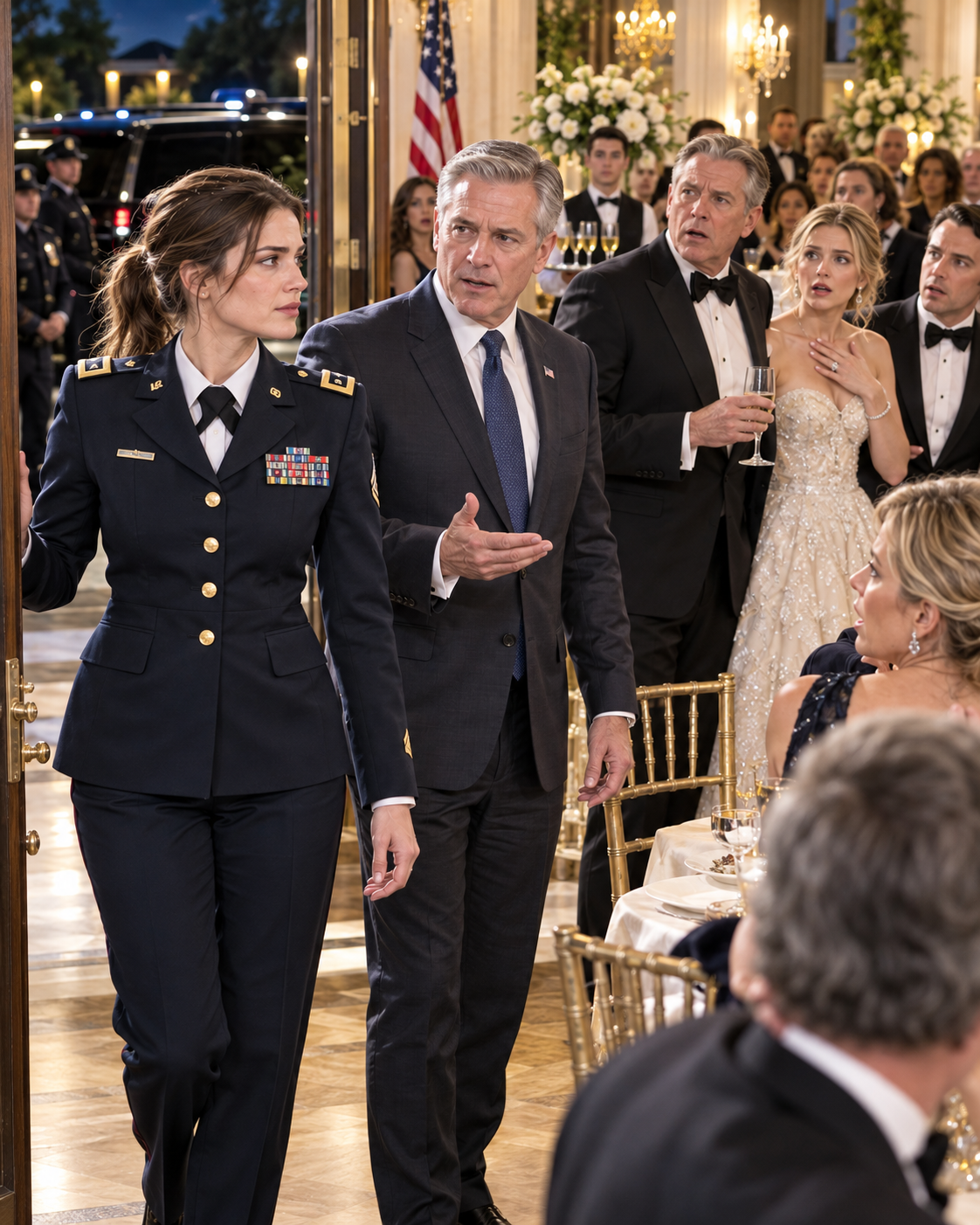
When we reached the front entrance, the doors opened, and the sound of conversation spilled into the night.
A string quartet was playing near the staircase.
Guests were holding champagne glasses.
My father stood beside Arthur Whitmore, smiling as he explained something that made the older man laugh.
Then the first security officer entered.
The music faltered.
The Secretary of State followed, accompanied by his protective personnel.
And I walked in beside him.
For a moment, nobody seemed to understand what they were seeing.
Then the room began to change.
A woman lowered her glass so quickly that champagne spilled across her fingers.
Nathan turned toward the entrance, his smile disappearing.
Clara stood motionless beside the staircase, her face draining of color as she recognized me.
My father looked from the Secretary to the security personnel, then finally to me.
His expression was not recognition.
It was confusion, sharpened by the fear of being publicly embarrassed.
“Emily?” he said.
I did not answer immediately.
I was focused on the Secretary’s condition and the security team coordinating the next steps.
A member of the estate staff guided us toward the designated secure area while the protective detail established control of the entrance.
The Secretary paused before following them.
He looked across the room at the gathered guests, then turned toward me.
“Colonel Bennett,” he said clearly, “thank you for coordinating our extraction. Your route planning and response helped get us out of a dangerous situation.”
The title struck the room like a dropped glass.
My father blinked.
Arthur Whitmore stared at me.
Nathan’s mouth opened, then closed again.
Clara looked as though someone had quietly pulled the floor out from beneath her.
The Secretary continued, his voice tired but steady.
“Colonel Bennett commands the joint route security cell responsible for coordinating complex movements and protective operations across multiple regions. I’ve worked with teams that rely on her planning and judgment. Tonight, she helped coordinate the response that brought me to safety.”
Nobody laughed.
Nobody made a joke about meal kits.
The silence that followed was so complete that I could hear the faint clink of a spoon against a glass somewhere near the back of the room.
My father took one uncertain step toward me.
“Colonel?”
I looked at him.
“Yes.”
“But you told us—”
“I told you I worked in military security. You decided that meant something else.”
He looked toward the Secretary, perhaps hoping the official would soften the moment with a polite misunderstanding.
Instead, the Secretary offered him a brief nod and followed his protective detail toward the secured area.
I went with them.
The next several minutes were consumed by practical work.
Medical personnel examined the Secretary, communications were restored, and the protective team coordinated with the appropriate authorities.
I provided the information needed for the next stage of the response, confirmed the route details, and made sure that everyone understood which communications channels were reliable.
The Secretary was shaken but lucid.
His injuries required attention, but the immediate danger had passed.
Only after the necessary arrangements were in place did I step back into the main hall.
The party had not resumed.
Guests stood in small, silent groups, speaking in low voices.
My father was waiting near the staircase.
Arthur Whitmore stood beside him, his face carefully composed, though the embarrassment beneath it was obvious.
Clara was a few feet away, twisting the engagement ring on her finger.
My father spoke first.
“Emily, why didn’t you tell us?”
I looked at him, and for one strange second, I felt as though I were nine years old again, standing beside the shattered remains of my bridge.
“I did tell you.”
“No, I mean—why didn’t you explain what you actually do?”
“I tried for years.”
He shook his head.
“You always made it sound like ordinary government work.”
“I described my work. You chose the version that made it easiest to dismiss me.”
Arthur cleared his throat.
“Richard, perhaps we should discuss this privately.”
My father ignored him.
“You’re a colonel?”
“Yes.”
“And you command an operation like the one we just witnessed?”
“I coordinate a joint security cell. I don’t personally control every part of an operation, and I don’t work alone. Tonight involved many people doing their jobs under difficult circumstances.”
Even now, I could not bring myself to take credit that belonged to an entire team.
My father stared at me as if my refusal to boast confused him more than the title itself.
Nathan finally found his voice.
“Emily, that’s incredible. Why would you let us think you were delivering food?”
I turned toward him.
“I wasn’t delivering food.”
He looked uncomfortable.
“I mean, your father said—”
“Exactly.”
Clara took a step forward.
“Emily, I didn’t know.”
I looked at my sister.
For years, she had allowed my father to minimize me because the arrangement benefited her.
She had enjoyed being the daughter whose accomplishments were celebrated, the one whose future was treated as a family triumph.
She had watched him turn my work into a joke and had rarely challenged him.
“You never asked,” I said.
Her eyes filled.
“I didn’t think—”
“No,” I interrupted gently. “You didn’t think about it.”
She looked down at her ring.
I felt no satisfaction watching her struggle for words.
I had not wanted her engagement party to become a public reckoning.
I had wanted to congratulate my sister, eat something small, and go home.
But the truth had entered the room with me, and there was no way to make everyone forget what they had heard.
My father lowered his voice.
“Emily, you have to understand that I was proud of you in my own way.”
I stared at him.
“Then why did you spend my entire life making sure I knew you weren’t?”
He opened his mouth.
Nothing came out.
For once, there was no joke ready to rescue him.
I thought of my mother’s hands gathering the broken pieces of my bridge, her quiet voice telling me that I had built something other people did not yet understand.
I wished she could have been there.
Not to watch my father feel embarrassed.
Not to see a powerful official validate the life I had lived.
I wished she could have been there because she had believed in me long before anyone important knew my name.
My secure device vibrated.
The operations center needed an update, and I still had responsibilities to fulfill.
I glanced at the message, then looked at my family.
“I have to get back to work.”
My father reached toward me, then stopped.
“Can we talk later?”
“Perhaps.”
I did not promise anything.
I returned to the secured area, completed the necessary handoff, and coordinated the next stage of the response.
The Secretary was moved under appropriate protection, and the immediate crisis gradually gave way to the quieter work of documenting decisions, confirming personnel status, and making sure nothing had been overlooked.
It was well past midnight when I finally had a moment alone.
I sat in the vehicle, listening to the muted sound of radios and distant traffic.
My hands were steady, but my chest hurt in a way that had nothing to do with the evening’s physical demands.
For years, I had imagined what it would feel like if my father finally understood me.
I had pictured him listening to my accomplishments without interruption, asking questions about my work, and saying that he was proud of the woman I had become.
Instead, the first moment he believed me came when someone more powerful than him spoke my title aloud.
And that realization hurt more than his original insult.
Because it meant he had not needed proof that I was worthy.
He had needed proof that other people thought I was.
I closed my eyes and saw my mother’s envelope in my mind.
For the first time since her death, I knew I was ready to open it.
Part 3
The following morning, I returned to my apartment after completing the final reports required by the operation.
The sun was just beginning to rise over Washington, washing the buildings in a pale gold light that made the city look softer than it had felt during the night.
I took a shower, changed into comfortable clothes, and made coffee I barely touched.
Then I opened the drawer where I kept my mother’s letter.
The envelope had yellowed slightly at the edges.
My name was written across the front in her familiar handwriting, each letter rounded and deliberate.
I sat at the kitchen table and held it for several minutes before breaking the seal.
Inside was a single sheet of paper folded in half.
My mother had written it during the final weeks of her illness, when she knew she might not have much time left to tell me everything she wanted me to know.
“Emily, my sweet girl,
“If you are reading this, I imagine you have reached one of those moments when the world seems determined to tell you who you are.
“Please remember that other people’s understanding of you is not the measure of your life.
“Your father has always been afraid of what he cannot control. He believes that success must look a certain way, and he has spent too much of his life trying to make the people he loves fit inside that picture.
“I have watched you build things with your hands, solve problems with your mind, and carry burdens without asking anyone to notice.
“I have also watched you make yourself smaller when people failed to understand you.
“Please don’t confuse being quiet with being insignificant.
“Please don’t confuse being kind with allowing yourself to be hurt.
“And please don’t spend your life trying to earn respect from people who only offer it when they are afraid of losing their own.”
I stopped reading.
The words blurred, and I pressed the letter against my chest.
For years, I had told myself that my mother’s death was the reason I had stopped explaining myself to my family.
But sitting at that kitchen table, I understood that I had also been trying to preserve the last version of home in which I had felt understood.
I had stayed available to my father and Clara because part of me still hoped that one day they would see what my mother had seen.
I had kept attending family gatherings.
I had accepted the jokes.
I had swallowed my anger.
I had made my life easier for them to dismiss because I thought that if I remained patient enough, they might eventually become curious.
My mother had understood the cost of that hope.
I unfolded the final part of the letter.
“Your life will not always be understood by the people who knew you first.
“That does not make it less real.
“Build what you believe in, sweetheart. Protect the people who depend on you. And when someone tries to convince you that your worth is too small to matter, remember that the world is full of people who cannot recognize a bridge until they need to cross one.
“I love you more than I have ever managed to say.
“Mom.”
I cried then.
Not because I was ashamed of the party or because my father had embarrassed himself in front of wealthy guests.
I cried because my mother had known how lonely I could become while trying to earn love from people who treated it as a reward.
She had understood that the little girl who built a bridge had grown into a woman who could guide people through danger, yet still found herself waiting for her father’s approval.
When the tears finally eased, I folded the letter carefully and placed it back in its envelope.
I did not need to become harder.
I did not need to learn how to humiliate my father in return.
I needed to stop offering him the power to define me.
My phone rang before I finished my coffee.
Clara’s name appeared on the screen.
I let it ring twice before answering.
“Emily?”
Her voice was small.
“Hi, Clara.”
“Can we talk?”
I looked at the letter on the table.
“About what?”
“Last night.”
I said nothing.
She took a breath.
“Dad is furious about what happened.”
I almost laughed, but the sound never reached my throat.
“Is he furious that I was insulted, or that everyone heard him doing it?”
“I don’t know,” she admitted. “Probably both.”
It was the most honest thing she had said to me in years.
She continued quickly, as if afraid I might hang up.
“I should have said something when he was making those jokes. I knew they were cruel, and I let everyone laugh because I didn’t want to ruin my engagement party.”
“Yes,” I said.
“I kept telling myself that you didn’t care what he thought.”
“I cared. I just stopped showing you.”
There was a long silence.
“I am sorry,” she whispered.
I believed that she felt sorry.
But an apology did not automatically undo years of watching me become the family joke.
“Clara, I don’t need you to defend me because a cabinet official knows my name.”
“I know.”
“I need you to understand that I was your sister before you knew any of this. I was your sister when Dad broke my bridge. I was your sister when he dismissed my commission. I was your sister every time you sat there and let him make me feel small.”
Her breathing grew uneven.
“I know,” she said again. “I should have done better.”
“Yes, you should have.”
I did not say it to punish her.
I said it because the truth had spent too many years being softened for everyone’s comfort except mine.
She asked whether we could meet.
I told her I was not ready.
She began to cry, and I felt the old instinct to comfort her, to reassure her that everything would be all right, to take responsibility for making the conversation easier.
I let the instinct pass.
“I hope you have a beautiful marriage, Clara,” I said. “But I need some time away from this family.”
“Are you cutting us off?”
“I’m choosing some distance. What happens after that depends on whether anything changes.”
She did not argue.
Before we ended the call, she said, “Mom would have been proud of you.”
I closed my eyes.
“She was proud of me before any of this happened.”
Clara did not answer.
That afternoon, my father sent a message asking me to meet him privately.
I agreed to a brief conversation at a quiet café near his office, not because I owed him another chance to explain himself, but because I wanted to hear what he had to say without a room full of people watching.
He arrived early and stood when I entered.
For the first time in my life, he looked uncertain about how to greet me.
“Emily.”
“Dad.”
We sat across from each other.
He ordered coffee for himself but did not ask what I wanted.
That small omission told me how little had changed.
“I’ve been thinking about what happened,” he began.
I waited.
“I was wrong to make those comments in front of everyone.”
“Yes.”
“I shouldn’t have embarrassed you.”
I studied him.
“Would you have apologized if the Secretary of State hadn’t walked through that door?”
His face tightened.
“That’s unfair.”
“Is it?”
He looked out the window.
For several seconds, I thought he might stand up and leave.
Instead, he lowered his voice.
“I didn’t know the extent of your work.”
“You didn’t ask.”
“I thought you were doing administrative work.”
“I told you I coordinated military security.”
“You never explained it like that.”
“I explained it more than once. You interrupted me more than once.”
He rubbed his forehead.
“I suppose I didn’t listen.”
It was the closest he had come to acknowledging the truth.
Then he made the mistake of adding, “But you have to understand, Emily, I was trying to protect you. Military work is dangerous, and I never wanted you to be hurt.”
I felt the last fragile thread of hope inside me grow still.
“You weren’t protecting me, Dad. You were dismissing me because my life didn’t look the way you wanted it to.”
He opened his mouth, then closed it.
I continued.
“You treated Clara’s accomplishments as proof that she was special. You treated mine as inconveniences you didn’t want to understand. When I built something, you called it a toy. When I chose my career, you called it impractical. When I tried to tell you what I did, you reduced it to moving people around.”
My father stared at the table.
“I didn’t realize you felt this strongly.”
“That’s the problem. You never tried to realize anything about me.”
He looked older suddenly.
“I am proud of you now.”
The words might once have meant everything.
I imagined hearing them at sixteen, when I came home with a science award.
I imagined hearing them at twenty-two, when I received my commission.
I imagined hearing them during one of the long deployments when I had been so tired that my mother’s voice on the phone was the only thing that made home feel real.
But sitting across from him now, I understood that I could not go backward and give those words to the younger versions of myself who had needed them.
“Thank you,” I said.
He looked up, surprised.
“Does that mean we’re all right?”
“No.”
His expression fell.
“I don’t know how to fix this, Emily.”
For once, he sounded less angry than frightened.
I believed he was struggling.
I believed he had begun to see how much damage he had done.
But I also knew that understanding the damage was not the same as repairing it.
“You can start by changing how you treat people when you think they have nothing to offer you,” I said. “Not just me. Everyone.”
He nodded slowly.
“And if I do that?”
“Then perhaps, someday, we can have a different relationship.”
He reached toward my hand, but I placed mine around my coffee cup instead.
“I love you, Dad. But I am not going to keep making myself smaller so you can feel bigger.”
I stood before he could turn the conversation into another negotiation.
He remained seated, staring at the untouched coffee between us.
Outside, the afternoon traffic moved steadily through the city.
I walked to my car without looking back.
The days that followed were quieter than I expected.
The Secretary of State’s office issued a formal acknowledgment of the security team’s work, and the relevant military and federal channels documented the operation.
My contribution was recorded accurately, alongside the work of the other personnel who had coordinated the response.
I returned to my regular duties.
There were briefings, reports, and another assignment waiting to be planned.
My career did not suddenly become glamorous.
I still spent long hours studying routes, reviewing contingencies, and checking details that most people would never notice.
I still worked with people whose names would never appear in a newspaper.
And I still understood that the best outcome was often the one that looked as though nothing had happened.
The difference was that I stopped treating my family’s inability to understand my work as a problem I was responsible for solving.
Clara sent a few messages over the following months.
Some were apologies.
Some were ordinary questions about my life.
I answered when I felt ready and remained silent when I did not.
She eventually began telling me about her wedding plans without making every conversation a request for forgiveness.
I hoped she would learn to stand up for people even when doing so made her uncomfortable.
I hoped her marriage would give her room to become more honest than the daughter our father had taught her to be.
But I did not make my healing dependent on her progress.
My father changed more slowly.
He called less often at first, then began sending brief messages asking how I was doing.
The questions were awkward.
Sometimes he asked about work and then seemed unsure what to do with the answers.
I did not mistake these small efforts for a complete transformation, but I noticed them.
Whether our relationship could eventually be rebuilt remained uncertain.
For the first time, I allowed that uncertainty to exist without rushing to resolve it.
One evening, several months after the engagement party, I returned to my apartment after a long planning session and found the shoebox from my childhood tucked beneath a stack of old documents.
I had brought it with me when I moved away from home, though I rarely opened it.
Inside lay the broken pieces of my miniature bridge.
The wood had darkened with age.
One of the supports had cracked further, and a small length of wire had come loose from the side.
I took the pieces to my kitchen table and arranged them carefully.
For years, I had kept them because they reminded me of what my father had destroyed.
Now I saw something else.
I remembered how I had studied the design, how I had tested each support, and how my mother had knelt beside me to gather the fragments.
My father had broken the model.
He had not broken the part of me that knew how to build.
I found a small frame in a cupboard and placed the pieces inside it, not as a memorial to my childhood humiliation, but as a reminder of the girl who had kept creating things even when nobody important was watching.
Then I set the framed bridge on my bookshelf beside my mother’s letter.
The next morning, I woke before sunrise and prepared for another day of work.
My secure device rested on the kitchen counter.
My uniform hung neatly beside the door.
The world was already moving toward its next emergency, and somewhere, someone was counting on a plan they would never need to know I had helped create.
I took one last look at the framed bridge before leaving.
For most of my life, I had believed that proving my worth would finally make my family treat me with respect.
Now I understood that proof had never been the missing piece.
They had been looking at me through the limits of their own imagination, and no accomplishment could force them to see beyond those limits until they chose to do so.
I could not change what my father had said at the party.
I could not recover the years I had spent hoping that Clara would defend me.
I could not ask my mother to come back and tell me, one more time, that I was enough.
But I could decide what happened next.
I could continue serving the people who depended on me.
I could build a life that did not require an audience.
I could love my family without granting them unlimited access to my peace.
And I could remember the lesson my mother had left me in a sealed envelope: the world would not always recognize what I built, but that was never a reason to stop building.
As I stepped outside, the morning air was cool against my face.
My phone vibrated with a message from the operations center.
A new assignment was waiting.
I read the details, acknowledged the notification, and headed toward my car.
Somewhere behind me, the city was waking up.
Somewhere ahead, people I would never meet were depending on decisions I had yet to make.
I did not need my father to understand.
I did not need Clara to explain.
I did not need a powerful official to announce my title before a room full of strangers.
I knew who I was when the room was empty.
And that was the truth I would carry with me long after the laughter at the engagement party had faded into silence.