At my parents’ Christmas dinner in Atlanta, my father looked me in the eye and announced that my sister would inherit the family home
Part 2
Nobody moved.
The rain tapped against the windows, and somewhere in the kitchen, a timer began to beep.
Grandma Beatrice ignored it.
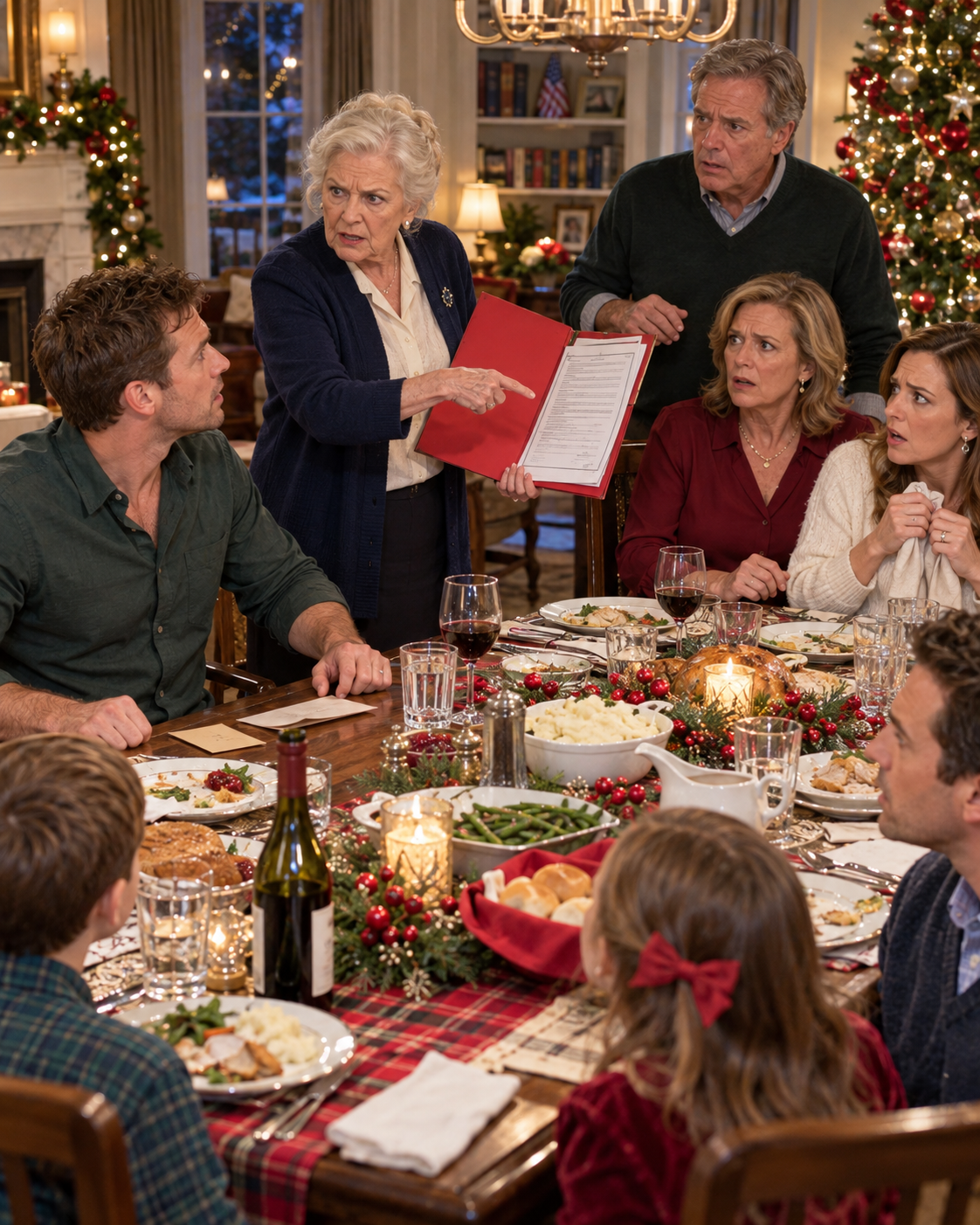
She opened the red folder and removed a stack of documents secured with a brass clip.
My father stood so abruptly that his chair struck the wall behind him.
“Put that away.”
Grandma didn’t even glance at him.
“No, Arthur. I’ve spent too many years putting things away because you didn’t like the truth.”
My mother pressed her napkin against her mouth.
Brenda stared at the papers as if they might suddenly burst into flames.
Kyle looked between them, completely lost.
“Can somebody explain what’s happening?” he asked.
Grandma turned toward him.
“I will, dear. But first, everyone needs to understand whose house they’re sitting in.”
She laid a deed on the table.
The paper was old, its edges softened by years of handling, but the names and legal description remained clear.
“This property belongs to me,” she said. “It always has.”
I frowned.
I had grown up believing my parents owned the house.
My father had paid the taxes, arranged the repairs, replaced the roof, and complained about the mortgage whenever something needed fixing.
Grandma continued before anyone could interrupt.
“Twenty-seven years ago, I purchased this house with money your grandfather left me. I allowed Arthur and Linda to live here under a life estate arrangement, which gives them the right to occupy the property during their lifetimes under the terms of the deed.”
She tapped the document.
“It does not give them the right to pretend the property is theirs to distribute as a reward for obedience.”
My father swallowed.
“You said we could have the house.”
“I said you could live here. I never said you could use it to manipulate your children.”
“That’s not fair.”
Grandma’s eyebrows rose.
“Fair?”
She repeated the word as though she had discovered something rotten in her soup.
“You fabricated a financial emergency, let one child sell his only car to rescue you, and then announced that the other child would receive a home she had done nothing to save. Don’t lecture me about fairness, Arthur.”
My mother began to cry.
“Beatrice, please. We were trying to teach them something important.”
“Then why did you need a lie?”
My mother had no answer.
Grandma turned to me.
“Logan, sit down, sweetheart.”
I remained standing, unable to trust my legs.
She reached across the table and squeezed my hand.
“I know about the car.”
The words nearly undid me.
For three days, I had been waiting for my parents to recognize what I had given up.
Hearing that simple acknowledgment from someone else made my throat burn.
Grandma’s eyes softened.
“I also know you have spent years showing up for people who rarely bother to show up for you.”
She looked toward Brenda.
“And I know your sister refused to answer her parents’ calls.”
Brenda’s face hardened.
“Grandma, you don’t know what my life is like.”
“You’re right,” Grandma said. “I don’t know every detail of your life. But I know you had a telephone, and I know your parents called you asking for help. You chose not to answer.”
“I have two children!”
“And Logan has one life.”
The table fell silent.
Grandma leaned back.
“You’ve all spent so much time measuring who deserves what that you’ve forgotten the difference between needing help and being entitled to someone else’s sacrifice.”
My father shook his head.
“This is a private family matter.”
“It stopped being private when you made a spectacle of your son’s generosity at Christmas dinner.”
She reached deeper into the folder and removed another document.
“This is the updated deed.”
My father stared at it.
“What updated deed?”
“The one I signed and had properly recorded last month.”
The room seemed to lose its warmth.
Grandma adjusted her glasses and read the relevant language aloud, explaining that she had arranged for the property to pass to me after her death, subject to the applicable terms and legal formalities.
The documents had been prepared with an attorney, and the recorded instrument reflected her decision.
I couldn’t speak.
My parents had just declared that Brenda would inherit the home.
Grandma had quietly made sure that neither of them could make that decision for her.
My father reached toward the paper.
Grandma placed her hand over it.
“Don’t.”
He withdrew his hand.
“You’re giving the house to Logan?”
“I’m arranging for the house to go to the person I believe will understand that a home is a responsibility, not a trophy.”
Brenda’s chair creaked as she shifted.
“So he gets everything because he sold a car?”
Grandma’s gaze sharpened.
“No. He gets this because I made my own decision about my property. The car merely reminded me that I was right to make it.”
She looked directly at my father.
“You thought this test would reveal which child loved you most. What it revealed was how quickly you were willing to punish the child who loved you without conditions.”
My father looked furious, but beneath his anger, I saw fear.
For the first time in my life, he was not the person controlling the room.
He was simply a man whose carefully arranged story had fallen apart in front of his family.
My mother reached for Grandma’s arm.
“Please. We didn’t mean for anyone to get hurt.”
Grandma gently pulled away.
“Intentions don’t erase consequences, Linda.”
Brenda’s husband, Kyle, finally found his voice.
“Wait. So the foreclosure wasn’t real, and the house doesn’t belong to Arthur and Linda?”
“That’s correct,” Grandma replied.
Kyle looked at Brenda.
“You told me your parents were in financial trouble.”
“They said they needed to find out who would help them.”
“You told me Logan was being dramatic about selling his car.”
Brenda opened her mouth, then closed it.
Kyle leaned back, visibly shaken.
“I thought he was making a choice because he wanted to. I didn’t know they were putting him through some kind of test.”
Neither did I, I thought.
That was the cruelest part.
I had believed I was helping my parents survive a crisis.
They had believed they were conducting an experiment.
Grandma gathered the remaining documents into a neat stack.
“I want something understood before this dinner ends. The deed is not a weapon. Logan is not a weapon. And neither is this house.”
She paused, allowing every word to settle.
“I am not giving Logan a prize for being a good son. I am choosing where my property will go because I have the right to choose, and because I will not allow a home I worked to provide to become the centerpiece of a family contest.”
My father sank into his chair.
For a moment, I almost felt sorry for him.
Then I remembered the envelope in his drawer, the money I had earned by giving up the car that carried me to work, and the way he had looked me in the eye and told me nobody had forced me to help.
The sympathy faded.
Grandma turned toward me again.
“There’s something else you should know, Logan.”
My chest tightened.
“What?”
She folded her hands.
“When your father called me to explain his little plan, he told me he was certain Brenda would be the one to help.”
My father closed his eyes.
Grandma continued.
“He said she had children, a mortgage, and responsibilities. He thought she would understand what family meant when the pressure was real.”
She looked at Brenda.
“But she blocked their numbers before they had even finished explaining what they needed.”
Brenda stared at the table.
“And Logan,” Grandma said, her voice gentler now, “didn’t ask whether he would get anything in return. He asked how much they needed.”
I felt the tears before I could stop them.
I hated crying in front of my father.
He had spent my childhood teaching me that tears were evidence of weakness, and I had spent my adulthood trying to prove him wrong.
But there was something different about these tears.
They weren’t for the house.
They weren’t even for the car.
They were for the little boy inside me who had believed that one day, if he did everything right, his father would finally look at him with pride.
Grandma squeezed my hand again.
“You don’t have to earn your place at this table by bleeding for everyone sitting around it.”
I looked down.
For the first time that evening, I let myself cry.
No one tried to stop me.
And no one dared to tell me I was being dramatic.
Part 3
Dinner ended without dessert.
The turkey grew cold, the candles burned low, and the Christmas music continued playing from the living room as if the house itself had failed to notice that something irreversible had happened.
My father went into his study.
My mother followed him a few minutes later, closing the door behind her.
Brenda sat on the sofa with Kyle, whispering urgently while their children played with a new toy near the fireplace.
Grandma Beatrice remained at the dining table, reviewing the documents she had brought.
I stood by the front window and watched the rain ease into a fine mist.
I had imagined many versions of that Christmas.
In some, my parents hugged me and thanked me for saving their home.
In others, they admitted they had made mistakes and promised to treat me differently.
I had never imagined standing in the house where I grew up, feeling more like a stranger than I had ever felt in my own apartment.
Grandma joined me by the window.
“You know,” she said, “when I was young, people told me a family home was supposed to keep everybody together.”
I looked at her.
“Didn’t it?”
“Sometimes. Other times, it gave people a place to hide their worst behavior.”
She watched the lights shimmer across the wet street.
“Your grandfather used to say that a house can shelter a family, but it can’t make one.”
I let those words settle.
“Why did you agree to the test?”
Grandma sighed.
“Because I wanted to believe your parents had a good reason for doing it. Arthur told me he was worried about what would happen when he and Linda got older. He wanted to know which child would stand beside them if their circumstances changed.”
“And you believed him?”
“I believed he might have been frightened. I did not believe he had the right to turn that fear into a trap.”
She glanced toward the dining room.
“When I learned what he had done, I made certain the legal arrangements reflected my own wishes. I wasn’t going to let your parents use my home to reward one child and humiliate the other.”
I swallowed.
“Did you always know they’d choose Brenda?”
“No,” she said. “But I suspected they had already decided what the right answer should look like.”
She touched my arm.
“That’s why tests like this are dangerous, Logan. When people decide what loyalty is supposed to look like before they ask the question, they aren’t looking for the truth. They’re looking for confirmation.”
I thought about my father counting the money.
About Brenda’s phone going silent.
About the envelope disappearing into a drawer.
“Can I ask you something?”
“Anything.”
“What if I’d said no? What if I couldn’t afford to help?”
Grandma turned toward me completely.
“Then you would still be worthy of love.”
The answer came so quickly that it hurt.
She continued, “Helping someone is a gift. It is not a debt they can collect from you, and it is not a price you must pay to belong.”
I pressed my forehead against the cool window glass.
I had spent so many years believing that being dependable meant never saying no.
If a friend needed a ride, I went.
If a coworker needed someone to cover a shift, I agreed.
If my parents called, I answered.
Somewhere along the way, I had confused being loved with being useful.
Grandma seemed to read the thought on my face.
“Your heart is a good thing, sweetheart. But you must learn to protect it from people who mistake kindness for an unlimited supply.”
Behind us, the study door opened.
My father emerged with his shoulders drawn tight.
He looked older than he had that morning.
“Mother,” he said, “can we speak privately?”
Grandma shook her head.
“We’ve done enough things privately tonight.”
He glanced at me.
“Logan, I owe you an apology.”
The words startled me so much that I turned away from the window.
My father rarely apologized.
When I was sixteen and broke my wrist during a football game, he had told me I should have been more careful.
When I quit college to pursue stunt work, he had said I was throwing away a future.
When I came home after a serious fall on a film set, he had asked how much money I had lost by missing work.
He had never been cruel every day.
That would have been easier to understand.
Sometimes he was warm, even funny. Sometimes he remembered little details about my life and surprised me with a thoughtful gift.
Those moments were enough to keep me hoping that the next time would be different.
Now he stood before me with his hands hanging awkwardly at his sides.
“We handled this badly,” he said.
I waited.
He glanced toward Grandma.
“I thought we were doing the right thing.”
“No,” I replied quietly. “You thought you were going to get the answer you wanted.”
His jaw tightened.
Then, to his credit, he didn’t argue.
“I was wrong.”
The apology hung between us, fragile and incomplete.
I wanted to accept it.
I wanted to be the son who could take three words and turn them into a new beginning.
But an apology could open a door without repairing the room behind it.
“What happens to the money?” I asked.
My father looked down.
“It’s in the drawer.”
“All of it?”
“Yes.”
“I need it back.”
He nodded.
“You’ll have it tomorrow.”
I believed he intended to return it.
I also understood that I would not have believed him so easily a few hours earlier.
That was another thing the evening had taken from me: not my ability to love my father, but my ability to accept his promises without question.
My mother stepped into the hallway.
Her eyes were swollen.
“Logan, I never wanted you to lose your car.”
“But you knew I was selling it.”
She covered her mouth.
“I thought you’d find another way.”
“With what money?”
She had no answer.
I looked at both of them.
“You keep saying you didn’t want anyone to get hurt. But you watched me give up something I needed, and neither of you stopped me.”
My mother’s tears spilled over.
“I am sorry.”
This time, I believed she was sorry.
I simply didn’t know whether she understood what she was sorry for.
Across the room, Brenda rose from the sofa.
“Fine,” she said, her voice trembling. “I guess I’m the villain now.”
Grandma turned slowly.
“No one has called you a villain.”
“You’ve all made it clear Logan is the good child and I’m the selfish one.”
I looked at her, exhausted.
“Brenda, I don’t want your place in the family. I wanted you to answer the phone.”
She stared at me.
For the first time that night, she looked less angry than frightened.
“I couldn’t deal with it,” she whispered. “Every time they call, there’s something they need. Money, errands, help with the kids. I feel like if I say yes once, I’ll never be allowed to say no again.”
The admission surprised me.
It didn’t excuse her decision, but it made the person behind it visible.
I knew that feeling in a different form.
The difference was that I had chosen to sell my car because I believed our parents were in danger, while she had chosen to disappear because she feared being asked to sacrifice something herself.
“Then you should have told them that,” I said. “You didn’t have to help. You just had to answer.”
Brenda’s eyes filled with tears.
“I know.”
Kyle put an arm around her shoulders.
He looked at me, then at Grandma.
“I’m sorry,” he said. “I should have asked more questions instead of assuming I understood what was happening.”
Grandma nodded.
“That’s a good place to start.”
For a long moment, nobody spoke.
Then Grandma closed the red folder.
“Here is what happens now,” she said. “Arthur and Linda will remain in their home according to the terms of the life estate. Logan will not be expected to sacrifice another thing to prove he belongs here. Brenda will not be punished by me for failing a test she never agreed to take. And nobody will use this house to threaten, bribe, or control anyone again.”
My father looked toward the dining room.
“And the inheritance?”
“My decision stands,” Grandma replied. “The property will pass according to the updated deed, subject to its legal terms. I will not change it because someone is embarrassed by the consequences of their own choices.”
She picked up her coat.
Then she turned to me.
“Come on, sweetheart. I’ll take you home.”
I almost laughed at the absurdity of it.
My eighty-three-year-old grandmother was offering to drive me home because my parents’ invented crisis had left me without a car.
But the thought made my throat tighten again.
“Grandma, you don’t have to.”
“I know.”
She held out her hand.
“I’m doing it because I want to.”
Those words followed me out into the cold.
She drove me back to Atlanta in her old sedan, keeping the heater on high and the radio low.
Halfway there, she reached into her purse and handed me a folded piece of paper.
It was a check for $6,800.
I stared at it.
“Grandma, I can’t take this.”
“You can.”
“But the money was for them.”
“The money was yours, Logan. You gave it because you believed someone you loved was in danger. They have agreed to return it, and this is my way of making certain you don’t have to wait to replace what you lost.”
I shook my head.
“I don’t want you paying for what they did.”
“You’re not asking me to pay for their behavior. I’m choosing to help you recover from it.”
She kept her eyes on the road.
“Learn the difference.”
I held the check carefully, as if it were something more fragile than paper.
At my apartment, Grandma parked by the entrance and waited while I got out.
Before she drove away, she lowered the window.
“One more thing.”
I leaned down.
“Don’t let this make you hard.”
I swallowed.
“I don’t know how not to.”
“Then start by learning that a boundary isn’t the opposite of love.”
She smiled sadly.
“It’s how you keep love from becoming resentment.”
That night, I lay awake listening to the rain and thinking about the house.
I didn’t dream about inheriting it.
I dreamed about the smell of pancakes in Grandma’s kitchen, the sound of my sister laughing when we were children, and the warmth of my father’s hand on my shoulder before he learned to hide affection behind criticism.
I mourned those memories more than I mourned the car.
The next morning, my father returned the money as promised.
He didn’t make excuses.
My mother sent a message saying she hoped I had slept well.
Brenda didn’t contact me for almost two weeks.
I went back to work, took the train when I could, borrowed rides from friends, and saved toward another vehicle.
The stunt business didn’t become easier.
I still had early call times, bruises that bloomed beneath my clothes, and days when the phone remained silent.
But something in me had changed.
When people asked for help, I began asking what I could realistically give without abandoning my own needs.
When my father called, I answered if I wanted to.
When I didn’t, I called back later.
I stopped treating every request as an emergency and every disappointment as proof that I had failed someone.
It was uncomfortable at first.
Then it became peaceful.
In March, Brenda came to my apartment alone.
She stood outside my door holding two coffees and looking as though she had rehearsed a speech all the way across town.
“I owe you an apology,” she said.
I let her in.
She sat at my small kitchen table and wrapped both hands around her cup.
“I was scared that if I helped them, they’d keep asking. I didn’t know how to say no, so I stopped answering. Then I told myself you were choosing to help because you wanted to, and that made it easier not to feel guilty.”
She looked up at me.
“When they announced the house, I knew it was wrong. But part of me was relieved it wasn’t me being judged anymore.”
The honesty hurt more than a dozen excuses would have.
“I was angry with you,” I admitted. “But what hurt most was realizing that when they called me, I never even considered leaving them alone with their problem. And when they called you, you never considered answering.”
She nodded, tears gathering in her eyes.
“I know.”
We didn’t hug immediately.
We sat in the uncomfortable truth for a while, letting it exist without trying to decorate it.
Eventually, she reached across the table.
“I’m sorry, Logan.”
This time, I took her hand.
“I believe you.”
Forgiveness didn’t restore everything that had been broken.
It didn’t erase the humiliation of Christmas dinner or give me back the years I had spent trying to earn my father’s approval.
But it gave us a place to begin, and for the first time, Brenda and I began speaking to each other without pretending our family had always been fair.
My parents’ relationship with me changed more slowly.
My father began asking about my work without making a joke about my injuries.
My mother stopped using guilt to persuade me to visit.
Some weeks were better than others.
There were still awkward conversations, defensive silences, and moments when old habits returned.
I learned not to confuse progress with perfection.
Grandma Beatrice lived long enough to see me buy another car, a used sedan with reliable brakes and a heater that worked even on the coldest mornings.
When I brought it to her house, she inspected it as seriously as if she were approving a building contract.
“Good,” she said. “Now you can get yourself wherever you need to go.”
I laughed.
“And what if somebody needs me?”
She gave me that familiar, knowing look.
“Then you can decide whether you have the time, the money, and the heart for it. All three matter.”
I remembered those words long after that visit.
The following Christmas, our family gathered at Grandma’s house instead of my parents’.
There was no announcement waiting at the head of the table, no hidden financial crisis, and no envelope whose contents would determine anyone’s worth.
My father helped clear the dishes.
My mother packed leftovers for Brenda’s children.
Kyle told a story that made everyone laugh, and Brenda asked me about a stunt sequence I had filmed that autumn.
Grandma sat beside me, her red folder nowhere in sight.
At one point, my father paused beside my chair.
“I know I haven’t made this right,” he said quietly. “I don’t expect one apology to fix it.”
I looked at him.
For once, he wasn’t asking me to make him feel better.
“I appreciate you saying that,” I replied.
It wasn’t a grand reconciliation.
It was a beginning.
Later, after everyone had gone home, Grandma and I stood on her porch beneath the soft glow of the Christmas lights.
The night smelled of pine and woodsmoke.
She slipped her hand through my arm.
“Do you still think about that evening?”
“Every Christmas.”
“Does it still hurt?”
I considered lying, but she had never needed me to pretend with her.
“Sometimes.”
She nodded.
“Some lessons leave scars. That doesn’t mean they have to remain wounds.”
I watched the lights reflected in the windows.
“Do you think my parents will ever understand what they did?”
“Perhaps,” she said. “Perhaps not. But your peace cannot depend on whether someone else becomes wise.”
She turned toward me.
“Remember this, Logan. Family isn’t proven by how much pain you can endure for people. It’s proven by whether love makes room for honesty, respect, and the freedom to say no.”
I thought of the six thousand eight hundred dollars, the Subaru disappearing down a parking-lot lane, and the red folder opening beneath the warm light of a Christmas dinner.
For months, I had believed the most important thing I lost that night was my car.
I was wrong.
What I lost was the illusion that sacrifice could force someone to love me the way I needed to be loved.
And what I gained was the understanding that I could love my family without surrendering myself to them.
Grandma squeezed my arm.
“Ready to go home?”
I smiled.
“Yeah. I am.”
Because home, I finally understood, was never just a deed, a roof, or a set of keys passed from one generation to another.
A house could be inherited.
Trust had to be rebuilt.
And love, real love, was never supposed to be a test you had to bleed to pass.