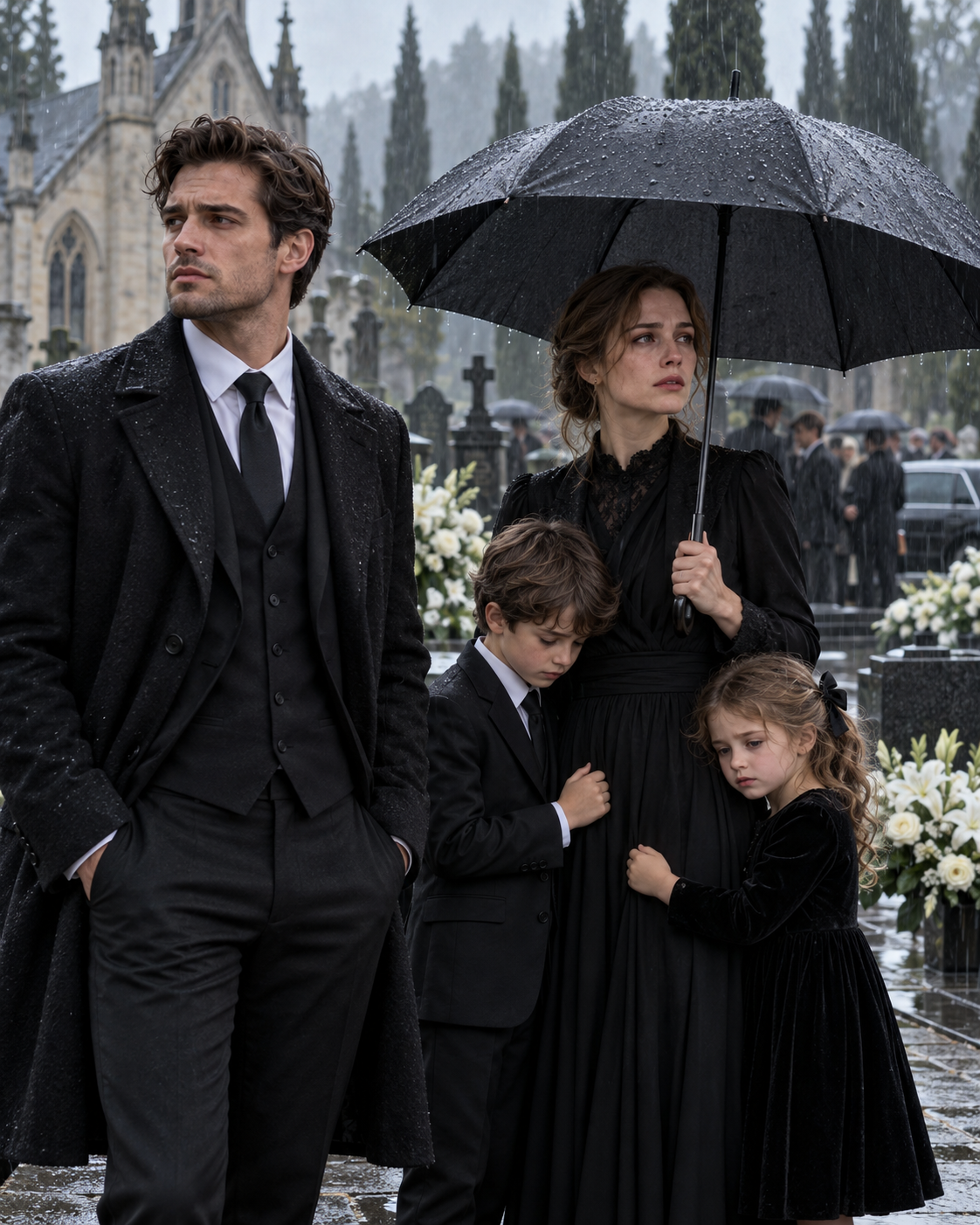
At my mother’s funeral in the rain, our family lawyer stepped between me and the woman holding two children with my eyes
For several seconds, I could only stare at the envelope, listening to the quiet sounds coming from the children’s bedroom.
My mother’s handwriting was unmistakable, every letter perfectly formed, every word arranged as if even her final message expected obedience.
Claire emerged from the bedroom and found me standing motionless beside the door.
“What is it?”
I handed her the envelope.
She read the sentence twice, then looked at me with an expression I could not decipher.
“Does your mother have a blue room?”
“She had everything,” I replied bitterly. “A blue room would hardly surprise me.”
But I remembered the place immediately.
At the far end of the estate’s west corridor stood a locked room that had once belonged to my father, Thomas Harrington, who died when I was seventeen.
After his death, my mother ordered the room sealed, explaining that the memories inside were too painful for the family.
I had never questioned her.
I had spent my entire life mistaking silence for respect.
The next morning, I found Arthur in his office and placed the envelope on his desk.
His face went pale.
“You know something,” I said.
He removed his glasses and rubbed the bridge of his nose.
“Your mother gave me instructions concerning that room several months ago.”
“What instructions?”
“To ensure you received this letter after her death.”
“Why didn’t you tell me about the room?”
“Because she specifically ordered me not to.”
I laughed without humor.
“Of course she did.”
Arthur stood and reached into a locked drawer, withdrawing a small brass key.
“Daniel, before you open that door, you need to understand something.”
I waited.
“Your mother was not simply afraid of losing control of you.”
He looked toward the window.
“She was afraid you would discover how much control she had already lost.”
His words followed me down the corridor.
The blue room was smaller than I remembered, its walls painted a faded midnight shade and its curtains heavy with dust.
A photograph of my father sat on the fireplace mantel, beside an old wooden model sailboat we had built together when I was a child.
For a moment, I was seventeen again, standing beside his hospital bed while my mother promised that everything would be all right.
Then I noticed the filing cabinet beneath the window.
It was open.
Inside lay dozens of envelopes, each bearing Claire’s handwriting.
Some were dated weeks after our divorce.
Others carried dates from years later.
There were birthday cards, photographs, handwritten notes, and letters addressed to me in careful, familiar script.
My hands began to shake.
I picked up the first envelope and turned it over.
The flap had never been opened.
Neither had the second.
Neither had the third.
Claire entered behind me, and I heard her sharp intake of breath.
“Oh, my God.”
She approached the cabinet slowly, as though she were afraid the letters might disappear if she moved too quickly.
One envelope contained a photograph of Claire sitting in a hospital bed, holding two newborn babies.
On the back, she had written, “Christopher and Sarah, three days old, October 14.”
Beneath it was a letter dated two weeks after their birth.
Daniel, I don’t know whether this will reach you, but I have to try one more time.
They are beautiful, and they have your eyes.
I don’t want your money or your mother’s house.
I want you to meet them before they learn to call someone else their father.
I stopped reading because the paper had begun trembling in my fingers.
Claire covered her mouth.
“I sent eleven letters,” she whispered. “I counted them because I wanted to remember every time I tried.”
I looked into the cabinet and discovered a folder bearing my mother’s initials.
Inside were copies of payments made to a private legal firm, correspondence from investigators, and a typed summary of Claire’s financial circumstances.
My mother had documented everything.
She knew where Claire lived, what she earned, how much she spent on rent, and which daycare the children attended.
There was even a photograph of Christopher and Sarah at a playground, holding hands beneath a bright yellow slide.
On the back, my mother had written one sentence.
They look like Daniel.
For seven years, she had known.
For seven years, she had watched my children grow from a distance while allowing me to believe they did not exist.
Claire sank into a chair.
“I thought she would stop eventually,” she said. “I thought that if I kept trying, someone would finally tell you the truth.”
“Why didn’t you call me directly?”
She looked at me, and the pain in her eyes made the question feel cruel.
“I did.”
She explained that she had called my office, my apartment, and the assistant whose number she remembered from our marriage.
Every time, she had been told I was unavailable or had explicitly asked not to speak to her.
Then my mother’s lawyers sent her a formal warning threatening to portray her as a gold-digging ex-wife who had fabricated a pregnancy to secure a financial settlement.
When Claire threatened to expose the truth, my mother offered her money in exchange for leaving the state and signing an agreement never to approach me or the company again.
“She said you would fight me for custody,” Claire told me. “She said your lawyers would destroy me, and that the children would grow up watching their parents tear each other apart.”
“You should have told someone.”
“I was twenty-seven, Daniel, with two babies and barely enough money to keep us in a safe apartment.”
Her voice broke.
“You had an empire behind you, and I had no idea how far your mother would go.”
I wanted to argue.
I wanted to insist that I would have found her, that I would have chosen my children, that nothing could have kept me away if I had known.
But the letters lay between us, each one a quiet accusation against the man I had believed myself to be.
I had not known the truth.
Yet I had never questioned why my mother’s version of events always made her the reasonable one and everyone else the enemy.
That afternoon, Arthur joined us in the blue room and revealed a final document hidden inside the folder.
It was a handwritten confession signed by my mother six months before her death.
She admitted to intercepting Claire’s correspondence, threatening her with litigation, and arranging the payment that forced her from our lives.
She also acknowledged commissioning a private investigator to confirm the twins’ paternity.
The trust had been created only after she received that confirmation.
“Why leave this confession?” I asked Arthur. “Why hide it until now?”
“Your mother said she wanted you to understand the full truth before making a decision about your future.”
I stared at him.
“Was that before or after she tried to dictate whom I should marry?”
Arthur looked uncomfortable.
“I believe she intended the will to force you to reconsider your priorities.”
“By stealing seven years from my children?”
He had no answer.
At the bottom of the confession, my mother had written a paragraph in a hand that looked strangely unsteady.
I told myself I was protecting my son from a woman I considered unsuitable.
In truth, I was protecting myself from a life I could not control.
I believed money could repair whatever my decisions destroyed.
I was wrong.
The words should have comforted me.
Instead, they made my anger sharper, because an apology written after death could never give Christopher his first day of school back or return the birthdays Sarah had spent waiting for a father who did not know her name.
Claire folded the confession and placed it on the desk.
“I don’t want revenge,” she said. “I want them to have a father who doesn’t make them feel like they’re asking too much.”
I looked toward the photograph of my newborn children.
“Then that’s what they’ll have.”
She did not smile.
“You can’t promise that after one emotional morning.”
“I know.”
“Being their father means showing up when they’re difficult, when they’re angry, when they ask questions you don’t know how to answer.”
“I know.”
“And it means not using them to get me back.”
Her final words struck harder than any accusation.
I held her gaze.
“I won’t.”
That evening, Christopher found me sitting on the floor outside his bedroom, struggling to assemble a wooden puzzle he had abandoned.
He watched me for a while before speaking.
“Are you staying in the house because Grandma left it to you?”
I set down a puzzle piece.
“I live here because it’s my home.”
“Will you go away if she takes it back?”
I looked at his small face and understood that his question had very little to do with the mansion.
He wanted to know whether love could be withdrawn when the price became too high.
“No,” I said, moving aside to make room for him. “Even if I lose this house, I’ll still be your dad.”
He considered my answer carefully.
Then he sat beside me and began fitting the pieces into place.
It was not forgiveness.
It was a beginning.
Over the following days, I discovered that becoming a father was less about grand gestures than showing up for small, ordinary things.
I learned that Sarah refused to eat carrots unless they were cut into stars.
I learned that Christopher counted the steps between his bedroom and the kitchen whenever he felt nervous.
I learned how to braid hair badly, how to read dinosaur books in ridiculous voices, and how to keep my patience when two children asked the same question twelve different ways.
At bedtime, I began sitting between their beds and reading until their eyelids grew heavy.
Sometimes Christopher fell asleep before the second chapter.
Sometimes Sarah reached for my hand in the dark, then pretended she had only been adjusting her blanket when she realized what she was doing.
Each small gesture felt like receiving something precious that I had not earned.
Claire watched from a careful distance.
We spoke about the children, their routines, their fears, and the things I had missed.
We did not speak much about our marriage.
When we did, the conversations were painful.
“You always let your mother answer for you,” Claire told me one night as we stood in the kitchen.
“I thought she knew better.”
“You were a grown man, Daniel.”
“I know.”
“And I loved you enough to believe you would eventually see what she was doing.”
I leaned against the counter.
“I should have trusted you.”
“Yes,” she replied. “You should have.”
She did not soften the truth to spare me.
I began to understand that rebuilding a family did not mean convincing Claire to forgive me for things I had not personally done.
It meant accepting that the harm was real even when my intentions had never been malicious.
Meanwhile, Harrington Industries was becoming impatient.
The board scheduled an emergency meeting and demanded that I explain my personal circumstances before the will’s conditions became a threat to the company’s stability.
The chairman, Richard Coleman, had spent twenty years cultivating relationships with my mother and considered himself the guardian of everything she had built.
He met me in the library before the meeting, his expression tight with disapproval.
“Your mother believed the family name carried obligations,” he said. “The company cannot afford another scandal.”
“My children are not a scandal.”
“I am speaking about perception.”
“You’re speaking about a six-year-old boy and girl as if they were a bad quarterly report.”
His jaw tightened.
“Your mother expected you to marry someone who could support your position and protect the company.”
I thought of Claire’s letters hidden in a dusty cabinet and the photograph of two newborn babies my mother had never allowed me to hold.
“Then my mother expected too much from a world she had mistaken for her own.”
Richard leaned forward.
“You could resolve this quickly by marrying someone appropriate.”
I recognized the suggestion immediately.
One of the board’s largest investors had a daughter named Vanessa, a polished and ambitious woman who had made no secret of her interest in me.
She had already sent a congratulatory note following my mother’s death and offered to help me navigate the family transition.
A marriage to Vanessa would satisfy the board’s expectations, preserve the controlling shares, and keep the mansion in my possession.
It would also turn my life into precisely the kind of arrangement my mother had always wanted.
When I told Claire about the conversation, she listened without interrupting.
Finally, she asked, “And what are you going to do?”
“I don’t know how to save everything without becoming the person she wanted me to be.”
Claire looked toward the children’s room.
“Maybe you don’t get to save everything.”
The simplicity of her answer frightened me more than the possibility of losing the mansion.
My whole life had been built around preserving what my mother considered valuable.
For the first time, I was being asked to decide what I valued.
Two weeks after the will reading, the paternity test results arrived.
The laboratory confirmed what my heart had already begun to accept.
Christopher and Sarah were my biological children.
Arthur arranged the necessary documents to secure their trust, which was protected independently of the marriage provision.
The money would cover their education, health care, and future needs, even if I lost the shares and the estate.
When I told Claire, she closed her eyes in relief.
“At least she can’t take their future away from them,” she whispered.
“No,” I replied. “But I won’t let money become the only thing I give them.”
That night, I found Sarah sitting beside the nursery window, clutching a photograph of my mother that she had discovered among the family albums.
She was tracing the older woman’s face with one small finger.
“Is Grandma mean?”
The question caught me off guard.
I sat beside her.
“Grandma did something very wrong.”
“Did she hate us?”
I took a breath.
“I don’t know what she felt, sweetheart, but I know she should never have kept us apart.”
Sarah studied the photograph.
“Maybe she was sad.”
Children possess a frightening ability to make room for possibilities that adults have already buried under anger.
“Maybe she was,” I said. “But being sad doesn’t make it okay to hurt people.”
She nodded as though she were filing the answer away for some future mystery.
Then she handed me the photograph.
“Can we put this away?”
I placed it inside a drawer rather than throwing it out.
I was not ready to forgive my mother, but I no longer wanted her choices to determine every decision I made.
The decisive moment came at the company’s annual shareholders’ meeting.
By then, I had spent weeks working with Arthur and an independent probate attorney to examine the will’s conditions and the evidence hidden in the blue room.
The confession gave us grounds to challenge the provision, although neither lawyer could promise how a court would rule.
The process would be costly, public, and uncertain.
I could avoid it all by marrying Vanessa before the year expired.
She called me the night before the meeting.
“I know this isn’t the romantic beginning either of us would have chosen,” she said, “but we could make it work.”
I appreciated her honesty.
“I don’t think it would be fair to either of us.”
“Because of Claire?”
“Because I refuse to build a marriage around a threat.”
She was silent for a moment.
Then she said, “Your mother would have hated that answer.”
For the first time in my life, I smiled at the thought.
“Yes,” I said. “She probably would have.”
The next morning, I entered the boardroom carrying copies of my mother’s confession and the intercepted correspondence.
I did not distribute the children’s private photographs or expose Claire’s most painful letters.
I had learned enough about power to understand that telling the truth did not require turning innocent people into public entertainment.
Richard opened the meeting by outlining the risks to the company if my personal affairs remained unresolved.
He spoke about reputation, continuity, and shareholder confidence.
He did not mention fatherhood once.
When he finished, I stood.
“My mother’s will demands that I marry a suitable partner within one year, or I lose control of this company and the family estate,” I said. “For most of my life, I would have done whatever she required.”
I placed the confession on the table.
“But I have learned that the same woman who wrote those conditions also intercepted eleven letters from my ex-wife, threatened her with legal action, and concealed the existence of my children.”
The room fell silent.
“She told me I had been abandoned,” I continued. “The truth is that she made abandonment look like a choice I had already made.”
Richard looked at the document but did not touch it.
“Are you suggesting that your mother acted against the company’s interests?”
“I am suggesting that the company is not entitled to decide whom I love or whether my children deserve a place in my life.”
One of the directors cleared his throat.
“What happens to your shares?”
“If the condition stands, they may be transferred to the foundation named in the will.”
“And the mansion?”
“I may lose that, too.”
The words tasted like defeat, but I kept speaking.
“I will challenge the condition through the proper legal process, and I will defend my children’s privacy. But I will not marry someone to satisfy a dead woman’s instructions, and I will not pretend my family is a liability just because that makes the board more comfortable.”
For a moment, I saw my mother’s face as clearly as if she were seated across the table.
I imagined her telling me to sit down, lower my voice, and remember who had paid for everything I possessed.
Then I remembered Christopher asking if I would disappear when the house was gone.
I had my answer.
“I built much of my life trying to prove I deserved my inheritance,” I said. “Now I would rather my children grow up knowing they never had to earn my love.”
No one applauded.
This was not the kind of room where people applauded honesty.
But when I sat down, something in my chest finally loosened.
The board postponed its decision pending a legal review of the confession and the contested provision.
Nothing had been won, and the threat to the shares remained.
But for the first time, I had made a decision without trying to imagine what my mother would think of it.
The following months were difficult.
Lawyers examined documents, the board debated its options, and financial advisers explained how much my life would change if I lost control of Harrington Industries.
Some nights, I lay awake calculating the cost of every possible future.
Other nights, I listened to Christopher and Sarah laughing in the room next door and wondered how I had ever mistaken wealth for security.
Claire and I grew closer, but not in the effortless way I once imagined reconciliation should feel.
There were arguments about bedtime, school routines, and the fact that I sometimes overcompensated for my lost years by saying yes to everything.
One afternoon, Christopher asked for an expensive toy I had seen advertised, and when I agreed immediately, Claire pulled me aside.
“You don’t have to buy back the time you missed,” she said.
“I just want them to be happy.”
“They need you to teach them what matters, not how much you can spend.”
She was right.
I returned the toy to the shelf and spent Saturday building a cardboard castle with them instead.
Sarah painted the walls purple, Christopher insisted on drawing a moat full of sharks, and the three of us remained on the living room floor until dinner.
It was the cheapest thing I had done in years.
It was also one of the happiest.
As the deadline approached, the legal challenge remained unresolved, and Arthur finally delivered the news we had been dreading.
Unless the estate agreed to suspend or renegotiate the provision, the controlling shares and the mansion would pass to the designated charitable foundation when the year expired.
The lawyers could continue the challenge, but there was no guarantee that the court would rule in my favor.
I walked through the mansion that evening, past the portraits, the marble staircase, and the windows overlooking the gardens where I had played as a child.
I realized I had spent years believing this house was the physical proof of my mother’s love.
But the house had never held me when I was frightened.
It had never told me I was enough.
It had never asked whether I was happy.
My children had done all those things without even understanding they were doing them.
When I returned to the east wing, Claire was sitting on the floor helping Sarah arrange her stuffed animals.
“I might lose the house,” I told her.
She looked up.
“I know.”
“And the company may never be mine in the same way again.”
“I know that, too.”
I sat beside her.
“I don’t know what our life will look like next year.”
Claire studied me for a long moment.
“Neither do I.”
There was no promise of reconciliation, no declaration that the past had somehow vanished, and no easy assurance that love would solve everything.
Then Christopher ran into the room holding a drawing.
It showed four people standing beneath a yellow sun beside a small blue house.
Above the tallest figure, he had written DAD in enormous, uneven letters.
“That’s our new house,” he announced. “It’s not as big, but there’s room for all of us.”
I looked at the drawing until the words blurred.
“It’s perfect,” I whispered.
The deadline arrived on a cold October morning.
After months of negotiation and legal uncertainty, I signed the documents allowing the estate’s controlling shares and the mansion to pass to the foundation while our challenge continued through the courts.
The decision meant surrendering the privileges I had spent my life protecting.
It also meant the children could stop growing up beneath the shadow of a condition that treated marriage as a financial transaction.
Claire and I moved into a modest house outside the city, with a creaking staircase, a small garden, and a kitchen that became crowded whenever the twins insisted on helping me cook.
Harrington Industries continued without my controlling vote, and I accepted a smaller executive role while the board reconsidered its long-term structure.
I was no longer the unquestioned heir.
For the first time, that did not feel like the end of the world.
Claire agreed that we could explore our relationship slowly, without promises neither of us was ready to make.
We began with honest conversations, shared school runs, and quiet evenings after the children went to sleep.
Some nights, we remembered the people we had been before my mother interfered.
Other nights, we allowed ourselves to imagine who we might become.
We never pretended that love could erase what had happened.
It could only give us the courage to build something different.
One evening, nearly a year after the funeral, I found Christopher standing beside the front door with his backpack on his shoulders.
“What’s wrong, buddy?”
He looked down at his shoes.
“Tomorrow is my school field trip.”
“I know.”
“You said you’d come.”
I knelt in front of him.
“I’ll be there.”
He studied my face, searching for something I could not name.
“Even if your work gets important?”
The question struck a place inside me that still hurt.
I thought of the letters in the blue room, of all those mornings and birthdays I had missed without knowing they existed.
Then I thought of the mother who had tried to measure love through wealth, appearances, and obedience.
“Especially then,” I told him. “You are important, too.”
Christopher threw his arms around my neck, and I held him tightly enough to feel his small heart beating against mine.
That night, after the children were asleep, I opened the last letter my mother had left in the blue room.
It contained no instructions, no legal conditions, and no attempt to arrange my future.
Only one sentence had been written on the final page.
I hope one day you will remember me as more than the worst thing I ever did.
I sat with those words for a long time.
I could not promise forgiveness, and I could not pretend her confession returned the years she had stolen.
But I could refuse to let her worst decision become the inheritance I passed on to my children.
I folded the letter and placed it inside a drawer beside Christopher’s drawing of our little blue house.
The next morning, I stood at the school gate while my son ran toward the bus, waving so enthusiastically that his backpack bounced against his shoulders.
Sarah stood beside me, her fingers wrapped around mine.
“Daddy?”
“Yes, sweetheart?”
“Will we always be a family?”
I looked at her, then toward Christopher climbing aboard the bus.
“We won’t always get everything right,” I said. “But I will keep showing up, and we’ll keep finding our way back to each other.”
She seemed satisfied with that answer.
As the bus disappeared around the corner, I felt the strange, quiet certainty that my life had finally become my own.
My mother had left me a mansion, a company, and a fortune full of conditions.
My children had given me something none of those things could purchase: a reason to become a better man.
And as I walked home beside Claire, her hand brushing mine, I understood the truth my mother had spent a lifetime trying to avoid.
A legacy is not the house that bears your name, the money you leave behind, or the people you force to remain beside you.
It is what the people you love believe about love after they have known you.
I could not change the years I had lost, and I could not undo the choices my mother had made.
But I could choose what happened next.
For the first time in my life, no inheritance, no threat, and no dead woman’s instructions stood between me and the people waiting for me at home.