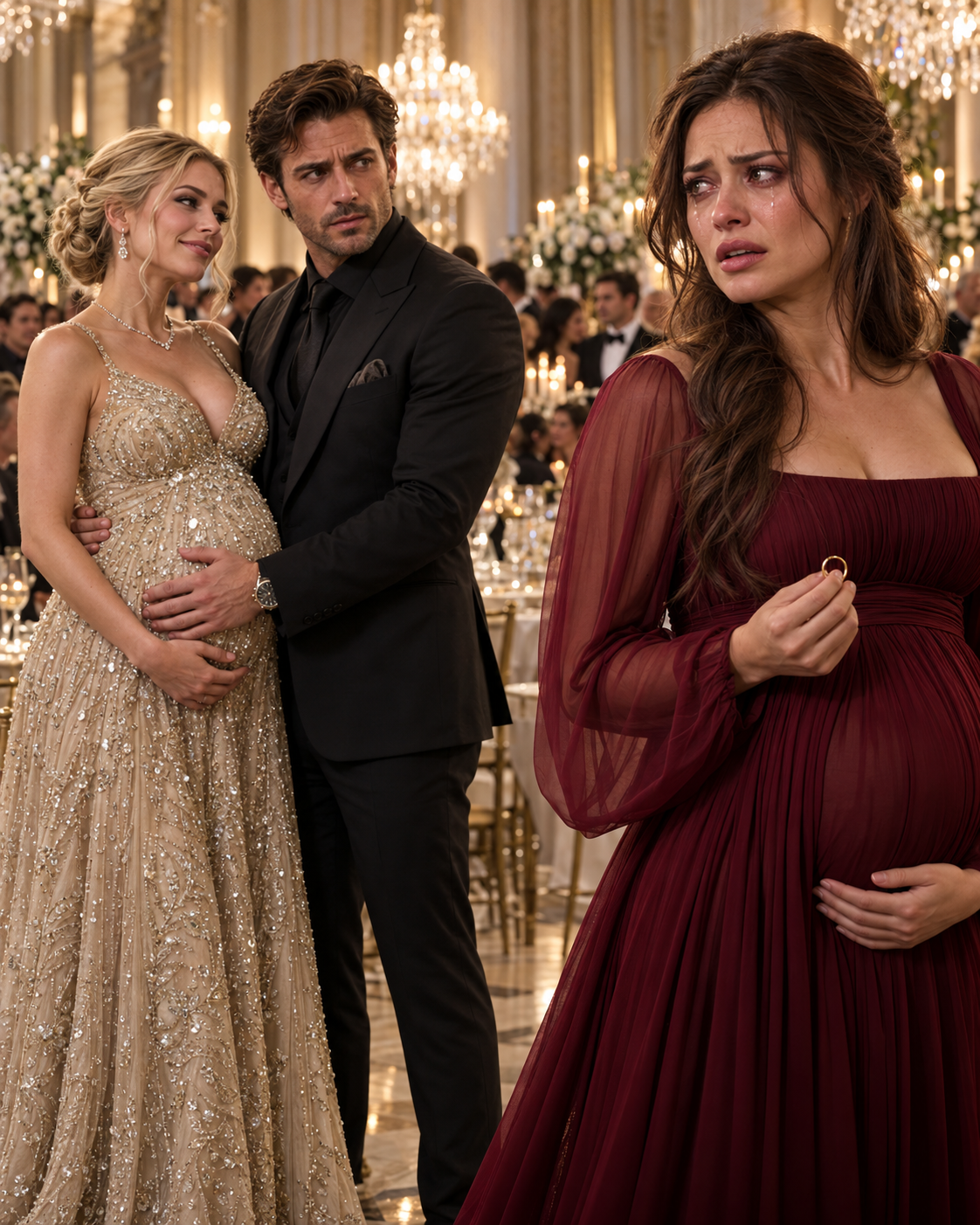
At my husband’s black-tie family gala, he rested a hand on another pregnant woman’s stomach and announced her baby
Part 2
The first week was harder than I had expected.
I had imagined that leaving would feel like stepping out of a burning building, that the moment I closed the door behind me, I would finally stop feeling the heat.
Instead, I woke every morning with my heart racing, reaching instinctively for a man who was no longer beside me, then remembering that he had never truly been there in the way I needed.
I rented a small apartment with two bedrooms, even though I needed only one at the time, because I wanted my child to have a room that belonged to them from the beginning.
The walls were bare.
The refrigerator hummed loudly at night.
I bought groceries, learned the neighborhood, and carried my own bags upstairs without waiting for someone to appear at my shoulder.
Ordinary things became small victories.
I made my first prenatal appointment under my own name, and when the nurse asked whether my husband would be joining me, I looked down at the appointment card before answering.
“I’m not sure what he’ll be doing,” I said.
It was the first time I had admitted that I no longer knew who Michael was.
Two days later, his attorneys arrived at the foundation.
They were polished, expensive, and practiced in making threats sound like professional courtesy.
They offered to arrange a private residence, a personal security team, and a monthly allowance large enough to ensure I would never need to work again.
In exchange, I was asked to sign a confidentiality agreement, agree to a period of reconciliation counseling, and refrain from making decisions regarding the pregnancy without informing Michael’s legal representatives.
The final document included a clause allowing his security department to maintain discreet awareness of my movements for my protection.
I read every page before setting the papers down.
“You can take these back,” I said.
One attorney folded his hands. “Mrs. Callahan, this arrangement would protect you and the baby. Your husband is concerned about your sudden departure.”
“My husband announced another woman’s pregnancy to an entire ballroom while I stood there holding the announcement for his own child.”
The attorney’s expression shifted.
“I understand that emotions are high.”
“No,” I replied. “You understand that your client expected me to behave the way I always have, and now you’re trying to turn my independence into a medical condition.”
“We’re simply attempting to prevent misunderstandings.”
“Then let’s remove the misunderstandings. I will not accept a residence purchased by your client, money he can use to control me, or security personnel who report my movements to him. I will not sign away my privacy to prove I am reasonable.”
They glanced at one another.
I continued before they could interrupt.
“I will receive what I am legally entitled to receive from the marriage, and nothing more. My employment will remain my own. My medical decisions will remain my own. Any future arrangements involving our child will be made through independent legal counsel and, when appropriate, the proper court process.”
The older attorney leaned back.
“Mr. Callahan may not appreciate being excluded from decisions about his child.”
“He excluded himself when he made a spectacle of choosing someone else in front of me. He can establish his rights as a father through the proper channels. He does not get to purchase his way back into my life as a husband.”
I watched them collect their documents.
For the first time, I understood that power was not always the loudest person in a room.
Sometimes it was the woman who had every reason to cry, who knew she was frightened, and who still refused to sign her name beneath something she did not believe in.
I hired an independent attorney who had no business ties to the Callahan family.
The separation process was ugly in the way expensive separations often are, full of letters, negotiations, and attempts to define a person’s freedom in financial language.
Michael’s representatives questioned my ability to support myself without the privileges of his household.
They suggested that leaving without notice demonstrated instability.
They asked whether I might reconsider if he agreed to limit Bianca’s involvement in his life.
I rejected that proposal immediately.
“His relationship with Bianca is his responsibility,” I told my attorney. “His relationship with our child will be decided by what is safe and healthy for the child. Neither one has anything to do with whether I return to him.”
The thought surprised me by how little it hurt.
I was still devastated, but the devastation no longer controlled my decisions.
I did not want revenge money.
I did not want his business secrets, his enemies’ names, or the ability to destroy what he had built.
I wanted my own income, my own address, my own medical decisions, and the right to raise my child without constantly wondering which part of my life he believed he owned.
When the attorneys proposed a temporary communication arrangement, I accepted one carefully defined channel for matters relating to the pregnancy and, eventually, our child.
No calls late at night.
No unannounced visits.
No gifts delivered to my home.
No messages passed through friends or employees.
No security team outside my building.
And no surveillance disguised as concern.
Michael signed the restrictions after his attorneys explained that violating them could damage his position in any future custody proceedings.
I would have preferred that he understood the reasons without needing a legal warning.
Still, I accepted his compliance for what it was.
A boundary did not need an apology to be valid.
For a while, his messages came through the designated channel with the stiffness of business correspondence.
I understand you have an appointment on Thursday. Please let me know if there is anything medically necessary that I should provide.
I answered only when an answer was required.
The appointment is routine. No financial assistance is needed.
Another message arrived three days later.
I would like to know whether the baby is healthy.
I stared at the screen for a long time.
The old version of me wanted to send a photograph of the ultrasound, to soften the distance and reassure him that he had not lost everything.
The woman I was becoming understood that I did not owe him intimacy simply because we shared a child.
The baby is healthy. Updates will be provided as appropriate.
I sent it, then put the phone down.
He did not reply.
I heard through our attorneys that he had begun dividing his time between his business obligations and Bianca’s growing child.
The news reached me without drama.
He attended medical appointments when invited, arranged a separate residence for Bianca and the baby, and made financial provisions without demanding that she become his wife.
I wondered sometimes whether he had behaved more honestly with her than he had with me.
Then I reminded myself that I did not know their private life, and that I no longer needed to investigate it.
Bianca did not contact me.
I was grateful for that.
Whatever she knew before the gala, whatever promises Michael had made her, I could not repair my marriage by turning another woman into a villain.
Michael had stood at the microphone.
Michael had placed his hand on her stomach.
Michael had looked at me and decided that my pain was a price he could afford.
Those choices belonged to him.
As my pregnancy progressed, I began returning to the foundation full-time.
For years, I had helped oversee its family-services program, arranging emergency housing, childcare assistance, and legal support for women trying to escape dangerous homes.
After I left Michael, the work changed for me.
I understood the woman who sat across from me with trembling hands and a carefully rehearsed explanation for why she had not left sooner.
I no longer told anyone that leaving was simple.
I told them that they did not have to decide everything that day, but they deserved to know that a different life could exist.
The board agreed to formalize my role independently of Michael’s personal office, with clear reporting lines and financial oversight.
It was a practical arrangement, not a dramatic declaration of war.
For the first time, I had a career whose success did not depend on whether my husband approved of my choices.
Some evenings, after meetings, I sat in the quiet apartment and opened the folder of baby names on my laptop.
I bought a crib with my own salary.
I folded tiny clothes into drawers.
I learned how to distinguish the movements that felt like soft flutters from the stronger kicks that made me stop halfway through a sentence.
And gradually, my fear began to make room for something else.
Anticipation.
I was going to meet a person who would never know the woman I had been in that ballroom, unless I chose to tell them.
I wanted my child to know that love could be strong without being frightening, that loyalty did not require silence, and that apologies meant little if the behavior never changed.
Michael never appeared outside my home.
He never sent a car to follow me.
He never used one of his men to obtain a photograph of the baby before I chose to share one.
I had expected him to fight every boundary, because that was how he handled the world.
Instead, he obeyed them with the grim discipline of a man who had finally encountered something he could not force.
Once, my attorney told me Michael had asked whether I hated him.
I sat with that question for a long time.
“No,” I finally said. “I don’t hate him.”
Then I looked out at the gray Chicago morning.
“But I don’t confuse not hating someone with needing them in my life.”
That answer was forwarded through the proper channel.
I never learned what Michael did after reading it.
By the time the first snow covered the city, I had stopped counting the days since the gala.
I was counting kicks, prenatal appointments, and the weeks until I could hold my child.
The old life still existed somewhere behind me, guarded by iron gates and men who answered to Michael.
But it no longer stood between me and the future.
Part 3
Labor began just after midnight on a rainy Thursday.
I woke with a sharp tightening across my abdomen, sat on the edge of the bed, and waited for the pain to pass.
When another came minutes later, I called the hospital.
By the time the car reached the entrance, the rain had turned the pavement silver beneath the streetlights.
Everything happened in fragments after that: the bright corridors, the nurse asking me to breathe, the pressure of my fingers around the bedrail, and the overwhelming realization that I was about to meet the person for whom I had changed the entire shape of my life.
Between contractions, I told the nurse that the baby’s father could be contacted through my attorney.
She asked whether I wanted him present.
I closed my eyes.
For months, I had imagined this moment and played out every possible version of it.
In some, Michael arrived angry and demanded to be let in.
In others, he begged forgiveness until I felt guilty for refusing him.
In the worst version, I looked at him and forgot everything he had done because seeing him hurt reminded me that I once loved him.
But none of those versions had to become real.
“Tell him he may come,” I said. “He can enter only if I say so, he cannot bring anyone with him, and he leaves the moment I ask. He is here as the baby’s father, not as my husband.”
The message was delivered through my attorney.
Michael arrived forty minutes later.
I did not see him at first.
I heard his voice outside the room, unusually quiet as he spoke to the nurse, followed by a long silence while he waited for permission.
When he finally entered, the man who had once commanded entire rooms looked as though he was afraid to take another step.
His hair was damp from the rain.
He wore a dark coat over a shirt that had not been buttoned properly at the collar.
He looked at me, then at the monitors, then at my swollen stomach.
“Sarah.”
His voice broke on my name.
I was too tired to comfort him.
“Wash your hands,” I said. “The nurse will show you what to do.”
He obeyed immediately.
For the next hour, I focused on bringing our baby into the world while Michael stood where the nurse told him to stand, silent and pale.
When the first cry finally filled the room, I began to sob.
Not because I had forgiven him.
Not because the pain was over.
I cried because the baby was real, because those tiny fingers were moving, because after months of fear and uncertainty, I could finally see the face I had imagined while lying awake in the dark.
A nurse placed our son against my chest.
He was warm, impossibly small, and furious about being born.
I laughed through my tears.
“Hello, sweetheart,” I whispered.
Michael stood beside the bed with both hands pressed against his mouth.
I had never seen him cry.
He did not make a sound, but tears slipped down his face as he looked at the child who had entered the world without knowing any of the things his father had done.
“Would you like to hold him?” I asked.
Michael looked at me as if he could not believe I had offered.
“Yes,” he whispered. “Please.”
The nurse helped him settle into the chair beside my bed and showed him how to support the baby’s head.
When she placed our son in his arms, Michael went completely still.
The baby opened his mouth in a tiny yawn, stretched one hand against Michael’s shirt, and then settled against his chest.
Michael looked down at him with an expression I could not bear to watch for too long.
“I didn’t know,” he said.
I knew what he meant.
He had not known about the pregnancy at the gala.
He had not known the little socks were meant for his child.
He had not known that he had been standing a few feet away from the beginning of a future I had wanted to share with him.
But he had known that he was humiliating his wife.
He had known that his announcement would hurt me.
And he had done it anyway.
“I know,” I said softly. “But now you do.”
He swallowed, looking at the baby.
“What do I call him?”
“Elliot.”
He repeated the name as though he wanted to memorize every sound.
“Elliot.”
For several minutes, neither of us spoke.
Then Michael looked toward me.
“I’m sorry.”
I believed that he meant it.
I also understood that remorse and repair were not the same thing, and that one honest moment could not erase months of choices.
“I believe you are,” I said.
His eyes searched my face for something more: forgiveness, perhaps, or an opening he could mistake for an invitation.
I did not give him one.
“I want to be a good father to him,” he said.
“Then be one.”
“I want to be there for both of you.”
“You can be there for him. What happens between us is different.”
He lowered his eyes.
For once, he did not argue.
When it was time for him to leave, he kissed Elliot’s forehead and carefully handed him back to me.
He stood beside the door for a moment, looking as though he wanted to say a hundred things.
Instead, he nodded.
“I’ll follow the arrangement,” he said.
“I expect you to.”
Then he walked out.
I watched the door close and waited for the old ache to rise, for the part of me that still loved him to demand that I call him back.
It never came.
There was sadness, certainly.
There would always be some sadness for the life I had once believed we would have.
But I held Elliot against my chest, listened to his breathing, and felt something stronger than regret.
Peace.
The months that followed were not perfect, but they were honest.
Michael established a formal parenting arrangement and followed it without demanding extra access or treating each visit as an opportunity to discuss our marriage.
He learned Elliot’s feeding schedule, arrived when he was supposed to, and asked questions instead of assuming he knew what was best.
He made mistakes, as every new parent does, but when I corrected him, he listened.
I did not reward those efforts with affection.
I did not punish him by withholding a relationship with his son.
I simply allowed him to be responsible for the choices he made now, the same way I had refused to carry responsibility for the choices he had made before.
Sometimes I heard news about Bianca and her child, who had become Michael’s first public responsibility as a father.
I hoped the child was safe and loved.
Beyond that, their lives were no longer mine to manage.
The foundation continued to grow, and I began leading a new housing initiative for mothers who needed a safe place to begin again.
I moved into a brighter apartment with sunlight in the nursery and enough room for a small table where I could work while Elliot slept.
My home was not grand.
Nobody bowed when I entered a room.
No one checked the locks three times because a powerful man’s enemies might be watching.
It was simply a place where I could leave a cup of tea on the table, sing badly while folding laundry, and make decisions without measuring every word against someone else’s temper.
I had once believed that being chosen by Michael meant I had won something extraordinary.
Now I understood that the more extraordinary thing was choosing myself when he made it clear he would not choose me in the way I deserved.
Michael remained wealthy.
He retained his empire, his influence, and the title that made people lower their voices when his name was mentioned.
He still lived in the sprawling mansion where every room held something expensive and every hallway echoed when no one walked through it.
But the story I heard from people who knew him was that he had become quieter there.
He no longer hosted the lavish family dinners he once loved, and he rarely lingered in the ballroom where he had announced his heir.
Sometimes, late at night, he sat alone in the study with the navy-blue gift box beside him.
He had kept the socks.
He had kept the unfinished card.
I never asked why.
Perhaps he wanted a reminder of the moment he had finally understood what his arrogance had cost him.
Perhaps he was still waiting for me to change my mind.
I would never know, because I stopped measuring my life by what he might be thinking.
One evening, months after Elliot was born, Michael returned our son after a scheduled visit.
He stood outside my door while I settled Elliot into my arms.
For a moment, he watched the baby curl his fingers around mine.
Then he looked at me.
“You seem happy,” he said.
“I am.”
He nodded slowly, as though the answer had confirmed something he had been trying not to believe.
“I’m glad,” he whispered.
I could have told him that I was happy in spite of him.
I could have reminded him that I had once wanted him beside me for every moment that mattered.
I could have listed all the birthdays, anniversaries, quiet evenings, and ordinary mornings he would never share with me again.
But I no longer needed him to understand the full inventory of what he had lost.
So I simply said, “Good night, Michael.”
He looked at me for another second, then turned toward the elevator.
I closed the door gently.
Inside, Elliot stirred against my shoulder, and I carried him to the window where the city lights shimmered across the glass.
Somewhere in Chicago, Michael Callahan still had more money than he could spend, more influence than most men could imagine, and an empire that would survive long after his name was forgotten.
But he no longer had the woman who had loved him before the world learned to fear him, the woman who had stood in a ballroom with a tiny gift and an open heart, hoping to give him one more reason to become the man she believed he could be.
I had once thought love meant staying until the other person finally understood your worth.
Now I knew that love could be real and still not be enough to make a life safe, honest, or whole.
I kissed Elliot’s forehead and switched off the nursery light, leaving only the small lamp beside his crib glowing in the darkness.
He would grow up knowing his father, but he would never be taught that a father’s power made cruelty acceptable, or that a woman’s love required her to disappear.
And as I stood beside my sleeping son, I realized that the life I had lost was not the only life I had been given.
I had lost a mansion, a name that opened doors, and the future I had once planned with a man who believed he could have everything without consequence.
In return, I had found a quieter kind of strength, a home where no one had to earn the right to feel safe, and a child who would never be asked to mistake fear for love.
Michael had kept his empire.
I had kept myself.
For the first time in my life, that was more than enough.