At my housewarming barbecue in a quiet Ohio neighborhood, I watched the champagne bubbles fade beside an untouched brisket
I stared at the message until my screen dimmed, then tapped it awake and enlarged the photograph.
The envelope was cream-colored, slightly bent at the corners, with my name written in the blocky handwriting I had seen on birthday cards, overdue bills, and the occasional note my father left on the kitchen counter.
I hadn’t spoken to him since he stood on my porch and called me selfish.
I typed, “Who is this?”
The reply came almost immediately.
“Someone who thinks you deserve to know the truth before your parents get rid of the evidence.”
A cold sensation crept up the back of my neck.
“What evidence?”
Three dots appeared, disappeared, then returned.
“Check the county property records. Your house has a history your father never told you about.”
I nearly dismissed it as another attempt to provoke me, but something about the envelope bothered me.
My father didn’t write letters unless he wanted a paper trail.
And if the message was fake, why had someone photographed an envelope that looked exactly like the ones he kept in his desk?
I opened my laptop and searched the county auditor’s property database, entering my address with fingers that suddenly felt clumsy.
The records showed the purchase date, the previous owner, and the sale price.
Nothing seemed unusual until I clicked through the older transfers.
A name appeared beside a deed recorded more than a decade earlier.
Margaret Ellis.
My grandmother.
I sat back in my chair.
Grandma Margaret had died when I was seventeen, leaving behind a collection of yellowing cookbooks, a chipped porcelain bird, and memories of a woman who always asked about my day before asking me to fix anything.
She was the only person in my family who had ever looked at me as though I was interesting even when my hands were empty.
I remembered her sitting on her porch one summer afternoon, watching me repair a loose step.
“You know, Nathaniel,” she had said, using my full name, “you can spend your whole life fixing other people’s houses and still forget to build a home for yourself.”
I had laughed because I thought she was talking about construction.
Now I wasn’t so sure.
I searched her name again and found a reference to an estate filing.
The document was old, but one line stood out: a residential property had been transferred to a family trust before her death.
My house.
I read it twice, then a third time.
According to the public record, the property had been transferred out of the trust years later, eventually passing to a private seller before I bought it.
The dates didn’t make sense.
If Grandma had placed the house in a trust, why had I never heard about it?
And why had my father never mentioned that his mother had once owned the exact property I had spent years saving to purchase?
I called the county recorder’s office the next morning and asked how to obtain copies of the relevant deeds.
The clerk explained the process and warned me that the public index might not contain every document.
I requested the records anyway.
While I waited, I drove to the hardware store, bought a new smoke detector, and tried to convince myself that I was chasing a coincidence.
But when I returned, another message was waiting.
This time, the sender gave me a name.
“Linda Reeves. I was your grandmother’s neighbor. She asked me to contact you if your parents ever tried to sell the house again.”
I read the sentence three times.
Then I called the number attached to the message.
A woman answered on the second ring.
“Nate?”
“Yes. Who are you, and what is going on?”
She sighed softly, as if she had been waiting years for this conversation.
“My name is Linda. I lived next door to your grandmother for almost twenty years. She was a good woman, and she worried about you.”
“Why would she worry about me?”
“Because she knew your father.”
The words landed harder than I expected.
Linda told me that Margaret had bought the house when she was younger, after leaving a difficult marriage and starting over with very little money.
She had lived there for years before moving closer to her doctors, eventually placing the property in a trust intended to protect it and preserve a place for family.
“She wanted you to have a chance to own something without owing anybody for it,” Linda said.
My throat tightened.
“Why me?”
“Because you were the one who visited her when nobody else did. You brought groceries. You sat with her. You never made her feel like she was a burden.”
I closed my eyes.
I remembered those visits, the afternoons spent drinking weak tea while she told stories about her youth.
I had never thought they were anything special.
Linda continued carefully.
“Your grandmother told me she wanted you to receive the house when you were ready to make a home of your own. But your father argued that you were too young, that you’d waste it, that Chloe had greater needs.”
My stomach twisted.
“What happened to the trust?”
“I don’t know every detail. I only know there was a dispute, and your grandmother changed her plans after she realized your father wasn’t going to respect them.”
“Changed them how?”
“She left documents with her attorney. I was never given the full story. She simply told me that if you ever bought that house yourself, I should make sure you knew what she had tried to do for you.”
The room seemed to shrink around me.
I had bought my house from a seller whose name meant nothing to me, paid for inspections, signed the mortgage, and spent thousands of dollars repairing its neglected rooms.
I had done it all believing I was the first person in my family to make that dream possible for myself.
Now I was learning that my grandmother might have wanted the same thing for me years earlier.
“Do you have anything that proves this?” I asked.
“One thing,” Linda replied. “A letter she asked me to keep. I think it’s time you read it.”
We met two days later at a coffee shop near the old neighborhood.
Linda was in her sixties, with silver hair and careful hands, and she carried a small folder inside her purse.
She slid an envelope across the table.
My name was written across the front in my grandmother’s unmistakable handwriting.
I couldn’t open it immediately.
For a moment, I was seventeen again, sitting beside her hospital bed, listening to her tell me that being a good person didn’t mean allowing other people to use me.
I broke the seal.
Inside was a letter dated six months before she died.
“My dear Nate,” it began, “if you are reading this, then I hope you have found a place where you can finally rest.”
My vision blurred.
She wrote about the house, the trust, and her wish that I should have a stable home when I was ready.
She explained that my father had asked her to give him control over the property, claiming he would manage it for the whole family.
She had refused because she feared he would eventually treat the house as an asset to distribute according to his own preferences.
Then came the sentence that made my hands shake.
“Your father told me that Chloe needed security more than you did, because you were strong enough to survive without help.”
I stopped reading.
It was the same excuse I had heard my entire life.
Nate could handle it.
Nate didn’t need anything.
Nate would understand.
My grandmother had seen it before I was old enough to name it.
I forced myself to continue.
She wrote that after the dispute, she had arranged for the trust to be dissolved according to its legal terms and the property sold, with the proceeds placed in an account she hoped would eventually benefit me.
But the final arrangements had become complicated after her death.
She wasn’t certain I would receive anything, and she didn’t want me to build my future around a promise that might fail.
Instead, she left me something more important: the truth about why she had fought for me.
“You have always believed that being strong means needing nothing,” she wrote. “It does not. Strength is knowing what you deserve, even when the people who should love you refuse to give it.”
At the bottom, she had added a note in smaller handwriting.
“If you ever own a home of your own, please do not let anyone convince you that it belongs to them simply because they are family.”
I pressed the letter against my chest.
Linda waited without speaking.
After several minutes, I asked the question that had been tearing at me.
“Did my father know I was buying this house?”
“I can’t be certain,” she said. “But I saw him driving past here shortly before the sale closed. He slowed down and stared at the property.”
A thought struck me.
“What if he knew the house was being sold and never told me anything?”
Linda’s expression was sad.
“That is something you’ll need to ask him.”
I didn’t want to ask him anything.
I wanted to believe that whatever had happened years ago was the result of misunderstandings, bad decisions, or paperwork nobody had bothered to explain.
But I also knew how quickly my family had turned up when they needed my labor.
If my father had known the history of the house, his silence would have meant something.
The next day, the county records arrived by mail.
Among them was a copy of the original trust deed and a later filing documenting the sale.
The documents did not prove that my parents had stolen anything, and I refused to make that accusation without evidence.
But they confirmed that my grandmother had intended the property to serve a purpose beyond its market value.
They also showed that the trust’s remaining proceeds had been distributed to her estate according to a separate legal process.
I contacted the attorney listed in the file.
After verifying my identity, he explained that most of the estate matters had been settled years earlier, but he could review archived documents to determine whether anything had been overlooked.
He warned me not to expect a miracle.
I told him I wasn’t looking for one.
I simply wanted to understand.
A week later, my father called.
I watched his name flash across the screen before answering.
“What?” I asked.
There was a pause.
“Your mother says you’ve been talking to Linda Reeves.”
I leaned against the kitchen counter.
“Yes.”
“That woman has always had a habit of sticking her nose into things that don’t concern her.”
“She gave me a letter from Grandma.”
The silence that followed was so complete that I could hear the refrigerator humming.
“What letter?”
“The one she wrote about this house.”
My father’s voice hardened.
“Your grandmother was old and confused near the end. She had ideas about what should happen to that property, but things changed.”
“Why didn’t you tell me she wanted me to have it?”
“Because it was never that simple.”
“Then explain it.”
He exhaled sharply.
“I was trying to protect the family.”
“From what?”
“From you making a mistake you weren’t ready for.”
I stared through the window at the backyard where the string lights still hung.
“You thought I wasn’t ready to own a home, but you were happy to call me every time your house needed repairs.”
“That’s not fair.”
“Neither was leaving me alone at my housewarming while you bought Chloe a car.”
He didn’t answer immediately.
When he finally spoke, his voice was quieter.
“Your sister has always needed more help than you.”
I had heard those words in a hundred different forms.
This time, they no longer sounded like a reason.
They sounded like a confession.
“Then help her,” I said. “But stop pretending that I don’t need anything just because I learned how to survive without you.”
I ended the call before he could reply.
For the next several days, my family stayed unusually quiet.
I expected another angry message, another accusation, another emergency that would somehow become my responsibility.
Instead, my mother sent a photograph of herself and me when I was six, standing beside a Christmas tree.
Her message read, “I miss when we were close.”
I studied the picture.
I remembered that Christmas.
I had spent the morning assembling Chloe’s dollhouse because my father had forgotten to buy the tools needed to finish it.
The picture had been taken after I finally sat down, exhausted, while everyone admired the gift.
My mother had always called that a happy memory.
I had never asked her what she remembered about it.
I typed a response, erased it, and tried again.
“I miss the family I thought we were.”
She never replied.
Meanwhile, the attorney called with an update.
He had located additional correspondence concerning my grandmother’s estate, including a letter from my father requesting that certain proceeds be used to help Chloe with educational expenses.
That request, by itself, had not been improper, and the estate documents showed that the money had been handled through the arrangements then in place.
There was no dramatic hidden fortune waiting for me, no secret bank account that would suddenly make every painful year worthwhile.
But the correspondence revealed something more difficult to accept.
My father had known my grandmother wanted me to have a chance at independence.
He had disagreed with her judgment and believed Chloe’s needs should come first.
He had not simply forgotten what she wanted.
He had made a choice.
When I finally understood that, I stopped searching for a version of the story in which everything had happened by accident.
I could accept that my parents loved me in whatever limited way they knew how.
I could even accept that they believed they had good reasons for treating us differently.
What I could no longer accept was the idea that their intentions erased the damage.
A month after my housewarming, my mother appeared alone at my front door.
She looked smaller without my father standing beside her.
I almost didn’t open it, but curiosity got the better of me.
She held a paper bag containing a loaf of banana bread, the kind she used to make when I was a child.
“I thought we could talk,” she said.
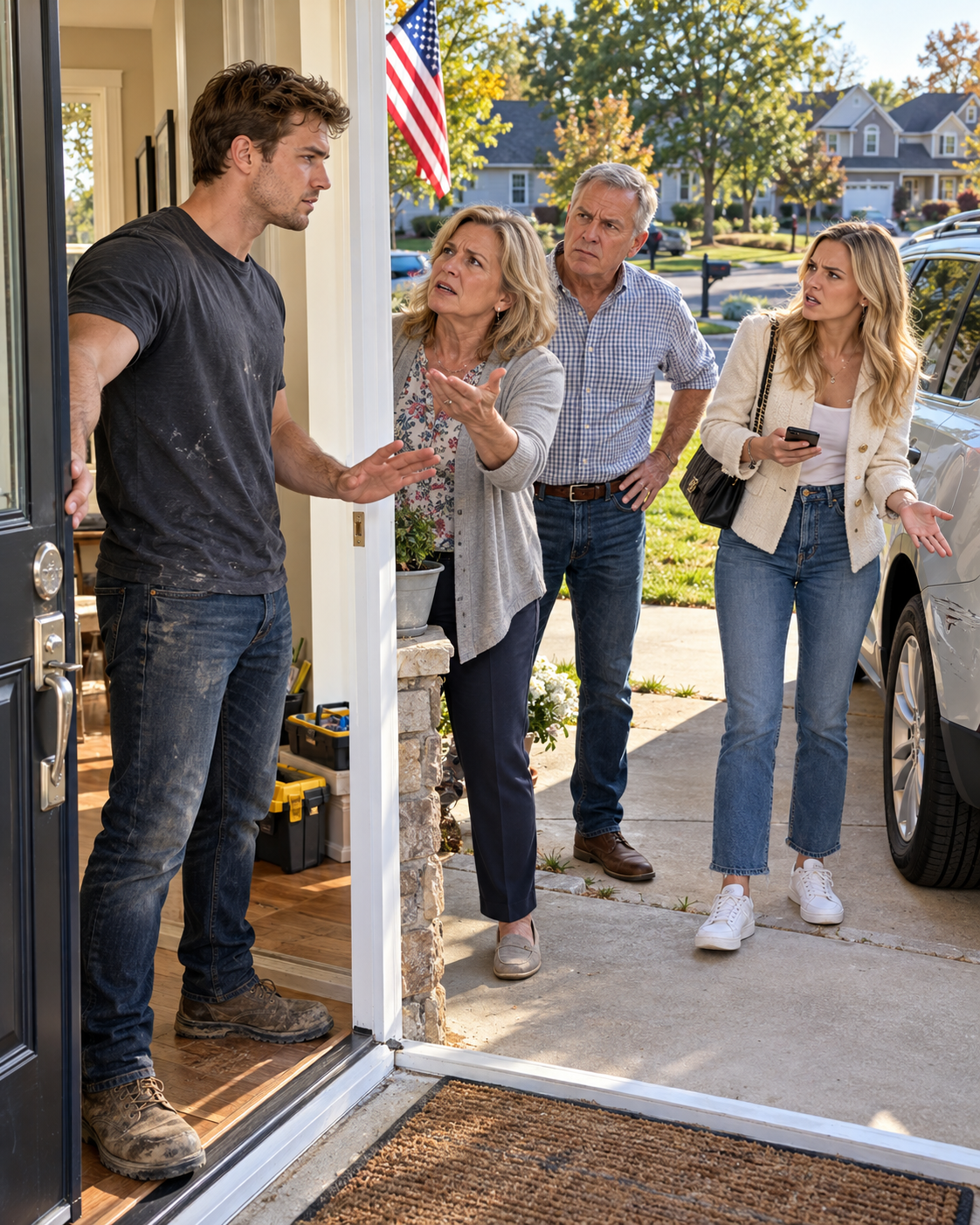
I let her stand in the doorway.
She glanced around the hallway, taking in the repaired walls, the new flooring, and the framed photograph of Grandma Margaret I had placed on the shelf.
“You’ve done a beautiful job,” she murmured.
“Thank you.”
She rubbed her hands together.
“Your father says you’re trying to make us look like terrible people.”
“I’m not trying to make anyone look like anything.”
“Then why are you shutting us out?”
I considered the question.
Because I was tired.
Because every conversation became a trial in which I had to prove my pain was real.
Because I wanted one day when someone called me simply to ask how I was doing.
But I didn’t say any of that.
Instead, I asked, “Why didn’t you come to my housewarming?”
Her eyes filled with tears.
“We thought we’d celebrate with you another time.”
“You could have called.”
“We were caught up in Chloe’s excitement.”
“You posted pictures all afternoon.”
She looked away.
“I know.”
It was the first time I had heard her admit anything without immediately defending herself.
For a moment, I wanted to let her inside.
I wanted to believe that one honest sentence could undo years of hurt.
Then she added, “You know how your sister is. She gets upset when she feels overlooked, and we were trying to make sure she felt loved.”
I felt something inside me settle.
“And what about me?”
My mother opened her mouth, but no answer came.
I looked at the banana bread in her hands.
“I don’t want gifts, Mom. I wanted you to show up.”
She began to cry.
I didn’t feel victorious.
I felt sad for both of us, for the years we had spent pretending that keeping the peace was the same thing as being a family.
“I love you,” she whispered.
“I love you too,” I said. “But I can’t keep proving it by making myself useful.”
She nodded, although I couldn’t tell whether she understood.
When she left, she took the banana bread with her.
That evening, Chloe sent me a long message accusing me of turning our grandmother’s memory into a weapon.
I read it carefully before responding.
“I’m not asking you to agree with everything I feel. I’m asking you to stop treating my boundaries like an attack.”
She replied with a single sentence.
“You’ve changed.”
For once, I didn’t take it as an insult.
Yes, I had changed.
I no longer believed that being the dependable one meant accepting whatever scraps of affection other people chose to offer.
I had learned that love could be complicated without being an excuse for cruelty, and that forgiveness didn’t require handing someone the keys to your life.
Over the following months, I kept working at the warehouse, saved money for the remaining renovations, and planted a small garden beside the fence.
The first tomatoes appeared in late summer.
I built a wooden bench beneath the maple tree and spent quiet evenings there, listening to distant traffic and the soft rustle of leaves.
Sometimes, I still wondered whether my family would ever understand what they had done.
Sometimes, I missed them so badly that I almost called.
But whenever guilt began whispering that I should go back to being the person they wanted, I remembered my grandmother’s letter.
Strength is knowing what you deserve.
I framed that sentence and placed it in my workshop, above the tools I had spent years using to repair everyone else’s problems.
One Saturday morning, nearly four months after the barbecue, a delivery truck stopped outside my house.
The driver carried a small wooden box to the porch and asked me to sign for it.
There was no return address, only my name and a short note taped to the lid.
I recognized the handwriting immediately.
It belonged to my father.
Inside the box lay an old brass key, a photograph of Grandma Margaret standing in front of my house decades earlier, and a folded sheet of paper.
The note contained only three sentences.
“Your grandmother asked me to give you this when you were ready. I should have done it years ago. There’s one more thing you need to know.”
Beneath the note was a property description for a narrow strip of land behind my backyard, a parcel I had always assumed belonged to the neighboring property.
I checked the county records that afternoon.
The parcel was real.
And according to the latest filing, it was still connected to an estate matter that had never been fully resolved.
I called the attorney, who asked me to send him a photograph of the documents.
He called back twenty minutes later.
“Nate, don’t sign anything your father gives you,” he said. “I need to review this first.”
“Why?”
He paused.
“Because your grandmother’s original instructions may have included rights to that land, and the person who currently controls those rights may not be who you think.”
I looked out at the fence, at the garden I had planted, at the quiet backyard where I had once sat alone beside an untouched barbecue.
For the first time, the house felt different beneath my feet.
Not less mine, exactly, but connected to a story that had begun long before I arrived with my savings and a toolbox.
I wanted to call my father and demand an explanation.
Instead, I placed the key and documents inside a drawer, locked it, and waited for the attorney to finish his review.
That night, I sat beneath the string lights and watched the first stars appear above the roof.
I thought about the boy who had spent his childhood fixing broken things because he believed that was how he earned his place in the family.
I wished I could tell him that one day he would build a home where nobody could measure his worth by what he could repair.
I wished I could tell him that some doors should remain closed, even when the people knocking claim they are family.
My phone vibrated beside me.
A message from my father appeared on the screen.
“Please call me before you talk to the lawyer again. You don’t know what your grandmother was trying to protect you from.”
I read it twice.
Then I turned the phone facedown and looked at the warm light spilling through the windows of my own home.
For years, I had believed the hardest thing in life was building something from nothing.
I was beginning to understand that the harder task was deciding what to do when the people who had taught you to survive finally realized you no longer needed them.
And somewhere beyond my fence, hidden in a stack of old records and an envelope that had arrived too late, there was still one last truth waiting to be uncovered.