At my grandfather’s ranch, my mother smirked as the lawyer opened his will, already celebrating the millions
Part 2
I drove to Montana two days later, carrying the old toolbox Grandpa had given me and a guilt so heavy that every mile seemed to pull me deeper into the past.
The ranch appeared exactly as I remembered it, with its weathered fences, rolling fields, and mountains rising beyond the pasture.
But the workshop door was closed, and the house looked strangely still.
I parked beneath the cottonwood tree where Grandpa used to sit on summer evenings, then remained behind the steering wheel for several minutes because I was afraid of what waited inside.
Before I could knock, the front door opened.
My grandmother, Eleanor Dawson, stood on the porch.
She looked smaller than I remembered, her white hair tucked behind her ears and her hands trembling slightly against the doorframe.
The moment she saw me, her expression collapsed.
“Ethan?”
I barely managed to nod before she crossed the porch and pulled me into her arms.
She held me with a desperation that made me feel like a child again, and then she began to cry.
“I’m so sorry,” she whispered into my shoulder. “I’m so, so sorry.”
I held her tighter.
“Grandma, what happened?”
She drew back, wiped her face, and stared at me as though she were trying to memorize every detail before time could steal anything else.
“Your grandfather waited for you.”
The words struck harder than the lawyer’s phone call.
“What do you mean?”
“He called you constantly, sweetheart. Every week at first. Then every few days. Near the end, he called almost every night.”
I felt the blood drain from my face.
“Called me where?”
“At the number your father gave him.”
For several seconds, I could only stare at her.
She led me inside and brought me to the kitchen table, where a thick folder sat beside a framed photograph of Grandpa standing in his workshop.
Inside the folder were pages of handwritten notes, appointment cards, and copies of letters he had sent to the number he believed belonged to me.
Most of the letters had been returned.
Others had never been returned at all, because they had been sent to an address my parents claimed was mine.
One note, written in Grandpa’s shaky handwriting, read, Ethan must be busy. I hope he knows I am proud of him even if he never wants to speak to me again.
I pressed the paper against the table.
“He thought I abandoned him?”
Grandma nodded, tears shining in her eyes.
“Your parents told him you wanted nothing to do with the family. They said you had asked them to keep him from contacting you.”
I stood so abruptly that the chair scraped across the floor.
“No. I called this house. I sent letters. I searched for you both.”
“I know that now.”
“How?”
She opened another envelope and slid a letter toward me.
It was the one I had written years earlier, the letter explaining my new address and promising to visit.
My own handwriting stared back at me.
At the bottom, Grandpa had written a sentence in blue ink.
Eleanor says we should give him time. I pray he remembers that he will always have a home here.
My throat tightened until speaking became painful.
“Why didn’t he call my new number?”
“Because your parents told him it was disconnected. When he asked for your address, they said you had moved again and threatened to involve lawyers if he continued trying to contact you.”
I looked toward the window, but the landscape blurred.
Grandpa had died believing I had rejected him.
And I had spent years believing he had done the same to me.
Two people who loved each other had been made to mourn each other while we were both still alive.
“Why didn’t you stop them?” I asked, though the question came out broken rather than angry.
Grandma lowered her eyes.
“I tried. Your mother said you had threatened to cut us off if we contacted you. Your father told me you were angry with your grandfather and wanted us to leave you alone.”
She paused, swallowing hard.
“At first, I believed there had been some terrible misunderstanding. But your parents kept answering the telephone whenever your grandfather called, always promising to pass along messages. He trusted his own son. I trusted that family would not do something so cruel.”
She wiped her cheeks.
“By the time I understood that something was wrong, George was too ill to travel, and your parents had convinced him that you had made your choice.”
I sat beside her, staring at the letters until the words became shapes without meaning.
For years, I had blamed myself for not trying harder.
Now I understood that every path I had taken toward Grandpa had been quietly blocked by the people who claimed to love us both.
Grandma reached across the table and covered my hand.
“He never stopped loving you, Ethan. Not for one day.”
I closed my eyes.
For the first time since the lawyer called, I allowed myself to cry.
Not quietly, not carefully, but with the raw grief of a man who had lost someone twice: once when the calls stopped, and again when he learned why.
After a while, Grandma took a breath and straightened.
“There is something else you need to know.”
She told me that Grandpa had spent his final years organizing his patents, selling several successful designs, and establishing a foundation to support agricultural innovation.
His work had become far more valuable than anyone in the family realized.
He had purchased additional land, partnered with agricultural researchers, and arranged for the ranch’s workshop to become a fully equipped innovation center.
The estate included property, investments, patent royalties, and other assets worth several million dollars.
My parents had known some of this.
They had visited Grandpa shortly before his final illness, bringing gifts and suddenly expressing an interest in his finances.
My father had begun referring to the ranch as a family asset.
My mother had told relatives that Miranda would help manage the estate someday.
“They believed he would leave everything to them,” Grandma said. “They thought that because your father was his only son, everything would naturally pass to him.”
I looked at the workshop door through the kitchen window.
“What did Grandpa want?”
She squeezed my hand.
“He wanted his work to continue. He wanted someone who understood it to carry it forward.”
Before I could ask anything else, a car pulled into the driveway.
Then another.
My stomach tightened as I recognized my father’s black SUV and Miranda’s silver sedan.
My mother stepped out wearing a dark designer coat and oversized sunglasses, looking more prepared for a business meeting than a funeral.
My father followed with the rigid confidence of a man who expected every room to make space for him.
Miranda came last, checking her phone before glancing toward the house.
When my mother saw me through the window, her expression hardened.
She walked inside without knocking.
“Ethan,” she said coolly. “I didn’t realize you were coming.”
I looked at her.
“Mr. Reeves called me.”
Her eyes flicked toward the folder on the table.
“Well, this is a family matter. I hope you’re not planning to make things difficult.”
My father entered behind her.
“Let’s keep this civil. Your grandfather’s death is hard enough without unnecessary drama.”
I almost laughed.
They had spent years telling me that Grandpa did not want me.
Now they wanted to lecture me about family.
Miranda gave me a thin smile.
“I assume you’ve heard about the estate. Just so we’re clear, you can’t expect to walk in after all these years and claim something that belongs to us.”
I looked at the sister who had received everything while I learned to live without asking for anything.
“I didn’t come for the money.”
“Of course not,” she replied. “You never do anything unless you think there’s something in it for you.”
Grandma stood.
“Enough.”
Her voice was quiet, but something in it made everyone turn.
“Your grandfather’s lawyer will read the will in the workshop tomorrow morning. Until then, none of you will touch his papers or make assumptions about what he wanted.”
My father gave a short, irritated laugh.
“Mother, surely you understand that the estate will need responsible management.”
“I understand exactly what your father wanted,” she replied. “Something you should have tried understanding while he was alive.”
For the first time, my father had no immediate answer.
That evening, I walked into the workshop alone.
The familiar smell of oil, sawdust, and old wood rose around me.
His tools remained arranged along the wall, and the workbench still bore the scratches from projects we had built together.
Beside the vise sat a small wooden box with my name carved into its lid.
Inside was a brass key and a folded note.
Ethan, if you are reading this, I hope the world has treated you kindly, but if it hasn’t, remember that you were never meant to spend your life proving your worth to people who refuse to see it. Build something good. That will always be enough.
I pressed the note to my chest.
Then I noticed another line at the bottom.
Ask Reeves for the sealed letter. The truth deserves daylight.
I stood motionless beneath the workshop lights.
My grandfather had known something was wrong.
He had left me a way to uncover it.
And tomorrow, in the room where he had taught me to build things, the people who had stolen our final years together would finally learn what he had left behind.
Part 3
The next morning, the workshop filled with the people who believed they had a right to Grandpa’s future.
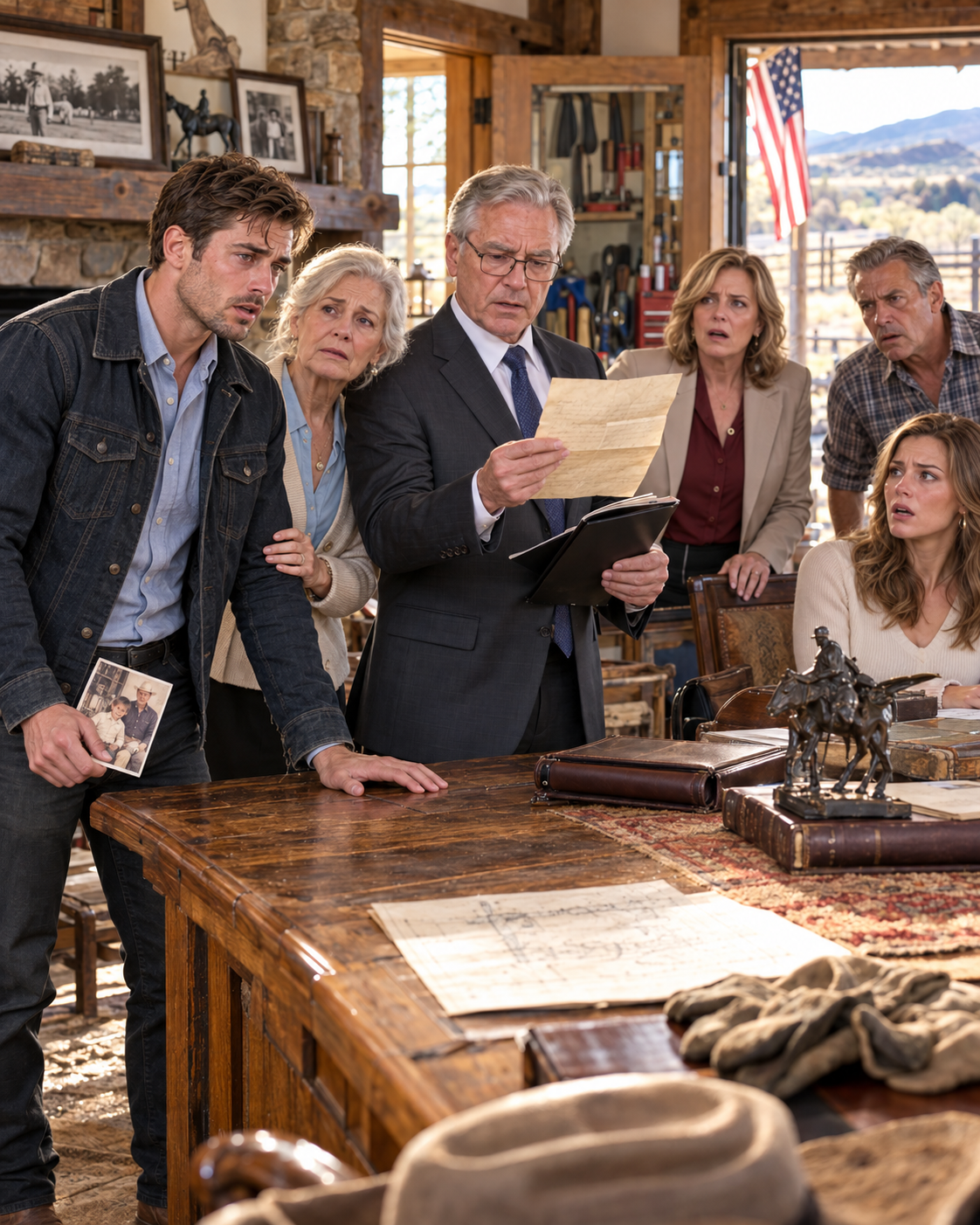
Mr. Reeves sat at the main workbench with a leather briefcase beside him, his glasses low on his nose and a stack of legal documents arranged before him.
Grandma sat to his right.
I took the chair across from them, placing Grandpa’s brass key on the table.
My parents sat together near the window, while Miranda occupied the chair closest to the door, her expression impatient.
My father checked his watch.
“Can we get this over with? We have a long drive back.”
Mr. Reeves looked at him.
“Your father spent the last several years trying to get in touch with his grandson. I believe we can spare an hour to understand his final wishes.”
My mother’s lips tightened.
“That is an unfortunate misunderstanding.”
Mr. Reeves did not respond.
He opened the first document and began reading.
The ranch, the adjoining property, the workshop, and the majority of the estate were to be placed in a protected trust supporting the Dawson Agricultural Innovation Center.
The center would be managed by a board, with me appointed as its founding director and entrusted with continuing the research Grandpa had spent his life developing.
The trust would fund apprenticeships, research grants, and affordable agricultural technologies for small farms.
The patent royalties and investment income would support its operations for years to come.
My father leaned forward.
“Excuse me. That cannot be right.”
Mr. Reeves continued reading.
The remaining assets were allocated according to specific instructions, with Grandma provided for and certain charitable gifts established in Grandpa’s name.
Miranda’s expression shifted from confidence to disbelief.
“What about the house?”
“The house and ranch are included in the trust arrangements,” Mr. Reeves replied.
My mother removed her sunglasses.
“And what does Ethan receive personally?”
Mr. Reeves looked at me before answering.
“He receives the authority and responsibility to establish and direct the innovation center, subject to the trust’s governing provisions. Your father believed his grandson possessed the necessary experience, character, and technical ability to fulfill that role.”
My father pushed his chair back.
“This is absurd. Ethan abandoned the family years ago.”
Grandma’s hands tightened around one another.
“No, Robert. You made sure he could not reach us.”
My father stared at her.
“Mother, don’t start.”
“I am finished keeping your secrets.”
The room became completely silent.
Mr. Reeves reached into his briefcase and removed a second envelope, sealed with dark red wax.
“Your father instructed me to read this supplementary letter aloud if any beneficiary challenged his stated intentions or attempted to misrepresent the circumstances surrounding his final decisions.”
My mother went pale.
Mr. Reeves broke the seal.
The letter began with Grandpa’s familiar handwriting, but the words were read aloud in the lawyer’s steady voice.
To my family, if you are hearing this letter, then I am gone, and I can no longer protect the people I love from the consequences of your choices.
My father shifted in his chair.
Mr. Reeves continued.
For years, I believed my grandson Ethan had chosen to abandon me. I believed he no longer wanted my calls, my letters, or even the knowledge that I was alive. I was wrong, and I learned the truth only after my health began to fail.
My hands went cold.
My son Robert and his wife repeatedly told me that Ethan had rejected contact. They provided a telephone number that never reached him and assured me that his address was unavailable. They told me Ethan had asked them to keep me away.
My mother shook her head.
“This is ridiculous.”
Mr. Reeves kept reading.
I later discovered that the ranch telephone line had been disconnected without my knowledge, and that the number supplied to me was not Ethan’s. Letters I believed had been delivered were withheld or sent to addresses where he could not receive them. I was told that my grandson did not want to see me, while he was being told that I did not want to see him.
Grandma began to cry silently.
I stared at my father, searching his face for some sign of regret.
There was none.
Only anger that the truth had escaped him.
I cannot recover the years that were stolen from us. I cannot tell Ethan that I waited for him, or hear him explain why he stopped calling, because he never stopped trying to reach me. I was made to believe that the child I loved had forgotten me, when the truth was that the people I trusted had taken his place between us.
My father stood.
“That letter is full of lies.”
Mr. Reeves raised one hand.
“Please sit down, Mr. Dawson.”
“I will not sit here and listen to my father accuse me from the grave.”
Grandma looked at him with an expression I had never seen before.
“You should have thought about that before you lied to him while he was alive.”
My father opened his mouth, but she continued.
“George called you his son until the day he died. He trusted you. He believed you would protect this family. Instead, you used his love to keep him from the grandson who gave him the most joy.”
My mother began shaking her head more violently.
“We were trying to keep the family together.”
“No,” I said quietly. “You were trying to control who had access to whom.”
Miranda looked between us, suddenly uncertain.
Mr. Reeves returned to the letter.
I am not making these decisions out of anger. I have consulted independent advisers, reviewed my estate plan repeatedly, and considered what will happen when I am no longer here. My work must continue in the hands of someone who understands its purpose.
He paused before reading the final section.
I leave the innovation center to Ethan because he has shown that knowledge means nothing unless it improves someone’s life. I leave Miranda the small cabin on the northern edge of the property, together with the personal belongings specifically designated for her. It is a modest gift, but it is a place she may call her own.
Miranda’s face flushed.
“A cabin?”
Mr. Reeves looked down at the document.
“That is correct.”
“You’re giving him millions in property and patents, and you’re giving me a cabin?”
“You are receiving exactly what your grandfather specified,” he replied.
My mother turned toward Grandma.
“You can change this. You’re his wife. You have rights.”
Grandma straightened her shoulders.
“I have reviewed the estate documents with Mr. Reeves and independent counsel. I will exercise the rights available to me under the law to protect the trust and carry out George’s wishes. I will not help you overturn his decisions because you dislike them.”
My father stared at her as though he had never considered that she might refuse him.
“You would choose Ethan over your own son?”
Grandma’s eyes filled with tears, but her voice remained steady.
“This was never a choice between my grandsons or my children. It was a choice between the truth and a lie. You made yours a long time ago.”
Mr. Reeves closed the letter.
For several seconds, nobody moved.
Then my father pointed at me.
“You planned this. You came back the moment you heard there was money.”
I looked at him, and for the first time, his accusation did not make me feel the need to defend myself.
“I came back because a lawyer told me my grandfather was dead. I would give every dollar in that estate to have one more conversation with him.”
My voice broke on the final word.
I did not try to hide it.
My mother looked away.
Miranda folded her arms, but the confidence had drained from her face.
My father was the only one still trying to turn the moment into a battle he could win.
“This isn’t over.”
He walked out.
My mother followed, muttering that the will would never hold up in court.
Miranda lingered by the doorway.
For a moment, I thought she might apologize.
Instead, she looked at me and said, “You always did know how to make yourself look like the victim.”
Then she left, and the workshop door slammed behind her.
The lawsuit arrived three weeks later.
My parents claimed Grandpa had lacked the mental capacity to make his final estate decisions and alleged that I had manipulated him into excluding them from their rightful inheritance.
They demanded that the will be invalidated and the trust dissolved.
They also attempted to suggest that Grandpa’s letter had been written under pressure, despite the fact that its contents had been documented through his lawyer and supported by contemporaneous records.
I read the complaint in Mr. Reeves’s office, my jaw tightening with every page.
“They’re accusing me of manipulating a man I barely got to speak to during his final years,” I said.
Mr. Reeves removed his glasses.
“People who build their lives around controlling a story often attack the evidence when the story collapses.”
Grandma sat beside me, holding a folder of her own.
“Then we give them the evidence.”
What followed was months of difficult work.
We collected the letters Grandpa had written, the returned envelopes, telephone records, and statements from people who had witnessed my parents intercepting communications.
My grandmother provided a sworn account of the conversations in which my parents had insisted I wanted no contact.
Mr. Reeves produced the records of Grandpa’s meetings with independent estate counsel, along with medical evaluations and documentation showing that he understood his assets, his decisions, and the consequences of his will.
The sealed letter was not our only evidence.
There were dated notes in Grandpa’s handwriting, copies of messages, and records showing that he had attempted to reach me long before his health deteriorated.
My own phone records and copies of the letters I had sent established that I had tried to contact him from my new home.
One detail proved particularly painful.
A former ranch employee remembered my father asking him to stop forwarding calls from the old landline because Grandpa was becoming upset whenever he mentioned me.
The employee had not understood the significance at the time, but he was willing to testify about what he had heard.
Piece by piece, the truth became harder to deny.
My parents’ attorneys requested a settlement before the case reached a full hearing, but we refused to surrender the innovation center simply to make the conflict disappear.
The court eventually rejected their attempt to invalidate the estate plan, finding that the evidence did not support their claims of incapacity or improper influence.
The trust remained intact, and Grandpa’s documented wishes were upheld.
The victory did not feel like winning.
It felt like finally being allowed to put down something heavy I had carried for years.
My parents had spent my entire childhood teaching me that peace meant giving them what they wanted.
For the first time, peace meant refusing.
Miranda kept the small cabin, but the inheritance did not make her suddenly understand what she had done.
She rarely contacted me, and when she did, her messages focused on the property rather than the years we had lost.
I stopped expecting an apology.
Some people would rather preserve their version of themselves than face the harm they caused.
My parents never admitted what they had done.
They told relatives that I had stolen the estate and that Grandma had been manipulated by grief.
A few people believed them.
Others quietly reached out after seeing the evidence.
I learned that telling the truth does not guarantee everyone will accept it.
It only means you no longer have to live inside someone else’s lie.
The following spring, I returned to the ranch to begin the work Grandpa had imagined.
The workshop doors were opened, the old machines were cleaned, and the first group of young engineers arrived with notebooks, toolboxes, and nervous smiles.
Some had grown up on farms.
Others had learned to repair broken equipment because their families could not afford replacements.
One young woman stood near the entrance, holding a homemade irrigation controller that looked as though it had been repaired more times than it had been built.
“I’m not sure it belongs here,” she admitted.
I recognized the uncertainty in her eyes because I had carried it for most of my life.
I took the controller from her and examined its wiring.
“Who designed this?”
“I did.”
“What problem were you trying to solve?”
She explained that her family’s well often ran low during the hottest weeks of summer, and she had designed a system to monitor usage and shut off irrigation before the pump was damaged.
I smiled.
“Then let’s find out how we can make it better.”
For a second, she looked as though she might cry.
Then she smiled too.
That afternoon, I unlocked the small cabinet beneath Grandpa’s workbench and found his old notebooks, filled with diagrams, measurements, and ideas that had never been completed.
On the first page of the oldest notebook, he had written, The best invention is not the one that makes its creator rich. It is the one that gives someone else a chance.
I placed the notebook beside my own and began planning the center’s first research projects.
We developed affordable water-monitoring systems, trained young technicians, and partnered with farmers who had spent years struggling to access reliable equipment.
The patent income helped fund scholarships for students who could not afford engineering programs.
Slowly, the ranch became what Grandpa had always wanted it to be: a place where curiosity mattered more than family connections, where practical knowledge was valued, and where nobody had to earn the right to be heard.
Grandma visited the workshop often.
Sometimes she brought coffee.
Sometimes she sat in Grandpa’s old chair and watched the young engineers work, her eyes following their movements as though she could see him among them.
One evening, as the sun settled behind the mountains, she found me standing alone beside the workbench.
“George would be proud,” she said.
I ran my hand over the scratched wood.
“I wish he could see it.”
She slipped her arm through mine.
“I think he knew you would find your way here.”
I looked toward the open doors, where the last of the sunlight fell across the tools he had left behind.
For years, I had believed that being loved meant being chosen over someone else, that I had to prove my worth to people who kept moving the finish line.
Grandpa had taught me something different.
Love was the person who made room for your questions, who listened when you spoke, and who helped you become more fully yourself without asking you to shrink for their comfort.
My parents had tried to take that love from me by turning silence into rejection.
They had almost succeeded.
But they had never understood that the bond between Grandpa and me was not built on telephone calls, money, or inheritance.
It was built in the hours we spent solving problems together, in the patience he showed when I made mistakes, and in the quiet confidence he placed in me long before I had learned to place it in myself.
I could not recover the years they stole.
I could not sit beside him one more time or tell him that I had never stopped trying.
But I could honor what he had given me.
That night, I locked the workshop and walked toward the house with his old toolbox in my hand.
The air smelled of cut grass and rain, and the mountains stood dark against the fading sky.
For the first time in years, I did not feel like the forgotten son or the family disappointment.
I felt like a man who had finally come home.
And as I looked back at the warm light glowing through the workshop windows, I understood the last lesson my grandfather had left me: some people will spend their lives trying to convince you that you are not worth loving, but you do not have to spend yours proving them wrong.
You only have to stop letting them decide what your life is worth.