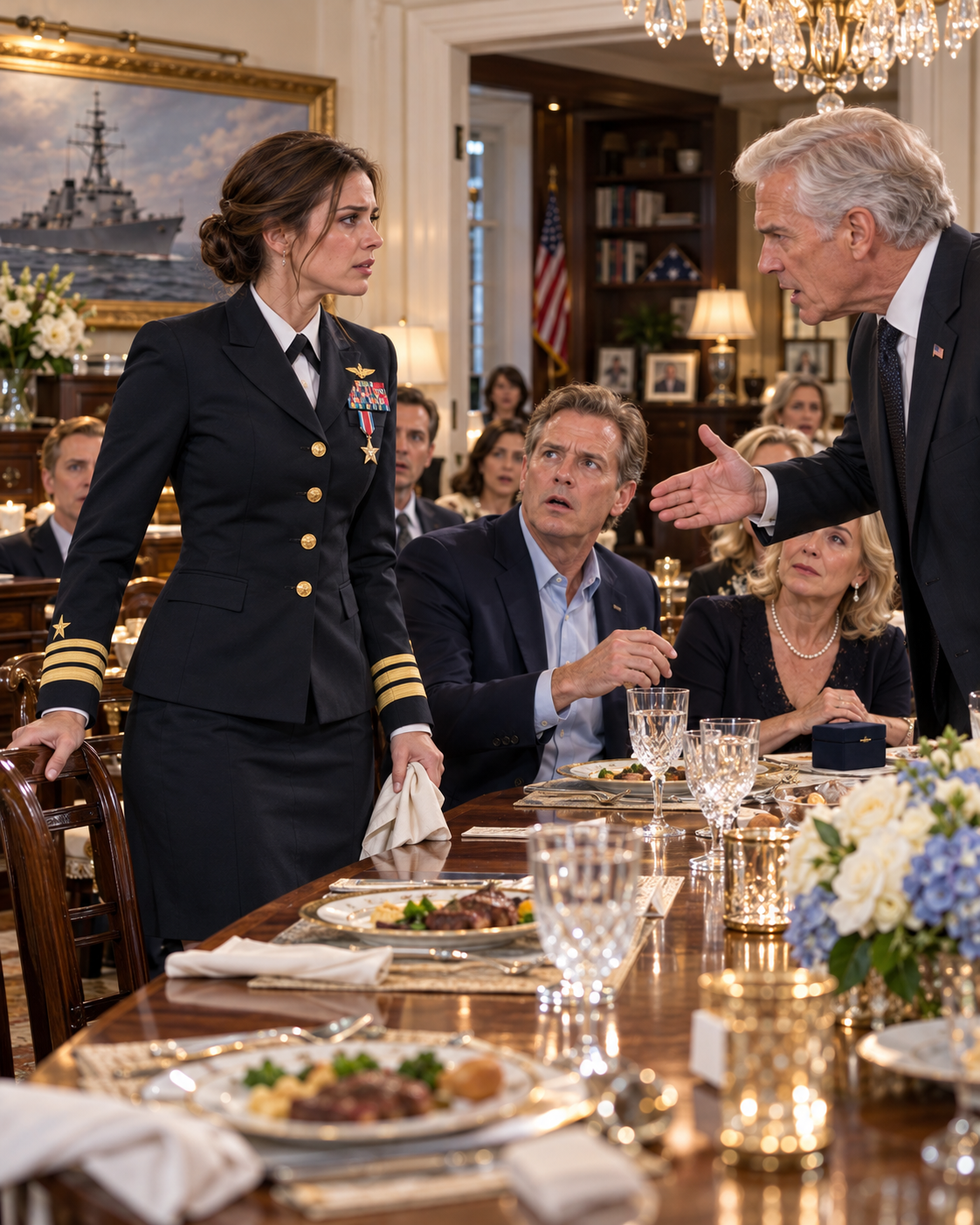
At my father’s prestigious family dinner in Annapolis, he slammed his hand against the table and demanded to know who had given me permission
I read Admiral Bowmont’s message again before answering, hoping I had misunderstood it.
There was no explanation, no hint of what he wanted to discuss, only a time and place: his private office at the Naval Academy the following morning.
I had spent years learning to distinguish between a genuine emergency and an anxious imagination, but that night I barely slept.
At dawn, I put on my uniform, pinned my Silver Star ribbon into place, and drove to Annapolis beneath a pale gray sky.
The admiral was waiting beside a window overlooking the Severn River.
He did not offer coffee or begin with the usual pleasantries.
Instead, he placed a thick folder on his desk.
“Commander, before you take your next command, you need to understand why your engagement was more complicated than the official account suggests.”
I remained standing.
“Was the review wrong?”
“No. The review reached the correct conclusion about your actions. You made the right decision under extraordinary pressure.”
“Then what was left out?”
He opened the folder and turned several pages toward me.
The first document was a timeline of the engagement.
The second contained a series of communications logs.
The third was a technical assessment of the hostile targeting sequence.
I recognized the time stamps immediately.
Seven seconds before my destroyer moved into the threat corridor, the carrier group had received an unexpected change in the threat assessment.
The information reaching my bridge had been incomplete.
I had made the maneuver based on what my team could verify, the tactical picture available to us, and the need to protect the carrier while avoiding a collision within our own formation.
“What am I looking at?” I asked.
“The official report described the delay as a decision made entirely at your discretion. But a communication from another command element arrived late, and the routing records suggest that the delay may have been avoidable.”
I felt the room grow colder.
“Are you saying someone withheld information from my ship?”
“I’m saying the evidence raises that possibility. We need to establish whether it was a technical failure, an operational mistake, or something more deliberate.”
I stared at the communications log.
The record did not prove sabotage.
It did not establish that anyone had intended to endanger the carrier.
But it showed that a critical warning had passed through a channel that should have delivered it sooner.
“Why am I only hearing about this now?”
“Because the initial review focused on the engagement itself and the decisions made on your bridge. The communications issue was handled separately. New information has since emerged that warrants another look.”
I thought of the seven seconds.
I had spent months replaying those moments, wondering whether I could have moved faster, whether I had exposed my crew to unnecessary danger, and whether the lives aboard the carrier had depended on a decision I had made too late.
Now I was being told that the information available to me might have been incomplete for reasons no one had fully explained.
“Does the Navy believe I made a mistake?”
“The Navy recognized your actions as meritorious. This inquiry is not an attempt to take that recognition away.”
He paused.
“But I won’t lie to you. If the routing failure affected the operational picture, we need to know why.”
I left his office with copies of the records and a promise to cooperate with the review.
Outside, the river looked calm, its surface reflecting the pale morning light.
I stood there for several minutes, remembering the bridge of the Resolute, the alarms, and the faces of the sailors who had trusted me to make a decision with incomplete information.
I had accepted responsibility for my actions.
I would not accept blame for facts that had been kept from me.
My next command was scheduled to begin in six weeks, and the Navy had no intention of delaying the appointment without a clear reason.
Still, the possibility of a hidden failure weighed on me.
That afternoon, I called my former executive officer, Lieutenant Commander Marcus Hale, who had served beside me during the engagement.
He answered on the third ring.
“Sloan. I heard about the new command. Congratulations.”
“Thank you. I need to ask you about the seven seconds.”
His tone changed.
“What did Bowmont tell you?”
I explained what I had seen in the records.
Marcus was silent for a long moment.
“There was confusion about the warning,” he finally said. “We knew that at the time, but we thought it was a systems issue. The bridge team did what it could with the information we had.”
“Did anyone tell you that the routing delay was being investigated?”
“Not that I remember.”
“Did you notice anything unusual before the engagement?”
He hesitated.
“There was one thing. A few days before the operation, our communications team received a request to change how a particular warning category was routed during periods of heavy traffic. The request appeared to have come through an authorized channel.”
My pulse quickened.
“Who requested it?”
“I don’t know. The technical team handled it, and the change was reversed afterward. I assumed it had been part of a routine network adjustment.”
“Do you still have the record?”
“I’ll see what I can find.”
We ended the call, and I immediately forwarded the information to the officer coordinating the review.
I resisted the urge to investigate independently.
The records were sensitive, and a commander’s responsibility did not give her permission to bypass the procedures designed to protect the integrity of an inquiry.
But I could not ignore the feeling that the engagement had been judged from the wrong angle.
For years, my father had insisted that I was not a real naval officer because he could not imagine a woman commanding a warship.
Now I wondered whether someone else had also made assumptions about who deserved to be heard.
The next evening, my mother called.
“Your father has barely spoken since dinner,” she said.
I leaned against my kitchen counter.
“That sounds unusual.”
“He keeps saying Admiral Bowmont embarrassed him deliberately. He says the admiral should have warned him that you were the commander involved.”
I closed my eyes.
“Why would he need to be warned?”
“Because he thinks he was made to look foolish.”
There was a weary sadness in her voice.
I could picture my father pacing through his study, searching for a way to turn his humiliation into someone else’s wrongdoing.
“Mom, I didn’t arrange any of this.”
“I know, sweetheart.”
She paused.
“He also asked me why I kept all those photographs.”
“What did you tell him?”
“I told him because I love my daughter.”
For once, I had no answer.
Then she added, “He asked whether you would come to dinner next Sunday.”
I felt the old reflex stir inside me, the instinct to return, smooth things over, and make him feel less uncomfortable with the truth.
But I had learned that peace purchased through silence was never really peace.
“I don’t know yet,” I said.
“That’s fair,” she replied. “You don’t owe anyone an immediate answer.”
Her support felt different now.
It was no longer a quiet hand reaching for me after my father had wounded me.
It was permission to make my own decision.
Three days later, Marcus sent the communications record to the review team.
The document confirmed that a routing adjustment had been authorized shortly before the engagement.
It did not identify the person who had requested it, but it showed that the change had been made using credentials associated with a senior operational office.
The review team expanded its inquiry and restricted access to the relevant records.
I was interviewed twice, once about the decisions made on my bridge and once about the communication chain leading to the engagement.
I answered every question as precisely as I could.
I did not embellish the danger to make my actions look heroic.
I did not hide the uncertainty that had existed in the moment.
I explained that my duty had been to protect the formation, evaluate the threat, and make the best decision possible with the information available.
When the interview ended, the investigating officer thanked me.
“Commander, the point of this review is not to find someone to blame for every imperfect decision. It’s to understand whether the system failed and whether that failure can be corrected.”
“Then I hope the system is allowed to tell the truth,” I replied.
The weeks that followed tested my patience.
Rumors spread through the small world of naval leadership, and I heard that some officers believed the inquiry was an attempt to reopen a settled engagement.
Others worried that any finding of procedural failure might damage the credibility of the award.
I refused to speculate.
I continued preparing for my next command, reviewing personnel records, studying operational plans, and meeting with the officers who would soon serve beside me.
My new ship would not care about family arguments or the stories told about me at dinner.
It would require preparation, judgment, and trust.
Those were things I could control.
My father, however, was not ready to relinquish his own version of events.
He sent me a long email explaining that he had criticized the engagement because he cared about naval standards.
He wrote that his words had been taken out of context and that Admiral Bowmont should not have corrected him in front of guests.
At the end, he added, “You must understand that I have spent my life defending the reputation of the Navy.”
I read the message twice.
Then I wrote a response.
“You taught me that standards matter, Dad. I agree. But standards cannot mean that only the people you respect are allowed to meet them. I am proud of my service, and I will not minimize it to make our conversations easier.”
I did not accuse him of being a bad father.
I did not list every insult I could remember.
I simply told him where I stood.
He did not respond.
On Sunday, I visited my mother alone.
She had prepared a pot of soup and placed the wooden memory box on the dining table.
“I thought you might want to see the rest,” she said.
Inside were letters I had written from training, photographs from my first ship, and a small notebook filled with her observations.
One entry described the day I called to tell her I had passed a demanding qualification.
“She sounded exhausted but happy,” my mother had written. “Vincent said the Navy gives out qualifications too easily. I told him Sloan had worked for it, and he walked out of the room.”
Another entry recorded the day I took command of the Resolute.
“I watched the ceremony online. She stood so straight that I cried before the speech was over. I wish her father could see what I see.”
I pressed the notebook to my chest.
“Why didn’t you ever show me this?”
My mother sat across from me.
“Because I was afraid that if I challenged your father too openly, he would make life harder for you. I thought I could protect you by supporting you quietly.”
“Did it work?”
She looked down at her hands.
“Sometimes. But I can see now that silence also left you alone.”
Her honesty was painful, but it did not make me love her less.
“I know you were trying to help me.”
“I was. And I am sorry I didn’t do more.”
We sat together for a while, the box between us.
For the first time, I could see my childhood without having to choose between loving my parents and acknowledging the hurt they had caused.
My mother had protected me in the ways she knew how.
My father had wounded me in the ways he had never bothered to examine.
Both truths could exist at once.
When I left, I took one photograph with me.
It showed me at seventeen, standing beside a small training vessel, my hair blowing across my face and my expression fierce with ambition.
On the back, my mother had written, “She already knows where she’s going.”
I kept it in the drawer beside my command papers.
Two weeks before my new assignment began, Admiral Bowmont called me into his office again.
The review team had completed its preliminary assessment.
The routing adjustment had contributed to the delayed delivery of the warning, but investigators had not established that it was intended to interfere with the engagement.
They were continuing to examine who had authorized the change and whether the procedure had been followed correctly.
The official review of my command decisions remained unchanged.
My actions had been judged appropriate under the circumstances, and the Silver Star remained fully supported by the evidence.
I felt relief, but not the kind that comes from winning an argument.
It was the relief of knowing that the record had been examined carefully rather than protected for convenience.
“Will the inquiry affect my new command?” I asked.
“No,” Admiral Bowmont said. “Your appointment stands.”
He closed the folder.
“Commander, I want you to remember something. You were not awarded that medal because you were fearless. You were awarded it because you accepted responsibility in a moment when every option carried risk.”
I thought about my father, who had spent decades treating command as a symbol of authority rather than a burden of responsibility.
“Thank you, sir.”
He studied me for a moment.
“Have you spoken to your father?”
“Not since his email.”
“Do you intend to?”
“I don’t know.”
He nodded.
“You don’t need to decide that before taking command. Just make sure your decision belongs to you, not to the anger he left behind.”
The advice stayed with me.
On the morning I was due to assume my new command, I stood in front of the mirror wearing my dress uniform.
The ribbons were straight.
The insignia sat exactly where it belonged.
For years, I had imagined that if my father ever acknowledged my accomplishments, something inside me would finally settle.
But the recognition I had wanted could not be forced from him, and I no longer wanted to build my life around waiting for it.
My mother called just before I left.
“I wish I could be there today,” she said.
“You’ll be there in every way that matters.”
She laughed softly.
“Your father is sitting in his study. He hasn’t said anything, but I think he’s watching the ceremony.”
I felt a complicated ache in my chest.
“Tell him he can watch if he wants to.”
“Would you like me to tell him anything else?”
I looked at the photograph of my seventeen-year-old self.
“Tell him I’m proud of the life I’ve built.”
My mother was quiet for a moment.
“All right, sweetheart.”
Then she added, “And for what it’s worth, I am proud of you, too.”
The ceremony was brief and formal.
Officers exchanged the necessary honors, the command changed hands, and I stood before the crew who would soon trust me with their safety.
I spoke about readiness, accountability, and the importance of listening to the people who recognized danger before anyone else did.
I told them that rank created responsibility, not immunity.
I told them that mistakes must be reported honestly and that nobody should be punished for raising a good-faith safety concern.
I did not mention my father.
I did not need to.
The lessons I had learned at his table had already become part of the officer I wanted to be.
After the ceremony, I checked my phone.
There was a message from my mother with a photograph attached.
My father sat alone in his study, watching the ceremony on a laptop.
Beside him lay the copy of my Silver Star citation I had left on his table.
He had unfolded it and placed it carefully beside the keyboard.
Beneath the photograph, my mother had written, “He watched every minute.”
I stared at the image for a long time.
It was not an apology.
It was not a promise that he would change.
But it was the first time I could remember him choosing to look at my life without interrupting it.
I put the phone away and returned to my crew.
The ship was waiting, and the work ahead mattered too much for me to remain trapped in the question of whether my father would ever understand me.
I could love him without agreeing with him.
I could hope he might change without making my future depend on it.
And I could honor my mother’s quiet faith without asking her to keep carrying the weight of our family’s silence.
That evening, as the ship prepared for its next phase of operations, I stood on the bridge and watched the harbor lights fade behind us.
I thought of those seven seconds in the strait, the lives depending on decisions nobody ashore could fully understand, and the difference between looking powerful and being responsible.
I had spent too many years trying to prove I belonged.
Now I had a crew to lead, a ship to protect, and a duty that did not require my father’s permission.
Just before midnight, a secure message arrived from the review team.
The investigators had identified the office responsible for the routing adjustment, and a new interview had been scheduled with a retired senior official whose name had not appeared in the original inquiry.
The message contained no accusation and no conclusion, only a request that I remain available to clarify one final point about the engagement.
I read it, saved it, and returned my attention to the dark water ahead.
The truth was still unfolding.
But whatever it revealed, I knew one thing with absolute certainty: I would not look away simply because the answer might make someone powerful uncomfortable.
My father had spent my life teaching me that respect belonged to those who commanded the room.
The Navy had taught me something better.
Respect belonged to those who accepted the weight of their decisions, who protected the people entrusted to them, and who had the courage to tell the truth when silence would have been easier.
I could not change the childhood I had lived or force my father to become the man I once needed.
I could decide what kind of commander, daughter, and woman I would be from that day forward.
And as the ship moved into the darkness, I finally stopped waiting for permission to be proud of myself.