At my father’s memorial service at Fort Myer, my own mother ordered me into the BACK ROW like I was a stranger
For several seconds, I could only stare at the envelope.
My father’s handwriting had always been unmistakable, even when he wrote nothing more complicated than a grocery list or a reminder to change the oil.
The letters leaned slightly forward, as if every word had somewhere important to be.
I ran my thumb across my name.
“For the day you stand.”
I whispered the words into the empty room, and something in my chest tightened.
Why had he hidden this from me?
I pulled the envelope from beneath the drawer and turned it over.
The flap was sealed, but not with tape or glue.
My father had pressed his old military insignia into a small circle of red wax, leaving an impression I recognized from a box of keepsakes he had once shown me.
I broke the seal carefully.
Inside lay a folded letter, a photograph, and a second envelope marked with the name James Holloway.
My heartbeat changed.
The photograph showed my father standing outside a plain brick building with three other men, all younger, all serious, their faces darkened by sunlight and fatigue.
On the back, he had written a date from nearly twenty years earlier and a single sentence.
“Some people serve quietly because the truth is expensive.”
I read it twice.
Then I unfolded the letter.
“My daughter,” it began, “if you’re reading this, I hope you have finally stopped confusing peace with surrender.”
I sat down hard on the bed.
“My greatest fear was never that you would fail. It was that you would become so good at carrying other people’s discomfort that you would forget you were allowed to put it down.”
My eyes burned.
“I know your mother has made you feel that your achievements create problems she must manage. I know you have learned to apologize before anyone accuses you of anything. I should have challenged that pattern sooner.”
I stopped reading.
For years, I had wondered why my father never openly confronted the arguments that unfolded behind closed doors.
When Mother criticized my posture, my career, my friendships, or the way I answered questions at family gatherings, he would sometimes look at me with an expression I could not interpret.
I had mistaken that look for helplessness.
Now I wondered whether it had been regret.
I continued.
“Your mother is not a villain, and I do not want you to turn her into one. Fear can become a cage, and sometimes people who live inside one start building the bars around everyone they love. That does not make the cage your responsibility.”
I pressed the letter against my knee.
“She was frightened by the life I chose. She was frightened by what people might ask of her, what they might discover about herself, and what she could not control. Over time, she began to believe that if she could control how we appeared, she could prevent anything bad from happening.”
The words seemed to illuminate years of memories I had never understood.
Mother insisting that I change out of my uniform before visiting her friends.
Mother asking me not to mention my work at dinner.
Mother becoming visibly upset whenever someone praised me in front of her.
I had always called it anxiety.
Perhaps it was anxiety.
But anxiety could explain behavior without excusing the damage it caused.
The letter continued.
“Your instincts are not disrespect. Your questions are not disloyalty. And your service does not become less honorable because someone you love feels uncomfortable seeing it.”
I lowered my head.
My father had been gone for six days, and somehow his words were reaching places I had spent thirty-two years protecting.
At the bottom of the page, he had written, “Speak to James. He knows what happened, and he knows why I never told you.”
I stared at the second envelope.
Outside, a car passed along the street, its tires whispering over damp pavement.
For a moment, I considered putting everything away.
I could fold the letter, slide it back beneath the drawer, and return to the familiar routine of pretending I had misunderstood.
It would be easier.
I had built an entire adult life around easier.
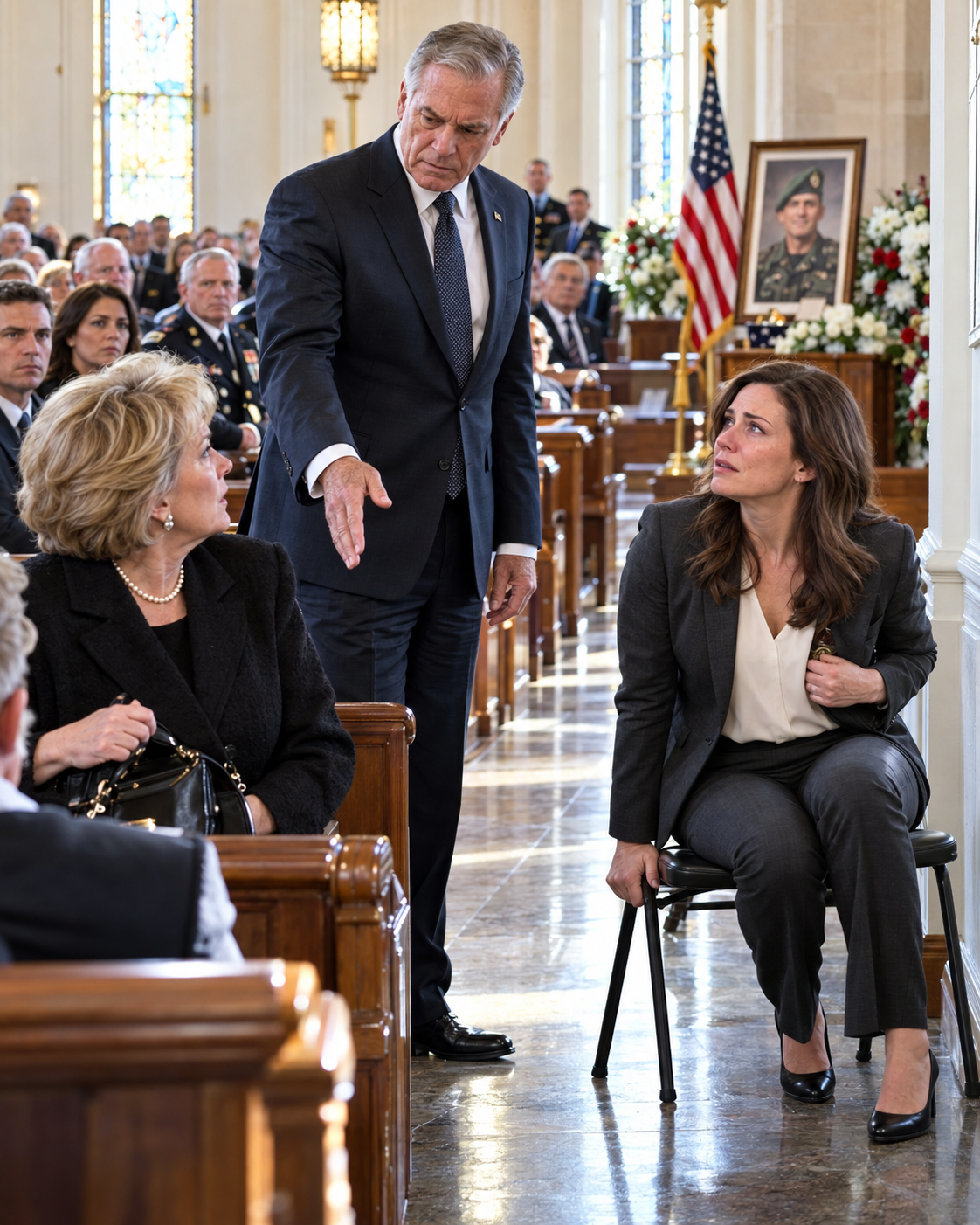
Then I remembered the chapel, the folding chair, and the way Colonel Holloway had walked down the aisle without hesitation.
I opened his envelope.
Inside was a handwritten note and a small flash drive.
The note contained only one paragraph.
“Daniel asked me to give you this when you were ready to hear the truth. I did not know whether the funeral would be that day. After what I witnessed, I believe he would say the waiting is over. Call me before you watch the recording.”
I looked at the clock.
It was almost seven.
I called the number written beneath his signature.
He answered on the second ring.
“Cross.”
“It’s me.”
“I was hoping you’d call.”
My throat felt dry. “What’s on the drive?”
A long silence followed.
“Something your father carried for years,” he said. “Something he wanted you to understand, not something he wanted you to use against your mother.”
“Why would my mother be involved?”
“Because she was there when the decision was made.”
I gripped the phone.
“What decision?”
“Come see me tomorrow morning. Bring the letter. Don’t confront her tonight.”
I almost laughed at the irony.
Everyone seemed to be telling me what I should and shouldn’t do, even now.
Then Holloway added, “This isn’t an order, Captain. It’s a request from a man who made your father a promise.”
I agreed to meet him.
After we hung up, I sat in the darkening room with the flash drive in my hand.
My mother called me downstairs twice.
I did not answer until the third time.
When I entered the kitchen, she was standing beside the counter, holding two cups of tea.
“I made you some,” she said.
The gesture was so ordinary that it almost hurt more than the funeral.
I sat down.
She placed a cup in front of me and studied my face.
“What did James Holloway say to you?”
I looked up.
“Why?”
“Because he’s always been intrusive. Your father admired him, but that doesn’t mean he understood our family.”
There it was again.
The old technique.
Turn the person who had witnessed the truth into the person who had created the problem.
“He said Dad talked about me.”
Mother’s expression tightened.
“Your father talked about many things.”
“Did he ever tell you he was proud of my instincts?”
She set her cup down a little too hard.
“Your father was proud of you.”
“Then why did I spend my whole life feeling as if I had to hide that?”
She stared at me.
For one brief moment, I saw something beyond anger.
Fear.
Then it vanished.
“You are tired,” she said. “We should not have this conversation tonight.”
I looked at the tea, untouched between us.
“No, Mom. We shouldn’t have had to wait until Dad died.”
Her face changed.
She turned toward the sink and began rinsing a spoon that was already clean.
I left before either of us could say something we could not take back.
That night, I watched the ceiling until dawn.
I thought about my father, about his letter, and about all the things I had believed silence meant.
I had believed he stayed quiet because he did not see what was happening.
I had believed Mother needed protection from my success.
I had believed that love required me to make myself smaller.
By morning, I was beginning to understand how many of those beliefs had been inherited rather than chosen.
At nine, I met Holloway in a small diner outside Arlington.
He sat in a booth near the window, wearing a plain navy jacket instead of the uniform that had once made younger officers straighten their backs.
He looked older than he had at the chapel.
Or perhaps grief had made me notice the years in his face.
He motioned for me to sit.
“Your father used to order black coffee and complain that the eggs were overcooked,” he said.
I smiled despite myself.
“He complained about everything he couldn’t fix.”
“Not everything,” Holloway replied. “He never complained about you.”
The waitress poured coffee, and neither of us spoke until she had left.
I placed the letter on the table.
“Tell me what happened.”
Holloway studied the envelope before answering.
“Almost twenty years ago, your father was part of a joint operation involving several federal agencies. The details are not the point. What matters is that the operation exposed a serious failure in how information was being handled.”
He paused.
“Your father noticed discrepancies that other people wanted ignored. He kept asking questions, and the more questions he asked, the more pressure he received to stop.”
I leaned forward.
“What kind of pressure?”
“Career pressure at first. Warnings about his future assignments. Suggestions that he was misreading things. Then people began asking whether his judgment had changed.”
My stomach tightened.
“They tried to make him look unreliable?”
“Some people did. Others simply wanted the problem to disappear.”
I thought of my father’s careful habits, the folders he labeled in neat handwriting, and the way he had taught me never to sign anything I had not read.
“What did he find?”
Holloway shook his head.
“I can’t give you operational details that are not mine to disclose. But I can tell you the dispute centered on a report that did not match the underlying records. Your father believed the discrepancy could put people at risk. He refused to endorse the report as written.”
“What happened to him?”
“He was cleared of wrongdoing. The matter was reviewed through the proper channels, and the immediate danger was addressed. But the process took a toll on him. He learned that doing the right thing does not guarantee people will stand beside you.”
Holloway reached into his jacket and removed a small photograph.
It showed my father outside the same brick building as the picture in the envelope.
Beside him stood a younger Holloway.
“Your father could have made a public accusation,” Holloway said. “He could have tried to win the argument through humiliation. Instead, he documented what he knew, protected the people he could, and accepted that some of the truth might never become a story anyone else heard.”
“Why didn’t he tell me?”
“Because he didn’t want you growing up believing every disagreement was a battle. He wanted you to learn discernment, not suspicion.”
Holloway looked directly at me.
“But he also knew you were observant. He saw how you noticed things other people avoided. He worried that your mother would teach you to distrust that part of yourself.”
My fingers curled around the edge of the table.
“What does she have to do with it?”
Holloway looked toward the window.
“Your mother was contacted during the investigation. Someone told her your father’s career and reputation were at risk. She was frightened, and she was asked to encourage him to stop pushing.”
I felt the room narrow around us.
“Did she?”
“She tried. She begged him to think about the family. She believed that if he stepped back, the pressure would end.”
I stared at the photograph.
“Did he listen?”
“No.”
Holloway’s voice softened.
“He listened to her fear. He understood it. But he would not sign something he believed was false.”
I remembered my mother’s words at the chapel.
You’re embarrassing me.
The phrase no longer seemed confined to that morning.
It had become a family language, used whenever someone else’s discomfort threatened to expose something we could not control.
“Did she know he was right?” I asked.
“I think she knew he believed he was right. That distinction mattered to her because it allowed her to avoid deciding what she believed.”
I sat back.
For years, Mother had told me that the military was my father’s obsession, that his colleagues were always watching, that public recognition invited trouble.
Now I wondered how much of that fear had begun during those months and how much she had carried into every part of our lives afterward.
Holloway slid the flash drive across the table.
“The recording is not evidence of some grand conspiracy. It is a conversation your father recorded with your permission in mind, though he never knew whether you would want to hear it. He made it after the review ended.”
I looked at the drive.
“Why give it to me now?”
“Because he believed you had reached a point where protecting you through silence might be doing more harm than good.”
Holloway paused before adding, “He also left instructions that I should give you something else if you ever asked why your mother treated your accomplishments as threats.”
“What else?”
“A letter he wrote to himself, years ago. He asked me to keep it separate from the official records. I have it at home.”
I felt a chill.
“Why?”
“Because he said you might need to hear your mother’s side before you decided what to do with yours.”
I almost told him that I had heard her side my entire life.
Instead, I took the flash drive.
When I returned home, Mother was in the living room, folding a blanket that did not need folding.
She glanced at the drive in my hand.
“What is that?”
“Something Dad left me.”
Her hands stopped.
For a moment, neither of us moved.
Then she placed the blanket over the arm of the sofa.
“James has been filling your head with stories.”
“Did you know Dad refused to sign a report because he believed it was wrong?”
She turned away.
“I knew he was under pressure.”
“Did you ask him to stop?”
“I asked him to think about his family.”
“Did you ask him to lie?”
She spun around.
“Of course not!”
Her voice cracked on the final word.
I believed her.
That was the terrible part.
I believed she had never wanted him to lie, only to stop doing the thing that frightened her.
But a person could cause damage without ever intending to become cruel.
“I need you to tell me what happened,” I said.
She pressed both hands against the back of a chair.
“Your father was a good man. He was stubborn, and he thought being right meant he could survive anything. You have no idea what it was like to wait for a phone call, to wonder whether a knock at the door meant someone had been hurt, to hear people say his name as if they were discussing a problem.”
“I know what it was like to watch you become angry whenever anyone noticed me.”
She flinched.
“I was trying to protect you.”
“From what?”
“From the attention. From expectations. From the possibility that people would start looking at you the way they looked at him.”
I stepped closer.
“Mom, I became a federal officer. People look at me because of the work I do. I cannot spend the rest of my life apologizing for that.”
Her eyes filled, but she blinked the tears away.
“You don’t understand how frightened I was.”
“Then tell me. Don’t punish me for it.”
For the first time, she had no immediate answer.
I went upstairs and watched the recording alone.
The video opened on my father sitting at his desk, older than I remembered him from the photograph, his shoulders slightly rounded, his uniform shirt hanging neatly on a chair behind him.
He looked directly into the camera.
“If you’re watching this, I hope you are doing well,” he said.
His voice was steady, but fatigue had settled into the lines around his eyes.
“I hope you have found people who respect your judgment. I hope you have learned that courage is not the absence of fear. It is deciding what fear is allowed to control.”
He glanced down at something on the desk.
“Your mother was scared. I knew that. I never blamed her for being afraid. But fear became the reason every difficult conversation had to end before it began.”
He looked back at the camera.
“I let that happen at home because I wanted you to have peace. I thought I could carry the consequences quietly and keep them away from you. I was wrong about one thing. Children notice what adults refuse to name.”
My throat tightened.
“I saw you making yourself smaller. I saw you apologizing for questions that deserved answers. Every time I told myself you would understand when you were older, I gave the silence another year to grow.”
He breathed slowly.
“I cannot tell you how to handle your mother. I will not ask you to choose between loving her and respecting yourself. Those things should never have been made enemies.”
Then he reached for a small object on the desk.
It was another unit patch, older than the one I carried, its edges worn almost white.
“This is not a symbol of perfection,” he said. “It is a reminder that service is not measured by how much discomfort you can endure without speaking. It is measured by what you protect, what you refuse to falsify, and whether you can look at yourself honestly when the room is empty.”
He fell silent for a long time.
Then he said the words I would remember for the rest of my life.
“If someone you love asks you to disappear so they can feel safe, love them enough to stay visible.”
The screen went dark.
I remained still, my hands resting on my knees.
I had expected a revelation that would turn my mother into a monster or my father into a flawless hero.
Instead, he had given me something much harder.
A truth in which everyone was human, everyone had made choices, and no one could escape the consequences by claiming good intentions.
Downstairs, I heard a cupboard close.
Then another.
I removed the drive and went to find my mother.
She was sitting at the kitchen table with a shoebox in front of her.
Inside were old photographs, folded letters, and several military event programs I had never seen.
She did not look up when I entered.
“Your father gave me that patch,” she said, touching the corner of a photograph.
I sat opposite her.
“What patch?”
“The one you carry. He brought it home after one of his assignments. He told me it reminded him why he had to keep doing his job, even when people were angry with him.”
She drew a breath.
“I used to think if I could keep the family quiet, I could keep us safe. I convinced myself that every ceremony, every conversation, every person asking questions was another opportunity for something to go wrong.”
She looked at me.
“After that investigation, I stopped trusting the world. I started trusting control.”
Her confession was quiet, almost embarrassed.
“I told myself I was protecting you. But when people praised you, I heard expectations. When you wore your uniform, I remembered how powerless I had felt watching your father go through that period. I wanted to pull you away from anything that might make you suffer the way he did.”
I held her gaze.
“So you tried to make me ashamed of the things I loved.”
She closed her eyes.
“Yes.”
The word was barely audible.
I had imagined this moment for years without knowing I was imagining it.
I had expected excuses, denials, or another accusation that I was being too sensitive.
I had not expected one word that finally named the wound.
“I am sorry,” she said.
I waited.
She looked down at her hands.
“I don’t know how to make it right.”
For the first time, I understood that an apology could be sincere and still be insufficient.
“You can’t undo the years,” I told her. “But you can stop asking me to pretend they didn’t happen.”
She nodded, crying openly now.
I did not rush to comfort her.
That was new, too.
I let her feel the sadness without taking responsibility for removing it.
In the days that followed, we began speaking in ways that felt unfamiliar and uncomfortable.
Mother told me about the sleepless nights during my father’s investigation, about the letters she had been afraid to open, and about the humiliation she felt when people asked whether he was in trouble.
I told her about the promotions I had downplayed, the invitations I had declined because I knew she would worry, and the times I had changed the subject when someone praised my work.
Neither of us was innocent of the pattern.
But only one of us had been expected to disappear to maintain it.
A week after the funeral, Holloway invited me to his home.
He gave me the letter my father had written to himself.
It was dated several years after the investigation and contained no secrets about the operation, only a personal account of what the experience had taught him.
Near the end, my father had written, “I hope my daughter never mistakes endurance for duty. I hope she knows that a person can be loyal without agreeing, compassionate without surrendering, and strong without allowing every wound to become a private burden.”
Holloway folded his hands.
“Your father was proud of the officer you became,” he said. “But he was prouder of the person who kept asking questions when it would have been easier to look away.”
I looked at him.
“Why didn’t you tell me this at the funeral?”
“Because a funeral is not the place to hand someone else’s grief a verdict. I could stand up when I saw you being pushed aside. I could remind the room that your place mattered. But the rest had to be yours to discover.”
I thought about his words at the chapel.
Move her back.
For the first time, I understood that he had not simply been telling my mother to move me.
He had been telling the room to stop accepting my humiliation as normal.
He had been telling me something, too.
You do not have to earn the right to occupy the space that is already yours.
Several weeks later, I attended a professional ceremony wearing my uniform.
Mother came with me.
She spent most of the drive asking about parking, the schedule, and whether she would have to speak to anyone.
The familiar anxiety was there, but something had changed.
At the entrance, she looked at the insignia on my shoulder.
“You look like your father,” she said.
I waited for the qualification, the request to cover it, the warning that people might stare.
None came.
Inside, I introduced her to my colleagues.
When one of them congratulated me on a recent achievement, Mother started to glance away.
Then she stopped herself.
“She worked very hard for that,” she said.
Her voice trembled, but she did not take the words back.
It was not a miracle.
It did not repair my childhood or erase the folding chair at Fort Myer.
But it was a beginning.
Later that evening, I placed my father’s unit patch beside my own insignia on the dresser in my apartment.
For years, I had treated the patch like a piece of history I was permitted to keep only as long as I did not draw attention to it.
Now I saw it differently.
It represented the people who had served before me, the mistakes they had made, the truths they had protected, and the burdens they had sometimes passed to the next generation without realizing it.
I could honor my father without pretending he had done everything right.
I could love my mother without allowing her fear to dictate my life.
And I could remember the chapel without returning to the wall.
Months later, Mother called to ask whether I would help her sort through the last of my father’s papers.
I agreed.
We sat together at the dining table, opening folders and reading the notes he had left behind.
Near the bottom of a box, we found a sealed envelope addressed to both of us.
My mother recognized the handwriting immediately.
She looked at me, then at the envelope.
For a moment, the old fear returned to her face.
“What if there’s something in there I don’t want to know?” she whispered.
I thought of my father’s letter, of Holloway’s steady voice, and of the years we had lost to the things nobody wanted to name.
I placed the envelope between us.
“Then we’ll know it together.”
She reached for it, but her fingers stopped just short of the seal.
I covered her hand with mine, not to restrain her, not to direct her, but to let her know she did not have to face the truth alone.
Together, we opened it.
The first page contained only a few lines in my father’s familiar handwriting.
“Margaret, if you are reading this with our daughter, then perhaps the silence has finally ended.”
My mother began to cry.
I continued reading.
“Everything I wanted to protect is already here. Not my reputation. Not my uniform. Not the version of our family that other people see. You are here. And if we are going to honor the life we built, we must finally tell each other the truth.”
Beneath the letter was a second page, covered in dates and names I recognized from my father’s old photographs.
At the bottom, he had written one final sentence.
“There is one more person who knows what happened, and I hope you will hear them before you decide what my silence meant.”
I looked at Mother.
She was staring at the names, her face drained of color.
“Do you know who this is?” I asked.
She nodded slowly.
Then she whispered a name I had not heard in years, a name that connected my father’s past to a part of my own life I had always believed was settled.
“I thought they were gone,” she said.
I looked down at the page again, feeling the old instinct to retreat rise inside me.
This time, I let it pass.
My father’s legacy had never been a promise that the truth would be painless.
It was the reminder that pain did not have to decide what we did next.
I folded the letter carefully and placed it beside the unit patch.
Then I reached for my phone.
Whatever waited beyond that name, I would face it standing.
And for the first time in my life, I knew I would not be standing alone.