At my father’s mahogany table, in front of twenty-two guests, he cut me off with a cold smile and ordered me to let my brother
Part 2
Bennett enlarged the first page.
“Echo 6 identified the device and began the clearance procedure at 0917.”
My father stared at the screen.
Julian’s breathing had become shallow.
Bennett continued.
“At 0931, a logistics order changed the convoy movement schedule.”
I knew that number.
I had remembered it for fifteen years.
Twelve minutes.
That was all it took.
Twelve minutes had separated a completed sweep from a disaster.
I looked at Julian.
He wouldn’t meet my eyes.
Bennett tapped the screen again.
“The order originated from a terminal assigned to Julian Kenneth Mercer.”
My father’s face went blank.
Julian whispered, “That’s not what happened.”
Bennett looked at him.
“Then tell us what happened.”
Julian opened his mouth.
Nothing came out.
Bennett continued.
“Your unauthorized access to EOD Mobile Unit 6 records occurred three days after the incident.”
The room had become so quiet I could hear the air conditioning.
“You removed the callsign Echo 6 from the copied field report.”
My father slowly lowered his glass.
Bennett’s voice remained calm.
“You replaced it with your own operational identifier.”
Julian shook his head.
“I was trying to correct an administrative error.”
“No.”
Bennett’s answer was immediate.
“You were rewriting history.”
I closed my eyes.
For one second, I was back on that road.
I could feel the heat against my face.
I could hear the distant engine noise.
I could see the device hidden beneath the dirt.
I remembered raising my hand.
I remembered shouting for the convoy to stop.
Then the ground disappeared.
The blast threw me sideways.
Something struck my left hand with such force that I thought it had been torn off.
I remember staring at it.
I remember seeing bone.
Then I remember a medic screaming my name.
Seven months of physical therapy followed.
Seven months of learning how to hold a spoon.
How to button a uniform.
How to grip a weapon.
How to write without crying.
But that wasn’t the part I remembered most.
I remembered waking in the military hospital in Germany.
I remembered looking at the ceiling.
I remembered asking for my emergency contact.
My father’s name was still on the form.
At least it had been.
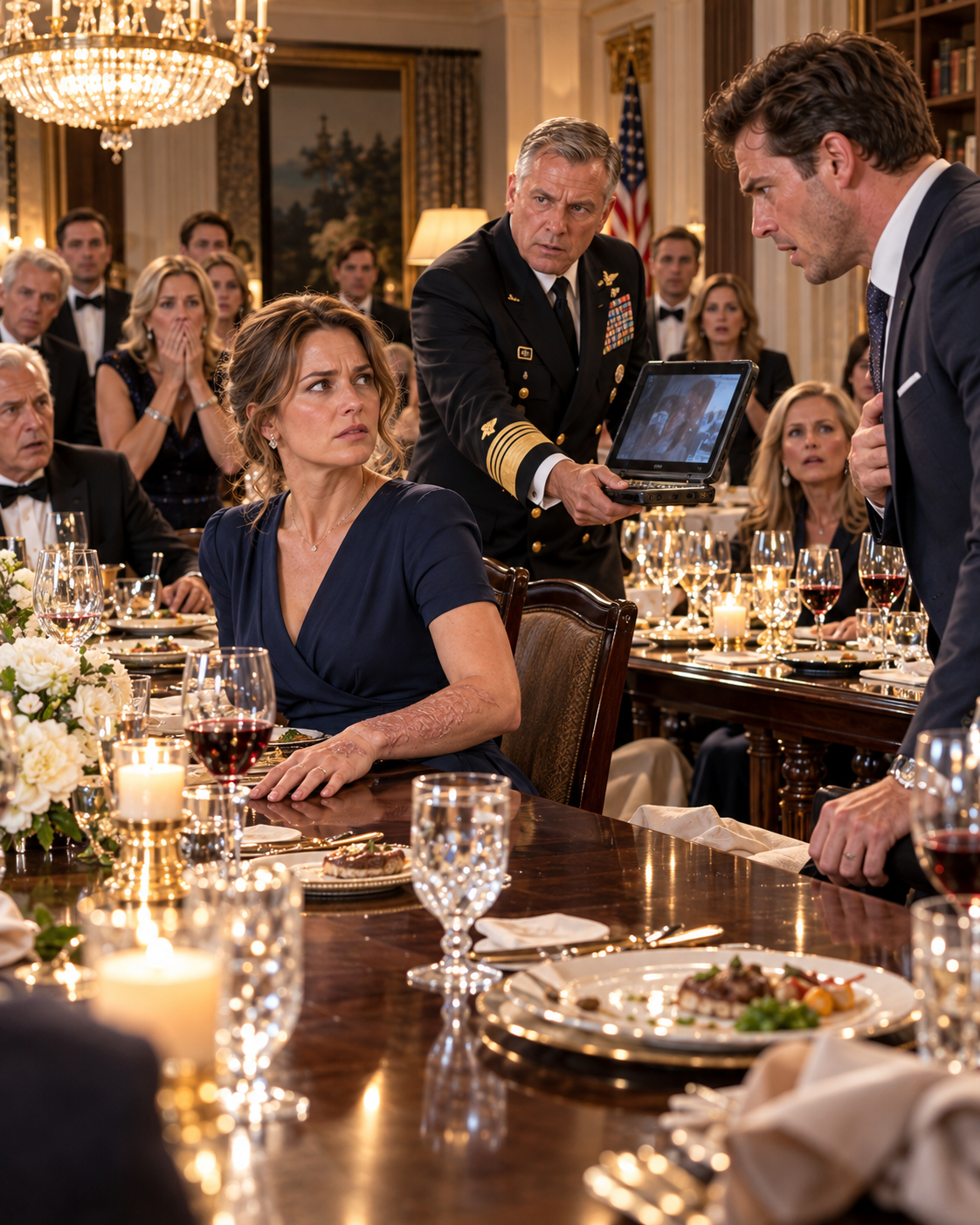
Bennett brought up another document.
“Kenneth Mercer received three separate calls from the military hospital in Germany.”
My father’s head snapped up.
Bennett looked at him.
“The first call was made when Claire was listed as critical.”
My father’s face turned gray.
“The second came after her first surgery.”
Bennett paused.
“The third was made because doctors needed authorization and family notification.”
No one moved.
Bennett continued.
“All three calls were documented.”
He turned the terminal toward my father.
“And after the third call, the emergency contact information was removed.”
My father stared at the screen.
“I don’t remember that.”
Bennett’s eyes hardened.
“You requested it.”
My chest tightened.
My father looked at me.
“Claire…”
I had spent years wondering why he never came.
Why my mother never came.
Why the hospital room remained empty except for nurses and other wounded soldiers.
Why I had waited for one phone call that never came.
Now I had my answer.
My father had known.
He had known I was badly injured.
He had known where I was.
And he had chosen not to come.
Not because he didn’t know.
Because he didn’t want the story to change.
Julian covered his face.
“I’m sorry.”
I stared at him.
He began crying.
Not the polished tears of a man performing grief.
These were ugly.
Uncontrolled.
Childlike.
“I thought it would only be one report,” he said.
“No one was supposed to get hurt.”
I felt my throat tighten.
“You accelerated the convoy.”
“I know.”
“You put me in that blast radius.”
“I know.”
“You stole my callsign.”
He lowered his hands.
“I know.”
“And you let Dad believe you were the one who saved those men.”
Julian broke.
“I was afraid.”
I looked at my father.
He couldn’t look at me.
Julian whispered, “Dad was proud of me.”
That sentence hurt more than anything else.
Because it explained everything.
Not the crime.
Not the lie.
The reason behind it.
My father had built a family legend around a son who never earned it.
And I had been forced to live quietly beneath that legend.
Bennett closed the terminal.
“Your brother’s records have already been preserved.”
Julian looked up.
“What happens now?”
Bennett stood.
“Now the government decides.”
A knock came from the front door.
Then another.
This time, no one at the table spoke.
The door opened.
Two federal investigators entered.
One identified himself as NCIS.
The other carried Department of Defense credentials.
Julian looked at me.
For the first time that night, I saw the brother I remembered.
Not the hero.
Not the liar.
Just the frightened boy who had once followed me around the house.
“I didn’t want you to get hurt,” he whispered.
I believed him.
That was the cruelest part.
He hadn’t intended to destroy my life.
He had simply believed his own future mattered more.
The investigators placed him under arrest.
My father stood halfway from his chair.
“Wait.”
The agents continued.
“Kenneth, don’t.”
My father looked at me.
His eyes were wet.
“Claire, I can explain.”
I shook my head.
“No.”
He stopped.
I picked up my coat.
For fifteen years, I had wanted an explanation.
Now I understood that some explanations were only excuses wearing better clothes.
As I walked toward the front door, Bennett stepped beside me.
He carried a small dark case.
“There’s one more thing.”
I turned.
He opened it.
Inside was a medal.
My breath caught.
The Purple Heart was resting beside the Bronze Star with Valor.
“They were delayed,” Bennett said.
“Your records were compromised.”
I stared at the medals.
For years, I had believed the absence meant I wasn’t worthy.
Now I understood it meant someone had stolen the truth.
Bennett held the case toward me.
“You earned these.”
My fingers trembled as I took it.
The metal was cold.
Heavier than I expected.
Outside, the night air hit my face.
Behind me, I heard my father’s voice.
“Claire.”
I stopped.
I didn’t turn around.
“I’m proud of you.”
For a moment, I almost laughed.
Then I heard the front door close behind me.
And I walked away.
Part 3
The court-martial lasted months.
The evidence did not leave much room for argument.
Unauthorized access.
Falsified records.
Interference with military logistics.
Obstruction.
And the deliberate alteration of an official combat report.
Julian was dishonorably discharged.
He lost his rank, his benefits, and the identity he had spent years constructing.
But punishment did not erase what happened.
Nothing could.
My father stopped appearing at family events.
His company eventually collapsed.
The dinner table was sold.
I heard it went to a private collector.
A stranger now eats dinner at the same piece of mahogany where my brother once called himself a hero.
I never went back.
I deployed four more times.
I went back to places where roads looked ordinary until you knew how dangerous they could be.
I trained younger technicians.
I taught them to trust procedure.
I taught them that courage wasn’t the absence of fear.
It was doing the right thing while fear was screaming at you to run.
I earned my master’s degree between deployments.
The work was difficult.
Some nights, I studied until two in the morning with my injured hand aching beneath the desk.
But every time I wanted to quit, I looked at the scars.
They reminded me that pain could become part of you without becoming the definition of you.
Years passed.
Then more years.
Fifteen years after that dinner, I stood on a Navy parade deck beneath a clear morning sky.
My uniform was immaculate.
My ribbons were aligned.
My left hand rested at my side.
The scars were still there.
They would always be there.
An officer read my orders.
Then another officer saluted me.
I took command of my own unit.
When the ceremony ended, the sailors gathered around me.
Some were young enough to have been children when Route Copperhead happened.
One of them noticed my hand.
“Ma’am, does it still hurt?”
I looked down.
The old scars caught the sunlight.
“Sometimes.”
He waited.
I smiled.
“But that’s not the same as being broken.”
He nodded.
Then he returned to formation.
I stood alone for a moment after everyone left.
The wind moved across the parade deck.
Somewhere in the distance, a flag snapped against its halyard.
I thought about Julian.
I wondered whether he still remembered that night.
I wondered whether my father ever understood what he had done.
Maybe they did.
Maybe they didn’t.
But I finally understood something I had been too young to understand on that road.
Truth doesn’t always arrive when you need it.
Sometimes it comes years later.
Sometimes it comes after people have already hurt you.
Sometimes it arrives carrying evidence, medals, court records, and memories you spent a lifetime trying to bury.
But when it comes, it doesn’t need permission.
It doesn’t need a powerful father.
It doesn’t need a famous brother.
It doesn’t need twenty-two people around a polished table raising glasses to a lie.
A lie can command a room for an evening.
It can build a reputation.
It can even become a family’s favorite story.
But truth is patient.
Truth keeps every scar.
Every signature.
Every timestamp.
Every name.
Every sacrifice.
And when the truth finally stands up, it doesn’t have to shout.
It only has to remain standing.
I looked once more at my left hand.
The bones had healed differently than they were supposed to.
The skin would never look untouched again.
Neither would I.
But as I closed my fingers into a steady fist, I felt no shame.
That hand had survived the blast.
I had survived the betrayal.
And the woman standing on that parade deck was no longer the daughter who had waited for her father to believe her.
She was the officer who had learned to believe herself.
I turned toward my sailors and walked back to my unit.
Behind me was everything they had tried to take from me.
Ahead of me was everything they never could.
And for the first time in my life, I understood that the scars I once wished I could hide were not evidence that I had been broken.
They were proof that the truth had survived.