At my father-in-law’s glittering hotel gala, he raised his champagne glass, looked me in the eye, and called me the BIGGEST EMBARRASSMENT
# Part 2
The receptionist tried to stop me before I reached the executive floor.
“I’m sorry, Major, but Mr. Whitmore is in a closed meeting.”
I showed her my identification.
“Then please tell him I have a question about Ridgeview.”
Her expression changed.
She picked up the telephone, listened for several seconds, and looked at me with the uncertainty of someone who had just been instructed to deny an obvious fact.
“Mr. Whitmore says he isn’t available.”
I nodded, thanked her, and continued down the corridor.
The boardroom doors stood open just long enough for me to hear Warren’s voice discussing the company’s next acquisition.
Then I walked inside.
Twelve executives turned toward me.
Warren sat at the head of a long walnut table, his silver hair perfectly arranged, a presentation glowing on the screen behind him.
For one brief moment, he looked merely annoyed.
“What on earth is this?”
I approached the table and placed the brass storage key beside his leather portfolio.
The tiny metallic sound seemed louder than it should have.
“I’d like to discuss the Ridgeview financial discrepancies.”
His expression didn’t change immediately.
Then his eyes fell to the faded paper tag attached to the key.
The color drained from his face so quickly that I wondered whether anyone else had noticed.
“Where did you get that?”
“Your father’s records.”
He pushed his chair back.
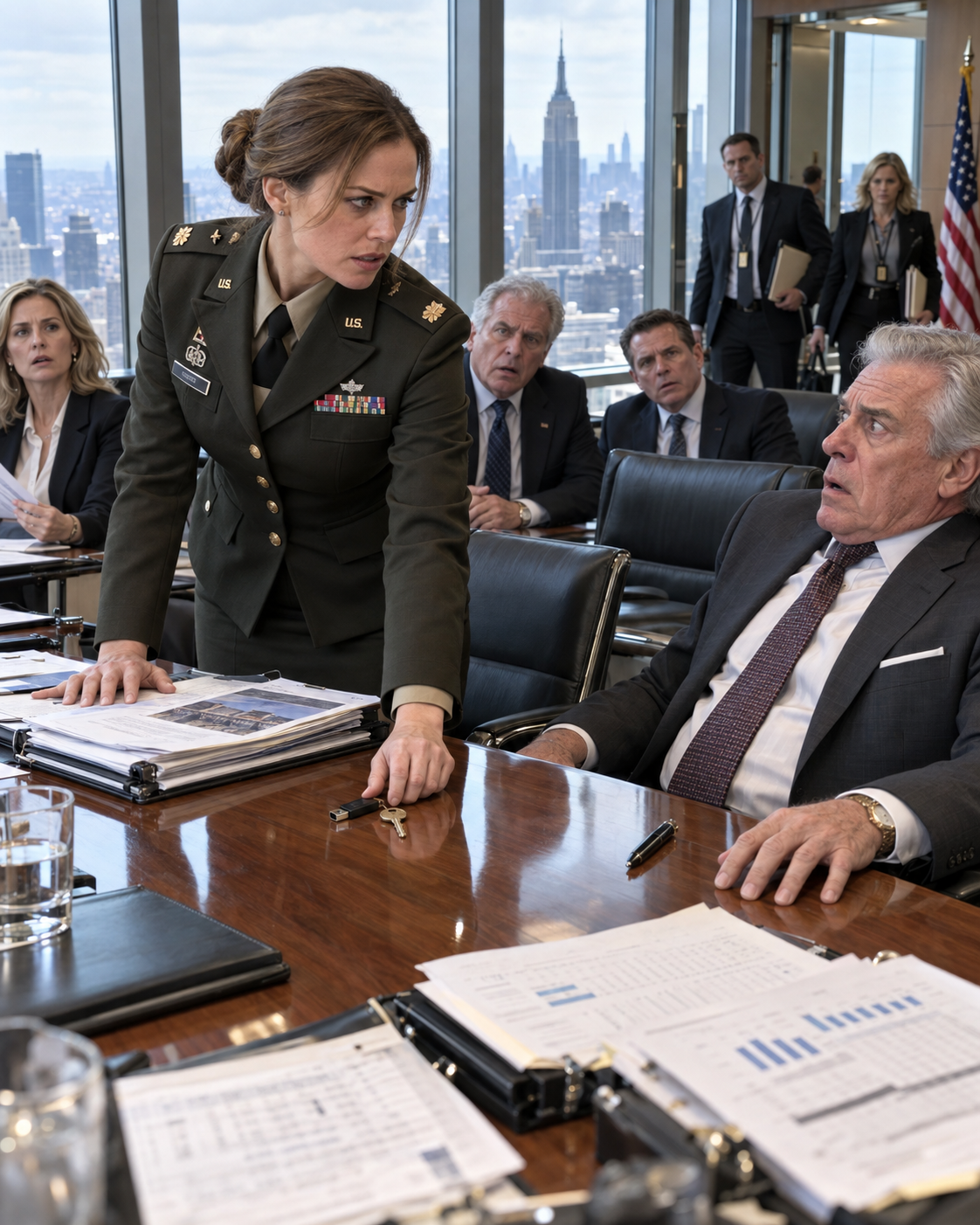
“This meeting is over.”
One of the directors frowned.
“Warren, we still have three agenda items.”
“I said the meeting is over.”
I remained where I stood.
“Before everyone leaves, I’d like an answer to one question. Why did Whitmore Hospitality report millions in completed preservation work when the supporting records show payments to companies with no verifiable operations?”
Nobody moved.
Warren stared at me with the expression of a man watching a locked door open by itself.
“You have no idea what you’re talking about.”
“Then it should be easy to explain.”
He turned toward security.
“Get her out of here.”
A gray-haired director named Thomas Bell raised one hand.
“Wait a moment. What exactly is Ridgeview?”
Warren looked at him.
“An old project. Complicated accounting. Nothing relevant to today’s business.”
“Then you won’t mind an independent audit,” I said.
His gaze snapped back to mine.
“You are an Army officer, not an accountant, and certainly not an executive of this company.”
“That’s correct.”
I straightened my shoulders.
“I’m also a citizen who has discovered evidence suggesting that public funds may have been diverted through fraudulent transactions.”
The room seemed to contract around us.
Warren lowered his voice.
“You have no understanding of the consequences of making accusations like that.”
“I understand that evidence should be examined.”
He leaned across the table.
“You are going to regret this.”
I had heard threats from men who mistook volume for strength, and I had worked under commanders who understood that the most dangerous moments were often the quietest.
So I picked up the key, placed it back in my pocket, and met his eyes.
“That depends on what the records show.”
I left before security could touch me.
My hands began trembling only after the elevator doors closed.
I had expected anger, perhaps even an attempt to discredit me, but I hadn’t expected the naked terror I had seen in Warren’s face.
He had recognized the key.
More importantly, he had recognized that his father had not died without leaving someone a way to find the truth.
That afternoon, an unfamiliar man in a maintenance uniform approached me near the underground parking garage.
He was in his early sixties, with tired eyes and a faint scar along his jaw.
“Major Claire Bennett?”
I turned.
“Yes.”
He glanced toward the security cameras.
“My name is Daniel Price. I worked maintenance at Ridgeview before they transferred me here.”
I waited.
He reached into his jacket and handed me a small USB drive.
“Mr. Arthur gave me this years ago. He told me to keep it somewhere safe until somebody came looking for the records.”
“Why didn’t you give it to the investigators?”
Daniel’s face tightened.
“Because the last time I tried to report what was happening, my supervisor told me I’d lose my job, and my daughter was still in college.”
He looked ashamed, though he had done nothing to deserve it.
“I kept telling myself that somebody more important would handle it.”
He pressed the drive into my hand.
“Then I heard Mr. Whitmore had thrown his wife out of the house, and that a woman in uniform had walked into the boardroom asking about Ridgeview.”
His eyes held mine.
“I figured maybe you weren’t going to let it disappear again.”
I thanked him and drove directly to a secure location where I could examine the files without connecting the drive to my personal computer.
The contents were worse than anything I had found in the storage unit.
There were fifteen years of transaction histories, internal emails, contractor agreements, draft audit reports, and spreadsheets tracing payments through a network of shell companies.
Some of the corporations had names that sounded respectable, complete with professional letterheads and registered business addresses.
But the same individuals appeared repeatedly across supposedly unrelated entities.
A consulting company received a payment for preservation planning, then transferred nearly all of it to a second company.
That company paid a third entity for construction services that could not be verified.
Eventually, money flowed into accounts associated with businesses controlled by people connected to Warren.
The records suggested that millions in historic preservation grants had been diverted from their intended purpose while the company continued claiming reimbursement for incomplete or nonexistent work.
There were emails in which senior employees questioned the discrepancies.
Several messages showed that their concerns had been dismissed.
One contained a chilling sentence from a senior executive: “The numbers only become a problem when someone insists on connecting them.”
Another email revealed that Arthur had ordered an internal review years earlier.
After the review began, the finance department had been instructed to restrict access to certain records.
A draft report disappeared from the official archive.
The employee who prepared it resigned shortly afterward.
Arthur had apparently spent his final years rebuilding the evidence from copies, private notes, and documents preserved by people who had been too frightened to speak openly.
He had not trusted the company to investigate itself.
He had trusted paper, timestamps, bank records, and the stubborn belief that facts could outlive the people who tried to bury them.
I called Marcus Reed, a retired Army JAG colonel who had advised me on procurement compliance during an earlier assignment.
Marcus had a patient voice and a habit of asking the one question everyone else wanted to avoid.
After I explained what I had discovered, he didn’t congratulate me or promise that everything would be fine.
Instead, he said, “Have you changed any of the files?”
“No.”
“Have you contacted Warren again?”
“No.”
“Good. Don’t confront him privately, don’t circulate the material, and don’t try to investigate beyond what you’ve already obtained.”
I heard papers moving on his desk.
“These records could point to serious federal offenses, but we need to distinguish what they prove from what they merely suggest.”
“What do I do now?”
“Preserve the originals. Document how you received them. Then let the proper investigators determine what happened.”
Marcus connected me with an attorney experienced in federal financial investigations, who helped organize the evidence and prepare a formal referral to the appropriate authorities.
I also made sure my Army chain of command was informed about the situation so that my personal involvement would not be mistaken for an official military investigation.
Within days, federal investigators began examining the material.
They requested copies of the relevant documents, identified the agencies that had awarded the grants, and started tracing the payments through the companies listed in Arthur’s records.
I answered questions, provided a timeline, and handed over everything I had found without attempting to interpret evidence beyond my knowledge.
For the first time, the matter was moving beyond Warren’s reach.
But the man who had controlled an empire for decades wasn’t going to surrender quietly.
The first attack came through an anonymous online account that claimed I had stolen confidential business records to settle a personal grudge.
The second appeared in a gossip column suggesting that I had threatened Warren in exchange for a position at his company.
Then someone leaked an altered photograph from the gala, cropped to make it appear that I had confronted him aggressively while he stood calmly among his guests.
David read the article at our kitchen table.
“They’re trying to make you look unstable.”
“They’re trying to make the evidence look personal.”
He reached across the table and took my hand.
“Does it work?”
I thought about the headlines, the strangers sending messages, and the people who had once thanked me for my service suddenly asking whether I had become obsessed with my husband’s family.
“It hurts,” I admitted. “But it doesn’t change the records.”
David squeezed my hand.
“Then we hold on to that.”
Marion, meanwhile, moved into a modest apartment near the river.
She left behind the house, the staff, the designer clothes, and the carefully arranged life that had made her look enviable from the outside.
When I visited her, she was sitting beside an open window, watching sunlight move across the water.
“I used to think leaving him would destroy me,” she said.
“What do you think now?”
She considered the question.
“I think I was disappearing long before he asked me to leave.”
She began rebuilding her life slowly, reconnecting with old friends and learning to make decisions without calculating Warren’s reaction.
Her first independent purchase was a secondhand bookcase she assembled herself.
She sent David a photograph of it with a message that read, “No one has told me where it belongs, so I put it wherever I wanted.”
He laughed for the first time in weeks.
Then, one Tuesday morning, the federal investigators requested an urgent meeting with Whitmore Hospitality’s board.
The preliminary findings had exposed significant discrepancies between the reported preservation expenditures and the supporting records.
The company could no longer dismiss the matter as an old accounting misunderstanding.
An independent forensic audit was underway, and the investigators had identified transactions requiring further scrutiny.
Warren responded by announcing a special shareholders’ meeting.
His public statement described the inquiry as a coordinated attempt to damage the company, and he promised to clear his name.
For the first time since the gala, I saw him on television speaking directly to the public.
He wore the same immaculate expression, the same controlled smile, and the same expensive suit.
But when the reporter asked whether he would cooperate fully with the investigation, his pause lasted just a fraction too long.
I recognized that pause.
It was the silence of a man who had spent years controlling every question and had finally encountered one he could not answer without risking everything.
The shareholders’ meeting was scheduled for the following Friday.
I knew I would not be the person presenting the evidence.
That responsibility belonged to the investigators, the independent auditors, and the people whose job it was to establish what the records actually proved.
My role was to preserve what Arthur had left behind and refuse to let intimidation turn the truth into a private family dispute.
On Friday morning, I sat beside David in the back row of the company’s largest conference room.
Marion sat on my other side, her hands folded tightly in her lap.
Warren entered through a side door to a mixture of applause and nervous whispers.
He glanced toward us.
For one second, his eyes met mine.
Then he looked away.
At the front of the room stood the former chief financial officer, a man named Robert Hayes who had left the company years earlier.
Beside him were the lead forensic auditor and two federal agents.
A large evidence box rested on the table.
Warren’s face changed when he saw it.
And when the meeting chair called everyone to order, I understood that the final battle would not be fought through insults, rumors, or threats.
It would be fought through records that had survived every attempt to make them disappear.
# Part 3
The room fell silent as Robert Hayes approached the microphone.
He had been Whitmore Hospitality’s chief financial officer for nearly a decade before leaving under circumstances the company had described as a voluntary retirement.
Now he stood with both hands resting on the podium, looking older than I remembered from the photographs in Arthur’s files.
“I did not come here to speculate about anyone’s motives,” he began. “I came because the records I helped prepare were altered, restricted, or excluded from later reporting, and because shareholders deserve to understand the financial risks facing this company.”
Warren stood abruptly.
“This is a personal vendetta by a disgruntled former employee.”
The meeting chair asked him to sit.
Robert continued.
He described how payments connected to Ridgeview had passed through multiple corporate entities, how invoices had been approved despite missing documentation, and how concerns raised within the finance department had failed to receive independent review.
The forensic auditor then presented the findings of the preliminary examination.
The presentation was methodical.
There were no dramatic accusations, no triumphant speeches, and no attempt to turn suspicion into proof before the work was finished.
There were transaction dates, invoice numbers, bank transfers, grant reports, and comparisons between claimed expenses and verifiable construction records.
The numbers spoke for themselves.
Across multiple years, substantial sums had been paid to entities whose services could not be adequately substantiated.
Some payments appeared to have been routed through related companies before reaching accounts associated with individuals connected to the business.
Several restoration projects had been reported as substantially complete despite evidence that major work remained unfinished.
The auditors explained that the full scope of the losses was still under investigation, but the discrepancies were too serious to dismiss.
Then one of the federal agents stood.
“The evidence collected to date raises substantial concerns regarding the use of public funds and the accuracy of financial representations made in connection with the Ridgeview projects.”
He did not announce a verdict.
He did not need to.
Warren’s face had become rigid, and his hands gripped the edge of the table.
“This company has created thousands of jobs,” he said. “We have preserved historic buildings that would otherwise have been lost. You are destroying decades of work because of accounting irregularities.”
Robert looked directly at him.
“An accounting irregularity is a mistake. A mistake gets corrected when it is discovered. These discrepancies were documented repeatedly, and the underlying transactions continued.”
Warren turned toward the shareholders.
“Are you going to let an outsider who barely understands our business dictate the future of this company?”
I felt the familiar urge to stand and defend myself.
But I remained seated.
This wasn’t about whether Warren liked me, whether he respected my uniform, or whether I deserved a place at his table.
It was about whether the company had used money intended to preserve public heritage as a private source of wealth.
The board chair announced that an emergency vote would be held on Warren’s continued leadership.
The room erupted in overlapping conversations.
Warren leaned toward the directors nearest him, speaking rapidly, gesturing toward the auditors, the former CFO, and the agents.
One by one, the people who had spent years agreeing with him began to look elsewhere.
When the votes were counted, the result was decisive.
Warren Whitmore was removed as chief executive officer.
For a moment, he remained seated, staring at the paper in front of him as though the numbers might rearrange themselves if he waited long enough.
Then the federal agents approached.
“Warren Whitmore, we have a warrant for your arrest.”
The sound that followed was not applause.
It was the rustle of expensive suits, the scrape of chairs, and the sudden realization that the most powerful man in the room no longer controlled what happened next.
Warren looked toward David.
My husband stood motionless, his face pale.
For years, he had wanted nothing more than a father who could love him without conditions.
Now that father was being led away in handcuffs.
“David,” Warren said, his voice breaking for the first time I had ever heard. “Tell them what this family has done for you.”
David swallowed.
“You taught me that everything has a price.”
Warren stared at him.
David’s eyes filled with tears, but his voice remained steady.
“I’m still trying to learn that people don’t.”
The agents escorted Warren through the side door.
No one cheered as it closed.
The man who had once commanded entire ballrooms with a raised glass left behind a room full of people who were suddenly afraid to look at one another.
In the weeks that followed, the investigation widened.
The company cooperated with authorities, outside auditors examined additional projects, and investigators continued tracing the money and identifying the people who had helped move it.
Warren faced federal charges related to the alleged financial scheme, and the case proceeded through the legal system.
Some of the employees who had stayed silent came forward.
Others insisted they had known nothing.
Daniel Price provided a statement about Arthur’s efforts to preserve the records, and Robert Hayes supplied additional documentation that had not appeared in the company’s official files.
Arthur’s private archive became one part of a much larger evidentiary record.
His son had spent years believing that wealth could protect him from consequences.
His father had spent his final years preparing for the possibility that it could not.
But the collapse of Warren’s public image did not bring immediate peace.
Within days, new rumors began circulating.
Anonymous sources accused me of manipulating the investigation to punish Warren for humiliating me.
A fabricated story suggested that I had used military contacts to obtain confidential financial information.
Another claimed David had secretly known about the alleged misconduct and had cooperated with me to seize control of his father’s company.
None of the stories provided credible evidence, but they spread faster than the corrections.
Strangers sent me messages calling me vindictive, ambitious, and disloyal.
A reporter waited outside our home for two afternoons.
Someone left an envelope containing printed photographs from the gala in our mailbox, each marked with insulting captions.
For a few nights, I slept badly.
I would wake before dawn and lie beside David, listening to the refrigerator hum in the kitchen, wondering how a truth supported by thousands of pages could be made to look so uncertain in the space of a headline.
One morning, I found David standing on the back porch, holding his phone.
“They’re saying you destroyed my family,” he said.
I felt my stomach tighten.
“I’m sorry.”
He looked at me as if I had spoken another language.
“Why are you apologizing?”
“Because this has cost you something, too.”
He placed his phone facedown on the railing.
“My father made his choices. You didn’t make them for him.”
He took my hands.
“The family I want to protect is standing right here.”
I leaned into him, and for the first time in weeks, I allowed myself to cry without trying to make the tears quiet.
We stopped reading anonymous comments.
We let our attorney respond to false claims when a response was necessary, and we refused to spend every evening defending ourselves to people who had already decided what they wanted to believe.
I continued serving in the Army.
I went to work, attended briefings, reviewed logistics plans, and did the ordinary tasks that had existed before Warren’s name became a headline.
The world did not stop because my father-in-law had been arrested.
Supplies still had to arrive where they were needed.
Young soldiers still depended on people to make careful decisions.
Life, stubborn and unsentimental, kept asking me to show up.
That became its own kind of healing.
Marion’s recovery took longer.
She had spent decades organizing her life around Warren’s moods, anticipating his anger, smoothing over his insults, and convincing herself that the next quiet morning meant things had changed.
When the divorce proceedings began, she discovered that freedom could be frightening when every major decision had previously been made for her.
I helped her find an apartment near the river, in a quiet neighborhood where the sidewalks were lined with trees and the windows caught the afternoon sun.
She chose the furniture herself.
She planted herbs on the balcony.
She began taking long walks after breakfast, sometimes stopping to watch boats move beneath the bridges.
One afternoon, I found her standing beside the water with a paper cup of coffee in her hands.
“I spent years thinking peace meant keeping him happy,” she said.
“And now?”
She watched a small boat drift past.
“Now I think peace means I don’t have to be afraid of what happens when he isn’t.”
She smiled, and the expression seemed to belong to a younger version of herself.
“I should have left a long time ago.”
“Maybe,” I said. “But you’re here now.”
She nodded.
For a while, neither of us spoke.
We didn’t need to.
Months passed, and the legal case continued.
Warren’s company underwent restructuring, shareholders demanded stronger oversight, and the preservation projects came under renewed scrutiny.
Some of the historic buildings required additional funding and years of work to restore what had been neglected.
The consequences extended far beyond the boardroom.
Communities had lost resources intended to protect places that carried their history, and employees had spent years working inside a system they did not fully understand.
The money could not be returned by changing a headline.
Trust could not be restored by removing one executive.
But the records had finally been brought into the open, and the work of repair could begin.
Nearly a year after the gala, David asked whether I would visit his father.
Warren was being held at a federal detention facility while his case proceeded.
I had no desire to see him.
The thought of sitting across from him brought back the ballroom, the laughter, and the way he had looked at my uniform as though it were a stain on his family name.
But David wasn’t asking me to defend Warren.
“I need to know whether I can let go of some of this,” he said. “Not for him. For myself.”
I studied my husband’s face.
He had changed during that year.
The boy who had once spent his childhood trying to earn his father’s approval had begun to understand that love offered only as a reward was never something he could safely depend on.
“If I go,” I told him, “I won’t promise him anything.”
“I wouldn’t ask you to.”
So I went.
The detention center was colder than I expected, with pale walls, fluorescent lights, and a faint smell of disinfectant.
A guard led me to a small visiting room where Warren sat behind a table.
He looked older.
His hair had thinned, his shoulders had lost some of their former authority, and his expensive suits had been replaced by plain institutional clothing.
Yet the first thing I noticed was not his appearance.
It was the absence of an audience.
There were no investors waiting for his approval, no employees watching his face for permission to speak, and no guests ready to laugh when he made a cruel remark.
For the first time since I had known him, he seemed unsure of what expression to wear.
“Claire,” he said.
I sat opposite him.
“Warren.”
He looked down at his hands.
“I suppose you came to see whether I’m sorry.”
“I came because David asked me to.”
He absorbed that without answering.
For several seconds, the silence stretched between us.
Then he spoke.
“I was wrong about you.”
It was such a small sentence for a man who had spent years making me feel small.
He continued before I could respond.
“I thought your service made you stubborn. I thought you had no ambition because you weren’t interested in the things I valued. I believed that if I embarrassed you enough, you’d either change or leave.”
His throat moved.
“And when I realized you might uncover what I’d done, I became afraid of you.”
I watched him carefully.
“Because I knew how you would investigate,” he said. “You wouldn’t care who I was. You would follow the records.”
“That was the point.”
He nodded slowly.
“I know.”
For the first time, he looked directly at me without contempt.
“I hurt Marion. I hurt David. I used people who trusted me, and I told myself I was protecting what my father built. I kept saying I was doing it for the family, but I think I was protecting myself.”
His eyes shone with tears he seemed almost embarrassed to show.
“I’m sorry, Claire.”
I had imagined hearing those words many times.
In some versions, I pictured myself standing taller, finally receiving the recognition I had been denied.
In others, I imagined the apology arriving too late to matter.
But sitting across from him, I felt neither triumph nor the sudden relief I had once expected.
I felt tired.
Not because the apology was meaningless, but because it could not travel backward through time and undo the years when I had wondered whether I would ever be enough.
“Thank you for saying that,” I replied.
He waited.
“Can you forgive me?”
I thought about Marion’s quiet apartment, David’s trembling hands after the shareholders’ meeting, Daniel’s fear of losing his daughter’s tuition, and Arthur’s careful handwriting on the documents that had outlived him.
I thought about the people who had trusted Warren and the communities that had paid the price for his decisions.
“I can choose not to carry hatred for you,” I said. “But forgiveness doesn’t mean reconciliation.”
His face tightened.
“I understand.”
“I’m not going to pretend we can become the family you wanted us to be. I’m not going to tell David that what happened was acceptable, and I’m not going to erase the consequences of your choices because you’ve finally admitted they were choices.”
He looked away.
For a moment, I felt the old instinct to soften my words, to make them easier for him to hear.
Then I let that instinct pass.
“You don’t need my permission to become a better man,” I told him. “But you do need to take responsibility for what you’ve done.”
He nodded, slowly and silently.
When the guard signaled that our time was over, Warren stood.
“Claire?”
I turned.
“You were never an embarrassment.”
I held his gaze.
“I know.”
And for the first time, I knew it without needing him to believe it.
I walked out of the detention center into the afternoon sunlight.
The air was cool, and traffic moved steadily along the street, ordinary and indifferent to the fact that a chapter of my life had just closed.
David was waiting beside the car.
He didn’t ask what Warren had said.
He simply opened his arms, and I stepped into them.
“Are you okay?” he whispered.
I rested my head against his chest.
“Yes,” I said, surprised by how true it felt.
We drove to Marion’s apartment that evening.
She had made dinner, and the three of us sat near the open window while the river reflected the last light of the day.
Marion talked about a book she was reading.
David complained about a project at work.
I told them about a young officer who had accidentally sent an entire briefing to the wrong distribution list, and for the first time in months, our laughter felt unburdened.
There were no champagne glasses, no chandeliers, and no powerful men deciding who deserved to sit at the table.
There was only a meal, a quiet room, and the fragile, ordinary happiness of people who had stopped asking permission to live their own lives.
Later, I stepped onto the balcony alone.
The river moved beneath the evening sky, carrying reflections of lights that trembled on the water before breaking apart.
I thought about the girl I had been when I first married David, eager to be accepted by a family whose wealth seemed to give its members the authority to define everyone around them.
I thought about the years I had spent trying to answer insults with patience, hoping that enough restraint might eventually earn me respect.
I understood now that patience was not the same as surrender, and forgiveness was not the same as reopening a door someone had once used to hurt me.
Warren had lost his company, his reputation, and his freedom because of decisions he had made.
But he had never possessed the power he believed he held over my worth.
That power had existed only as long as I kept handing it to him.
I took a slow breath and looked out at the water.
I was still a soldier.
I was still a wife.
I was still the woman who had walked into a boardroom carrying a small brass key and refused to be intimidated by a man who believed the world belonged to him.
But I was no longer the woman standing beneath the chandeliers, silently wondering whether she deserved to be there.
I had learned that belonging was not a prize handed down by the wealthy, the powerful, or even the people we loved.
It was something we could build through our choices, our courage, and the way we treated others when no one was watching.
The truth had not made me powerful because it had brought Warren down.
It had made me free because it had shown me that I never needed his approval to stand upright in the first place.
And as the river carried the last of the evening light into the dark, I finally left behind the cruelest lie he had ever taught me: that my worth was something another person could give, withhold, or take away.