At my court-martial, a four-star general called me a disgrace in front of an entire military tribunal, stripped my rank
Part 2
At four forty-five the next morning, I stood beside the highway with a duffel bag, my old flight jacket, and the envelope tucked inside my shirt.
The helicopter arrived just as the first strip of sunlight appeared above the mountains.
No insignia marked its dark fuselage.
Two armed men waited inside, and neither offered a greeting.
I climbed aboard.
By the time we reached Groom Lake, the desert had become a vast sheet of copper beneath us.
The test facility emerged from the haze in layers of fences, radar domes, hangars, and runways that seemed to lead nowhere.
Beyond the perimeter, the mountains stood like silent witnesses.
I had flown over restricted facilities before, but seeing Groom Lake from inside a military helicopter felt different.
This place did not merely hide aircraft.
It hid decisions.
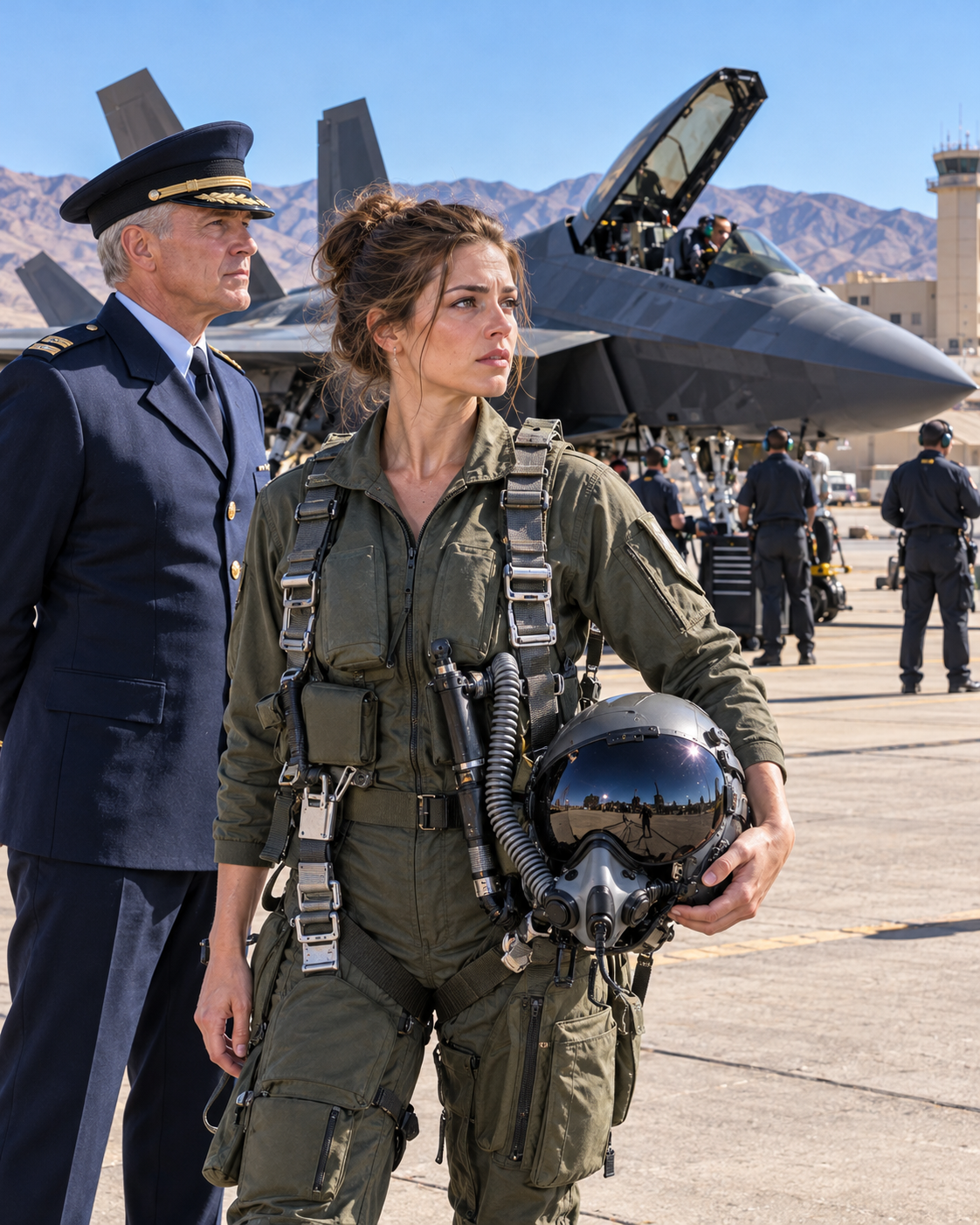
General Reed was waiting outside Hangar Six when we landed.
He wore a flight suit now, with his name stitched above his chest pocket.
“You came,” he said.
“I want to know why my court-martial was connected to your aircraft.”
His expression tightened.
“First, we need to see whether you can fly it.”
“That’s not an answer.”
“No,” he admitted. “It isn’t.”
He led me into the hangar.
The X-44 Wraith stood beneath a bank of white lights, its black titanium fuselage gleaming like the shell of some enormous insect.
Its wings were swept sharply backward, and its twin engines rested inside a body built around an aerodynamic configuration so aggressive that the aircraft seemed barely willing to remain still on the ground.
It was beautiful in the way a lightning strike was beautiful.
Powerful.
Unpredictable.
Completely indifferent to what stood beneath it.
A thin man in a white laboratory coat approached us, carrying a tablet.
“General, this is a terrible idea.”
Reed did not introduce him.
He didn’t need to.
Ian Foster looked at me as though someone had dragged a dead animal into his laboratory.
“This is the mechanic?”
“Former combat pilot,” Reed replied.
“Former,” Foster emphasized.
His gaze dropped to my hands, where old scars crossed the knuckles.
“Captain Mercer, I have spent four years developing the control architecture of this aircraft. We have hundreds of engineers working on it, and you intend to solve our problems by turning off the systems that keep it in the air?”
“I intend to find out why your systems keep trying to throw it out of the sky.”
Foster gave a thin, contemptuous smile.
“The Wraith operates beyond conventional human reaction time. Its adaptive intelligence predicts instability before a pilot can even perceive it.”
“Then why did every accident begin after the pilot corrected a movement the system initiated?”
His smile disappeared.
“You’ve read incomplete telemetry.”
“I’ve read enough.”
“The flight-control system has safeguards against precisely the scenario you’re proposing.”
“Those safeguards are part of the problem.”
Foster turned to Reed.
“If you allow this, you will be personally responsible for whatever happens.”
Reed looked toward the aircraft.
“I already am.”
For a moment, nobody spoke.
Then Reed handed me a tablet displaying a list of conditions for the test.
I scanned the page.
The software limiters would remain active.
Automated stabilization would remain active.
The flight computer would retain authority over thrust vectoring.
I looked up.
“No.”
Foster folded his arms.
“This is the approved test configuration.”
“Then find another pilot.”
Reed took the tablet from me.
“What exactly do you want?”
“Complete manual control of thrust vectoring, no automated override of my commands, and a clean separation between the aircraft’s sensors and the system that interprets them. I want the raw readings. I want to know what the airframe is doing, not what the computer thinks it ought to be doing.”
Foster shook his head.
“You cannot simply disable the flight-control architecture of an experimental aircraft and expect a human being to compensate.”
“I don’t expect to compensate for everything. I expect to stop the computer from creating problems I could otherwise survive.”
“The airframe is unstable.”
“Then let’s stop pretending the software can make it stable by arguing with the pilot.”
Foster’s face reddened.
“This is not a propeller plane from the last century.”
“No,” I said. “A propeller plane would probably have the good sense to listen.”
Reed raised one hand before Foster could respond.
“Give him the configuration he requested.”
“General—”
“Now, Doctor.”
Foster stared at him, then at me.
His expression had changed.
The contempt was still there, but something else had entered it.
Fear.
Not fear that I would fail.
Fear that I might succeed.
The next two hours passed beneath a ceiling of fluorescent lights and humming diagnostic equipment.
Engineers moved around the aircraft, making changes that Foster supervised with the rigid precision of a man who believed obedience could compensate for uncertainty.
I sat in the cockpit for the first time just before sunrise.
The canopy lowered above me with a heavy mechanical seal, and the hangar disappeared behind a curved wall of glass.
The cockpit was so cramped that my shoulders nearly brushed the sides.
A cluster of displays glowed in front of me.
The control stick sat between my knees, surrounded by switches, emergency handles, and unfamiliar interface controls.
I touched the stick.
It felt too light.
That bothered me more than the aircraft’s appearance.
A control should communicate something through the hand.
Resistance.
Pressure.
A warning when the aircraft was approaching the edge of what it could survive.
The Wraith felt like it was waiting for permission to move.
A technician’s voice came through my headset.
“Manual thrust-vector control is enabled. Automated flight-command overrides are disabled. Safety monitoring remains active, but it will not intervene in your control inputs.”
Foster’s voice followed.
“Any departure from the approved test envelope will terminate the flight.”
I closed my eyes for a moment.
I remembered Afghanistan.
The radio.
The men trapped in the valley.
The feeling of knowing that a decision could be wrong and still be the only decision a decent person could make.
Then I opened my eyes.
“Copy that.”
The engines started with a deep vibration that traveled through the seat and into my ribs.
The Wraith’s twin turbojets came alive, and the sound rolled across the runway like distant thunder.
I eased the aircraft forward.
For the first few minutes, the Wraith behaved almost politely.
The controls responded to small inputs, and the aircraft accelerated without complaint.
At eighty knots, I checked the instruments.
At one hundred and twenty, I brought the nose up.
The runway dropped away beneath me.
I climbed through the morning haze, leaving Groom Lake behind.
At ten thousand feet, the aircraft felt fast but manageable.
At twenty thousand, the sky deepened to a darker blue.
Reed’s voice came through the radio.
“Status?”
“Responsive. No significant oscillation.”
“Continue to the planned test altitude.”
I climbed higher.
At thirty-five thousand feet, the desert looked like a map drawn in shades of gold and brown.
The Wraith shuddered as I brought the engines toward the upper end of the test range.
Then the acceleration pressed me into the seat.
Mach one.
Mach one point five.
Mach two.
The sound outside became a distant, meaningless thing.
At Mach 2.3, the aircraft began to vibrate.
I eased the throttle back slightly.
The nose moved left.
I corrected.
The nose moved farther left.
I corrected again, more gently this time.
The control stick pushed back against my hand.
A warning flashed across the display.
ASYMMETRICAL PRESSURE.
Then another.
FLIGHT CONTROL DISAGREEMENT.
“Foster, what is the system reading?”
“Your right-side pressure sensors are showing a drop. The aircraft is compensating.”
“It’s overcompensating.”
“Hold your heading. The stabilization model is calculating a correction.”
The stick jerked against my palm.
The nose pitched upward, then rolled sharply to the right.
I countered, but the response came late and much harder than I intended.
A third warning flashed.
THRUST VECTOR MISMATCH.
The aircraft bucked violently.
My shoulder slammed into the cockpit wall, and the world outside the canopy spun through a blur of blue sky and white cloud.
“I’m losing directional stability,” I said.
Foster answered immediately.
“Restore automated stabilization.”
“No. The automated response is increasing the oscillation.”
“Your control inputs are destabilizing the airframe.”
I watched the pressure readings collapse on the right side.
The aircraft was entering the same feedback loop I had seen in the telemetry.
Except now I was inside it.
The Wraith rolled again.
I felt the beginning of a flat spin, that awful moment when the aircraft stopped behaving like something moving through the air and started behaving like a falling object with no intention of recovering.
The horizon vanished.
The desert flashed above me.
Then below me.
Then above me again.
“Mercer, eject!” Reed shouted over the radio.
I could hear people yelling in the control room.
I could hear the alarm tone.
I could hear my own breathing, short and ragged inside the oxygen mask.
The aircraft was dropping through the sky in a widening spiral.
“Jack, eject now!” Reed repeated.
My hand moved toward the ejection handle.
Then I stopped.
I thought of the three injured pilots.
I thought of the man in the coma.
I thought of the way the Wraith’s software had fought against every attempt to correct its behavior.
The aircraft was not simply falling.
It was trapped in its own corrections.
And every movement I made to force it back into line was feeding the spin.
I remembered something an old instructor had told me during my first year of flight training.
When the aircraft is already beyond your ability to command it, your next input can be the one that finishes killing you.
Sometimes survival begins with knowing when to stop.
“Mercer!” Reed’s voice cracked through the headset.
I took my hand off the stick.
Then I released the controls entirely.
The Wraith continued to rotate.
For one terrible second, I felt as though I had surrendered my life to gravity.
But the rotation began to change.
The aircraft’s nose drifted toward the direction of its natural pendular movement.
The violent oscillation weakened.
The spin remained, but its rhythm shifted.
I watched the instruments and waited for the airframe to tell me what it was doing instead of forcing it to do what I wanted.
The pressure imbalance was still there.
The altitude was disappearing.
My vertical speed indicator plunged.
At twelve thousand feet, the spin tightened.
At ten thousand, the aircraft rolled through another violent rotation.
At eight thousand, Foster shouted something about the control surfaces.
I barely heard him.
I was watching the rotation rate.
I was waiting for the one moment when the aircraft’s movement and gravity would stop fighting each other.
The desert rose toward me.
The warning lights flashed so brightly that the cockpit seemed to pulse red.
At six thousand feet, I could see the ridgelines.
At four thousand, the spin began to loosen.
At three thousand, the nose started to drop toward the direction of travel.
The aircraft was aligning.
Not enough.
Not yet.
I held my hands clear of the controls, forcing myself not to interfere.
The Wraith shuddered as air began to flow more cleanly across its surfaces.
The rotation slowed.
For the first time since the pressure failure, the aircraft seemed to be moving with the air instead of fighting it.
I reached for the thrust-vector controls.
The desert was no longer a distant landscape.
It was a wall coming toward me.
And I had only seconds left to make the decision that would determine whether the Wraith became a breakthrough or a smoking crater.
Part 3
At one thousand feet above the ridgelines, I brought both throttles forward.
The engines roared as the afterburners ignited, and the sudden surge of thrust slammed me into the seat.
I engaged manual thrust vectoring, directing the engine exhaust to force the nose upward while the aircraft still had enough forward motion to respond.
The G-force hit like a concrete wall.
My vision narrowed at the edges.
Nine Gs.
For a fraction of a second, the desert and the sky became one spinning smear of brown and blue.
The Wraith’s titanium belly skimmed above the scrub-covered ridges, so low that I could make out individual rocks and the pale branches of dead desert bushes.
Then the nose rose.
The wings caught the air.
The aircraft shuddered once, hard enough to make my teeth click together, and the horizon stopped moving.
I was flying.
Not comfortably.
Not safely.
But flying.
The Wraith leveled into a shallow glide above the desert, its engines screaming while I eased the thrust back to keep from driving the aircraft into another unstable state.
I held the controls with barely enough pressure to feel their response.
No fighting.
No forcing.
Just small adjustments, each one followed by a moment of patience.
The aircraft obeyed.
For several seconds, the radio was completely silent.
Then Reed spoke.
“Mercer, confirm your status.”
I swallowed, trying to force air through a throat that felt packed with sand.
“I’m flying.”
“Repeat.”
“The aircraft is stable. Manual control is responding.”
In the control tower, nobody cheered.
Nobody spoke.
I imagined them standing around their screens, watching the same telemetry that had predicted my death only moments earlier.
I imagined Foster staring at the flight data and searching for a reason to call the recovery an accident.
I kept the Wraith moving in a broad, controlled arc across the desert.
The pressure readings remained uneven, but they were no longer collapsing.
The control stick felt different now.
Not lighter.
Honest.
“Ground control,” I said, “the aircraft isn’t impossible to fly. Your system was treating every human correction as a threat. I stopped fighting the airplane, and it finally stopped fighting me.”
Reed’s voice came back, quiet and strained.
“Bring it home, Jack.”
I did.
The return flight was the longest forty minutes of my life.
Every change in altitude, every turn, every adjustment of thrust demanded attention.
I refused to rush.
The Wraith had nearly killed me because its systems were designed to react faster than thought.
I would bring it home by giving every decision the time it deserved.
When Groom Lake finally appeared beneath the nose, the runway looked impossibly short.
I lowered the landing gear and brought the engines back.
The aircraft touched down with a hard, shuddering impact.
The tires screamed against the runway.
For a moment, I thought the left gear had failed.
Then the Wraith straightened, rolled forward, and slowed to a stop.
I sat motionless in the cockpit, listening to the engines wind down.
My hands were trembling.
My legs felt hollow.
I had survived.
And for the first time in eight months, I felt something other than anger when I thought about flying.
The canopy opened.
A crew rushed toward the aircraft, but I raised one hand to tell them I could climb out myself.
When my boots touched the runway, Reed was waiting beside the ground crew.
He looked at me for several seconds without speaking.
Then he reached out his hand.
I looked at it.
“Before you congratulate me, General, I want the truth.”
His hand slowly lowered.
“Come inside.”
Foster was already in the debriefing room.
A wall-sized display showed the flight’s telemetry, including the moment I had released the controls and the exact sequence that followed.
He stood with his arms folded, his face pale beneath the harsh lights.
“The aircraft should not have recovered,” he said.
“It did.”
“The pressure imbalance should have made that spin unrecoverable.”
“It nearly did.”
Foster turned toward the screen.
“You deliberately removed the primary control interface at the point of maximum instability.”
“I stopped feeding the instability.”
“That is not a reliable control strategy.”
“Neither is a computer that interprets its own pilot as an enemy.”
He opened his mouth, then closed it.
Reed stood at the far end of the table, watching both of us.
“Show him the secondary telemetry,” he ordered.
Foster hesitated.
It was only a moment.
But I saw it.
Reed saw it, too.
“Now, Doctor.”
Foster tapped his tablet.
A new set of graphs appeared on the screen, showing the system’s internal predictions alongside the actual pressure readings.
The data revealed something I had not seen in the flight records.
Before each previous accident, the system had registered a minor disagreement between the aircraft’s sensors and its aerodynamic model.
Rather than reduce its response, the AI had increased the authority of its corrections.
Each attempt to stabilize the aircraft had pushed it farther from the real conditions of flight.
But there was another anomaly.
The previous pilots had not all received the same software configuration.
The first had been flying with a conservative control profile.
The second had been flying with an updated model.
The third had been flying with an experimental response routine that had never been approved for human testing.
I stared at the display.
“Who authorized these changes?”
Foster looked at Reed.
Reed’s expression turned cold.
“Answer the question.”
Foster lowered his eyes.
“The modifications came from the advanced systems division.”
“Whose approval?” I asked.
He remained silent.
Reed placed a second folder on the table.
“Colonel Harlan’s.”
The room seemed to lose its air.
I looked at the general.
“The same Harlan who presided over my court-martial?”
“Yes.”
“Why?”
Reed took a long breath.
“Because the Wraith program was running behind schedule, and the department had promised operational capability by the end of the fiscal year. Harlan believed the adaptive system could be made to perform beyond the original design limits.”
“So he pushed it beyond what it could safely do.”
“He authorized the changes. Foster implemented them.”
Foster’s voice was barely audible.
“I warned them the model needed more validation.”
Reed turned toward him.
“You signed the test approvals.”
“Because I was told the flight data would be reviewed before any human trial.”
“But it wasn’t.”
Foster said nothing.
I thought about the men who had been carried away on stretchers.
The pilot in the coma.
The people who had built a machine intended to save American lives, only to turn it into a danger because someone had demanded results before the truth was ready.
Then I thought about my court-martial.
The missing testimony.
The erased recommendation.
The signature at the bottom of my mission report.
“What does this have to do with Afghanistan?” I asked.
Reed opened the folder and laid out a series of documents.
The first was my original mission order.
The second was a transcript of the radio communications from the night I had diverted to rescue the trapped infantrymen.
The third was a message from Harlan to the operations staff, written the morning after the mission.
I read it once.
Then again.
Harlan had not merely accused me of disobedience.
He had ordered the removal of several communications from the official record, including a transmission in which he had personally directed our unit to preserve the aircraft and abandon the stranded infantrymen until the designated evacuation window.
The mission had been part of a classified operational assessment.
The aircraft and its supporting systems were considered more valuable than the men trapped in the valley.
My diversion had saved those soldiers, but it had also destroyed the clean operational data Harlan wanted for his assessment.
Worse, the surviving infantrymen could testify that the original order had placed them in danger.
My court-martial had silenced the pilot who disobeyed it and damaged the credibility of the men who survived.
I felt something cold settle behind my ribs.
“You knew,” I said to Reed.
He did not try to deny it.
“I knew the order was wrong. I knew your actions saved lives. I wrote my recommendation because I believed the tribunal would consider the evidence.”
“But you let them take my rank.”
“I was overruled, and I was told the matter would be corrected through the proper channels.”
“Eight months ago.”
His face tightened.
“I should have done more.”
The admission was so simple that it hurt more than an excuse would have.
I turned back to the documents.
“Why bring me here now?”
“Because your flight produced the first usable evidence that the Wraith’s failures were being aggravated by the control architecture. The data cannot be dismissed as a sensor error or an isolated malfunction.”
“And because I survived long enough to prove it.”
“Yes.”
I looked at the general.
“So you needed me to save your program.”
“No,” Reed said. “I needed someone who could tell the truth about it, even if the truth ended the program.”
For the first time since he had arrived at my garage, I believed him.
That did not mean I forgave him.
“Then here’s the truth,” I said. “The aircraft has potential, but it isn’t ready for operational use. The control architecture needs to be rebuilt. The test protocols need independent oversight. And every pilot who was injured deserves to know exactly what happened.”
Reed nodded.
“Agreed.”
“Every document related to my court-martial needs to be restored to the record.”
“Agreed.”
“And Harlan doesn’t get to bury this in another classified report.”
Reed looked at the folder.
“That decision won’t be mine alone.”
“Then make sure the people who decide can see the evidence.”
He nodded again.
This time, he looked less like a general and more like a man who understood how much damage silence could do.
The investigation began before the end of the day.
The flight data was secured.
The software changes were suspended.
Foster surrendered the approval records, along with internal messages showing that repeated warnings about the adaptive control system had been ignored.
Several engineers confirmed that they had been pressured to accelerate testing.
One of the injured pilots, after regaining consciousness, provided a statement describing how the aircraft had repeatedly fought his inputs before the crash.
Within days, the Wraith program was grounded.
Within weeks, Colonel Harlan was removed from his command pending a formal investigation.
The official report on my court-martial was reopened.
For the first time, the record contained the complete radio transcript from Afghanistan.
The infantrymen I had rescued were contacted.
Every one of the survivors confirmed the same thing: I had turned back because their lives were in immediate danger, and my actions had given them a chance to get home.
One of them sent me a letter.
His name was Daniel Brooks, and he had been a twenty-two-year-old private when I found his unit pinned beneath the ridge.
He wrote that he had spent the eight months since my discharge wondering whether the pilot who saved him had paid a price for doing so.
He said he had never known my name until the investigation began.
At the bottom of the letter, he wrote one sentence that I read until the words blurred.
My daughter is alive because you came back for me.
I sat alone in the temporary quarters at Groom Lake and held that letter in both hands.
For eight months, I had tried to convince myself that losing my rank did not matter.
I had told myself that the work in Red Mesa was enough, that the uniform had never made me who I was.
But the truth was more complicated.
I had not missed the uniform.
I had missed knowing that someone believed me.
And now, after all those months, a man I had never met had given me something no tribunal could take away.
He had reminded me that the truth of a decision did not depend on whether powerful people approved of it.
The formal proceedings would take time.
Harlan would have lawyers.
The military would issue carefully worded statements.
Some people would argue that I had endangered a classified program by speaking about what happened.
Others would insist that the system had worked because the investigation had finally uncovered the evidence.
I knew better than to expect a clean ending.
Institutions rarely admitted their failures all at once.
They admitted them in pieces, under pressure, when the cost of denial became greater than the cost of honesty.
But the evidence existed now.
The flight recordings existed.
The rescued soldiers had spoken.
And no one could make those things disappear simply by removing my wings.
Three months later, my court-martial was formally overturned.
The ruling acknowledged that material evidence had been withheld and that my actions during the Afghanistan operation had been justified by the immediate threat to the lives of the stranded infantrymen.
My commission was restored.
So was my rank.
When the letter arrived, I read it standing outside my quarters, beneath a sky that seemed too wide for the little patch of paper in my hands.
Then I folded it carefully and placed it in my pocket.
I did not cheer.
I did not cry.
I simply stood there, listening to the wind move through the desert.
The military could restore my record.
It could not return the eight months I had spent believing that my service had meant nothing.
But perhaps that was not the point.
The point was that the men in the valley had made it home.
The point was that the pilots who had been hurt would no longer be blamed for failures they had not caused.
And the point was that a machine designed to protect people would not be allowed to hide its dangers behind a wall of authority and polished language.
A week later, Reed found me in the hangar beside the grounded Wraith.
“We’re rebuilding the control system,” he said. “Independent engineers will review every change, and no further human test will occur until the new architecture passes the full validation process.”
“Good.”
“We’d like you to consult on the program.”
I looked at the aircraft.
Its black fuselage reflected the overhead lights, but it no longer seemed like a monster.
It looked like what it had always been: a machine built by human beings, carrying both their intelligence and their mistakes.
“I’m not interested in making it fly at any cost,” I said.
“Neither am I.”
“Then I’ll help you make it safe.”
Reed held out his hand.
This time, I shook it.
Not because everything was forgiven.
Because, for the first time, the work ahead mattered more than the anger behind us.
Months later, when the Wraith returned to flight testing under a revised control system, I stood beside the runway and watched another pilot climb into the cockpit.
The new system did not promise to eliminate every risk.
It promised something more honest: clear authority for the pilot, transparent safety limits, and a design that treated human judgment as a necessary part of flight rather than an obstacle to be overcome.
The aircraft accelerated down the runway and lifted into the morning sky.
It climbed steadily, banked through a broad turn, and returned without incident.
I watched it land, then looked toward the desert horizon.
I had once believed that being a good pilot meant having the courage to take control when everything went wrong.
The Wraith had taught me something harder.
Sometimes courage meant taking your hands off the controls long enough to understand what was really happening.
Sometimes leadership meant admitting that a system you trusted had failed.
And sometimes duty meant disobeying an order when obedience would cost innocent lives.
I returned to Red Mesa after the first successful test series.
My garage was still standing beside the abandoned motel, its corrugated roof still rattling whenever the wind came down from the mountains.
The same old pickup trucks waited for repairs.
The same radio played country music behind the counter.
But I was no longer the man who had left eight months earlier, convinced that his country had decided he was disposable.
I kept my restored flight wings in a small wooden box above my workbench.
Not because I needed to look at them.
Because I wanted to remember that a title could be taken away, a record could be rewritten, and a reputation could be destroyed by people who had never stood where you stood.
But the lives you saved were real.
The choices you made were real.
And the truth, however long it took, was worth defending.
One evening, as the sun dropped behind the distant ridgelines, my phone rang.
It was Daniel Brooks.
He told me his daughter had just started school.
He said she had asked him why he always kept an old photograph of his army unit beside his bed.
He had told her that some people come into your life for only a few minutes and change the direction of everything that follows.
Then he thanked me again.
I sat quietly after the call ended, looking at the oil-stained hands that had once held the controls of the fastest aircraft I had ever flown.
Those hands had repaired engines, signed a court-martial statement, and released a control stick when every instinct told me to hold on.
I finally understood that none of those moments defined me on its own.
What mattered was the choice beneath them.
To listen when others were afraid.
To question what everyone else had accepted.
To refuse to confuse obedience with honor.
And to remember that no machine, no rank, and no institution was worth more than the human lives it was supposed to serve.
Outside, the desert wind moved across the empty highway, carrying dust into the fading light.
Somewhere beyond the mountains, the Wraith was waiting for its next flight.
I hoped it would fly for decades.
I hoped it would save lives.
But I hoped, more than anything, that the people who built it would remember the lesson it had nearly cost me my life to teach.
The sky does not care about your rank.
Gravity does not respect your orders.
And the truth does not become a lie simply because someone powerful tells you to keep quiet.
I had gone to war to bring strangers home.
I had lost everything because I refused to leave them behind.
And when the desert finally gave me my life back, I discovered that the greatest victory was not proving I could fly an impossible aircraft.
It was proving that doing the right thing still mattered, even when the world punished you for it.
Because in the end, I had never needed my wings to know who I was.
I had only needed the courage to keep coming back for the people who could not save themselves.