At my brother’s wedding reception in downtown Columbus, my mother grabbed the microphone
For several minutes, I couldn’t move.
Rain tapped against my kitchen windows while the document lay open beneath the yellow light, its edges trembling whenever my fingers brushed them.
My father’s name appeared at the top, followed by a bank account number I didn’t recognize and a handwritten authorization dated three months before his death.
At the bottom sat Kevin’s signature.
It was unmistakably his.
I knew the sharp angle of the K, the long stroke beneath his last name, and the way he always pressed too hard on the final letter.
But I couldn’t understand what I was looking at.
Dad had been careful with money.
He wasn’t wealthy, but he had life insurance, a modest retirement account, and savings he intended to use for our education.
After his death, Mom had handled the paperwork.
She told us there wasn’t much left after the hospital bills and funeral expenses.
I had believed her because I was eleven and because the alternative was imagining that my mother might lie to her children while they were grieving.
I turned the page.
The document referred to a custodial savings account established for me, with Dad listed as the original trustee and Mom designated as the successor.
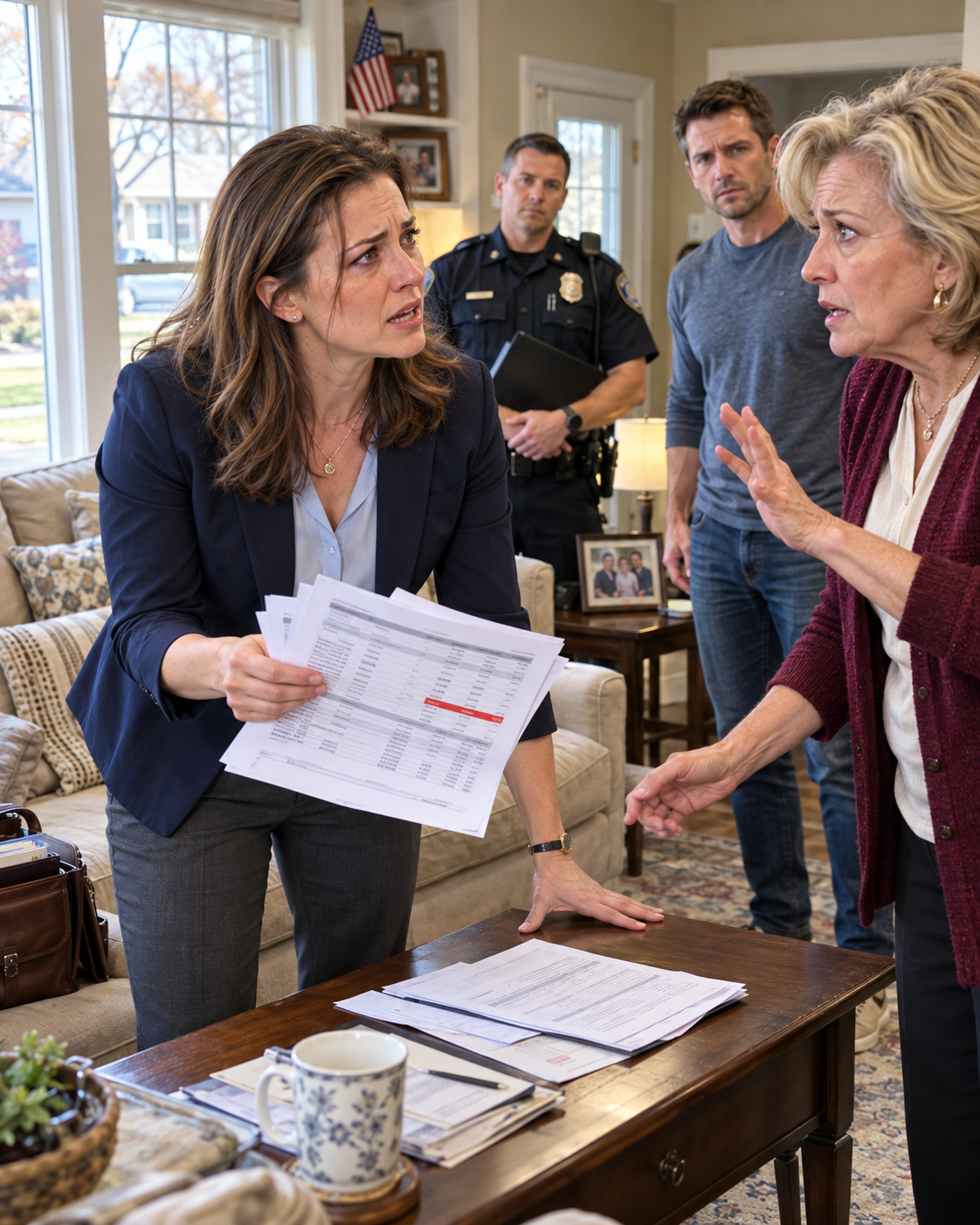
A second page contained a transfer authorization bearing Kevin’s signature.
The amount was partially obscured by a crease, but the remaining figures were enough to make my stomach tighten.
$18,500.
I called my attorney, Rachel Bennett, even though it was nearly nine at night.
She answered after the third ring.
“Daniel, what’s wrong?”
“I received something connected to my father’s estate, and I think it may change everything.”
I described the documents without guessing at their meaning.
Rachel instructed me to photograph every page, preserve the envelope, and avoid contacting either my mother or Kevin until she could examine them.
“One signature doesn’t tell us the whole story,” she warned. “We need the original records and a clear timeline.”
I wanted to argue.
I wanted someone to tell me whether my brother had helped our mother steal from me before I was old enough to understand what money meant.
Instead, I put everything in a folder and spent the rest of the night staring at the ceiling.
The following morning, Rachel arranged for a forensic review of the documents and requested the relevant estate and bank records.
The bank could not release every historical record without the proper authorization, but the account information gave us somewhere to begin.
Over the next several days, we learned that my father had established an education fund for both his sons.
Kevin’s account had been used to pay for college expenses.
Mine had been intended to remain untouched until I reached adulthood, with provisions for education and other needs.
The account should have contained a substantial balance when I turned eighteen.
Instead, the records showed that most of the money had been withdrawn years earlier.
The date was the part I couldn’t stop thinking about.
It was less than a year after Dad died.
I remembered that year vividly.
Mom had told me we needed to cut back because the household was struggling.
I stopped asking for school trips and new clothes.
I wore the same winter coat until the sleeves became too short.
When a teacher suggested I join an academic competition that required a small fee, I told her I wasn’t interested.
I had assumed we were poor.
Now I wondered whether my sacrifices had been necessary at all.
Rachel met me in her office on Monday afternoon.
She placed a copy of the records on the table and waited until I sat down.
“The documents suggest funds intended for you were withdrawn without a clear explanation in the material we’ve obtained,” she said carefully. “We cannot yet establish who authorized every transaction or whether the signature on this page is genuine.”
“What about Kevin?”
“His signature appears on one authorization. That doesn’t establish that he knew the money belonged to you, or that he understood what he was signing.”
I stared at the paper.
“Then why would he sign it?”
“That’s what we need to find out.”
I wanted to believe there was an innocent explanation.
It was the same reflex that had kept me forgiving my family for years.
Every time Kevin failed, I found reasons.
Every time Mom hurt me, I remembered that she had lost her husband.
I could explain their behavior so thoroughly that I never had to acknowledge what it was doing to me.
But an explanation wasn’t the same as an excuse.
Rachel requested a meeting with the attorney who had handled my father’s estate.
The attorney was retired, but after reviewing the records, he agreed to speak with us.
His name was Martin Hayes, and he remembered my father well.
“Your father was very specific about those accounts,” he told us during a video call. “He wanted both boys to have opportunities, but he was especially concerned that neither child should feel responsible for the household finances after his death.”
The sentence struck me harder than I expected.
Dad had anticipated the very burden I had spent my childhood carrying.
“Did he know my mother might use the money?” I asked.
Martin shook his head.
“I have no reason to believe that. He trusted your mother to follow his instructions.”
He explained that the estate documents were incomplete in the file he retained, and some records had been transferred to a successor firm years earlier.
He agreed to help Rachel locate them.
That evening, I drove to the cemetery.
I hadn’t visited Dad’s grave in almost a year.
The grass was wet, and the clouds hung low over the rows of headstones.
I stood with my hands in my coat pockets and tried to remember his voice.
He used to call me his little accountant whenever I lined up coins on the living-room carpet and calculated how much I could save.
“Numbers don’t lie,” he’d tell me, smiling. “But people can use numbers to hide the truth.”
I had spent my career examining financial records for discrepancies.
It had never occurred to me that the most painful discrepancy in my life might be buried in my own childhood.
I didn’t cry immediately.
I simply stood there until the cold reached my bones.
Then I whispered, “I’m trying to find out what happened, Dad.”
The next breakthrough came from Ashley.
She called me on a Saturday morning, sounding exhausted.
“Kevin told me you’re digging into Dad’s estate.”
“Rachel is trying to establish what happened to an account in my name.”
“He says you’re trying to ruin his life.”
“I’m trying to understand why my money disappeared.”
Ashley breathed out slowly.
“Daniel, I need to tell you something, and I’m afraid you’re going to hate me for not telling you sooner.”
I sat down at the kitchen table.
“Tell me.”
She explained that shortly after the wedding, Kevin had received several calls from our mother that he refused to take in front of her.
One evening, she had overheard them arguing about the bank investigation.
Kevin had said, “You told me that account was closed years ago.”
Mom replied, “It was supposed to be.”
Then Kevin said something that had made Ashley stop outside the bedroom door.
“You said nobody would ever look at the old paperwork.”
I closed my eyes.
“Did you hear anything else?”
“Your mother said the transfer was supposed to be temporary, and that you would never have noticed if you hadn’t started making such a fuss about the honeymoon.”
The words settled between us like broken glass.
Ashley began to cry.
“I didn’t know about the original account, Daniel. I swear I didn’t. But I should have told you what I heard sooner.”
I believed that she was frightened.
I also knew that fear could keep people silent long after silence became harmful.
“Why are you telling me now?”
“Because Kevin has been asking me to take out a loan against our future savings to help Mom pay you back. He says it’s the only way to keep the family together.”
I looked toward the window.
“Did he agree to do it?”
“He said he would handle everything, but I found a folder with copies of the bank documents in his desk. There were notes in his handwriting.”
My heart began to pound.
“What kind of notes?”
“Dates. Account numbers. And a reminder about your old security questions.”
For a moment, I could hear nothing but the faint hum of my refrigerator.
“Can you send those to Rachel?”
“I can,” Ashley said. “But I need to be honest with you. I don’t know whether I can stay married to someone who has lied to me about this.”
I didn’t tell her what to do.
She was facing her own shattered picture of the man she had married, and I knew how humiliating it felt to realize that the person you loved might have built a relationship on information you never had.
“Whatever you decide,” I said, “make sure you protect yourself.”
After we hung up, she sent Rachel photographs of the notes and documents.
They didn’t prove every allegation, but they provided investigators with specific leads.
The detective handling my original case contacted me again.
Because the historical account might involve separate transactions and additional conduct, he explained that any new allegations would need to be examined independently.
Rachel submitted the documents through the appropriate channels.
Then we waited.
The waiting was worse than I expected.
Every unknown number made my shoulders tense.
Every letter in the mailbox felt like a warning.
I began waking before dawn, replaying memories that had once seemed ordinary.
Mom telling me there was no money for a school trip.
Kevin buying a new gaming console that Christmas.
Mom explaining that he needed it because he was under pressure.
The family vacation we couldn’t afford, followed by the expensive birthday party she threw for Kevin a month later.
I had spent years believing that being low-maintenance was a virtue.
Now I wondered whether my silence had made it easier for everyone to treat my needs as optional.
One night, I opened the old box of photographs I had inherited from Dad.
Inside was a picture of the three of us at a county fair.
Kevin was standing beside Dad, holding a stuffed bear.
I was sitting on Dad’s shoulders, laughing so hard my eyes were closed.
On the back, Dad had written, “My boys, my greatest investment.”
I held the photograph until the edges softened beneath my fingers.
Whatever had happened to the money, it could not change the fact that my father had loved me.
That realization became an anchor.
I didn’t have to prove I had deserved his love.
I didn’t have to compete with Kevin for a place in the family.
And I didn’t have to keep paying for the privilege of belonging.
Several weeks later, Rachel called with an update.
The successor firm had located additional records from the estate.
Those records indicated that Dad’s instructions had required the custodial funds to remain separately accounted for until certain conditions were met.
There was no clear documentation showing that the money had been used for my benefit.
A bank record also showed a transfer to an account controlled by my mother.
The records did not resolve every question, but they contradicted the story I had been told as a child.
“Can we prove Kevin knew what was happening?” I asked.
“Not from the bank records alone,” Rachel replied. “But the notes Ashley provided may help investigators establish what he knew later, particularly regarding the attempted transfer from your current account.”
“And Mom?”
“The evidence is becoming more significant, but we need to let the investigation proceed.”
I hated how careful she had to be.
I wanted a single document that would explain every missing dollar, every lie, and every moment I had mistaken neglect for strength.
Instead, I was learning that the truth arrived in pieces, and each piece demanded patience.
The next confrontation happened at a family gathering I had not planned to attend.
My aunt Linda called to tell me that Grandma had been hospitalized after a fall.
She asked me to visit, and I went because Grandma had always been kind to me in ways my mother rarely noticed.
When I arrived at the hospital, Kevin was standing outside her room.
He looked older than he had at the wedding.
His eyes were bloodshot, and his expensive watch seemed strangely out of place against the tired expression on his face.
“We need to talk,” he said.
“I don’t think we do.”
“Please, Daniel.”
I stopped.
For once, he didn’t sound entitled.
He sounded afraid.
“I didn’t know everything Mom was doing when Dad died,” he said. “I was a teenager. She told me she needed help moving money between accounts because the bills were piling up.”
“Then why did you sign the authorization?”
He looked at the floor.
“She said it was paperwork for the estate. She told me Dad wanted us to have equal shares, and that you wouldn’t need the money until later.”
“Did you ever ask where it went?”
His jaw tightened.
“Not at first.”
“And later?”
He didn’t answer.
The silence was enough to hurt.
“How much did you know?” I asked.
“I found out more when I was older.”
“How much more?”
He rubbed both hands over his face.
“Mom told me she’d used some of it to keep the house. She said she would replace it when things got better.”
“And did things get better?”
He shook his head.
“Then she told me not to bring it up because you were doing well, and you didn’t need the money.”
I felt something inside me go still.
There it was, the sentence that had governed my entire life.
Because I was doing well, I supposedly needed less.
Because I had learned to survive without help, my family believed they could take whatever they wanted.
“Did you know about the fifteen thousand dollars?” I asked.
He hesitated.
“Mom told me she was going to borrow it.”
“Did she have my permission?”
“No.”
“Did you stop her?”
His eyes filled with tears.
“No.”
For a moment, I wanted to strike him.
Instead, I gripped the edge of the chair beside me and took a slow breath.
“Why?”
“She said she needed it to cover what she owed. She told me you would forgive her once you calmed down.”
“And you believed her?”
“I wanted to.”
That answer hurt more than a denial.
Kevin had not merely believed our mother.
He had chosen the version of reality that demanded the least courage from him.
He wiped his eyes.
“I’m sorry.”
I looked at my brother, the boy who had once shared a bedroom wall with me, the man who had spent his life being rescued from consequences.
“I needed you to be my brother,” I said. “Not another person who decided I could be sacrificed because I would survive.”
He started to speak, but I raised my hand.
“I’m not ready to forgive you.”
He nodded, staring at the floor.
I walked into Grandma’s room without another word.
She was awake, sitting against her pillows, her silver hair spread across the cushion.
When she saw me, she reached for my hand.
“Your father worried about you,” she whispered.
I sat beside her.
“Why?”
“Because you were always trying to make things easier for everyone else.”
My throat tightened.
She told me that Dad had once spoken to her privately about setting aside money for my education.
He had worried that after his death, I might feel obligated to take care of my mother and brother.
“He said you were a good boy, but he was afraid everyone would mistake your goodness for permission.”
I looked away, unable to speak.
Grandma squeezed my fingers.
“Don’t let them turn your heart into a place where they can keep taking things.”
I stayed with her until the nurse arrived to check her medication.
When I left the hospital, the sun had broken through the clouds.
For the first time in weeks, I could breathe without feeling as though I were waiting for another blow.
The investigation continued into the following months.
My mother eventually provided a written statement through her attorney acknowledging that she had accessed information connected to my account and attempted to arrange a transfer without my authorization.
She disputed parts of the account history and argued that she had intended to repay the money.
That intention did not erase the unauthorized attempt.
Nor did it undo the years of secrecy surrounding the earlier funds.
The authorities evaluated the evidence according to the applicable law, while Rachel pursued the financial questions through the appropriate legal channels.
I learned that accountability was rarely as cinematic as I had imagined.
There was no dramatic confession in a crowded room.
There were forms, interviews, statements, and difficult conversations with people who preferred not to remember.
Eventually, the existing settlement was enforced, and the historical account issue was addressed through a separate financial resolution.
The funds that could be substantiated were accounted for, and the obligations established through the process were documented.
Kevin cooperated with investigators regarding his later knowledge of the attempted transfer, although the precise legal consequences depended on evidence beyond his admission to me.
Ashley moved into her sister’s apartment while she decided what to do about the marriage.
She told me she had started counseling and was trying to understand why she had ignored warning signs that seemed obvious in hindsight.
“I thought loving someone meant believing the best about them,” she said during one of our conversations.
“It can,” I replied. “But it shouldn’t mean ignoring what they’re actually doing.”
She eventually filed for separation.
I never learned whether she would one day forgive Kevin, and I understood that it was not my decision to make.
My mother, meanwhile, sent one final letter through her attorney.
It contained no apology.
She wrote that she hoped I would someday understand how difficult life had been for her after Dad died, and that she had done what she believed was necessary to keep our family afloat.
At the bottom, she added, “I hope you can stop punishing me.”
I read the letter twice.
Then I placed it beside the photograph of Dad and considered how easily pain could become a justification for causing more pain.
Mom had suffered after losing her husband.
I had suffered, too.
Her grief deserved compassion, but it did not give her ownership of my future.
I wrote no response.
I had already made my decision, and I no longer needed her to agree with it.
The formal no-contact order remained in place, and I continued to keep my finances separate from the family.
I changed the security questions on every account, used a password manager, enabled multifactor authentication, and made sure no relative could reset my access through outdated personal information.
These were practical steps, but they carried an emotional meaning that mattered even more.
For the first time, I was taking my safety seriously without waiting for someone else to approve.
Spring arrived in Columbus, bringing longer evenings and the smell of wet earth through my open windows.
I planted a small maple tree in the yard, choosing a spot where it would receive plenty of sunlight.
Dad had loved trees.
He used to say that the best time to plant one was when you could imagine someone else sitting beneath it years later.
As I pressed the soil around the roots, I thought about the boy who had once sat alone in his bedroom after his father died.
I wished I could tell him that he would grow up to be capable, independent, and loved by people who did not require him to pay for their affection.
I wished I could tell him that he would someday learn to say no without feeling as though he had committed a crime.
Most of all, I wished I could tell him that surviving a family did not mean he had to spend the rest of his life proving he deserved one.
Months later, I received an unexpected message from Kevin.
It was short.
“Mom says you still have Dad’s old documents. There’s something else you should know about the account, but I don’t know if I should tell you.”
I stared at the screen.
The old instinct rose immediately.
Call him.
Ask what he meant.
Find out whether there was one final missing piece that could make the entire story understandable.
Then I remembered the hospital corridor, the silence after my questions, and the years I had spent confusing uncertainty with obligation.
I didn’t answer that night.
The next morning, I sent the message to Rachel and asked her whether there was any reason to communicate with him outside the established legal arrangements.
She advised me to keep the boundaries in place until the remaining records could be reviewed.
So I did.
I went to work, finished my reports, bought groceries, and came home to the quiet house I had built for myself.
The maple tree stood in the yard, its young leaves moving gently in the wind.
For years, I had believed the worst thing my family could take from me was money.
I was wrong.
They had taken certainty, trust, and the feeling that love was supposed to be a safe place.
But they had not taken everything.
They had not taken the years I could still live differently.
They had not taken the right to decide who had access to me.
And they had not taken the truth my father had tried to leave behind: that my worth was never measured by how much I could give away.
I still don’t know what Kevin meant by that final message.
Perhaps there is another document, another transfer, another secret someone has kept buried for decades.
Perhaps he finally wants to tell the truth because the lies have become too heavy to carry.
I may learn the answer someday.
But I no longer intend to destroy my peace trying to force it out of someone who has spent a lifetime choosing silence.
Sometimes, closure is not discovering every detail of what happened.
Sometimes, it is deciding that the people who hurt you no longer get to determine what happens next.
And when I stand beneath the young maple tree on quiet evenings, I imagine my father looking down at the life I am building.
I imagine him smiling, not because I recovered every dollar, but because I finally understood what he had wanted me to protect.
My future.
My dignity.
My peace.
For the first time, I am no longer waiting for my family to choose me.
I have finally chosen myself.