At Fort Belvoir’s emergency department, Dr. Crandall sneered at me for questioning his decision to declare a little girl dead
General Whitaker did not speak again immediately.
He stood beneath the fluorescent lights with the old photograph trembling between his fingers, while the sounds of the emergency department continued around us as if the world had not just cracked open.
I could not look at Daniel’s face.
Not in that photograph.
Not after three years of convincing myself that the past was a place I would never have to visit again.
“Where did you get that?” I finally asked.
“The military rescue archives,” he replied. “My daughter found it while researching a school project about service members stationed at Fort Belvoir. She recognized your name in an article about a rescue operation in Alaska.”
My mouth went dry.
“What kind of article?”
“One about a helicopter crew that attempted to recover a missing soldier after a winter training accident.” He paused. “The article said the soldier died. It also mentioned that the rescue specialist leading the operation resigned from active duty shortly afterward.”
I stared at him.
“I didn’t resign because I was afraid of the cold.”
“I never said you did.”
“You don’t understand what happened.”
“Then help me understand.”
His voice was not commanding now. It was tired, and underneath the exhaustion was the same desperate need I had seen in his eyes when he first entered the emergency department.
A father had almost lost his daughter.
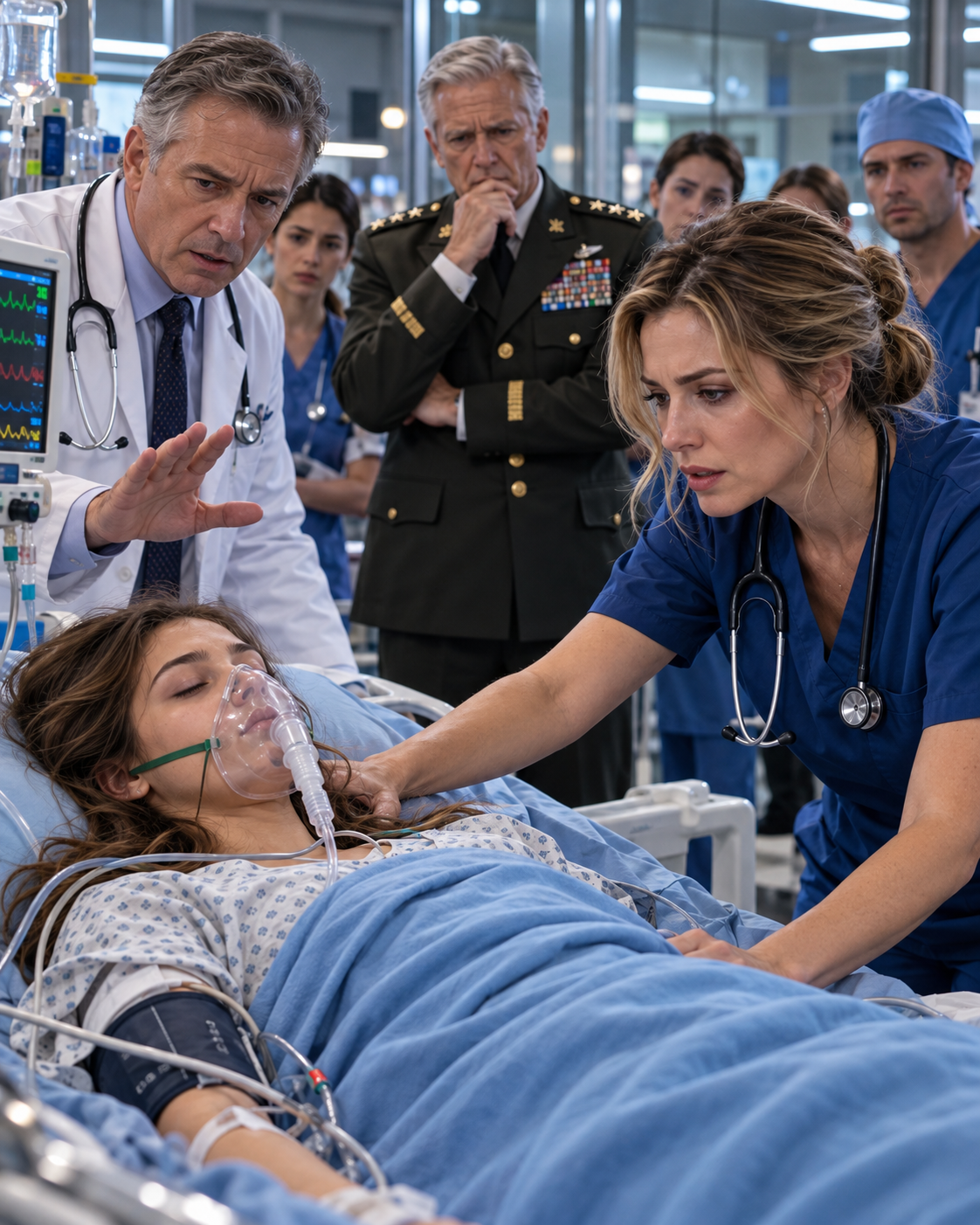
He was looking at a woman who had spent years believing she had already lost something she could never recover.
I wanted to walk away.
Instead, I followed him into a quiet consultation room, where the photograph lay between us like evidence at a trial.
Three years earlier, I had been Lieutenant Elena Hayes, a military flight nurse and SERE rescue specialist assigned to a unit that supported difficult recovery operations.
I had spent years learning to function when fear threatened to shut down the mind, how to recognize the difference between a desperate situation and an impossible one, and how to keep moving when everyone else was waiting for permission to be afraid.
Daniel Mercer had been my closest friend.
He was a combat medic with a crooked smile, a terrible sense of humor, and an almost unreasonable belief that every person could be brought home if someone was willing to keep searching.
He used to tell me that the most dangerous words in a rescue operation were not “I’m scared.”
They were “There’s nothing more we can do.”
We had laughed about that over burnt coffee and late-night briefings, never imagining those words would one day become the sentence that destroyed me.
The operation took place in Alaska during a winter training exercise that had turned into a real emergency when a transport vehicle broke through thin ice near a remote access route.
Daniel was among the personnel sent to assist.
The weather deteriorated faster than forecast, and the rescue helicopter encountered brutal crosswinds as we approached the site.
By the time we reached the ice, the water was black, the snow was blinding, and the temperature had fallen far below freezing.
Daniel went in with the first rescue team.
Then the ice shifted.
A crack split the surface, the radio erupted with overlapping voices, and the team lost visual contact with him.
I remember the sound of the winch.
I remember the wind battering the helicopter.
Most of all, I remember hearing Daniel call my name over the radio.
“Elena, I need you to listen.”
His voice was strained, but he was still speaking clearly.
I told him to conserve his energy and give us his position.
He tried.
Then another transmission broke across his signal, followed by a burst of static.
When the team finally recovered him, he was unresponsive.
The medical personnel worked desperately, but the conditions were unforgiving, and the evacuation took longer than anyone wanted.
Daniel never regained consciousness.
For weeks afterward, I replayed the operation in my head, searching for the second when I might have chosen differently, moved faster, or recognized a danger sooner.
The official review found no single decision responsible for his death.
It cited the weather, the unstable ice, and the limitations of the rescue environment.
I read the report until I knew every line by heart.
Then I read it again.
It did not matter.
My mind kept inventing alternate endings.
If I had ordered a different approach, would he have lived?
If I had recognized the shifting ice sooner, could we have reached him earlier?
If I had ignored the operational restrictions and sent the aircraft closer, would I have saved him—or lost more people?
There were no answers that could bring Daniel back.
Eventually, I left military service and accepted a civilian nursing position.
I stopped talking about rescue work.
I stopped attending reunions.
I packed away my flight gear and kept only the small photograph that General Whitaker had somehow found.
I told myself that a quieter life would heal me.
For a while, I even believed it.
Then he said, “My daughter wasn’t supposed to be near that frozen reservoir.”
I looked up.
“What?”
“Emily was visiting a friend whose family lives near the training grounds. She went for a walk after an argument, and nobody realized how close she had come to the restricted area.”
His expression tightened.
“The rescue team found her after another child saw the broken ice. She was already in critical condition when they pulled her out.”
I pictured Emily on the stretcher, her hair dripping onto the floor.
“Was anyone else in the water?”
“The initial report says no.”
“But you don’t believe it.”
“I don’t know what to believe.” He rubbed his forehead. “The child who found her told the police that Emily kept saying somebody was underneath the ice, holding her hand.”
A chill moved through me.
“Did she say who?”
“Not at first. She was confused and barely responsive. But in the ambulance, she said the person had a name.”
He turned the photograph toward me.
“Daniel.”
The room seemed to tilt.
I grabbed the edge of the table, forcing myself to breathe.
“That doesn’t make sense.”
“I know.”
“Daniel died three years ago.”
“I know that, too.”
His answer was so quiet that it hurt more than disbelief would have.
I looked again at the photograph, searching Daniel’s face for something I had missed.
He had always been superstitious about cold water.
Not frightened of it, exactly, but respectful in a way that made him seem older than his years.
Once, during training, he had told me that people underestimated how easily the cold could confuse their judgment.
“The water steals your sense of time,” he had said. “It convinces you that you’re already gone.”
I had teased him for being dramatic.
Now I wondered whether Emily had heard the name from a story, a dream, or a memory planted in her mind by someone who knew our history.
I refused to let grief turn coincidence into proof.
“Did Emily ever meet me?” I asked.
“No. But she knew about the operation from the article, and she might have seen your photograph.”
“Then she could have recognized my name and repeated Daniel’s.”
“Possibly.”
His eyes remained fixed on mine.
“But there is something else.”
He took a folded document from his uniform pocket.
It was a preliminary incident report from the reservoir, and several lines had been highlighted.
One witness reported hearing a child calling for help from beneath the ice several minutes before Emily was found.
Another described seeing a dark shape moving near the edge of the water.
The final statement came from a maintenance worker who had arrived after the rescue.
He claimed that the access gate had been unlocked despite being secured earlier that evening.
“Someone opened it,” I said.
“That’s what the investigators are trying to establish.”
“Was there anyone else nearby?”
“The police are reviewing the cameras and interviewing the witnesses.”
He hesitated.
“There’s also a missing-person report from the previous night.”
My pulse quickened.
“Who?”
“A civilian maintenance contractor named Michael Voss. He was assigned to inspect the reservoir’s perimeter fencing.”
The name meant nothing to me.
But the general’s next words changed that.
“His personnel records show that he previously worked as a civilian support contractor for military cold-weather training operations in Alaska.”
I stared at him.
“Was he involved in Daniel’s recovery?”
“According to the records, he was assigned to the same training facility.”
For three years, I had believed Daniel’s death was a tragedy with no hidden meaning.
Now an unexplained disappearance, a compromised security gate, and a child repeating his name were tangled around the edges of that old wound.
Still, a suspicious pattern was not proof of a conspiracy.
I had learned that lesson the hard way.
“General, I need to see the original rescue report,” I said.
“Why?”
“Because if this contractor was present during Daniel’s operation, I want to know exactly what he did.”
He studied me for a long moment.
Then he nodded.
“I can arrange access through the appropriate channels, but I need you to understand something.”
“What?”
“My daughter is alive because someone refused to accept an uncertain answer as a final one.”
His voice faltered.
“I don’t know whether what she said means anything beyond a frightened child’s memories. But I know what I saw in that emergency room.”
I looked down at my hands.
They had begun trembling again.
“I didn’t save her alone.”
“No,” he said. “You reminded everyone that she hadn’t been given every chance.”
For a moment, the distinction mattered more than he could know.
I had spent years believing that if I could not save everyone, I had no right to trust myself with anyone.
Emily had forced me to confront the flaw in that belief.
A rescue specialist could make the right decision and still lose someone.
A doctor could follow a protocol and still be wrong about what remained possible.
A frightened child could describe an impossible experience without understanding what it meant.
None of those truths canceled the others.
General Whitaker rose.
“Emily is being transferred to the pediatric intensive care unit. You should get some rest.”
“I can’t.”
“I suspected you would say that.”
He paused at the door.
“There’s one more thing I didn’t tell you.”
I looked up.
“When Emily was briefly responsive in the ambulance, she asked the paramedic to give you something.”
My heart thudded painfully.
“Me?”
“She apparently heard your name from someone at the scene.”
He reached into his pocket and placed a small plastic evidence bag on the table.
Inside was a silver military identification tag, scratched and darkened by age.
I recognized the chain first.
Then the lettering.
DANIEL MERCER.
My chair scraped backward.
“No.”
The word escaped before I could stop it.
I had watched the recovery team inventory Daniel’s personal effects after his death.
His identification tag had been documented among the items returned to his family.
I remembered the paperwork because I had signed the witness statement.
This tag had a fresh, jagged scratch across the lower edge, and something dark was caught in the groove.
“How did this get to the reservoir?” I whispered.
“The investigators found it clenched in Emily’s hand.”
“That isn’t possible.”
“I know what the records say.”
“Then somebody planted it.”
“Perhaps.”
He did not insist on any other explanation.
That was what frightened me most.
The general left me with the evidence bag, and I sat alone for several minutes, listening to the muffled sounds of the hospital.
I wanted the tag to be a trick.
I wanted it to be a coincidence.
I wanted Daniel’s name to belong only to the past.
But the evidence was real, and so was the question it raised.
I called the chief of emergency medicine and requested permission to review the incident documentation with the hospital’s designated liaison, while the police retained control of the physical evidence.
Then I called the number listed on the preliminary report for the investigating officer.
By midnight, I had learned that Michael Voss’s vehicle had been found abandoned near a service road less than a mile from the reservoir.
His phone had been recovered inside.
The last outgoing message was timestamped twenty minutes before Emily entered the water.
It contained six words.
THEY KNOW WHAT HAPPENED IN ALASKA.
The detective handling the case, Sarah Collins, met me in a conference room at the hospital the following morning.
She was in her forties, with tired eyes and a habit of listening without interrupting.
When I explained my connection to Daniel, she did not look impressed or suspicious.
She looked concerned.
“I’m going to be very clear,” she said. “We have no evidence that anything supernatural happened at the reservoir, and we have no proof that Mr. Voss is connected to Emily’s fall.”
“I understand.”
“But we do have evidence of a possible security breach, a missing contractor, and an object associated with a deceased service member.”
She opened a folder.
“We’re treating those as separate investigative leads until we can establish a connection.”
That was the first sensible thing anyone had said about the mystery.
I gave her the timeline of Daniel’s rescue and described the contractor’s possible role.
She wrote down every detail.
When I mentioned the message on Voss’s phone, she asked whether Daniel had ever reported misconduct at the training facility.
I shook my head.
“Not to me.”
“Did he ever express concern about the safety procedures?”
I hesitated.
One memory had begun to surface.
Two days before the accident, Daniel had argued with a contractor over a maintenance log.
I had heard raised voices outside the equipment bay and found Daniel standing beside a clipboard, furious.
When I asked what was wrong, he told me a pressure sensor on a rescue access system had failed a routine check, but someone had signed off on the inspection anyway.
He said the contractor claimed it was a harmless discrepancy.
Daniel wanted the system taken out of service until it could be tested.
I had told him to document the issue and bring it to the officer in charge.
I had not asked what happened afterward.
“Did you remember the contractor’s name?” Detective Collins asked.
“No. I remember the argument, not the person.”
She closed the folder halfway.
“Then we’ll need the original maintenance records.”
By afternoon, the military liaison had agreed to provide the relevant documents to the investigators.
The first records showed that the failed sensor had been repaired after Daniel’s accident.
The second showed that an inspection entry had been altered.
The third revealed that Michael Voss had signed the original entry before another employee amended it.
It was troubling, but still incomplete.
A changed record could mean negligence, administrative error, or deliberate concealment.
We needed more.
Meanwhile, Emily remained under close observation.
Her condition was improving, but the medical team warned that her recovery would take time.
I visited her once, with permission from her father and the attending staff.
She was awake, pale, and exhausted, with a blanket tucked around her shoulders.
When she saw me, she studied my face as if trying to match it to someone in a dream.
“Are you the nurse from the emergency room?”
“Yes.”
“You told them not to stop.”
I pulled a chair beside her bed.
“I asked them to take another look.”
“Daddy said you saved me.”
“Your doctors and nurses worked very hard, Emily. You did some hard work, too.”
She considered that.
Then she looked toward the window.
“Is Daniel still cold?”
My throat tightened.
“Who told you about Daniel?”
She shook her head.
“I didn’t know his name before.”
“Can you tell me what you remember?”
Her fingers twisted the edge of the blanket.
“I was walking by the fence. I heard somebody crying, so I went closer. The gate was open.”
She stopped and swallowed.
“I saw something in the water. I thought it was a person, but when I leaned over, the ice broke.”
I kept my voice gentle.
“What happened after you fell in?”
“I couldn’t move very well. The water hurt, and then everything got quiet.”
Her gaze drifted.
“I saw a man. He was standing where the water was dark, and he looked sad.”
I did not ask whether he had been alive or dead.
I did not tell her what I believed.
“What did he say?”
“He told me to keep looking at the lights.”
She closed her eyes briefly.
“He said my daddy was coming, and I had to stay awake if I could.”
A tear slipped down her cheek.
“Then he said you would know what to do.”
I felt the old grief rising so sharply that I had to grip the chair.
“Did you see his face?”
“Not clearly.”
“Did he tell you his name?”
She nodded.
“Daniel.”
I let the silence settle before speaking again.
“Emily, when people are very cold or frightened, memories can become confusing. It’s okay if you’re not sure what you saw.”
“I know.”
She looked directly at me.
“But I know what I heard.”
Her certainty was quiet, without the theatrical conviction of someone trying to persuade an adult.
I could not decide what it meant.
Perhaps she had heard the name at the scene.
Perhaps a rescuer had spoken about Daniel.
Perhaps her mind had built a story around fragmented sounds and fading consciousness.
Or perhaps there was something about the final moments before the ice swallowed the world that neither science nor memory could easily explain.
I left her room without asking another question.
Outside, General Whitaker was waiting.
“She told you about him,” he said.
“Yes.”
“Do you believe her?”
I thought about the evidence bag, the altered maintenance records, and the message on Voss’s phone.
“I believe she experienced something that felt real to her. I won’t pretend I know exactly what it was.”
He nodded slowly.
“That’s an honest answer.”
For the first time since the emergency room, I saw a little peace in his face.
Then Detective Collins called.
Michael Voss had been found.
He was alive, disoriented, and being treated for exposure at a medical facility several counties away.
He had left his vehicle near the service road and attempted to cross a drainage channel on foot, apparently trying to reach a nearby highway.
His injuries were consistent with a fall, and investigators had not yet determined whether his disappearance was voluntary.
Collins asked me to identify him from an old photograph.
When she showed it to me, I recognized the man standing outside the equipment bay three years earlier.
He was older now, with a narrow face and thinning hair, but the expression was unmistakable.
“That’s him,” I said. “He was the contractor who argued with Daniel.”
The detective’s expression tightened.
“Then we’re going to ask him about the inspection records.”
The interview took place two days later, after Voss was medically cleared and advised of his rights.
I was not present for the initial questioning, but Collins called me afterward.
Voss had admitted that he signed the original maintenance entry despite knowing the sensor had failed.
He claimed he had been pressured by a supervisor who wanted the training site operational before a scheduled inspection.
He also admitted that Daniel had discovered the discrepancy and threatened to report it.
According to Voss, he later changed his account because he feared losing his contract.
But he denied causing Daniel’s death.
He said he had never touched the rescue system during the accident and had no knowledge of how the sensor failure might have affected the operation.
His account was not enough to settle the case.
The investigators still needed technical analysis, independent witnesses, and a complete review of the maintenance records.
When I heard his statement, I felt neither relief nor vindication.
Daniel was still dead.
The missing years were still missing.
And even if someone had concealed negligence, no confession could return the friend who had once promised to buy me coffee after every impossible mission.
The military review reopened the old file.
Experts examined the sensor logs and compared the recorded readings with the weather and rescue timeline.
They found evidence that the malfunction might have contributed to the delay in locating Daniel, although the report could not establish that it was the sole cause of his death.
The final findings were careful.
They identified procedural failures, inaccurate maintenance documentation, and a breakdown in reporting that should never have been tolerated.
Voss cooperated with the investigation, and the responsible authorities began reviewing whether further disciplinary or legal action was warranted.
There was no dramatic courtroom confession.
No single villain stood up and admitted to destroying my life.
There was only the slow, difficult work of separating what could be proven from what I had feared for three years.
And somehow, that was harder than the anger.
Because anger had given my grief a target.
The truth offered no such comfort.
A week after Emily was discharged from intensive care, General Whitaker invited me to meet him in a quiet courtyard outside the hospital.
Emily sat beside him in a wheelchair, wrapped in a pale blue jacket, looking smaller than she had on the stretcher but unmistakably alive.
She held a folded piece of paper in both hands.
“I made you something,” she said.
It was a drawing of three people standing beside a helicopter beneath a bright yellow sun.
One figure wore a military uniform.
Another had dark hair and a crooked smile.
The third was a little girl holding the hand of a woman in blue scrubs.
I recognized the crooked smile immediately.
“You drew Daniel?”
Emily nodded.
“I don’t know what he looked like, not really. I just remember that he wasn’t scared.”
I sat beside her.
“That’s a good way to remember someone.”
She handed me the picture.
At the bottom, in uneven letters, she had written: THANK YOU FOR COMING BACK.
I could no longer hold the tears in.
For three years, I had believed that leaving the military meant I had abandoned the person I used to be.
I had treated my survival as a kind of betrayal, as if living a quieter life dishonored the people who had not come home.
But Emily’s drawing showed me something I had been too ashamed to understand.
I had not stopped caring.
I had not forgotten what Daniel taught me.
I had simply mistaken pain for proof that I needed to keep suffering.
General Whitaker waited until Emily was speaking with a nurse before he approached me.
“I spoke with the chief of emergency medicine,” he said. “They’re organizing additional training on severe hypothermia, including the limits of interpreting early findings in profoundly cold patients.”
“That’s good.”
“They also want you involved, if you’re willing.”
I looked toward the hospital doors.
“I don’t know if I’m ready to go back to that kind of work.”
“Then don’t decide today.”
He glanced at Emily, who was showing her drawing to a passing orderly.
“My daughter may never remember every detail of what happened in that water. But she will remember that people kept working when the situation looked hopeless.”
He paused.
“You can teach people that without becoming the person you were three years ago.”
I thought about the emergency room, the monitor, and Crandall’s certainty.
I thought about how close I had come to remaining silent because I was afraid of being wrong.
Most of all, I thought about Daniel’s old warning that the most dangerous words in a rescue operation were the ones that turned uncertainty into surrender.
“I’ll meet with the training team,” I said.
The general nodded.
“That sounds like a beginning.”
In the months that followed, I helped develop training sessions for emergency department staff on recognizing the limitations of routine assessment in severe hypothermia, coordinating specialist consultation, and making careful decisions when the evidence was incomplete.
Dr. Crandall attended the first session.
He did not offer excuses.
During a break, he approached me beside the training room’s coffee machine.
“I owe you an apology,” he said.
I waited.
“I was so focused on being decisive that I stopped asking whether my decision was justified. When you challenged me, I treated it as a threat instead of a warning.”
He looked down at his cup.
“I can’t promise I’ll never make another mistake. But I can promise I’ll listen more carefully when someone gives me a reason to reconsider.”
For the first time, I saw him not as the arrogant doctor who had humiliated me, but as a professional confronting the uncomfortable truth that expertise did not make him infallible.
“That’s all anyone can ask,” I replied.
The military investigation continued, and the findings led to changes in maintenance oversight and documentation procedures.
Michael Voss faced formal scrutiny over the inaccurate records, while investigators continued examining the chain of responsibility.
No evidence established that he had deliberately placed Emily in danger.
The open gate remained a separate question, one the authorities investigated without assuming that every troubling detail belonged to the same story.
As for Daniel, his family received an updated account of the circumstances surrounding his death.
The revised findings could not tell them exactly what he had experienced in his final minutes, but they acknowledged failures that the original review had not fully addressed.
I wrote his mother a letter.
I told her about the training we were building, about the little girl who had survived the freezing water, and about the lessons Daniel had taught me long before the accident.
I apologized for disappearing.
I did not ask her to forgive me.
She wrote back three weeks later.
Her letter contained only a few lines, but I read them until the paper softened at the folds.
She said Daniel had never expected me to carry his death like a punishment.
He had loved me as a friend, she wrote, and he would have wanted me to keep living.
I sat at my kitchen table that night and cried for the first time without trying to bargain with the past.
I cried for Daniel.
I cried for the years I had spent mistaking guilt for loyalty.
And I cried because, at last, I could remember his smile without immediately seeing the ice.
I returned to Fort Belvoir the following spring for a training seminar.
The emergency department looked almost exactly as it had on the night Emily arrived, but I was no longer the same woman standing behind Dr. Crandall.
My badge still said Staff Nurse Elena Hayes.
I had not reclaimed my old rank or returned to the military.
I did not need to.
The life I had now was smaller than the one I had left, but it was no longer a hiding place.
Before the seminar began, I visited the pediatric unit.
Emily had sent a card with her father, telling the staff she was back at school and learning to swim again under close supervision.
Her final sentence read, I still remember the lights.
I held the card for a long time.
Then I tucked it into the pocket of my uniform beside Daniel’s photograph.
I had kept that photograph for years as evidence of everything I had lost.
Now I carried it as a reminder of what I still had the power to give.
That evening, as I prepared to leave the hospital, General Whitaker approached me near the entrance.
“I have something for you,” he said.
He handed me a sealed envelope.
Inside was a copy of a newly declassified operational note from the Alaska incident, released as part of the review.
Most of it contained technical details I had already seen.
But a handwritten line at the bottom had been overlooked in the earlier copies.
The handwriting was Daniel’s.
If Elena ever doubts herself, tell her she did everything she could with what she knew.
I read the sentence once.
Then again.
The general said nothing while I pressed the page against my chest.
For the first time, the past did not feel like a door slamming shut.
It felt like a voice reaching across the distance, not to pull me backward, but to let me go.
I thanked him, folded the document carefully, and stepped outside into the cool evening air.
For years, I had thought courage meant refusing to stop, no matter how much pain I carried.
Now I understood that courage could also mean admitting what could not be changed, learning from what had gone wrong, and choosing to help the living without demanding that the dead return.
I was almost at my car when my phone vibrated.
An unfamiliar number had sent a message with no greeting and no explanation.
I opened it.
There was a photograph of the frozen reservoir, taken at night.
At the edge of the image stood a figure in a dark coat, facing the water.
Beneath it were seven words.
YOU SAVED HER, BUT YOU MISSED THE SECOND PERSON.
I stared at the screen until the parking lot lights blurred.
Then another message appeared.
ASK WHAT EMILY SAW BENEATH THE ICE.
My fingers went numb around the phone.
I wanted to call Detective Collins immediately, and I knew I would.
I wanted to believe the message was a cruel prank, a confused witness, or someone trying to exploit a tragedy that had already caused enough pain.
But beneath the fear, something else stirred.
Not certainty.
Not the old, punishing need to find a hidden answer at any cost.
Just the knowledge that a question remained, and that it deserved to be examined carefully.
I looked through the hospital windows toward the pediatric unit, where children were sleeping beneath warm blankets and nurses were moving from room to room, refusing to let the night make decisions for them.
Then I saved the message and walked back inside.
Whatever waited beneath the ice, I would face it with evidence, with patience, and with people I trusted beside me.
I could not promise to rescue everyone.
I could promise never again to confuse uncertainty with permission to abandon someone.
And somewhere in the quiet space between the life I had lost and the life I was learning to live, I heard Daniel’s voice as clearly as I had three years before.
Keep looking for the lights, Elena.
So I did.