At Edwards Air Force Base, with my wings stripped from my uniform in front of an entire squadron
Part 2
The first missile warning hit my brain like a hammer.
My vision fractured.
For half a second, I saw three skies.
Then six.
The Chimera rolled left.
I pulled right.
The aircraft ignored me.
“Come on.”
I forced the stick forward.
Nothing.
The neural interface screamed.
Every sensor flooded my mind at once.
Heat.
Pressure.
Acceleration.
Distance.
Threat.
Fear.
The aircraft wasn’t responding to my hands.
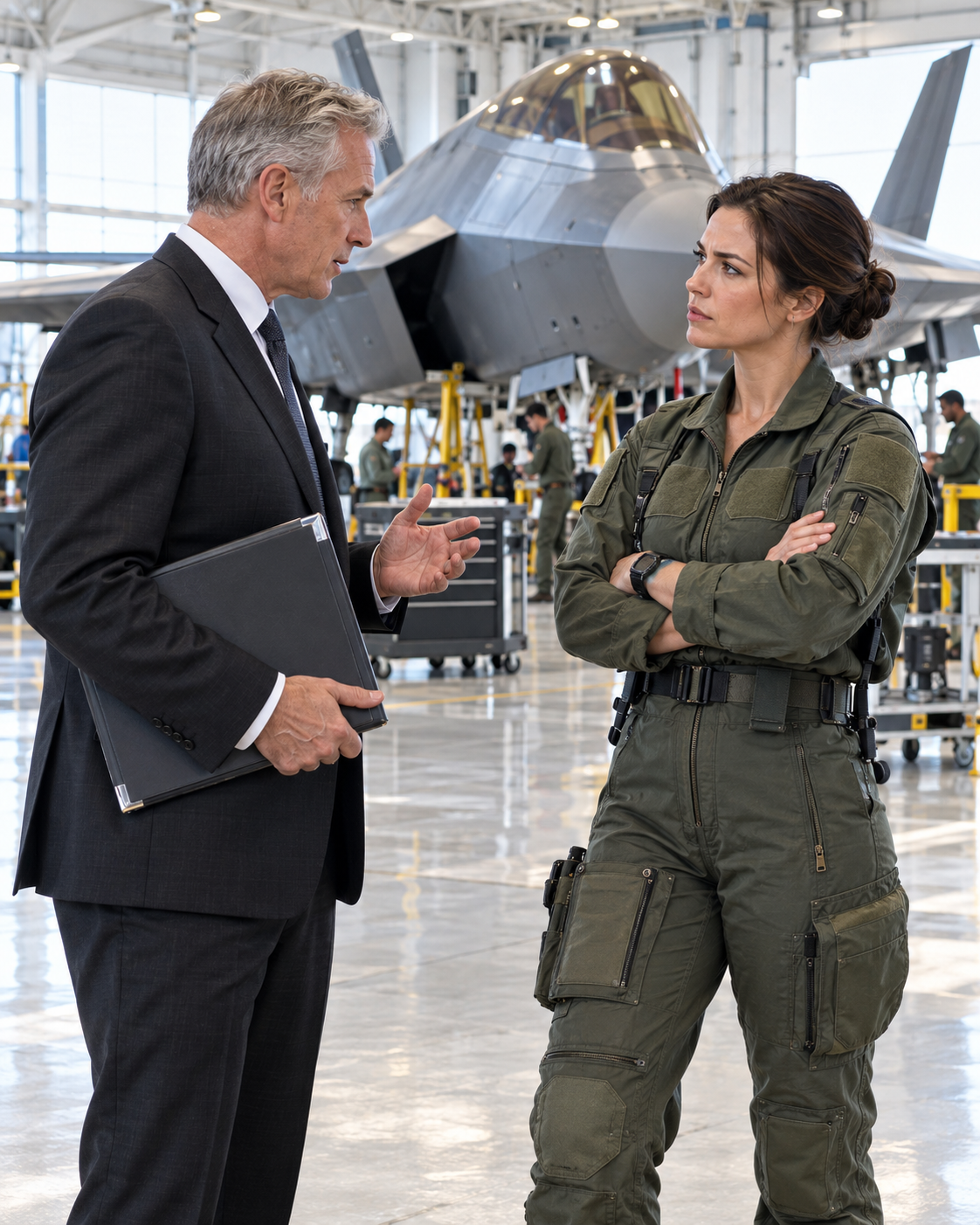
It was responding to my thoughts.
And my thoughts were becoming noise.
The first missile launched.
A white streak tore across the darkness.
I rolled hard.
The Chimera rolled harder.
My body slammed against the seat.
Black spots filled my vision.
“Abort!” someone shouted through the radio.
I tried.
The aircraft ignored the command.
The second missile launched.
Then the third.
I suddenly understood the terrible design flaw.
The computer wasn’t rejecting my corrections.
It was anticipating them.
Every evasive maneuver I considered had already been predicted because the AI had been trained on my combat history.
It knew how I fought.
It knew when I pulled.
It knew when I broke formation.
It knew the strange instinct that had kept Frank alive over the Mediterranean.
It had learned me so completely that it no longer knew how to distinguish my instinct from its own.
I had spent two years being punished for flying like a machine couldn’t.
Now I was trapped inside a machine that had learned to fly like me.
“Then stop fighting me,” I whispered.
I released the stick.
The aircraft stabilized.
The missile warnings became quieter.
I closed my eyes.
Not physically.
Inside the neural interface.
I stopped trying to command the Chimera.
I stopped trying to be its pilot.
I let myself become part of it.
The change was immediate.
The aircraft felt lighter.
The noise disappeared.
The three drones became points of pressure in my mind.
I could feel their intentions before their computers committed to them.
One climbed.
One cut left.
One stayed behind.
A triangle.
A kill box.
The exact kind of trap I had used against enemy fighters years earlier.
Except now I was inside it.
The lead drone fired.
I pushed the Chimera straight up.
Mach three.
Ninety thousand feet.
The horizon vanished.
The world below became a thin blue curve.
My lungs struggled.
The pressure warning turned red.
Then another warning appeared.
Structural limit exceeded.
I ignored it.
The aircraft climbed.
The G-load passed ten.
Then eleven.
Then twelve.
Pain exploded behind my eyes.
Tiny blood vessels burst.
My peripheral vision disappeared.
I could barely see the center of the display.
But I could feel the drones.
They were following.
They had committed to the geometry.
That was their mistake.
I pulled the Chimera into a maneuver no sane pilot would attempt at that altitude.
The nose snapped over.
For one impossible second, the entire aircraft seemed to stand still against the black sky.
Then the world flipped.
The Chimera entered a high-altitude Kulbit.
My body felt like it was being crushed through the seat.
I heard something crack inside my helmet.
I wasn’t sure whether it was plastic or bone.
The drones tried to follow.
They couldn’t.
Their targeting algorithms predicted a normal escape vector.
The Chimera gave them something else.
The first drone overshot.
The second followed.
The third broke formation too late.
I opened my eyes.
Three targets floated directly in front of me.
The Chimera’s weapons display offered one final option.
EMP cannon.
I armed it.
The control room went silent.
“Don’t fire,” General Stone ordered.
I smiled despite the blood running from my nose.
“Then you shouldn’t have armed it.”
I pulled the trigger.
There was no explosion.
No fireball.
Just a silent pulse of electromagnetic energy.
The first Valkyrie went dark.
The second rolled sideways.
The third spun into a desert dive.
Three billion dollars of military hardware began falling toward the Mojave.
Then my own aircraft began to fail.
The engines were overheating.
The outer skin was scorched.
Hydraulic pressure was collapsing.
The Chimera had survived.
Barely.
So had I.
I pointed the nose toward Edwards.
And for the first time since I had entered the cockpit, the machine followed me without resistance.
That scared me more than the missiles.
Because somewhere in the back of my mind, I knew the test wasn’t really about whether I could fly it.
It was about whether I could trust something that had been built from the worst parts of me.
Part 3
The runway appeared through a haze of blood and smoke.
I lowered the landing gear manually.
Nothing happened.
I tried again.
The left gear deployed.
The right gear didn’t.
“Of course,” I whispered.
I kept descending.
Mission control sounded terrified.
“Chimera, go around.”
“No.”
“Your gear is compromised.”
“I know.”
“You have engine fire.”
“I know.”
“You are losing hydraulic pressure.”
“I know.”
Silence.
Then Vance’s voice came through.
“Bring her home.”
I had heard those words before.
Not from him.
From Frank.
Two years earlier, when his crippled F-18 had fallen toward the Mediterranean, Frank had said the same thing.
Bring me home.
I had broken formation for him then.
I broke every rule for him now.
The Chimera touched down on one wheel.
The aircraft bounced.
Sparks erupted beneath the fuselage.
I held the nose straight.
The remaining landing gear slammed onto the runway.
The jet slid through smoke for what felt like a mile before finally stopping.
The engines died.
Silence swallowed the cockpit.
I sat there breathing.
My hands were shaking.
My eyes were burning.
For a few seconds, I couldn’t move.
Then the canopy opened.
Medical crews surrounded the aircraft.
I climbed out slowly.
Every step hurt.
Blood had dried beneath my eyes.
My flight suit was scorched.
The black skin of the Chimera was blistered behind me.
Then I saw Donald Vance climbing the gantry stairs.
He stopped in front of me.
For once, he didn’t look like a CEO.
He looked like the colonel who had stripped my wings away.
“How bad?” I asked.
“The contract is safe.”
I laughed.
“I didn’t ask about the contract.”
He looked at the aircraft.
Then at me.
“You were right.”
Those three words hurt more than the G-forces.
I stared at him.
“About what?”
He swallowed.
“The Mediterranean.”
I didn’t breathe.
“The command order you disobeyed was altered before it reached your aircraft.”
My chest tightened.
“By whom?”
“General Stone.”
The same man who had just launched live missiles at me.
Vance continued.
“He wanted you removed from the program because your combat record made you difficult to control.”
“And you knew?”
“I suspected.”
“That’s not an answer.”
He looked down.
“I found the evidence six months ago.”
I stepped closer.
“Then why didn’t you clear my name?”
His eyes filled with something I had never seen there before.
Shame.
“Because if I exposed it, the Pentagon contract would have collapsed.”
There it was.
The truth beneath two years of silence.
Not justice.
Not honor.
Money.
Reputation.
Power.
I looked at the black aircraft behind him.
“And Frank?”
“Frank knew.”
My throat tightened.
“He knew?”
“He was the one who found the altered command logs.”
For two years, I had believed my closest friend had disappeared from my life because I had ruined both our careers.
Instead, he had been fighting the same machine from inside a hospital bed.
Vance handed me a sealed envelope.
Inside was my restored commission.
My record.
The original flight logs.
And a set of silver wings.
I stared at them for a long time.
Then I looked back at the Chimera.
“Keep the wings.”
Vance frowned.
“Why?”
“Because I don’t need them to know what I am.”
He nodded slowly.
Then I turned toward the aircraft.
The technicians were already surrounding it.
Someone was taking photographs.
Someone else was whispering about the twelve-G maneuver.
I barely heard them.
All I could think about was the strange feeling from the cockpit.
The moment I stopped fighting the machine.
The moment I trusted it enough to let it become part of me.
For years, everyone had told me that my instincts were the problem.
Too aggressive.
Too independent.
Too unpredictable.
They had tried to beat that out of me.
The Chimera had done something different.
It had listened.
It had learned.
And when I finally stopped trying to control it, it met me halfway.
A week later, the Pentagon reinstated my clearance.
General Stone resigned before the investigation ended.
The altered flight records became evidence in a case that reached far beyond one pilot and one aircraft.
Frank eventually walked into my hangar on a cane.
He looked thinner.
Older.
But he smiled.
“You still flying like an idiot?”
I looked at him.
“Only when necessary.”
He laughed.
It was the first time I had heard that laugh in two years.
Outside, the Chimera waited beneath the desert sun.
Its black fuselage was still scarred from the flight.
I walked toward it and placed my hand against the burned metal.
It was cold.
Quiet.
Almost alive.
I used to think being a pilot meant learning how to obey a machine.
Then I thought it meant learning how to command one.
I was wrong.
Sometimes flying means knowing exactly when to stop fighting.
Sometimes courage looks like disobedience from the ground.
And sometimes the person everyone calls reckless is simply the only one willing to see the danger everyone else has been trained to ignore.
I climbed the ladder into the cockpit.
The canopy lowered.
The neural interface came alive.
For one second, the aircraft was silent.
Then the system recognized me.
A soft tone sounded inside my mind.
Ready.
I smiled.
“Let’s go.”
The engines ignited.
And as the Chimera rose over the Mojave, I finally understood what those two stolen years had taught me.
They could take your rank.
They could erase your name.
They could bury the truth beneath paperwork and signatures.
But they could never confiscate the part of you that knows, when everyone else is screaming to stay in formation, that someone you love is falling.
Sometimes the only way home is to break the rules.