At Dulles Airport, a wealthy finance executive laughed at my worn-out coat and scuffed leather tote
Part 2
The captain was waiting beside the cockpit door when I reached the forward galley.
He was a broad-shouldered man in his fifties with a neatly trimmed gray beard, and although he maintained the professional composure expected of a commercial pilot, concern was visible around his eyes.
“Ms. Bennett, thank you for coming.”
“What happened?”
“We’ve received a request from the White House to establish secure communication with you.”
For one second, I simply stared at him.
“Through the aircraft?”
“Yes, ma’am. We’ve received instructions to accommodate the connection through the approved aviation communications arrangements. The chief of staff has asked for you specifically.”
I looked at the cockpit door.
“Is the aircraft safe?”
“As far as we can determine, yes. We have no indication of an immediate threat to the plane.”
“Good. Keep your crew focused on flying. Don’t change anything operationally unless air traffic control or the appropriate authorities instruct you to do so.”
He nodded and opened the door.
Inside the cockpit, the first officer had turned slightly in his seat, and a communications handset rested on a console beside the captain’s chair.
The captain pointed toward a small fold-down seat behind the pilots.
“You can use this space.”
I sat down and picked up the handset when the line connected.
A familiar voice greeted me.
“Margaret?”
“Daniel.”
Daniel Shaw had served as White House chief of staff through two administrations and had become one of the few people who could identify my mood from a single syllable.
He sounded older than he had that morning.
“Tell me you’ve seen the latest intelligence.”
“I’m reading the preliminary assessment. I need the verified reports, not the circulating summaries.”
“They’re being transmitted through the secure channel.”
“Then send the raw timeline, the source assessments, and the latest diplomatic communications. I want to know what happened, not what everyone hopes it means.”
“I expected that answer.”
“Then why did you call me?”
“Because the president is in the secure operations room, the national security team is divided, and two governments are preparing to make decisions that could put American forces in direct confrontation.”
I closed my eyes for a moment.
There it was.
The sentence every senior national security official dreaded hearing and secretly knew might arrive at any hour.
“Start from the beginning,” I said.
Daniel explained that a serious international escalation had developed over several hours, following a series of military movements and a breakdown in direct communications between rival governments.
Early reports suggested that a major deployment might be imminent.
Other intelligence indicated that at least part of the activity could be intended as a signal rather than preparation for immediate action.
No single assessment fully explained what was happening.
Worse, both sides appeared to believe the other was preparing to strike first.
“Has the president spoken with our ambassador?” I asked.
“Yes.”
“Military leadership?”
“Yes.”
“Have we established a direct channel to the other government?”
“Not reliably.”
I opened my notebook and wrote three words across the top of the page.
Intent. Capability. Timing.
Those were the questions that mattered.
A military unit might have the capability to attack without having the intent to do so.
A government might intend to deter its rival without understanding that its movements looked like preparation for war.
And timing could transform a dangerous misunderstanding into an irreversible disaster.
“Daniel, I need the source reliability assessments before anyone makes a recommendation based on that deployment.”
“They’re coming.”
“And no one should interpret the absence of a response as evidence that a strike has begun. We need independent confirmation before changing our posture.”
“I’ll relay that.”
“Also, who is currently speaking to the other side?”
He answered.
I listened carefully, then asked him to clarify a detail that had been missing from the briefing summary.
The answer changed the sequence of events.
What had first appeared to be a coordinated preparation for attack might instead have been a response to an earlier movement that had gone unnoticed by the people now making the most urgent decisions.
It was not proof of peaceful intent.
It was enough to show that the available evidence did not justify the most extreme conclusion.
“Tell the president I recommend a short, tightly defined pause in any irreversible decision while we verify the timeline and reopen the diplomatic channel,” I said. “Maintain the readiness necessary to protect our personnel, but don’t let uncertainty become authorization for escalation.”
Daniel was silent for a beat.
“The secretary of defense wants a firmer recommendation.”
“Then tell him I won’t manufacture certainty to make his job easier.”
A faint breath came across the line.
“That’s why I called you.”
I looked toward the cockpit windows.
The sky ahead was clear, but the aircraft suddenly seemed very small beneath it.
“Daniel, listen to me. If there is evidence of an imminent attack, we respond to the evidence. If there isn’t, we don’t create an attack by treating every ambiguous movement as proof of one.”
“I understand.”
“Make sure everyone else does.”
We continued for several minutes, reviewing the sequence of reports as they arrived.
The conversation was precise, often interrupted by requests to verify a time, identify a source, or distinguish an established fact from an analyst’s interpretation.
I did not issue military orders from the airplane, and I did not pretend to have information that had not yet been confirmed.
My responsibility was to offer a clear assessment to the president and challenge assumptions that could lead the country toward a disastrous decision.
Finally, Daniel said, “The president wants to speak with you directly.”
“Put him through.”
A short tone sounded.
Then the president’s voice came across the line, controlled but unmistakably tense.
“Margaret, I hear you’re recommending restraint.”
“I’m recommending an informed decision, Mr. President.”
“And if the other side uses the pause to move against us?”
“Then we will have to act on the facts we have. But we should not confuse the possibility of an attack with proof that one is underway.”
He was quiet for a moment.
“How much time do you need?”
“Give me enough time to establish whether the movement described in the first report occurred before or after the diplomatic channel failed. If the sequence is what I suspect, it changes the interpretation of their behavior.”
“Can you be certain?”
“No. I can tell you that the information currently being presented as certainty does not support that conclusion.”
The president exhaled.
“That’s an uncomfortable answer.”
“It’s the honest one.”
The line fell silent long enough for me to hear the faint hum of the aircraft around me.
Then he said, “All right. We’ll hold the decision while the team verifies the timeline. Stay available.”
“I will.”
The call ended.
I placed the handset back in its cradle, looked at the notes in my lap, and realized my hands had become cold.
Not because I feared the president.
Not because I feared being wrong.
I feared the terrible speed at which uncertain information could become accepted truth once enough powerful people repeated it.
I had watched that happen before.
A rumor became an intelligence judgment.
An intelligence judgment became a briefing slide.
A briefing slide became the reason someone signed an order.
And once the order was issued, everyone involved began explaining why there had never been another choice.
The captain glanced over his shoulder.
“Everything all right, ma’am?”
“For the moment.”
He nodded but didn’t look convinced.
I was about to thank him when the first officer leaned forward.
“Captain, we’ve got something outside.”
The captain turned toward the left window.
I followed his gaze.
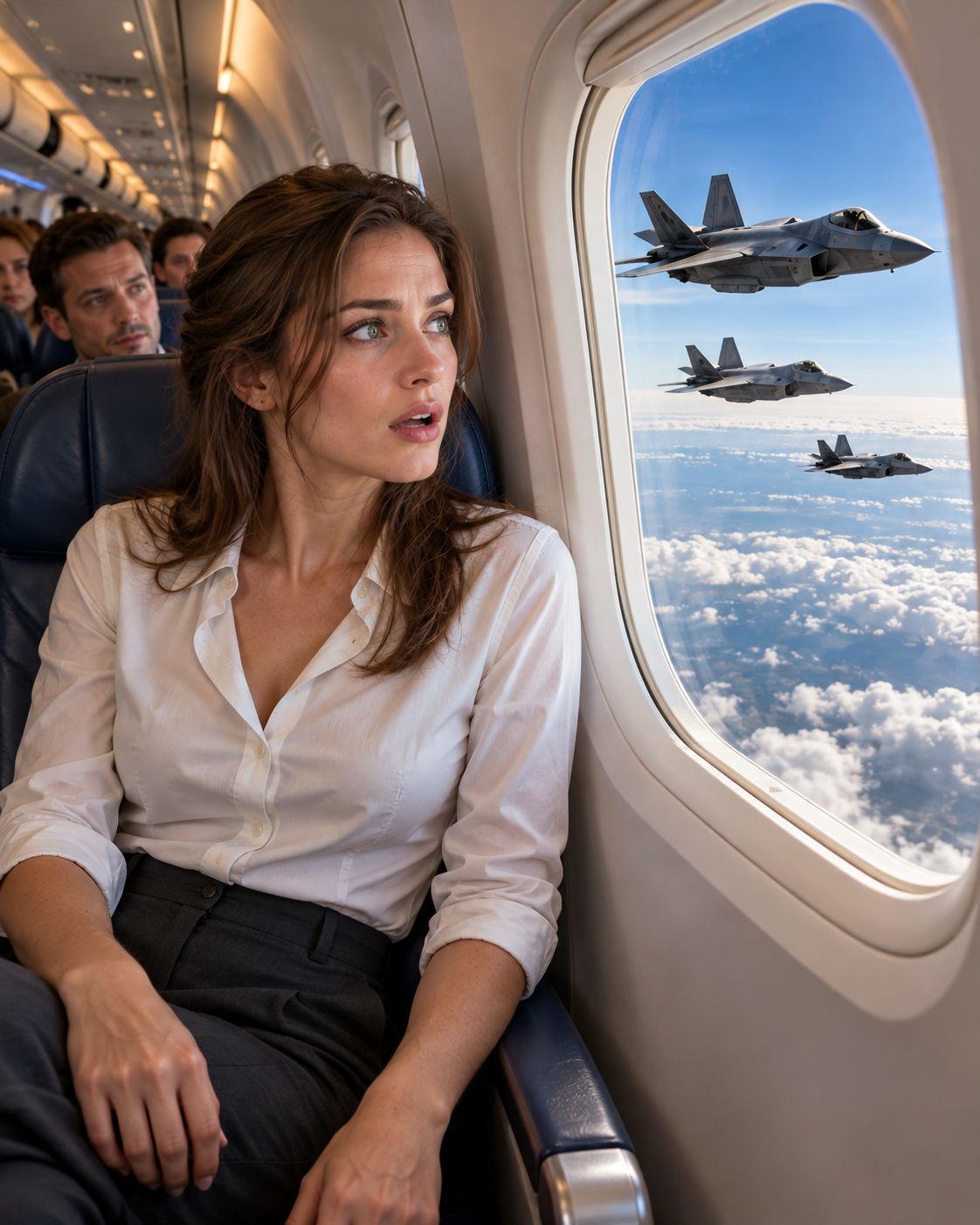
At first, I saw only pale sky and a line of clouds trailing behind the wing.
Then two dark shapes appeared at a distance, approaching with controlled precision.
They grew larger until their unmistakable profiles emerged against the sunlight.
F-22 Raptors.
The fighters moved into a position outside the aircraft, their angular silhouettes catching the light as they maintained a disciplined formation.
For a moment, even the captain seemed to forget to breathe.
“Are those ours?” I asked.
“Yes,” he said slowly. “But I haven’t received an explanation for why they’re here.”
The communications panel sounded again.
He answered, listened, then looked at me with fresh concern.
“Air traffic control has relayed an instruction from the appropriate authorities to maintain our assigned course and altitude. We’re being provided an escort while the situation is assessed.”
I stared through the glass at the fighters.
I knew that military aircraft might be positioned for any number of legitimate reasons, and I would not confuse their presence with proof of a specific threat.
But I also knew the coincidence was unlikely to be accidental.
The executive branch had requested the escort as an additional security measure while a sensitive government communication was taking place aboard a commercial flight.
Whatever else was happening, the authorities clearly believed the situation required unusual caution.
I returned to the handset as another message from Daniel arrived through the secure connection.
“Margaret, we’ve confirmed the first timeline discrepancy. The movement may have been defensive rather than offensive. The diplomatic team is reopening direct contact.”
I let my head rest against the seat for a second.
“Good. Don’t overcorrect in the other direction. We still need confirmation.”
“Understood.”
“And make sure the president knows the escort does not change my assessment. It changes the security posture, not the facts.”
“I’ll tell him.”
When I ended the call, I remained in the small space behind the pilots, watching the two fighters keep station outside the window.
They were extraordinary machines, built to operate at a level most people would never encounter.
But the sight of them did not make me feel powerful.
It made me feel the weight of the responsibility that had followed me onto the plane, into the cockpit, and across the miles between Washington and Chicago.
Somewhere in the cabin behind me, people were ordering coffee and checking the time until landing.
Craig Mercer was probably wondering why I had been called forward.
He might have imagined I was a government assistant, a consultant, or someone who had somehow caused a delay.
Whatever story he told himself, it would be based on the assumption that a person’s importance should be visible before it could be real.
I understood that assumption better than he ever would.
For most of my career, the work that mattered most had taken place behind closed doors, in quiet conversations and careful decisions that never appeared on a public schedule.
When things went well, nobody knew how close they had come to going wrong.
When things failed, everyone suddenly wanted a name to blame.
The aircraft began a gradual descent toward Chicago.
The captain received updated instructions, and the flight attendants prepared the cabin for landing.
Before the secure connection closed, Daniel called one final time.
“The president has received your assessment. He’ll keep the decision on hold pending verification and the diplomatic team’s report.”
“Good.”
“Margaret, one more thing.”
“What is it?”
“He asked me to tell you that he appreciates your judgment.”
I looked out at the fighters.
“Tell him I hope he never needs it under worse circumstances.”
The line disconnected.
I returned my notebook to the folder, closed the cover, and sat quietly as the city appeared beneath the wing.
I had spent the flight trying to prevent a crisis from becoming an irreversible decision.
Now, as the plane descended through the clouds, I had no idea that the lesson I had just given the president was about to arrive in a much more personal form.
Part 3
Chicago appeared beneath us in patches of gray water, highways, rooftops, and winter-brown fields.
The two F-22s maintained their escort position as our aircraft approached O’Hare, their presence visible to passengers who had crowded toward the windows.
Whispers moved through the cabin.
A child pressed both hands against the glass.
A man across the aisle began filming until a flight attendant reminded him to remain seated and put his device away.
Craig Mercer leaned toward his colleague, his expression somewhere between fascination and disbelief.
“What’s going on?” he asked.
His colleague shrugged.
“Military exercise, maybe.”
“Not that close to a commercial flight.”
Craig looked down the aisle toward the cockpit, then back at me.
For the first time since we had boarded, he appeared uncertain about the assumptions he had made.
I sat quietly with my tote beside my feet.
There was no reason to announce what I had done.
There was no award waiting at the gate, no crowd of officials prepared to applaud me, and no public statement that would ever connect my name to the decision made during our flight.
If the diplomatic channel stayed open and the two governments stepped back from confrontation, most people would never know how close the situation had come to a different outcome.
That was usually how successful national security work looked.
The absence of disaster rarely made headlines.
As our wheels touched the runway, the cabin erupted in the familiar sounds of landing: the hiss of air brakes, the rattle of overhead compartments, and the relieved conversations of passengers preparing to continue their lives.
The pilot announced our arrival at O’Hare and asked everyone to remain seated until the aircraft reached the gate.
Through the window, I noticed activity on a nearby section of the airport, where security vehicles moved along a restricted route.
A moment later, another aircraft appeared beyond the terminal structures.
The markings and distinctive blue-and-white exterior were unmistakable.
Air Force One.
Its presence was part of a separate executive-branch movement coordinated with the security arrangements already underway.
The sight drew everyone’s attention, but I knew better than to assume the two aircraft had anything to do with each other beyond the unusual timing of their arrival.
I did not need to know why the president’s aircraft was there.
I needed to know that the diplomatic process continued and that the information reaching decision-makers remained accurate.
My phone vibrated once inside my tote.
A brief message from Daniel appeared on the secure device.
Direct contact established. No immediate action authorized. Verification continues.
I read the words twice.
Then I locked the screen.
For the first time in several hours, the muscles across my shoulders loosened.
The flight attendants began releasing passengers by row.
Craig stood almost immediately, straightening his jacket and checking the time on his expensive watch.
His colleague lifted the two briefcases from the overhead compartment.
When the line reached row 23, I rose, retrieved my scuffed tote, and waited for the aisle to clear.
Craig turned as I stepped forward.
He looked directly at me, and I watched him search for the right expression.
Recognition had not yet arrived.
Only curiosity, embarrassment, and the uneasy suspicion that he had misjudged something important.
“Excuse me,” he said.
I stopped.
“Yes?”
“Were you the person the captain called to the cockpit?”
“I was.”
His eyes flickered toward the forward galley.
“Are you with the government?”
I adjusted the strap of my tote.
“Yes.”
He looked as if he wanted to ask something else, but couldn’t decide what he was entitled to know.
I gave him no explanation.
We walked down the aisle together, with the other passengers moving slowly around us.
When we reached the jet bridge, a uniformed airport officer stood beside a security representative, waiting for me near the entrance.
“Ms. Bennett,” the representative said quietly. “Your transportation is ready. The team is standing by for your arrival.”
Craig stopped walking.
The officer did not address him.
The representative did not ask to see his boarding pass or offer him directions.
Their attention remained on me.
That was when the truth finally began to settle into his face.
He looked at my old coat, my plain shirt, and the battered tote I carried as if he were seeing them for the first time.
“You’re Margaret Bennett?” he asked.
I nodded.
His mouth opened, then closed.
“My company has contracts with several federal agencies,” he said, his voice suddenly careful. “Mercer Strategic Capital. We handle infrastructure financing and government projects.”
“I know what your company does.”
The words came out without menace or warmth.
For a moment, he looked almost relieved.
Then he seemed to remember what he had said in the boarding line.
“I’m sorry about earlier,” he began. “I didn’t realize—”
I waited.
He searched my face for some sign that he could complete the sentence by explaining why his behavior had been reasonable under the circumstances.
“I made an assumption,” he finally said.
“You did.”
“I shouldn’t have.”
“No, you shouldn’t have.”
His colleague stared at the floor.
Craig swallowed.
“I hope you understand. I was under pressure, and I was trying to get to a meeting.”
“So was I.”
I said it gently, not because I wanted to spare his pride, but because I wanted him to understand how ordinary his excuse sounded.
For years, I had watched people use urgency, stress, and professional status to justify treating strangers as though their dignity were negotiable.
I was not interested in humiliating him in return.
He had already experienced the discomfort of discovering that the person he dismissed was someone he suddenly wanted to impress.
What mattered was whether he understood the mistake after the opportunity to gain something from me had disappeared.
“I hope your meeting goes well, Mr. Mercer,” I said.
Then I continued down the jet bridge.
The security representative walked beside me, discussing the next briefing and the revised schedule.
A black government vehicle waited beyond the restricted airport entrance, but I paused before stepping inside.
I turned once toward the terminal windows.
Passengers were still collecting bags, checking phones, arranging rides, and looking forward to reunions with people waiting on the other side of the doors.
Most of them would never know about the secure call or the hours of uncertainty that had preceded our landing.
Craig would remember, though.
He would remember the woman in the economy cabin whose clothes he had mistaken for evidence of insignificance.
He would remember the way he had spoken to me when he believed there could be no consequences worth considering.
But I hoped he would remember something more useful than embarrassment.
I hoped he would remember that he had never known enough about a stranger to justify his contempt.
Inside the vehicle, my phone rang again.
Daniel’s voice came through the secure connection.
“The president wants you at the next briefing. The new information is coming in, and he wants your assessment in person.”
“I’ll be there.”
“How was the flight?”
I looked down at the tote resting on my knees.
“Uneventful, once you ignore the fighter escort.”
He laughed softly, the first unguarded sound I had heard from him all day.
“Only you would call it uneventful.”
I watched the airport disappear through the window as the vehicle joined the stream of traffic.
“I’ve had worse trips,” I said.
The call ended, and I leaned back against the seat.
I was tired in the way only a person who has spent hours carrying responsibility can be tired, with a heavy mind and a body that seems to remember every minute it was asked to remain still.
But beneath that exhaustion was a quiet sense of relief.
The crisis had not ended.
The intelligence would continue to change, the diplomatic negotiations would remain difficult, and the president would still have to make decisions with imperfect information.
My work was not finished simply because a call had ended or a plane had landed.
Still, for that moment, we had avoided turning uncertainty into an excuse for irreversible action.
I thought about Craig’s expression as he watched me walk away.
It would have been easy to take satisfaction in his shock, to enjoy the moment when his certainty dissolved and the person he had mocked became someone worth respecting.
But respect earned only after a person’s title is revealed is a fragile thing.
It depends on status, not character.
I had spent twenty-three years working behind doors that most Americans would never see, and I had learned that titles could open those doors without making the person carrying them wise, honest, or kind.
The measure of a person was not how carefully others treated them when their importance became known.
It was how they treated people when they believed no reward or consequence was attached.
I had been underestimated in the boarding line, but I had not lost anything there.
Craig had revealed his assumptions, and I had been reminded why I preferred a quiet life outside the spotlight whenever the work allowed it.
I placed my hand on the leather tote and looked out at the city waiting beyond the airport.
Soon, I would return to the briefing room, open the latest intelligence reports, and help the president decide what the country should do next.
Nobody at the meeting would care what I had worn on the flight or whether my luggage looked expensive.
They would care whether I could distinguish evidence from assumption, whether I could admit what we did not know, and whether I had the courage to tell powerful people the truth when the truth was inconvenient.
That was the work.
That was always the work.
And as the car carried me toward the next difficult decision, I held on to a lesson I had learned long before Craig Mercer ever looked down at my coat.
You do not need to look powerful to carry responsibility, and you do not need to humiliate someone to prove that they underestimated you.
Sometimes, the most important thing a person can do is remain exactly who they are while the world discovers, too late, that appearances were never the whole story.