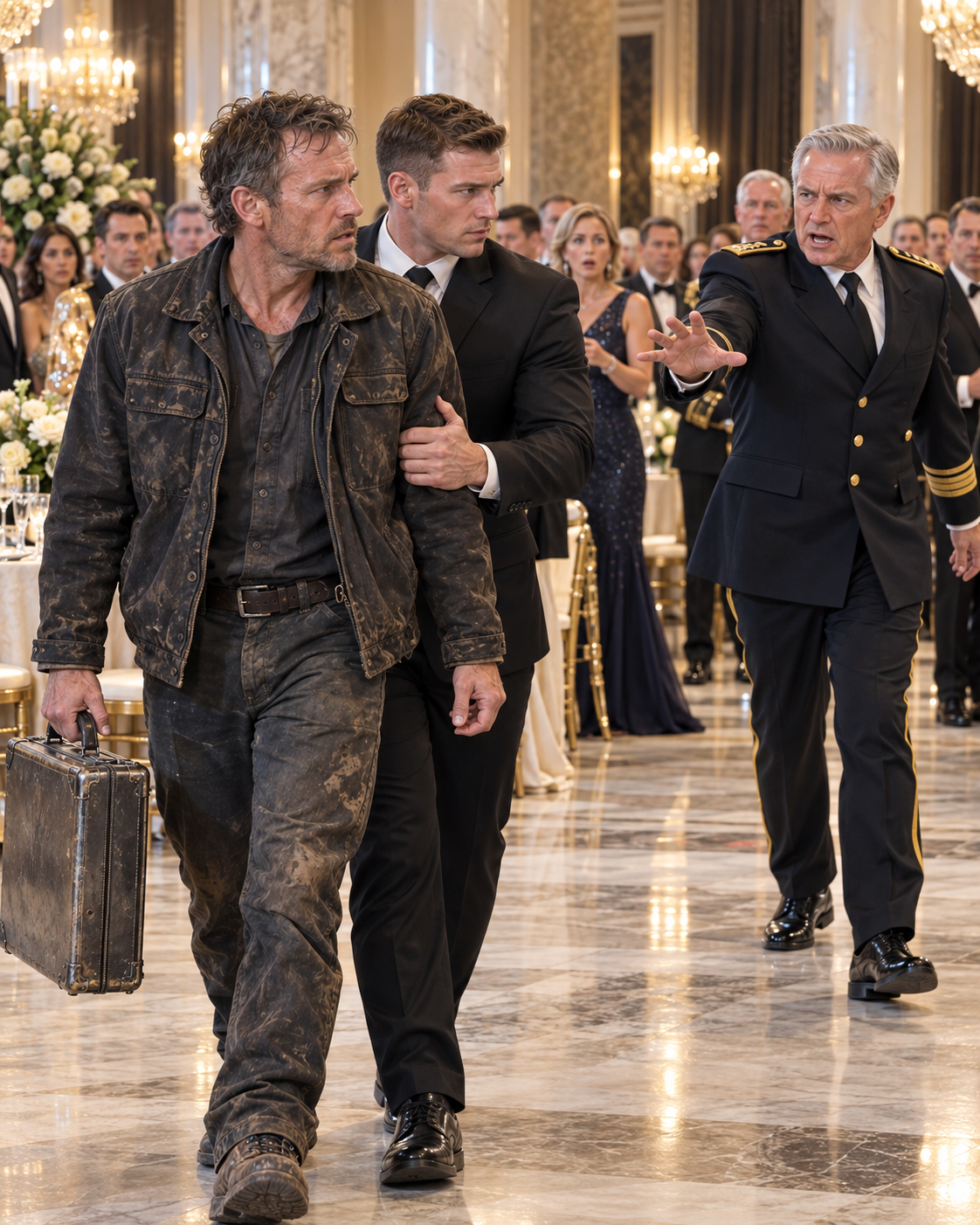
At an air base gala in Virginia, a four-star general shouted “DON’T TOUCH HIM!” when a private guard grabbed my shoulder
Part 2
General Vance walked toward me slowly.
The room seemed to shrink around him.
“How long have you had it?”
I looked down at the steel chest.
“Since the ridge.”
He closed his eyes for a moment.
“The ridge.”
Julian swallowed.
Arthur finally spoke.
“General, I believe there’s been a misunderstanding.”
Vance turned toward him.
“No.”
One word.
Cold.
Final.
“There has been a misunderstanding for eighteen years.”
Nobody moved.
I could hear the faint hum of the exhibit screens behind us.
Then Vance looked at the placard.
His expression hardened.
“Who approved this?”
Arthur straightened.
“Our historical division worked with the military liaison office.”
“That isn’t what I asked.”
Arthur didn’t answer.
Julian stepped forward.
“General, our company has invested millions in preserving the history of Northstar.”
Vance looked at him.
“Then you should have preserved the truth.”
Julian’s mouth opened.
Nothing came out.
A staff officer approached Vance and whispered something into his ear.
Vance nodded.
Then he turned back to me.
“You still have the notebook?”
I felt something tighten behind my ribs.
“Yes.”
“All these years?”
“All these years.”
He looked at the steel chest again.
“I thought it was lost.”
“It almost was.”
I had found it eighteen years ago beneath a collapsed section of the lower anchor platform.
The same place where Sergeant Owen Hayes had made his final stand.
Owen had been my closest friend.
Not just a teammate.
Not just another soldier.
My brother.
We had been trapped on a mountain ridge during Northstar after an extraction system failed.
The weather had turned the mountain into a wall of ice.
Twenty-seven soldiers were stranded above a ravine.
The official report later called the evacuation a successful deployment of emergency rescue equipment.
That was technically true.
It just wasn’t the whole truth.
The rescue equipment had failed.
The powered pulley had seized.
The anchor assembly was breaking apart.
There was no backup.
So I built one.
With cable, scrap steel, a damaged winch, and whatever pieces we could pull from the wreckage.
It was ugly.
It was dangerous.
It was the only thing we had.
Owen stayed below me at the lower anchor line.
The wind was so violent we had to shout into each other’s faces.
“Mercer!”
“What?”
“The cable’s slipping!”
“I know!”
“Then get them across!”
“I need you to hold it!”
He looked at the anchor.
Then at me.
He knew what would happen if he let go.
The next soldier went across.
Then another.
Then another.
Twenty-seven people crossed that night.
Among them was a young Colonel Raymond Vance.
Owen never came back.
The final cable tore loose just as I reached for him.
I still remember his face.
Not fear.
Not panic.
Just exhaustion.
And the smallest smile.
“Get them home.”
Then he disappeared into the storm.
For eighteen years, I had carried that moment inside me.
I had also carried the notebook he left behind.
Its green cover was cracked.
Several pages were stained with ice, oil, and blood.
Inside were Owen’s measurements, calculations, corrections, and notes from the hours before the rescue.
His handwriting proved the machine that Sterling Aerospace claimed to have deployed did not exist yet.
The technology came years later.
The dates on the exhibit weren’t a mistake.
They were a lie.
And somebody had built an entire corporate legend around the deaths and sacrifices of men who could no longer contradict them.
Julian approached me after the crowd began to disperse.
His voice was lower now.
“Mr. Mercer, we should talk privately.”
“No.”
“This doesn’t have to become ugly.”
“It already is.”
Arthur joined him.
He no longer looked amused.
He looked like a businessman trying to calculate the cost of a disaster.
“We can correct the display.”
“No.”
“We can make sure Owen Hayes receives proper recognition.”
I stared at him.
“You should have done that eighteen years ago.”
Arthur’s jaw tightened.
Then he offered me something else.
A position.
Senior technical adviser.
Generous salary.
Private office.
A consulting agreement that would make more money in a year than I had earned in several.
All I had to do was sign a confidentiality clause.
Julian leaned toward me.
“Everyone wins.”
I looked at him for a long moment.
Then I said the only thing I could.
“I didn’t protect the truth for eighteen years just to sell it tonight.”
Arthur’s face hardened.
Vance had heard every word.
He walked toward us.
“Open the box.”
My hands trembled slightly as I set the steel chest on the table.
The latches were cold beneath my fingers.
When I opened it, the room became completely silent.
Inside were my original engineering sketches.
Old photographs.
A broken pulley component.
A rusted section of anchor cable.
And beneath them all, wrapped in faded cloth, was Owen’s notebook.
I lifted it carefully.
For eighteen years, I had wondered whether keeping it had been enough.
That night, I finally understood.
Keeping the truth isn’t the same as giving it a place where nobody can erase it.
I handed the notebook to General Vance.
His fingers shook when he took it.
He opened the first page.
Owen’s handwriting stared back at him.
Vance whispered his name.
“Owen.”
Then he closed his eyes.
When he opened them again, he looked at the crowd.
“We are going to tell this story correctly.”
Part 3
The next hour moved like a storm.
Military legal officers arrived.
Contract investigators began photographing the Sterling display.
Every date, every specification, every claim on the placard was documented.
The enormous banner celebrating Sterling Aerospace’s supposed role in Northstar came down before midnight.
Nobody applauded.
Nobody cheered.
It was too late for that.
The truth had arrived carrying an eighteen-year-old wound.
Arthur Sterling stood beneath the empty display frame while officials questioned his staff.
Julian remained silent.
For once, he had nothing clever to say.
General Vance asked me to step onto the podium.
I refused at first.
“I don’t want the attention.”
“This isn’t about attention.”
He held Owen’s notebook against his chest.
“It’s about the man who never got any.”
So I agreed.
I walked onto the stage wearing the same oil-stained jacket.
The same boots.
The same clothes Julian had mocked less than two hours earlier.
The room looked different now.
Not because I had changed.
Because they had.
Three hundred people watched me.
I looked at them and thought about Owen.
Then I looked at Vance.
He gave me a small nod.
I stepped toward the microphone.
Before I could speak, Vance did.
“This rescue was not performed by Sterling Aerospace.”
The room fell silent.
“It was performed by soldiers who had almost nothing left and refused to leave each other behind.”
He opened the notebook.
“The man who made the final sacrifice was Sergeant Owen Hayes.”
His voice broke slightly.
“Owen Hayes saved my life.”
He looked toward me.
“He saved twenty-six others.”
Then he looked down at the notebook.
“And for eighteen years, the record failed him.”
I finally spoke.
“Owen didn’t care who received credit.”
My voice sounded strange through the speakers.
“He cared whether people got home.”
I told them about the broken pulley.
About the freezing darkness.
About the lower anchor line.
About Owen refusing to leave until the last soldier crossed.
I didn’t make him sound like a legend.
He wasn’t.
He was a tired man in a freezing mountain storm who was afraid and kept working anyway.
That was enough.
When I finished, there was no applause.
There was something better.
Silence.
The kind that means people are finally listening.
The original evidence was transferred to the national archives under military custody.
Owen’s notebook was catalogued as primary mission evidence.
My engineering sketches went with it.
The damaged pulley component went with them too.
For the first time, there was a permanent record that couldn’t be quietly edited by a marketing department.
Before I left, General Vance found me outside the hangar.
The night air was bitter.
“You should have told me you were coming.”
“I wasn’t sure you’d remember me.”
He looked offended.
“I have remembered you every day.”
I didn’t know what to say.
He looked toward the steel chest.
“Thank you.”
I shook my head.
“Thank Owen.”
Vance nodded.
“I will.”
Then he said something I hadn’t expected.
“I should have said his name years ago.”
I looked at him.
“You were fighting a different battle.”
“That’s not an excuse.”
“No.”
He took a breath.
“But it can be a reason to do better.”
We stood there for a moment beneath the cold Virginia sky.
Then I finally headed toward my old pickup.
The truck started on the second try.
The heater took several minutes to warm up.
There was an empty milk jug rolling around the passenger floorboard.
I picked it up and laughed quietly.
For all the generals and billion-dollar contracts and polished speeches inside that hangar, my daughter was still waiting at home for one simple thing.
Milk.
I stopped at a twenty-four-hour store before driving home.
When I walked through the front door, Hannah was sitting on the couch with a blanket around her shoulders.
She looked at the clock.
“You’re late.”
“I know.”
“Did you get the milk?”
I held up the jug.
“Always.”
She smiled.
I put it in the refrigerator.
Then I stood in the kitchen for a moment, listening to the quiet hum of the house.
No cameras.
No generals.
No executives.
No applause.
Just home.
Hannah looked at me.
“Was the delivery important?”
I thought about Owen.
I thought about the mountain.
I thought about the steel chest sitting empty in my truck.
“Yeah,” I said.
“It was.”
She didn’t ask anything else.
She didn’t need to.
Years later, people might remember the gala.
They might remember the executive whose company was exposed.
They might remember the general who stopped security with two words.
But I hoped they remembered something smaller.
A name.
Owen Hayes.
Because history doesn’t always lose the truth in explosions or wars.
Sometimes it loses it quietly.
A date gets changed.
A credit line gets rewritten.
A dead man’s name disappears beneath a corporate logo.
And if nobody speaks, the lie eventually becomes history.
That night, I learned that truth doesn’t always need a hero.
Sometimes it only needs one person stubborn enough not to sell it.
I had spent eighteen years carrying a battered steel box because I couldn’t save my brother.
But when I finally handed that notebook into the hands of the nation, I understood something I had never allowed myself to believe.
I hadn’t failed Owen.
I had carried him home.
And as I turned off the kitchen light and heard my daughter laughing softly from the living room, I realized that was all any of us can really hope for in the end.
Not that the world remembers our faces.
Not that our names become famous.
Just that when the truth is finally told, someone remembers who stood in the darkness and refused to let go.