At a veterans’ fundraiser on the Harwell Regional Airport tarmac, a retired colonel stopped mid-speech
# Part 2
Colonel Reyes reached for the microphone someone had carried down from the stage.
I caught his wrist before he could take it.
“Please don’t.”
My voice sounded smaller than I expected.
He looked at my hand, then at my face.
“Daniel, I’ve been looking for you.”
“Why?”
“Because I owe you something.”
“You don’t owe me anything.”
His expression changed, and for the first time, the decorated colonel looked less like a commanding officer and more like an old man carrying a weight he had never learned to put down.
“That isn’t your decision to make.”
Behind him, the crowd waited in confused silence.
The volunteer had switched off the radio, but its final transmission seemed to remain suspended in the air.
Reyes gently removed my hand from his wrist.
“I won’t share anything classified,” he said. “I won’t tell them what they aren’t entitled to know. But I will tell them the truth about the man standing in front of me.”
I shook my head.
“You don’t understand what you’re asking.”
“I understand better than you think.”
“No, sir. You don’t.”
For a moment, neither of us spoke.
Then I saw his eyes move toward the old radio.
“I’ve heard that recording hundreds of times,” he said. “Every year, on the anniversary of that mission, I listen to it.”
My throat tightened.
“Why would you do that to yourself?”
“Because four men came home that night, and I was the officer who ordered you to leave them behind.”
The words struck harder than any accusation could have.
I looked away.
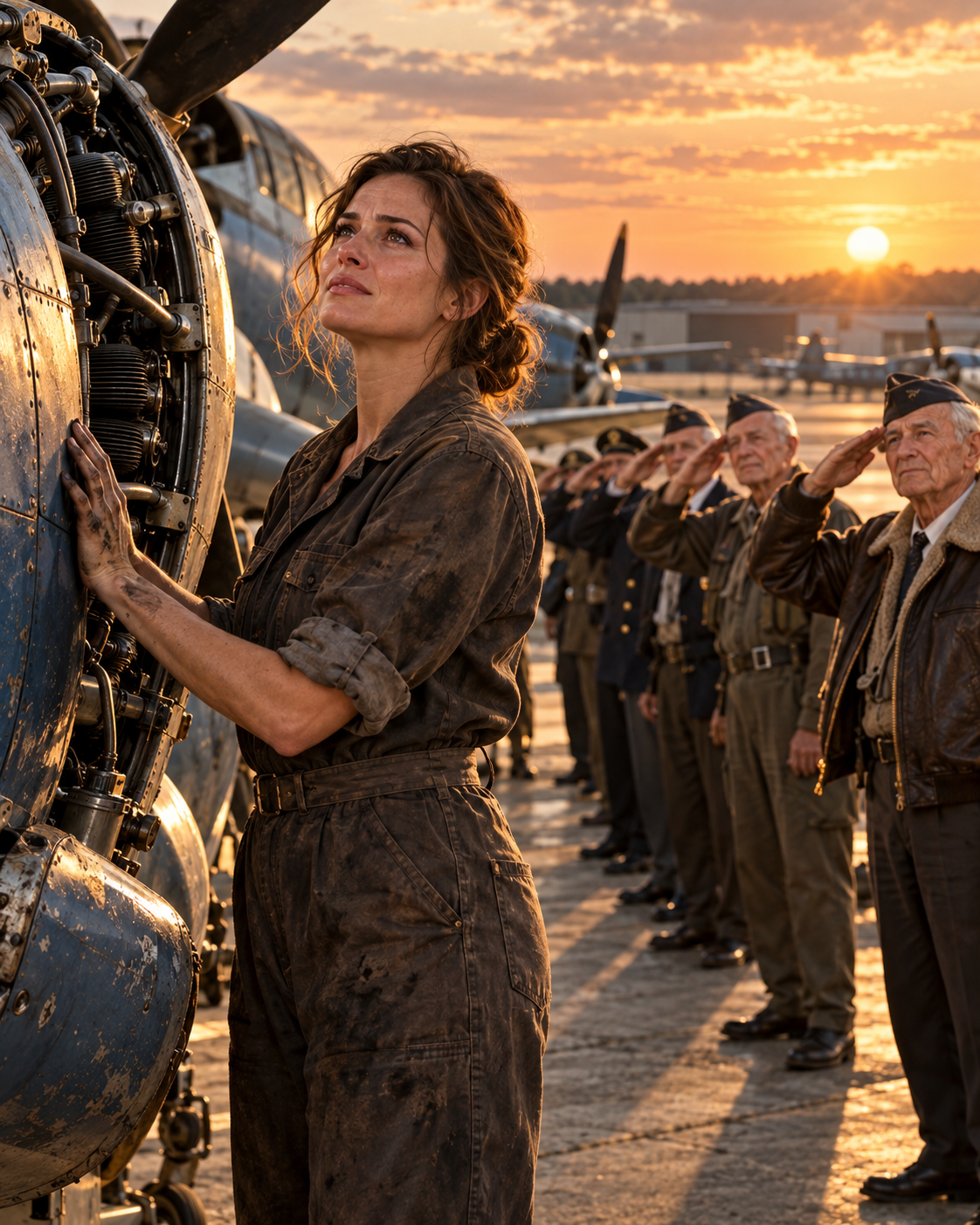
The memory came back in fragments, each one sharper than the last.
Ten years earlier, the mission had begun as a routine nighttime extraction near a contested bridge in a remote combat zone.
Our team had been sent to retrieve a small unit pinned down after an operation went wrong.
The plan was simple.
Reach the landing zone, collect the wounded, and leave before enemy forces could close the surrounding roads.
But the bridge had become a trap.
An explosion destroyed part of the approach road, and gunfire erupted from positions we hadn’t identified.
Our aircraft took damage during the initial pass.
The pilot fought to keep us airborne while smoke climbed into the night, and the radio filled with overlapping reports of casualties and collapsing defensive positions.
When we located the soldiers, four were wounded.
One was unconscious and bleeding badly.
Another was pinned beneath a section of twisted equipment.
The other two were conscious but unable to move without assistance.
There wasn’t enough room to evacuate everyone safely in a single pass under those conditions, and the aircraft could not remain over the area without risking a crash.
The commanding officer ordered us to pull away, regroup, and wait for a safer opportunity.
But I could see the men below us.
I could see one of them trying to drag himself toward his fallen teammate.
I could see another pressing both hands against a wound, his face illuminated by the orange glow of burning fuel.
And I knew what waiting might cost.
I had been trained to assess risk, stabilize casualties, and follow command decisions.
I had also been taught that the mission mattered because human lives mattered.
Sometimes those principles fit together.
That night, they seemed to tear each other apart.
I asked the pilot for another approach.
He told me the aircraft was damaged and that we had minutes, not hours, before our situation became impossible.
Then Colonel Reyes’s voice came over the radio.
“Ghost Hook, abort the approach. That’s an order.”
I remember staring through the open side of the aircraft at the smoke rising from the bridge.
I remember my hands shaking.
I remember thinking about the men below us, and about their families, who would never know whether their sons had been frightened, whether they had called for help, or whether someone had heard them.
I answered the radio.
“Negative. I’m not leaving them.”
I didn’t feel fearless.
I felt terrified.
I went back because the men on that bridge had run out of people who could help them, and I could not bear the thought of being the last person who might have reached them.
The second approach was worse than the first.
The aircraft took another hit, and the pilot fought to maintain control while the crew chief shouted warnings over the rotor noise.
I reached the wounded under fire, treated the most critical casualty as quickly as I could, and helped move the pinned soldier clear of the wreckage.
There was no heroic speech.
There was no moment when fear disappeared.
There was only the next wound to dress, the next man to lift, and the next few seconds I needed to keep all of us alive.
We got the four soldiers aboard.
The aircraft climbed away with damage that made every vibration feel like a countdown.
I held pressure on the worst wound throughout the flight, talking to the injured men because I needed them to stay awake.
One of them kept asking whether his brother knew where he was.
Another apologized repeatedly for bleeding on my uniform.
I told him to save his breath.
When we reached safety, I finally looked down at my hands.
They were covered in blood.
Some of it belonged to strangers.
Some of it belonged to men whose names I would remember for the rest of my life.
The rescue was later sealed behind classification restrictions because the operation had intersected with intelligence work that could not be publicly disclosed.
My participation was never something I could explain in detail.
Even the praise that followed came privately, in closed rooms, behind doors that shut before anyone could ask questions.
I received commendations and medals.
I signed agreements.
I returned to duty.
And eventually, I came home.
What nobody had prepared me for was the silence.
At first, I welcomed it.
No alarms.
No urgent calls.
No one shouting for a medic while the world burned around us.
But ordinary sounds began to carry the wrong meanings.
A car backfiring made my shoulders lock.
A helicopter overhead could send me back to that bridge before I knew where I was.
I woke from nightmares with my fists clenched and my heart racing, unable to remember for several seconds that I was home.
People told me I was lucky.
They said I had done my part and deserved to move on.
I tried.
I worked different jobs.
I attended gatherings.
I smiled when people asked how I was doing.
But every time someone thanked me for my service, I heard the four voices I had not been able to save from my memory, and I wondered whether I had become a person who knew how to rescue strangers but no longer knew how to live among the living.
So I took the maintenance job at Harwell.
Engines made sense.
Machines broke for reasons that could be found, tested, and repaired.
A damaged wire didn’t ask me why I had survived.
A failed compressor didn’t wake me at three in the morning.
I could do my work, collect my paycheck, and leave without telling anyone who I had been.
For three years, that arrangement had been enough.
Until Colonel Reyes stood in front of me with a microphone.
He climbed back onto the stage.
I watched him from the edge of the tarmac, my pulse hammering so hard I could feel it in my throat.
“Ladies and gentlemen,” he began, “I need to correct something I once believed about courage.”
The crowd settled.
“Ten years ago, I was responsible for a mission that went terribly wrong. Four American soldiers were trapped in an ambush near a damaged bridge, and the aircraft assigned to their extraction had already taken fire.”
He paused.
“I ordered the medic to withdraw. It was the safest decision I could make with the information available to me, and I believed he would obey.”
I lowered my eyes.
“But the medic heard the wounded calling for help, and he made a decision that changed four families forever.”
Reyes looked toward me.
“His name was Daniel Walker. His call sign was Ghost Hook.”
A murmur moved through the audience.
I heard someone whisper the name as if they were testing whether it belonged to a real person.
Reyes continued, his voice growing unsteady.
“He went back into a burning ambush when every reasonable calculation told him not to. He treated the wounded under fire, helped recover four soldiers, and brought them out alive.”
He took a breath.
“The operation was classified, and he was forbidden from discussing the details. So he came home carrying a story he could never tell, while the men he saved went on living lives he would never see.”
My vision blurred.
I had imagined many ways my past might catch up with me.
I had imagined an official letter, a phone call from an old commander, or a chance meeting with someone who recognized my face.
I had never imagined standing beside a maintenance tent while hundreds of people learned my secret through a loudspeaker.
Reyes looked straight at me.
“Daniel, I spent ten years telling myself that I had made the right call that night. I told myself that following the safest course was the same as doing everything possible.”
His voice cracked.
“But every time I listened to that recording, I heard a medic who understood something I had forgotten. Sometimes the person giving orders cannot see the human being left behind.”
He lowered his head.
“You saved my men, Daniel. And I am sorry that you had to carry the weight of that night alone.”
The tarmac went silent.
Then someone near the front stood up.
A gray-haired veteran in a wheelchair placed one hand over his heart.
Another veteran rose beside him.
Then another.
Within seconds, the entire crowd was standing.
Hundreds of people faced me, their hands raised in a silent salute.
I had stood in military ceremonies before.
I had watched flags rise and listened to names read aloud.
But nothing had prepared me for the sight of so many strangers honoring a man they had never known, a man who had spent three years making sure nobody noticed him.
I tried to look away.
I couldn’t.
For the first time in a decade, the past was not a secret I had to defend.
It was a truth other people were willing to stand beside me and carry.
And then, through the crowd, a woman began walking toward me.
# Part 3
She was in her late thirties, with dark hair pulled into a loose ponytail and a small American flag pinned to the collar of her jacket.
She moved slowly, as if she were afraid that one sudden movement might make me disappear.
When she reached me, she stopped just beyond arm’s length.
“Daniel Walker?”
I nodded, unable to speak.
“My name is Emily Carter.”
The name meant nothing to me at first.
Then she reached into her purse and took out a photograph.
It showed a young soldier standing beside a woman in a wedding dress, both of them squinting into the sunlight.
The soldier had a broad smile and one arm draped around her shoulders.
“He was my older brother,” she said. “Thomas Carter.”
The world seemed to narrow around those three words.
Thomas.
One of the four.
I remembered his face beneath the dust and blood, his stubborn refusal to let me examine his injuries until I had checked the man beside him.
I remembered telling him that he was in no position to negotiate.
He had laughed once, weakly, and said, “You always this bossy, Doc?”
I had promised him that we would get him home.
I had made promises to a lot of wounded men.
Some had lived.
Some had not.
I had never known what became of Thomas.
Emily held the photograph between us.
“He told us about you,” she said. “Not your real name. Not where you came from. He called you Ghost Hook.”
My throat tightened.
“He said you kept talking to him during the flight because he was scared he wouldn’t wake up. He said you told him about the most boring things you could think of, just to keep him listening.”
I looked at the photograph.
I remembered talking about breakfast.
I had told Thomas that the hospital would probably serve him terrible coffee and rubbery eggs, and that if he wanted to complain about it, he needed to stay alive long enough to file the complaint.
He had laughed despite the pain.
I had forgotten the exact words until Emily brought them back.
“He said he never got to thank you properly,” she continued. “He spent years trying to find out who you were, but the operation was classified, and nobody would tell him anything.”
She stopped and pressed her lips together.
“Thomas died three years ago.”
The crowd around us seemed to fade.
I felt the old instinct rise inside me, the instinct to retreat before grief could reach the places I had spent years protecting.
“I’m sorry,” I whispered.
Emily shook her head.
“He wasn’t killed in combat. He came home. He married his high school sweetheart, had two daughters, and worked as a firefighter for almost twenty years.”
She smiled faintly through her tears.
“He had a bad heart. One morning, he collapsed in the kitchen before he could leave for work. They tried everything, but they couldn’t bring him back.”
I lowered my head.
For years, I had carried the image of Thomas as a wounded soldier beneath a burning sky.
I had never allowed myself to imagine him growing older.
I had never pictured him walking his daughters to school, arguing with his wife about what to cook for dinner, or sitting on a porch after a long shift.
I had saved his life that night.
But I had never known what his life became.
Emily reached for my hand.
“He wanted you to know that he made it,” she said. “He wanted you to know that the time you gave him mattered.”
I stared at her fingers wrapped around mine.
“I only did my job.”
“No,” she replied softly. “You did your job when you could have walked away. You gave him the chance to live the life he was supposed to have.”
My face crumpled before I could stop it.
I turned away, ashamed of the tears gathering in my eyes, but Emily stepped closer and wrapped her arms around me.
For one second, I stood rigid.
My body had forgotten how to accept comfort without searching for danger.
Then something inside me finally gave way.
I folded into the embrace and cried.
Not the quiet tears I had hidden in my truck after another sleepless night.
Not the tears I had swallowed at memorial services when I saw families standing beside empty chairs.
These were the tears of a man who had spent ten years believing that nobody could understand what he carried, only to discover that the people he had saved had been carrying a piece of his story, too.
Emily held me without asking me to explain.
Behind us, the veterans remained standing.
Nobody clapped.
Nobody shouted my name.
They simply waited, allowing the moment to belong to the living and the dead.
When I finally stepped back, Emily wiped her cheeks and gave me the photograph.
“You should keep this,” she said.
“I couldn’t.”
“You can.”
She placed it in my hand and closed my fingers around it.
“Thomas would have wanted you to have it.”
I looked at the smiling soldier in the picture, and for the first time in years, I did not see only the wounded man I had carried away from the bridge.
I saw a brother.
A husband.
A father.
A firefighter.
A whole life that had continued long after that terrible night.
I pressed the photograph against my chest.
“Thank you,” I whispered.
Emily shook her head.
“No, Daniel. Thank you.”
When she returned to her family, Colonel Reyes approached me again.
He had removed his jacket, and his eyes were red.
“I should have found you sooner,” he said.
“You couldn’t have known where I was.”
“I could have tried harder.”
I considered telling him that it didn’t matter, that the past was over, and that we should all move on.
Instead, I decided to give him the same honesty he had finally given me.
“I didn’t want to be found.”
He nodded slowly.
“I know.”
“I thought if I stopped being Ghost Hook, I might stop hearing that night.”
“And did it work?”
I looked across the tarmac toward the maintenance hangar.
The open doors revealed the familiar shapes of tools, equipment, and aircraft support vehicles.
For three years, I had believed that the place offered me a life without the past.
But the truth was that I had brought the past with me everywhere.
“No,” I admitted. “It didn’t.”
Reyes looked toward the crowd.
“Then maybe it’s time you stopped fighting it alone.”
The ceremony resumed eventually, but something had changed.
People approached me quietly, never demanding details I couldn’t share.
An older veteran shook my hand and told me that his daughter was a flight nurse.
A young service member thanked me for reminding him why he had enlisted.
Dennis stood near the maintenance tent with his mouth open, looking as though he had just discovered that the quiet man who repaired his generators had secretly walked out of a history book.
When he finally reached me, he rubbed the back of his neck.
“So, Ghost,” he said, then stopped himself. “Sorry. I guess that’s not just a nickname.”
I almost smiled.
“It’s complicated.”
He nodded, suddenly serious.
“Yeah. I imagine it is.”
After a moment, he asked, “You still coming in Monday?”
I looked at him.
For the first time, the question didn’t feel like a demand to return to the place where I had hidden.
It felt like an invitation to return to the life I had built, without pretending that it was the only life I had ever lived.
“Yeah,” I said. “I’ll be there.”
Dennis smiled.
“Good. Compressor three is making that noise again.”
I laughed.
It surprised both of us.
The sound came out rough and unfamiliar, but it was real.
That evening, I drove home with Thomas’s photograph resting on the passenger seat.
When I entered my apartment, I went straight to the bedroom and pulled the old shoebox from beneath the bed.
For years, I had treated it like something dangerous.
I had hidden the medals, the commendations, and the folded uniform as if the objects themselves could summon the night I had survived.
I set the box on the kitchen table and opened it.
The medals caught the light.
For a long time, I simply stared at them.
Then I lifted the uniform and unfolded it carefully.
The fabric had faded.
One sleeve still carried a faint stain that I had never managed to remove completely, though I had tried more times than I cared to admit.
I used to think that the stain was proof of what the war had taken from me.
That night, I understood that it was also proof of what I had been willing to give.
I placed Thomas’s photograph beside the medals.
His smile looked strangely at home there.
I didn’t suddenly become a different man.
The nightmares did not vanish.
The memories did not become painless because hundreds of people had saluted me, and I knew there would still be mornings when a helicopter overhead made my chest tighten.
But I had spent years mistaking silence for healing.
I had believed that the only way to survive my past was to erase every visible trace of it.
Now I understood that healing might begin with something far smaller.
A conversation.
A photograph.
A name spoken without shame.
The following Monday, I returned to the airport for my regular shift.
The younger mechanics were gathered beside the tool cabinets when I walked in.
One of them glanced up.
“Hey, Ghost, you hear about that colonel at the fundraiser?”
I hung my jacket on its usual hook.
“I was there.”
He stared at me.
“No way. You actually met the guy?”
I picked up my wrench.
“Something like that.”
He waited for a punchline, but none came.
Then he nodded toward the engine bay.
“Compressor three is acting up again.”
“I heard.”
I went to work.
The tools felt familiar in my hands, and the machines still made sense to me.
But when a helicopter crossed the sky beyond the hangar doors, I stopped for a moment and listened.
The sound no longer belonged only to smoke, gunfire, and the desperate minutes before dawn.
It also belonged to the men who had survived.
To Thomas, who had gone on to raise two daughters and fight fires in his own community.
To Emily, who had carried her brother’s gratitude for years without knowing where to deliver it.
And to the younger version of myself, terrified and exhausted, who had made a choice he could never fully explain.
I could not change what had happened on that bridge.
I could not save every person I had treated, and I could not make the dead come home.
But I could stop punishing the man who had tried.
Months later, a letter arrived from Emily.
Inside was another photograph, this one showing Thomas standing beside his daughters at a summer picnic.
On the back, she had written, “He got to be their dad because you brought him home.”
I read the sentence several times.
Then I placed the photograph in a frame beside my kitchen window, where the morning light reached it every day.
The medals remained in their box, but I no longer hid the box beneath the bed.
I set it on a shelf.
Not because I needed strangers to know who I had been, and not because I wanted anyone to call me a hero.
I kept it there because I was finally ready to acknowledge the truth.
I had been a medic.
I had been afraid.
I had made impossible choices.
I had lost people.
I had saved people.
And I was still here.
The world might remember Ghost Hook as the voice on a classified recording, the medic who refused to leave four wounded soldiers behind.
I would remember him differently.
I would remember a frightened young man who did not know whether he would make it through the night, but who kept moving because someone needed him.
For ten years, I had believed that man belonged to a past I had to bury.
Now I knew he belonged to me.
And the greatest gift I received on that airport tarmac was not the salute, the recognition, or the colonel’s apology.
It was the freedom to stop disappearing.
Because sometimes the people who save others spend the rest of their lives believing they must do it quietly, without witnesses, without gratitude, and without ever admitting how much it cost them.
Sometimes all they need is for one person to remember.
And sometimes, when the past finally finds its way home, it does not come to destroy the life you have built.
It comes to remind you that the life you are living now belongs to the same person who survived everything that came before it.
My name was Daniel Walker.
For three years, the men at Harwell Regional Airport had called me Ghost.
But when I walked into the hangar that morning, I no longer felt the need to disappear.
I was still a mechanic.
I was still a veteran.
I was still a man learning how to live with the things he could never change.
And somewhere beneath the noise of the engines, I could finally hear something I had not heard in ten years.
Not the radio.
Not the gunfire.
Not the desperate voice begging for extraction.
Just the quiet, steady sound of a life that was still mine.