At a storage auction in Greystone City, billionaire Victor Sterling laughed at the filthy race car I had uncovered and called me
Part 2
I looked through the kitchen window at Julian, who was sitting at the counter trying to convince a spoonful of cereal to stay balanced on his nose.
For a second, I wanted to tell Sarah that I had no idea what she was talking about.
Instead, I gave her the truth.
“An old storage facility in Greystone City. It’s scheduled for auction, and a billionaire named Victor Sterling has already dismissed the car as worthless.”
There was a pause on the other end.
“Has he seen the chassis number?”
“I don’t think so.”
“Good,” she replied, though she didn’t sound relieved. “Listen carefully. The design and the number you’ve sent me are consistent with a remarkably rare surviving car from a legendary European racing program. I need to verify several details before I can give you a definitive identification, but this could be extraordinarily significant.”
I gripped the edge of the counter.
“How significant?”
“Potentially museum-level significant. But don’t start restoring it, don’t replace original components, and don’t let anyone persuade you to sell it before a proper examination.”
My eyes moved toward the stack of bills beside the toaster.
“Someone has already offered to buy it?”
“Not me,” Sarah said. “I’m warning you because I know how these situations unfold. People hear the words ‘old racing car,’ assume it’s junk, and sell something irreplaceable for the price of scrap. Then, when the truth emerges, the seller has no way to recover it.”
I thanked her and agreed to send additional photographs.
After we hung up, I stood motionless for several seconds, listening to Julian humming over his breakfast.
The car might be worth a fortune.
Or it might turn out to be a fascinating but incomplete relic worth far less than I imagined.
Either way, I had reached a point where guessing was no longer good enough.
I called Sarah again that afternoon and arranged for an independent specialist to inspect the vehicle.
She also explained the importance of provenance, the documented history that connected a physical object to the events it had witnessed.
A matching chassis number could be a major clue, but the car’s originality, surviving components, historical records, and chain of ownership would all matter.
I listened to every word.
I was accustomed to diagnosing problems that revealed themselves through burnt insulation, cracked pipes, or the smell of overheated machinery.
This was different.
Every decision could affect the value of something that had survived decades of neglect.
For the first time in years, I had to resist the urge to fix what looked broken.
Two days later, the specialist arrived at the warehouse carrying a leather case filled with measuring tools and documentation.
He spent hours examining the chassis, taking photographs, checking stamped numbers, and comparing the car’s surviving features with historical records.
He barely spoke while he worked.
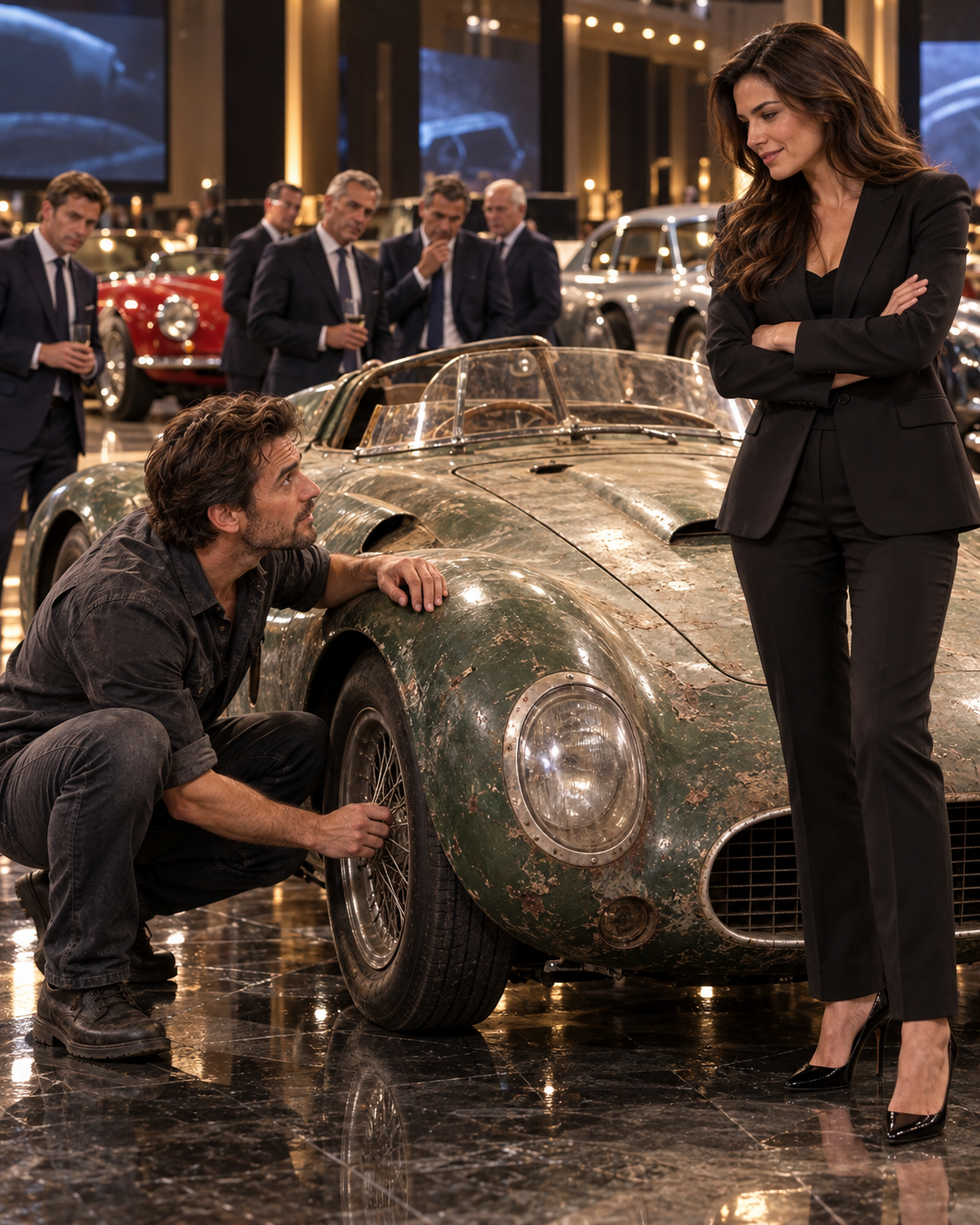
When he finally straightened up, his expression was serious.
“Whatever you do,” he told me, “don’t attempt to make this car look new. Original finishes, old repairs, and even seemingly insignificant components can tell us how it has survived. Altering them could destroy evidence and reduce its historical value.”
“So I should leave it alone?”
“Exactly. Clean only where necessary, preserve what remains, and let specialists document everything.”
He would not promise a final valuation that day, but he confirmed that the vehicle warranted further investigation and that the historical match was credible.
It was the first solid evidence that my instincts had not betrayed me.
I should have felt triumphant.
Instead, I felt frightened.
For years, I had lived with the knowledge that one broken appliance or unexpected medical bill could throw our entire household into chaos.
Now I was responsible for a discovery that might change our lives, and I had no idea how to protect it.
The following morning, the first private offer arrived.
A representative for an unnamed collector contacted the storage facility and requested a meeting.
He was polite, well-dressed, and careful never to reveal his client’s identity.
He offered $90,000 for the car, subject to a straightforward transfer.
I nearly laughed when I heard the number.
Ninety thousand dollars would have paid our overdue rent, cleared my credit cards, replaced my truck, and left enough money to give Julian a little breathing room.
It would have been the kind of relief I had imagined during hundreds of sleepless nights.
But Sarah had warned me that the first offer might be designed to exploit my desperation rather than reflect the car’s true value.
I asked for time.
The representative’s smile faded.
“You should understand that the vehicle could require extensive work,” he said. “Our client is assuming all the risk.”
“Then he can wait until the inspection is complete.”
He left without another word.
By evening, a second offer arrived.
This one was $160,000.
The third came from a different intermediary, who claimed his buyer could close immediately if I agreed to keep the discovery quiet.
He offered $225,000.
Then, on Sunday morning, a final proposal landed in my inbox.
Two hundred and seventy-five thousand dollars.
I read it three times.
The amount sat on the screen like a door opening into a different life.
I imagined paying the landlord and watching his expression change when I handed him a check.
I imagined taking Julian to a dentist without first calculating whether the appointment would interfere with the electric bill.
I imagined buying him a proper desk, a new winter coat, and the laptop he needed for school.
I imagined waking up without the familiar pressure in my chest.
Then I remembered the words Sarah had spoken.
“Don’t sell something irreplaceable for the price of scrap.”
Two hundred and seventy-five thousand dollars was not the price of scrap.
But it might still be a fraction of what we had found.
I called Sarah and told her about the offer.
She didn’t tell me to reject it.
Instead, she asked me one question.
“If you accept this today and discover next month that the car was worth ten times as much, will you be able to live with that decision?”
I stared at the number on my screen.
“I don’t know.”
“Then you aren’t ready to sell.”
She explained that a reputable auction house could evaluate the car, verify its documentation, and expose it to competing collectors and museums.
There were no guarantees.
The car might attract intense interest, or the final price might disappoint everyone.
Auction fees, taxes, legal ownership questions, and the costs of professional handling would all have to be addressed.
But a transparent process could give the vehicle the chance to find the right buyers rather than disappear into a private collection before its history was understood.
I contacted the storage facility’s owners and made sure the car’s ownership and auction rights were clarified in writing before moving forward.
I would not risk a fortune by pretending that finding something automatically made it mine.
Once the necessary arrangements were completed, the vehicle was consigned to a prestigious auction house specializing in significant historic automobiles.
Sarah helped assemble the historical documentation, and the specialist prepared a report describing the car’s condition without concealing its age or imperfections.
The auction house agreed to present it as an important potential survivor from the racing program, subject to the evidence gathered during authentication.
I signed the paperwork with a hand that shook more than I wanted anyone to notice.
That night, I sat beside Julian on the edge of his bed.
His room was small, with a window that rattled whenever the wind came from the north.
A stack of schoolbooks leaned against the wall, and his sneakers had begun separating at the soles.
“Are we going to be rich?” he asked.
I took a long breath.
“We might get some money from the car.”
“Enough to stop worrying?”
I looked at the boy who had learned to recognize financial trouble by the silence that followed an unexpected phone call.
“Enough to make some things easier,” I said. “But I don’t want you thinking money is the thing that makes a life good.”
He frowned.
“Then why does everyone act like it is?”
I had no easy answer.
So I told him about the years I had spent learning my trade, about the customers who paid me fairly and the ones who tried to cheat me, and about the old pickup my father had repaired so many times that it seemed to have become part of the family.
“My dad never had much money,” I said. “But when something broke, he looked at it carefully before deciding it couldn’t be saved.”
“Like the car?”
“Exactly like the car.”
Julian leaned against my shoulder.
“Do you think Grandpa would be proud?”
The question nearly undid me.
My father had died before Julian was old enough to remember him clearly, leaving behind a toolbox, a handful of photographs, and lessons I had not fully understood until I became a parent myself.
“Yes,” I whispered. “I think he would.”
The auction was scheduled for the seventh day after I first uncovered the vehicle.
During that week, the story spread through specialist circles.
Collectors requested documentation.
A museum representative contacted the auction house.
Researchers examined the historical photographs, and the authentication process continued as the team assembled a more complete picture of the car’s past.
The auction house kept its promises and made no guarantee about the final price.
I appreciated that honesty more than I could explain.
Meanwhile, Victor Sterling’s name surfaced again.
Someone had told him the car was receiving serious attention.
He contacted the facility’s owners and requested updated information, only to discover that the vehicle was no longer available for a private purchase.
According to one of the staff members, Sterling had been irritated.
I tried not to enjoy that detail.
He had every right to make an initial mistake about the car’s value.
What bothered me was the way he had made his judgment about me at the same time.
Still, I had no interest in proving him wrong simply for the satisfaction of watching him lose face.
I wanted the truth established, the car preserved, and my son given a future that did not depend on my body remaining strong enough to work twelve-hour days forever.
The night before the auction, I checked Julian’s schoolbag, laid out his clothes, and sat at the kitchen table with the final documentation.
I could barely sleep.
Every time I closed my eyes, I pictured the dusty grille beneath my fingers and wondered what would happen when the bidding began.
At dawn, Julian appeared in the kitchen wearing the cleanest shirt he owned.
“Do I have to dress up?” he asked.
“It’s a pretty important day.”
He looked down at his shirt.
“Then I want to look like I belong there.”
I swallowed hard.
“You belong anywhere you walk into, buddy.”
He smiled, but I noticed him straighten his shoulders.
For the first time in a long while, I saw him enter a room without trying to make himself smaller.
We left for the auction together.
Neither of us knew that, within a few hours, the number on the auction screen would become something neither of us could have imagined.
Part 3
The auction house stood in a converted industrial building on the other side of the city, its glass entrance reflecting the morning sunlight.
Inside, everything seemed designed to remind visitors that the objects around them belonged to another world.
Polished floors stretched beneath dramatic lighting.
Collectors in tailored suits spoke quietly beside museum representatives, while auction staff moved through the room with practiced precision.
I wore my best jacket, which had lost a button near the cuff, and kept checking that the envelope containing my documents was still in my pocket.
Julian walked beside me, taking everything in with wide eyes.
“Dad, are all these cars really worth that much?”
“Some are.”
“What about ours?”
I looked toward the display area.
The forgotten machine from the Greystone warehouse stood beneath the lights, its deep green bodywork cleaned enough to reveal its remarkable shape without erasing the evidence of its long neglect.
It looked different there.
Not because anyone had transformed it into something new, but because people were finally examining what had survived.
The old paint still showed its age.
Small imperfections remained visible.
The car did not need to pretend it had just left a factory.
A man from the auction house greeted us and explained that the documentation had attracted serious interest.
The specialist’s report and historical photographs had helped establish a credible connection to the racing program, though final conclusions would always depend on the evidence available.
Several prospective buyers had inspected the vehicle.
One was a museum representative.
Another had flown in from overseas.
Two private collectors had requested additional details about the chassis and its surviving components.
I listened, nodded, and tried not to read too much into any of it.
Then I saw Victor Sterling.
He stood near the back of the room with one of his assistants, wearing the same charcoal suit I remembered from the warehouse.
For a moment, our eyes met.
His expression changed almost imperceptibly.
He looked from me to the car, then back again.
I could not tell whether he felt embarrassed, angry, or simply surprised that a man he had dismissed was now standing among the people who might determine the vehicle’s future.
He approached us before the auction began.
“I hear you’ve created quite a stir,” he said.
“The historians and the auction house have done most of the work.”
Sterling glanced toward the display.
“Have they confirmed what it is?”
“They’ve established a credible historical match, and the authentication process has attracted serious interest.”
He studied me for a moment.
“You were more confident about it than I was.”
“I was curious,” I replied. “There’s a difference.”
His jaw tightened slightly, but before he could answer, the auctioneer took the stage and invited the audience to settle into their seats.
Sterling returned to the back of the room.
Julian sat beside me, his hands folded in his lap.
I could feel the nervous energy coming off him, and I rested a hand on his shoulder.
“Whatever happens,” I whispered, “we’re going home together, and we’ll still be us.”
He nodded.
Then the auctioneer introduced the car.
The opening bid was five hundred thousand dollars.
For a second, the room seemed to stop breathing.
I had imagined a strong result, perhaps even a million dollars if the right collectors became interested.
Half a million as the opening figure was already beyond anything I had allowed myself to expect.
A bidder near the front raised his paddle.
“Five hundred thousand.”
Another voice answered almost immediately.
“Six hundred thousand.”
The auctioneer acknowledged the bid.
“Six hundred thousand, thank you. Do I hear seven?”
A paddle rose on the opposite side of the room.
“Seven hundred thousand.”
Julian’s fingers closed around mine.
The bidding moved upward in clean, deliberate steps.
Eight hundred thousand.
Nine hundred thousand.
One million.
At the first million-dollar mark, a murmur passed through the audience.
The auctioneer smiled, but his voice remained controlled.
“One million dollars. Thank you. Do I hear one point two?”
A museum representative raised her paddle.
A private collector answered.
The numbers climbed.
One point four million.
One point six.
One point eight.
I stared at the screen, afraid that if I blinked, the figures would disappear.
Every new bid seemed to loosen a knot I had carried inside me for years, but the relief was mixed with a strange sadness.
I thought about all the nights I had sat awake calculating bills.
I thought about Julian pretending he wasn’t hungry.
I thought about the times I had promised him something small and then quietly postponed it because another expense had appeared.
I had not known that the car would lead us here.
I had only known that dismissing it without looking closer would have been wrong.
At two million dollars, Julian turned toward me.
“Dad,” he whispered, “is that real?”
I squeezed his hand.
“Yes, buddy.”
“Two million?”
“Yes.”
He looked at the auctioneer as though the man were speaking another language.
The bidding continued.
Two point two million.
Two point five.
Three million.
The museum representative made another offer, and a collector near the aisle immediately raised the price.
Three point five million.
Four million.
The atmosphere changed.
People who had been whispering fell silent, watching each new bid with the focused intensity of spectators at a championship final.
At four and a half million, one bidder withdrew.
Another held on.
Five million.
The auctioneer paused long enough for the room to feel the weight of the number.
“Five million dollars. Do I hear five and a half?”
A paddle rose near the back.
“Five and a half million.”
The auctioneer turned toward another bidder.
“Six million?”
A response came from the front row.
“Six million.”
My mouth had gone dry.
Julian leaned toward me.
“Are we millionaires now?”
“We haven’t sold anything until the hammer falls,” I whispered.
He nodded, repeating the lesson as if he were trying to hold himself steady.
The auctioneer called for six and a half million.
A bidder answered.
Seven million followed.
Then seven and a half.
The room had become so quiet that I could hear the faint scrape of a chair being moved several rows behind us.
At seven and a half million dollars, only two serious bidders remained.
One represented a private collector.
The other was the museum representative, who conferred briefly with a colleague before lifting her paddle again.
“Seven million, seven hundred and fifty thousand.”
The auctioneer turned to the remaining collector.
“Seven million, seven hundred and fifty thousand. Do I hear eight million?”
The man looked toward the stage.
For one terrible second, I thought he was finished.
Then his paddle rose.
“Eight million.”
A collective breath seemed to move through the room.
The auctioneer repeated the number.
“Eight million dollars.”
He looked toward the museum representative.
She glanced down at her notes, then slowly lowered her paddle.
The auctioneer counted the final seconds.
“Going once.”
My heart hammered against my ribs.
“Going twice.”
Julian’s hand was trembling in mine.
“Sold.”
The hammer struck the desk.
Eight million dollars.
For a moment, I couldn’t move.
The applause began around us, but the sound reached me as though I were underwater.
I stared at the car, at the auctioneer, at the screen displaying the final price.
Eight million dollars for the machine a billionaire had dismissed after five seconds.
Eight million dollars for the object I had nearly walked past because I needed to get home and put dinner on the table.
Eight million dollars because I had looked twice.
Julian stood so quickly that his chair scraped backward.
“Dad!”
He threw his arms around me.
I held him tightly, pressing my face against his hair as the room blurred.
I wasn’t crying because we had become wealthy.
I was crying because, for the first time in years, I could imagine a future without fear sitting beside us at the breakfast table.
The auction staff congratulated us, and Sarah Hayes found me a few minutes later.
She shook my hand warmly.
“You did the right thing by waiting.”
I looked at the woman who had encouraged me to seek the truth when an immediate fortune had been offered.
“I almost didn’t.”
“But you did.”
I thanked her, though the words felt far too small.
The final hammer price was not the amount that would land in my bank account.
Auction fees, contractual terms, applicable taxes, and other obligations would have to be settled, and the funds would not arrive instantly.
I made sure the paperwork was reviewed carefully before signing anything.
I had spent too many years worrying about money to start treating it carelessly simply because the numbers had grown larger.
Still, as Julian and I walked out into the afternoon sunlight, the world seemed different.
The same city traffic crawled along the streets.
The same delivery trucks rumbled past.
People hurried to work, carrying their own private burdens.
Nothing around us had changed.
Everything inside me had.
Over the following weeks, the auction house completed the necessary arrangements, and the proceeds were distributed according to the contract and applicable obligations.
When the money became available, I sat down with a qualified financial adviser and an accountant before making any major decisions.
We paid off the overdue rent, credit cards, and outstanding bills.
I cleared the debts that had followed me from one month into the next, and I made sure Julian’s medical and school needs were covered.
The first thing I bought for him was not a sports car, a gaming system, or an expensive watch.
It was a proper desk and a comfortable chair for his room, along with a good laptop for school.
He stared at them as if I had brought home something far more valuable.
“These are mine?”
“Every bit of them.”
He ran his hand across the desk.
Then he turned toward me and hugged me so tightly that I could barely breathe.
I had seen him pretend not to care about things he wanted because he was afraid of making me feel guilty.
Watching him enjoy something without checking my expression first was worth more than I could explain.
We bought a modest three-bedroom house in a quiet neighborhood with a small backyard and enough space for Julian to have a room of his own.
It wasn’t a mansion.
There were no marble staircases or elaborate gates, and the kitchen needed a little work.
But the roof was sound, the windows closed properly, and the front door locked without needing to be lifted by its handle.
I stood in the empty living room on the day we moved in, listening to the silence.
For years, I had thought of a home as something I was always one missed payment away from losing.
Now, for the first time, I could imagine building memories somewhere without wondering how long we would be allowed to stay.
We set aside money for Julian’s future education, established an emergency fund, and invested the remainder with professional guidance rather than chasing quick profits.
I kept working, too.
Not because I needed to accept every emergency call, but because I still liked solving problems with my hands.
The money gave me choices.
It did not change the kind of man I wanted to be.
A few months after the auction, Victor Sterling called me.
I almost let the phone ring out.
When I answered, his voice sounded different from the confident tone I remembered in the warehouse.
“Mr. Carter, I wanted to speak with you about the car.”
“All right.”
“I owe you an apology.”
I leaned back in my chair, surprised by the words.
He explained that he had judged the vehicle too quickly and had made an even greater mistake by assuming that my occupation meant I lacked the knowledge to recognize something important.
“I underestimated you,” he admitted. “I saw a dirty car and a handyman. I didn’t bother to look beyond either one.”
For a moment, I remembered the way his assistant had laughed.
I remembered Julian standing beside me, wondering why a stranger with so much money had felt the need to make his father feel small.
I could have used the call to humiliate Sterling in return.
Instead, I looked through the doorway at Julian, who was sitting at his new desk, concentrating on a school assignment.
“Mr. Sterling, you were wrong about the car,” I said. “But the bigger mistake was thinking that the first thing you see tells you everything you need to know.”
He was silent.
Then he said, “That’s fair.”
I didn’t tell him I forgave him.
Some things did not require a dramatic declaration to be put behind you.
We ended the call politely, and I returned to the kitchen, where the afternoon sunlight lay across the floor.
Julian appeared a few minutes later, carrying his science notebook.
“Was that the rich man?”
“Yes.”
“What did he want?”
“To apologize.”
Julian looked thoughtful.
“Did you tell him he was wrong?”
“I told him that looking carefully matters.”
He smiled.
“Like Grandpa said?”
I felt something warm and painful move through my chest.
“Exactly like Grandpa said.”
That evening, we sat together in the backyard while the sky faded from blue to orange.
The grass needed cutting, a loose board on the fence needed repairing, and the kitchen faucet still dripped every few minutes.
For the first time in years, those things felt like ordinary problems rather than warnings that our lives were about to collapse.
Julian leaned back in his chair and looked up at the first stars.
“Dad, do you ever think about what would have happened if you hadn’t found that number?”
“All the time.”
“What if you’d just listened to the rich man?”
I considered the question.
“I might have walked away from something extraordinary.”
He looked toward the house.
“Then I guess being curious is important.”
“It is,” I said. “But so is being patient enough to prove what you think you know.”
He nodded, absorbing the words in the serious way children sometimes do when they sense that a lesson is larger than the moment in which it is spoken.
I wanted him to remember the eight million dollars, of course.
I wanted him to remember that a forgotten machine could carry a history more valuable than anyone suspected.
But I wanted him to remember something else, too.
I wanted him to understand that the lesson had begun long before the auction room, when his father had been tired, broke, and tempted to accept the first easy answer.
The car hadn’t become valuable because I had believed in it.
It had become valuable because I had taken the time to investigate what was actually there.
And no amount of money could make that principle less important.
Years later, I would still remember the dusty warehouse, the smell of rust, and the cold canvas beneath my fingers.
I would remember Victor Sterling’s careless laugh, Sarah Hayes’s warning, and the hammer falling at eight million dollars.
But the moment I treasured most was not the auction.
It was a quiet evening in our new home, when Julian sat beside me at the kitchen table, studying a broken pocket watch he had found in a box of his grandfather’s old belongings.
He turned it over in his hands, examining the worn case and the tiny scratches around its edge.
“Do you think this is worth anything?”
I smiled.
“I don’t know yet.”
He reached for a small magnifying glass and leaned closer.
“Then let’s find out.”
I watched him work, and for a moment, I could almost see my father standing beside him, patient hands resting on the table, teaching the next generation to look beyond what the world had already decided was worthless.
We had gained a house, security, and a future that no longer seemed balanced on the edge of a missed payment.
But the greatest thing I had given my son was not the money.
It was the understanding that he never had to measure himself by someone else’s first impression, and that the world often hides its most extraordinary truths beneath surfaces people are too hurried, too proud, or too distracted to examine.
The forgotten race car had changed our lives because I refused to look away.
And whenever Julian asked me what I hoped he would remember about that strange week in Greystone City, I gave him the same answer.
“Look twice, buddy. The world doesn’t always reveal its real value the first time you see it.”