At a glittering charity gala in Washington, D.C., my sister laughed into a microphone and called my military career a glorified “library job,”
Part 2
General Pierce walked toward the stage without hurry, but the conversations around the ballroom faded as he approached.
He was not a man who needed to raise his voice to command attention.
His years in uniform had taught him how to stand still and let other people realize that he was waiting.
Olivia handed him the microphone with a strained smile.
“General, we’re in the middle of a foundation announcement.”
“I heard,” he said.
His gaze moved to the financial summary behind her.
“Which is why I thought I should speak before this becomes a matter of public misinformation.”
Marcus stepped forward.
“Sir, with respect, this is an internal governance issue.”
“Then I suggest you handle it with accurate records and appropriate procedures.”
The general turned toward me.
“Colonel Voss, may I?”
The ballroom went silent.
I felt the words land before anyone else seemed to understand them.
Colonel Voss.
Not Eleanor, the quiet sister.
Not the woman who organized appointments and handled paperwork.
Not the family embarrassment who was supposedly unable to explain her own career.
My actual rank.
My earned responsibility.
The title I had never used to impress anyone because I had spent years protecting information that did not belong to me alone.
Olivia stared at him.
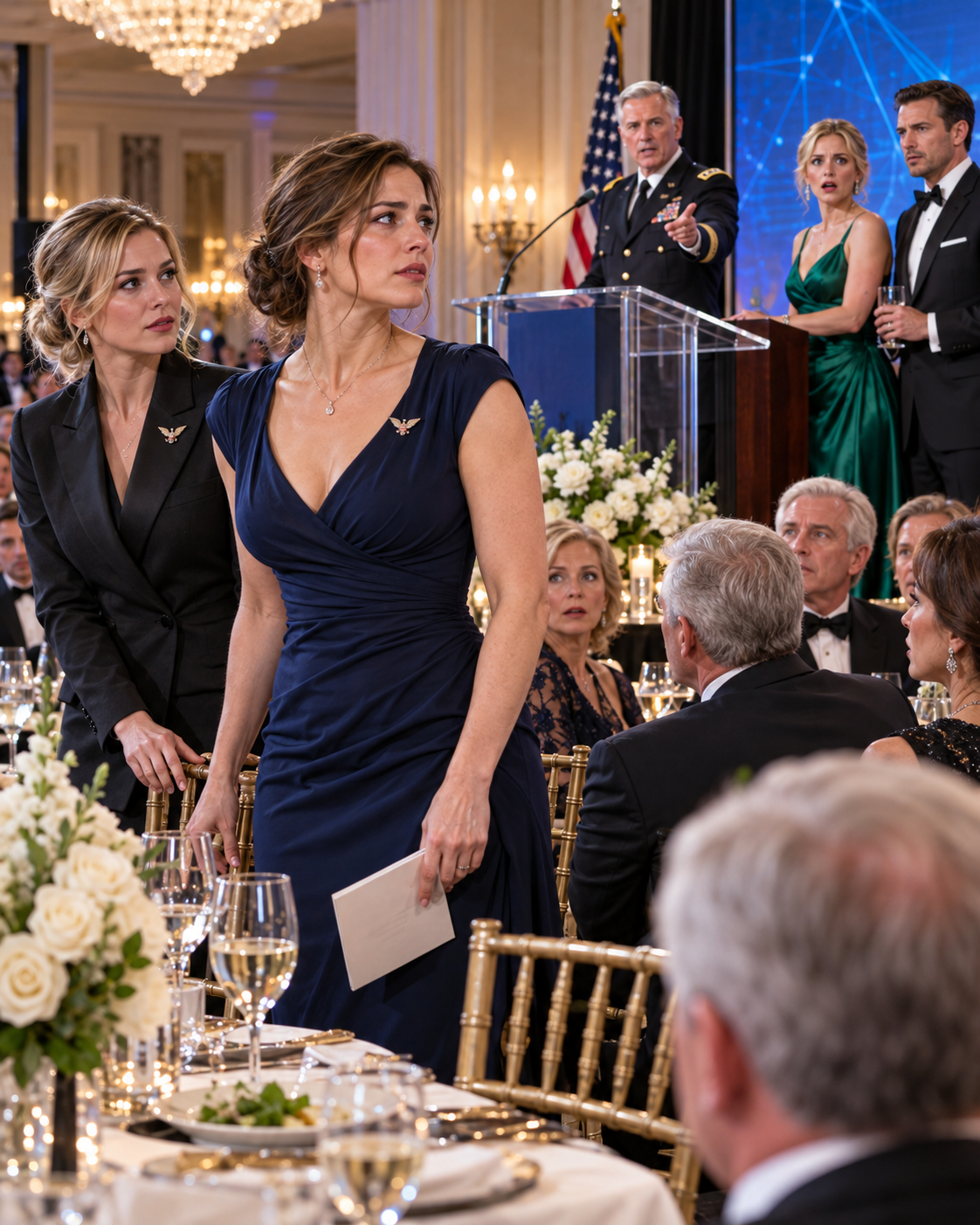
“Colonel?”
General Pierce faced the audience.
“Ladies and gentlemen, I apologize for interrupting the program. I was invited here as a private donor, and I intended to keep my remarks focused on the foundation’s mission. However, I have just heard a public description of Colonel Eleanor Voss’s military service that is materially inaccurate.”
He paused.
“Colonel Voss has led sensitive rescue and stabilization operations involving American personnel and partner forces in difficult overseas environments. Some of her assignments remain classified, and I will not discuss operational details here. What I can say is that her service record reflects responsibilities far beyond administrative support.”
A veteran at one of the nearby tables sat straighter.
Another guest lowered his champagne glass.
General Pierce continued.
“I have personally worked with teams whose success depended on the quality of her planning and judgment. She has earned the respect of senior officers and the trust of people whose lives were placed in her hands.”
He looked directly at Olivia and Marcus.
“Calling that a library job is not merely disrespectful. It is a false description of a career you do not understand.”
No one laughed.
I kept my hands folded in my lap, though I could feel my pulse beating against my fingertips.
I had never wanted a public revelation.
I had spent years keeping my work separate from my family because the people I served deserved privacy, and because I did not believe rank should be used as a weapon in personal disputes.
Yet there was something deeply painful about hearing the truth spoken aloud in the very room where my sister had tried to turn my life into a joke.
Not because I needed the guests to admire me.
Because I had once wanted my own family to ask who I had become.
Olivia gripped the edge of the lectern.
“I think there has been a misunderstanding,” she said. “Eleanor never told us she held that kind of position.”
General Pierce regarded her calmly.
“Colonel Voss is not obligated to disclose classified assignments at a family dinner.”
Marcus tried to recover his composure.
“Even so, military rank does not exempt anyone from financial scrutiny. If the foundation’s records are in question, they should be audited.”
“I agree,” I said.
Everyone turned toward me.
“An independent audit is appropriate. It should examine the complete records, including donor restrictions, reimbursements, program expenses, and the authorization of transfers.”
Olivia looked startled by my support.
I continued before she could interrupt.
“It should also distinguish between verified contributions, pledged contributions, and funds that were merely discussed. Those are not the same thing.”
The general’s expression tightened slightly.
He had evidently recognized that I was moving beyond the insult and toward the substance of the problem.
Marcus gave a humorless laugh.
“Are you suggesting we misrepresented the foundation’s finances?”
“I’m suggesting that the records should answer that question.”
I turned toward Rhea.
She placed a slim folder on the table in front of me.
Inside were copies of the foundation’s public donor acknowledgments, the correspondence I had retained, and the relevant financial summaries I had received in my capacity as an early contributor and adviser.
I had not brought the documents intending to expose anyone.
I had brought them because I had learned long ago that uncomfortable conversations became easier when the facts were organized.
Olivia saw the folder and went pale.
“Where did you get those?”
“From my own records and the documents the foundation provided to me.”
“You had no right to collect internal information.”
“These are records I was entitled to receive as a contributor and adviser. Any additional material can be obtained through the formal audit.”
Marcus leaned closer.
“Eleanor, you need to be very careful.”
I looked at him.
“I have been careful for a long time.”
The general stepped away from the microphone, allowing the event coordinator to display the relevant pages on the screen with my permission.
The first document was a donor acknowledgment listing a contribution under Olivia’s name that had actually originated from a family trust I had introduced to the foundation.
The money had been donated lawfully, and there was nothing improper about a donor receiving recognition for facilitating a gift.
The problem was that the public materials described Olivia as the personal source of the funds, rather than as the person who had helped secure them.
The second document showed a restricted donation intended for direct veteran housing support.
A substantial portion had later appeared under broad administrative and outreach expenses.
That categorization was not proof of wrongdoing by itself, but the supporting documentation was incomplete.
The third document was an email in which Marcus asked staff to classify a series of event-related expenses as program development costs before the quarterly donor report was finalized.
One message included a sentence that made the room grow colder.
“Keep the categories broad enough that the committee won’t start asking who approved the individual charges.”
Marcus stepped away from the screen.
“That email is being taken out of context.”
“Then the audit can establish the context,” I replied.
Olivia looked toward our parents.
My mother was staring at the documents with one hand pressed against her mouth.
My father seemed to be studying the tablecloth.
For the first time, they could not rescue Olivia by changing the subject.
The evidence was not a childhood story in which one daughter could be described as sensitive and the other as misunderstood.
It was a set of records that required professional scrutiny.
General Pierce returned to the microphone.
“I want to be clear about something,” he said. “Colonel Voss’s service record does not make her immune from questions, and no donor should be beyond review. But no person should be publicly accused by implication simply because someone wishes to control the narrative.”
He turned toward the foundation’s board members seated near the stage.
“I recommend that the board appoint an independent auditor, preserve all relevant records, and temporarily suspend any discretionary financial approvals that could compromise the review.”
A board member named Denise Harper stood.
“I support that recommendation.”
Another member nodded.
Marcus’s expression hardened.
“You cannot make governance decisions from a banquet stage.”
“No,” Denise replied. “The board will make those decisions through its proper procedures. But we can certainly stop pretending we haven’t heard what was said tonight.”
The event coordinator quietly removed the financial slides from the screen.
Olivia stood frozen behind the lectern.
I could see the calculation working behind her eyes.
She had expected me to become emotional, to protest the audit, or to reveal something about my service that would violate my obligations.
Any of those reactions could have been presented as evidence that I was unstable, secretive, or untrustworthy.
Instead, I had agreed to scrutiny and asked for the same standard to apply to everyone.
There was nowhere for her to place the story she had prepared.
Then General Pierce did something I had not expected.
He stepped away from the stage and came to stand beside my chair.
He did not salute me.
He did not turn the moment into a military ceremony.
He simply extended his hand.
“Colonel,” he said, “thank you for continuing to support the people who need this program.”
I stood and shook his hand.
“Thank you for being here, sir.”
The simple exchange seemed to affect the room more deeply than the revelation of my rank.
It was not an act of worship.
It was professional respect freely given.
I saw a young veteran near the back watching us, his expression thoughtful.
He had probably heard people like Marcus describe military service as though only the most visible acts of courage mattered.
I hoped he understood that leadership was often less dramatic than people imagined.
Sometimes it was the person who remained steady while everyone else tried to make the truth disappear.
The banquet did not end immediately.
The food remained on the tables, the musicians waited for instructions, and the guests began speaking in subdued clusters.
Some approached General Pierce to thank him for his service.
Others asked Denise Harper about the proposed audit.
A few came to me with awkward apologies for laughing at Olivia’s joke.
I accepted the sincere ones without making anyone perform remorse for an audience.
I was not interested in punishing strangers for failing to understand what my family had never bothered to learn.
Olivia finally approached me after the board members had begun conferring privately.
Her face was flushed, and her eyes were bright with anger.
“You humiliated me.”
I looked at her for a long moment.
“I didn’t tell you to call my service a joke.”
“You could have corrected me privately.”
“You made it public.”
She glanced toward the guests.
“You know how important this foundation is to me.”
“I know how important it is to the veterans who depend on it.”
“That isn’t fair.”
“Neither was what you did.”
For a moment, she looked like the sister I remembered from childhood, standing beside my bed after breaking something I had treasured and insisting that I was cruel for being upset.
Then the familiar expression hardened.
“You always have to make me look bad.”
I felt the old ache, but it no longer controlled my response.
“No, Olivia. I just stopped helping you make me look small.”
She stared at me as if she had never heard those words before.
Perhaps she hadn’t.
For most of our lives, I had softened every confrontation until she could walk away believing that nothing had really happened.
I had mistaken the absence of open conflict for peace.
Now I understood that peace purchased through permanent self-erasure was not peace at all.
Rhea appeared at my side.
“The car is ready whenever you are.”
I nodded.
Before leaving, I turned toward the board members.
“I will cooperate fully with the independent review. Please make sure the audit includes the original donor agreements and the restrictions attached to each contribution.”
Denise Harper nodded.
“We will.”
“And please ensure the veterans’ programs continue wherever possible during the review. They should not pay for the board’s failure to supervise its own finances.”
“We’ll protect essential services while the audit proceeds.”
That was the only assurance I needed.
As I walked toward the ballroom doors, I heard Marcus call my name.
“Eleanor, wait.”
I stopped, but I did not turn immediately.
When I finally faced him, his confidence had disappeared.
“You know we were trying to build something good,” he said.
“I hope you were.”
His eyes narrowed.
“What is that supposed to mean?”
“It means the purpose of an organization doesn’t excuse the way it is managed.”
He glanced toward the board members, then back at me.
“You could destroy everything Olivia has worked for.”
I held his gaze.
“If the foundation is doing good work, the audit will help prove it. If the records are wrong, the veterans deserve to know.”
He had no answer.
I left the ballroom with Rhea beside me, the sound of the orchestra fading behind us.
For the first time that evening, I felt my shoulders loosen.
The truth had not repaired my family.
It had simply stopped me from carrying their version of me any further.
Part 3
The independent audit began the following week.
I provided the documents I had retained, answered the auditors’ questions, and directed them to the original donor agreements and correspondence that could verify the source and intended use of the funds.
I did not speculate about anyone’s motives.
I did not tell the auditors what conclusions they should reach.
I gave them the records and allowed the process to do its work.
That discipline mattered because the truth was more complicated than a simple story about a good sister and a bad one.
Some of Olivia’s fundraising achievements were genuine.
She had persuaded several donors to support the foundation, organized successful events, and devoted considerable time to its public programs.
Marcus had helped expand the organization’s reach and had built relationships with businesses willing to sponsor veterans’ services.
Their contributions were real.
So were the questions raised by the accounts.
The audit identified inconsistent donor attribution, inadequate documentation for certain expenses, and weaknesses in the approval process for restricted funds.
It also found that some public materials had overstated Olivia’s direct financial contributions by failing to distinguish between money she personally donated and gifts she had helped facilitate.
Several expenses required repayment or reclassification, while other items were cleared after additional documentation was produced.
The review did not establish that every questioned expense had been improper, and I refused to describe it that way.
The foundation’s board implemented stronger financial controls, required independent review of restricted donations, and corrected the public donor records.
Marcus stepped down from his executive role while the board completed its governance changes.
Olivia resigned as fundraising chair, citing personal reasons.
Neither was publicly declared guilty of a crime, and I made no attempt to turn the findings into a spectacle.
I wanted the foundation to become worthy of the people it claimed to serve.
That was more important than watching my sister suffer.
Still, the aftermath hurt in ways I had not anticipated.
My parents called several times during the first month.
My mother asked whether I could persuade the board to let Olivia return.
My father said that families should protect one another from public embarrassment.
Neither asked whether I had been hurt by the banquet.
Neither asked why I had spent so many years hiding the details of my career from the people who supposedly knew me best.
They were worried about Olivia’s reputation.
They were worried about Marcus’s professional future.
They were worried that our family would become a subject of gossip among the people they wanted to impress.
I listened until my father said, “You could have handled this without making things so difficult.”
I closed my eyes.
There it was again.
The expectation that I would absorb the consequences so everyone else could remain comfortable.
“I didn’t create the problem,” I said. “I agreed to an audit. The records created the questions.”
“She’s your sister.”
“I know.”
“Then act like it.”
I looked out at the street below my apartment, where people hurried through the rain with their collars turned up against the wind.
“I have acted like her sister my entire life,” I said quietly. “I am no longer willing to act like I don’t exist.”
My mother began crying on the other end of the line.
For years, her tears would have made me retreat.
I would have apologized, promised to visit, and tried to restore the appearance of family harmony.
This time, I felt compassion for her without surrendering my judgment.
“I love you,” I said. “But I won’t pretend nothing happened just to make this easier.”
We ended the call without resolving anything.
For several weeks, the silence that followed felt heavier than I expected.
I had spent so much of my life believing that if I became patient enough, accomplished enough, or useful enough, my family would eventually recognize me.
When that hope finally began to fade, I grieved for more than the relationships themselves.
I grieved for the younger version of me who had believed she could earn unconditional love through perfect behavior.
I wished I could tell her that she did not have to become indispensable to deserve kindness.
She did not have to win a medal, lead a mission, or save a life to earn the right to be treated with respect.
She had deserved that respect before she had accomplished anything at all.
Rhea stayed close during those weeks.
She never told me that I should cut off my family, and she never insisted that I forgive them.
Instead, she invited me to walk with her along the river, brought dinner when I forgot to eat, and listened when I needed to speak about things I had spent years keeping to myself.
One evening, as we sat on a bench overlooking the water, she asked whether I regretted attending the banquet.
I thought about the moment Olivia raised the microphone and the laughter moved through the room.
I remembered my mother’s lowered eyes, Marcus’s warning smile, and the sudden silence when General Pierce addressed me by my rank.
“I regret that it happened,” I said. “I don’t regret that I stopped pretending it was acceptable.”
Rhea nodded.
“That sounds like a distinction worth keeping.”
“It is.”
She looked toward the water.
“People sometimes think strength means never being affected by what others do to you.”
I smiled faintly.
“I know. I’ve spent years trying to prove I was strong enough not to care.”
“And did it work?”
“No.”
We sat in silence for a while, watching the last light fade from the river.
Then I laughed softly.
It surprised me.
Not because anything was particularly funny, but because I could feel the tightness in my chest beginning to loosen.
For the first time in months, I was not preparing an explanation for my life.
I was simply living it.
Several weeks later, the foundation invited me to attend a small event marking the restoration of its veterans’ housing program.
The board had reorganized its financial oversight, appointed new leadership, and established a clearer process for tracking restricted contributions.
Denise Harper called personally to tell me that the program would continue.
“We’re grateful you insisted that the audit protect the services as well as examine the records,” she said. “It would have been easy for everyone to focus on the controversy and forget the people who needed us.”
“They should never have been forgotten.”
“I agree.”
She paused before adding, “I also wanted you to know that your original proposal is still guiding the program’s next phase.”
The words caught me off guard.
I had drafted that proposal years earlier, when the foundation was little more than a collection of ideas and a handful of people who wanted to help.
I had written about temporary housing, employment support, legal referrals, and the importance of treating veterans as people rebuilding their lives rather than symbols to be displayed at fundraising events.
Olivia had used parts of that proposal in her speeches, but I had never objected.
The mission had always mattered more to me than the credit.
Now, hearing that the program would continue because someone had finally examined the original work, I felt a quiet satisfaction I could not have obtained from any public apology.
I attended the event in a simple dark suit.
There were no grand introductions, no photographers waiting to capture my reaction, and no attempt to turn my military service into a dramatic performance.
A young veteran named Marcus Hill approached me after the presentation.
He had served overseas, returned home with a serious injury, and spent months struggling to find stable housing while waiting for employment support.
“I heard about the banquet,” he said awkwardly.
I raised an eyebrow.
“I hope you heard that the veterans’ program is still running.”
“I did. That’s why I’m here.”
He shifted his weight.
“I just wanted to say that I used to think people like me were supposed to be grateful for whatever help we got. If an organization had problems, I figured I shouldn’t complain because at least someone was trying.”
I listened carefully.
He continued, “But watching the board fix the program instead of shutting it down made me realize that asking people to do what they promised isn’t the same as being ungrateful.”
Something inside me softened.
“No,” I said. “It isn’t.”
He looked relieved.
“I think I needed to hear that.”
“You deserve honest help,” I told him. “Not perfect people. Just people willing to take responsibility for what they do.”
He thanked me and joined the others.
I watched him walk away, thinking about how often people were told to accept less because someone else had supposedly sacrificed so much to help them.
That was one of the most dangerous forms of charity.
It turned gratitude into silence and made accountability seem like betrayal.
The foundation had been created to help people regain their footing.
It could not fulfill that purpose if the people running it believed their good intentions placed them beyond scrutiny.
After the event, General Pierce found me near the exit.
He wore the same understated service pin he had worn at the banquet.
“I hope the attention hasn’t been too uncomfortable,” he said.
“Some of it has.”
“I apologize for revealing your rank in front of everyone without giving you much warning.”
I considered that.
“You were trying to correct something false.”
“I was. But your privacy matters, too.”
His acknowledgment meant more than I expected.
I had spent so much time protecting other people’s secrets that I sometimes forgot I was entitled to boundaries of my own.
“Thank you,” I said. “Next time, I’ll appreciate a warning.”
He smiled.
“Fair enough, Colonel.”
We shook hands.
Then he added, “For what it’s worth, the work you did overseas mattered. You don’t have to discuss it publicly for that to remain true.”
I watched him leave, carrying those words with me long after the event ended.
For years, I had told myself that I did not need my family to understand my service.
That was true in one sense.
My achievements did not become real only when someone praised them.
The people we had brought home were real.
The families who received their loved ones back were real.
The decisions made under pressure, the risks carried by the teams, and the lives protected through careful planning were real.
But it was also true that I had wanted my parents and my sister to know me.
Not to admire my rank or repeat my commendations, but to ask what mattered to me, what I had learned, and what it had cost to keep going.
I had wanted them to be curious about the person beneath the uniform.
That longing had never made me weak.
It had made me human.
Olivia contacted me two months after the banquet.
Her message was short.
“Can we talk? Just the two of us.”
I stared at it for a long time before agreeing to meet at a small café near the river.
She arrived without Marcus and without the polished smile she wore at public events.
For once, she looked tired.
“I don’t know where to begin,” she said.
“Begin with what you want to say.”
She wrapped both hands around her coffee cup.
“I was angry that people respected you for something I didn’t understand.”
I said nothing.
She looked up.
“Growing up, everyone said you were independent. They acted as though you didn’t need anything from us. I think I used that as an excuse not to ask what you needed.”
It was not a complete apology, but it was the first honest explanation she had ever offered me.
“I was jealous,” she continued. “You could walk into a room and say almost nothing, and people who had served with you trusted you with their lives. I worked so hard to be noticed, and I thought you were pretending not to care about being noticed at all.”
I studied her face.
“I wasn’t pretending not to care. I was trying not to make my work about me.”
“I know that now.”
She looked down at her hands.
“When I made the joke at the banquet, I thought everyone would laugh and move on. I didn’t expect General Pierce to speak, and I didn’t expect the records to become part of the conversation.”
I waited.
She took a breath.
“But I shouldn’t have needed any of that to understand that what I said was cruel.”
For the first time, I believed she understood at least part of what she had done.
I did not reach across the table to comfort her.
I did not tell her that everything was fine.
“It hurt,” I said. “Not because you failed to recognize my rank. Because you were comfortable humiliating me in front of strangers.”
Olivia’s eyes filled.
“I know.”
“And the audit wasn’t the problem. If the records needed to be reviewed, they needed to be reviewed. The problem was using an accusation as a weapon before you knew the facts.”
She nodded slowly.
“I understand.”
I wanted to believe that our relationship could become something different.
But I had learned that a sincere moment was not the same as lasting change.
“I am willing to see what happens next,” I told her. “I can’t promise that we’ll go back to the way we were.”
She wiped her eyes.
“Maybe we shouldn’t.”
That answer surprised me.
We finished our coffee and spoke about ordinary things for a few minutes.
It was not reconciliation in the dramatic sense.
There were no promises that everything would be forgotten, no declarations that family mattered more than anything else.
It was simply the first conversation in which neither of us tried to control the other person’s feelings.
When we parted, I felt neither triumphant nor defeated.
I felt cautious.
That was enough.
My parents took longer.
My mother eventually sent a letter acknowledging that she had often expected me to be the strong one because it made life easier for everyone else.
My father apologized for treating my independence as evidence that I needed less affection.
Their words did not erase the years behind them, but they opened a door I had stopped trying to force.
I began visiting them occasionally.
Sometimes we talked about my work in general terms.
Sometimes we discussed Olivia.
Sometimes we sat together without trying to solve anything.
I kept certain boundaries.
I no longer accepted jokes about my career, and I did not volunteer to repair every disagreement before anyone else had made an effort.
Love, I was learning, could survive honesty.
What it could not survive indefinitely was the demand that one person keep disappearing to preserve the comfort of everyone else.
A year after the banquet, I attended another veterans’ fundraiser.
The foundation was smaller, more transparent, and less interested in grand displays of generosity.
The financial reports were available to donors, the program restrictions were clearly documented, and the people receiving assistance had a voice in deciding what services they needed.
There were still problems to solve.
There always would be.
But the organization had begun to resemble the mission it claimed to serve.
I stood near the back of the room while a young woman spoke about moving from temporary housing into her first apartment.
She thanked the staff, the donors, and the volunteers who had helped her rebuild her life.
Then she said something that made me look up.
“For a long time, I thought needing help meant I had failed. Now I know that accepting help doesn’t mean giving up my right to make decisions about my own future.”
The room applauded.
I felt Rhea’s shoulder brush mine.
“Good program,” she whispered.
“Good people,” I replied.
Across the room, Olivia was speaking with a donor.
She glanced toward me and gave a small, uncertain smile.
I returned it.
There was still distance between us, and perhaps there always would be.
But the distance no longer felt like a judgment on my worth.
It was simply the space required for two people to learn how to meet each other honestly.
Later that evening, I stepped outside onto the hotel terrace.
The city lights stretched into the distance, and a cool breeze moved through the trees along the street.
I thought about the girl who had once carried her scholarship letter home, hoping her parents would understand how much it meant.
I thought about the young officer who had learned to lead without applause.
I thought about the colonel who had spent years protecting other people’s privacy while allowing her own family to define her by what they could see.
And I thought about the woman I was becoming.
I no longer needed a room full of people to stand when I entered.
I no longer needed Olivia to announce my achievements or Marcus to admit that he had been wrong.
I did not need to reveal every classified detail of my career to prove that my work had mattered.
The truth had existed long before the banquet microphone was switched on.
The lives we saved had never depended on my family’s approval.
The respect I had earned overseas had never depended on whether Olivia understood it.
And the person I was at home deserved the same dignity as the officer I had been in uniform.
Rhea joined me at the railing.
“Ready to go?”
I looked once more through the glass doors at the room full of people talking, laughing, and making plans for the year ahead.
“Yes,” I said.
As we walked toward the exit, I touched the small service pin attached to the inside of my evening bag.
I had carried it for years without displaying it, not because I was ashamed of my service, but because I wanted to remember that a person’s worth could not be reduced to a symbol.
That night had taught me something I should have learned much earlier.
I did not have to choose between humility and self-respect.
I could remain quiet without accepting humiliation.
I could love my family without allowing them to decide who I was.
And I could forgive someone without handing them the power to hurt me in exactly the same way again.
When I reached the car, I looked back at the hotel one final time.
For most of my life, I had waited for my family to see me clearly.
Now I understood that recognition was a gift, not a verdict.
Some people would learn to see me.
Others might never do so.
Neither outcome could change the life I had lived or the values I had carried through it.
I slid into the passenger seat, and Rhea started the engine.
The city moved past the windows in ribbons of gold and white.
I thought of the veterans who would receive housing assistance because the foundation had finally learned to account for its promises.
I thought of the people whose names I could never publicly share, but whose survival would always remain part of my story.
And I thought of the younger version of myself who had believed that being overlooked meant she had somehow failed to become important.
If I could speak to her now, I would tell her that she had never needed to become extraordinary to deserve love.
She had never needed to save a life to earn respect.
She had never needed to explain every silence to prove that she was present.
She had been enough before the uniform, before the rank, before the commendations, and before the room fell quiet.
The banquet had not made me a colonel.
The general had not given me my worth.
The audit had not made the truth real.
They had simply exposed what had been there all along.
I rested my head against the seat and watched the lights recede behind us.
For the first time, I was no longer waiting for someone else to tell my story correctly.
I knew who I was.
And I was finally willing to let that be enough.