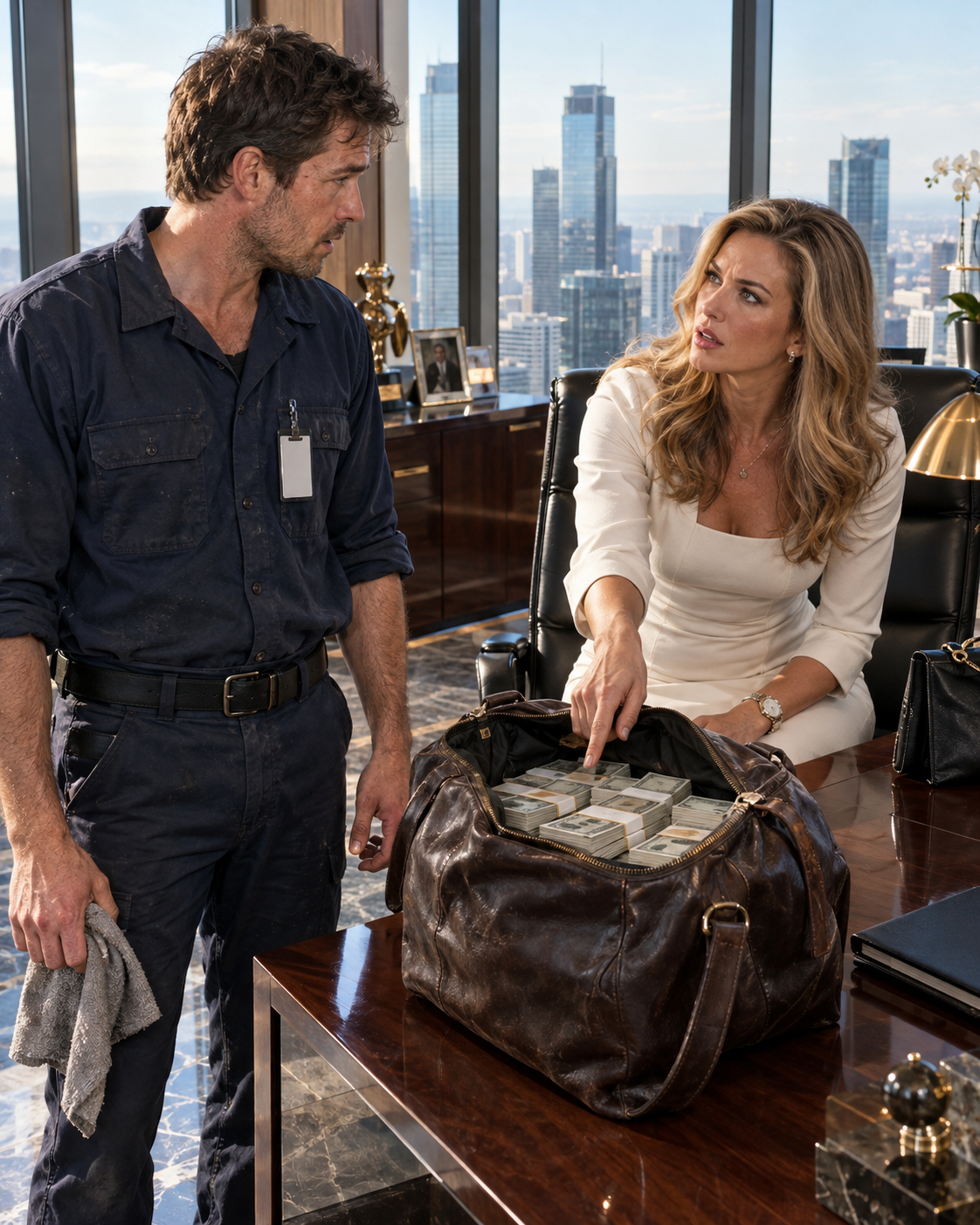
At 7:00 a.m. inside Adams Technologies, my CEO dropped a leather bag containing $100,000 onto her desk
For a moment, I forgot how to breathe.
My signature sat at the bottom of a document I had never seen before, beneath a transfer authorization for $18,500 from Adams Electrical Supply.
Across the table, Charles Whitman leaned back in his chair and folded his hands.
“Well,” he said, “perhaps Mr. Brooks would like to explain why his name appears on a suspicious financial record.”
Every executive turned toward me.
I felt the old, familiar sensation of standing in a room where everyone had already decided what kind of man I was.
Rachel didn’t look at me.
She was studying the document, her jaw set.
“Daniel, do you recognize this signature?”
“That’s my signature,” I answered. “But I never authorized that transfer.”
Charles gave a short, dismissive laugh.
“Convenient.”
I wanted to defend myself, but my mind had returned to nine years earlier, to a cold November evening at the electrical supply store and the brass key that Rachel had placed on the table.
Back then, I was twenty-seven, newly separated from Lily’s mother, and working whatever hours I could get to keep my daughter fed.
Rachel’s father, Thomas Adams, owned the little store where I handled inventory, deliveries, and repairs.
He wasn’t a rich man, but he treated people with a dignity that made you want to work harder for him.
One evening, a delivery truck broke down just before closing.
I stayed late to help Thomas move the remaining supplies into the warehouse, and afterward, he invited me into his office.
He was holding a small brass key on a faded leather ring.
“This opens the old records cabinet,” he said. “The one behind the workbench.”
I laughed.
“Why are you telling me that?”
“Because people forget where the truth lives when they get too comfortable with the paperwork.”
He told me he had discovered discrepancies in the store’s accounts and suspected someone was using the company to move money without his permission.
He didn’t accuse anyone by name.
Instead, he asked me to help him compare delivery receipts with the invoices stored in the cabinet.
I agreed.
For two nights, we checked records until the numbers began to make sense.
Several invoices listed electrical equipment that had never arrived, while payments had been approved as if the goods had been delivered.
The initials on the approvals belonged to a temporary financial consultant who had been helping with the store’s expansion.
Charles Whitman.
At the time, he was a young accountant hoping to build a career in corporate finance.
Thomas confronted him privately.
A week later, the consultant was gone, and Thomas told me the discrepancy had been resolved.
I never learned how.
Then Thomas suffered a sudden heart attack, and everything changed.
The store struggled without him, the family eventually sold the business, and I moved on to other jobs.
I kept the brass key because Thomas had told me to hold on to it until he asked for it back.
He never did.
For years, I carried it on my key ring without thinking much about it.
Now, sitting in Rachel Adams’s boardroom, I understood why she had shown me that photograph.
The past had not disappeared.
It had been waiting for someone to look closely enough.
“Mr. Whitman,” Rachel said, “would you like to explain why this transfer was processed through a temporary account you controlled?”
Charles’s expression remained composed.
“I’d be delighted. The transaction was reviewed by the store’s management. Mr. Brooks handled inventory and delivery records, so his signature is hardly surprising.”
“I was never responsible for financial transfers,” I said.
Charles turned toward me.
“Yet you recognize your signature.”
“Because I signed delivery forms. Someone could have copied it.”
Rachel raised one hand, silencing the room.
“We’ll establish what happened through records, not accusations.”
She placed another document on the table.
It showed a series of payments from the Adams Children’s Education Fund, a charity created to help employees cover school supplies, tutoring, and summer programs.
Over six months, more than $240,000 had disappeared through a chain of consulting payments and fabricated invoices.
The money had been approved under Charles’s department.
His face hardened.
“This is an internal accounting matter,” he said. “It has nothing to do with a janitor who found a bag of money.”
“You’re right about one thing,” Rachel replied. “The bag has nothing to do with the charity fund. That’s why I’m concerned that someone used it to launch a smear campaign against Daniel.”
Charles stood.
“This meeting is becoming absurd.”
“Then sit down and let us finish.”
The room went silent.
Rachel had inherited a company full of people who remembered her father as a warm, generous man, but many had mistaken her youth for weakness.
I watched her hold the room without raising her voice.
She turned to the company’s security director, who placed a printed report beside the financial records.
“The anonymous posts targeting Daniel originated from a device registered to an executive office,” Rachel said. “The account was created using credentials assigned to Mr. Whitman’s administrative assistant.”
Charles shook his head.
“That proves nothing. Someone could have used her computer.”
“That’s possible,” Rachel said. “Which is why we reviewed the access logs and the original message drafts.”
The security director opened a folder.
“The drafts were saved under Mr. Whitman’s account. Several contain references to Daniel’s financial history that were not available in the employee directory.”
My stomach tightened.
Someone had investigated my private life, searched for my vulnerabilities, and turned them into weapons.
All because I had refused to keep money that wasn’t mine.
Charles looked around the table, searching for a friendly face.
He found none.
“This is a witch hunt,” he said. “Rachel, you’re letting personal sentiment cloud your judgment. Your father made the same mistake when he allowed people like Brooks to get too close.”
Rachel went completely still.
“Don’t use my father to excuse what you’ve done.”
“I’m trying to protect the company.”
“Then explain the missing charity funds.”
Charles’s eyes flickered toward the financial records.
It was the first real crack in his composure.
Rachel reached into her folder and removed a small brass key on a faded leather ring.
My heart began to pound.
It was almost identical to the one I had carried for nine years.
“My father gave this key to Daniel,” she said. “He told me that if the old records ever became relevant again, I should ask Daniel what he remembered.”
Charles stared at it.
For the first time, he looked genuinely frightened.
Rachel turned to me.
“Daniel, do you still have the key?”
I reached into my pocket and pulled out the worn ring.
The brass had darkened with age, and the leather was cracked where my thumb had rubbed it over the years.
Rachel placed her key beside mine.
They were not identical.
Mine had a tiny stamped number near the teeth.
Hers had a narrow groove cut into the handle.
Together, they formed the two halves of a small mechanical lock.
“I found this in my father’s desk after he died,” she said. “I never understood why he kept it.”
I stared at the keys.
Thomas had never told me they belonged to a larger mechanism.
He had only said that the records cabinet held documents he wanted preserved.
“There’s something in the old store,” I whispered.
Rachel nodded.
“We believe the original accounting records may still exist.”
Charles pushed his chair back.
“This is ridiculous. That store was sold years ago. Whatever records existed should have been destroyed under the retention policy.”
“Should have been?” Rachel asked.
He realized his mistake a second too late.
The security director leaned forward.
“Mr. Whitman, how would you know whether those records were destroyed?”
Charles said nothing.
The meeting ended with his access suspended pending an independent investigation.
I left the boardroom with Rachel and Ray, the company’s financial auditor, following close behind.
My hands were still shaking.
“Why didn’t you tell me about the key earlier?” I asked Rachel.
“Because I didn’t know you had the other half,” she said. “My father kept a great deal of his work private. After he died, I found notes suggesting he had preserved evidence of the original fraud, but I couldn’t identify where.”
She looked at the key in my hand.
“I think he trusted you because you didn’t want anything from him.”
I shook my head.
“I wanted a lot from him. I wanted a better life for Lily. I wanted someone to tell me I wasn’t failing as a father.”
Rachel’s expression softened.
“He knew that. He used to say the most trustworthy people weren’t the ones who needed nothing. They were the ones who could admit what they needed without selling their principles to get it.”
The words stayed with me long after we left the building.
That afternoon, Rachel arranged for a lawyer to accompany us to the former electrical supply store.
The building stood on a quiet commercial street, its windows covered with dusty paper and an old sign barely visible above the entrance.
The new owner had turned the front section into a storage facility, but the back office remained untouched.
When I stepped inside, the smell of dust and old wood brought back a rush of memories so strong that I had to stop.
I could almost hear Thomas laughing behind his desk.
I could almost see him placing a paper cup of coffee beside the inventory sheets and telling me to stop apologizing for working hard.
Rachel stood beside me, looking at the empty shelves.
“I was twenty when my father died,” she said. “I thought I knew him because I knew his habits, his favorite books, the way he took his coffee. Then I inherited his business and discovered how much he had carried without telling me.”
“Maybe he didn’t want you to carry it too.”
“Maybe. But sometimes protecting someone by hiding the truth leaves them with a different kind of pain.”
She said it without accusation, and I wondered whether she was speaking about Thomas or herself.
Behind the workbench, we found a narrow cabinet built into the wall.
My key slid into the lock, but it wouldn’t turn.
Rachel tried hers.
The mechanism clicked.
Together, the keys released the cabinet’s inner latch.
Inside sat a metal cash box, several account ledgers, and a sealed envelope marked with Thomas’s handwriting.
Rachel picked up the envelope carefully.
“To be opened only when both keys are present.”
She broke the seal.
Inside was a letter addressed to Rachel and another addressed to me.
My fingers trembled as I opened mine.
Daniel,
If you’re reading this, it means someone has once again tried to make money more important than the people it is supposed to serve.
I am sorry I did not tell you everything when I had the chance.
You helped me discover that money had been diverted from the store’s accounts. You also helped me understand that the person responsible had access to records beyond the store itself.
I could not prove the full extent of the scheme before my health failed, but I preserved copies of the invoices, correspondence, and account numbers.
I feared that naming the wrong person without evidence would destroy an innocent life, so I locked the records away.
If my daughter ever needs them, help her find the truth.
Do not protect my reputation at the expense of someone else’s future.
I sat down on an old wooden crate.
For years, I had wondered why Thomas had entrusted me with a key to a cabinet that supposedly contained nothing important.
Now I understood.
He hadn’t been asking me to guard a secret.
He had been asking me to guard the truth until someone had the courage to face it.
The ledgers revealed a network of false invoices and payments routed through several consulting companies.
One company had been dissolved, but its original registration documents listed Charles Whitman as a controlling partner.
The same company had received payments from the education fund years later, after Charles had joined Adams Technologies.
Ray compared the old records with the modern transactions.
“The amounts are different,” he said, “but the structure is nearly identical. Fake invoices, approval chains, and payments to companies with no real operations.”
Rachel looked at the letter from her father.
“He never stopped,” she whispered.
The evidence was compelling, but Rachel insisted on following every legal step.
The company notified independent counsel, preserved the documents, and referred the suspected financial misconduct to the appropriate authorities.
Charles was not publicly declared guilty before the investigation concluded.
His access remained suspended, and the company cooperated with investigators who traced the transactions through bank records and vendor contracts.
During the following weeks, the pressure became unbearable.
Employees whispered when I passed.
Some believed I had helped Rachel build a case against Charles in exchange for a promotion.
Others thought I had deliberately kept the old records hidden until the right moment.
I wanted to explain everything, but Rachel advised me to let the evidence speak.
“People who have already chosen a story about you won’t always listen to the truth,” she told me. “Don’t spend your life begging them to change their minds.”
At home, Lily noticed the strain.
One evening, she found me sitting at the kitchen table with the old brass key beside my unpaid bills.
“Is that the key to a treasure chest?” she asked.
I smiled weakly.
“Something like that.”
“Are we going to be rich?”
The question hurt because I knew what she really wanted.
She wanted to stop hearing me tell her that we couldn’t afford something.
She wanted to attend the science program.
She wanted to invite friends over without worrying that our apartment was too small.
“No, sweetheart,” I said, pulling her onto my lap. “But we might be able to make things better.”
She studied my face.
“Did you do something bad?”
“No.”
“Then why do you look scared?”
I pressed my cheek against her hair.
“Because sometimes doing the right thing is hard, even when you know it’s right.”
She considered that for a moment.
“Then maybe you need someone to remind you.”
She took my hand and squeezed it with all the strength her small fingers could manage.
I cried after she went to bed.
Not because I was afraid of losing my job, but because I had spent so much time trying to shield her from hardship that I had forgotten she was already learning what courage looked like by watching me.
Three weeks later, the independent investigation uncovered evidence that Charles had directed payments to shell companies and had used confidential employee information to discredit people who questioned his decisions.
The investigators also found that the anonymous smear campaign had been coordinated through accounts controlled by his office.
Charles resigned before the company’s board could complete its disciplinary proceedings, and the financial findings were referred for further legal action.
The education fund began recovering part of the missing money through frozen payments and the return of funds from vendors connected to the investigation.
Rachel announced an independent review of all charitable accounts and created a protected reporting process for employees who suspected wrongdoing.
She also asked the board to approve a new version of the facilities management development program.
The program would provide paid training, professional certifications, and a pathway into operations leadership for employees whose potential had been overlooked because of their job titles.
I was invited to interview again.
This time, I entered the room without my cleaning cart, wearing the only suit I owned.
It was slightly too large in the shoulders, but Lily had helped me polish my shoes until she could see her reflection in them.
Rachel sat across from me with two other managers.
She asked about budgets, maintenance schedules, safety procedures, and conflict resolution.
I answered honestly, including the things I still needed to learn.
When she asked why I wanted the position, I thought about the years I had spent cleaning offices after everyone else went home.
“I know what this building looks like when people stop paying attention,” I said. “I know which doors don’t close properly, which lights flicker, and which problems get ignored because the people responsible never have to see them. I want to help run a place where the people doing the essential work aren’t invisible.”
One of the managers nodded.
Rachel asked one final question.
“What would you do if someone above you ordered you to ignore a problem because fixing it would make the company look bad?”
I thought of Thomas, of Walt-like stubbornness in my own heart, and of the leather bag that had changed my life.
“I would document what I found, report it through the right channels, and keep pushing until someone addressed it. I’d also make sure I understood the risk before acting, because good intentions don’t excuse reckless decisions.”
Rachel held my gaze for a long moment.
Then she smiled.
“That’s the answer I was hoping for.”
I was accepted into the program.
My first assignment was to shadow the facilities director and help design a system for tracking repairs, vendor contracts, and safety complaints.
The work was difficult, but I loved it.
For the first time in years, I could imagine a future that wasn’t simply another month of trying to keep the lights on.
When I told Lily about the opportunity, she threw both arms around my neck.
“Does this mean I can go to science camp?”
I held her close.
“If we plan carefully, yes.”
She squealed so loudly that our neighbor knocked on the wall.
That summer, Lily attended the program.
On the morning I dropped her off, she wore a backpack almost as large as her torso and carried a notebook covered in drawings of planets and rockets.
Before she ran inside, she turned back.
“Daddy, are you proud of me?”
I knelt and straightened the strap on her shoulder.
“More than you know.”
She grinned.
“I’m proud of you too.”
Then she disappeared through the doors, leaving me standing in the sunlight with tears in my eyes.
I had spent years believing that being a good father meant making sure Lily never saw how difficult life could be.
But she had seen it all along.
She had watched me work when I was exhausted, choose honesty when money was scarce, and keep trying when the future looked smaller than our hopes.
What mattered wasn’t that I had hidden every hardship from her.
What mattered was that I had shown her hardship did not have to decide who she became.
Months later, Rachel invited me to her office.
The old photograph of her father still stood on her desk, but beside it was a framed copy of the restored accounting report and a small brass key.
“I wanted you to have this,” she said, handing me a letter.
It was a formal acknowledgment of Thomas’s efforts to preserve the original records and of my role in bringing the evidence forward.
For the first time, the company recognized the man who had tried to protect it long before anyone thought to protect him.
I read the letter twice.
“I wish he could have seen this.”
Rachel looked at the photograph.
“So do I.”
We stood in silence, two people who had inherited different pieces of the same man’s unfinished work.
Then she said, “My father believed a company was only as honest as the people it was willing to listen to.”
I thought of the security guards, the cleaners, the warehouse staff, and the people who noticed problems long before they reached an executive’s desk.
“Maybe that’s what we should build,” I said. “A place where telling the truth doesn’t depend on how important your title is.”
Rachel nodded.
“Then let’s build it.”
I still kept my old janitor’s uniform in the back of my closet.
Not because I expected to need it again, but because I never wanted to forget the man who wore it while wondering whether he could afford his daughter’s dreams.
The leather bag had contained enough money to change my circumstances overnight, but returning it had changed something deeper.
It had forced powerful people to reveal what they valued, and it had reminded me that integrity was not a guarantee of an easy life.
Sometimes doing the right thing costs you comfort, reputation, and the approval of people who were never willing to see you clearly.
Sometimes the reward arrives slowly, through evidence, patience, and the courage to keep standing when others try to push you down.
And sometimes the most important thing you leave your child isn’t money, a title, or a perfect future.
It’s the knowledge that they can face the world without having to become someone they cannot respect.
I thought the story ended there.
Then, one rainy evening, Rachel called me into her office and closed the door.
She placed a new envelope on the desk.
Inside was a letter written by her father shortly before his death, one that had not been included in the old records.
The first line read, “Rachel, if Daniel has finally found the truth, there is one more thing you need to know about the money.”
I looked up at her.
She had gone pale.
Because the letter didn’t explain where the missing money had gone.
It explained why Thomas had never reported the final transfer.
And the name written beside that transfer belonged to someone neither of us had suspected.</WritingBlock