At 4:17 p.m. on a crowded American airbase, my wing commander called me a “USELESS CUSTODIAN” in front of an entire flight crew
Part 2
The first missile warning became a continuous scream.
I did not look at Danny.
I could hear him working through the emergency checklist, his voice steady despite the fear pressing against every word.
“Hydraulics normal. Fuel balance normal. No structural warnings.”
“Keep reading.”
“Cabin secure. Communications active. Defensive systems standing by.”
I glanced at the tactical display.
The enemy fighters had split into two groups, one pressing from behind while the other moved to cut off our escape.
They were confident.
That was their first mistake.
They saw a large tanker, a lumbering machine full of fuel, and assumed its size made it predictable.
They did not know how many hours I had spent studying energy, closure rates, and the consequences of turning too hard at the wrong speed.
They did not know that I had once flown an aircraft designed to survive fights in which a fraction of a second could decide everything.
And they certainly did not know how badly I wanted to forget that I knew those things.
“Control, six-two,” I said. “We have eight hostile fighters. Request immediate fighter support.”
The reply came through in broken fragments.
“Support is launching. Maintain communication. Assistance inbound.”
Inbound.
A comforting word when help was minutes away.
A useless word when a missile was already looking for you.
I watched the lead fighter shift into position behind us.
Its pilot was waiting for a predictable turn, a familiar defensive move, something he could anticipate and punish.
I refused to give him one.
Instead, I adjusted our course and altitude carefully, making use of the aircraft’s permitted operating limits and the thin layer of cloud below us.
The tanker shuddered as I changed our flight path.
Danny gripped his console.
“That wasn’t in the briefing.”
“No,” I replied. “It wasn’t.”
The first missile warning intensified.
I initiated a hard defensive maneuver within the aircraft’s limits, using the available space and our changing geometry to disrupt the attacker’s solution.
The tanker protested through its frame.
A moment later, the warning faded.
I did not celebrate.
The missile had missed, but the fighter behind it was already moving to establish another firing position.
The enemy pilots were learning.
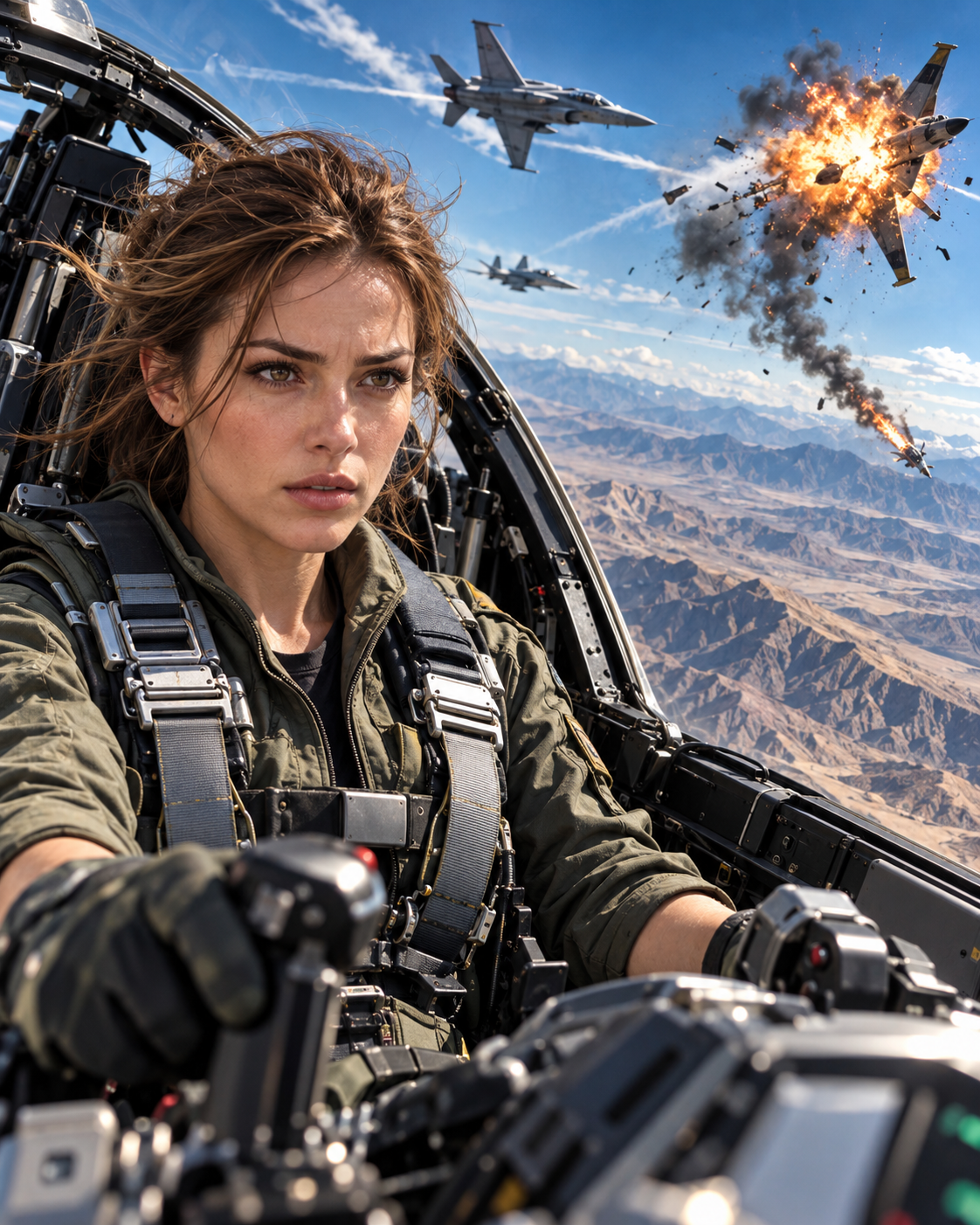
So was I.
They expected an aircraft that would hold steady, obey the rules of a normal refueling route, and continue broadcasting its intentions through every movement.
Instead, they encountered a pilot who understood that the most important advantage in a fight was sometimes the ability to make the other person misunderstand what would happen next.
“Daniel,” Danny said quietly, “you’ve done this before.”
It was not a question.
I swallowed.
“Yes.”
“Fighters?”
“Yes.”
He stared at me for half a second, then returned to his instruments.
“Okay. Then tell me what you need.”
That was all.
No accusation.
No demand for an explanation.
Just trust.
It nearly broke me.
Another fighter rushed toward our rear quarter.
I saw its approach and felt the old instinct rise, sharp and immediate, like a door opening inside a house I had sealed shut.
I adjusted our path to deny the attacker the easy angle it wanted.
The fighter overshot its intended position, forcing its pilot to maneuver again.
It was a small advantage, nothing more.
But in the sky, small advantages could become the difference between another breath and none at all.
The aircraft behind us pulled away, then returned from a different direction.
The enemy formation tightened.
Their leader transmitted again.
“American tanker, cease evasive action. You are making this situation more dangerous.”
I almost laughed.
They had brought eight fighters to threaten an unarmed aircraft, and now they were offended that we refused to cooperate.
“That’s rich,” Danny muttered.
For one brief second, I felt the shadow of Michael’s old grin.
Then the memory vanished, leaving the familiar ache behind.
I forced my attention back to the present.
Our fuel load had become another concern.
The tanker was carrying far more than it needed for a quiet return, and every violent movement placed additional strain on an aircraft never intended to be thrown around like a fighter.
I could not keep pushing indefinitely.
We had to survive long enough for help to arrive.
The enemy knew it.
They began alternating their approaches, forcing us to react while the others positioned themselves for a cleaner shot.
A warning flashed across the panel.
Then another.
Danny’s voice tightened.
“Multiple threats.”
“I see them.”
“How many?”
“Too many.”
I heard myself say it, and hated how familiar the words sounded.
Five years earlier, I had said almost exactly the same thing while Michael’s aircraft disappeared from my display.
My breathing began to shorten.
The cockpit seemed to shrink around me.
For a heartbeat, I was back over the strait, hearing his voice break through the static.
“Break right! Danny, break right!”
Except it had been Michael then, and the name I had called was my own.
The memory tried to pull me under.
I gripped the controls until my knuckles hurt.
Not again.
Not with Danny sitting behind me.
Not while another family waited for someone to come home.
I leaned forward and concentrated on the instruments, separating the immediate facts from the ghosts in my head.
The aircraft was damaged but controllable.
Our communications remained active.
The enemy had not yet achieved a stable firing solution.
And I still had options.
“Control, six-two. We need those fighters now.”
“Six-two, support is inbound. Maintain your position as best you can.”
As best you can.
I had heard those words before, too.
They were the language of people who understood the danger but could not reach you in time.
I looked through the windshield.
The horizon was bright and merciless.
Then I noticed a new problem.
One enemy fighter had begun moving away from the main group, apparently preparing to approach from a position that would force us toward the others.
The maneuver was deliberate.
For the first time, I felt genuine respect for the man trying to kill us.
He was not reckless.
He was thinking.
That made him more dangerous than the rest.
I could not outturn his aircraft.
I could not outrun the entire formation.
And I could not simply point the tanker toward home and hope they lost interest.
So I changed the question.
I stopped asking how to beat eight fighters at their own game.
I began asking how to keep eight pilots from working together.
I watched their spacing, their timing, and the way they responded to one another’s movements.
Their leader trusted the formation.
Their formation depended on predictable separation.
And their confidence depended on the assumption that we would continue behaving like a frightened transport crew.
I could not make our aircraft a fighter.
But I could make it a problem they had not prepared to solve.
“Danny, I need you to keep the radio clear unless something changes.”
“Copy.”
“And if we lose communications, follow the emergency procedures. Don’t improvise.”
He paused.
“You’re planning something.”
“I’m planning to get us home.”
It was not the whole truth.
But it was the only part that mattered.
The next few minutes became a blur of warnings, abrupt changes in the aircraft’s attitude, and enemy fighters repeatedly adjusting their positions.
I used the tanker carefully, never forgetting that its wings carried an enormous burden of fuel and that the airframe had limits I could not afford to ignore.
The enemy kept expecting a clean, predictable response.
I gave them uncertainty.
One attacker broke off to avoid closing too quickly.
Another had to alter course to keep from crowding its own wingman.
Their formation began to stretch.
The opening was small.
But I saw it.
And then, from the corner of my display, a new symbol appeared.
Two friendly aircraft were approaching at high speed.
Danny saw them a moment later.
“Please tell me those are ours.”
“They’re ours.”
“Thank God.”
I wanted to feel relief.
Instead, I felt a terrible urgency.
We had survived this long, but the enemy still had weapons, and our aircraft was becoming harder to control with every passing minute.
The two friendly fighters identified themselves as American F/A-18 Super Hornets.
Their arrival changed the atmosphere immediately.
The enemy formation hesitated.
For the first time since the ambush began, its pilots had to consider the possibility that they were no longer the most dangerous aircraft in the sky.
The lead hostile fighter transmitted a final warning.
“American tanker, you are interfering with a military operation. Comply immediately.”
I looked at the damaged warning panel, then at the approaching American fighters.
I was too tired to be angry.
“Control,” I said, “we have friendly support in sight. Our aircraft is damaged, and we need a safe route home.”
The response came almost instantly.
“Six-two, your escort is taking the threat. You are cleared to withdraw.”
Danny let out a breath that sounded as if it had been trapped inside him for an hour.
“That’s it, right?”
I watched the enemy fighters begin to turn away.
“Not yet.”
Because one of them was still coming toward us.
And this time, he was coming alone.
Part 3
The lone fighter approached from behind, its nose steady and its movements deliberate.
The other enemy aircraft were turning away from the incoming Super Hornets, but this pilot seemed unwilling to abandon the engagement without one final attempt.
His position was dangerous.
Ours was worse.
A warning flashed across the panel, followed by a series of alerts that told me the aircraft was no longer in the condition I had been pretending it was.
Danny read the indicators aloud.
“Engine parameters are fluctuating. We’re getting a temperature warning.”
I kept my voice level.
“Monitor it.”
“Daniel, that’s not a minor warning.”
“I know.”
The hostile fighter closed the distance.
I could see its shape through the rear-facing camera feed, a dark speck growing larger against the blue.
For one moment, the cockpit seemed to fall silent.
Then I heard Michael’s voice again, clear as if he were sitting beside me.
“Try not to make me look good out there, Mercer.”
My throat tightened.
I had spent five years believing that surviving him meant carrying his death like a debt I could never repay.
Now, with Danny behind me and the tanker shaking around us, I finally understood how cruel that belief had been.
Michael had not moved to protect me because he wanted me to spend the rest of my life punishing myself.
He had done it because he wanted me to live.
I could honor him by bringing Danny home.
Nothing more was required.
I made one final controlled adjustment to our flight path, keeping within the aircraft’s limits as the Super Hornets moved to intercept the remaining threat.
The hostile fighter changed course.
Its pilot had finally realized that the tanker he had dismissed as helpless was no longer isolated.
A moment later, the American fighters moved between us and the enemy.
Their presence transformed the encounter.
The lone attacker abandoned his approach and turned away.
The remaining hostile aircraft followed, withdrawing into the distance until their shapes disappeared against the haze.
No one cheered.
Danny did not laugh.
I did not feel victorious.
I felt the strange, hollow exhaustion that comes after a person has spent every ounce of himself trying not to die.
“Control,” I said, “tanker six-two. Hostile aircraft withdrawing. We are returning to base with significant damage.”
The controller answered with our recovery instructions and confirmed that emergency crews were standing by.
Then the engine warning sounded again.
This time, it did not stop.
I glanced at the instruments.
One engine was operating outside its normal parameters.
The other remained functional, but the aircraft was carrying damage we could not fully assess in flight.
Danny’s face had gone pale.
“Can we make it?”
I studied the panel, the remaining indications, and the route home.
There was no room for bravado.
“I believe we can.”
He nodded once.
“Then let’s go home.”
Those four words carried more courage than anything I had heard during the engagement.
We began our return.
Every minute seemed longer than the one before it.
The damaged aircraft responded sluggishly, and I had to concentrate on the simplest tasks as if I were learning to fly all over again.
My hands no longer shook.
Fear had not disappeared.
It had simply become useful.
I monitored the aircraft, communicated with air traffic control, and followed the recovery procedures while Danny handled the checklists.
Neither of us spoke about what had happened.
There would be time for that later.
If there was a later.
When the runway finally appeared beneath us, the setting sun had turned the horizon a deep, bruised orange.
Emergency vehicles lined the edges of the field.
Fire crews waited near the approach end.
The runway lights seemed impossibly bright.
I brought the tanker down carefully, keeping the approach stable despite the damage.
The landing gear struck the runway with a heavy, jarring impact.
The aircraft bounced once.
I corrected.
It settled.
For several seconds, we rolled forward without speaking.
Then the aircraft slowed enough for me to guide it toward the designated stopping area.
I shut down the systems according to the emergency checklist.
The engine noise faded.
Silence filled the cockpit.
Danny removed his headset and looked at me.
His eyes were wet.
“You’re going to have to tell me who you really are.”
I stared through the windshield at the emergency crews approaching the aircraft.
For the first time in five years, I did not feel the need to hide.
“I’m the same guy who’s been flying beside you all this time.”
Danny shook his head.
“No. You’re the same guy. But now I know what you’ve been carrying.”
I looked down at my hands.
They were finally still.
When we climbed out, the base was waiting.
Word had spread before the fire crews finished their inspection.
Pilots, maintainers, intelligence officers, and senior commanders had gathered beyond the safety line.
Some looked relieved.
Others looked confused.
A few stared at the damaged tanker with the stunned expression of people who had just watched the impossible become a fact.
Colonel Hayes stood near the edge of the crowd.
His clipboard was gone.
He approached me slowly, his eyes moving from the scorched fuselage to my face.
“Mercer,” he said, “I want a full account of what happened up there.”
“Yes, sir.”
He glanced toward Danny, who had climbed down behind me.
“Your boom operator says you recognized the enemy’s tactics before anyone else did.”
I said nothing.
Hayes studied me more closely.
“Where did you learn to fly like that?”
The question hung between us.
For years, I had feared this moment.
I had imagined judgment, accusations, and the reopening of wounds I had barely managed to close.
But standing on that runway, with the smell of burned metal in the air and the memory of Michael still fresh in my mind, I realized that secrecy had become another kind of prison.
“I used to fly F-15Es, sir.”
Hayes went still.
One of the fighter pilots behind him lowered his sunglasses.
Another stopped talking.
Hayes’s voice dropped.
“How long?”
“Five years before I transferred to tankers.”
“Why wasn’t that included in your squadron’s operational background?”
“It was in my service record. I never discussed it.”
“Why?”
I looked past him at the aircraft.
“Because I lost my wingman during a hostile engagement, sir. I survived, and he didn’t. After that, I couldn’t stand being in a fighter cockpit.”
For the first time since I had known him, Colonel Hayes had no immediate answer.
His expression changed, not dramatically, but enough for me to see the man beneath the rank.
“I’m sorry,” he said.
Two simple words.
They did not bring Michael back.
They did not undo five years of guilt.
But they were the first words anyone in authority had offered me that did not attempt to turn my loss into a line in an official report.
Hayes looked at the damaged tanker again.
“Those pilots were right about one thing,” he said quietly. “You were flying an aircraft that wasn’t built for that fight.”
“Yes, sir.”
“And you still brought your crew home.”
I thought about that.
“No, sir. We brought each other home.”
Danny looked away, rubbing a hand across his face.
Hayes nodded.
Then he did something I had never expected.
He turned toward the assembled aircrew and addressed them.
“Nobody on this base is going to call this man a custodian as an insult again.”
His gaze settled on the fighter pilots who had laughed earlier.
“If you want to understand what happened today, study the report when it becomes available. If you want to understand the man who brought that aircraft home, listen to him when he is ready to speak.”
He turned back to me.
“Mercer, I want you to help us build something. A survival and threat-response curriculum for our tanker and transport crews. Not a fantasy about turning support aircraft into fighters. A serious program about recognizing danger, protecting the crew, managing an emergency, and knowing how to survive long enough for help to arrive.”
For the first time in years, someone was asking me to use my past instead of bury it.
I looked at the runway.
Then I thought of Michael.
“Yes, sir,” I said. “I’ll help.”
The investigation lasted months.
The damage to the aircraft was extensive, and the intelligence review raised difficult questions about the hostile formation, its intentions, and the circumstances that had allowed it to approach us.
I gave my account repeatedly.
Some details were reconstructed from recordings and flight data.
Others could only be explained by the decisions Danny and I had made under pressure.
I was careful not to turn our survival into a legend.
The tanker had not become a fighter.
It had not been invincible.
We had been frightened, outnumbered, and operating an aircraft with serious limitations.
We survived because we kept thinking, worked together, followed the procedures that mattered, and adapted when the situation demanded it.
The arrival of the Super Hornets had been decisive.
Without them, I could not honestly claim that we would have survived.
I made sure that fact remained in every version of the report.
The training program that followed was not built around heroic maneuvers or impossible promises.
It focused on threat recognition, disciplined communication, crew coordination, emergency decision-making, and the hard truth that a support aircraft must never be mistaken for a harmless one simply because it carries no guns.
We practiced how to recognize when a routine mission was becoming dangerous.
We taught crews how to manage fear without allowing it to silence them.
We studied historical encounters, examined the consequences of delayed decisions, and reminded every aircrew that survival depended on preparation long before the first warning sounded.
Danny became one of the program’s strongest instructors.
He was especially good at teaching crews how to speak honestly under pressure.
“You don’t have to pretend you’re not scared,” he would tell them. “You just have to keep communicating while you’re scared.”
That sentence became part of the curriculum.
So did another.
“An unarmed aircraft is not a helpless crew.”
I never told the students that they could defeat eight fighters.
I told them that they deserved training that respected the danger they might face.
There was a difference.
Months later, after the program’s first major review, Colonel Hayes called me into his office.
On his desk lay a photograph of our damaged tanker returning to the runway, its fuselage streaked with soot and one engine still running.
Beside it was a second photograph.
It showed Michael and me standing beside our F-15Es years earlier, both of us smiling beneath the desert sun.
Hayes had obtained it from my old squadron records.
“I thought you might want this,” he said.
I picked it up carefully.
Michael’s grin was exactly as I remembered it.
For a moment, I was unable to speak.
Hayes sat back.
“I spent years thinking a good pilot was someone who could win a fight,” he said. “I think I was wrong about that.”
I looked at the photograph.
“Winning matters, sir.”
“Of course.”
He paused.
“But bringing people home matters more.”
I placed the photograph inside my folder and thanked him.
That evening, I took it to the memorial wall near the base chapel.
Michael’s name was engraved among the names of other aircrew who had never returned.
I stood there for a long time, listening to the wind move through the trees.
I told him about Danny.
I told him about the tanker, the warning lights, and the moment I had finally stopped letting the past decide who I was allowed to become.
Then I admitted the truth I had never been able to say aloud.
“I thought surviving you meant I had to suffer forever.”
The words sounded small in the open air.
“I was wrong, Mike.”
I touched the edge of the photograph.
“You saved my life because you trusted me to do something with it. I think I’m finally starting to understand.”
Nothing answered.
The sky remained silent.
But for the first time, the silence did not feel like an accusation.
A year after the ambush, I was standing beside a training aircraft when a young transport pilot approached me.
He was nervous, barely out of flight school, and wearing the unmistakable expression of someone afraid that asking a question might expose how little he knew.
“Sir, can I ask you something?”
“Of course.”
“Is it true that you used to fly fighters?”
I smiled.
“Yes.”
He hesitated.
“Then why did you become a tanker pilot?”
I looked across the flight line.
Fuel trucks moved between hangars.
Ground crews worked beneath open panels.
Pilots climbed into aircraft that would carry supplies, equipment, and people whose names would never appear in headlines.
For years, I had mistaken quiet work for a quiet life.
I had thought the absence of danger meant the absence of purpose.
I had been wrong about that, too.
“Because I needed to learn how to live again,” I told him. “And because someone has to make sure the people out there have the fuel they need to get home.”
He nodded slowly.
Then he asked the question I had been waiting years to hear, though I had never known it.
“Does that make you less of a pilot?”
I looked him in the eye.
“No.”
The answer came easily.
“It makes you a different kind of pilot. And whatever aircraft you’re flying, never confuse being unarmed with being unprepared.”
He thanked me and walked away.
I watched him go, then turned toward the tanker waiting on the ramp.
Its engines were quiet.
Its wings cast long shadows across the concrete.
To anyone passing by, it looked like an ordinary machine built for an ordinary job.
I knew better now.
It carried fuel, yes.
It carried crews, cargo, and the quiet responsibility of keeping other aircraft in the sky.
But it also carried something that could not be measured in gallons or pounds.
It carried the work of people who showed up every day without expecting applause.
People who prepared for dangers they hoped never to face.
People who understood that courage did not always arrive with weapons blazing or a heroic speech.
Sometimes courage looked like two tired airmen strapped into a damaged aircraft, trusting each other enough to keep moving.
Sometimes it looked like a man finally forgiving himself for surviving.
And sometimes it looked like a pilot everyone called Custodian, standing beneath the wide American sky, no longer ashamed of the life he had chosen or the life he had lost.
I still fly tankers.
I still check my instruments twice, listen carefully to my crew, and return to base without expecting anyone to notice.
Some of the younger pilots still call me Custodian, but now they say it with a different kind of respect.
I don’t mind the name anymore.
A custodian protects what others take for granted.
And after everything I lost, everything I learned, and everything Danny and I survived, I finally understood that there was no shame in being the man who helped bring everyone else home.