At 35,000 feet over the Atlantic, a flight attendant pointed at me in front of 311 terrified passengers and called me a lunatic
Part 2
The door closed behind Megan, leaving Donald staring at me through the narrow cockpit gap.
“That folder,” I said.
He hesitated.
“What’s in it?”
His face tightened.
“Maintenance records.”
“For this aircraft?”
He nodded.
“I was auditing the fleet.”
“Did you know about the engine?”
“I knew there had been vibration reports.”
“How many?”
He looked down.
“Enough.”
The word settled inside the cockpit like smoke.
I wanted to tear him apart for keeping quiet, but the aircraft lurched again and the altimeter began unwinding faster than my anger could rise.
“Save it,” I told him.
He understood.
He closed the cockpit door and went back to the cabin.
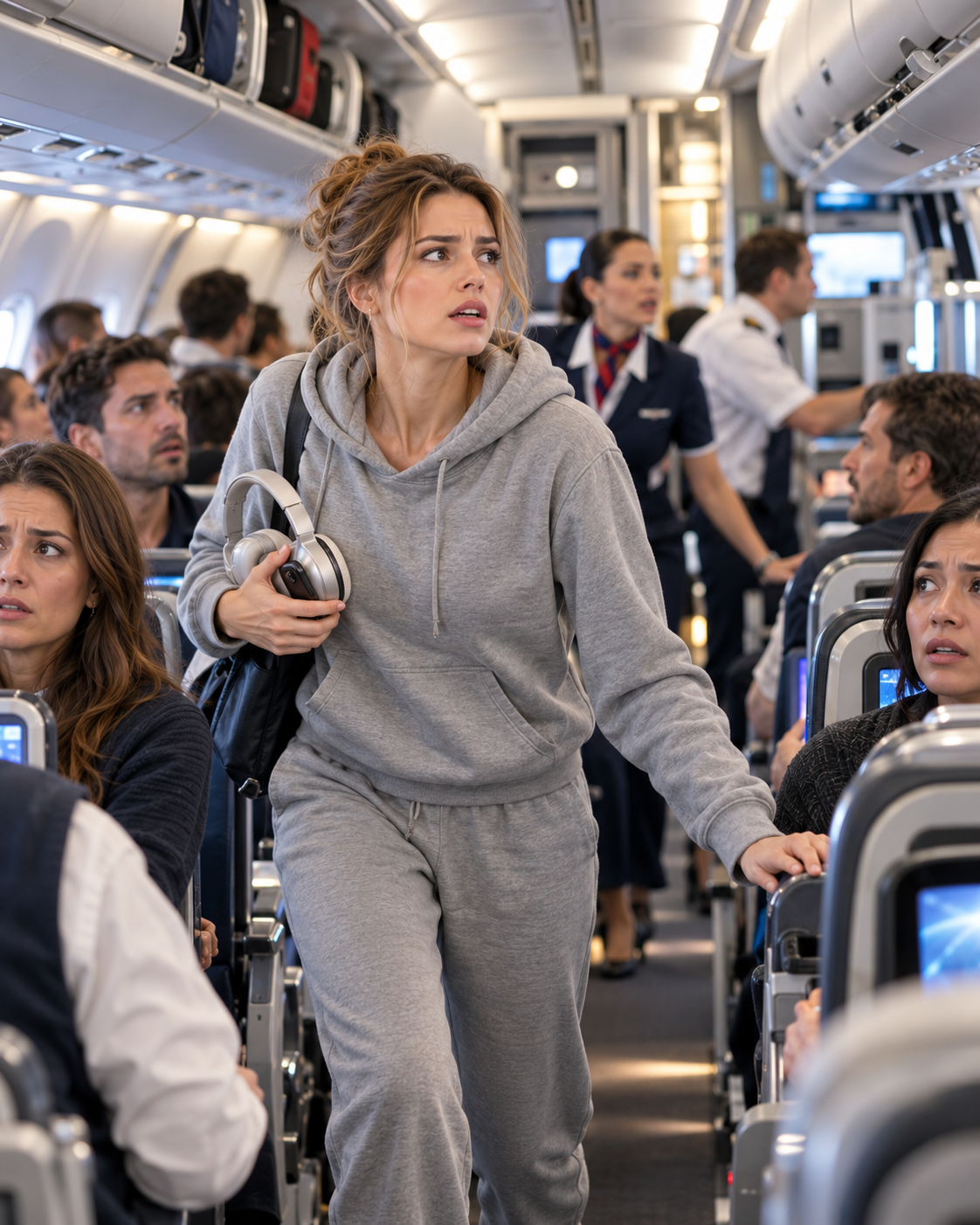
I had more immediate problems.
The right side of the aircraft was fighting me with a force I could feel through my shoulders.
Every rudder input demanded more strength.
Every correction had to be made before the airplane answered, because the airplane no longer responded like a machine built for passengers.
It responded like something wounded.
Shannon Control kept talking to me in a calm voice that seemed impossibly normal.
“United 482, confirm heading for Keflavik.”
“Direct Keflavik.”
“Descend when ready.”
“I’m already descending.”
I watched the fuel estimate drop.
The leak was winning.
The surviving engine was healthy enough to keep us moving, but not healthy enough to carry us all the way the way I wanted.
That was when my training stopped being about aircraft systems and became about energy.
Fight the drag.
Protect airspeed.
Trade altitude for survival.
I reduced thrust on the good engine and pushed the nose down.
The aircraft accelerated through the turbulence, then dropped toward the black Atlantic like a stone that had remembered it had wings.
Megan came forward again.
“There’s smoke from the right side.”
“Any fire?”
“No.”
“Keep passengers seated.”
“Major…”
I looked at her.
She swallowed.
“Do you think we’ll make it?”
I wanted to lie.
I couldn’t.
“We’re going to give ourselves every chance.”
She nodded and disappeared.
The trim system suddenly kicked.
The nose rose sharply.
I countered with force, but the control pressure kept changing in violent pulses.
“Come on,” I whispered.
The trim moved again.
I knew what could happen if it ran away.
The aircraft could pitch beyond recovery before I had enough time to react.
I reached for the stabilizer controls and disconnected the system.
An alarm screamed.
Then another.
For a few seconds I had nothing but the yoke, the rudder pedals, and the mechanical feel of cables transmitting every demand directly into the structure.
My forearms began to burn.
My shoulders shook.
I had never been so tired while being so awake.
The cockpit windows were filling with gray.
I could no longer see the ocean.
Only storm.
“United 482, weather at Keflavik is deteriorating,” Shannon said.
“How bad?”
“Visibility near minimums. Crosswinds sixty knots, gusting higher.”
Megan heard the transmission and whispered a curse.
I didn’t answer.
I was doing arithmetic in my head.
Altitude.
Fuel.
Speed.
Distance.
The numbers kept shrinking.
I thought about Hailey drawing pictures for me.
She always drew airplanes with absurdly large wings and tiny windows because she said, “You need room to come home.”
I almost laughed.
Instead, I felt tears press against my eyes.
I blinked them away.
Then Donald’s voice came through the cockpit door.
“Major.”
I turned.
He held the red folder.
“I need you to know something.”
“Not now.”
“You need to know.”
He stepped closer.
“The right engine had repeated compressor vibration warnings for weeks.”
I stared at him.
“Why wasn’t it grounded?”
His jaw tightened.
“Because the reports were reclassified as intermittent.”
“By whom?”
He looked away.
“Senior maintenance management.”
“And you?”
“I found out three days ago.”
The words hit harder than turbulence.
“You knew and still got on this airplane?”
“I was taking the records to New York.”
I looked at the folder.
For one terrible second I imagined Hailey learning that her father had died because a man had decided a schedule mattered more than a warning.
Then the aircraft dropped three hundred feet.
Donald grabbed the frame.
I pointed toward the cabin.
“Go.”
He obeyed.
I turned back to the instruments.
There was no room left for rage.
Keflavik appeared on the navigation display like a small, fragile promise.
We had to reach it without wasting another pound of fuel.
I began the descent.
The storm swallowed us.
The surviving engine was cut to the power setting I needed for the steep glide.
The airplane shook violently.
Every second, our speed became a negotiation between gravity and control.
“United 482, you’re cleared for the approach.”
I answered, “Copy.”
My palms were slick.
The runway was still invisible.
Then lightning flashed far away, and for half a heartbeat I saw Iceland beneath us.
Black earth.
White snow.
No second chance.
I brought the nose around.
The aircraft entered the final descent with the crosswind hitting us like a giant invisible hand.
The right main landing gear came down.
I waited for the confirmation.
Nothing.
“Gear indication?” Shannon asked.
“Right main is unsafe.”
There was silence.
Then, softly, “Understood.”
I stared at the red light.
At this point, every pilot’s nightmare had become my reality.
A damaged engine.
Hydraulic failure.
A fuel leak.
A manual flight control system.
A blizzard.
A sixty-knot crosswind.
And one stubborn wheel that refused to lock.
I lowered the gear again.
Nothing.
I raised it.
Nothing.
The runway was getting closer.
My altitude was bleeding away.
The snow outside was so thick it erased the horizon completely.
I had two choices.
Go around with fuel we didn’t have.
Or force the aircraft onto the runway with one main gear uncertain.
I heard Hailey’s voice inside my head.
“Daddy, don’t be scared.”
I whispered back, “I’m trying.”
The radar altimeter called out one hundred feet.
I looked at the runway lights.
They jumped sideways in the wind.
I aligned the jet as best I could.
Thirty seconds later, the right gear was still not locked.
I knew what I had to do.
The next move would either save us or kill everyone on board.
At one hundred and fifty feet, I deliberately increased the slip.
I kicked full rudder and lowered one wing into the crosswind.
The entire 777 yawed violently.
The freezing air hammered the exposed landing gear.
The fuselage screamed as it fought the angle.
For a heartbeat, nothing happened.
Then I felt a brutal metallic jolt through the rudder pedals.
The right main gear snapped downward.
A green light appeared.
Locked.
I almost shouted.
There was no time.
The runway was beneath us.
I crabbed the aircraft to nearly forty-five degrees against the wind, holding the nose away from the runway while the fuselage pointed toward it.
Snow blasted across the windshield.
The lights came faster.
Twenty feet.
Ten.
Five.
I kicked the rudder.
The nose straightened.
The wheels hit.
The left main gear slammed down first.
Then the right.
The impact tore through the cabin.
Tires exploded almost immediately.
The aircraft shuddered and began sliding.
I could not use asymmetric reverse thrust without making the damaged side worse.
So I stood on the brakes.
The pedal pressure felt useless.
The steering tiller fought back.
The runway vanished under a sheet of blowing snow.
The jet drifted toward the edge.
Five hundred feet.
Three hundred.
One hundred.
I saw darkness beyond the lights.
Then rock.
Then ocean.
The aircraft struck something beneath the fuselage and bounced.
I fought the tiller with both hands.
Fifty feet from the cliff, the nose finally came straight.
The 777 screamed once more, shuddered, and stopped.
For several seconds I could hear nothing.
Not the wind.
Not the alarms.
Not my own breathing.
I looked at the instruments.
The aircraft was still.
We were alive.
I closed my eyes.
“Thank you,” I whispered.
Then the cabin erupted.
Part 3
I shut down the remaining systems one by one because the cockpit had become a maze of alarms, dead indicators, and hot wires.
The oxygen mask hung against my cheek until I finally pulled it away and heard the raw silence that came after nine hours of fear.
I opened the cockpit door.
The cabin was dim, filled with drifting smoke and the frozen breath of three hundred people trying to understand why they were still alive.
Nobody spoke at first.
Megan stood in the aisle with tears running down her face.
Kevin Vance had been stabilized by a passenger with medical training, and Captain Foster was breathing after an off-duty surgeon controlled the bleeding.
Then someone began clapping.
One person.
Then five.
Then dozens.
Within seconds, all 312 survivors were on their feet.
They were applauding so loudly that the broken cabin seemed to vibrate with it.
Some were crying.
Some were laughing.
One man simply stood with both hands over his face.
Megan reached me first.
“You brought us back.”
I shook my head.
“We all did.”
She hugged me anyway.
I had no words left for the gratitude in that cabin.
I had flown combat missions.
I had landed damaged aircraft before.
But nothing had ever felt like looking into three hundred faces and realizing every one of them had quietly placed a piece of their life in your hands.
Outside, Icelandic rescue crews moved through the snow with flashing lights, and paramedics climbed aboard as if they had been summoned from another world.
When Donald stepped off the aircraft, he was carrying the red folder.
He handed it to the lead investigator.
“These are the maintenance records,” he said.
The investigator opened them under the aircraft’s floodlights.
Donald looked at me.
“I should have spoken sooner.”
I believed him.
I also knew that believing him would not undo what almost happened.
The next morning, photographs of the ruined engine were everywhere.
News crews waited at the terminal.
Reporters called me a hero.
Someone had already used the phrase “miracle landing.”
An official told me that commendations were being prepared.
A network producer wanted an interview.
A senior officer from the Air Force shook my hand and said, “Major, you’re going to be remembered for this.”
I thanked him.
Then I walked away.
Because all I could remember was a seven-year-old girl standing somewhere inside JFK Airport.
Hailey didn’t care about the engine.
She didn’t care about the wind.
She didn’t care about the 777’s tires exploding fifty feet from a cliff.
She cared that I had promised to come home.
My flight to New York was rebooked with the surviving passengers, and when we finally reached JFK a day later, the terminal was packed.
Camera flashes exploded.
People shouted my name.
Someone started a chant.
I barely heard any of it.
Then I saw her.
Hailey was standing beside my mother, wearing the yellow jacket I had zipped around her the last morning before deployment.
She had grown since I left.
Seven years old, and somehow taller than the child I remembered.
Her eyes found mine.
She dropped the stuffed rabbit.
“Daddy?”
That one word broke everything I had held together.
I dropped to my knees in the middle of the arrivals terminal and pulled her into my arms.
She slammed against my chest so hard I almost fell backward.
“I knew you’d come back,” she whispered.
I buried my face in her hair.
I could smell the strawberry shampoo she had used as a toddler, and suddenly I was no longer the pilot of a crippled 777.
I was just a father who had been given one more chance.
“Did you miss me?” she asked.
“Every second.”
She pulled back and studied my face.
“Are you staying this time?”
I looked at her for a long moment.
There were cameras behind her.
There were officers waiting nearby.
There were reporters with microphones and questions about Iceland, the landing, the explosion, the records, and the man who had somehow taken control of a passenger jet after both professional pilots were incapacitated.
But none of that mattered.
“I am,” I told her.
“Promise?”
“I promise.”
She wrapped both arms around my neck.
That was the moment I finally understood what the nine months had been trying to teach me.
A pilot can measure altitude.
A pilot can calculate fuel, airspeed, drag, wind, and distance.
A pilot can look death in the face and still choose the next control input.
But there are some things no instrument can measure.
The weight of a child’s trust.
The sound of your name in the mouth of someone who thought you would never leave her again.
The unbearable beauty of simply being home.
Later, I would learn that the maintenance records triggered investigations, hearings, suspensions, and lawsuits.
I would learn that people who had buried warnings would spend years explaining why they had done it.
I would hear my name attached to awards I never expected and headlines I never asked for.
But none of those things followed me into Hailey’s bedroom that night.
She had fallen asleep holding my sleeve.
I sat beside her until sunrise, afraid that if I let go, the whole world might disappear again.
On the nightstand was a drawing she had made before I returned.
It showed an airplane above a blue ocean, with two stick figures waiting on the ground.
Above them she had written four crooked words.
“Come home, Daddy. Please.”
I touched the paper and understood something I had forgotten at 35,000 feet over the Atlantic.
Sometimes surviving is not about defeating death.
Sometimes it is simply being given the chance to keep the promise you made to the person waiting for you.
And after everything that happened, every medal, every headline, every standing ovation became smaller than the one truth I carried home from Iceland.
The greatest landing of my life was not the runway at Keflavik.
It was the moment I finally landed back in my daughter’s arms.