At 3:12 a.m., Dr. Harold Finch humiliated me in front of a hallway full of dying patients, ordering me to “stay in my lane”
Part 2
The first patient I marked was the teenage boy who had arrived gasping for air.
He could not have been older than seventeen.
His name was Eli Brooks, according to the paramedic’s report, and he had been working beside his father at the docks when the explosion threw him against a steel railing.
His lips were turning blue.
His chest rose unevenly, and the veins in his neck stood out beneath his soot-covered skin.
Dr. Chen crouched beside him, checking the monitor.
“His oxygen saturation is dropping. I can’t get a reliable breath sound on the left.”
I leaned close enough to hear the boy trying to speak.
“Hey, Eli. Stay with me.”
His eyes moved toward mine.
“Dad?”
“We’re looking for him,” I said, squeezing his hand. “You keep fighting for me, all right?”
He tried to nod.
Kevin looked at me, his expression suddenly terrified.
“Could be a tension pneumothorax.”
“That’s my concern.”
He swallowed.
“I’ve assisted with one, but I’ve never done it independently.”
“You’re not alone. I’ll guide you, and we’ll follow the emergency protocol.”
His hands trembled as he prepared the necessary equipment.
I kept my voice calm, guiding him through the assessment and the emergency decompression procedure within his training and the hospital’s protocol.
“Focus on the landmarks. Don’t rush because you’re frightened. Be precise because he needs you to be.”
Kevin drew a breath and proceeded.
For a second, nothing changed.
Then the trapped air escaped, and Eli’s chest began to rise more effectively.
The monitor numbers slowly improved.
Kevin stared at the boy as if he had just watched the world rearrange itself.
“Oh, my God.”
“Keep monitoring him,” I said. “We aren’t finished.”
Eli’s fingers tightened around mine.
His eyes were still frightened, but now there was air moving in and out of his lungs.
I gave his hand one final squeeze before moving to the next stretcher.
Behind us, a nurse whispered, “How did she know?”
I heard her.
I simply didn’t answer.
The triage system spread across the emergency department, crude but effective.
We used clear priority numbers to communicate urgency, with immediate threats to life at the front of the line, patients who could safely wait under close observation next, and those whose injuries were less severe directed toward appropriate treatment areas.
The numbers did not replace clinical judgment.
They made it possible for every team to act on the same judgment without losing precious minutes arguing about who had arrived first.
I assigned tasks, reassessed patients, and moved between the treatment bays, checking pulses and breathing, asking for vital signs, and listening for changes in the voices of the people around me.
“Room two needs a surgeon now.”
“Get the blood bank on the phone again.”
“Don’t send that patient upstairs until someone confirms the elevator is safe.”
“Write the time on the chart. Every intervention needs a time.”
The emergency department had become a living map of suffering.
A woman with burns across her back whispered her daughter’s name between doses of pain medication.
A young paramedic sat against a wall with blood on his sleeves, shaking so hard that he could barely hold a cup of water.
A man with a broken arm kept apologizing for taking up space.
I stopped beside him.
“You’re not taking anything from anyone,” I told him. “Let us take care of you.”
He looked at me with red-rimmed eyes.
“My wife was behind me when it happened.”
“I know you’re scared.”
“What if she—”
“I know.”
I could not promise that his wife was alive.
I could only make sure that when the answer came, he would still be here to hear it.
Then a nurse called me toward the surgical holding area.
The next decision was waiting there.
A senior naval officer had been pulled from the wreckage near the fuel docks.
He was in his late fifties, his uniform torn and blackened, with severe crush injuries and signs of profound internal trauma.
A medic had recognized the insignia still attached to his damaged collar.
His name was Commander Robert Hale.
His blood pressure was collapsing despite resuscitation, and the attending surgeon who examined him believed his chances of surviving the necessary operation were extremely poor.
He needed an operating room.
So did a twenty-six-year-old dockworker named Marcus Reed, whose injuries were severe but potentially survivable with immediate surgery.
Marcus was conscious enough to understand the argument happening above him.
“Please,” he whispered. “My wife is pregnant.”
A nurse took his hand.
“We’re doing everything we can.”
Across the bay, Commander Hale opened his eyes.
He saw the younger man and then looked toward me.
“Don’t let him die because of me,” he rasped.
I leaned closer.
“Commander, we’re assessing both of you.”
He shook his head, each movement costing him.
“I’ve been around long enough to know what you’re deciding.”
His gaze moved back toward Marcus.
“He has a family waiting for him.”
There are moments in medicine when every available choice feels like a betrayal.
I had no guarantee that Marcus would survive surgery.
I had no guarantee that Commander Hale could survive his injuries, even with the operating room and every available unit of blood.
But the medical team had to make a decision based on the severity of their injuries, their likelihood of benefiting from immediate treatment, and the resources actually available.
We could not let rank, uniform, or the order in which ambulances arrived make that decision for us.
I reviewed the assessments with the trauma surgeon.
Then I looked at Marcus.
“Prepare him for the next available surgical slot.”
The words left my mouth quietly.
They still felt like a weight dropped into my chest.
Commander Hale was assigned the highest level of stabilization and monitoring possible while the team continued to assess whether operative intervention could offer a realistic chance of survival.
As I stepped away, he caught my wrist.
“Captain,” he whispered.
I froze.
His eyes were unfocused, his breathing ragged.
For one terrifying second, I wondered whether he had seen something in me that I had spent years trying to conceal.
Then he released my wrist, and the moment passed.
I turned toward Marcus’s stretcher.
I did not look back until the team had moved him toward surgery.
By 4:06 a.m., the first operating room was occupied, the second was preparing its next case, and the backup generator was straining to support the hospital’s essential systems.
The air smelled of smoke, sweat, and the sharp chemical odor of disinfectant.
My ribs had begun to ache from the constant twisting and lifting.
I ignored the pain.
A ceiling panel groaned overhead as another power fluctuation rattled the corridor.
“Move the stretchers away from that section!” I shouted.
A metal support shifted.
Before anyone could react, a ceiling tile dropped hard against my right shoulder and ribs, scattering dust across my clipboard.
Pain flashed through my side.
I stumbled against the wall, caught myself, and immediately pushed away.
“Sarah!” Kevin shouted.
“I’m fine.”
“You’re bleeding.”
I glanced down.
A thin line of blood had appeared where a sharp edge had torn my scrub top.
“It’s superficial. Get those patients clear of the corridor.”
“Someone needs to examine you.”
“Someone needs to keep the hallway open.”
I heard my own voice, calm and clipped, and recognized the tone from another life.
Kevin stared at me for a second.
Then he turned and helped move the stretchers.
There would be time to feel the pain later.
There was always time to feel it later.
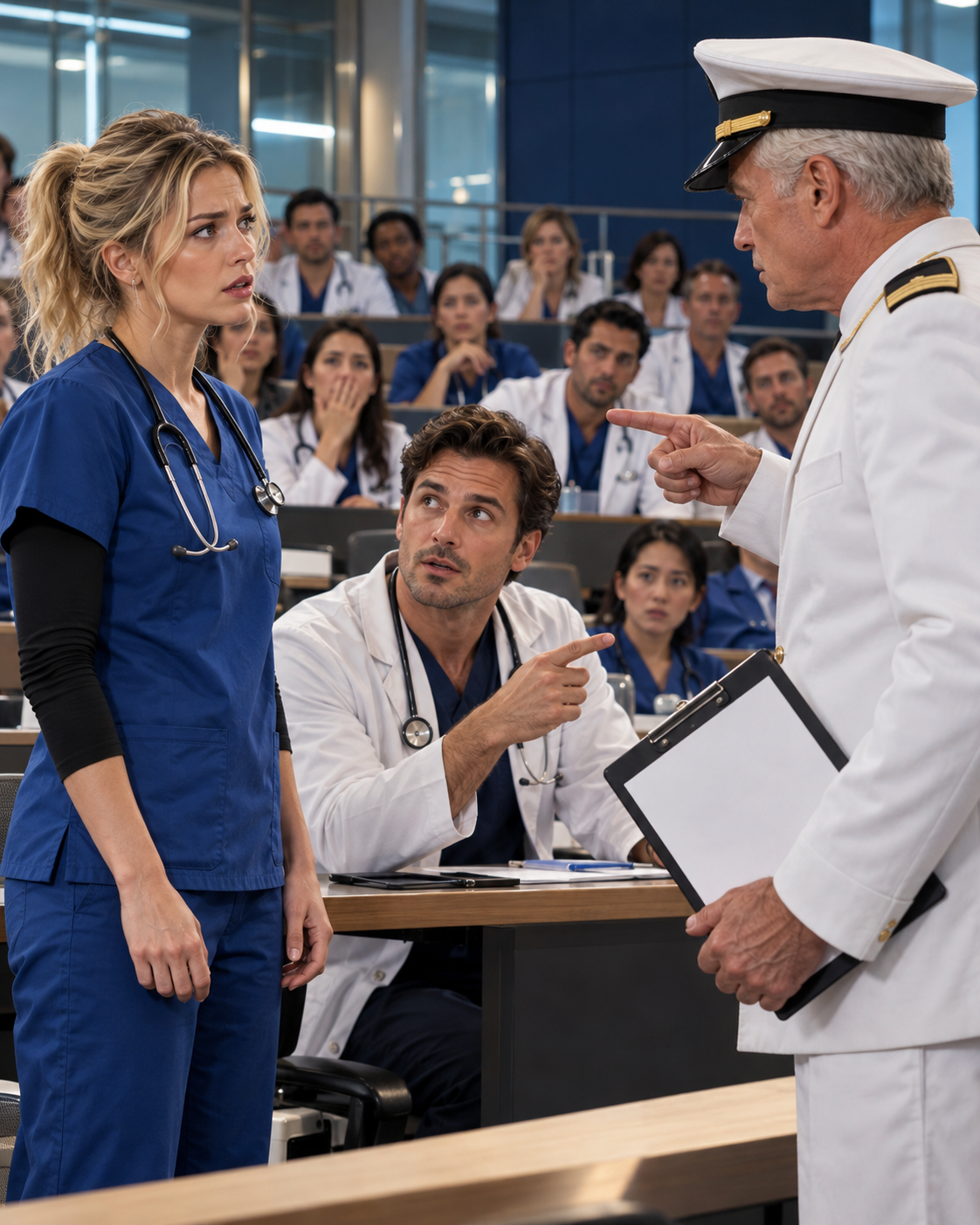
At 4:21 a.m., Dr. Finch finally confronted me in front of the entire emergency team.
He had just emerged from the first operating room, his gloves removed and his expression sharpened by exhaustion and fury.
“What exactly do you think you’re doing?”
I was checking the priority assignments on a patient’s wrist when he seized the clipboard from my hand.
“You have redirected patients, changed the surgical queue, and issued instructions to physicians without my authorization.”
“I established a common triage system because the arrival order was placing critical patients at risk.”
“You are a staff nurse.”
“Yes.”
“You do not command this department.”
“I am coordinating the immediate response while the attending teams treat their assigned patients.”
His face reddened.
“Do you have any idea what happens when nurses decide they know better than surgeons?”
I looked at the patients behind him.
“I know what happens when we ignore a patient because the wrong person arrived first.”
Several people stopped moving.
Finch noticed.
He hated having an audience when he was not the one controlling it.
“You are finished,” he said. “Hand over your assignments and report to administration when this incident is over.”
I felt the old reflex rise inside me: step back, accept the reprimand, let someone else carry the responsibility.
I had spent years trying to become a person who no longer needed to stand at the center of a crisis.
But the teenage boy was breathing because Kevin had acted.
Marcus was on his way to surgery because someone had looked past his place in line.
And twenty-four other people still needed us to make decisions with the resources we had.
“No,” I said.
Finch stared at me.
“What did you say?”
“I said no. You can file whatever report you believe is appropriate, but the triage assignments remain in place until the attending teams reassess the patients and the available resources.”
His expression changed.
It was not merely anger anymore.
It was disbelief that someone he considered insignificant had refused to shrink.
“You arrogant little—”
“That’s enough, Doctor.”
The voice came from the far end of the corridor.
It was quiet.
It was also unmistakably commanding.
The older man in the gray coat stepped out from the shadows beside the emergency stairwell.
He had been watching the response for nearly an hour, observing the way staff members reacted under pressure, the way decisions were made, and the way one nurse had become the point around which the department’s chaos was slowly organizing itself.
Finch turned toward him.
“Sir, this is an internal hospital matter.”
The stranger reached into his coat and produced official identification.
“My name is Rear Admiral Arthur Sterling, United States Navy.”
The corridor seemed to lose its sound.
Even the nearest monitor suddenly felt distant.
Sterling’s gaze moved from Finch to the clipboard in the surgeon’s hand, then to me.
He straightened.
“Captain Vance.”
I stood still.
“Admiral.”
Finch’s hand loosened around my clipboard.
The admiral continued, his voice carrying easily through the crowded corridor.
“I have been observing this facility’s emergency response under the authority of a confidential preparedness review. I would like you to explain your triage decisions, Captain.”
Finch looked at me as if he had never seen my face before.
And for the first time all night, he had absolutely nothing to say.
Part 3
For a moment, nobody moved.
Dr. Finch looked from Admiral Sterling to me, then back again, as if waiting for someone to explain that he had misunderstood what he had just heard.
“Captain?” he finally repeated.
The word came out smaller than I had ever heard his voice.
Sterling did not look at him.
“Captain Sarah Vance served in the Navy Nurse Corps and has extensive experience in combat trauma and emergency casualty coordination. Her background was not disclosed to this facility because the purpose of this review was to observe how the hospital’s systems functioned under pressure, not to give its leadership advance notice of every evaluator’s presence.”
He paused.
“Her identity does not make every decision she makes automatically correct. Her decisions must still be clinically defensible. But what I have witnessed tonight is a nurse identifying an immediate threat, communicating a coherent response, and adapting to conditions that rendered your usual procedures inadequate.”
Finch’s face had gone pale.
I could see the questions moving behind his eyes.
Why hadn’t anyone told him?
Why had he been allowed to speak to me that way?
Why had the quiet nurse he had dismissed repeatedly possessed the authority to command a response he had failed to recognize was necessary?
But the question that mattered most was still waiting in the hallway.
“Admiral,” I said, “we have two viable operating rooms, eleven immediately available units of blood at the start of the response, and multiple patients requiring reassessment. The surgical teams are working through the highest-priority cases. We need continued support from anesthesia, blood bank, and facilities, and we need confirmation of the electrical safety of the remaining suites before anyone attempts to reopen them.”
Sterling nodded once.
“What do you need from me?”
“Authority to keep the response coordinated, additional qualified personnel where available, and no unnecessary interruptions while the teams are treating patients.”
“You have it.”
He turned toward Finch.
“Chief Surgeon, your clinical teams remain responsible for their patients. Captain Vance will continue coordinating triage and resource prioritization until the incident commander determines otherwise. If you disagree with a decision, bring the clinical evidence forward. Do not disrupt patient care to defend your position.”
Finch swallowed.
“Understood, Admiral.”
I retrieved my clipboard from his hand.
There was no triumph in the gesture.
Only work waiting to be done.
I turned away before either man could say anything else.
The next two hours became a series of small battles against time.
The backup power stabilized enough to allow essential equipment to remain operational, though the damaged surgical suites stayed closed until the technical team could verify their safety.
The blood bank coordinated additional supplies through the regional network, but every unit had to be tracked carefully, matched correctly, and allocated according to the patients’ changing needs.
The operating rooms continued working.
The emergency department continued breathing.
And the people inside it continued fighting to live.
At 4:48 a.m., Marcus Reed was taken into surgery.
Before the doors closed, he turned his head toward me.
“Tell my wife I tried,” he whispered.
“You can tell her yourself,” I said.
He tried to smile.
Then the doors shut between us.
I stood there for one second longer than I should have.
I thought about the wife waiting somewhere beyond the hospital walls, perhaps staring at her phone, perhaps watching the same black smoke rise over the waterfront.
I thought about how easily the night could have ended differently if we had mistaken arrival time for medical urgency.
Then I returned to the department.
At 5:03 a.m., Eli Brooks was stable enough for transfer to a higher level of care.
His father had been found alive in another treatment area, with serious injuries but a viable chance of recovery.
When a nurse told Eli the news, he began to cry.
Not loudly.
Just a few exhausted tears slipping into the soot on his cheeks.
“Can I see him?”
“Not yet,” I said. “But you will.”
He looked at me.
“You promise?”
I thought about all the promises I had learned never to make.
“I promise we’ll keep working to get you there.”
He accepted that answer.
It was enough for the moment.
At 5:17 a.m., the team caring for Commander Hale called for an update.
His condition remained critical, and the physicians continued reassessing the possibility of surgery against the severity of his injuries and the resources available.
He had survived longer than the first assessment suggested he might.
That did not mean he was out of danger.
It meant the team had to keep asking the question rather than deciding his fate once and never looking again.
I went to his bedside.
His eyes opened when I spoke his name.
“Commander Hale, can you hear me?”
He gave a faint nod.
“Your team is working hard.”
He looked toward the ceiling.
“Did the kid make it?”
“Eli is stable. His father is alive.”
Something eased in the commander’s expression.
“Good.”
I adjusted his blanket.
“Do you need anything?”
He looked at me again, more clearly this time.
“You ever get used to it?”
“Get used to what?”
“Choosing who gets the next chance.”
I could have given him the professional answer.
I could have told him that triage protocols existed to make decisions consistent, that clinical assessments guided resource allocation, and that no one person should carry the full weight of a mass casualty response.
All of that was true.
None of it answered his question.
“No,” I said. “You learn to make the decision carefully. You learn to ask for help. But you don’t get used to what it costs.”
He closed his eyes.
“Then don’t let it cost you everything, Captain.”
I stood beside him until his breathing settled.
When I finally left, the sky outside the emergency department windows had begun to change from black to a bruised shade of blue.
At 5:46 a.m., a surgeon emerged from the operating room where Marcus had been taken.
His mask hung loose around his neck, and fatigue had carved deep lines around his eyes.
“Reed is through the initial procedure,” he said. “He’s critical, but we controlled the major bleeding. The next several hours will matter.”
I let out a breath I had been holding without realizing it.
“Thank you.”
The surgeon shook his head.
“The team did it.”
He was right.
No one had saved Marcus alone.
No one had saved Eli alone.
The response had depended on dozens of people doing their jobs while frightened, exhausted, and painfully aware that the resources might not stretch far enough.
The triage system had not made us heroes.
It had helped us work together before the chaos could pull us apart.
At 6:02 a.m., I finally allowed a nurse to examine my ribs.
The injury was painful, but there was no obvious sign of a life-threatening complication. I was instructed to undergo further evaluation and stop lifting patients until I had been properly assessed.
I promised to comply.
Then I sat down for precisely three minutes before another nurse appeared with an updated casualty list.
Twenty-six names.
Twenty-six people who had arrived from the same terrible event.
I scanned the list, moving my finger down the page.
One patient had died despite every appropriate intervention.
Then another.
The second death came just before 6:10 a.m.
I read the name twice, hoping I had somehow misunderstood it.
I had not.
Two people were gone.
Twenty-four were alive.
I lowered the paper.
The department was quieter now, but it was not peaceful.
A family was crying behind a closed curtain.
A physician was dictating a transfer report.
Somewhere down the hall, a child asked for water.
There was no applause.
There was no music swelling beneath the fluorescent lights.
There was only the aftermath, which was often harder to face than the crisis itself.
At 6:20 a.m., the official casualty count was confirmed.
Twenty-four survivors.
Two deaths.
I repeated the numbers silently.
Twenty-four.
Two.
For a moment, the hallway around me faded, and I was back in a different place, beneath a different sky, remembering faces I had never managed to forget.
I closed my eyes.
Not here, I told myself.
Not yet.
When I opened them, Admiral Sterling was standing a few feet away.
He had removed his gray coat and draped it over one arm.
Without it, he looked less like a mysterious stranger and more like an exhausted man who had spent the night watching people reveal who they were when the world stopped giving them time to prepare.
“You should be sitting down, Captain.”
“I have been told that twice already.”
“Then perhaps you should listen to someone.”
I almost smiled.
“Perhaps.”
He stood beside me, looking toward the emergency bays.
“You made difficult decisions with incomplete information and limited resources. You communicated your priorities clearly, reassessed when conditions changed, and kept the response focused on the patients rather than on the chain of command.”
I looked down at my clipboard.
“We lost two.”
“Yes.”
The admiral did not rush to comfort me.
He did not tell me that two deaths were acceptable or that twenty-four survivors erased the pain of the other two.
After a moment, he said, “A successful response is not one in which nobody dies. It is one in which every reasonable effort is made to give each person the best possible chance, and every decision is made for the right reasons.”
I swallowed.
“I keep thinking about Commander Hale.”
“So do I.”
“I chose to send Marcus to surgery first.”
“You chose based on the clinical assessments and the likelihood that immediate intervention could save him. Commander Hale’s injuries were devastating, and his team continued to reassess him. That was not a judgment about whose life mattered more.”
I stared at the floor.
“It felt like one.”
“Of course it did,” Sterling replied. “You’re human, Captain. You were supposed to feel the weight of that decision. The important thing is that you did not let the weight stop you from making it.”
I had spent years believing that the only way to survive the memories of command was to leave them behind.
Standing there, with the morning light spreading slowly across the hospital floor, I began to understand that leaving command behind was not the same as leaving its lessons behind.
Some lessons were not burdens.
They were obligations.
At 6:34 a.m., the hospital administration assembled the emergency leadership team for an initial debriefing in a conference room beside the intensive care unit.
The chairs were mismatched.
The coffee was cold.
Everyone looked as if they had aged several years in one night.
Dr. Finch sat near the head of the table, his hands clasped so tightly that his knuckles had turned white.
I took a seat near the door, still wearing my stained scrubs.
Sterling stood at the front of the room.
“This morning’s response exposed serious vulnerabilities in our emergency preparedness, including the loss of surgical capacity following the power surge and the absence of a sufficiently clear, shared triage process for a mass casualty event.”
He reviewed the response without raising his voice.
He praised the staff members who had stabilized patients, the teams that had kept essential equipment functioning, and the clinicians who had made difficult decisions under pressure.
He also made it clear that the hospital would need to examine why its initial command structure had become a source of delay instead of a source of coordination.
Then he turned to Finch.
“Doctor, do you have anything to add?”
Finch looked at the table.
For the first time since I had met him, he seemed uncertain whether his usual confidence would protect him.
“I do,” he said.
He turned toward me.
“Captain Vance.”
I lifted my eyes.
“I owe you an apology.”
No one moved.
Finch took a slow breath.
“I dismissed your concerns earlier in the night. I treated your warnings as challenges to my authority instead of considering the evidence you were presenting. When the emergency began, I relied too heavily on an arrival-order policy that was not appropriate to the situation.”
His voice faltered slightly.
“I also tried to remove you from the response when your decisions were helping the team coordinate care. That was wrong.”
He looked directly at me.
“I am sorry for the way I spoke to you, and for the fact that I allowed my pride to interfere with my judgment.”
For a moment, I saw the man beneath the white coat.
Not the chief surgeon everyone feared, but someone confronting the possibility that his confidence had blinded him to his own mistakes.
I could have made him suffer.
I could have repeated every insult he had thrown at me that night and watched the room decide what kind of man he was.
Instead, I thought about the patients still recovering upstairs.
“I accept your apology,” I said. “But I hope we do more than apologize. We need a clear mass casualty protocol, regular drills, reliable communication between nursing and surgical teams, and a process that allows anyone to raise a concern when a patient is deteriorating.”
Finch nodded slowly.
“You’re right.”
Those two words surprised me more than the apology.
Sterling closed his folder.
“Then that is where the work begins.”
The meeting ended without a ceremony.
There were no medals, no speeches about courage, and no sudden transformation of the hospital into a perfect place.
There were action items, follow-up reviews, and difficult questions about staffing, power redundancy, blood supplies, and clinical authority.
That was how change usually began.
Not with a dramatic promise, but with the willingness to examine what had failed and the discipline to make it better.
When I returned to the fourth-floor corridor, the hospital was waking up.
Morning sunlight reached through the windows and illuminated the dust still clinging to the floor.
A nurse was restocking supplies.
Someone was pushing a fresh linen cart toward the patient rooms.
The vending machine had finally stopped rattling.
I picked up my clipboard from the nurses’ station and checked the next name on my rounds.
Mr. Donnelly was awake and stable after urgent treatment.
Margaret was beside his bed, holding his hand.
When she saw me, she stood.
“The doctor told me you were the one who kept insisting something was wrong.”
I glanced at the chart.
“We had to keep looking.”
She reached for my hand.
“Thank you for not giving up on him.”
For a second, I could not find the words.
I had been called Captain by an admiral, praised in front of hospital leadership, and forced to confront a past I had spent years keeping to myself.
Yet it was Margaret’s trembling fingers around mine that nearly undid me.
“You’re welcome,” I whispered.
I checked Mr. Donnelly’s pulse, reviewed his latest observations, and explained what the team would be watching for next.
Then I stepped back into the corridor.
Dr. Finch stood near the nurses’ station, speaking quietly with Kevin.
When he saw me, he paused.
There was no sudden friendship between us, no effortless repair of the trust he had damaged.
But he gave me a small nod.
I returned it.
That was enough for the beginning of a different kind of working relationship.
Kevin caught up with me near the elevator.
“Sarah?”
I turned.
“Yeah?”
He hesitated, then looked down at the notes in his hand.
“When you told me not to rush because I was frightened, I thought you were talking about the procedure.”
“I was.”
He nodded.
“But I think you were talking about everything.”
I studied his tired face.
“Being afraid isn’t the problem, Kevin. Pretending you aren’t afraid can be.”
He looked toward the emergency department, where the first of the surviving patients was being prepared for transfer.
“I want to learn how you do what you do.”
I felt the old instinct to deflect the compliment.
To tell him I had simply done my job.
To disappear back into the quiet role I had chosen for myself.
Instead, I said, “Then keep asking questions. Keep listening to the nurses who know their patients. And never confuse someone’s title with proof that they’re right.”
Kevin nodded, absorbing the words.
Then he headed back toward the department.
I continued down the corridor, clipboard in hand, moving from one patient room to the next.
The admiral’s recognition would become part of the official review.
The hospital would examine its procedures.
Dr. Finch would have to decide what kind of chief surgeon he wanted to be when the next crisis arrived.
And I would still be Sarah Vance.
I would still check vital signs, answer frightened questions, document small changes, and stand beside people on the worst days of their lives.
My rank had not made me more worthy of respect than the nurses working beside me.
My past had not made my decisions infallible.
And the fact that I had once commanded medical teams in combat did not make me a different person from the nurse who had held Margaret’s hand in the early hours of the morning.
It only meant that I had learned, in places I wished I had never seen, how quickly a life could slip away when people cared more about authority than about the truth.
At the end of the corridor, sunlight fell across an empty chair beside a patient’s bed.
I stopped there for a moment and listened to the ordinary sounds of the hospital returning around me.
A monitor beeped steadily.
A cart rolled over the tile.
Someone laughed softly at the nurses’ station, the exhausted, disbelieving laugh of a person who had made it through something terrible.
I took a breath that hurt my ribs and let it out slowly.
Twenty-four people had survived.
Two had not.
I would remember all twenty-six.
Then I lifted my clipboard and resumed my rounds, because the most important thing about saving lives was never the moment someone finally discovered who you were.
It was what you did for the person in front of you when nobody knew your name, nobody applauded your courage, and nobody had time to ask whether you deserved to be heard.
Sometimes the person everyone overlooks is the one who sees the danger first.
And sometimes the greatest test of leadership is not whether you can make people obey you, but whether you can put your pride aside long enough to listen when someone is trying to save a life.