At 2:47 AM in St. Jude’s Hospital, Chief of Orthopedics Dr. Robert Hayes publicly called me “an inexperienced nurse chasing miracles”
Eight months after Admiral Edward Vance walked back into St. Jude’s Hospital, I still kept the copy of that old surgical report in the bottom drawer of my locker.
I had read it so many times that the crease down the middle had begun to split.
“Residual continuity of the spinal cord cannot be excluded.”
Those words haunted me because they were not a diagnosis, a promise, or even a conclusion. They were a warning that uncertainty remained, written by someone who had examined the admiral when the evidence was fresh.
Yet for two decades, uncertainty had somehow become certainty, and certainty had become a sentence that no one thought to question.
The Listening Initiative was already receiving referrals from physicians across the hospital, and our first review meetings were filled with cases that had grown complicated over time. Some patients received reassuring explanations for symptoms that had never been properly investigated. Others had undergone years of treatment based on assumptions that no longer fit their medical records.
We did not promise to reverse every diagnosis.
We promised to look again.
That distinction mattered, and Dr. Sophia Chen insisted that we remember it whenever hope threatened to outrun the evidence.
“Listening is not the same as agreeing with every theory,” she told our team during the program’s first formal meeting. “It means taking the concern seriously enough to investigate it honestly.”
Dr. Hayes had become one of the initiative’s strongest supporters, although I could tell that his enthusiasm was mixed with regret.
He no longer dismissed unusual observations in front of patients. He asked nurses what they had noticed, requested older records when necessary, and admitted when the evidence was incomplete.
Still, something about the admiral’s case bothered him.
One evening, after our review meeting ended, he approached me in the corridor.
“Elena, do you have a minute?”
I closed my notebook.
“Of course.”
He glanced at the empty conference room before speaking.
“I reviewed every record we could obtain from the admiral’s original hospitalization. There are missing pages, inconsistencies in the operative notes, and an imaging recommendation that was never carried forward.”
“You saw the report?”
“I did.”
“Do you know why it disappeared?”
He shook his head.
“No. But I intend to find out.”
I studied his face, remembering the man who had called me inexperienced while a patient lay helpless on his stretcher.
“Why does it matter now?” I asked.
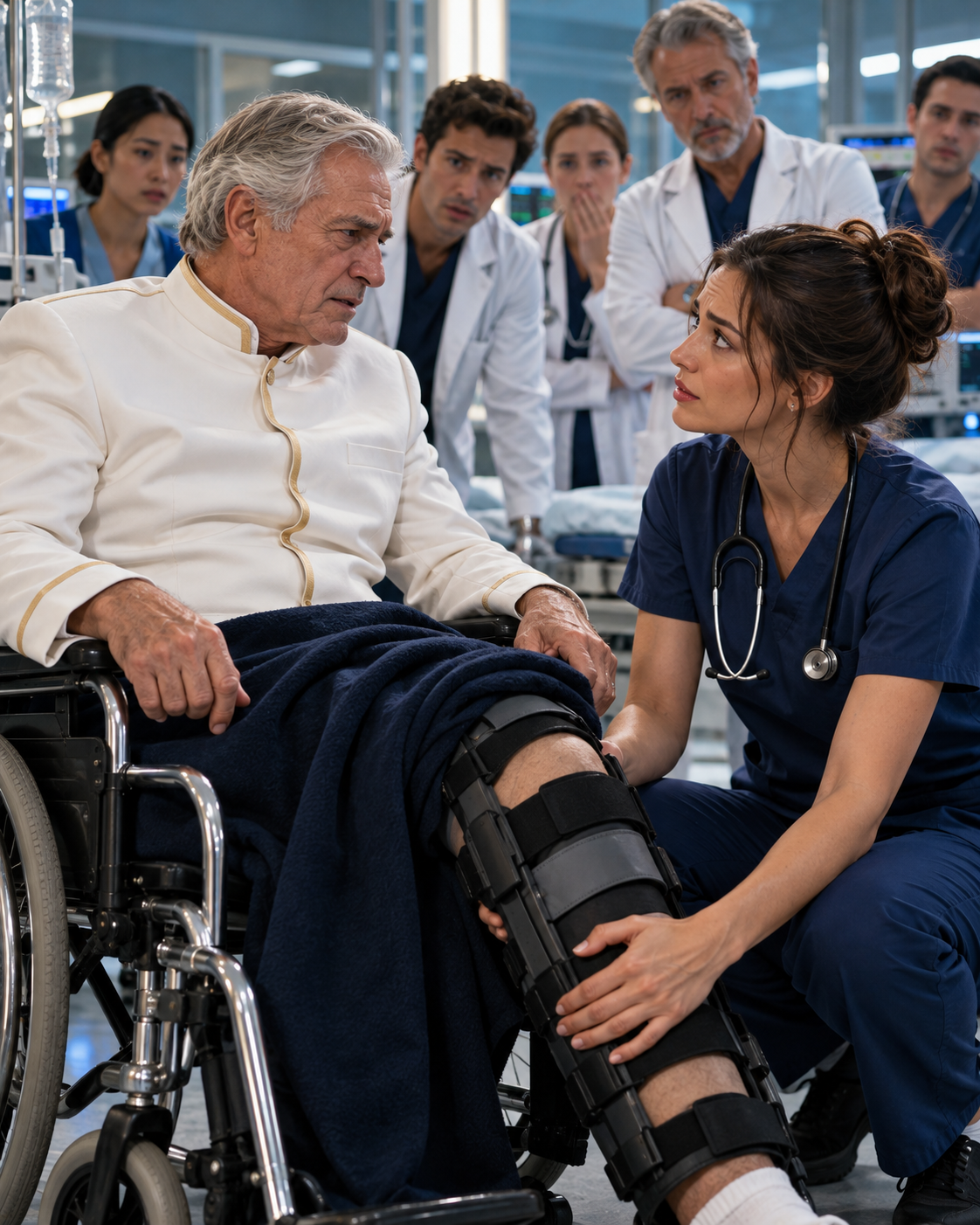
He looked down at his hands.
“Because if the record was incomplete through an innocent mistake, we need to understand how it happened. And if someone deliberately withheld information, we need to know that too.”
For the first time, I saw that his regret had become something more useful than shame.
It had become responsibility.
The following morning, Admiral Vance called the hospital and asked to speak with me.
His voice sounded stronger than it had during those first weeks of rehabilitation, but his walking remained difficult, and his therapists had warned him not to rush. He could cross a room with his cane, manage short stretches without it on good days, and stand for several minutes before pain and fatigue forced him to rest.
Recovery was not a miracle that erased twenty years.
It was a life he was learning to inhabit differently.
When I arrived at the rehabilitation center, I found him beside a window overlooking a small garden. His cane rested against the chair, and a folder lay open across his knees.
“I have something I want you to see,” he said.
Inside the folder were copies of letters he had written over the years to the hospital where his original surgery had taken place. In one, he had asked whether the metal hardware in his spine might have obscured the original injury. In another, he had requested a specialist review after a therapist noticed a change in his muscle response.
The replies were brief, polite, and discouraging.
His injury was considered complete.
Further testing was unlikely to change the prognosis.
He should focus on adapting to permanent disability.
“I believed them,” he said, touching the edge of the last letter. “After enough years, you stop asking whether the door is locked. You start believing there was never a door.”
I felt my throat tighten.
“Did you ever receive an explanation for the missing recommendation?”
“No. I was told the original records were incomplete.”
He paused, then looked at me.
“I spent twenty years thinking my body had betrayed me. I’m not going to spend the rest of my life pretending it was the only thing that failed.”
He had hired an attorney to help him obtain the complete medical file, not because he wanted revenge, he explained, but because he wanted to know whether another patient might have been harmed by the same failure.
I understood why he had called.
He wanted someone who would keep asking questions even when the answers became uncomfortable.
The records request took several weeks.
During that time, the Listening Initiative began its first formal case reviews, and I learned that careful listening often required more patience than dramatic action. A patient might describe a symptom that sounded insignificant until it was compared with a medication change. A nurse might remember a movement that had occurred only once. A family member might produce a letter that no longer appeared in the electronic chart.
Each detail had to be verified.
Each conclusion had to be earned.
Our first major success involved a retired teacher named Margaret Bell, who had been referred for repeated falls and unexplained weakness. Her symptoms had been attributed to aging and arthritis, but during an interview she mentioned that the weakness became worse after taking a particular medication.
Her physician had never heard that detail because she had never been asked about the timing.
The team reviewed her medications and arranged additional testing. The investigation identified a treatable contributor to her symptoms, and her care plan was adjusted.
Margaret returned weeks later with a box of homemade cookies for the staff.
“I thought I was just getting old,” she told me. “I had started apologizing every time I needed help.”
I thought about the admiral, and about the way he had looked at the ceiling when Hayes first described his paralysis as a settled fact.
Sometimes, the greatest damage was not only what happened to the body.
It was what happened to a person’s belief that their experience deserved attention.
The initiative began receiving praise from hospital administrators, but not everyone welcomed it. Some physicians worried that reviewing old diagnoses would encourage unrealistic expectations or create unnecessary work. Others feared that acknowledging uncertainty would be mistaken for admitting incompetence.
At one meeting, a senior consultant folded his arms and said, “If we reopen every difficult case, we will never have time to treat the patients in front of us.”
Dr. Chen answered calmly.
“We are not reopening every case. We are identifying cases where meaningful evidence was overlooked, where symptoms have changed, or where the original conclusion no longer fits the available facts.”
“And what happens when patients hear that?” he asked. “They assume we can fix everything.”
“Then we tell them the truth,” she replied. “That a review may confirm the original diagnosis, reveal a new treatment, or leave us with unanswered questions. Honesty is not the same as promising a cure.”
I watched the room settle into silence.
For years, I had believed that speaking up meant finding the perfect sentence strong enough to defeat authority. I was beginning to understand that lasting change required something harder: building a process that could survive even when the person speaking was ignored.
Then, six weeks after the admiral first showed me the missing recommendation, his attorney called the hospital.
The archive had located an additional box of records.
It contained an unsigned internal memorandum, several pages of correspondence, and a handwritten note from a physician who had assisted during the original operation.
Dr. Hayes asked me to join him and Dr. Chen in a secure conference room while the hospital’s legal and compliance teams reviewed the documents.
The memorandum was dated three days after the admiral’s accident.
It described uncertainty about the extent of the spinal injury and recommended that the case be reassessed once the metallic hardware could be accounted for in later imaging. A subsequent note stated that the prognosis had been communicated to the family as permanent paralysis.
There was no proof in those pages that anyone had deliberately concealed the warning.
There was, however, evidence that the warning had not been consistently included in the records used by later clinicians.
The distinction was important.
“We cannot call this a cover-up just because the file is incomplete,” Dr. Chen said. “We need to establish how the documents were handled, who received them, and whether the omission changed the course of his care.”
Hayes nodded.
“I agree.”
But when the compliance officer turned to the correspondence, he stopped speaking.
One letter had been sent by the original hospital’s records department to an outside consulting physician. Its subject line referred to a request for clarification of the admiral’s neurological prognosis.
The letter included a typed sentence: “The family has been advised that the injury should be considered irreversible, and further investigation is not recommended at this stage.”
Beneath that sentence was a signature.
The name belonged to the physician whose handwritten note had raised the possibility of residual spinal cord continuity.
I stared at the page, struggling to reconcile the two documents.
“Did he change his mind?” I asked.
“Possibly,” Dr. Chen said. “Or the letter may have been written by someone else under his name. We do not have enough context to know.”
Hayes leaned closer to the paper.
“We need the original author’s account.”
The physician had retired years earlier and was living in a coastal town several hours away. Through the appropriate legal channels, the hospital arranged an interview, with the admiral’s permission and an independent reviewer present.
Before the meeting, I called Admiral Vance.
“I want you to know that the documents do not establish deliberate wrongdoing,” I told him. “They raise questions, but we need to be careful about what we conclude.”
“I appreciate that,” he replied. “I spent twenty years living with a conclusion that nobody seemed willing to question. I will not demand that someone else be judged without evidence.”
His answer reminded me why I had come to respect him so deeply.
He was angry, but he was not allowing anger to become a substitute for truth.
The retired physician, Dr. Samuel Whitaker, agreed to meet us at St. Jude’s. He arrived carrying a thin leather briefcase and moved slowly, leaning on a wooden cane.
When he saw the documents on the table, his face changed.
“I remember this case,” he said.
He read the memorandum in silence, then turned to the letter bearing his name.
“I did not write this.”
The compliance officer asked whether he was certain.
Whitaker nodded.
“I remember recommending reassessment. I was concerned that the injury had been classified too definitively given the limitations of the original imaging. But I left the hospital shortly afterward, and I never saw this letter.”
“Could someone have signed it on your behalf?” Dr. Chen asked.
“I cannot say who did. I would need to examine the original correspondence and the hospital’s procedures from that period.”
He paused, visibly troubled.
“I should have followed up. I believed I had handed the concern to the team responsible for the patient’s ongoing care. When I moved, I assumed they would continue the review.”
It was not a dramatic confession.
It was something more painfully familiar: a series of assumptions, each one small enough to seem harmless, accumulating until no one could see the person trapped beneath them.
Whitaker agreed to provide a written statement and cooperate with the review. The hospital referred the matter for independent examination, and the admiral’s attorney pursued the remaining records.
Weeks passed before the review reached its preliminary findings.
There was no conclusive evidence that anyone had intentionally altered the file to prevent treatment. The records did show serious weaknesses in documentation, communication, and follow-up, including a failure to preserve uncertainty when the diagnosis was transferred between teams.
The hospital issued a formal acknowledgment of those failures and expanded the Listening Initiative to include an independent review pathway for patients whose complex diagnoses had not been reassessed despite meaningful changes in symptoms.
It was not the dramatic verdict some people expected.
No single villain emerged to explain twenty lost years.
Instead, the evidence revealed something more ordinary and more disturbing: a warning had been written, passed between people, and gradually lost beneath the weight of routine, incomplete records, and unquestioned assumptions.
For the admiral, the findings brought no simple relief.
One afternoon, I found him sitting in the rehabilitation garden, his cane across his lap. He had read the preliminary report that morning.
“Are you disappointed?” I asked.
He watched a pair of sparrows fighting over a crumb on the path.
“I wanted someone to tell me why,” he said. “I wanted a name, a reason, something I could point to and say, ‘There. That is where my life changed.’”
He rubbed his hands together, working through the stiffness in his fingers.
“But I keep thinking about all the people who touched that file. Maybe one person made a bad decision. Maybe several people thought someone else was handling it. Maybe everyone believed they were doing their best.”
He looked up at me.
“And somehow, I was still the one who paid for it.”
I sat beside him.
“I’m sorry.”
“So am I.” His eyes glistened, but his voice remained steady. “I am sorry for the years I spent believing I had no right to ask another question.”
We sat together until the afternoon light began to fade.
His recovery continued, but it did not follow the clean arc people wanted from his story. Some days he walked farther than his therapists expected. Other days, nerve pain forced him to return to his wheelchair. He would never know exactly how much function he might have regained if the compression had been relieved earlier, and no honest physician could promise that the outcome would have been different.
Yet he kept working.
He visited rehabilitation centers and spoke to medical students about the difference between hope and certainty. He told them that patients did not need doctors to promise miracles; they needed doctors who could explain what was known, what remained uncertain, and what evidence might change the answer.
At one lecture, a student asked whether he blamed the medical profession for what had happened.
The admiral considered the question before answering.
“I blame the decisions that were made without enough scrutiny,” he said. “But I also know that medicine is full of people trying to help under pressure, with imperfect information. If you want to honor patients, don’t pretend mistakes never happen. Build a system that can recognize them before they become someone else’s lifetime.”
The room remained silent long after he finished speaking.
A year after his first visit to St. Jude’s, the hospital held a small ceremony to mark the expansion of the Listening Initiative. Margaret Bell attended with her daughter. Dr. Whitaker sent a letter of support. Dr. Hayes stood beside Dr. Chen, and I was asked to speak about the role of nurses in recognizing changes that might otherwise be overlooked.
I had prepared a speech, but when I stepped to the microphone, the words seemed suddenly too polished.
So I told them about my father.
I described the grease beneath his fingernails, the stories he told about repairing engines in terrible weather, and the stubborn belief that every failure left evidence if someone cared enough to look. I told them about the last hospital room I had shared with him and the questions I had been too young and frightened to ask.
Then I told them about the admiral’s toe lifting beneath my hand.
“That movement did not prove he would walk again,” I said. “It proved we had a question worth investigating. Our responsibility was not to turn that question into a promise. It was to refuse to bury it before we knew the answer.”
I looked around the room.
“Listening is not simply being kind. It is a clinical responsibility. It means taking observations seriously, checking the evidence, documenting uncertainty, and allowing new information to change our minds. It means understanding that a person can be mistaken without being foolish, and an expert can be knowledgeable without being infallible.”
When I finished, Admiral Vance rose from his seat.
He stood slowly, steadying himself with his cane, and walked toward the front of the room. His steps were still uneven, and he paused halfway to gather his strength.
Nobody rushed to help him.
They understood that this was his moment to choose.
When he reached me, he extended his hand.
I took it, and he smiled.
“You once asked me to move a toe,” he said. “That was a very small request.”
“It was all we needed to start.”
“No,” he replied gently. “It was all we needed to stop pretending we already knew the answer.”
The audience rose to its feet.
I felt tears sting my eyes, but this time they were not the tears of someone watching a life slip away. They were the tears of someone finally understanding that one small act of attention could travel much farther than the person who performed it would ever know.
After the ceremony, I returned to the emergency room for my night shift.
The corridors looked the same. The monitors still beeped, the phones still rang, and tired families still sat beneath fluorescent lights waiting for news that might change everything.
At 2:47 AM, almost exactly a year after the admiral had arrived, an elderly man was brought in complaining of weakness in his left hand.
His initial examination appeared reassuring. The physician on duty suspected a pinched nerve, but when I helped the patient settle into bed, he told me that the weakness had started suddenly and that he had dropped his coffee cup twice that evening.
I glanced at the clock.
Then I looked at his face, at the uneven grip of his left hand, and at the frightened way he kept apologizing for taking up our time.
I called the physician back and explained what I had noticed. Together, we reassessed the symptoms and arranged urgent evaluation rather than allowing the first explanation to settle into the chart.
The cause was not what we had initially suspected, and the patient received treatment based on the new findings.
Later, while documenting the encounter, I opened the bottom drawer of my locker and touched the folded copy of the admiral’s old report.
The paper was still there, but I no longer saw it only as evidence of a failure.
I saw it as a reminder that uncertainty was not a weakness to hide. It was a responsibility to carry carefully.
Before dawn, a message appeared on my phone from Admiral Vance.
It contained a photograph of him standing in his garden without his cane, one hand resting lightly on a railing. Beneath it, he had written, “Still working on the next step.”
I smiled and typed back, “One step at a time.”
Then another message arrived.
“There’s something I never told you about the night I first moved my toe.”
I stared at the screen.
A second message followed.
“Before you touched my foot, I had been trying to move it for nearly an hour. I could feel something happening, but I thought I was imagining it. When you asked me to try, I was afraid that if nothing happened, I would lose the last reason I had to hope.”
I read the words twice, my chest tightening.
Then he sent one final message.
“I wasn’t only waiting for someone to find the truth, Elena. I was waiting for someone to believe that I could still be worth the trouble.”
The emergency room hummed around me, full of people carrying pain they could not always explain and fears they did not know how to voice.
I thought of my father, the admiral, Margaret Bell, and every patient who had learned to apologize before asking for help.
I thought of how easily a question could be dismissed, a warning overlooked, or a life reduced to a conclusion written years earlier.
And I understood that the most important part of the admiral’s story was not that he had walked again.
It was that, for one brief moment in a crowded emergency room, someone had stopped long enough to notice that he might still be able to.
We could not promise every patient a miracle.
We could promise to look, to listen, to investigate, and to change our minds when the evidence demanded it.
Sometimes that would lead to a treatment. Sometimes it would lead to a harder truth. Sometimes the only thing we could offer would be an honest answer and the dignity of knowing that no one had stopped searching too soon.
But I would never again mistake a familiar diagnosis for a complete understanding of a human being.
Outside, the rain began to ease, leaving the hospital windows silver beneath the first light of morning.
I put my phone away and returned to my patients.
There would always be another chart, another symptom, another quiet voice waiting to be heard.
And somewhere in the records of someone who had been told there was nothing left to do, there might still be a sentence no one had noticed.
The question was whether we would be willing to look for it.