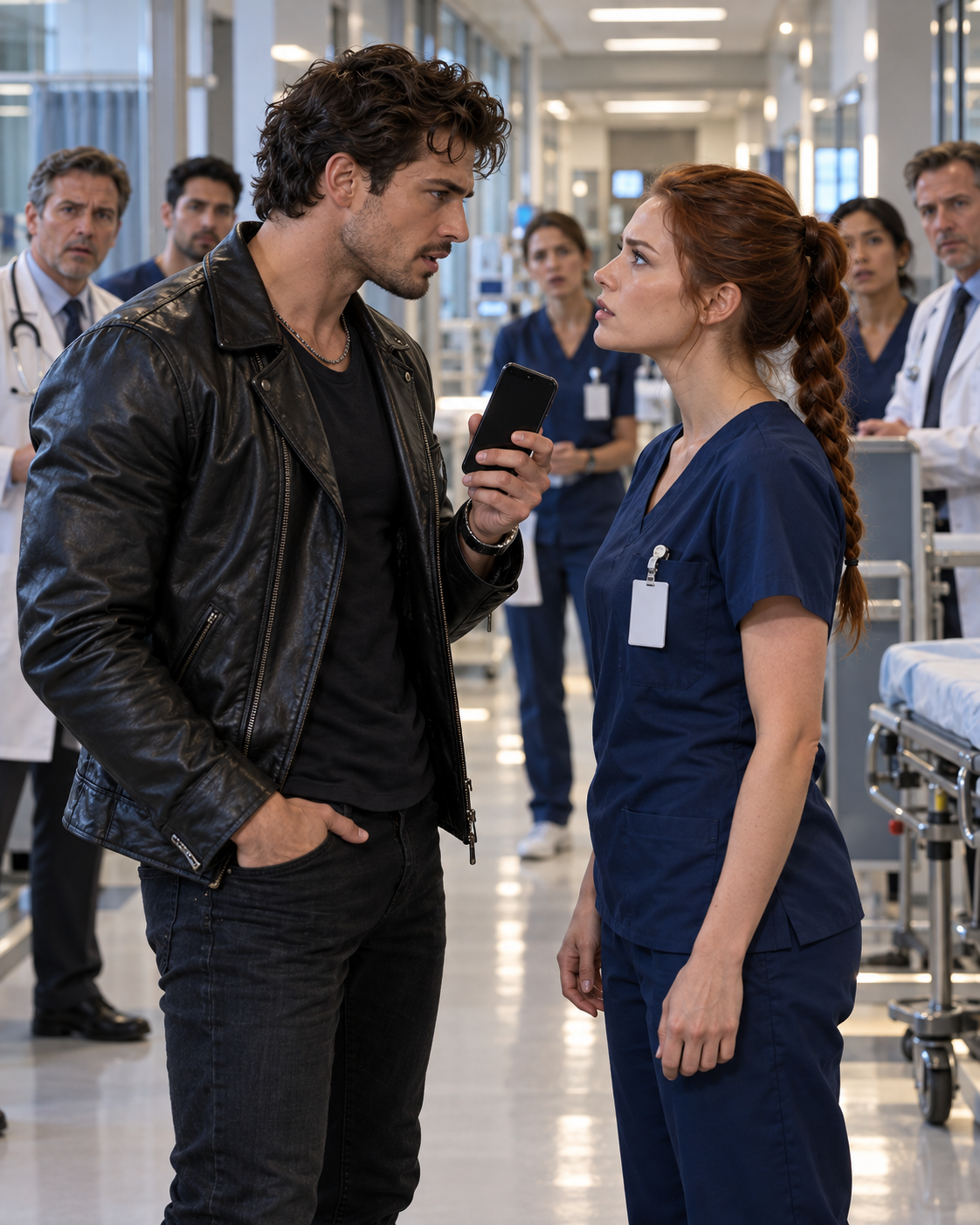
At 2:17 a.m. in Crestwood Memorial Hospital, I watched a furious billionaire’s son shove his phone inches from my face
Part 2
Julian didn’t go home.
Instead, he sat alone in the corner of the hospital lobby with his phone in both hands, staring at the same screen without actually reading anything.
His father’s condition remained uncertain.
His anger had nowhere left to go.
Around four in the morning, he made a call.
“Find out who she is.”
The person on the other end was silent.
“Tonight,” Julian added.
A private security specialist named Marcus Hale arrived less than an hour later.
Marcus had spent twenty-five years protecting wealthy families and investigating threats that never appeared in public records.
He sat beside Julian and listened without interrupting.
“She put you on the floor?”
Julian looked away.
“Yes.”
“Did she hurt you?”
“No.”
Marcus studied him.
“Then why do you look frightened?”
Julian didn’t answer.
Marcus eventually received my name from the hospital directory.
Then he began searching.
At first, there was almost nothing.
Nursing license.
Employment history.
A clean civilian record.
Then he found something buried beneath layers of classification.
He stared at the screen for several minutes.
“Julian.”
“What?”
“You need to understand that what I’m about to tell you isn’t something you repeat.”
Julian turned toward him.
Marcus showed him the first file.
There was a photograph.
It was me, years younger, wearing a uniform instead of navy scrubs.
The expression was the same.
Calm.
Focused.
Unimpressed.
But the woman in that photograph belonged to a different world.
There were commendations.
Combat citations.
Records of special operations deployments.
References to missions that were mostly redacted.
Then came reports from mountain operations overseas.
Ambushes.
Evacuations.
Wounded personnel recovered under fire.
A mission where I had carried two injured soldiers through a narrow ravine while enemy fire struck the rocks around me.
Another report described me taking command after the team leader was wounded.
Another mentioned that I had refused evacuation until every member of my unit had been accounted for.
Julian read the pages without speaking.
Finally, he looked at Marcus.
“How much of this is real?”
“All of it.”
“But she’s a nurse.”
“Now.”
Marcus scrolled farther.
“There are records here that aren’t even fully accessible to me.”
Julian swallowed.
“And the martial arts?”
Marcus almost smiled.
“Your black belt isn’t the relevant part of this story.”
Julian stared at the floor.
For the first time in his life, perhaps, he had discovered the difference between looking dangerous and actually being dangerous.
But what stayed with him wasn’t the joint lock.
It was something else.
I had every opportunity to humiliate him.
I hadn’t.
I had every reason to hate him.
I didn’t.
I had stopped him without breaking him.
Then I had offered him coffee.
That confused him more than anything in those files.
At 6:41 a.m., Dr. Whitman finally walked into the lobby.
Julian stood immediately.
“How is my father?”
Dr. Whitman explained that Arthur had survived the initial crisis but remained in serious condition.
The next several hours would determine whether the damage progressed.
Julian nodded.
He didn’t argue.
He didn’t threaten anyone.
Then his eyes found mine.
I was checking medications at the station.
He walked toward me slowly.
His hands were empty.
His shoulders were lower.
He stopped several feet away.
“I owe you an apology.”
I looked at him.
“For what?”
He gave a humorless laugh.
“Everything.”
I waited.
He looked down at his wrist.
“I was afraid.”
That was the first honest thing he had said all night.
I nodded.
“I know.”
“I thought if I made enough noise, someone would make this stop.”
“It doesn’t work that way.”
“I know that now.”
He took a breath.
“I’m sorry.”
I believed him.
Not because the apology was perfect.
Because it wasn’t.
It sounded uncomfortable and unfinished, like the truth often does when someone says it for the first time.
I gestured toward the chair.
“Sit.”
He did.
I told him exactly what I could about his father’s condition.
No promises.
No false hope.
No polished language designed to soften reality.
“Your father is very sick,” I said.
Julian’s eyes became wet.
“Is he going to die?”
“I don’t know.”
He looked at me.
“That’s the honest answer?”
“Yes.”
He nodded slowly.
Then I said something I knew he needed to hear.
“If you want to help him, don’t make this room about your fear.”
His face tightened.
“Then what do I do?”
“Be calm.”
“I don’t know how.”
“Then learn.”
He looked toward the treatment doors.
“Your father doesn’t need his son to be powerful right now.”
I paused.
“He needs him to be present.”
Julian lowered his head.
That morning, something changed.
Not dramatically.
Not all at once.
He simply stopped trying to control everything.
He sat beside his father’s bed.
He listened when the nurses spoke.
He thanked people.
He stopped recording.
And when the night shift became overwhelmed, he disappeared for ten minutes and came back carrying coffee.
One cup for me.
Several for the nurses.
He placed mine on the desk without saying anything.
I looked at it.
“Black?”
He nodded.
“How did you know?”
“I asked.”
I almost smiled.
That was the first time Julian Vance had done something without demanding anything in return.
His father slowly improved.
But the changes in Julian continued long after the immediate danger passed.
He started asking questions.
Not about money.
Not about hospital policy.
About resilience.
About leadership.
About why some people remained calm when everything around them collapsed.
One evening, he found me alone near the ICU windows.
“Can I ask you something?”
“Sure.”
“How did you stop being afraid?”
I looked at the reflection of the hospital lights in the glass.
“I didn’t.”
He waited.
“You learn to carry fear without letting it choose what you do next.”
He thought about that for a long time.
Then he nodded.
“I think I’ve spent my whole life doing the opposite.”
“You can change that.”
He looked at me.
“Did you?”
I didn’t answer immediately.
There were some questions that reached places I had spent years protecting.
But eventually I said, “I’m still learning.”
And somehow, that answer seemed to mean more to him than anything else.
Part 3
Three weeks later, Arthur Vance walked out of Crestwood Memorial Hospital.
He was thinner.
He was slower.
But he was alive.
Julian stood beside him, one hand carefully gripping his father’s arm.
Arthur stopped before leaving and looked at me.
“My son tells me I owe you my life.”
I shook my head.
“Your doctors and nurses worked very hard.”
Arthur smiled.
“Apparently, my son did too.”
Julian looked embarrassed.
That might have been the strangest sight of all.
The man who had once threatened to fire an entire hospital now looked uncomfortable receiving praise.
Before they left, Julian turned to me.
“I’ve been thinking about something.”
“That sounds dangerous.”
He laughed.
“I want to fund a program here.”
“What kind?”
“For veterans.”
I listened.
He explained that he wanted to create a permanent transition program for military veterans moving into civilian healthcare careers.
Training.
Scholarships.
Counseling.
Mentorship.
Placement.
A bridge between the skills they had built in service and the lives they wanted afterward.
“Why?” I asked.
He looked toward the hospital doors.
“Because I met someone who showed me that a person can survive a war and still choose to spend the rest of their life saving people.”
I didn’t know what to say.
So I simply nodded.
The program was established months later.
Its first classroom was small.
Its first group was smaller.
Some veterans arrived carrying the same invisible weight I knew too well.
They were disciplined.
Capable.
Exhausted.
Some didn’t know how to explain what they had seen.
Some weren’t sure they still belonged anywhere.
I understood.
Because I had once stood exactly where they were standing.
And sometimes, the greatest part of healing isn’t forgetting the person you were.
It’s learning how to give that person a new purpose.
Julian stayed involved.
He came to the hospital regularly.
He brought coffee.
He learned nurses’ names.
He listened more than he spoke.
One night, months after the incident, I found him helping an elderly veteran carry a box of donated medical equipment down the hallway.
He caught me watching.
“What?” he asked.
“Nothing.”
He smiled.
“You know, I used to think strength meant making everyone else afraid of you.”
I leaned against the doorway.
“And now?”
He looked down the hallway.
“Now I think strength is being the person who makes everyone else feel safe.”
I nodded.
“That’s better.”
He smiled.
“I learned from a nurse.”
I looked at him.
“No.”
He shook his head.
“From someone who happened to be a nurse.”
For a moment, neither of us spoke.
Then the overhead lights flickered softly across the polished hospital floor.
The same floor where, months earlier, Julian had been on his knees.
The same place where I had once whispered that I could have ended the confrontation differently.
But I had chosen not to.
Because leaving the battlefield had taught me something combat never could.
You don’t prove strength by destroying the person in front of you.
You prove it by knowing you could, and choosing a better answer.
Years of training had taught me how to control a room.
Pain had taught me how to control myself.
And nursing had taught me something even harder.
Sometimes the bravest thing a person can do is stay gentle when the world gives them every reason not to be.
I still wear navy scrubs.
I still braid my hair before every shift.
I still walk through those hospital doors when most of the city is asleep.
And every now and then, a new veteran walks into our program carrying a past they think has made them broken.
I look at them and remember the woman I used to be.
Then I tell them the same thing I once told a frightened billionaire’s son.
“Lower your voice.”
“Take a breath.”
“You’re still here.”
And perhaps that is the secret I spent twelve years learning without realizing it.
Real strength doesn’t need to roar.
It doesn’t need a title, a fortune, a weapon, or a room full of people afraid to challenge it.
Sometimes, real strength simply walks into the room, keeps its head when everyone else loses theirs, reaches for the person who is hurting, and quietly gets the job done.
That night, Julian thought he had walked into a hospital to save his father.
He didn’t realize his father would survive, while something inside his son would have to die first.
His arrogance died.
His need to intimidate died.
And in its place, something far more valuable finally learned how to live.
As for me, I never told Julian everything about the people I lost overseas.
Some stories belong to the dead.
But whenever I watch another veteran cross the threshold of Crestwood Memorial wearing uncertainty instead of confidence, I remember why I stayed.
I left the battlefield because I was tired of learning how to survive.
I became a nurse because I wanted to learn how to help other people do the same.
And in the end, perhaps that was the real mission all along.
Not to become harder.
Not to become feared.
But to become strong enough to remain human.