At 11:40 on a freezing Tuesday night, a corporate lawyer ordered me to destroy an old Mustang in my own repair shop
The photograph lay between us on the dusty floor of the abandoned depot, its edges curled from years of damp and neglect.
Arthur stared at the young girl standing beside Elias Brandt, his lips moving silently as if he were trying to remember a name he had spent half his life refusing to speak.
Katherine tightened her grip on his arm.
“Dad, who is she?”
He didn’t answer.
Outside, the wind scraped through the broken windows, carrying the distant sound of a vehicle approaching along the overgrown road.
I slipped the photograph into the evidence envelope we’d found in the ammunition can and checked the doorway.
“We need to leave,” I said. “Whoever sent that message knows where we are.”
Arthur remained on his knees.
For twenty-six years, he’d chased the ghost of his missing friend, endured whispers that he had helped sell out American soldiers, and watched his family disintegrate under the weight of an accusation he could never disprove.
Now the truth had finally surfaced, and instead of relief, it had brought him another secret.
“Arthur,” I said gently, “you don’t have to explain everything right now, but we can’t protect anyone if we don’t know what we’re facing.”
He raised his eyes.
“The girl was named Rebecca.”
Katherine went still.
“Rebecca who?”
Arthur swallowed.
“Rebecca Brandt. Elias’s daughter.”
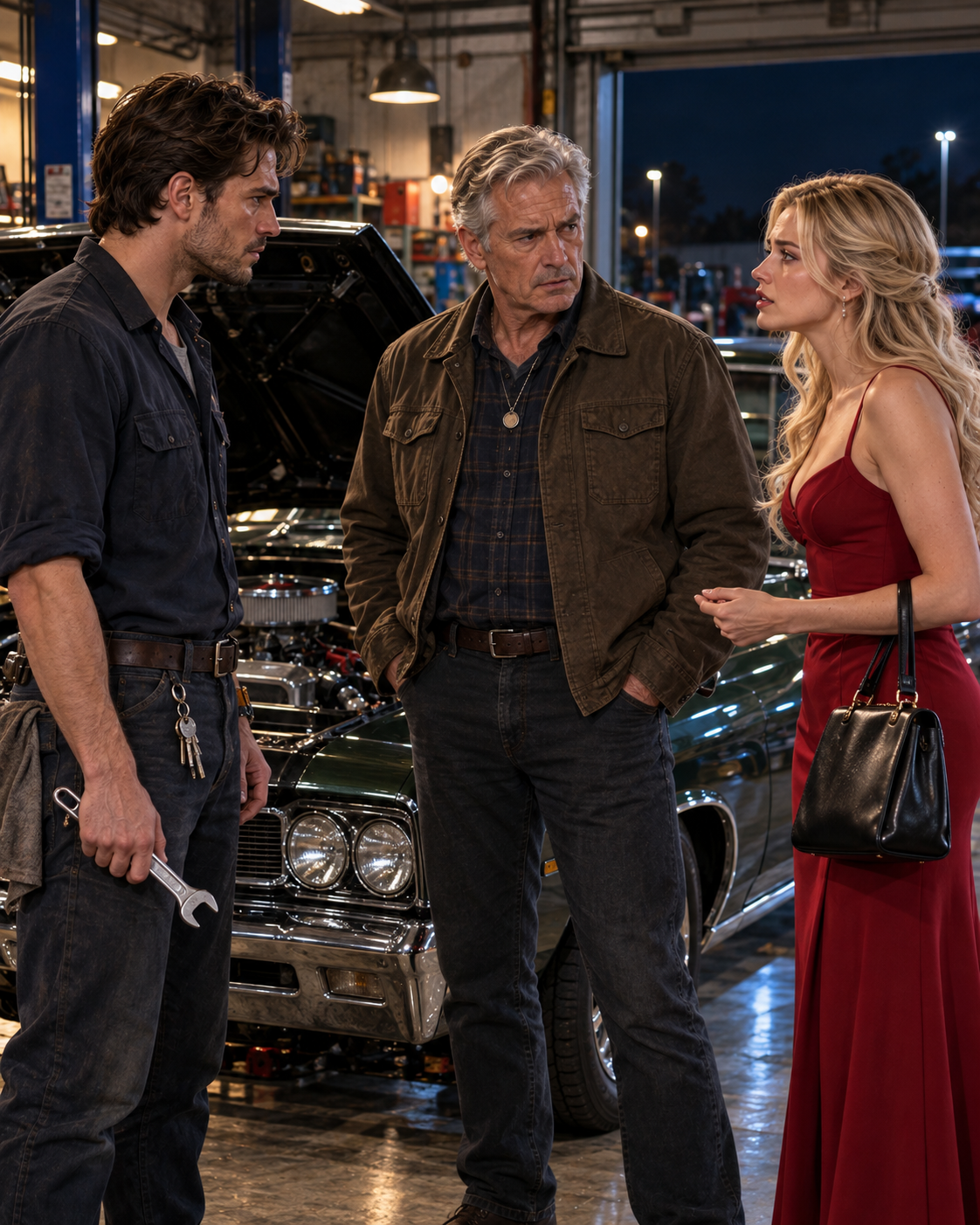
The approaching engine grew louder.
I helped Arthur to his feet while Katherine gathered the ledgers and photographs into a canvas bag.
We slipped through a side entrance and crossed the frozen field behind the warehouse, keeping low beneath the broken fence line.
A black SUV rolled into the depot as we reached the road.
Its headlights swept over the empty loading bays.
Someone had arrived just minutes too late to find us.
We climbed into my battered pickup and drove south without speaking until the depot disappeared behind the trees.
Only then did Katherine turn toward her father.
“You told me Elias had no family.”
“I told you what I believed would keep you safe.”
“That’s not an answer.”
Arthur pressed his hands together, staring at his knuckles.
“When Elias started investigating Carrian, he became convinced the company had someone inside the Army feeding them inspection schedules and procurement details. He thought the leaks came from a senior officer, but he couldn’t prove it.”
“And Rebecca?” I asked.
“She was seventeen. Her mother had died years earlier, and Elias was all she had. When he realized someone was watching his house, he asked me to help him get her somewhere safe.”
Katherine’s expression hardened.
“What happened?”
Arthur looked out the window.
“I arranged a transfer for some equipment that Elias wanted to examine. I thought we were moving evidence into secure custody. I didn’t know the paperwork had already been altered.”
He paused, breathing through the memory.
“Two days later, Elias disappeared. Rebecca vanished the same week. The Army accused Elias of stealing classified material, and my signature appeared on the transfer order. I was suspended, investigated, and eventually dismissed.”
“Why didn’t you tell us about Rebecca?” Katherine asked.
“Because a letter arrived six months later. It said that if I ever looked for her, she would die. It included a photograph of her outside a school in another state.”
Arthur rubbed his face.
“I thought the threat was real. I thought staying silent was the only way to keep her alive.”
Katherine looked away, and I saw her struggling with two opposing truths: her father had lied to her for years, but perhaps he had done so out of fear rather than indifference.
“Did Mom know?” she asked.
“She knew I was searching for Elias. She didn’t know about Rebecca. When the Army investigation began, I became obsessed with clearing my name. I stopped being a husband. I stopped being your father.”
His voice cracked.
“Your mother begged me to come home, and I kept telling her I was almost there. I thought one more lead would fix everything.”
Katherine’s eyes filled, but she didn’t cry.
“Mom died believing she wasn’t enough to make you stay.”
Arthur closed his eyes.
“I know.”
“No, Dad. You know she died. You don’t know what it was like to watch her wait for you every night.”
The words settled into the cab, heavier than the winter air.
I understood that kind of waiting.
After Laura’s diagnosis, I’d spent months telling myself there would be another treatment, another specialist, another conversation after the next appointment. Even after the doctors stopped promising anything, I kept planning repairs around a future that was already disappearing.
When she died, I had all the words I’d postponed and nowhere left to put them.
“Sometimes,” I said quietly, “we tell ourselves we’re sacrificing everything for the people we love, when we’re actually afraid to face the things we can’t fix.”
Neither of them answered.
But Katherine reached across the seat and picked up the photograph.
“Then we stop running,” she said. “We find Rebecca, we preserve this evidence, and we make sure nobody can bury it again.”
For the first time since she had arrived at my shop, she and Arthur looked in the same direction.
We returned to town just after noon, taking the records to a storage unit behind my garage rather than risking our homes.
Katherine called an old colleague who worked in federal litigation and explained that she needed independent counsel for a potential whistleblower case involving military procurement fraud.
She didn’t mention the names over the phone.
By late afternoon, she had arranged a meeting with a retired federal investigator named Daniel Mercer, whose career had ended after he challenged an internal inquiry into defense contractor misconduct.
He arrived at the shop carrying a leather folder and a wary expression.
“I’ve spent fifteen years hearing rumors about Carrian,” he said after examining the first few pages. “But rumors don’t bring down companies. Originals do.”
Katherine spread the ledgers across my workbench.
“We have originals.”
“You have some originals,” Mercer corrected. “What you need is authentication, a documented chain of custody, and someone who can explain how these records connect to the people who authorized the contracts.”
He examined the requisition order with particular care.
“This signature is genuine.”
Arthur’s face tightened.
“Then I’m finished.”
“Not necessarily,” Mercer said. “A genuine signature proves you signed the order. It doesn’t prove you knew the shipment contained counterfeit parts or that you approved the later substitutions. We need the records that show who changed the specifications and when.”
He turned another page and found a handwritten notation beside a shipment number.
A set of initials appeared beside it: M.V.
Mercer went quiet.
Katherine noticed immediately.
“What is it?”
“Those initials may belong to Major Malcolm Voss. He was a procurement officer who later became a Carrian consultant.”
Arthur stared at the page.
“Voss approved the original inspection schedule. He told the board Elias had falsified his findings.”
“Then he may have been protecting the people responsible,” Mercer said. “But we can’t accuse him on the strength of two letters.”
He photographed every page, logged the materials, and arranged secure transfer to an independent forensic examiner.
Before leaving, he warned us that the company’s lawyers would likely try to discredit Arthur before the evidence could be verified.
“They’ll attack his credibility, his career, and his family history,” Mercer said. “They’ll make his grief sound like obsession and his questions sound like revenge. You need to be ready for that.”
Arthur gave a humorless smile.
“They’ve been doing that for twenty-six years.”
Mercer looked at him carefully.
“Then this time, don’t fight them alone.”
That evening, Katherine drove Arthur to her house.
He hesitated on the front step, staring at the porch light as though it belonged to a place he had no right to enter.
“I haven’t been here in years,” he said.
“I know.”
“Your mother used to put that light on whenever I worked late.”
Katherine swallowed.
“She kept doing it long after you stopped coming home.”
Arthur looked down at the key in her hand.
“I don’t know how to make that right.”
“You can’t,” she said. “But you can stop making it worse.”
She opened the door.
Inside, the house was warm, tidy, and painfully ordinary. A framed photograph of Katherine’s mother sat on the mantel, her smile bright enough to make Arthur turn away.
Katherine brought him a blanket and set a glass of water beside the couch.
Before going upstairs, she paused.
“There’s something else you should know. I kept your old letters.”
Arthur looked up.
“You did?”
“I was angry enough to throw them away a hundred times. I never did.”
She disappeared upstairs before he could answer.
For the first time in years, Arthur slept under the same roof as his daughter.
I returned to the shop, where the Mustang sat beneath the fluorescent lights, its hood still warm from the afternoon drive.
I had just finished locking the side door when someone knocked on the glass.
A woman stood outside, wearing a plain navy coat and holding a small envelope.
She looked to be in her forties, with tired eyes and a thin scar running from her left temple toward her hairline.
When I opened the door, she studied my face.
“Are you the mechanic who found the recorder?”
I didn’t answer immediately.
“Who are you?”
She glanced toward the Mustang.
“My name is Rebecca Brandt.”
For a moment, the garage seemed to tilt beneath my feet.
I let her inside and called Katherine, who arrived twenty minutes later with Arthur beside her.
The instant Rebecca saw him, she stopped walking.
Arthur stood motionless, one hand resting against the workbench.
“Rebecca,” he whispered.
She looked older than the girl in the photograph, but the fear in her expression was unchanged.
“You shouldn’t have found the records,” she said.
Arthur took a shaky step forward.
“We thought you were dead.”
“I was supposed to be.”
Katherine moved between them, not to keep them apart but to make sure neither had to face the moment alone.
“Who threatened you?” she asked.
Rebecca placed the envelope on the workbench.
“People who knew my father had proof. People who understood that if he disappeared, the evidence would be harder to authenticate and everyone who knew him could be dismissed as unreliable.”
Inside the envelope was a photocopy of a handwritten letter dated three months after Elias vanished.
The letter was addressed to Arthur.
The handwriting was unmistakable.
Arthur read it with trembling hands.
“If Rebecca reaches you, tell her the truth about the last shipment. The parts weren’t the only things they replaced.”
He read the sentence again.
“What does that mean?” I asked.
Rebecca looked at the Mustang.
“My father discovered that the counterfeit components were only part of the operation. Someone had altered the serial numbers on entire shipments, making defective equipment appear to have come from approved manufacturers. The same paperwork was then used to hide missing inventory and redirect military funds.”
Mercer, whom Katherine had called as soon as Rebecca arrived, listened over a secure video connection.
“That could establish a much larger scheme,” he said. “But where did Elias get the original records?”
Rebecca looked at the false panel behind the Mustang’s rear compartment.
“He didn’t put everything in the car.”
She reached into her coat and produced a small brass key.
“He gave me this before he disappeared. He said if I ever found Arthur, I should bring it to him.”
Arthur stared at the key.
“Why didn’t you come sooner?”
Rebecca’s eyes filled.
“Because I spent twenty-six years believing you had helped them take him away.”
Arthur flinched as if she had struck him.
“I never betrayed your father.”
“I know that now,” she whispered. “But I didn’t know it then.”
She explained that after Elias disappeared, a family friend had taken her out of state and helped her establish a new identity. She received occasional anonymous payments, enough to survive, but every attempt to learn more about her father ended with warnings, unexplained visits, or the sudden loss of a job.
She had stopped searching because she feared that anyone close to her would become a target.
Then, three nights earlier, an anonymous message had reached her with a photograph of the Mustang.
The sender claimed that Arthur had finally found what Elias left behind.
Rebecca had spent two days deciding whether to answer.
“What made you come?” Katherine asked.
Rebecca glanced at Arthur.
“I realized I was living exactly the way they wanted me to live. Afraid, alone, and too frightened to ask the questions my father died trying to answer.”
Arthur’s face crumpled at the word died.
“Do you know that for certain?”
Rebecca hesitated.
“No.”
The single word changed everything.
She had assumed her father was dead because the people watching her had never allowed another possibility. But she had never seen a body, never received a death certificate she could verify, and never found a grave.
The letter suggested Elias had hidden evidence beyond the Mustang.
The brass key opened a narrow compartment beneath the Mustang’s rear seat, one that none of us had noticed because the access plate had been covered with layers of upholstery glue.
Inside was a strip of microfilm and a folded note.
Arthur read the note aloud.
“Depot records are a decoy. Follow the transfer number to the place where the vehicles were tested. If I cannot return, the man who knows the truth is the one who signed the final inspection.”
Arthur went pale.
“I signed the initial requisition. I never signed a final inspection.”
Mercer leaned closer to his camera.
“Then somebody forged a second document using your name, or somebody altered the meaning of the first. We need to identify the test facility and recover its records.”
The transfer number on the microfilm led to a former Army vehicle proving ground in western Pennsylvania, closed after a budget consolidation nearly thirty years earlier.
The site was now privately owned, its buildings leased to a salvage company.
Mercer warned us not to go there without law enforcement, but the property records showed that the salvage company had dissolved two years earlier.
The land had since passed through three shell companies, the latest registered to a holding firm linked to Carrian.
“We’re not walking into that place unprepared,” Katherine said.
For once, Arthur didn’t argue.
The following morning, Mercer contacted a federal task force investigating defense procurement fraud. He provided copies of the authenticated documents and arranged for investigators to accompany us to the proving ground.
By noon, we were standing outside a chain-link gate beneath a sky the color of dirty steel.
The buildings beyond it were empty, their windows shattered and their roofs sagging beneath decades of weather.
A federal agent cut the lock under the authority of a search warrant.
We entered the main testing garage and found old vehicle frames, corroded tools, and rows of steel cabinets.
Rebecca walked slowly through the building, studying the walls.
“My father used to say machines remember what people try to forget,” she murmured.
Near the rear of the garage, she stopped beside a concrete inspection pit.
A faded circle crossed by three jagged lines had been painted on the wall.
The same symbol we’d found beneath the Mustang.
Arthur touched the mark with his fingertips.
“Elias used it to identify the inspection area where the components were tested.”
An agent examined the floor and found a steel cover secured with four bolts.
Beneath it was a narrow service chamber containing sealed storage cases.
The first case held inspection samples with counterfeit manufacturer markings. The second contained film reels, handwritten reports, and copies of correspondence between Carrian executives and Major Voss.
The third case was empty except for a small tape recorder and a cassette labeled with Elias’s name.
We carried everything outside and transferred it into the custody of the federal investigators.
Mercer arranged for the tape to be digitized and examined by specialists.
That evening, we gathered in a secure conference room while the recording played through a set of speakers.
At first, there was only static.
Then a man’s voice emerged, weary but unmistakable.
“My name is Elias Brandt. If this recording is being heard, the inspection records have survived. Carrian Aeros Systems knowingly replaced certified vehicle components with counterfeit parts, then altered the inventory records to conceal the substitutions. When I reported the discrepancies, Major Voss ordered the findings removed.”
Arthur gripped the edge of the table.
The recording continued.
“Sergeant Arthur Vance processed the initial requisition in good faith. He did not know the specifications had been changed. His signature is being used to make the shipment appear legitimate, and I believe the same people intend to frame him for my disappearance.”
Arthur lowered his head.
For twenty-six years, he had believed his signature was the chain that bound him to the crime.
Now his friend was saying, in his own voice, that the chain had been forged around him.
But the recording wasn’t finished.
“If you’re hearing this, Rebecca, I need you to know that I never abandoned you. I tried to get you somewhere safe. I believed I could return once the evidence was secure.”
There was a long pause, followed by the sound of a door closing.
Then Elias spoke again, more quietly.
“Voss has discovered the second ledger. I have to move it tonight. If anything happens to me, the final records are with the only person I still trust inside Carrian.”
The tape ended with a burst of static.
Rebecca covered her mouth.
Arthur stared at the recorder, unable to move.
“He was alive when he made that recording,” she whispered.
“Yes,” Mercer said. “But we don’t know how long afterward, or whether he survived.”
A forensic examination of the remaining records revealed a name hidden behind an internal company code.
Martin Hale, Carrian’s former chief compliance officer, had resigned shortly after Elias vanished and disappeared from public life.
Investigators traced him to a small coastal town in Maine, where he lived under his own name and worked part-time repairing fishing boats.
When federal agents contacted him, he initially refused to speak.
Then they showed him the tape.
Within an hour, he agreed to cooperate.
Hale told investigators that Carrian executives had known about the defective components and had authorized a deliberate substitution program to protect profits and preserve a lucrative military contract.
Major Voss had helped conceal the changes by falsifying inspection reports, while Elias had discovered the discrepancies and threatened to expose the company.
Hale admitted that he had helped arrange Elias’s escape from the proving ground after Voss’s men attempted to detain him.
“I told him to disappear,” Hale said during his recorded interview. “I thought I was saving his life. I gave him money and documents, then arranged for someone to get Rebecca out of state. I believed he would contact her when it was safe.”
“Did you ever hear from him again?” an investigator asked.
Hale stared at the table.
“Once. A letter arrived several months later. He said he was alive and moving between safe places, but that he couldn’t risk contacting Rebecca directly.”
“Where is he now?”
“I don’t know. The last letter came more than twenty years ago.”
It was the first genuine lead Rebecca had received in decades, and it was barely more than a whisper.
But Hale provided something else: an original ledger showing how Carrian had used Arthur’s requisition number to disguise later shipments, along with correspondence proving that Voss had personally ordered the changes.
The evidence was enough to trigger a wider federal investigation.
Within weeks, investigators executed search warrants at Carrian’s offices and several former executives’ homes. Major Voss, who had retired years earlier, was questioned, and the company announced that it would cooperate with authorities while denying any institutional wrongdoing.
Its lawyers continued to attack the evidence, but the authenticated records, the tape, and Hale’s testimony made the old accusations much harder to sustain.
Arthur’s name was formally cleared of the allegations that he had knowingly participated in the scheme.
The announcement appeared in a short news report on a Thursday morning.
I watched Arthur read it in my shop, sitting beneath the same fluorescent lights where he’d spent a night waiting for a machine to tell him whether his life had been a lie.
He read the statement twice.
Then he folded the paper and placed it in his pocket.
“That’s it?” he asked.
Katherine stood beside him.
“It’s a beginning.”
He nodded, but the relief he’d imagined for twenty-six years never arrived in the way he expected.
There was no sudden restoration of the career he’d lost, no return to the years he’d spent absent from his family, and no way to apologize to the soldiers who had died because people in power had treated their safety as a line item.
The truth had cleared his name, but it could not give him back the life he’d sacrificed while chasing it.
That evening, Katherine invited Arthur to visit her mother’s grave.
I drove them to the cemetery because neither wanted to travel alone.
The grass was wet from recent rain, and the bare branches moved gently above the rows of headstones.
Arthur knelt beside Laura Vance’s grave, placing a small bunch of white flowers against the stone.
“I’m sorry I kept choosing tomorrow,” he whispered. “I thought I had time.”
Katherine stood behind him, her eyes shining.
For a long time, she said nothing.
Then she knelt beside him.
“Mom loved you,” she said. “But she needed you here, not just in the promises you kept making.”
Arthur bowed his head.
“I know.”
“I don’t know if I can forgive everything yet.”
He looked at her.
“You don’t owe me forgiveness.”
She rested her hand on his shoulder.
“But I don’t want to spend the rest of my life being angry at a man who finally came home.”
Arthur began to cry, quietly at first, then with the helpless grief of someone who had spent decades refusing himself the right.
Katherine held him while the rain gathered on their coats.
I stood a few feet away, thinking of Laura and the years I’d spent mistaking endurance for healing.
When we returned to the shop, Rebecca was waiting beside the Mustang.
She had received a new message through the investigators’ secure contact system.
It contained a scanned letter with no return address.
The handwriting matched Elias’s.
The letter was dated eleven years earlier.
Rebecca read the first lines, then sat down abruptly on a stool.
Arthur moved toward her.
“What does it say?”
She pressed the paper to her chest.
“It says he knew where I was. He watched from a distance because the people who helped him escape told him that any contact could expose me.”
“Does it say where he went?” Katherine asked.
Rebecca shook her head.
“It mentions a town in northern Vermont, but the last page is missing.”
The investigators began tracing the letter’s origin, while Rebecca searched the old records for references to the town.
No one could promise that Elias was still alive.
No one could promise that the letter was genuine.
But for the first time, hope had evidence to stand on.
Months passed.
Carrian’s investigation widened, several former executives faced charges, and military procurement officials began reviewing contracts linked to the falsified records.
The process moved slowly, as justice often does, through hearings, affidavits, and arguments over documents most people would never read.
Arthur attended every public hearing he was permitted to enter.
He didn’t do it to punish himself anymore.
He did it because he had learned that silence could protect the wrong people just as effectively as a lie.
Katherine began helping veterans and whistleblowers who needed legal assistance navigating retaliation claims and investigations. She no longer treated every mention of her father’s past as a threat to the life she had built.
Their relationship did not heal overnight.
There were difficult conversations, long pauses, and apologies that sometimes arrived years too late.
But they started having dinner together every Sunday.
Arthur learned to ask about Katherine’s work without turning every conversation toward the past, and Katherine learned to ask questions without assuming the answers would hurt her.
Some Sundays, they talked about Laura.
Other Sundays, they talked about nothing important at all.
Those ordinary evenings became their quietest victory.
As for me, I kept the Mustang in my shop until the investigators released it.
I repaired the remaining damage, replaced the corroded wiring, and left the small engraved symbol beneath the rear axle untouched.
It no longer looked like a mark of shame.
It looked like a reminder that even the smallest piece of evidence can survive a long time in the dark.
One afternoon, my son called from college.
We talked about his classes, his roommates, and a girl he was nervous about asking to dinner.
Before hanging up, he paused.
“Dad, you know you can call me even when nothing’s wrong, right?”
I looked around the shop, at the tools hanging in neat rows and the Mustang resting beneath the lights.
“I know,” I said.
And for once, I understood that knowing something and living as though it were true were two different things.
That night, I called him back just to ask how his day had gone.
Nearly a year after the Mustang first arrived, Rebecca received another message from the investigators.
A storage facility in northern Vermont had been searched as part of an unrelated estate inquiry. Among the belongings of a deceased tenant was a box of photographs, letters, and a service identification card bearing the name Elias Brandt.
The tenant’s death certificate listed the man’s legal name as Elias Brandt, though investigators were still working to verify the identity.
There was no explanation of why he had remained hidden, no final confession, and no neat answer to the questions that had consumed three lives.
Only a small envelope addressed to Rebecca.
She opened it with Arthur beside her.
Inside was a photograph of a middle-aged man standing outside a modest house, his hair silver at the temples, his face older but unmistakably familiar.
On the back, someone had written, “I never stopped looking for a way home.”
Rebecca pressed the photograph to her lips.
Arthur closed his eyes, and Katherine wrapped an arm around both of them.
We never learned whether Elias had died before the box was discovered or whether he had spent his final years under another name, too afraid to risk the people he loved.
The investigation continued, and the remaining questions stayed unanswered.
But Arthur no longer sat alone in his house, waiting for a knock that might never come.
He had his daughter beside him, Rebecca within reach, and the truth at last recorded in places no powerful company could quietly erase.
One evening, he returned to my shop and stood beside the Mustang, listening to its engine idle smoothly.
“Do you think a man can ever make up for the years he lost?” he asked.
I thought about Laura, about my son growing older somewhere beyond the walls of my garage, and about all the conversations I’d postponed because I believed there would always be another chance.
“No,” I said honestly. “But he can decide what he does with the years he has left.”
Arthur nodded, resting his hand on the hood.
Then he took a small envelope from his coat and placed it on my workbench.
Inside was a photograph of Elias, younger and smiling beside the Mustang, with Arthur standing at his shoulder.
On the back, in handwriting I had never seen before, were five words.
“There’s still one more witness.”
I looked up, but Arthur was already walking toward the door.
Outside, a car waited beneath the streetlight, its headlights dark and its engine silent.
Someone inside raised a hand to the glass.
Arthur stopped moving.
For a moment, he looked like the frightened young technician he must once have been, standing at the edge of a truth he couldn’t yet understand.
Then the door opened, and a voice from the darkness spoke his name.