As our crippled Boeing screamed toward a rain-soaked runway, a military colonel watching from the control tower called me
Part 2
“Five hundred feet,” Lucas Vance announced.
The runway lights emerged below us, broken into trembling lines by the driving rain.
I could see the emergency vehicles gathered beyond the threshold, their red lights flashing through the mist.
The runway looked impossibly narrow.
The Boeing felt heavier than it should, its damaged right side resisting every correction.
“Wind is pushing you left,” Vance said. “You need to correct right.”
“I know.”
“Your descent rate is increasing.”
“I know.”
“Then tell me what you need.”
That question caught me off guard.
For eleven years, people had told me what I could no longer do, what I was supposed to forget, and what kind of life I should build instead.
Very few had asked what I needed.
“Keep the runway in sight,” I said. “Call out my altitude and any change in alignment. Nothing else unless I ask.”
“Copy that.”
His voice changed.
The skepticism was gone.
I heard concentration instead.
“Four hundred feet.”
The aircraft drifted right.
I corrected, but the controls felt heavier now, as if the plane were resisting the very idea of landing.
“Three hundred feet.”
Rain hammered the windshield.
The centerline appeared, vanished behind a sheet of water, and appeared again.
“Two hundred feet.”
I adjusted the power and held the approach as steady as the damaged aircraft would allow.
The right main gear remained a threat I could not solve in the air.
I could only prepare for the moment it met the ground.
“One hundred feet.”
The cockpit filled with warning tones.
The hydraulic pressure dipped again.
I felt the control response weaken beneath my hands.
“Seventy-five.”
The runway was rushing toward us.
“Fifty.”
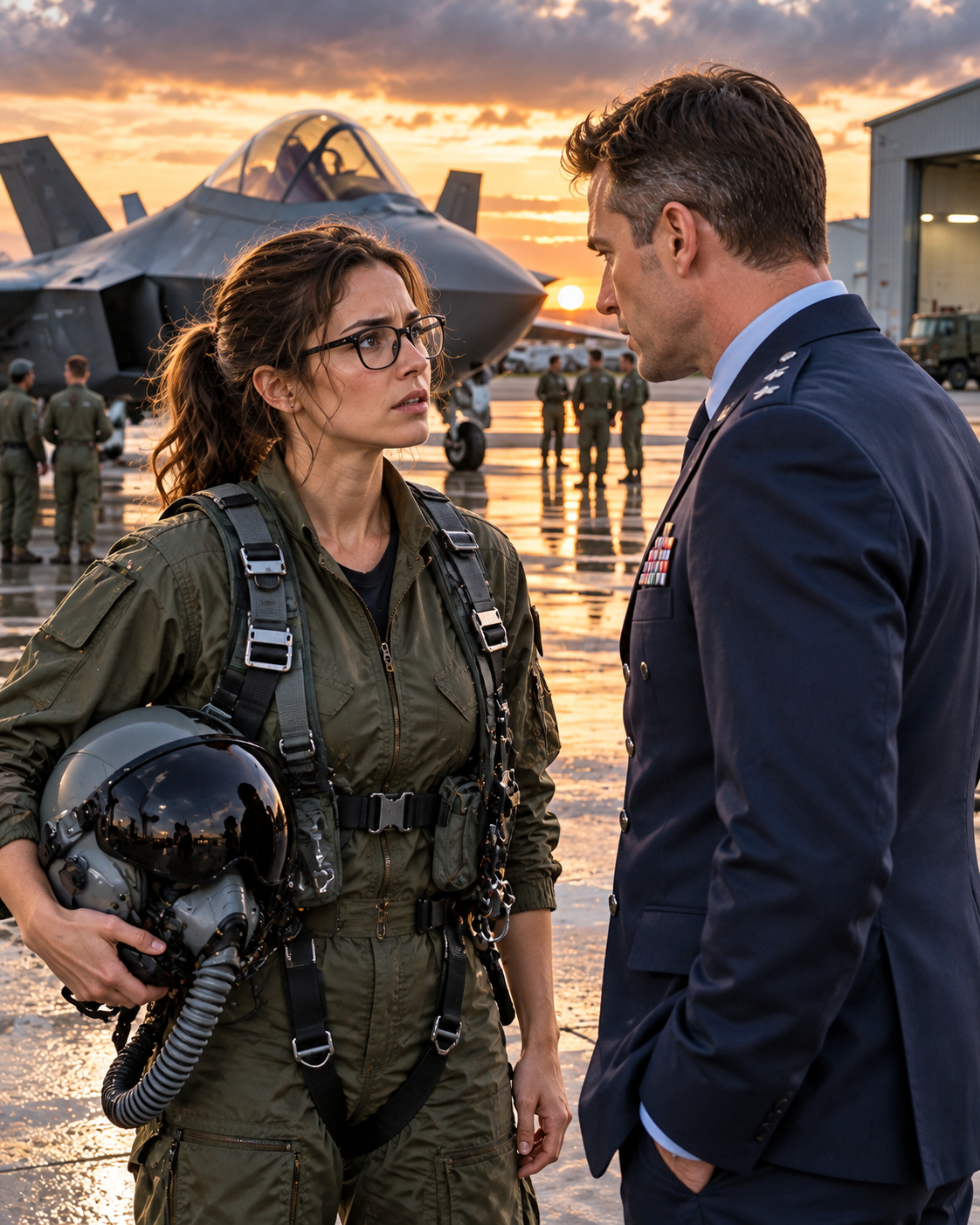
My breathing slowed.
“Thirty feet.”
I eased the nose upward to flare.
The left main gear struck the runway first.
The impact jolted through the aircraft, and water exploded outward from the tires.
For a fraction of a second, I thought we might make it.
Then the right side collapsed.
The sound was like a steel building tearing itself apart.
Metal screamed against concrete.
Sparks erupted beneath the wing, bright orange against the black rain.
The aircraft yawed violently to the right, and the nose began to swing toward the edge of the runway.
Passengers screamed behind us.
The first officer shouted something I could not hear.
I pressed the opposite rudder and fought the controls, trying to keep the nose pointed forward as the damaged engine nacelle scraped the pavement.
The cabin shook so violently that overhead bins burst open.
Luggage tumbled into the aisle.
Sarah’s voice thundered through the intercom.
“Brace! Brace! Heads down! Stay down!”
I kept my eyes forward.
The runway edge rushed toward us.
I could not stop the aircraft cleanly.
I could only influence where it went.
The Boeing slid off the pavement into the muddy shoulder, bouncing hard enough to throw my shoulder against the harness.
The damaged wing shuddered.
For one terrible instant, I expected the aircraft to roll.
Instead, it slammed down again and skidded through the mud, dragging a trail of sparks and broken metal behind it.
Then the nose swung back toward the open field.
The aircraft shuddered once more.
And stopped.
Silence struck harder than the landing.
The engines wound down into a low, uneven rumble.
Rain tapped against the windshield.
Somewhere behind me, a passenger was sobbing.
I stared at the instruments, waiting for the next disaster.
No fire.
No explosion.
No sudden loss of electrical power.
The aircraft was damaged beyond anything I could repair, but it had stopped with all fifty-two people still alive.
I released a breath I had been holding for what felt like an eternity.
Then the smell of fuel reached me again.
Stronger this time.
I turned toward the first officer.
“Possible fuel leak under the right wing. We evacuate now.”
He reached for the emergency checklist.
I was already moving.
“Sarah, evacuate the cabin. Use the safe exits only. Keep everyone away from the right wing and the engine. Tell the fire crews we have a suspected fuel leak.”
Her voice came back immediately.
“Understood.”
I turned toward the captain.
He was unconscious again.
The first officer checked his breathing and called for medical assistance.
I wanted to help him out myself, but the fuel smell was growing stronger, and the remaining electrical systems could not be left in an unknown state.
I looked at the checklist.
Then at the captain.
Then at the damaged aircraft around us.
For eleven years, I had dreamed of leaving the sky behind.
Now the sky had forced me back into a cockpit, and I had one final responsibility before I could walk away.
I began the emergency shutdown procedure, isolating the remaining electrical systems and securing the fuel controls according to the checklist.
My hands were steady.
My heart was not.
Outside, the emergency vehicles converged on the aircraft.
Firefighters spread foam beneath the wing and around the damaged engine while paramedics moved toward the passenger exits.
The first officer called out each completed item.
I answered each one.
When the final critical checks were complete, I looked once more at the instruments.
Then I unbuckled.
The cockpit door opened onto a cabin transformed by chaos.
Passengers were moving toward the exits in a desperate but increasingly orderly stream.
Sarah stood near the forward aisle, guiding people toward the slides and shouting instructions over the rain and the distant crash of firefighting equipment.
A man held his bleeding forehead.
A woman clutched a child against her chest.
An elderly passenger sat frozen in his seat until another traveler helped him stand.
I stopped beside Sarah.
“How many are still inside?”
“Three, including the captain. The first officer is with him.”
“Keep them moving. Don’t let anyone return for luggage.”
She looked at me, her face wet with rain and tears.
“Who are you?”
I almost laughed.
It seemed the entire aircraft wanted an answer to that question.
“I’m Claire.”
She stared at me.
“That’s not what I meant.”
“I know.”
I helped the remaining passengers toward the exit, checking the rows as I went.
When I reached the rear section, a young man was struggling to free his seat belt with shaking hands.
“It’s stuck,” he said.
I knelt beside him and released the buckle.
“Look at me. You’re going to stand up, follow the lights, and keep moving away from the aircraft. Can you do that?”
He nodded.
“Good. Keep going.”
He stumbled toward the exit.
I followed him outside.
Cold rain struck my face.
Mud sucked at my shoes.
Firefighters waved us away from the aircraft, guiding the passengers toward a safe area while paramedics moved between them.
The air smelled of wet grass, fuel, and hot metal.
I turned back toward the Boeing.
It sat crooked in the mud, one side visibly lower than the other, its damaged engine surrounded by foam.
A strange, hollow feeling opened inside me.
For years, I had imagined that if I ever returned to flying, I would feel the old excitement.
Instead, I felt grief.
Not for the aircraft.
Not for the career I had lost.
For the woman I had once been, and for how long I had believed she no longer existed.
A military vehicle stopped near the emergency command post.
A tall man in a dark raincoat stepped out, his silver hair flattened by the weather.
Colonel Thomas Sterling.
I recognized the insignia before I recognized his face.
He walked toward me with a hard expression, flanked by two officers.
“Who was flying that aircraft?”
I looked at him.
“I was.”
He stared as if he had misheard me.
“You were a passenger.”
“Yes, sir.”
“Then explain why an unqualified civilian was in control of a commercial Boeing during an emergency landing.”
His words landed like a slap.
I was too tired to argue.
“The captain was incapacitated. The first officer asked for help. The aircraft was losing hydraulic pressure, and the right main gear had failed.”
Sterling’s jaw tightened.
“That is not an answer to my question.”
Before I could respond, Lucas Vance approached from the other side.
He had removed his flight helmet, and rain ran down his face.
He looked at me with an expression I could not read.
“Colonel, I think you should hear her call sign before you decide she’s unqualified.”
Sterling turned.
“Her what?”
Vance never took his eyes off me.
“Major Cole has identified her. The name matches the old flight records.”
My stomach tightened.
“No,” I whispered.
Vance’s expression softened.
“I’m afraid so.”
He took a breath.
“You’re Falcon, aren’t you?”
For a moment, the rain seemed to stop.
I could hear the firefighters shouting in the distance.
I could hear the passengers being counted.
I could hear the faint crackle of the radio clipped to Vance’s vest.
But all I could think about was a call sign I had not heard in eleven years.
Falcon.
The name I had left behind in a world that no longer wanted me.
Colonel Sterling studied my face.
“Major Cole says Falcon disappeared after a classified training incident eleven years ago.”
I looked toward the Boeing.
The aircraft’s damaged wing gleamed beneath the emergency lights.
“I didn’t disappear,” I said quietly. “I went home.”
Vance lowered his head.
And for the first time since the aircraft touched down, I felt more frightened standing on the ground than I had been in the cockpit.
Part 3
Colonel Sterling did not speak for several seconds.
He stood in the rain, watching me as if he were trying to reconcile the exhausted woman in muddy shoes with the pilot whose name had been spoken in military briefings long after she vanished from active duty.
“Claire Bennett,” he said at last. “Is that your legal name?”
“Yes, sir.”
“And before that?”
I looked at him.
“Major Claire Bennett, United States Air Force. Callsign Falcon.”
His expression changed.
Not dramatically.
Just enough for me to see that the answer had confirmed something he had already suspected.
“Why did you leave?”
The question was simple.
The truth was not.
I looked toward the ambulances.
A paramedic was helping Captain Miller onto a stretcher while another checked the passengers for injuries.
Sarah stood near the evacuation line, counting heads and speaking to a frightened child.
Everyone was alive.
That was the only fact that mattered at that moment.
“I didn’t leave because I stopped caring about flying,” I said. “I left because I couldn’t bear what flying had become.”
Sterling’s face remained unreadable.
Vance stepped closer.
“Sir, we should get her out of the rain before we conduct an interview.”
“She’ll be interviewed,” Sterling replied. “By several agencies, if what I’m hearing is accurate.”
“I understand.”
“Do you?” His gaze sharpened. “You just took control of a commercial aircraft without being listed as a crew member. You made decisions that could have killed everyone aboard. You may have saved them, but we need to know exactly what happened.”
I nodded.
He was right about that.
The landing had not been a miracle, and I had no intention of pretending otherwise.
The aircraft’s mechanical failure would require a full investigation.
The captain’s medical emergency, the first officer’s actions, my entry into the cockpit, the handling of the controls, and the emergency evacuation would all need to be examined.
I would answer every question I could.
But not because a colonel had ordered me to remember who I used to be.
I would answer because fifty-two people had trusted us with their lives, and they deserved the truth.
Before Sterling could continue, Vance spoke again.
“There’s something else you should know, Colonel. Major Cole believes the old Falcon incident may be relevant to how she handled the aircraft today.”
I felt my throat tighten.
“Lucas, don’t.”
He looked at me.
“I won’t tell your story for you.”
That surprised me.
For years, people had spoken about my life as if I were not in the room.
They had described my accident, my medical evaluation, and my departure from the Air Force in language that reduced a person to a file.
Vance waited.
He was giving me the choice.
So I made it.
“Eleven years ago, I was flying an F-22 during a classified training exercise,” I began. “A systems failure left my aircraft badly damaged, and I was forced to make decisions under conditions that were changing faster than the available information.”
Sterling listened without interrupting.
“I brought the aircraft back, but the incident triggered an investigation. There were questions about the exercise, the equipment, and the decisions made before the failure. I cooperated fully.”
“And then you were grounded?”
“Medically, initially. Later, the review process made it clear that returning to operational flying was unlikely.”
“Why?”
I hesitated.
Because the answer had never been as simple as the paperwork suggested.
The accident had left me with injuries that healed more slowly than I expected.
The investigation had left me with doubts I could not discuss.
And the people who had once trusted me had begun looking at me as if survival itself were evidence of a mistake.
“I was physically capable of doing many things,” I said. “But I wasn’t cleared to return to the cockpit. I could have spent the rest of my life fighting that decision, or I could find another way to live.”
“So you became a teacher.”
“Yes.”
“Why history?”
I almost smiled.
“Because teenagers ask difficult questions, and they don’t care much about your rank.”
For the first time, Vance smiled.
Sterling did not.
“You understand that the civil aviation authorities will want a full account of your actions.”
“I do.”
“And the military will want to review your identity and service history.”
“I understand that too.”
He glanced toward the damaged Boeing.
“Then I suggest you start by telling us how you managed to land that aircraft.”
I looked at the runway.
The rain had begun to ease, though the sky remained dark.
I could still see the black streak where the engine nacelle had scraped the concrete.
“The aircraft was already in serious trouble when I entered the cockpit,” I said. “The landing gear was compromised, hydraulic pressure was declining, and the right side was pulling against the controls. I didn’t have enough information to make the aircraft safe. I had enough information to understand that we couldn’t remain airborne indefinitely.”
Vance nodded.
“What did you prioritize?”
“Control. Alignment. A landing before the remaining hydraulic assistance disappeared.”
“And the gear?”
“I couldn’t fix it. I could only prepare for the failure and keep the aircraft pointed as straight as possible when it happened.”
Sterling looked toward the runway again.
“You took it off the pavement.”
“Yes.”
“You could have rolled the aircraft.”
“Yes.”
“You could have lost the wing.”
“Yes.”
“You could have killed everyone aboard.”
I met his eyes.
“Yes, sir. I knew that.”
The rain ran down my collar.
I did not look away.
“But the aircraft was already becoming uncontrollable, and the fuel situation left us limited options. I made the best decision I could with the information available. I’m prepared to have that decision examined.”
For a long moment, Sterling said nothing.
Then he nodded once.
“Good. That’s the answer I needed.”
A paramedic approached us.
“Captain Miller is alive and being transported for evaluation. He has a significant head injury, but he’s breathing on his own. All passengers have been accounted for.”
My knees nearly buckled.
I closed my eyes.
Fifty-two.
All fifty-two.
The number settled into my chest with a force I had not expected.
I had spent eleven years measuring my life against the flight I could no longer make.
I had forgotten that sometimes the only measure that mattered was whether the people entrusted to you got home.
Sarah approached from the evacuation area, her uniform soaked through.
She looked at me with red eyes.
“The passengers want to thank you.”
I shook my head.
“They don’t need to thank me.”
“They want to.”
“I didn’t do it for that.”
“I know,” she said. “That’s why they want to.”
She reached out and squeezed my arm.
For a moment, I had no words.
Then she turned back toward the passengers, leaving me alone with the colonel and the pilot who had called me by a name I thought the world had forgotten.
Vance watched me carefully.
“Can I ask you something?”
“Go ahead.”
“When you heard the aircraft failing, did you know immediately what you were going to do?”
I thought about the cockpit.
The warning tones.
The smell of fuel.
The first officer’s frightened face.
“No,” I said. “I knew what could go wrong. I knew what we couldn’t afford to lose. The rest was one decision at a time.”
He nodded slowly.
“That’s what Major Cole said you were like.”
I looked at him.
“What else did he say?”
Vance’s expression grew serious.
“He said Falcon never panicked, even when the odds were terrible. He said you had a habit of seeing the one thing everyone else was too distracted to notice.”
I felt an old ache rise behind my ribs.
“I panicked plenty,” I said. “I just learned not to let it make the decisions.”
Vance looked toward the aircraft.
“That may be the most useful thing I’ve heard all day.”
The next several hours passed in interviews, medical checks, and preliminary statements.
I gave my account of what had happened in the cockpit, including the first officer’s request for assistance and the steps I had taken after entering the flight deck.
I did not embellish my role.
I did not claim the landing had been perfect.
I explained what I had observed, what I had believed, and why I had acted as I did.
Investigators would determine the mechanical causes of the failure and assess the decisions made during the emergency.
I understood that my actions would be scrutinized.
I welcomed it.
Lives had been at stake, and the truth mattered more than the story anyone wanted to tell about me.
Near dawn, after the passengers had been transported and the emergency crews began clearing the runway, I finally found a quiet corner inside the airport terminal.
My canvas bag sat beside me, still holding the stack of essays I had promised to grade over the weekend.
The sight of it made me laugh.
A few hours earlier, I had been worrying about whether my students would finish their assignments on time.
Now military officers were discussing my former call sign, aviation investigators were documenting my actions, and somewhere in a hospital Captain Miller was fighting his way back from a head injury.
I opened the bag and pulled out the paperback novel.
I had lost my place.
A woman sitting nearby noticed the book in my hand.
“Are you the pilot?”
I looked at her.
She was perhaps forty, with a blanket around her shoulders and a child’s small backpack resting at her feet.
“I helped,” I said.
She shook her head.
“My daughter was on that plane. She told me a woman came into the cockpit and helped bring everyone down.”
Her voice trembled.
“I don’t know how to thank you.”
I glanced at the little backpack.
“What is your daughter’s name?”
“Emily.”
“Is she okay?”
“She’s frightened, but she’s okay.”
I nodded.
“Then stay with her. That’s what she needs most right now.”
The woman began to cry.
I sat beside her while she gathered herself, and for a few minutes we did not discuss the aircraft or the military or the name Falcon.
We talked about her daughter.
We talked about how they had been traveling to visit her grandmother.
We talked about the ordinary plans that had seemed so unimportant before the plane began to fail.
When she finally stood to leave, she took my hand.
“I hope you know what you did.”
I watched her walk toward the terminal doors.
For eleven years, I had wanted to believe that the best part of my life had already happened.
I had mistaken the end of my flying career for the end of my usefulness.
But the woman with the backpack had reminded me of something I had forgotten.
A life was not measured by the uniform someone wore, the aircraft they flew, or the title printed beside their name.
It was measured by the people whose lives became safer because they had been there.
A week later, I returned to my classroom.
The students had heard rumors about the emergency landing, but none of them knew the full story.
My principal asked whether I wanted to take time off.
I told her I was fine, though I suspected the word meant something different now.
When I walked into the classroom, a boy in the back raised his hand.
“Ms. Bennett, is it true you landed a plane?”
The room fell silent.
I set my books on the desk.
“It’s true that I helped during an emergency.”
“Are you a pilot?”
I looked at the faces watching me.
Once, I would have avoided the question.
I would have smiled, changed the subject, and told myself that my past was none of their business.
This time, I gave them an honest answer.
“I used to be.”
A girl in the front row tilted her head.
“Why did you stop?”
I considered telling them that some questions needed time, that some answers were too complicated for a classroom on a Monday morning.
Instead, I told them the truth.
“Sometimes life takes away something you thought you were meant to do. When that happens, you have to decide whether losing that thing means losing yourself.”
Nobody laughed.
Nobody looked away.
I walked to the board and wrote the day’s lesson.
History, I reminded them, was full of people whose lives changed in a moment, and whose real character emerged in the decisions they made afterward.
As I turned back toward the class, I realized I was no longer speaking only about the people in their textbooks.
I was speaking about myself.
I did not know what the aviation investigation would conclude.
I did not know whether the military would ask me to return in some capacity or whether my name would remain attached to the landing for years.
I did know that I had no intention of letting the world decide who I was before I had a chance to decide for myself.
I was Claire Bennett.
I was a teacher.
I had once been Falcon.
And I was no longer ashamed of any of those truths.
That evening, after the last student had left, I stood beside the classroom window and watched the clouds gather above the school.
A jet passed high overhead, its silver shape briefly catching the fading sunlight.
For a moment, I felt the familiar ache.
Then it softened.
I no longer needed to chase the aircraft or imagine myself in its cockpit.
The sky had called me back once, in the worst possible way, and I had answered because people needed help.
That did not mean I belonged to the sky forever.
It meant I had finally made peace with the person I had been.
I turned off the classroom lights and picked up my bag.
The next morning, I would return to teaching.
I would grade the essays, answer difficult questions, and remind my students that courage rarely feels like courage while you are living through it.
Sometimes it feels like fear, exhaustion, and the simple refusal to abandon someone who needs you.
Eleven years earlier, I had believed my life ended when I lost the right to fly.
On that rain-soaked runway, I discovered that a life can change direction without losing its purpose.
I had not returned to the cockpit to reclaim my old name.
I had entered it because fifty-two people needed someone to take responsibility when the instruments began to fail.
And when the storm finally cleared, I understood something I wished I had learned years ago.
The past can shape your hands, sharpen your instincts, and teach you how to survive.
But it does not own your future.
I had spent eleven years hiding from the sky because I thought it had taken everything from me.
Now I could look up without bitterness, knowing that I had carried something precious out of the wreckage.
Not my rank.
Not my call sign.
Not the career I had lost.
I had carried forward the part of myself that still knew how to act when someone else’s life depended on it.
And for the first time in eleven years, I was no longer afraid of being remembered as Falcon.
I was simply grateful to be Claire Bennett, a woman who had found her way home, not by returning to the life she once had, but by finally accepting the life she had chosen.