The moment forty cowboys abandoned my beef stew at Silver Ridge Ranch, their coldhearted foreman smiled, unaware I would uncover the secret buried beneath his cruelty.
The voice came again from beyond the orchard fence, trembling as it called the name of a woman who had been dead for eleven years.
“Margaret, please, I know you’re here.”
Thomas Whitmore dropped his hat, and I watched the color drain from his face.
Cole Bennett moved in front of me, his hand resting near the revolver at his hip.
“Stay behind me, Amelia,” he whispered.
But I had spent too many years obeying frightened men who believed silence could protect me.
I stepped around him and stared into the darkness.
A tall figure stood beside the broken fence, leaning heavily against a wooden walking stick.
His coat was torn, his silver hair hung beneath a weather-beaten hat, and one side of his face carried a terrible scar.
Yet his eyes were unmistakable.
They were the same gray eyes staring back at me from the photograph in my trembling hands.
“Jonathan?” Thomas whispered.
The stranger stopped breathing for a moment.
Then his walking stick slipped from his fingers and struck the frozen earth.
“Thomas,” he said, his voice cracking. “You told me she was dead.”
I looked from one brother to the other.
“Who told you that?”
Jonathan stared at me as though he were seeing a ghost.
His lips parted, but no words came.
Then his gaze fell upon the photograph I held against my chest.
“Where did you get that?”
“It belonged to my mother.”
His face twisted with sudden pain.
“Your mother?”
“My name is Amelia Carter.”
The old man staggered backward and caught himself against the fence.
For several terrible seconds, nobody moved.
Then Jonathan lifted one shaking hand toward me.
“Little Amy?”
I felt something deep inside me break.
Nobody had called me that since my mother died.
“How do you know that name?”
Tears filled his eyes.
“Because I whispered it against your mother’s stomach before you were born.”
The orchard seemed to tilt beneath my feet.
I had imagined meeting my father a thousand times as a little girl.
Sometimes he was a soldier returning from war.
Sometimes he was a traveler who had lost his way.
But never had I imagined finding him broken and trembling beneath a Colorado moon.
“You’re supposed to be dead,” I whispered.
Jonathan closed his eyes.
“So was your mother.”
Thomas suddenly stepped forward.
“Jonathan, we need to go inside.”
“No.”
The word came from my mouth before I could stop it.
“Nobody is going anywhere until someone tells me why my entire life has been built upon lies.”
Cole looked toward Thomas.
“You owe her the truth.”
Thomas’s jaw tightened.
“And you think the truth won’t destroy what’s left of this family?”
I held up my mother’s letter.
“Whatever the truth is, it belongs to me.”
Jonathan began to cry.
Not loudly, not dramatically, but with the helpless grief of a man who had carried sorrow until his body could no longer contain it.
“I searched for you,” he whispered. “God help me, Amelia, I searched for you.”
Then his knees buckled.
Cole caught him before he struck the ground.
We carried him into the ranch house while the wind rattled the windows like impatient fingers.
I heated water and brought clean cloths as Thomas helped remove Jonathan’s filthy coat.
Beneath his shirt were scars that made my stomach turn.
There were old wounds across his shoulders and a deep indentation near his ribs.
Someone had hurt this man terribly.
Jonathan noticed me staring and pulled the blanket higher.
“Those are old troubles, child.”
“Old troubles don’t disappear because nobody speaks about them.”
He gave a weak, sorrowful smile.
“You sound exactly like Margaret.”
Hearing my mother’s name spoken with such tenderness nearly undid me.
For years, I had carried her memory alone.
Now a stranger sat before me with an entire lifetime of memories I had never been allowed to share.
I wanted to embrace him.
I wanted to scream at him.
Most of all, I wanted to know why he had not come sooner.
Thomas stood near the fireplace, staring into the flames.
Finally, he spoke.
“Our father owned Silver Ridge before either of us was grown.”
Jonathan’s expression darkened.
“He owned the land, but he believed that meant he owned everyone living on it.”
Thomas nodded.
“When Jonathan fell in love with Margaret, Father threatened to disinherit him.”
“Margaret wasn’t wealthy,” Jonathan whispered. “But she was kinder than anyone I’d ever known.”
He looked toward the kitchen.
“She cooked for the ranch hands when they were sick, taught their children to read, and planted peach trees where everyone said nothing would grow.”
A faint smile touched his mouth.
“She always said stubborn things sometimes needed a little sweetness.”
My throat tightened.
That sounded like my mother.
Not the exhausted widow I remembered, but the brave young woman she had once been.
“Then what happened?” I asked.
Thomas looked away.
Jonathan answered instead.
“Your grandfather discovered Margaret was carrying you.”
The fire cracked sharply.
“He sent men to frighten her away.”
My fingers curled against my skirt.
“Did they hurt her?”
Jonathan’s silence was answer enough.
“She survived,” he finally said. “And I promised no one would ever touch her again.”
He reached toward Thomas.
“My brother helped us draw up a deed, giving Margaret half the ranch.”
I looked at the paper lying beside the fireplace.
“Then the deed is real.”
“Every word.”
Thomas slowly lowered himself into a chair.
“Father discovered our plans before the marriage could take place.”
Jonathan stared into the fire.
“Three nights later, I was riding to Denver to meet Margaret when someone shot my horse beneath me.”
My heart pounded.
“I woke in a locked wagon, bound and bleeding.”
He swallowed.
“The men told me Margaret had died giving birth.”
I covered my mouth.
“They showed me a little silver locket and said it had been taken from her body.”
Thomas bowed his head.
“Father told me Jonathan had abandoned her.”
Jonathan turned toward his brother.
“And you believed him?”
Thomas’s face crumpled.
“I wanted to.”
The confession struck the room like a gunshot.
“I was twenty-three, frightened of Father, and desperate to inherit something that had never truly belonged to me.”
Jonathan’s voice dropped.
“So you let him bury me.”
Thomas did not deny it.
“I signed the papers declaring you dead after Father claimed your body had been found.”
I felt sick.
“And my mother?”
“She came here searching for him,” Thomas whispered. “I told her Jonathan had ridden away willingly.”
Jonathan pressed both hands against his face.
“Oh, Margaret.”
I remembered my mother sitting beside our kitchen window on winter evenings, staring toward the western mountains.
I remembered how she sometimes held a silver locket without ever opening it.
And I remembered asking why she looked so sad.
“Some goodbyes are never spoken,” she used to tell me.
I had believed she meant my father had died before I was born.
Now I understood she had spent years believing he had chosen to abandon us.
I rose from my chair.
“I need some air.”
Cole followed me onto the porch but kept a respectful distance.
Snow had begun falling across the yard.
The ranch buildings stood silent beneath the moonlight.
“Did you know?” I asked.
Cole did not pretend to misunderstand.
“I knew there was a dispute over the land.”
“And my father?”
“I found evidence he might be alive three months ago.”
I turned sharply.
“Three months?”
He nodded.
“A letter arrived from a mission hospital in New Mexico.”
“You knew someone was searching for me?”
“I knew Jonathan Whitmore was asking whether Margaret Carter had a daughter.”
My chest tightened.
“And you said nothing.”
“Thomas told me the man was a fraud.”
I stared at him.
“Did you believe that?”
Cole looked ashamed.
“I wanted to.”
The words hurt worse because they were familiar.
Thomas had wanted to believe his brother was gone.
Cole had wanted to believe the ranch owner.
And my mother had been left to suffer because frightened men found convenient lies easier than difficult truths.
“That’s why you humiliated me at supper,” I said.
Cole’s face hardened with shame.
“I thought you might have come to claim the ranch.”
“Forty men walked away from my table because you told them to.”
He nodded.
“Yes.”
I looked toward the kitchen window, where warm light spilled across the snow.
“Do you know what I thought that night?”
Cole said nothing.
“I thought they saw a fat, lonely woman who didn’t belong anywhere.”
He flinched.
“I never meant—”
“Perhaps you didn’t,” I interrupted. “But you made me feel smaller than any person should feel.”
He removed his hat.
“I’m sorry, Amelia.”
I believed he meant it.
But an apology could not erase the memory of forty untouched bowls.
“Trust isn’t something you can demand back,” I told him.
Then I went inside.
By morning, Jonathan’s fever had risen.
He could barely lift his head, and I spent hours cooling his forehead and helping him drink broth.
Between restless dreams, he called for Margaret.
Each time, I felt my heart twist.
At noon, Eli entered the kitchen carrying fresh firewood.
He found me sitting beside an untouched bowl of soup.
“Miss Amelia?”
I looked up.
“Yes, sweetheart?”
He shifted awkwardly.
“The boys heard what happened.”
I sighed.
“Then I imagine they’ll have plenty to say.”
Eli shook his head.
“They’re worried about you.”
Before I could answer, he placed a folded paper on the table.
Forty names had been written beneath a single sentence.
“We were wrong to leave your table, and we’d be honored if you’d let us sit at it again.”
I stared at the crooked handwriting.
Some names were barely legible.
Others had been carefully drawn by men whose hands were better suited to ropes than pens.
At the bottom, Cole had written one additional line.
“No man at Silver Ridge will ever be ordered to turn his back on you again.”
I pressed the paper against my chest.
For the first time since Jonathan’s arrival, I allowed myself to cry.
That evening, every cowboy came inside before supper.
Nobody touched his food until I sat down.
Samuel raised his tin cup.
“To Miss Amelia, who managed to make decent men out of forty stubborn fools.”
Laughter filled the dining room.
I smiled through my tears.
But just as we began eating, a rider approached the ranch at full gallop.
The front door burst open.
A frightened young stable hand stumbled inside.
“Mr. Whitmore, there’s trouble coming from Denver!”
Thomas rose.
“What kind of trouble?”
The boy struggled to catch his breath.
“Three men rode through town asking about Jonathan Whitmore.”
Silence fell across the room.
“One of them is Sheriff Harlan Pike.”
Thomas went white.
Jonathan gripped the edge of the table.
I noticed his fear immediately.
“Who’s Sheriff Pike?”
Jonathan looked at me with haunted eyes.
“The man who helped my father make me disappear.”
Outside, thunder rolled across the mountains.
Cole reached for his gun.
“How long until they get here?”
The boy swallowed.
“By morning.”
Nobody slept much that night.
The men secured the stable doors and checked their rifles while Thomas searched through old records.
I stayed beside Jonathan.
Near midnight, he reached beneath his pillow and handed me a small leather pouch.
Inside was a wedding ring.
The gold was worn, and a tiny peach blossom had been engraved along its edge.
“I bought this for your mother,” he whispered.
I turned it carefully between my fingers.
“She never received it?”
He shook his head.
“I carried it through every place they sent me.”
His eyes filled.
“When I escaped, I thought I could find her.”
“Why didn’t you?”
“They kept moving me from one labor camp to another, and every time I got free, somebody dragged me back.”
He coughed painfully.
“Years passed before the men holding me lost their power.”
I held his hand.
“And you still came looking?”
“Every morning I woke, I prayed she was alive.”
My voice broke.
“She waited for you.”
Jonathan shut his eyes.
“Then I have already lost the greatest treasure God ever gave me.”
I wanted to tell him he had not lost everything.
That I was sitting beside him.
That perhaps we still had time.
But I was afraid to promise something life might steal.
The following morning, Sheriff Pike arrived beneath a heavy gray sky.
He was a broad-shouldered man with a polished badge and eyes that never seemed to settle.
Two armed deputies rode beside him.
Thomas met them outside.
I stood on the porch with Cole and several ranch hands.
“Morning, gentlemen,” Pike said pleasantly.
Then he looked straight at me.
“You must be Margaret Carter’s daughter.”
My skin went cold.
“I am.”
He smiled.
“Then you’ve caused quite a disturbance.”
Cole stepped forward.
“State your business, Sheriff.”
Pike reached inside his coat and produced a folded warrant.
“Jonathan Whitmore is wanted for the murder of his father, Edward Whitmore.”
Thomas staggered backward.
“That’s impossible.”
Pike shrugged.
“Your father was found dead three weeks ago.”
Jonathan appeared behind me, leaning against the doorway.
“My father died?”
For a moment, the hatred vanished from his face, replaced by something almost childlike.
Pike looked pleased.
“Seems you have a great deal to answer for.”
I stepped between them.
“Jonathan has been missing for decades.”
“Missing men can still commit crimes, ma’am.”
“He was in New Mexico three weeks ago.”
Pike’s smile thinned.
“Then he’ll have an opportunity to prove it.”
He reached for Jonathan.
Cole caught his wrist.
“Not without reading that warrant.”
The sheriff’s eyes narrowed.
“Careful, Bennett.”
The two deputies shifted toward their guns.
I could feel the men behind us preparing to fight.
One wrong movement would turn the porch into a battlefield.
Then Thomas spoke.
“Let me see the document.”
Pike hesitated.
It lasted only a second.
But I noticed.
Thomas unfolded the warrant and examined the signature.
His expression changed.
“This was signed by Judge Bellamy.”
“That’s right.”
“Judge Bellamy died last spring.”
A terrible silence followed.
Then Pike struck Thomas across the face with his revolver.
Cole moved instantly.
He knocked the weapon aside as the first deputy drew his gun.
A shot shattered the kitchen window.
I dropped to my knees.
Someone screamed.
The second deputy fired toward Cole, but Eli slammed into him from behind.
They crashed into the snow.
Samuel swung a shovel against the first deputy’s arm.
Within seconds, the ranch yard erupted into shouting, gunfire, and pounding boots.
Then a sharp cry cut through everything.
Cole fell against the porch railing.
Blood spread across his sleeve.
“Cole!”
I crawled toward him as Jonathan struggled to stand.
Pike grabbed me by the collar.
“Where’s the deed, woman?”
His breath smelled of whiskey.
I stared at him.
“So that’s what this is about.”
He tightened his grip.
“Your grandfather’s land belongs to the men who earned it.”
“No,” I whispered. “It belongs to the people he stole it from.”
Pike raised his revolver.
Before he could fire, Jonathan struck him with his walking stick.
The sheriff stumbled backward.
Cole, bleeding heavily, seized Pike’s ankle and dragged him into the snow.
Samuel and James rushed forward, pinning him down.
The other deputies surrendered when they saw forty furious cowboys surrounding them.
I barely noticed.
I was already tearing strips from my apron to bind Cole’s wound.
“Look at me,” I ordered.
He tried to smile.
“You’re giving orders now?”
“Be quiet.”
“That’s more like it.”
His face was dangerously pale.
I pressed harder against the bleeding.
“Don’t you dare die before I decide whether to forgive you.”
He gave a weak laugh.
“Then I suppose I’d better stay.”
We carried him inside.
By evening, the doctor from town had removed the bullet.
It had missed the bone, though Cole had lost enough blood to leave him weak for days.
Meanwhile, Samuel and Thomas searched Pike’s saddlebags.
What they found changed everything.
There were forged land deeds, unsigned warrants, and a ledger recording payments from Edward Whitmore.
One entry described money given to the men who had kidnapped Jonathan.
Another listed monthly payments to Sheriff Pike.
And beside Margaret Carter’s name was a chilling instruction.
“Keep the woman away from Silver Ridge.”
I sat at the kitchen table reading those words.
My mother had spent her final years washing laundry for wealthy families and sewing clothes by candlelight.
There had been winters when we barely had enough coal to keep warm.
Yet half of Silver Ridge had legally belonged to her all along.
Thomas stood across from me.
“I should have told her.”
I looked up.
“Yes, you should have.”
His shoulders sagged.
“I was afraid Father would destroy me.”
“And so you helped him destroy her.”
He began to weep.
I had never seen a grown man look so completely defeated.
But for once, I refused to comfort someone simply because his guilt had become painful.
“Your sorrow is yours to carry, Thomas.”
He nodded.
“I know.”
“Then do something useful with it.”
The next morning, Thomas rode to Denver with the forged papers and two trusted ranch hands.
He returned four days later accompanied by a territorial investigator and a lawyer.
The investigation continued through the winter.
Edward Whitmore’s death had been natural, and Pike’s murder accusation had been fabricated to silence Jonathan.
More evidence surfaced from the ranch accounts, proving that Edward had concealed Margaret’s ownership and paid men to imprison his own son.
Pike and his deputies were taken into custody to face charges.
But the hardest truth emerged from a letter Edward had written before his death.
He had admitted everything.
Not because he was sorry.
But because he feared that the land would pass into the hands of someone he considered beneath his family.
In his final paragraph, he had written:
“Margaret Carter’s daughter must never inherit Silver Ridge.”
I read that sentence three times.
Then I folded the letter and placed it beside my mother’s recipe book.
For the first time, I understood something that had taken me half a lifetime to learn.
Cruel people could steal money, opportunities, and precious years.
But they could not decide what kind of person their victims would become.
Spring arrived slowly.
The snow retreated from the valley, exposing green grass and muddy wagon trails.
Jonathan grew stronger, although he would always walk with a limp.
He began spending his mornings beneath the peach trees, telling me stories about my mother.
He remembered the way she sang while baking bread.
He remembered her stubborn refusal to leave a hungry person unfed.
And he remembered the first time she had laughed at one of his terrible jokes.
“Your mother had a laugh that made a man believe the world might be kinder tomorrow,” he told me.
I smiled.
“She still laughed like that when I was little.”
Jonathan reached for my hand.
“I’m glad someone heard it after I was gone.”
One afternoon, I took him to the small cemetery beyond the eastern pasture.
My mother was buried miles away, but I had planted a young peach tree beside a simple memorial stone.
I had carved her name into it myself.
Margaret Carter.
Beloved Mother.
A Woman Who Never Stopped Giving.
Jonathan knelt before the stone.
He placed the little wedding ring beneath it and bowed his head.
“I’m sorry I couldn’t come home, Margaret.”
I stepped away to give him privacy.
When I returned, he was still kneeling.
“Do you think she forgave me?” he asked.
I sat beside him.
“She never stopped loving you.”
He wiped his eyes.
“How can you know?”
“Because she taught me to make peach pie from a recipe she brought from this ranch.”
He looked at me.
“Even when she believed you’d left her, she kept something beautiful from the life you shared.”
Jonathan reached for my hand.
And there, beneath the spring sunlight, I finally embraced my father.
Not because the past had been repaired.
It never could be.
But because we had been given the chance to stop wasting the future.
By early summer, the court had confirmed my mother’s share of Silver Ridge and recognized my inheritance.
Thomas called a gathering in the dining hall.
Forty cowboys crowded around the tables where they had once rejected my first meal.
He stood before them holding the property papers.
“Half this ranch now belongs to Amelia Carter,” he announced.
A cheer rose so loudly that the windows rattled.
I laughed through my tears.
Then Thomas raised his hand.
“And I intend to give her my half as well.”
The room fell silent.
I stared at him.
“Thomas, you don’t have to do that.”
“Yes,” he replied softly. “I do.”
He placed the papers before me.
“I spent most of my life protecting an inheritance I never earned.”
His voice trembled.
“I cannot return the years your family lost, but I can stop pretending the land matters more than the people living on it.”
I looked at the documents.
Then at the men surrounding me.
Some had no families.
Others had nowhere else to go.
All of them had helped turn a cold, struggling ranch into something worth saving.
“I’ll accept your offer on one condition,” I said.
Thomas nodded.
“Name it.”
“Silver Ridge will never again turn away a hungry traveler who cannot afford a meal.”
A murmur passed through the room.
“And every man who works this land will be treated with dignity, whether he owns a horse or nothing but the clothes on his back.”
Samuel stood first.
“You have my word.”
Then Eli rose.
“And mine.”
One by one, all forty cowboys stood.
The sound of their boots against the floor brought back the memory of that first terrible supper.
Only this time, nobody was walking away.
That evening, Cole found me in the orchard.
His arm had healed, though a faint scar remained.
He carried two slices of peach pie on a wooden plate.
“I thought the owner might appreciate dessert,” he said.
I laughed.
“You’re getting bold, Mr. Bennett.”
He handed me a slice.
“I’ve been meaning to ask you something.”
I raised an eyebrow.
“If it’s about another bowl of stew, the answer is no.”
He smiled, then grew serious.
“I treated you cruelly because I was afraid of losing the only home I had.”
I looked toward the ranch house.
“And now?”
“Now I know a home isn’t something you keep by shutting other people out.”
He hesitated.
“I don’t expect you to forget what happened.”
“I haven’t.”
“But if you’ll allow it, I’d like to spend whatever years I’ve got proving I’ve learned to be a better man.”
His words settled gently between us.
I studied the rough face that had once frightened me.
There was kindness there now.
Not perfect kindness.
Not the sort found in fairy tales.
But something real, earned through mistakes and difficult choices.
“Are you asking to court me, Cole Bennett?”
He removed his hat.
“Yes, ma’am.”
I pretended to consider.
“Can you wash dishes?”
“Yes.”
“Chop wood?”
“Every morning.”
“Eat beef stew without insulting the cook?”
He laughed.
“I’ll eat two bowls.”
I smiled.
“Then perhaps we can start with supper.”
He took my hand.
And for the first time in many years, I did not pull away from the possibility of being loved.
Autumn returned to Silver Ridge with golden leaves and cool evenings.
The peach orchard produced more fruit than anyone expected.
We filled the pantry with preserves, dried peaches, and jars of sweet syrup.
Jonathan supervised the harvest from his favorite chair.
Thomas helped mend fences beside the ranch hands.
Cole spent his evenings helping me prepare supper, although his biscuits remained a terrible disappointment.
And every Sunday, we opened our doors to travelers, widows, orphaned children, and anyone who needed a warm place to rest.
One afternoon, a thin young woman appeared at the kitchen door with two little boys hiding behind her skirt.
Her shoes were torn.
Her hands trembled.
“I’m sorry to bother you,” she whispered. “I heard there might be work here.”
I recognized the fear in her eyes.
I had carried that same fear when I first arrived.
“What’s your name, sweetheart?”
“Clara.”
“Can you cook?”
“A little.”
“Can you learn?”
She nodded desperately.
I opened the door wider.
“Then come inside.”
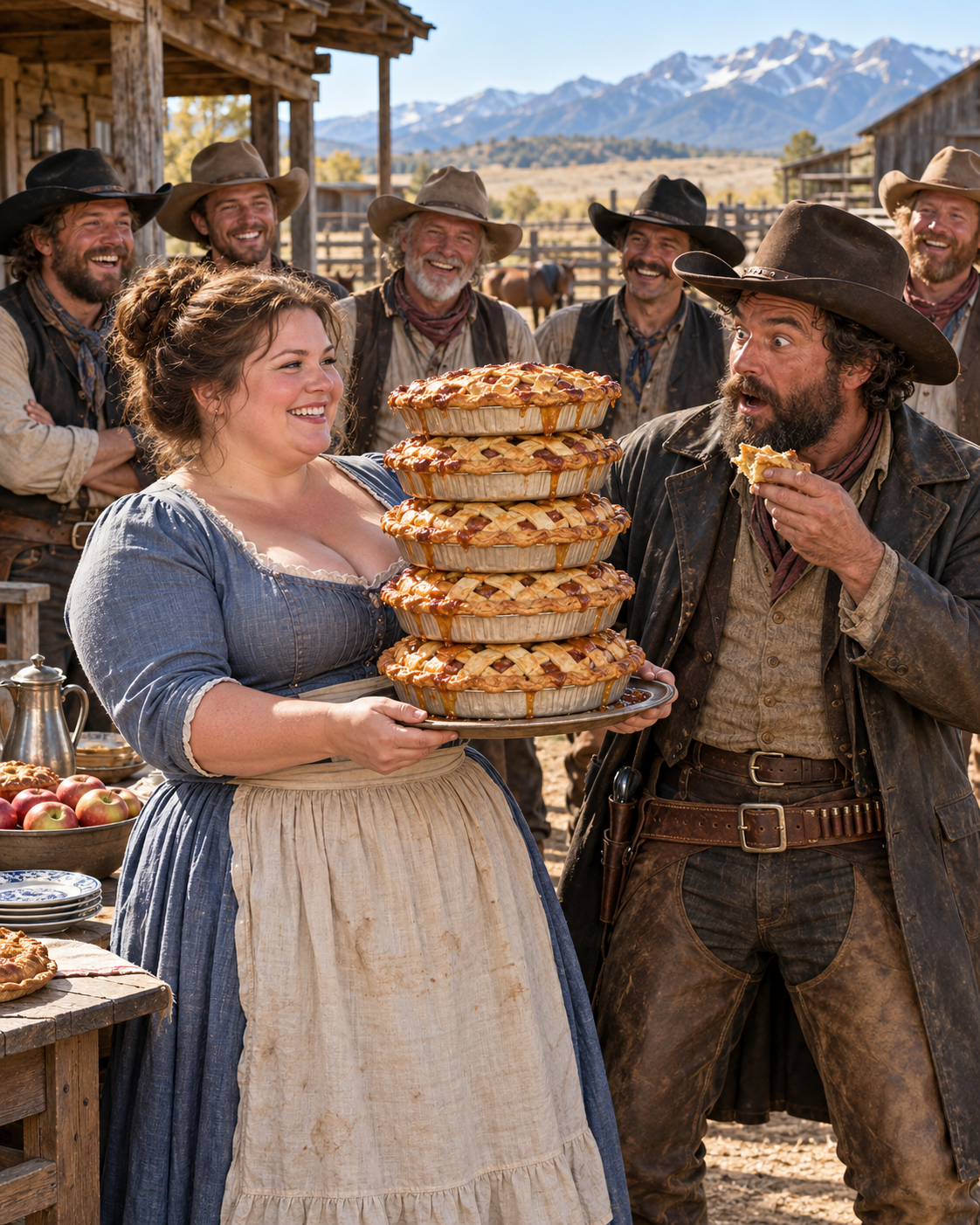
Her youngest boy stared at the pies cooling beside the window.
“Are those for rich people?” he asked.
Something inside me ached.
I knelt before him.
“No, darling.”
I handed him a warm slice.
“These are for hungry people.”
The child took one bite and smiled.
His mother began crying quietly into her hands.
And suddenly I understood why my own mother had spent so many years feeding strangers even when our cupboards were nearly empty.
She had not been trying to fill their stomachs alone.
She had been reminding them they mattered.
That evening, as the sun disappeared behind the Rocky Mountains, I stood outside the dining hall listening to laughter spill through the open windows.
Forty cowboys sat around the tables.
Clara and her children were among them.
Thomas was telling a story.
Jonathan was smiling.
And Cole was bringing in a pot of beef stew.
I thought of the lonely woman who had stood in this same doorway one year earlier, watching forty men reject everything she had worked so hard to give.
She had believed her worth depended on whether strangers accepted her.
She had believed grief meant the beautiful parts of her life were finished.
I wished I could reach back through time and take that woman’s hand.
I would tell her that some doors close because the people behind them do not yet know how to welcome anyone.
And sometimes, the bravest thing a person can do is remain kind without surrendering their dignity.
Cole appeared beside me.
“What’s on your mind?”
I leaned against his shoulder.
“My mother.”
He slipped his hand into mine.
“She’d be proud of you.”
I looked toward the orchard, where her beloved peach trees swayed beneath the evening breeze.
“I hope so.”
From inside, Eli shouted that supper was getting cold.
Cole smiled.
“Shall we?”
I looked through the doorway at the faces waiting around our table.
There was my father, whom I had believed lost forever.
There was Thomas, learning that repentance required more than regret.
There were forty rough cowboys who had discovered that strength did not mean hiding tenderness.
And there was a place for me among them.
“Yes,” I whispered. “Let’s go home.”
We entered the dining hall together.
As I sat down, the men rose from their chairs.
For a heartbeat, the sight stopped my breath.
Then Samuel lifted his cup.
“To Amelia Carter, the woman who fed forty stubborn men until they remembered how to be human.”
The room erupted in laughter and applause.
I covered my mouth, overwhelmed.
Jonathan reached across the table and squeezed my hand.
And this time, when the men sat down, every one of them reached for my stew.
I watched them eat, talk, and smile beneath the warm lamplight.
For years, I had believed that healing meant forgetting everything that had hurt me.
But I knew better now.
Healing meant remembering the pain without allowing it to decide the rest of my life.
It meant knowing that forgiveness did not excuse cruelty, and that love was proven through actions rather than beautiful promises.
Most of all, it meant understanding that no person should have to earn kindness by becoming smaller, quieter, prettier, or more acceptable to others.
My mother had left me no fortune that I knew of.
She had left me a worn recipe book, two strong hands, and the courage to keep offering goodness in a world that had not always been gentle.
And somehow, those gifts had helped me build a home.
Outside, the first stars appeared above Silver Ridge.
Inside, forty men asked for second helpings.
I laughed and carried another steaming pot to the table.
Because I had finally learned that a person’s true worth is never measured by the people who walk away.
It is revealed in the love they choose to give, the boundaries they learn to keep, and the lives they help make better.
And as my father smiled across the table, I understood one final truth.
Sometimes, what seems like the end of everything is only the place where a beautiful new life begins.
THE END.