The Duke of Brook Haven offered Eleanor Pembroke two choices: marry him before the week was over, or watch her father hang.
THE DUCHESS OF BROOK HAVEN — THE FINAL CHAPTER
Eleanor Pembroke had married a duke to save her father from the gallows.
Now, standing in the library of Brook Haven, she was holding a letter that threatened to send them both there.
The words seemed to move beneath the candlelight.
“Silas Pembroke has confessed, and by sunrise, his daughter will be named as his accomplice.”
Across the room, Gideon Ashford reached for the ceremonial sword hanging above the fireplace.
“Put that down,” Eleanor said.
He stopped, his hand resting against the cold metal.
“Julian has gone too far.”
“And what exactly will you accomplish with a sword?”
Gideon turned toward her.
For a moment, she saw the man the world feared: the ruthless Duke of Brook Haven, whose quiet displeasure could destroy fortunes and reputations.
But his anger was not directed at her.
“He intends to have you arrested before I can challenge the confession.”
“Then we must challenge it tonight.”
Gideon looked toward the windows, where the rain had begun to fall harder.
“The magistrate is nearly two hours away.”
“Then we should stop wasting time.”
She folded Julian’s letter and placed it inside her sleeve.
Gideon watched her, something unreadable passing across his face.
“You’re not afraid?”
Eleanor reached for her gloves.
“I am terrified, Your Grace.”
Her fingers hesitated over the final button.
“But I have spent enough of my life allowing frightened men to decide what happens to me.”
For the first time that night, Gideon almost smiled.
Almost.
Then he opened the library door.
“Mrs. Bell, have the carriage brought around.”
The elderly housekeeper appeared immediately, though Eleanor suspected she had never gone far.
“Your Grace,” Mrs. Bell whispered, “there is something you ought to know.”
Gideon’s expression changed.
“What is it?”
Mrs. Bell glanced over her shoulder.
“Lord Julian did not leave by himself.”
Eleanor felt the room grow still.
“Who accompanied him?”
“A woman, sir. She wore a dark traveling cloak, but I recognized her voice.”
Mrs. Bell clasped her hands.
“It was Miss Harcourt.”
Gideon went motionless.
Eleanor had never heard the name.
Yet something about the way her husband stood told her it mattered.
“Who is Miss Harcourt?” she asked.
He did not answer immediately.
Then he said, “The daughter of the man who managed this estate before Julian.”
“And where is her father now?”
Gideon looked at the dying fire.
“Dead.”
***
The carriage traveled through the night, its wheels sinking into deep ruts along the flooded road.
Eleanor sat opposite Gideon, studying the envelope he had nearly hidden from her.
“My father’s letter,” she said.
Gideon lifted his eyes.
“You still have it.”
“You kept it from me.”
“I promised him I would.”
“And now?”
He held her gaze for several seconds before withdrawing the folded paper from his coat.
“Now I believe that promise may cost you your freedom.”
Eleanor broke the seal carefully.
Her father’s handwriting was uneven, the ink faded where moisture had touched the page.
My dear Eleanor,
If you are reading this, I have failed you more completely than I ever imagined possible.
I have done shameful things, but the theft they accuse me of was not mine alone.
I signed papers for Lord Julian Vance because he promised to settle my debts.
When I understood what those papers concealed, he threatened to accuse you of helping me.
There is proof.
Look where the old accounts were buried, beneath the place where the village children once came to learn.
Forgive me if you can.
Your father.
Eleanor read the letter twice.
The carriage lantern swayed above them.
“The village school,” she whispered.
Gideon leaned forward.
“What?”
“The old schoolhouse. Mrs. Bell said it was closed after the former estate manager died.”
Gideon’s eyes narrowed.
“Harcourt.”
Eleanor looked up.
“The manager?”
“Thomas Harcourt kept separate records of the estate’s charitable expenditures. He was meticulous, irritatingly honest, and quite incapable of overlooking a missing shilling.”
“What happened to him?”
“He fell from the northern bridge during a storm.”
Eleanor folded the letter.
“And everyone believed it was an accident?”
Gideon’s silence answered her.
Outside, thunder rolled across the distant hills.
“We must turn back,” she said.
Gideon pulled the carriage cord.
“No. Julian is expecting us to search the estate. We go to the magistrate first.”
“But the evidence—”
“Will still be there if we give him no reason to suspect we know where to look.”
Eleanor studied him.
“And if he already knows?”
The carriage slowed.
Gideon looked toward the dark road behind them.
“Then we have very little time.”
***
The magistrate’s residence stood beyond the market square, its windows illuminated despite the late hour.
Inside, Magistrate Alden received them in a chamber smelling of damp wool and extinguished candles.
He was a thin man with silver spectacles and the careful manner of someone accustomed to powerful visitors.
“Your Grace,” he said, rising. “I had not expected you.”
“Nor had I expected to hear that a man under your protection had confessed without his solicitor present.”
Alden adjusted his spectacles.
“Mr. Pembroke signed a formal admission this evening.”
“May I see it?” Eleanor asked.
The magistrate looked toward Gideon.
“My lady, these are delicate legal matters.”
Eleanor stepped closer to his desk.
“Then I shall be delicate.”
She held out her hand.
After a moment, Alden opened a drawer.
The confession consisted of two pages, both marked with her father’s trembling signature.
Eleanor studied the final paragraph.
Then she turned back to the first page.
“Who witnessed this?”
“Lord Vance and a clerk.”
“And where is the clerk?”
“At his lodgings, I presume.”
She touched the margin.
“This document was written before my father signed it.”
“Naturally, Duchess.”
“No. I mean it was written before he was questioned.”
Alden’s expression tightened.
Eleanor pointed to a faint brown mark beneath the signature.
“My father is left-handed. When he writes, he smudges fresh ink toward the right. There is no smudge here.”
Gideon stepped beside her.
Alden reached for the document.
Eleanor moved it away.
“Furthermore, the signature is darker than the confession itself. Someone prepared the statement and brought it to him afterward.”
The magistrate stared at her.
“That proves very little.”
“Then allow me to speak with him.”
Alden hesitated.
Gideon’s voice became dangerously quiet.
“You will permit the Duchess to see her father.”
The magistrate lowered his eyes.
“Of course, Your Grace.”
***
Silas Pembroke sat in a narrow room behind the courthouse, his clothes disordered and his face hollow beneath the yellow lamplight.
When Eleanor entered, he struggled to his feet.
“Ellie.”
She had not heard the childhood nickname since the morning of his arrest.
For a moment, she remained near the door.
He looked older than he had three weeks earlier.
His hands shook.
There was an ugly bruise beneath one eye.
“Who hurt you?” she asked.
Silas glanced at the guard outside.
“No one.”
Eleanor approached him.
“Father.”
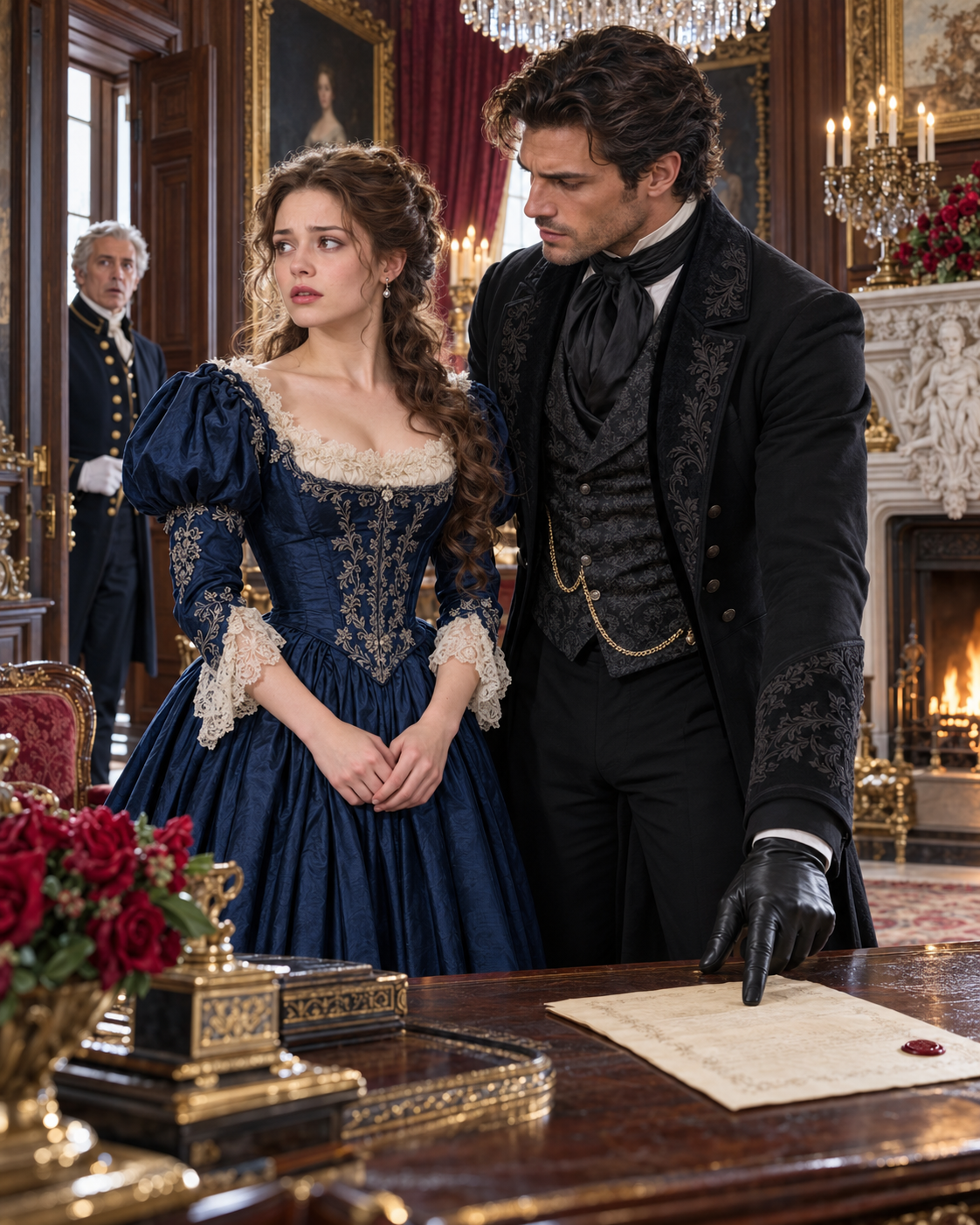
His mouth trembled.
“They told me you would be charged if I refused.”
“Julian?”
Silas nodded.
“He said the money passed through accounts bearing your name.”
“My name?”
“He had papers. Documents I had never seen.”
Eleanor felt Gideon move behind her.
Silas lowered his voice.
“I tried to tell them the truth. They brought another statement and said it was the only way to protect you.”
Eleanor looked at her father’s hands.
The nails were broken, and one finger had been wrapped in a dirty bandage.
“Did you sign it?”
“Yes.”
She closed her eyes briefly.
Then she took his injured hand.
“You must tell me everything.”
Silas stared at the floor.
“I borrowed from Julian. At first, small amounts. Then larger ones.”
His breath caught.
“He knew I couldn’t repay him. He offered me work preparing financial documents.”
“And you never asked why?”
“I didn’t want to know.”
Eleanor released his hand.
The admission settled between them, heavier than an excuse could carry.
Silas looked up.
“I thought I could repair the damage before anyone discovered it.”
“That is what you always thought,” she said softly.
He flinched.
She had defended him against creditors, neighbors, and men who came to their door demanding payment.
Yet she had never been able to defend him against his own choices.
“Did you know what Julian was stealing?”
“Not until I saw the village relief accounts.”
Gideon stepped forward.
“What about them?”
Silas swallowed.
“Money intended for coal, medicines, school repairs, and tenant assistance was being transferred into private accounts.”
Eleanor remembered the cold servants’ quarters, the leaking cottage roofs, the children without proper shoes.
“How much?”
Silas shook his head.
“Enough to destroy half the families under Brook Haven’s protection.”
Gideon’s face became utterly still.
“And Harcourt?”
Silas stared at him.
“He discovered it.”
Neither man spoke for several seconds.
Then Silas whispered, “The night he died, he was carrying the original ledgers to the schoolhouse.”
***
They returned to Brook Haven shortly before dawn.
Gideon ordered the gates locked and instructed Mrs. Bell to admit no visitor without his permission.
Eleanor went directly to the servants’ hall.
The household had already begun stirring, although most of the faces around the table looked exhausted.
“I need someone who remembers the old village school,” she said.
A young maid named Clara raised her hand.
“My mother cleaned it, Your Grace.”
“Did it have a cellar?”
“Only a storage room underneath the classroom.”
“Was there a fireplace?”
“Yes, Your Grace. A large one with a loose stone near the hearth.”
Mrs. Bell turned sharply toward the girl.
“Clara.”
The maid lowered her eyes.
Eleanor noticed.
“What is it?”
Mrs. Bell’s hands tightened around her apron.
“Mr. Harcourt once asked me to deliver a parcel there. He said it was important that Lord Julian never hear of it.”
“Did you deliver it?”
“Yes, Your Grace.”
“What happened afterward?”
The housekeeper’s eyes filled.
“Three days later, they brought him home from the river.”
Gideon stood beside the doorway, listening.
Eleanor looked toward him.
“Now do you believe it was an accident?”
He did not answer.
He simply reached for his coat.
***
The old schoolhouse stood at the edge of the village, half-hidden beneath ivy and leaning trees.
Morning mist clung to the broken windows.
Inside, the air smelled of dust, wet timber, and long-abandoned chalk.
Eleanor crossed the classroom toward the fireplace.
Gideon followed, holding a lantern.
The hearthstones were dark with soot.
She knelt, pressing her fingers along the mortar.
One stone moved slightly.
“Gideon.”
He set the lantern down and helped her loosen it.
Behind the stone lay a shallow cavity.
Empty.
For several seconds, neither moved.
Then Eleanor noticed a pale rectangle where dust had collected around something that had recently been removed.
“Someone was here,” she whispered.
Gideon touched the fresh scratches on the stone.
“Within the last day.”
A floorboard creaked behind them.
They turned.
A woman stood in the doorway, her cloak wet with morning mist.
She was perhaps thirty, with dark hair pinned beneath a plain bonnet and eyes that showed no surprise at finding them there.
“Miss Harcourt,” Gideon said.
She looked at him without bowing.
“You should not have come.”
Eleanor rose slowly.
“Where are the ledgers?”
The woman glanced at the empty fireplace.
“Somewhere Lord Vance will never find them.”
Gideon stepped forward.
“You were seen leaving with him last night.”
“Yes.”
“Then you have been helping him.”
Miss Harcourt gave a tired smile.
“I have spent six years pretending to help him.”
The silence that followed was broken only by rain dripping through the roof.
She reached beneath her cloak.
Gideon moved instinctively in front of Eleanor.
But the woman withdrew a narrow leather-bound notebook.
“My father understood what Julian was doing,” she said. “He copied every fraudulent transfer before he died.”
“Why did you wait so long?” Eleanor asked.
“Because Julian knew where my mother lived.”
Her fingers tightened around the notebook.
“He sent her money each month and reminded me how easily an elderly woman might suffer an unfortunate accident.”
Gideon’s expression darkened.
“Where is she now?”
“Safe. Your wife made certain of it.”
Eleanor stared at her.
Miss Harcourt looked directly at Eleanor.
“When the Duchess arranged coal deliveries for the poorest cottages, she sent someone to repair my mother’s roof. For the first time in years, Julian’s men could not approach the house without being noticed.”
Eleanor remembered the tiny cottage beyond the mill.
An old woman had pressed her hand and thanked her for remembering people no one else seemed to see.
She had not known the woman’s name.
Miss Harcourt held out the notebook.
“My father believed someone would eventually come who cared more about the village than the accounts.”
Eleanor took it carefully.
Inside were columns of figures, dates, signatures, and coded references to private banks.
On the final page, written in red ink, was a note.
If anything happens to me, examine the northern bridge.
Gideon read it over her shoulder.
His face changed.
“What does that mean?” Eleanor asked.
Miss Harcourt swallowed.
“My father did not fall from the bridge.”
***
They were halfway back to Brook Haven when the first gunshot shattered the morning.
The horses reared.
The carriage lurched violently, throwing Eleanor against the door.
Gideon caught her before she struck the window.
A second shot cracked through the trees.
“Down!” he ordered.
The coachman shouted as the carriage swerved toward the ditch.
Then everything stopped with a terrible jolt.
For several seconds, Eleanor could hear only the horses struggling against their harnesses.
Gideon pushed the carriage door open.
“Stay inside.”
She caught his wrist.
“Don’t.”
He looked back.
There was mud on his cheek and blood seeping through the shoulder of his coat.
“You’ve been hit.”
“It’s a scratch.”
But his arm hung stiffly.
Eleanor pulled him back into the carriage.
Outside, footsteps approached through the wet grass.
She slipped the notebook beneath the seat cushion.
The door was wrenched open.
A man wearing a dark riding coat pointed a pistol into the carriage.
“Hand over the documents.”
Gideon moved, but Eleanor placed a hand against his chest.
“Which documents?”
The man hesitated.
“The ones you took from the school.”
Eleanor reached slowly into her sleeve.
She withdrew the forged confession Julian had sent to the magistrate.
“Is this what you want?”
The stranger glanced at it.
“Give it here.”
She held it just beyond his reach.
“Who sent you?”
He raised the pistol.
Gideon’s voice cut through the silence.
“Lower that weapon.”
The man laughed.
“Your title doesn’t carry much weight on an empty road, Your Grace.”
“No,” Gideon replied. “But the four estate guards behind you might.”
The stranger turned.
A horse emerged from the mist.
Then another.
Gideon’s men had followed at a distance since dawn.
The pistol fell into the mud.
Within moments, the attacker was disarmed and restrained.
Eleanor climbed from the carriage, her knees unsteady beneath her skirts.
Gideon followed, pressing one hand against his wounded shoulder.
“You knew we might be followed,” she said.
“I suspected.”
“And you didn’t tell me?”
“I thought you had endured enough fear.”
Eleanor looked at the blood staining his sleeve.
“Then stop deciding what I can endure.”
He met her gaze.
A faint smile appeared despite the pain.
“Yes, Duchess.”
***
By afternoon, Brook Haven had become a fortress of hurried footsteps, guarded doors, and whispered instructions.
Gideon’s wound was cleaned and bandaged.
The surgeon declared that the bullet had passed through the flesh without striking bone.
Eleanor remained beside him throughout the examination.
Only when the surgeon departed did Gideon notice the blood on her cuffs.
“You’re hurt.”
“It isn’t mine.”
She looked toward his bandaged shoulder.
He reached for her hand.
The gesture was hesitant, almost unfamiliar.
“Eleanor, I owe you an apology.”
She sat beside him.
“For which offense? I should like to know how much time we have.”
He gave a quiet laugh, then winced.
“For believing I could protect you by keeping you ignorant.”
She looked down at their joined hands.
“That is not protection, Gideon.”
“I know.”
“You married me because you needed someone connected to my father’s documents.”
“At first.”
The words settled between them.
Eleanor slowly withdrew her hand.
“At first?”
Gideon looked toward the rain-streaked window.
“When I discovered your father’s involvement, I believed Julian had already reached you. I thought marriage would place you beyond his immediate control.”
“Yet you never offered me the truth.”
“No.”
“Or a choice.”
His expression tightened.
“No.”
Eleanor stood.
“I will help you expose him because innocent people have suffered, and because my father deserves a fair judgment.”
She moved toward the door.
“But when this is finished, we must speak about what becomes of our marriage.”
Gideon did not ask her to stay.
Perhaps that was the first honest kindness he had offered her.
***
The following morning, Julian Vance arrived at Brook Haven carrying an official order for the Duchess’s arrest.
He entered the great hall smiling, accompanied by Magistrate Alden and two constables.
Eleanor waited near the staircase.
Gideon stood beside her, his wounded arm supported beneath his coat.
“How unfortunate,” Julian said, inspecting the bandage. “I heard there was trouble on the road.”
“Indeed,” Gideon replied.
Julian turned toward Eleanor.
“My dear Duchess, I am afraid the law has finally caught up with your family.”
Alden cleared his throat.
“Lady Ashford, evidence has been presented suggesting your involvement in fraudulent transfers.”
Eleanor descended the final step.
“Then I assume you have examined the original accounts.”
Julian’s smile remained fixed.
“Naturally.”
“How fortunate. We have them here.”
She nodded toward Mrs. Bell.
The housekeeper opened the drawing-room doors.
Miss Harcourt entered carrying a wooden document box, followed by the estate secretary and a solicitor summoned from London.
Julian’s expression changed almost imperceptibly.
“Miss Harcourt.”
“Lord Vance.”
“I understood you had left the county.”
“I thought it best to return before you destroyed anything else.”
The solicitor placed several documents upon a table.
Among them lay the notebook, copies of bank transfers, and a signed statement from the man who had attacked the carriage.
Julian stared at the papers.
“This is absurd.”
Eleanor stepped forward.
“Then explain why funds intended for the village school were transferred into accounts controlled by you.”
“Those were legitimate estate expenses.”
“And why the same payments appear under different names in the official ledgers?”
“Administrative errors.”
“And why my father’s signature was copied onto documents dated while he was imprisoned?”
Julian’s eyes flickered toward the magistrate.
Gideon noticed.
“An excellent question,” he said.
Alden took a step backward.
The solicitor opened another folder.
“We have also obtained testimony from the clerk who prepared Mr. Pembroke’s confession.”
Julian’s mouth tightened.
“He was following lawful instructions.”
“Instructions issued before Mr. Pembroke was questioned,” Eleanor said.
For the first time, Julian’s voice rose.
“You have no understanding of the responsibilities involved in managing an estate of this size.”
Eleanor looked around the hall.
At the polished staircase.
At the servants gathered beyond the open doorway.
At the faces that had once lowered themselves whenever Julian entered.
“I understand that children went without heat while you collected money intended to keep them warm.”
Julian’s gaze snapped toward her.
“You ungrateful little—”
“Enough.”
Gideon’s voice was soft, but the word stopped him.
“You have mistaken my silence for ignorance, Julian.”
The duke stepped closer.
“And my wife’s kindness for weakness.”
Julian laughed bitterly.
“Your wife? You purchased her to keep her father quiet.”
The room fell silent.
Eleanor felt the words strike something she had carefully refused to examine.
Gideon did not deny them.
Instead, he looked at her.
“She knows why I proposed.”
Julian’s smile returned.
“Then surely she knows what she is worth to you.”
Gideon turned back.
“More than anything you have ever understood.”
Julian’s expression twisted.
He reached inside his coat.
A constable shouted.
Gideon moved toward Eleanor.
But Julian did not draw a pistol.
He withdrew a folded document and hurled it onto the floor.
“Then perhaps she should know what her precious father truly did.”
***
The document was an agreement bearing Silas Pembroke’s signature.
It authorized the transfer of substantial charitable funds into accounts controlled by Julian Vance.
Unlike the forged confession, the signature appeared genuine.
Eleanor recognized the familiar slant of the letters immediately.
Her throat tightened.
Julian watched her face with satisfaction.
“He knew exactly what he was signing.”
For several seconds, no one spoke.
Then Eleanor bent and picked up the paper.
She read it carefully.
Once.
Twice.
Finally, she looked at Julian.
“You’re right.”
Gideon turned sharply.
“Eleanor—”
“My father signed this.”
Julian’s smile widened.
“And therefore—”
“Therefore he must answer for what he did.”
Her voice remained steady.
“But his guilt does not excuse yours.”
She placed the agreement beside the other documents.
“Nor does it make every accusation against him true.”
The solicitor nodded.
“Precisely, Your Grace.”
Julian looked from one face to another.
He had expected her to defend her father blindly.
He had expected Gideon to protect the family name at any cost.
Instead, the truth stood between them, neither hidden nor softened.
Alden removed his spectacles.
“Lord Vance, I believe further inquiry is necessary.”
Julian’s expression turned cold.
“You were perfectly willing to accept my evidence yesterday.”
“That,” the solicitor replied, “is another matter requiring investigation.”
The constables approached.
Julian backed toward the doors.
“You cannot arrest me on the word of a servant’s daughter and a desperate woman.”
Miss Harcourt stepped forward.
“My father left one more piece of evidence.”
She opened the wooden box and withdrew a sealed statement.
Gideon recognized the handwriting.
Thomas Harcourt had written it days before his death.
It described a meeting at the northern bridge, where Julian had demanded the original ledgers.
Harcourt had refused.
The statement named the stableman ordered to accompany Julian that night.
That same man had been discovered the previous evening, living under another name in a nearby town.
His testimony matched the account.
Julian’s breathing changed.
“You have no proof I pushed him.”
Miss Harcourt looked directly at him.
“No one said you pushed him.”
Julian froze.
Gideon took one measured step forward.
“But you have just told us how he died.”
The constables seized Julian before he reached the door.
He struggled once, then stopped.
As they led him away, Eleanor saw something she had never expected.
He looked frightened.
Not of punishment alone.
Of being seen without the power he had used to frighten everyone else.
***
The inquiry lasted several weeks.
Julian’s accounts were examined, witnesses were questioned, and Magistrate Alden was removed from his duties pending investigation into his conduct.
The evidence established that Julian had stolen substantial sums from the Brook Haven estate and concealed the losses through falsified records.
Thomas Harcourt’s death was reopened as a criminal investigation.
The recovered testimony eventually led to charges against Julian and an accomplice for Harcourt’s killing.
Silas Pembroke was not declared innocent.
He had knowingly signed financial documents in exchange for money to satisfy his gambling debts.
He had ignored the consequences until the harm became impossible to conceal.
But the false accusations against Eleanor were withdrawn, and the forged confession was set aside.
Silas received a sentence that required him to answer for his own offenses rather than those Julian had attempted to place upon him.
On the day of his hearing, Eleanor visited him.
He sat opposite her in a plain chamber, his hair neatly combed and his hands resting quietly on the table.
“I’m sorry,” he said.
She looked at him.
He did not reach for her hand.
Perhaps he understood that forgiveness could not be demanded simply because regret had finally arrived.
“I know,” she answered.
“I wanted to give you a better life.”
“You wanted to avoid seeing what your choices were doing to the one we had.”
Silas lowered his eyes.
A long silence followed.
Then he nodded.
“Yes.”
Eleanor felt the weight of years she had spent protecting him.
She had loved him when he was reckless.
She loved him still.
But she no longer mistook love for an obligation to carry another person’s guilt.
“I will visit,” she said. “And I will help you rebuild your life when the law permits it.”
Silas looked up.
“But I cannot live it for you.”
Tears gathered in his eyes.
This time, he made no promise he could not keep.
“Then I shall have to learn how.”
***
Winter settled over Brook Haven with pale mornings and snow that gathered along the branches of the old orchard.
The village school reopened before Christmas.
Its windows were repaired, the fireplace rebuilt, and new desks placed beneath the high beams.
On the first morning, Eleanor stood near the entrance while children hurried past her carrying books and slates.
Miss Harcourt had agreed to serve as the school’s headmistress.
Mrs. Bell supervised a charitable fund established from the recovered estate money, with independent records that could be inspected by the villagers.
And Gideon, to the astonishment of everyone who remembered the old duke’s cold household, attended the school’s opening without being asked.
Eleanor found him standing near the doorway, holding a child’s wooden toy.
A small boy regarded him solemnly.
“You’re the duke,” the child said.
“So I have been told.”
“Are you very rich?”
Gideon glanced toward Eleanor.
“Apparently not rich enough to escape difficult questions.”
The boy considered this.
Then he pointed toward the broken wheel of his toy cart.
“Can you fix this?”
Gideon crouched.
“I can try.”
Eleanor watched him examine the tiny wooden axle with the same concentration he gave his estate accounts.
His injured shoulder had nearly healed.
He no longer seemed to notice when she entered a room.
Or rather, he always noticed.
He simply no longer looked away.
***
That evening, Eleanor found an envelope on the writing desk in her sitting room.
Her name appeared across the front in Gideon’s precise handwriting.
Inside lay a legal document.
She read the first page, then the second.
It was an agreement securing her independent income, providing for her residence, and allowing her to live apart from him should she wish.
No conditions.
No penalty.
No obligation to remain at Brook Haven.
When Gideon appeared in the doorway, Eleanor was still holding the papers.
“What is this?”
“A choice.”
She looked up.
“You intend to send me away?”
“No.”
He entered slowly.
“I intend to ensure you never have to stay because you cannot afford to leave.”
Eleanor stared at him.
The man who had once placed a marriage contract before her now stood with empty hands.
“I treated our marriage as a transaction,” he said. “I thought I could arrange your safety by arranging your life.”
“And now?”
“Now I understand that safety without freedom is simply another kind of confinement.”
She looked down at the document.
Outside, snow moved silently across the darkened garden.
“You could have kept this from me,” she said.
“I have kept enough from you.”
He approached the desk but stopped before reaching her.
“I won’t ask you to forgive what I did simply because I have learned to regret it.”
Eleanor studied him.
For the first time, Gideon Ashford appeared to have nothing prepared.
No bargain.
No carefully measured advantage.
Only the possibility that she might leave.
“What do you want?” she asked.
His breath caught almost imperceptibly.
“For you to stay.”
“Because I am your duchess?”
“No.”
He glanced toward the papers in her hand.
“Because Brook Haven has become a place worth returning to since you arrived.”
Her fingers tightened around the envelope.
“And you, Gideon?”
He looked at her.
“Because I have spent years believing that needing someone meant giving them the power to hurt me.”
The room was very quiet.
“And now?” she whispered.
He gave a faint, unguarded smile.
“Now I find that I would rather risk being hurt than spend another evening pretending I don’t listen for your footsteps.”
Eleanor lowered the papers.
She crossed the distance between them slowly.
Then she placed the agreement on the table beside him.
“I am not signing this tonight.”
Gideon’s expression faltered.
“You should have time to consider it.”
“I have considered it.”
She reached for his hand.
“But I would like to begin by choosing where I sleep tonight.”
For several seconds, he did not move.
Then his fingers closed gently around hers.
“Eleanor.”
It was only her name.
Yet he spoke it with a tenderness she had once believed him incapable of offering.
She smiled.
“Yes, Gideon?”
“May I kiss you?”
She raised her eyes to his.
“You may.”
He leaned toward her carefully, giving her every opportunity to change her mind.
She did not.
Outside, the first heavy snowfall of winter softened the stone walls of Brook Haven.
Inside, for the first time, neither of them was counting the cost of staying.
***
Spring arrived slowly.
The fields turned green, the cottages acquired fresh roofs, and the village children could once again be heard reciting lessons through the open schoolhouse windows.
Silas wrote regularly.
His letters contained fewer excuses and more ordinary details about the work he was doing.
Eleanor kept them in a drawer, answering when she wished, sometimes quickly and sometimes only after several days.
She no longer felt compelled to rescue every silence.
Gideon continued managing the estate, but the decisions that affected its people were discussed openly with those who lived there.
Mrs. Bell once observed that Brook Haven had become an entirely different place.
Eleanor disagreed.
“The house was always capable of warmth,” she said. “Someone simply had to open the doors.”
One bright afternoon, she found Gideon in the garden beneath the old pear tree.
He was reading a letter, his brow furrowed.
“More estate troubles?” she asked.
He folded it.
“No. A message from your father.”
Eleanor paused.
“What does he want?”
Gideon handed her the page.
Silas had asked whether, upon his eventual release, he might visit Brook Haven.
He made no demands.
He offered no explanation for the years already lost.
He simply hoped that one day Eleanor might be willing to sit with him beneath the same roof and speak of ordinary things.
She read the letter in silence.
Then she folded it and slipped it into her pocket.
“What will you tell him?” Gideon asked.
Eleanor looked across the garden, where sunlight rested on the new leaves.
“That he may write again.”
Gideon nodded.
Nothing more needed to be said.
She reached for his hand.
They walked toward the house together, passing the windows that had once been dark even in the middle of winter.
A servant opened the garden doors, and the distant sound of laughter drifted from the kitchen.
Eleanor stopped at the threshold.
“Do you remember the night we first met?”
Gideon glanced at her.
“I remember a woman informing me that her father’s gambling debts would not become her responsibility.”
“An entirely reasonable condition.”
“The most reasonable thing anyone had said to me in years.”
She laughed softly.
“At the time, I thought you were the coldest man in England.”
“I probably was.”
“And now?”
He considered the question.
Then he took her hand and pressed it against his chest.
“Now I have a wife who refuses to let the fires go out.”
Eleanor shook her head, smiling.
“You give me too much credit.”
“No,” Gideon said. “I believe I have spent most of my life giving people far too little.”
They entered the house together.
Years later, the villagers would remember the Duchess of Brook Haven not for her title, her marriage, or the scandal that had brought her there.
They remembered the winter the school reopened.
The coal delivered before the first frost.
The wages paid without pleading.
The woman who listened when no one else would.
And beside her, they remembered a duke who learned that authority could command obedience, but only kindness could earn trust.
Eleanor never forgot the price of the marriage contract she had signed in desperation.
She kept the original document in a locked drawer, beside the later agreement Gideon had offered when she was finally free to choose.
One recorded the day she had surrendered her future to save someone she loved.
The other marked the day she discovered that love could exist without surrender.
And whenever she opened that drawer, she was reminded of something her younger self had not yet understood.
A person may deserve compassion without being entitled to our sacrifice.
A promise may be honorable without requiring a lifetime of suffering.
And the truest measure of love is not how firmly someone holds us, but whether they would still open the door if we decided to leave.
Gideon had once given Eleanor a choice between marriage and ruin.
In the end, she had given him something far more difficult.
The chance to become a man worthy of being chosen.
And she chose him.
Not because she owed him her life.
Not because he had saved her father.
Not because society called him her husband.
But because, when she finally stood before an open door, he made no attempt to close it.
And for the first time in her life, Eleanor Pembroke stayed simply because she wanted to.
THE END.