The Duke of Avenmir had spent four years waiting for Harriet Aldwin to give him the slightest encouragement.
The words remained between them, as cold and unexpected as the morning wind.
Harriet Aldwin stared at the sealed letter in the Duke’s hand, her fingers still resting against his.
“Another woman?” she repeated.
The Duke of Avenmir did not answer immediately.
Across the fields, a church bell began to ring, its distant notes drifting through the mist.
“Yes,” he said at last. “Lady Eleanor Veyne.”
Harriet withdrew her hand.
It was a small movement, performed without haste, but the Duke felt the absence of her touch more keenly than he had expected.
“I see.”
“I do not believe you do.”
“Then I should be grateful if you explained.”
He looked down at the letter, turning it once between his fingers.
“It is an arrangement that was proposed to me six weeks ago.”
“And you accepted?”
“No.”
Harriet’s eyes lifted.
“Then why are you expected to announce an engagement?”
“Because certain people have decided that my agreement is a formality.”
For the first time that morning, Harriet closed her pocketbook without marking her place.
“That seems a rather extraordinary assumption.”
“It is one my family has made about me for most of my life.”
He spoke without bitterness, yet something in his expression suggested that the habit had cost him more than he cared to admit.
Harriet studied him.
“Does Lady Eleanor know that you have not agreed?”
“I cannot be certain.”
“Have you spoken to her?”
“Not privately.”
“Then I believe,” Harriet said, “that your first obligation is to discover whether the lady herself wishes to marry you.”
The Duke looked almost startled.
“You are remarkably calm.”
“I assure you, Your Grace, I am not.”
Her gloved thumb had begun rubbing the worn corner of her pocketbook.
He noticed.
“I have spent four years imagining what I might say to you,” he confessed. “And now that you have offered me everything I wanted, I find myself unable to accept it without causing difficulty.”
“Difficulty is not the same as impossibility.”
“No,” he said softly. “It is not.”
Harriet looked toward the stile, where the first sunlight had begun to catch the wet wood.
“Then perhaps we should begin by establishing the facts.”
He gave a quiet, incredulous laugh.
“Are you proposing an investigation into my proposed marriage?”
“I am proposing that we prevent an unfortunate one.”
She hesitated.
“Possibly two.”
The Duke looked at her for a long moment.
Then, with the gravity of a man accepting an unusually serious military commission, he bowed.
“I place myself entirely at your disposal, Miss Aldwin.”
“An unwise declaration,” she replied, opening her pocketbook again. “But a useful beginning.”
By eleven o’clock, Harriet had learned considerably more than the Duke had originally intended to tell her.
They sat in the morning room of Aldwin Cottage, where a small fire burned beneath a mantel crowded with porcelain figures.
Her aunt, Mrs. Beatrice Aldwin, had received the Duke’s unexpected visit with such astonishment that she had forgotten to offer him tea until Harriet quietly reminded her.
Now the older woman sat beside the window, pretending to embroider.
Her needle had not moved for nearly ten minutes.
The Duke explained that Lady Eleanor was the only daughter of Lord Veyne, a wealthy landowner whose family had maintained close ties with Avenmir for two generations.
A marriage between the houses would consolidate adjoining estates and settle several complicated financial obligations.
Harriet listened without interruption.
“And your own fortune?” she asked.
“Is sufficient.”
“Your estates?”
“Prosperous.”
“Your debts?”
“Manageable, and entirely unrelated to Lord Veyne.”
“Then why is the marriage considered necessary?”
The Duke paused.
Mrs. Aldwin’s needle slipped from her fingers.
“Because,” he said, “my late brother made certain promises before his death.”
Harriet’s expression changed.
She knew that the Duke’s elder brother had died unexpectedly years before, leaving Avenmir to inherit a title he had never expected to hold.
“What sort of promises?”
“That is where the difficulty begins.”
He took the sealed letter from his coat and laid it upon the table.
It bore the Veyne family crest.
The wax had been broken.
Harriet noticed immediately.
“You have opened it.”
“Last night.”
“And?”
“Lord Veyne claims to possess documents proving that my brother pledged a portion of our family estate as security for a private obligation.”
Mrs. Aldwin stopped pretending to embroider.
“Good heavens.”
Harriet remained still.
“Does he?”
“I have never seen such documents.”
“Then how can he demand an engagement?”
The Duke’s jaw tightened.
“He has suggested that their contents would prove extremely damaging if made public.”
The room fell silent.
Outside, wheels rattled along the lane, followed by the faint call of a passing tradesman.
Harriet looked at the letter.
“May I read it?”
The Duke hesitated.
“Some of its language is unpleasant.”
“I am twenty-nine, Your Grace. I have survived unpleasant language.”
He handed it to her.
She read carefully, beginning at the first line and continuing to the final signature.
Then she read it again.
The Duke watched her expression, expecting alarm.
Instead, she frowned.
“This is curious.”
“What is?”
“He threatens to publish your brother’s correspondence, yet he never specifies what the correspondence contains.”
“That was my observation.”
“And he requests your presence in London on the first Thursday in November, although he has already informed several acquaintances that your engagement will be announced.”
“Yes.”
Harriet tapped the paper lightly.
“Then he is depending upon your fear of the documents rather than the documents themselves.”
The Duke leaned forward.
“Do you think he is bluffing?”
“I think a gentleman possessing convincing evidence would ordinarily be less reluctant to describe it.”
Mrs. Aldwin made a small sound of approval.
Harriet continued.
“And I think we should speak to Lady Eleanor before we decide anything further.”
The Duke considered her.
“You intend to accompany me?”
“Of course.”
“Harriet—”
She looked up.
He stopped.
For four years he had addressed her with immaculate formality.
Now her name seemed to emerge whenever he forgot to be cautious.
Harriet noticed that too.
“Your Grace?”
His expression softened.
“I would not willingly expose you to the unpleasantness of this affair.”
“I would not willingly permit you to marry another woman merely to spare me an unpleasant afternoon.”
Mrs. Aldwin put down her embroidery.
“Well,” she said briskly, “I suppose we must invite Lady Eleanor to tea.”
Lady Eleanor Veyne arrived two days later in a dark blue travelling dress, accompanied by an elderly companion and a footman carrying an unnecessarily large parcel.
She was twenty-three, pale, and possessed of a composed beauty that seemed almost carefully practiced.
Harriet met her in the drawing room.
The Duke stood near the fireplace.
When Lady Eleanor entered, he bowed.
She curtsied.
Their greeting was so restrained that Harriet immediately suspected neither had any wish to be there.
Tea was served.
Polite remarks were exchanged about the weather, the roads, and the inconvenience of recent rain.
Lady Eleanor answered every question perfectly.
Yet she did not drink.
Harriet observed that the young woman’s left hand remained concealed beneath the folds of her skirt.
When the servant withdrew, Harriet set down her cup.
“Lady Eleanor, I hope you will forgive an unusually direct question.”
The young woman looked at her.
“Certainly.”
“Do you wish to marry the Duke of Avenmir?”
The silence was absolute.
The Duke slowly turned his head.
Lady Eleanor’s companion inhaled sharply.
Then Eleanor looked toward the door.
“No,” she whispered.
The answer came so quietly that Harriet nearly missed it.
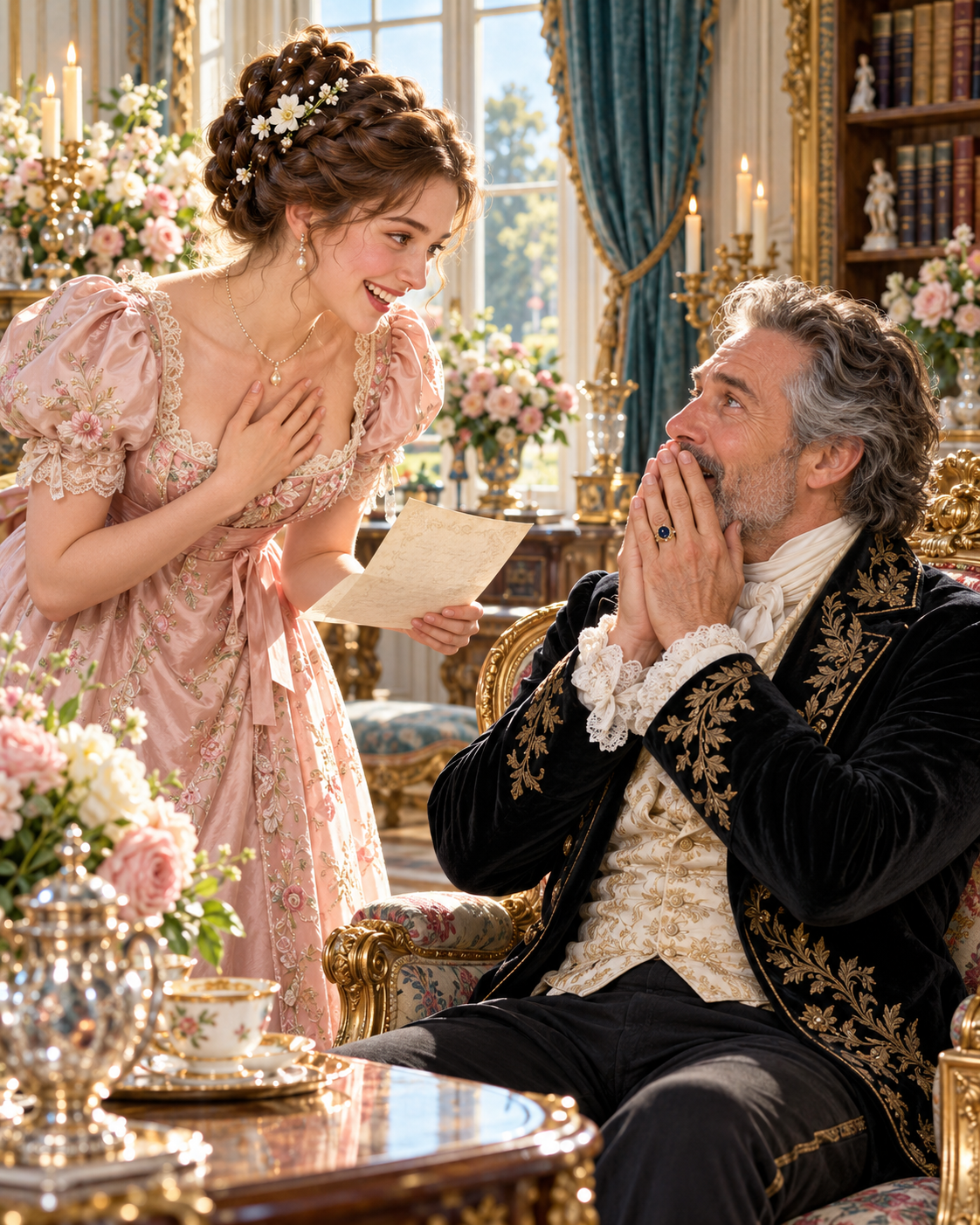
The Duke stepped forward.
“Lady Eleanor, you need not fear offending me.”
Eleanor raised her eyes.
“I know that, Your Grace.”
“Then why has your father arranged this marriage?”
Her lips parted, but no words emerged.
Harriet noticed the young woman’s hidden hand moving beneath the fabric.
“Is there someone else?” she asked gently.
Eleanor’s face lost its remaining color.
Her companion began to rise.
“Lady Eleanor is fatigued. Perhaps this conversation—”
“Please, Mrs. Mercer,” Eleanor said.
The older woman stopped.
For the first time, Eleanor’s voice held something firmer than obedience.
“Please let me answer.”
She brought her left hand into view.
Around her wrist was a narrow strip of faded green ribbon.
Harriet recognized it as the sort sometimes exchanged privately between young people who had no formal permission to court.
Eleanor touched it.
“There is a gentleman,” she admitted.
The Duke’s expression grew thoughtful.
“Does your father know?”
“Yes.”
“And he disapproves?”
“He has forbidden me to speak his name.”
Harriet waited.
Eleanor looked at the floor.
“Mr. Samuel Whitcombe.”
The Duke drew a breath.
“The physician’s son?”
Eleanor nodded.
“He has no title, and my father considers his prospects insufficient.”
“Does he have a profession?” Harriet asked.
“He is training to become a surgeon in Bath.”
“And is he a good man?”
Eleanor’s eyes filled, though her voice remained steady.
“He returned every letter I wrote when my father threatened his family.”
Harriet leaned slightly forward.
“Did he explain why?”
Eleanor nodded again.
“He said he would rather lose me than allow me to believe affection required the ruin of people who had done nothing wrong.”
For a moment nobody spoke.
Then the Duke said quietly, “I should like to meet Mr. Whitcombe.”
Eleanor looked at him with sudden hope.
“You would?”
“Yes.”
Harriet watched the young woman’s shoulders relax.
It was the first natural movement she had made since entering the room.
But their relief did not last.
A carriage stopped outside.
Heavy footsteps sounded in the hall.
Then the drawing room door opened without warning.
Lord Veyne entered.
He was a broad man with iron-gray hair and the confident bearing of someone who had seldom been refused anything of consequence.
His gaze moved from his daughter to the Duke.
Then to Harriet.
“I was not informed,” he said, “that this was to be a family conference.”
Harriet rose.
“Then you have arrived at a fortunate moment, my lord.”
Lord Veyne looked at her with open displeasure.
“And you are?”
“Harriet Aldwin.”
“Ah.”
His expression changed.
“I have heard of you.”
“I cannot imagine the reports have been particularly interesting.”
He ignored the remark.
“Avenmir, a word in private.”
The Duke remained where he stood.
“Whatever concerns Lady Eleanor may be discussed in her presence.”
Lord Veyne’s eyes narrowed.
“That would be inadvisable.”
“Nevertheless.”
The older man reached inside his coat.
From a leather case he withdrew several folded sheets tied with black ribbon.
“Perhaps you have forgotten the circumstances under which your brother died.”
The Duke became very still.
Harriet saw it happen.
The warmth vanished from his face, replaced by a rigid expression she had not seen even during their conversation at the stile.
Lord Veyne placed the papers on the table.
“Your brother was not the honorable man you have spent fifteen years pretending him to be.”
Eleanor whispered, “Father, please.”
“Be silent.”
The Duke moved.
Only one step.
But Lord Veyne stopped speaking.
“You will not address your daughter in that manner here.”
The two men faced each other across the tea table.
Harriet looked at the papers.
“May I examine them?”
Lord Veyne laughed without amusement.
“This is not a matter for a young lady.”
“Then it should be very simple to explain.”
His eyes hardened.
“You are remarkably impertinent.”
“So I have been told.”
The Duke turned toward her.
There was unmistakable concern in his expression.
But Harriet had already reached for the documents.
Lord Veyne placed his palm over them.
“These remain in my possession until His Grace provides his answer.”
Harriet looked at his hand.
Then at the Duke.
“Do you intend to marry Lady Eleanor?”
“No.”
The answer was immediate.
Eleanor closed her eyes.
Lord Veyne’s face darkened.
“You understand what refusal will mean?”
“I understand that you have threatened my family’s reputation.”
“And that does not concern you?”
“Very much.”
The Duke glanced at Harriet.
“But there are matters that concern me more.”
Lord Veyne snatched up the papers.
“Then you will hear from my solicitors.”
He turned toward the door.
Harriet spoke before he reached it.
“My lord, there is something unusual about your letter.”
He stopped.
“The document you sent His Grace was dated the ninth of October.”
Lord Veyne said nothing.
“Yet the paper bears the watermark of a London stationer whose new design was introduced only this year.”
“A remarkably insignificant observation.”
“Perhaps.”
Harriet folded her hands.
“But you claim that these papers have remained untouched among your family records for fifteen years.”
Lord Veyne slowly turned around.
Harriet met his gaze.
“I wonder whether the original documents are equally recent.”
For the first time, the older man appeared uncertain.
It lasted no more than a second.
Then he left.
The carriage departed within minutes.
Eleanor remained behind, trembling so badly that Mrs. Mercer had to steady her.
The Duke went to the window.
Harriet watched him, noticing the way his hand rested against the glass.
“You knew,” he said without turning.
“Knew what?”
“That there might be something wrong with the documents.”
“I suspected.”
“And you chose to confront him.”
“He was being unpleasant to his daughter.”
Avenmir turned.
“Harriet, Lord Veyne is capable of causing considerable harm.”
“Then it is fortunate that he has given us reason to question his evidence.”
The Duke crossed the room.
For a moment she thought he meant to reprimand her.
Instead, he took her hand.
“You are an extraordinary woman.”
“No,” she replied. “Merely an attentive one.”
His thumb brushed the seam of her glove.
“I have been attentive to you for four years, and I believe I have understood very little.”
Harriet’s cheeks warmed.
“You may improve with practice.”
Three days later, they travelled to London.
Mrs. Aldwin accompanied Harriet, declaring that she had no intention of allowing her niece to become involved in a ducal scandal without a respectable chaperone.
Eleanor remained in Dorset under Mrs. Mercer’s protection.
The Duke arranged for his solicitor, Mr. Pembroke, to examine copies of the disputed correspondence.
It was in Pembroke’s office, beneath the smoky light of a November afternoon, that the first decisive discovery was made.
The solicitor was an elderly gentleman with silver spectacles and a habit of speaking only after he had considered every word.
He examined the copied signatures.
Then he removed his spectacles.
“Your Grace, there is a serious discrepancy.”
The Duke leaned forward.
“What discrepancy?”
“Your brother’s signature.”
“It appears genuine.”
“The handwriting does.”
Pembroke reached into a drawer and produced an old deed.
“But your brother ceased signing his name with his middle initial after his marriage.”
Harriet looked at the two papers.
The difference was small.
Almost invisible.
Yet the disputed agreement carried the earlier signature style, although it was supposedly dated three years after the marriage.
“Could he not have reverted to his previous habit?” the Duke asked.
“Certainly,” Pembroke replied. “But it would be curious.”
Harriet studied the document.
“And the witness?”
Pembroke adjusted his spectacles.
“A former estate steward named Richard Hale.”
“Can he be found?”
“He died six years ago.”
The Duke’s expression tightened.
“Then we have reached a dead end.”
“Not necessarily,” Harriet said.
Both men looked at her.
“If Mr. Hale witnessed the agreement, he might have recorded it elsewhere.”
Pembroke considered this.
“He maintained account books.”
“Do they survive?”
“I believe his widow has them.”
The Duke rose.
“Then we shall call upon her.”
They found Mrs. Hale in a modest house near Clerkenwell.
She was a small, sharp-eyed woman who regarded the Duke’s expensive coat with more suspicion than admiration.
When Pembroke explained their purpose, her expression changed.
“My husband told me there would be trouble over those papers.”
The Duke leaned forward.
“What papers?”
Mrs. Hale looked toward the door.
Then she crossed the room, opened a wooden chest, and removed a cloth-wrapped bundle.
“He kept this because he was frightened.”
Inside lay a narrow ledger.
The pages were yellowed, the binding badly worn.
Harriet watched as Pembroke turned them carefully.
There were ordinary entries concerning rents, horses, repairs, and wages.
Then, near the middle, a single line had been marked with a cross.
Pembroke read it aloud.
“Payment received from Lord Veyne for the preparation of an agreement concerning the Avenmir estate.”
The Duke went pale.
“Read the date.”
Pembroke did.
It was eleven days after the Duke’s brother had died.
For several seconds, nobody moved.
Then Harriet quietly asked Mrs. Hale whether her husband had ever explained the entry.
The widow pressed her lips together.
“He said he had done a wicked thing.”
“What thing?”
“He helped prepare a paper that made a dead man appear to have promised something he never had.”
The Duke stood abruptly.
His chair scraped against the floor.
Mrs. Hale flinched.
Harriet rose beside him.
“Your Grace.”
He stopped.
His breathing had grown uneven.
For fifteen years, he had defended his brother’s memory against rumors he had never fully understood.
Now the truth lay before him in faded ink.
Not proof of dishonor.
Proof of an attempt to manufacture it.
Pembroke closed the ledger.
“This will require careful handling.”
Harriet looked at the widow.
“Why did your husband never reveal it?”
Mrs. Hale’s eyes glistened.
“Because Lord Veyne threatened to accuse him of stealing from the estate.”
She swallowed.
“And we had three children.”
The Duke lowered himself slowly into his chair.
After a long silence, he said, “Your husband was wrong to assist him.”
Mrs. Hale nodded.
“Yes, Your Grace.”
“But he was not wrong to fear for his family.”
The widow began to cry.
Avenmir turned toward Pembroke.
“Whatever becomes of this matter, Mrs. Hale is not to be left without protection.”
Harriet looked at him.
For a moment, her carefully ordered thoughts gave way to something she could not have arranged neatly on paper.
She had admired his patience.
His manners.
His steadiness.
But she had never loved him quite so much as she did when he offered kindness to someone who had helped injure his family.
The confrontation with Lord Veyne took place the following morning.
Pembroke had arranged a private meeting at his chambers.
Lord Veyne arrived confident and impatient.
His confidence lasted until he saw the ledger.
He stared at it.
Then at the solicitor.
“Where did you obtain that?”
“From its lawful owner,” Pembroke replied.
The Duke remained seated.
For once, he appeared entirely composed.
“You will withdraw every claim against my brother’s estate.”
Lord Veyne’s mouth tightened.
“And if I refuse?”
“Mr. Pembroke will place the evidence before the proper authorities.”
The older man looked toward Harriet.
“You.”
She said nothing.
“You have interfered in matters you cannot possibly comprehend.”
Harriet rested her hands in her lap.
“I understand enough to recognize that your daughter was never consulted about her future.”
“My daughter has obligations.”
“She does,” Harriet answered. “But none that require her to surrender her life to protect your ambitions.”
Lord Veyne rose.
“Do not presume to lecture me about family duty.”
The Duke stood as well.
“Then perhaps you should hear it from me.”
His voice remained quiet.
That made the words more difficult to ignore.
“For years, I allowed myself to believe that duty required silence. I feared scandal so greatly that I nearly permitted you to determine the rest of my life.”
Lord Veyne glanced toward the documents.
“You would expose your brother’s name to public disgrace?”
“No,” the Duke said. “I would defend it with the truth.”
Pembroke placed a prepared statement upon the desk.
Lord Veyne read it.
His face grew gray.
He signed before noon.
The document formally withdrew every claim against the Avenmir estate and acknowledged that the disputed agreement could not be relied upon.
The Duke did not demand public humiliation.
He demanded that Lord Veyne cease threatening his daughter and permit her to determine her own marriage.
The older man resisted longest on that point.
But when Pembroke quietly reminded him that the forged papers remained in the solicitor’s possession, his resistance ended.
He signed again.
And for the first time in her life, Eleanor Veyne was free to refuse the husband chosen for her.
That evening, Harriet found the Duke standing alone on the terrace of his London residence.
The city lay beneath a pale moon, its rooftops softened by smoke.
She approached without speaking.
He turned when he heard her footsteps.
“Mrs. Aldwin tells me you intend to return to Dorset tomorrow.”
“I do.”
“And your investigation?”
“Concluded satisfactorily.”
He smiled faintly.
“You make it sound like a household account.”
Harriet joined him beside the stone balustrade.
“An account may be a very serious matter when the figures are wrong.”
He watched her in silence.
Then he reached into his coat.
For one alarming moment, Harriet thought he meant to produce another letter.
Instead, he withdrew her pocketbook.
She stared.
“I believe you left this in my carriage.”
She took it from him.
“Thank you.”
“I did not read it.”
“I should hope not.”
“Though I confess I was tempted.”
Harriet looked down at the worn leather cover.
“There is very little of interest remaining in it.”
“On the contrary,” he said. “I believe there is one matter we have not settled.”
She looked up.
“The proposal?”
“Yes.”
“You accepted.”
“I did.”
“Then what remains?”
The Duke drew a slow breath.
“The question of whether you still wish to marry me.”
Harriet frowned.
“Why should my wishes have altered?”
“Because you have now seen the complications of my life.”
“I have.”
“You have seen my family’s failings, my uncertainty, and my willingness to be intimidated by threats that should never have governed my conduct.”
“Yes.”
“And you may reasonably conclude that I am not the man you believed.”
Harriet opened her pocketbook.
He looked briefly dismayed.
“Must we consult the evidence again?”
“Only one page.”
She turned to the final leaf.
There, beneath her carefully numbered reasons for marriage, was a sentence she had written in a less certain hand.
The Duke recognized the change immediately.
“What does it say?”
Harriet hesitated.
The wind stirred a loose strand of hair against her cheek.
Then she read aloud.
“Although the foregoing considerations are sound, I must acknowledge that none of them adequately explains why I look for him whenever I enter a room.”
The Duke did not move.
Harriet kept her eyes on the page.
“Nor why I find myself remembering the smallest remarks he makes, or why an ordinary morning seems considerably improved when I have seen him.”
Her voice softened.
“I had intended to omit that portion.”
“Why?”
“Because it did not seem sufficiently rational.”
He reached for the notebook, but stopped before touching it.
“Harriet.”
She looked at him.
“I have spent four years believing my affection was a burden I had no right to place upon you.”
“And I,” she replied, “have spent a considerable portion of those years wondering why a gentleman who seemed to enjoy my company never asked to share more of it.”
He gave a small, helpless laugh.
“We have been remarkably foolish.”
“I would prefer to call us excessively cautious.”
“An elegant distinction.”
“I thought so.”
He took her hand.
There was no audience.
No prepared speech.
No elaborate declaration.
Only the distant sound of carriage wheels and the faint warmth of his fingers around hers.
“Miss Aldwin,” he said, “would you do me the extraordinary honor of becoming my wife?”
Harriet considered him with exaggerated seriousness.
“I should like to review your reasons.”
The Duke stared at her.
Then he laughed.
It was an entirely unguarded sound, so unexpected that Harriet found herself smiling before she could prevent it.
“My reasons,” he said, “are numerous.”
“Then perhaps you ought to write them down.”
“I could begin with your intelligence.”
“A promising opening.”
“Your courage.”
“Continue.”
“Your kindness.”
She lowered her eyes.
“And the fact that every day I spend without you feels like a day in which I have neglected something important.”
Harriet’s smile faded into something quieter.
He stepped closer.
“I love you,” he said. “Not because you are sensible, though you are. Not because you are brave, though you have been braver than I. I love you because I am more fully myself in your company than I have ever been elsewhere.”
Harriet closed the pocketbook.
“That,” she said softly, “is a considerably better proposal than mine.”
“Does it meet with your approval?”
“Yes.”
He lifted her hand to his lips.
“And may I finally accept yours?”
“You accepted it several days ago.”
“I should like to do so properly.”
She looked into his face.
“Then yes, Your Grace.”
His expression softened.
“Perhaps, in time, you might call me Edmund.”
Harriet considered the suggestion.
“Very well, Edmund.”
He closed his eyes briefly, as though hearing his name in her voice were a pleasure he needed a moment to bear.
Their wedding took place in Dorset six weeks later, on a bright December morning.
Mrs. Aldwin cried throughout the ceremony, though she later insisted the church had been unusually cold.
Eleanor Veyne attended with Mrs. Mercer.
Beside her stood Samuel Whitcombe, newly qualified to begin his surgical career and looking rather astonished to find himself welcomed among the guests.
Lord Veyne did not attend.
The Duke had made certain that Eleanor’s financial security would no longer depend upon her father’s willingness to approve her choices.
She and Samuel had no immediate plans to marry.
For the first time, they had the luxury of making plans without fear.
Harriet considered that a most satisfactory outcome.
After the ceremony, when the guests had begun gathering outside the church, Edmund discovered his bride standing beside a narrow stone wall.
She was writing something in her pocketbook.
He approached.
“Am I permitted to inquire what occupies you on our wedding day?”
“An amendment.”
“To what?”
“My original proposal.”
He leaned against the wall.
“Have you discovered another reason for marrying me?”
“Yes.”
“And what might that be?”
Harriet looked up.
“I had believed that a successful marriage depended chiefly upon compatibility, good judgment, and mutual respect.”
“An admirable foundation.”
“Certainly.”
She closed the notebook.
“But I have come to understand that one cannot calculate every uncertainty out of life.”
Edmund watched her.
“Indeed?”
“Sometimes one must make a decision without possessing every fact.”
He took her hand.
“That sounds dangerously unlike you.”
“I am aware.”
She slipped the notebook into her pocket.
“Fortunately, I have married a gentleman who appears willing to tolerate occasional departures from my principles.”
He bent to kiss her forehead.
“Gladly.”
Years later, the old pocketbook remained in the top drawer of Harriet’s writing desk.
Its pages held household accounts, observations about the gardens, reminders concerning birthdays, and the names of tenants who required assistance during difficult winters.
But the first pages were never removed.
There remained her careful list of reasons for marrying the Duke of Avenmir, written in a neat hand on an autumn morning when she had believed courage could be managed through preparation.
Beside the final reason, Edmund had eventually added a sentence of his own.
His handwriting was larger and less orderly than hers.
Harriet discovered it one evening after they had been married for nearly ten years.
She read it while her husband sat by the fire, pretending not to watch her.
Then she looked up.
“Edmund.”
“Yes, my dear?”
“Have you been writing in my notebook?”
“Only once.”
“Without permission?”
“I feared you might refuse.”
She examined the sentence again.
Then she crossed the room and placed her hand upon his shoulder.
He looked up at her.
“Was it an unforgivable liberty?”
“No,” she said.
And she kissed him.
The sentence remained there for the rest of their lives.
It read:
“She believed she had to provide reasons for being loved. I only wish she had known that she was loved long before she found the courage to ask.”
And perhaps that was the lesson of their unusual beginning.
Life rarely allows people to prepare perfectly for the moments that matter most.
There will always be unfinished conversations, inconvenient circumstances, expectations to disappoint, and fears that seem entirely reasonable until someone asks whether they are worth obeying.
Harriet had believed that love required a convincing argument.
Edmund had believed that love required silence to remain honorable.
Both had mistaken caution for wisdom.
But they had eventually learned that honesty, offered with kindness, is sometimes the bravest form of devotion.
For love does not demand that we arrive without uncertainty, nor does it promise a life untouched by difficulty.
It asks only that, when the moment comes to speak, we do not allow fear to answer in our place.
And on a quiet morning beside a wooden stile in Dorset, a woman with a pocketbook and a man with four years of unspoken affection had finally discovered the simplest truth of all.
A heart can spend years waiting for permission to love, when all it truly needs is the courage to be heard.
THE END.