The Duke of Ashborne had spent three seasons making Genevieve Croft wish she were invisible.
The gentleman standing before Genevieve Croft wore an expression of such polished courtesy that, for one bewildering moment, she almost doubted what she had just heard.
Her solicitor was dead.
And the document being offered to her already bore her signature.
“Miss Croft,” the gentleman said, bowing slightly, “I apologize for disturbing your evening, but this matter requires your immediate attention.”
Genevieve looked at the paper, then at the fountain pen resting between his gloved fingers.
“I believe you have mistaken me for someone else.”
The gentleman’s smile did not change.
“Mr. Harcourt assured me you would understand.”
“Mr. Harcourt died yesterday.”
The words were barely louder than a whisper, yet something altered in the man’s face.
Behind her, the Duke of Ashborne moved half a step closer.
The gentleman recovered quickly.
“A most regrettable development, certainly. However, his office continues to manage your affairs.”
“Then his office can manage them tomorrow.”
“I am afraid that will not be possible.”
Genevieve noticed a small stain near the gentleman’s cuff.
Black ink.
Fresh enough to have marked the edge of his glove.
He had been preparing documents shortly before approaching her.
Documents bearing a signature she had never given.
“What exactly requires my attention?” she asked.
“A minor administrative correction concerning the annuity established in your name.”
He opened the portfolio and presented the first page.
The document was covered in dense legal language, interrupted by several blank spaces awaiting dates and witnesses.
At the bottom appeared the unmistakable shape of her signature.
Genevieve Croft.
Every curve seemed familiar.
Almost.
The final stroke of the letter G extended too far beneath the line.
She remembered practicing her signature as a girl, carefully shortening that particular flourish because her father had once teased her about wasting ink.
Whoever had written this had copied an older version.
A version that had appeared on correspondence she had sent years earlier.
“This is a forgery,” she said.
The gentleman’s smile disappeared.
“Miss Croft, I would advise discretion.”
“And I would advise you to explain why you are carrying a forged document through a ballroom.”
Several nearby guests turned.
The Duke’s hand settled lightly against the back of an empty chair.
Not touching her.
Not intervening.
Simply waiting.
The gentleman lowered his voice.
“You are making a very serious accusation.”
“I am aware.”
“Perhaps His Grace might persuade you to discuss this privately.”
Genevieve turned toward the Duke.
For three seasons, she had watched him make decisions for everyone within reach, as though rank entitled him to unquestioned obedience.
Now he studied her expression and said nothing.
At last, she looked back at the gentleman.
“His Grace does not speak for me.”
A faint, almost imperceptible movement crossed the Duke’s face.
It might have been surprise.
It might have been approval.
The gentleman closed his portfolio.
“Very well. I shall inform Lord Bellweather of your position.”
At the mention of that name, the Duke went still.
Genevieve noticed.
“Lord Bellweather?” she repeated.
The elderly gentleman she had seen watching them stood near the ballroom entrance.
He was no longer smiling.
The man with the portfolio followed her gaze.
“I believe you are acquainted with him.”
“I have met him twice.”
“Then I suggest you remember that acquaintance favorably.”
He bowed and withdrew into the crowd.
Only when he had disappeared did Genevieve turn fully toward the Duke.
“Tell me everything.”
The Duke looked toward the entrance, where Lord Bellweather was already leaving.
“There is a carriage waiting outside,” he said.
“I have no intention of entering your carriage.”
“I did not ask you to.”
“Then whose carriage?”
“Yours, Miss Croft. I instructed your driver to bring it to the side entrance.”
Genevieve narrowed her eyes.
“You have been giving orders to my servants?”
“I asked your coachman whether he wished his mistress to return home safely.”
“And what did he say?”
“That he preferred receiving his instructions from you.”
Despite everything, the corner of her mouth moved.
“A sensible man.”
“Immensely.”
The Duke’s expression softened for the briefest moment.
Then he glanced toward the doors.
“Please leave before Bellweather realizes you have the original letter.”
Genevieve touched the reticule at her wrist.
“Why does he want it?”
“Because it may be the only document he cannot replace.”
She studied him beneath the chandelier light.
“Then you had better explain why it was in your possession.”
He drew a measured breath.
“My father was one of the trustees named in the original arrangements.”
“And you?”
“I inherited more than his title.”
Before she could press him, a woman’s voice interrupted.
“Genevieve, darling, I have been looking everywhere for you.”
Lady Marlowe approached in a cloud of pale silk and expensive perfume.
Her fan fluttered rapidly, though the ballroom was warm.
Genevieve had known the widow for years.
Lady Marlowe had once dismissed her prospects with the sympathetic cruelty of a woman who enjoyed delivering unpleasant truths.
Recently, however, she had become remarkably attentive.
“My dear,” Lady Marlowe continued, “Lord Bellweather tells me there has been a most unfortunate misunderstanding.”
Genevieve felt the Duke straighten beside her.
“Concerning what?”
“Your financial arrangements, naturally.”
Lady Marlowe lowered her fan.
“You must not allow gentlemen of business to confuse you with unnecessary details.”
Genevieve looked at the woman’s perfectly composed face.
“How fortunate, then, that I have no intention of allowing anyone to confuse me.”
Lady Marlowe gave a strained laugh.
“Such independence can make a young lady rather difficult.”
“Only to those who find her obedience convenient.”
The widow’s fan stopped.
For a moment, the orchestra and distant conversations seemed to fall away.
Then Lady Marlowe smiled.
“You have changed, Miss Croft.”
“Yes,” Genevieve replied. “I have.”
She inclined her head and walked toward the side entrance.
The Duke followed at a respectful distance.
Outside, the rain had softened into a cold mist.
Gas lamps shone against the wet cobblestones, and the horses shifted beneath their harnesses.
Genevieve’s coachman opened the carriage door.
“Home, miss?”
She hesitated.
Then she turned toward the Duke.
“You may accompany me as far as my aunt’s house.”
He looked surprised.
“Your aunt?”
“Mrs. Eleanor Whitcomb. She has known my family longer than either of us has been alive.”
A slight smile touched his mouth.
“A formidable woman.”
“She is.”
“And I presume she dislikes me.”
“Immensely.”
The Duke accepted this without protest.
He climbed into the carriage after her, taking the seat opposite rather than beside her.
As the wheels began turning, Genevieve removed the letter from her reticule.
The paper had softened along its creases.
She unfolded it beneath the carriage lamp.
The first paragraphs were familiar now, filled with expressions of affection and careful explanations concerning the annuity.
But the final portion had been written in a different hand.
The ink was darker.
The letters were smaller.
There was one sentence she had overlooked.
Should any trustee attempt to place these funds under the authority of a prospective husband, such an action shall be regarded as evidence of deliberate misconduct.
Genevieve read it again.
Then she raised her eyes.
“Prospective husband?”
The Duke leaned back slightly.
“Yes.”
“Why would my inheritance require protection from a man I have not married?”
His silence gave her the first part of the answer.
She folded the paper slowly.
“Someone intends to marry me.”
The Duke did not deny it.
“Bellweather has a nephew,” he said.
“Mr. Julian Bellweather?”
“You know him?”
“He has sent flowers every morning for the past fortnight.”
The Duke’s jaw tightened.
“Have you accepted his attentions?”
“I accepted the flowers. I did not accept the man.”
“Good.”
Genevieve’s eyes sharpened.
“You are dangerously close to giving an opinion I did not request.”
The Duke looked toward the rain-darkened window.
“My apologies.”
Silence gathered between them.
Then he spoke again.
“Bellweather has been attempting to gain control of the trust for nearly a year. Your inheritance prevents him from doing so, unless he can persuade you to appoint another administrator.”
“Or persuade me to marry his nephew.”
“Yes.”
“And the forged document?”
“An attempt to make the transfer appear voluntary.”
Genevieve rested the letter in her lap.
“How much money is involved?”
The Duke hesitated.
“Enough to rescue a family estate burdened by debts.”
She looked at him carefully.
“His estate?”
“And possibly others.”
Something in his voice caught her attention.
“Yours?”
The carriage passed beneath a streetlamp.
For an instant, his face was clearly illuminated.
“Yes,” he answered.
Genevieve felt the weight of the admission settle between them.
Now she understood why Lord Bellweather had looked at the Duke with such confidence.
Ashborne himself was entangled in the arrangement.
“Then why warn me?”
“Because I discovered what Bellweather intended.”
“When?”
His gaze dropped.
“Three years ago.”
The carriage seemed suddenly smaller.
Genevieve stared at him.
“Three years?”
He did not look away.
“My father’s affairs were more complicated than I understood when I inherited the title. Bellweather held several obligations against the estate.”
“And you knew he wanted my inheritance?”
“I knew he believed it would eventually become available.”
“Through marriage?”
“Yes.”
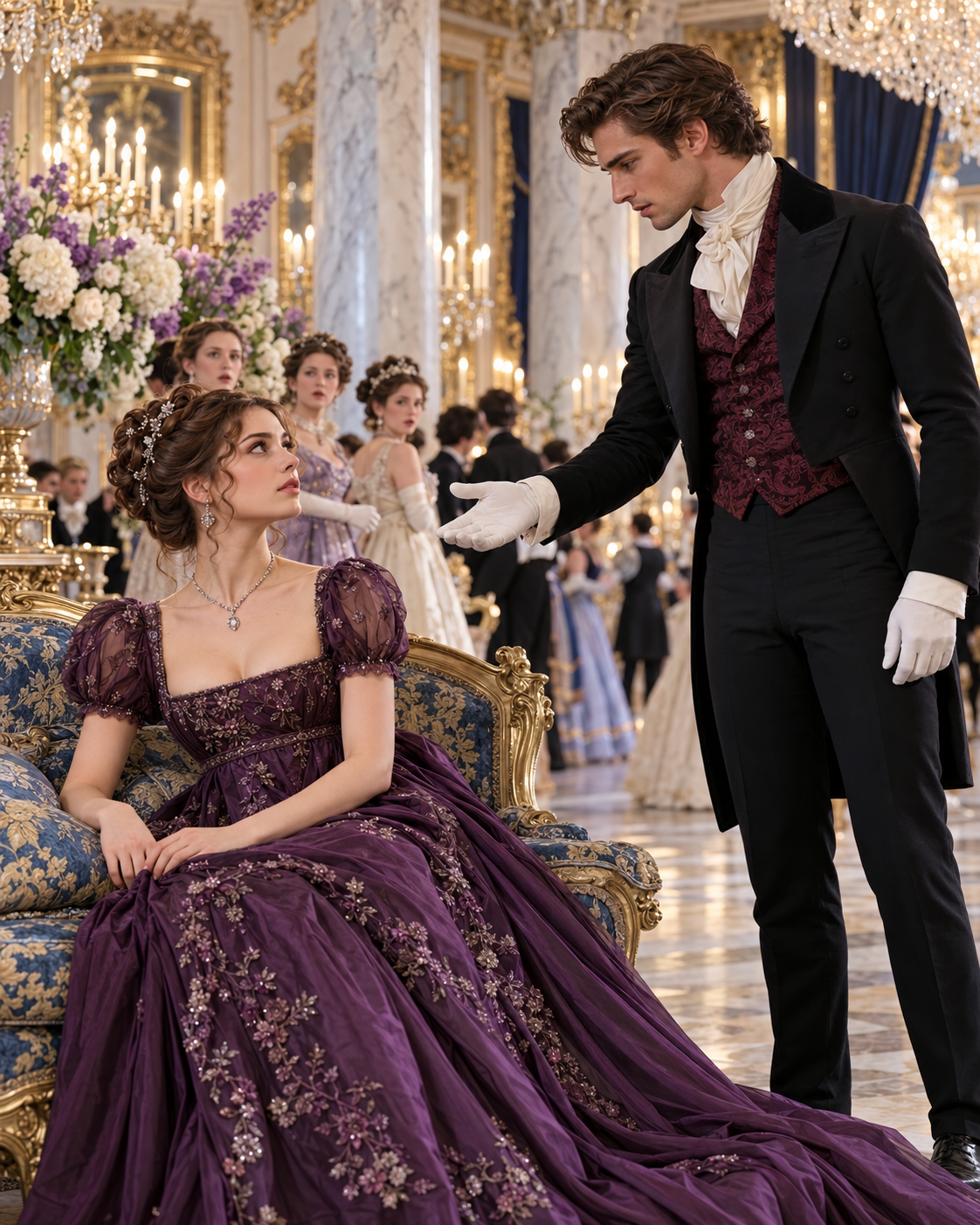
Genevieve remembered a ballroom three seasons earlier.
A young woman in an unfashionable gown.
A gentleman laughing quietly.
The Duke’s voice suggesting that his friends could do better.
Her fingers tightened around the letter.
“Was that why you humiliated me?”
The Duke closed his eyes briefly.
“At first, I thought discouraging your attachment would keep Bellweather from believing a match between us was possible.”
Genevieve waited.
He opened his eyes.
“That does not excuse what I said.”
“No,” she answered.
“It does not.”
He seemed to search for something else to offer.
There was nothing.
Genevieve looked out at the passing houses.
For years, she had imagined that the Duke disliked her because she was insufficiently beautiful, insufficiently clever, insufficiently accomplished.
She had quietly collected his humiliations and arranged them into evidence against herself.
Now he offered a different explanation.
Not one that erased the hurt.
Only one that revealed how little it had ever belonged to her.
“You could have spoken to me,” she said.
“I should have.”
“You could have treated me with ordinary courtesy.”
“Yes.”
“You could have trusted me with the truth.”
His voice was low.
“I know.”
Genevieve turned back toward him.
“And you expect me to believe your sudden interest is entirely honorable?”
“No.”
That answer startled her.
The Duke leaned forward, his elbows resting against his knees.
“I expect you to doubt me. I have given you excellent reasons.”
Outside, the carriage slowed.
Mrs. Whitcomb’s house appeared beyond the rain-speckled glass.
Genevieve gathered her gloves.
“Then we understand one another.”
The Duke stepped down first and offered his hand.
She ignored it.
But as she passed, she noticed a pale scar across his knuckles.
His right hand trembled slightly before he concealed it.
She wondered what else he had been concealing.
Mrs. Whitcomb received them in her drawing room wearing a dark blue dressing gown and an expression of profound irritation.
“Ashborne,” she said, “if you have brought scandal to my doorstep, I shall personally see that it leaves with you.”
The Duke bowed.
“I fear scandal may already be on its way.”
“Then it had better remove its muddy boots.”
Genevieve almost laughed.
Her aunt took one look at her face and stopped making jokes.
“What has happened?”
Within minutes, the letter lay open across a writing desk.
The forged document had been described.
Lord Bellweather’s name had been spoken.
And Mrs. Whitcomb had sent a servant to fetch a locked tin box from her study.
She opened it with a small brass key.
Inside were old letters, receipts, and a bundle of legal correspondence tied with faded green ribbon.
“I hoped we would never need these,” she said.
Genevieve moved closer.
“What are they?”
“Proof that your benefactor anticipated trouble.”
Among the papers was a memorandum from Mr. Harcourt, dated four months earlier.
He had expressed concern about discrepancies in the trust accounts.
Several substantial payments had been made to an investment company controlled by Lord Bellweather.
The transactions lacked proper authorization.
Genevieve read the amounts in silence.
“This is theft.”
Mrs. Whitcomb nodded.
“And it appears someone intended to conceal it before you could examine the accounts.”
The Duke picked up one of the receipts.
His expression changed.
“This company,” he said quietly.
“What about it?” Genevieve asked.
“My father invested in it before his death.”
Mrs. Whitcomb studied him.
“Did he?”
The Duke examined the receipt more closely.
“Yes. Bellweather told me those investments had failed.”
“And you believed him?”
“I had no reason not to.”
Mrs. Whitcomb closed the tin box.
“Then perhaps, Your Grace, you have been foolish in considerably more expensive ways than you imagined.”
He accepted the remark without objection.
A knock interrupted them.
The housekeeper appeared at the doorway.
“Forgive me, ma’am, but a young gentleman insists upon seeing Miss Croft.”
Genevieve turned.
“Who?”
“Mr. Julian Bellweather.”
The room went still.
Mrs. Whitcomb rose.
“Tell him this is not a suitable hour.”
“He says it concerns Miss Croft’s solicitor.”
Genevieve exchanged a glance with the Duke.
“Show him in.”
Julian entered looking nothing like the confident gentleman who had recently filled her drawing room with flowers.
His coat was damp.
His cravat was crooked.
One side of his face bore a faint bruise.
“Miss Croft,” he said, stopping near the doorway, “I came to warn you.”
The Duke moved forward.
“About your uncle?”
Julian’s eyes narrowed.
“I see you have finally decided to involve yourself, Ashborne.”
“Speak plainly,” Genevieve said.
Julian looked at her.
For once, he did.
“My uncle intends to announce our engagement tomorrow.”
Mrs. Whitcomb made a sharp sound of disbelief.
“On whose authority?”
“A document bearing Miss Croft’s signature.”
Genevieve felt a cold steadiness settle over her.
“There is no engagement.”
“I know.”
Julian reached into his coat and withdrew a folded sheet.
“I refused to cooperate when I saw what he had done.”
The Duke studied him.
“And the bruise?”
Julian gave a humorless smile.
“My uncle believes persuasion should occasionally be physical.”
He offered Genevieve the paper.
It contained a draft announcement prepared for the society newspapers.
The wording described a long-standing understanding between their families.
Genevieve’s name appeared beside Julian’s.
Beneath it was a proposed wedding date.
Three weeks away.
“He meant to publish this?” she asked.
“At breakfast.”
“And afterward?”
“He would claim you had already consented privately. By the time you contradicted him, everyone would have an opinion about your character.”
Mrs. Whitcomb’s expression hardened.
“A particularly familiar method.”
Julian lowered his head.
“I am sorry.”
Genevieve examined him.
“Did you know about the annuity when you began calling on me?”
His silence was answer enough.
“Yes,” he admitted.
“Did you know what your uncle intended?”
“Not at first.”
“And when you discovered it?”
“I told myself I could still make you happy.”
Genevieve looked at the flowers wilting in a vase beside the fireplace.
White roses.
His favorite offering.
Not hers.
“You never asked what would make me happy.”
Julian swallowed.
“No.”
She folded the announcement and handed it to her aunt.
“Then perhaps tonight has been educational for us both.”
He bowed his head.
“I will testify against him.”
The Duke regarded him carefully.
“Even if it destroys your inheritance?”
Julian’s answer came after a long pause.
“There may be very little left to inherit.”
The following morning, the drawing room at Mrs. Whitcomb’s house became an unlikely center of legal activity.
A new solicitor, recommended by her aunt, arrived before nine.
Mr. Frederick Vale was a quiet, silver-haired man who listened without interruption and examined every document twice.
By noon, he had discovered something none of them expected.
The forged authorization was not merely an attempt to transfer Genevieve’s money.
It had been prepared to conceal a transfer already initiated.
“Someone has attempted to withdraw a substantial sum,” he explained, tracing a figure beneath his spectacles.
Genevieve leaned over the desk.
“How substantial?”
“Nearly half the annuity’s capital.”
The Duke swore softly.
Mrs. Whitcomb closed her fan with a sharp snap.
“Can it be stopped?”
“If we establish the forgery immediately.”
“Then we shall.”
Mr. Vale hesitated.
“There is another difficulty.”
Genevieve looked up.
“The bank has received notice that Miss Croft may be mentally unfit to administer her affairs.”
For several seconds, nobody spoke.
Then Genevieve smiled.
It was not a pleasant smile.
“How convenient.”
Mr. Vale nodded gravely.
“The allegation has no supporting medical evidence, but it may delay access to the funds while the matter is investigated.”
“Who submitted it?”
“Lord Bellweather.”
The Duke pushed back his chair.
“I will confront him.”
“No,” Genevieve said.
The single word stopped him.
He turned.
She stood beside the writing desk, the forged signature lying beneath her hand.
“You will not.”
“He has committed fraud.”
“And he is counting on you to behave like an angry duke who believes a threat will solve everything.”
Ashborne stared at her.
Mrs. Whitcomb concealed a smile behind her fan.
Genevieve continued.
“We shall meet him with documents, witnesses, and a solicitor who knows precisely which questions to ask.”
The Duke slowly returned to his chair.
“What would you have me do?”
It was the first time he had asked her that question.
She looked at him for a moment.
“Find out where the missing money went.”
By evening, the answer had begun to emerge.
The investment company controlled by Bellweather had purchased debts associated with several noble estates.
Among them were obligations belonging to the Ashborne family.
Bellweather had used money diverted from Genevieve’s trust to buy influence over families desperate to preserve their fortunes.
In return, he demanded favorable marriages, property transfers, and positions of authority.
Her annuity was not merely wealth to be stolen.
It was the foundation of a quiet empire built on desperation.
And the Duke’s father had been one of its earliest victims.
Ashborne read the accounts in silence.
Genevieve watched his expression grow rigid.
“My father trusted him,” he said.
Mr. Vale adjusted his spectacles.
“Many people did.”
The Duke placed the documents on the table.
“I spent years trying to repay debts that should never have existed.”
Genevieve studied his hands.
They were steady now.
“And you treated people cruelly while you carried that burden.”
His eyes lifted.
“Yes.”
She had not expected agreement to trouble her more than an argument.
But it did.
There was no excuse in his voice.
No request for pity.
Only acknowledgment.
Mr. Vale arranged the papers into a neat pile.
“We have enough to demand an immediate injunction, but Bellweather will attempt to discredit everyone involved.”
“Then let him try,” Genevieve said.
Mrs. Whitcomb glanced toward the window.
“He will.”
Three days later, Lord Bellweather invited Genevieve to his London residence.
The invitation arrived on expensive cream paper.
It contained no apology.
Only a suggestion that their disagreement might be resolved quietly, without unnecessary injury to her reputation.
Genevieve accepted.
But she did not arrive alone.
Mrs. Whitcomb accompanied her, along with Mr. Vale.
The Duke waited outside with Julian, who had agreed to provide testimony.
Lord Bellweather received them in a library lined with dark shelves.
A fire burned beneath a marble mantelpiece.
The room smelled of polished wood and cigar smoke.
“Miss Croft,” he said warmly, “how good of you to come.”
Genevieve remained standing.
“I understand you have been making arrangements concerning my marriage.”
Bellweather smiled.
“A misunderstanding, my dear.”
“Then you will have no objection to withdrawing the announcement.”
“Certainly, once we have settled the financial matter.”
Mr. Vale opened his case.
“I believe that matter has already been settled by law.”
Bellweather’s eyes shifted toward him.
“And you are?”
“The gentleman instructed to protect Miss Croft’s interests.”
“How unnecessary.”
“Quite the contrary.”
Mr. Vale placed the forged document on the desk.
Then he laid beside it a certified copy of Genevieve’s genuine signature.
“The differences are apparent.”
Bellweather did not touch either page.
“I know nothing of this.”
“Then you will welcome an investigation.”
The old man’s smile thinned.
“Investigations have a habit of revealing unpleasant things about everyone involved.”
Genevieve met his gaze.
“Is that intended as a threat?”
“It is intended as advice.”
He moved toward the fireplace.
“Young women seldom appreciate how fragile their position in society can be.”
Genevieve thought of three seasons spent measuring her worth through the approval of people like him.
She remembered every polite insult, every invitation withheld, every room in which she had tried to become smaller.
Then she looked at the man before her.
“You mistake my reputation for my livelihood, Lord Bellweather.”
His eyes hardened.
“Society can be unforgiving.”
“So can the law.”
Mr. Vale produced the bank records.
For the first time, Bellweather’s composure slipped.
“Where did you obtain those?”
“From the institution whose funds you attempted to misappropriate.”
“That information is confidential.”
“To you, perhaps,” Genevieve replied.
Bellweather reached for the papers.
Mr. Vale calmly withdrew them.
“You will receive copies through the appropriate legal channels.”
For a moment, Bellweather seemed to consider overturning the desk.
Instead, he laughed.
“You believe this will end well for you, Miss Croft?”
Genevieve picked up her gloves.
“I believe it will end with my money remaining mine.”
The library door opened.
Julian stood beside the Duke.
His uncle’s face changed.
“Julian.”
“I have given Mr. Vale my statement,” the young man said.
Bellweather stepped forward.
“You foolish boy.”
Julian flinched but held his ground.
“No more.”
The Duke entered behind him.
Bellweather looked from one face to another.
“You have all made a terrible mistake.”
“Perhaps,” Ashborne answered quietly. “But this time the mistake is ours to make.”
Outside the house, Genevieve finally released the breath she had been holding.
Her aunt touched her arm.
“You handled him admirably.”
Genevieve looked down at her trembling fingers.
“I was terrified.”
“Of course you were.”
Mrs. Whitcomb adjusted the ribbon beneath her bonnet.
“Courage is rarely as comfortable as people pretend.”
The investigation that followed was neither swift nor pleasant.
Bellweather contested every accusation.
He employed solicitors, approached influential acquaintances, and encouraged rumors concerning Genevieve’s judgment.
Several invitations ceased arriving.
Old acquaintances crossed streets to avoid her.
A newspaper printed a thinly disguised account of an unmarried heiress who had supposedly become unmanageable after receiving money.
Genevieve read it once.
Then she folded the paper and placed it beneath a vase.
She had spent too many years fearing gossip to surrender another season to it.
Mr. Vale secured an order preventing further unauthorized withdrawals.
Julian testified to the proposed marriage scheme.
The gentleman who had approached Genevieve at the ball was identified through correspondence recovered from Bellweather’s office.
And the forgery was examined by specialists whose findings left little room for dispute.
The most difficult revelation came later.
Mr. Harcourt had not died naturally.
A physician reviewing the circumstances raised questions about the sudden illness that had preceded his death.
No final conclusion could be drawn immediately.
But records showed that he had arranged to meet investigators shortly before he became ill.
His private notes contained repeated references to Bellweather’s accounts.
Genevieve sat with those notes long after the solicitor had gone.
The man who had first explained her independence had continued trying to protect it.
Even when doing so placed him in danger.
She arranged for his widow to receive assistance with the legal expenses associated with the investigation.
When Mrs. Harcourt came to thank her, Genevieve gently refused the gratitude.
“Your husband did something brave,” she said.
“I would rather his children remember that than remember the circumstances of his death.”
Mrs. Harcourt began to cry.
Genevieve took her hand.
Neither woman spoke for a while.
Months passed before the courts delivered their ruling.
Bellweather’s attempts to control the trust were declared unlawful.
The forged authorization was invalidated.
The remaining diverted funds became the subject of recovery proceedings, and Bellweather faced criminal prosecution for his part in the scheme.
Not every loss could be repaired.
Some money had disappeared into failed ventures.
Several families discovered obligations they had never properly understood.
Julian surrendered his expectations of inheritance and accepted a modest position far from London.
But Genevieve’s annuity was secured under independent administration.
And for the first time, no one disputed her right to direct it.
The Duke of Ashborne visited Mrs. Whitcomb’s house on a cold afternoon in early spring.
Genevieve found him standing beside the window, watching sunlight fall across the garden.
He had brought no flowers.
No expensive gift.
Only a small parcel wrapped in plain brown paper.
“What is that?” she asked.
He offered it to her.
“A collection of letters my father wrote concerning your family.”
She opened the parcel.
Inside were several carefully preserved pages.
One spoke warmly of Genevieve’s late benefactor.
Another described concerns about Bellweather’s influence.
The final letter had never been sent.
In it, the late Duke admitted that he had begun to suspect financial misconduct but feared the consequences of exposing it.
Genevieve read the last page slowly.
“Why give these to me?”
“Because they concern your history.”
“And yours.”
“Yes.”
She tied the ribbon around the letters.
“You could have kept them.”
“I have kept too many things that were never mine to withhold.”
Genevieve looked at him.
The arrogance she remembered had not vanished entirely.
He still carried himself with the certainty of a man accustomed to doors opening before him.
But he no longer seemed to expect every person behind those doors to obey.
“I owe you an apology,” he said.
“You have apologized before.”
“Not properly.”
He stood straighter.
“For three seasons, I made you the object of my contempt because I was too cowardly to confront a man who held power over me.”
Genevieve said nothing.
“I told myself I was protecting you. In truth, I was protecting my pride.”
The clock on the mantelpiece ticked softly.
“I cannot undo those years,” he continued. “Nor can I ask you to remember them differently.”
“No,” she said.
“You cannot.”
He accepted the answer.
“I only wanted you to know that I understand what I did.”
Genevieve looked down at the letters.
There had been a time when she would have given anything to hear those words.
Now they mattered.
But not in the way she had once imagined.
“Thank you,” she said.
The Duke inclined his head.
Then he turned toward the door.
“Ashborne.”
He stopped.
She studied his face.
“Why did you ask me to dance that evening?”
He hesitated.
“Because I wanted to.”
“That is not an explanation.”
A faint smile crossed his mouth.
“No. It is not.”
He looked toward the garden.
“I had watched you enter the ballroom without searching for anyone’s approval. You spoke to people because you wished to speak to them. You laughed without checking who was listening.”
Genevieve remained still.
“And I realized,” he said, “that the woman I had dismissed for three years had become someone I scarcely knew.”
She considered him.
“Perhaps you never knew me.”
His smile faded.
“You are right.”
Outside, a bird landed on the bare branch of a pear tree.
For a moment, neither spoke.
Then Genevieve asked, “And what do you want now?”
The Duke looked at her steadily.
“To know you, if you should ever permit it.”
She did not answer immediately.
Forgiveness, she was discovering, did not arrive like a door suddenly opening.
It came in smaller movements.
A conversation accepted.
An old injury acknowledged.
A boundary respected.
And sometimes, the decision to leave a door closed without anger.
“I cannot promise anything,” she said.
“I would not ask you to.”
“But you may call again next Thursday.”
His eyes softened.
“Thursday?”
“At four.”
“I shall be punctual.”
“And, Your Grace?”
“Yes?”
“Do not bring roses.”
He glanced at the vase beside the fireplace.
“No roses.”
After he departed, Mrs. Whitcomb entered the drawing room carrying a cup of tea.
“I gather the Duke has survived his visit.”
“Just barely.”
Her aunt settled into a chair.
“And have you forgiven him?”
Genevieve considered the question.
“I think I have begun to.”
“Will you marry him?”
Genevieve laughed softly.
“Aunt Eleanor, he has only just learned how to speak to me without issuing instructions.”
“A promising beginning for a duke.”
Genevieve crossed toward the window.
The spring light was pale but clear.
For the first time in years, she found herself thinking about the coming season without dread.
She had plans that no marriage proposal could replace.
A portion of her income would support education for young women whose families could not afford it.
Another would establish a small fund offering legal guidance to women managing inheritances and property.
Mrs. Whitcomb had already promised her assistance.
Mr. Vale had agreed to advise the undertaking.
And Genevieve intended to oversee the work herself.
She no longer wanted merely to possess independence.
She wanted to make it useful.
The following summer, a modest school opened in a renovated house near Bloomsbury.
On its first morning, Genevieve stood in the doorway watching a dozen girls arrange their books at wooden desks.
Their ages varied.
Some were shy.
Others were already whispering excitedly.
A young teacher adjusted the curtains to let in more light.
One girl approached Genevieve.
“Are you the lady who owns the school?”
Genevieve smiled.
“I helped establish it.”
The girl looked around.
“Will we really be allowed to study mathematics?”
“Certainly.”
“And history?”
“Yes.”
“And anything else?”
Genevieve knelt slightly so their eyes were level.
“Anything you are willing to work hard to understand.”
The girl considered this with great seriousness.
Then she ran back to her desk.
From the doorway, the Duke watched without interrupting.
He had become a frequent visitor during the preceding months.
Some afternoons were spent in quiet conversation.
Others ended in disagreements neither seemed eager to avoid.
He had learned that Genevieve disliked being spoken for.
She had learned that beneath his reserve lived a dry humor he rarely allowed society to see.
Their affection developed without grand declarations.
He listened.
She challenged him.
Sometimes he disappointed her.
Sometimes she surprised him.
And gradually, both discovered that honesty could survive a disagreement without diminishing respect.
When the children settled into their first lesson, the Duke approached.
“You have accomplished something remarkable.”
Genevieve looked through the doorway.
“They will accomplish the remarkable things.”
He smiled.
“Then I stand corrected.”
“An increasingly familiar experience for you.”
“Painfully familiar.”
They walked together toward the garden.
The afternoon sun warmed the gravel path.
For several minutes, they spoke of the school’s accounts, its teachers, and the possibility of opening another classroom.
Then the Duke stopped beside a flowering rosebush.
Genevieve noticed.
“You are looking unusually solemn.”
“I have a question.”
“That sounds dangerous.”
“Possibly.”
He removed his gloves.
Then, without reaching for her hand, he looked directly into her eyes.
“Genevieve, would you consider marrying me?”
She had imagined this moment once, long ago.
In those dreams, the Duke’s proposal had been proof that she was finally worthy of attention.
She had pictured a glittering ballroom, an astonished audience, and the delicious satisfaction of seeing those who had dismissed her forced to reconsider.
Now there was no audience.
Only a quiet garden.
A distant classroom filled with children’s voices.
And a man who had learned to ask rather than command.
Genevieve looked at him for a long moment.
“Would you expect me to give up the school?”
“No.”
“My work?”
“Never.”
“My money?”
“It is yours.”
“My opinions?”
He smiled faintly.
“I suspect losing those would be impossible.”
She lowered her gaze, concealing a smile of her own.
“And if I disagree with you?”
“Then I shall endeavor to deserve the argument.”
A breeze stirred the leaves overhead.
Genevieve extended her hand.
The Duke took it gently.
“I will consider your proposal,” she said.
His expression changed.
“Consider?”
“Carefully.”
“How long might that require?”
“I cannot say.”
He nodded, though disappointment flickered across his face.
“Then I shall await your answer.”
Genevieve stepped closer.
“And if I decide against it?”
His fingers loosened around hers.
“Then I shall remain grateful that you allowed me to know you.”
She watched him for another moment.
Then she smiled.
“In that case, Your Grace, I believe my answer is yes.”
He stood perfectly still.
“Are you certain?”
“Entirely.”
For once, the Duke of Ashborne had nothing clever to say.
Genevieve laughed.
He drew her hand to his lips.
And when he kissed it, there was no audience to impress, no victory to claim, and no bargain waiting to be completed.
Only a promise freely given.
They married in the autumn.
It was a smaller ceremony than society expected.
Mrs. Whitcomb wept discreetly into an embroidered handkerchief.
Julian sent a letter from the countryside wishing them happiness.
Mr. Vale attended with his wife and spoke warmly of the school.
And the Duke, standing beside Genevieve at the altar, looked more nervous than he had during any confrontation with Bellweather.
Afterward, when guests gathered beneath the trees, Genevieve found a moment alone in the garden.
She touched the simple gold ring on her finger.
For three seasons, she had believed happiness meant becoming the woman someone powerful might finally choose.
Her inheritance had taught her something else.
That security was not the same as affection.
That admiration was not the same as respect.
And that love, when it was worthy of the name, did not require a woman to surrender herself in exchange for belonging.
The Duke appeared at the garden gate.
“Everyone is looking for you.”
“I suspected they might be.”
“Shall I tell them you require another moment?”
Genevieve looked at him.
Once, she would have hurried back, terrified of disappointing anyone.
Now she considered the question.
“Yes,” she said. “One more moment.”
He nodded.
Then he remained beside the gate, waiting.
Genevieve smiled and held out her hand.
“You may stay.”
He crossed the garden and took it.
Together, they stood beneath the autumn leaves as laughter drifted from the house.
Years later, people would speak of their marriage as a great romantic triumph.
They would remember the Duke’s devotion, Genevieve’s grace, and the unlikely courtship that had astonished London.
Few would remember the forged signature, the rain-soaked carriage, or the trembling hands of a young woman who had refused to be frightened into obedience.
But Genevieve remembered.
She remembered the ballroom where she had finally said no.
The letter that had revealed how others intended to shape her life.
The solicitor who had risked his safety to protect her future.
And the quiet certainty that had grown within her when she understood that she no longer needed anyone’s permission to choose her own path.
One afternoon, many years later, a young student at the school asked her a question.
“Lady Ashborne, how does a lady know when someone truly loves her?”
Genevieve closed the book she was reading.
Beyond the window, the Duke stood in the garden teaching their youngest daughter how to plant a rosebush.
He was kneeling in the earth, his coat discarded over a nearby chair.
Their daughter was giving instructions.
He was listening with exaggerated seriousness.
Genevieve watched them for a moment.
Then she turned back to the girl.
“When someone loves you well,” she said, “you will not have to become smaller to make room for them.”
The student considered this.
“And if they ask you to?”
Genevieve smiled gently.
“Then, my dear, you already know your answer.”
Outside, her daughter called for help.
The Duke looked up toward the window.
Genevieve rose and went to join them.
The life waiting beyond that doorway was not the reward for having finally won a duke’s affection.
It was the life she had chosen, built upon the freedom she had fought to protect.
And she knew, with a certainty no one could ever take from her, that the most important moment of her story had not been the day the Duke of Ashborne asked her to marry him.
It had been the evening she looked him in the eye, refused his invitation, and discovered that the world did not end when she said no.
Because the greatest freedom is not being chosen by someone powerful, but having the power to choose for yourself.
THE END.