The day Jeremiah Whitaker’s oldest son dumped my dinner into the dirt before six ranch hands, his father called me worthless, unaware his boy was hiding a terrible secret.
The stranger standing outside Jeremiah Whitaker’s front door knew my name, and the photograph in his hand was twenty-two years old.
For one terrifying moment, I forgot how to breathe.
Snow swirled around his shoulders as he stood beneath the yellow porch light, smiling like a man arriving for Sunday supper.
But there was something about that smile that made every instinct inside me scream.
Jeremiah grabbed my wrist before I could reach the door.
“Don’t open it, Winnie.”
I turned toward him, stunned by the terror in his voice.
“Who is that man?”
His fingers tightened around my wrist.
“His name is Thomas Miller.”
My heart lurched because I remembered that name from a frightened teenage girl who once slept in a shelter in Billings.
Rebecca Miller had whispered it in her sleep.
It belonged to her father.
The man she had spent years trying to escape.
Outside, Thomas knocked again, three deliberate blows that seemed to shake the entire house.
“Jeremiah, I know you’re in there.”
Owen stood frozen beside the staircase, clutching his mother’s letter against his chest.
“That’s Grandpa Thomas?” he whispered.
Jeremiah’s expression told me the boys had never been allowed to know him.
“Go upstairs, Owen, and take your brothers with you.”
But Owen didn’t move.
“I’m tired of everybody hiding things from me.”
His voice cracked, and for once, Jeremiah had no answer.
Thomas pressed the old photograph against the window.
“Ask Winnie what happened at that shelter, Jeremiah.”
A terrible memory stirred beneath years of carefully buried silence.
I remembered a winter night, broken glass, and Rebecca crying behind a locked office door.
I also remembered a man’s voice promising that no one would ever believe a troubled girl over her own father.
I moved toward the door.
Jeremiah stepped in front of me.
“He wants to hurt you.”
“Then tell me why you hired me without telling me who Rebecca was.”
He looked away.
That small movement frightened me more than Thomas’s appearance.
Because I suddenly understood that the man who had brought me to this ranch was still keeping something from me.
I reached for the deadbolt.
“Winnie, please.”
I opened the door just enough for the chain to hold.
Thomas Miller looked older than I remembered, with silver hair and deep wrinkles surrounding pale blue eyes.
But his expression hadn’t changed.
He still wore the confidence of a man who believed the world would always make room for him.
“Hello, Winnie Carter.”
I felt the old name strike me like a slap.
“Nobody calls me that anymore.”
His smile widened.
“Rebecca did.”
The wind pushed snow across the threshold.
“What do you want?”
He glanced past me toward Jeremiah.
“I want to correct a terrible misunderstanding about my daughter’s death.”
Jeremiah stepped closer.
“You need to leave my property.”
Thomas ignored him.
“Rebecca wasn’t driving to the pharmacy when she died.”
“We know that,” Owen shouted from behind us.
Thomas’s eyes flickered toward the boy.
For one brief second, something resembling affection crossed his face.
Then it disappeared.
“Well, there’s my grandson.”
Owen took an uncertain step forward.
Thomas lowered his voice.
“Your mother was coming to meet me that night.”
My stomach twisted.
“Why?”
Thomas looked directly at me.
“Because she finally learned what you did.”
The words struck me with such force that I staggered backward.
Jeremiah slammed the door before Thomas could say another word.
Outside, the man laughed softly.
“I’ll be at the Silver Creek Motel, Winnie, and I think you’ll want to hear the rest.”
Then his boots crunched across the porch, and his truck disappeared into the white darkness.
For several seconds, nobody spoke.
Owen finally broke the silence.
“What did he mean?”
I looked at Jeremiah.
“That’s exactly what I’d like to know.”
Jeremiah stared at the closed door.
“Thomas Miller spent years convincing Rebecca that nobody could be trusted.”
“That doesn’t answer my question.”
He rubbed his face.
“Rebecca was trying to protect something.”
“What?”
His voice became almost inaudible.
“Evidence.”
Owen looked between us.
“Evidence of what?”
Jeremiah glanced toward the photographs hanging above the fireplace.
“Your grandfather wasn’t the respectable businessman everyone believed he was.”
Then he said something that made my knees weaken.
“And Rebecca believed someone had helped him destroy the records from that shelter.”
I remembered the fire immediately.
Twenty-two years earlier, the Billings Children’s Haven had burned during a freezing February night.
Nobody died, but several children lost the only safe home they’d ever known.
The official investigation called it an electrical accident.
I’d never believed that explanation.
Not after discovering that Rebecca’s file had disappeared the morning before the fire.
I lowered myself into a chair.
“Thomas was involved?”
Jeremiah nodded.
“Rebecca thought he started it.”
The old memories returned with painful clarity.
I remembered standing outside the burning building, wrapped in a blanket, watching firefighters carry children through the smoke.
I remembered Rebecca clinging to my coat.
And I remembered promising her that nobody would ever take her back to the man she feared.
Three days later, she vanished.
I’d spent months searching.
Eventually, someone told me she’d been placed with relatives in another state.
I had believed them.
That mistake had haunted me ever since.
“Why didn’t she contact me?” I whispered.
Jeremiah’s face crumpled.
“She tried.”
My heart seemed to stop.
“What?”
“She wrote you letters for years.”
I stared at him.
“Jeremiah, I never received a single one.”
He disappeared into the study and returned carrying a small wooden box.
Inside were faded envelopes tied together with a blue ribbon.
Every envelope bore my old name.
Most were marked RETURN TO SENDER.
I lifted one with trembling fingers.
The handwriting was Rebecca’s.
But the return address wasn’t.
Thomas Miller had written his own business address on the envelopes.
I understood immediately.
He had intercepted the letters before they ever reached me.
My eyes filled with tears.
“She thought I abandoned her.”
Jeremiah knelt beside my chair.
“She believed you were the only adult who had ever protected her without asking for anything in return.”
I pressed a letter against my chest.
For twenty-two years, two women had carried the same grief, each believing the other had chosen to disappear.
Owen watched me with an expression I’d never seen before.
The anger was gone.
In its place was something much more fragile.
Regret.
“I’m sorry about the mouse,” he whispered.
The words almost broke me.
I reached for his hand.
“That mouse and I came to an understanding.”
He gave a small, trembling laugh.
Then his face darkened.
“Grandpa said Mom was coming to meet him.”
Jeremiah rose slowly.
“She was.”
Owen’s voice sharpened.
“Then why did you tell everyone she was buying medicine?”
Jeremiah looked toward the window.
“Because I didn’t want you boys growing up afraid of your grandfather.”
Owen shook his head.
“But you let me believe I killed her.”
Jeremiah froze.
The accusation hung between them like a blade.
“I didn’t know you thought that.”
“You never asked.”
Jeremiah opened his mouth, but nothing came out.
Owen’s eyes filled.
“I told Mom I hated her, and then she died, and you couldn’t even look at me anymore.”
I watched Jeremiah’s face collapse beneath the weight of those words.
He approached his son slowly.
“Owen, I couldn’t look at anyone.”
His voice broke.
“I was afraid that if I started crying, I’d never stop.”
Owen tried to turn away.
Jeremiah caught him gently by the shoulders.
“You didn’t kill your mother.”
A sob tore through the boy’s chest.
“I was so mean to her.”
“She knew you loved her.”
“How can you know?”
Jeremiah pulled him close.
“Because she told me every single day.”
Owen resisted for one heartbeat.
Then he collapsed against his father’s chest.
I turned away, giving them the privacy grief had stolen from them for more than a year.
But that night, after everyone finally slept, I opened Rebecca’s letters beside the dying kitchen fire.
Some were filled with ordinary details.
She wrote about learning to drive, falling in love with a stubborn rancher, and holding her first baby.
She described Caleb’s first steps and Benji’s habit of falling asleep with toy horses beneath his pillow.
But the final letter was different.
It had been written three days before her death.
My hands trembled as I unfolded it.
“Winnie, I found out what my father did with the money meant for the children.”
I read the sentence twice.
Then I continued.
“He used the shelter’s records to hide what he stole, and when I was old enough to understand, he threatened anyone who knew.”
My pulse began hammering.
The next paragraph made the room spin.
“I found the original documents in an old metal box, and I hid them where he would never think to look.”
Below those words, Rebecca had written a single sentence.
“Remember the little blue bird you painted on my bedroom wall?”
I covered my mouth.
The blue bird.
I remembered painting it above Rebecca’s bed after she’d spent three nights refusing to sleep.
She told me birds frightened her because they could fly away whenever they wanted.
So I’d painted one with its wings folded.
“This bird is staying,” I’d told her.
She’d smiled for the first time.
Now, twenty-two years later, I finally understood why Rebecca had mentioned it.
I looked at the clock.
It was nearly three in the morning.
I should have waited until daylight.
Instead, I took a flashlight and walked quietly into the hallway.
Rebecca’s old sewing room stood at the end of the corridor.
Jeremiah had told me nobody had touched it since her death.
Inside, the air smelled faintly of lavender and cedar.
Fabric lay folded beside her sewing machine.
Photographs lined the windowsill.
And above a narrow daybed, painted directly onto the white wall, was a little blue bird.
I approached it slowly.
The paint was newer than I expected.
Rebecca had recreated the bird from her childhood.
I ran my fingers across its wings.
Something clicked beneath the wooden paneling.
My breath caught.
A narrow section of the wall shifted.
Behind it sat a small metal box.
I pulled it free and carried it toward the lamp.
Inside were bank statements, photographs, handwritten notes, and a flash drive wrapped in tissue paper.
At the bottom was a sealed envelope addressed to Jeremiah.
I was still staring at it when a floorboard creaked behind me.
I turned.
Owen stood in the doorway.
His eyes moved from the open wall to the metal box.
“You found it.”
I stared at him.
“You knew?”
He nodded.
“Mom showed me that hiding place a week before she died.”
“Why didn’t you tell your father?”
His face tightened.
“She made me promise not to.”
I felt a sudden chill.
“Why?”
He swallowed.
“Because she said somebody might come looking for it.”
I looked down at the documents.
“Owen, did your grandfather know about this box?”
The boy’s eyes filled with terror.
“He came here the day after her funeral.”
My hands went cold.
“He searched her room while Dad was outside.”
“Did he find anything?”
Owen shook his head.
“I heard him talking on the phone.”
“What did he say?”
Owen stared at the floor.
“He said Rebecca should have listened, and that the accident wasn’t supposed to happen that way.”
The world seemed to fall silent.
I pulled Owen close.
For the first time, he didn’t resist.
We woke Jeremiah immediately.
He examined the documents beneath the kitchen light while I called the county sheriff.
There were records of money diverted from charitable accounts, forged signatures, and payments to businesses connected to Thomas Miller.
The flash drive contained copies of correspondence and recordings Rebecca had saved.
Jeremiah listened to one recording with tears streaming down his face.
Thomas’s voice filled the room.
“You don’t understand how much trouble you’re making for this family.”
Rebecca answered quietly.
“I’m not letting you hurt anyone else.”
The recording ended with Thomas saying something that made every person in the kitchen go still.
“Then don’t expect me to protect you from what happens next.”
By sunrise, Sheriff Daniel Brooks arrived with two deputies.
He had known Rebecca for years.
When he heard her voice on the recording, his expression changed.
“Jeremiah, why wasn’t any of this given to investigators after the crash?”
“Because I never knew it existed.”
The sheriff examined the box.
“Where did you find it?”
Owen stepped forward.
“Mom hid it, and I kept her secret.”
Daniel crouched until they were eye to eye.
“You did the right thing telling us now.”
Owen’s chin trembled.
“Did Grandpa kill her?”
Nobody answered immediately.
Daniel finally spoke.
“We don’t know yet, son, but we’re going to find out.”
The sheriff took the evidence and asked us not to contact Thomas.
But Thomas had no intention of waiting.
At noon, Jeremiah received a call from the Silver Creek Motel.
Thomas had checked out before dawn.
His truck was gone.
And someone had broken into the motel office, apparently searching for information about calls made from his room.
Two hours later, I found a note beneath the windshield wiper of my pickup.
It contained only eleven words.
“You couldn’t save Rebecca then, and you can’t save them now.”
My stomach turned to ice.
I ran toward the house.
The kitchen was empty.
Caleb’s coat hung beside the door.
Benji’s boots were missing.
Then I heard Owen shouting from the barn.
I raced across the yard, slipping on the frozen ground.
Owen stood beside the open horse trailer, his face white with terror.
“Benji’s gone!”
My heart slammed against my ribs.
“What happened?”
“He said Grandpa wanted to show him something Mom left for him.”
Owen was shaking uncontrollably.
“I told him not to go, but he said Grandpa promised him a present.”
Jeremiah came running from the house.
When he heard what had happened, his expression became something I will never forget.
It was the face of a father watching his worst nightmare return.
The sheriff was called immediately.
But before the deputies could reach the ranch, Jeremiah’s phone rang.
Thomas Miller.
Jeremiah answered on speaker.
“Where is my son?”
Thomas sounded almost cheerful.
“He’s perfectly fine.”
I heard Benji crying faintly in the background.
Jeremiah gripped the phone so tightly his knuckles turned white.
“If you hurt him—”
“I only want the box Rebecca hid.”
“The sheriff has it.”
Silence.
Then Thomas laughed.
“That was foolish.”
His voice hardened.
“Bring me whatever copies you made, or this boy may never see his next birthday.”
The call ended.
Jeremiah sank against the wall.
Owen made a terrible sound.
“This is my fault.”
I grabbed his shoulders.
“No, Owen, this belongs to the man who took your brother.”
The sheriff organized a search, and deputies began checking remote roads and abandoned properties.
Thomas’s family owned an old hunting cabin near Black Pine Ridge.
Jeremiah remembered visiting it once with Rebecca.
Daniel sent deputies toward the cabin, but the mountain roads were nearly impassable after the blizzard.
I stood beside the kitchen window, trying to keep my hands from shaking.
Then Owen touched my arm.
“There’s something else.”
I turned.
“Tell me.”
He glanced at his father.
“Mom used to take us to a little place beyond the creek, where she said nobody could find us.”
Jeremiah looked up sharply.
“The old sheep camp?”
Owen nodded.
“Grandpa knows about it.”
I remembered Rebecca’s letter and the frightened girl who’d spent her childhood learning how to hide.
Some children grow up memorizing bedtime stories.
Rebecca had grown up memorizing escape routes.
Jeremiah knew the old camp could be reached by a narrow service track from the east pasture.
He gave the location to the sheriff.
Daniel warned us to stay home while deputies approached.
I agreed.
Then we waited.
Every passing minute felt like another stone placed upon my chest.
Caleb sat beside the fire holding Benji’s favorite toy horse.
Owen stood by the window, refusing to move.
Jeremiah paced between the kitchen and the porch.
Finally, the sheriff called.
His deputies had located Thomas’s truck near the sheep camp.
But the cabin was empty.
They had found fresh footprints leading toward an abandoned storage shed beyond the creek.
Then communication became difficult.
The mountains swallowed the radio signal.
Jeremiah whispered a prayer.
I reached for his hand.
For the first time since arriving at the Whitaker ranch, he held mine without hesitation.
Nearly forty minutes passed before another call came.
The sheriff’s voice was strained.
“We have the boy.”
Jeremiah nearly dropped the phone.
“Is he hurt?”
“He’s cold and frightened, but he’s safe.”
I closed my eyes.
Tears spilled down my cheeks.
Then Daniel added something that made my relief falter.
“Thomas fled into the timber before we reached the shed.”
Jeremiah looked toward the darkening mountains.
“Is he armed?”
“We found a rifle in his truck, but we can’t rule out another weapon.”
The sheriff told us to remain inside until the search was complete.
When Benji finally returned, he ran straight into Jeremiah’s arms.
His small body shook beneath the blanket wrapped around his shoulders.
“I’m sorry, Daddy.”
Jeremiah held him so tightly I thought neither of them would ever let go.
“You have nothing to be sorry for.”
Benji looked over his father’s shoulder.
“Grandpa said Mom didn’t love us enough to stay.”
The words seemed to drain the warmth from the entire room.
I knelt beside him.
“Your mother loved you more than anything in this world.”
His lower lip trembled.
“Then why did she go?”
I looked at Jeremiah.
He was crying openly now.
“Because sometimes people make choices that aren’t fair, sweetheart, and someone else’s cruelty took away her chance to come home.”
Benji wrapped his arms around my neck.
I held him until his trembling stopped.
That evening, the sheriff returned with news.
Thomas had been found hiding in an empty cattle shelter several miles from the old camp.
He had been arrested without further violence.
The evidence from Rebecca’s box was being examined, and investigators were reopening both the shelter fire investigation and the circumstances surrounding her death.
For the first time in fourteen months, Jeremiah looked as though he might someday breathe freely again.
But justice rarely arrives as quickly as grief.
The following weeks brought interviews, lawyers, and painful questions.
Investigators discovered that Thomas had used several charities to divert money into private accounts.
The Billings Children’s Haven had been one of them.
Records also showed that Rebecca had arranged to meet him the night she died.
She intended to confront him with copies of the financial evidence.
Thomas had followed her along a remote stretch of highway during a snowstorm.
At first, he insisted he’d been trying to persuade her to stop.
But investigators recovered additional messages from his phone records and an old backup drive.
He had threatened to ruin her family if she exposed him.
A forensic review of the crash evidence, combined with those records and his later statements, led investigators to conclude that Thomas had deliberately forced Rebecca’s vehicle off the road.
She had died before help could reach her.
Jeremiah received the news in the kitchen.
He stood motionless while the sheriff explained what the evidence showed.
When the conversation ended, he walked outside alone.
I found him beside the pasture fence, staring toward the mountains.
“I should have gone with her,” he whispered.
I stood beside him.
“You couldn’t have known what he would do.”
“I knew she was afraid.”
He pressed his hands against the fence.
“She asked me to stay with the boys, and I let her go alone.”
His shoulders began to shake.
“I keep thinking about the last thing I said to her.”
I waited.
He swallowed.
“I told her we could talk when she got home.”
The words broke my heart.
There are sentences people say every day without understanding how much they might someday cost.
See you tomorrow.
Drive safely.
We’ll talk later.
Ordinary words that become unbearable when tomorrow never comes.
I placed my hand over his.
“Jeremiah, she knew you loved her.”
He shook his head.
“I should have said it.”
“Then say it now.”
He looked at me.
“She can’t hear me.”
“Maybe not, but your boys can.”
He began crying again.
And this time, he let me hold him.
Thomas Miller eventually faced charges connected to Rebecca’s death, Benji’s abduction, and the financial crimes investigators uncovered.
Months later, he pleaded guilty under an agreement that spared the Whitaker boys a trial.
He received a lengthy prison sentence, and the court ordered restitution from the assets that could be recovered.
When Jeremiah told the boys, Caleb asked whether Grandpa would ever visit again.
“No,” Jeremiah answered gently.
Benji thought for a moment.
“Good, because he wasn’t very nice.”
Owen looked down at his hands.
“He was nice when he wanted something.”
The room became quiet.
I understood exactly what he meant.
Some people don’t frighten you by shouting.
They frighten you by teaching you that kindness always comes with a price.
On the thirtieth morning of my contract, I packed my suitcase.
I folded my clothes carefully and placed Rebecca’s letters inside the top compartment.
The ranch was quiet.
Outside, the first traces of spring sunlight touched the snow-covered mountains.
I had arrived expecting thirty days of work.
Instead, I had found the last chapter of a story I’d carried unfinished for twenty-two years.
I stood in the doorway, looking at the blue apron hanging behind the pantry door.
Rebecca’s apron.
I had never worn it.
Some things deserved to remain exactly where love had left them.
Then I heard footsteps behind me.
Owen stood at the end of the hallway.
His eyes dropped to my suitcase.
“You’re leaving.”
It wasn’t a question.
I looked at him.
“My contract ends today.”
His expression closed immediately.
For one heartbreaking second, I saw the angry boy who had dumped my dinner into the dirt.
“I knew it,” he whispered.
“Owen—”
“Everybody says they’re different.”
His voice began to shake.
“Then they leave anyway.”
I approached him slowly.
“I’m not leaving because of you.”
He laughed bitterly.
“That’s what people always say.”
I set my suitcase down.
“When I was younger, I thought being strong meant never needing anyone.”
He stared at me.
“I was wrong.”
I told him about my daughter.
About the years we’d spent speaking through short birthday calls and Christmas cards.
About how I’d buried myself in work because apologizing seemed harder than surviving alone.
“I’ve been running from something too, Owen.”
He looked at my suitcase.
“Then don’t run anymore.”
His words landed in the deepest part of my heart.
Before I could answer, Jeremiah appeared behind him.
Caleb and Benji followed, still wearing their pajamas.
Jeremiah held an envelope.
“I believe this belongs to you.”
I accepted it with trembling hands.
Inside was a new employment contract.
But instead of thirty days, the term read simply, “As long as both parties wish to continue.”
Below it, someone had written three additional signatures in crooked pencil.
Owen Whitaker.
Caleb Whitaker.
Benji Whitaker.
And beneath their names, in Benji’s uneven handwriting, were six words.
“Please stay because we love you.”
I pressed the paper against my chest.
For a long moment, I couldn’t speak.
Jeremiah stepped closer.
“Winnie, I don’t need someone to replace Rebecca.”
His voice was steady, but his eyes shone.
“Nobody ever could.”
He glanced at his sons.
“But this house has been cold for a long time, and somehow you’ve brought warmth back into it.”
A tear slid down my cheek.
“I don’t know whether I can promise forever.”
Owen stepped forward.
“Then promise breakfast tomorrow.”
I laughed through my tears.
“That I can do.”
Benji threw his arms around my waist.
Caleb joined him.
Then Owen wrapped his arms around all of us.
For the first time in years, I wasn’t holding myself together.
Someone else was holding me.
I stayed.
But I did something else that afternoon.
I called my daughter.
Her name was Emily.
When she answered, her voice was guarded.
“Mom?”
I stared out at the Montana mountains.
“Emily, I owe you an apology.”
She said nothing.
I continued.
“I thought working hard and keeping food on the table meant I was loving you well enough.”
My throat tightened.
“But sometimes you needed me to stop working and just listen.”
I heard her breathing change.
“I needed you a lot, Mom.”
“I know.”
Tears blurred the window.
“And I’m sorry I made you feel like needing me was something you had to apologize for.”
The silence stretched.
Then she whispered, “I’ve waited years to hear you say that.”
We talked for nearly an hour.
It didn’t erase the years between us.
But when we hung up, she promised to visit in the summer.
And for once, I believed we might find our way back to each other.
Spring arrived slowly at the Whitaker ranch.
The snow melted from the fences.
New calves stumbled through the pastures.
Benji planted sunflowers beside the kitchen steps because his mother had loved them.
Caleb learned to bake biscuits without turning the kitchen into a battlefield.
And Owen began sitting beside me after dinner, sometimes talking and sometimes simply enjoying the silence.
One evening, he brought me Rebecca’s blue apron.
“I think Mom would want you to have this.”
I took it gently.
“Are you sure?”
He nodded.
“She loved you before we even knew you.”
I ran my fingers across the faded fabric.
“She loved you boys more.”
Owen smiled.
“I know that now.”
Months later, on the anniversary of Rebecca’s death, we drove to the hill overlooking the valley.
Jeremiah carried fresh flowers.
The boys carried three small stones painted with their favorite memories of their mother.
Owen placed his stone beside the headstone.
On it, he’d painted a little blue bird.
“I used to think loving somebody meant keeping them from leaving,” he whispered.
Jeremiah placed an arm around his shoulders.
“What do you think now?”
Owen looked toward the mountains.
“I think it means making sure they know they’re loved while they’re here.”
I wiped my eyes.
Because that boy, who had once tried so desperately to drive everyone away, had finally understood something many adults spend their whole lives learning.
Love cannot prevent every goodbye.
But fear should never be allowed to steal the time we still have.
That evening, we returned to the ranch beneath a sky filled with stars.
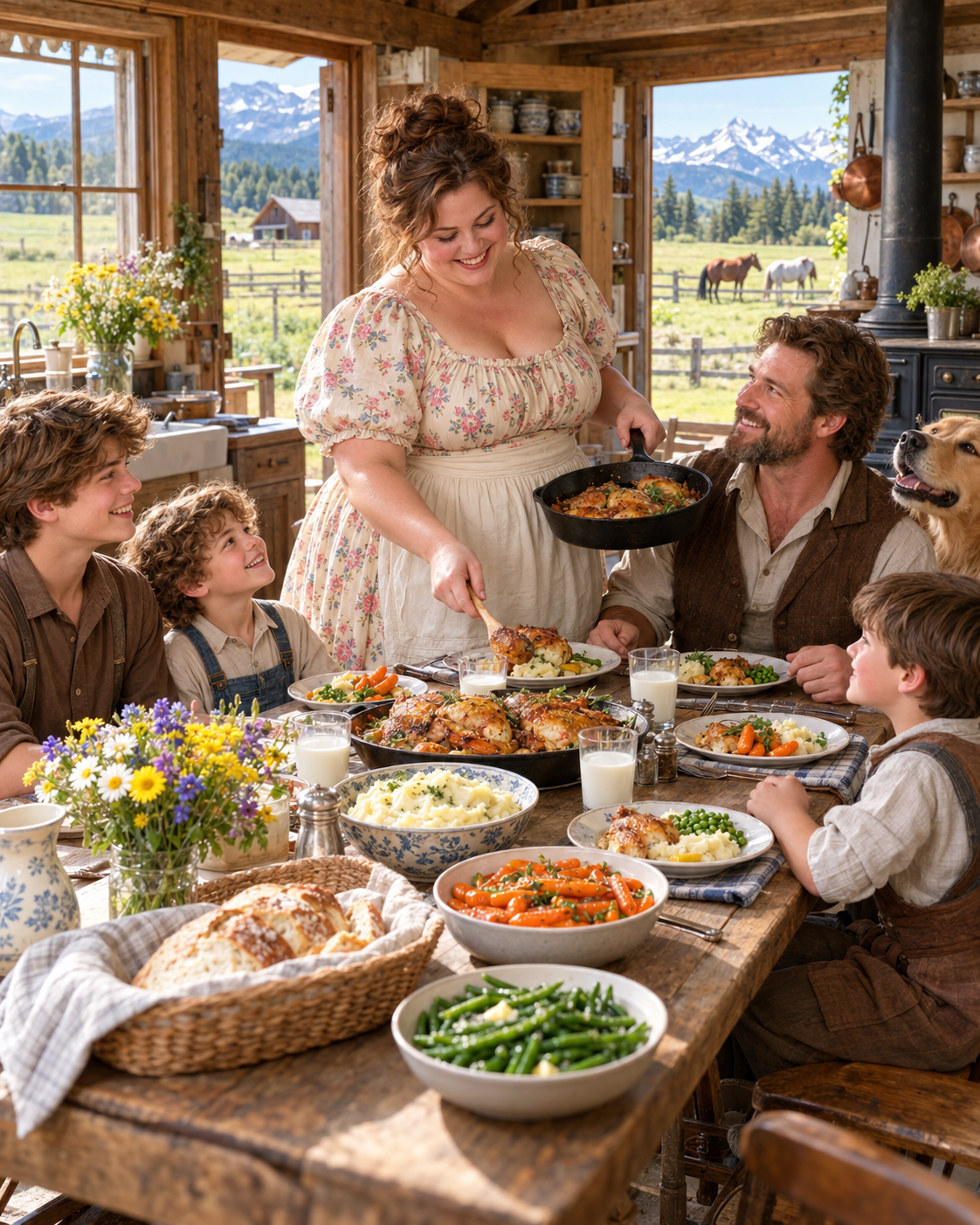
I made beef stew.
The same meal Owen had thrown into the dirt on my first night.
This time, he carried the pot carefully to the table.
“Don’t worry, Winnie,” he said with a grin. “I’ve retired from kitchen sabotage.”
Caleb laughed.
Benji reached for another biscuit.
Jeremiah sat at the head of the table, smiling as his boys argued over who deserved the largest helping.
Then he reached for my hand beneath the table.
It wasn’t a promise of marriage or some grand declaration about the future.
It was something quieter.
A simple reminder that neither of us had to face tomorrow alone.
I looked around the room.
At the three boys who had taught me that anger is sometimes grief wearing armor.
At the man who had learned that being strong doesn’t mean hiding your tears.
And at the empty chair we no longer avoided looking at.
Rebecca’s chair.
We had placed a small vase of sunflowers on it.
Not because we were trapped in the past.
But because remembering someone doesn’t mean refusing to live without them.
Later, while clearing the dishes, I found a folded note beneath my plate.
It was written in Owen’s unmistakable handwriting.
“Dear Winnie, I was mean because I thought if I made you leave first, it wouldn’t hurt when you disappeared.”
Below that, the writing became uneven.
“But you stayed long enough to show me that not everyone leaves because they stop loving you.”
I stood alone in the kitchen, reading those words through tears.
Then I turned the paper over.
There was one final sentence.
“Mom always said home isn’t a place where nothing bad happens, but a place where someone helps you through it.”
I pressed the note to my heart.
Outside, the Montana wind moved softly through the budding cottonwoods.
And somewhere beyond the mountains, the last light of evening disappeared.
I thought about Rebecca, the frightened girl I’d once promised to protect.
For years, I’d believed I’d failed her.
But perhaps love had been quietly finding its way back to us all along.
Through a desperate father’s advertisement.
Through three grieving boys.
Through thirty difficult days that changed everything.
I couldn’t bring Rebecca home.
I couldn’t return the years her children had lost.
And I couldn’t undo every mistake I’d made with my own daughter.
But I could choose what happened next.
I could answer the phone when Emily called.
I could listen when Owen was afraid.
I could sit beside Jeremiah on the nights when grief returned without warning.
And every morning, I could fill that old kitchen with warmth.
Because sometimes healing isn’t the moment the pain disappears.
Sometimes it’s the moment we stop letting pain decide who we’re allowed to love.
The following morning, I woke before sunrise and walked into the kitchen.
A small blue bird sat outside the window, its feathers glowing in the golden light.
I watched it for a moment before opening Rebecca’s recipe box.
Inside the lid, written in her familiar handwriting, was a sentence I had somehow never noticed.
“Feed them well, hold them close, and never let fear make your choices.”
I smiled through my tears.
Then I tied on her blue apron.
Behind me, three sets of footsteps thundered down the stairs.
“Winnie, what’s for breakfast?” Benji shouted.
I turned toward the boys, toward the warmth, toward the life I had almost been too frightened to accept.
“Pancakes, sweetheart.”
Owen grinned.
“With real sugar this time?”
I raised an eyebrow.
“Unless somebody’s been tampering with my ingredients.”
His laughter filled the room.
And when Jeremiah came downstairs, sleepy-eyed and smiling, he kissed the top of Benji’s head before taking his place at the table.
For the first time in many years, I looked at a family gathered around breakfast and didn’t feel like an outsider watching through a window.
I felt like someone who belonged.
Not because we’d forgotten the people we’d lost.
Not because we’d stopped being afraid.
But because we’d finally learned that a broken heart can still make room for love.
And as I poured the pancake batter onto the hot skillet, I realized something that would stay with me for the rest of my life.
Sometimes the people who push us away the hardest are the ones silently begging us not to leave, and sometimes the greatest gift we can give a wounded heart is the courage to stay.
THE END.