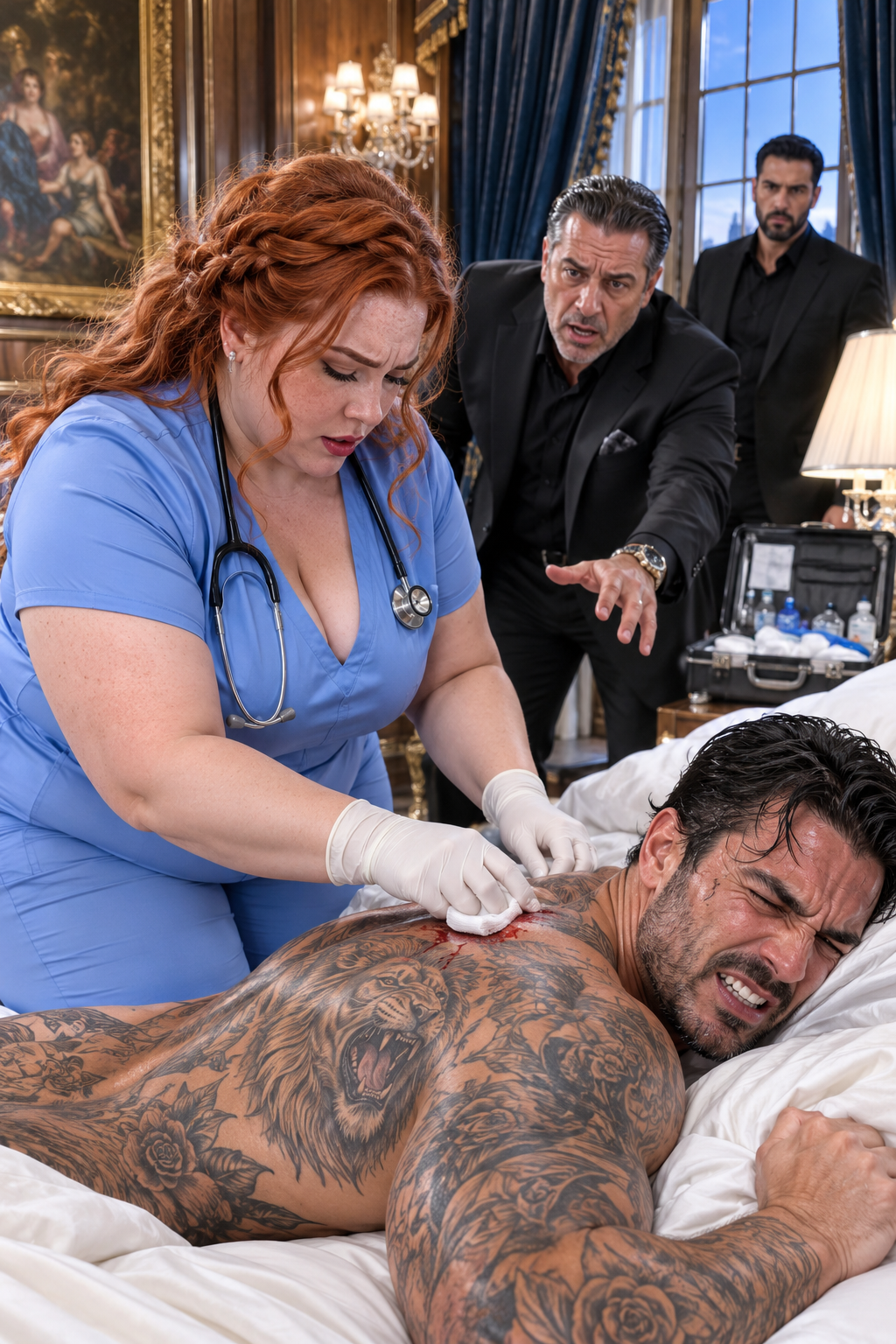
The armed men dragged veterinarian Maisie Dobbs into the Finelli mansion to save a dying sheepdog.
Then he made another offer.
“I want you to remain this family’s trusted physician.”
Maisie raised an eyebrow.
“Augusto, I’m a veterinarian.”
“I know.”
“I cannot become your personal medical doctor.”
“Then help me choose people who will tell me the truth.”
She considered that.
“You need a qualified physician who isn’t afraid of you. And you need to listen when that physician tells you something you don’t like.”
Augusto leaned back carefully.
“Can you recommend one?”
“I can help you find an independent medical team. But I won’t pretend my veterinary license qualifies me to treat humans.”
“Fair enough.”
He extended his hand.
“Then you’ll be my family’s trusted doctor for Bruno, and the person who reminds us when we’re being fools.”
Maisie shook it.
“That second job may take considerably more time.”
For the first time in days, Augusto laughed.
Meanwhile, Lorenzo and the bodyguards continued searching for Bellini.
They eventually located him in a luxury hotel outside Philadelphia, preparing to leave the country.
Rather than allowing the confrontation to become another act of violence, Augusto ordered his men to preserve the medical records and turn their findings over to investigators.
Bellini faced a formal investigation into his treatment decisions, his failure to pursue the documented signs of infection, and his conduct after Augusto’s emergency.
The investigation would take time, and Maisie refused to speculate about his intentions.
What mattered to her was that the truth could finally be examined.
Several weeks later, Bruno was running across the mansion lawn again.
Augusto was recovering steadily under the care of a new medical team, one that insisted on regular follow-up appointments and didn’t hesitate to contradict him.
And Maisie’s clinic had a newly renovated treatment room, better equipment, and a fund to help families who couldn’t afford emergency veterinary care.
She still visited the Finelli estate every Thursday to check on Bruno.
Sometimes Augusto joined them in the garden, asking questions about the dog or offering her coffee.
He never again asked her to practice human medicine.
But whenever one of his men dismissed a concern because an important person had already given an answer, Augusto had a habit of saying, “Remember what happened when we stopped asking questions.”
Maisie had entered that mansion believing the greatest danger came from the armed men guarding its doors.
She left understanding something more complicated.
Power could make people afraid to speak.
Wealth could make terrible judgment look respectable.
And even the most intimidating man in the room could become helpless when everyone around him valued obedience more than honesty.
Augusto Finelli had employed some of the most expensive physicians money could buy.
Yet the person who recognized the danger was a veterinarian who had arrived carrying medicine for a sick sheepdog.
Sometimes saving a life begins with a simple act of courage: refusing to ignore what everyone else has chosen not to see.
The first time Maisie Dobbs returned to the Finelli estate after saving Augusto’s life, she found three armed men arguing over a German shepherd’s breakfast.
“He won’t eat it,” Lorenzo complained, holding a silver bowl filled with expensive imported dog food.
“Because you’ve been feeding him roasted chicken behind my back,” Maisie replied.
The enormous sheepdog, Bruno, lifted his head from the carpet and wagged his tail.
Lorenzo looked offended.
“He was recovering.”
“He was manipulating you.”
From the doorway came a low, amused voice.
“That makes two of us.”
Augusto Finelli stood leaning against the doorframe, one hand resting carefully against his ribs. He was thinner than Maisie remembered, and the color hadn’t entirely returned to his face, but his dark eyes were alert.
Three weeks earlier, she’d watched him fight for his life while an untreated infection overwhelmed his body.
Now he was standing in front of her, smiling.
“You’re supposed to be resting,” she said.
“And you’re supposed to be treating my dog.”
“I am. Unfortunately, his biggest medical problem appears to be your staff.”
Augusto laughed, then winced.
Maisie’s smile vanished.
“Sit down before you tear something.”
He obeyed.
That surprised everyone in the room.
Especially Lorenzo.
In the twenty years he’d worked for the Finelli family, he’d never seen anyone order Augusto around without consequences.
But Maisie had already established an unusual position inside the mansion.
She wasn’t afraid of its owner.
She wasn’t impressed by his money.
And she was the only person Bruno trusted enough to allow near his injured paw without growling.
Augusto watched her examine the dog’s leg.
“How’s he doing?”
“Much better. The infection has cleared, and his appetite is excellent. Possibly too excellent.”
“Good.”
“But he needs another week of restricted activity.”
Augusto glanced at Lorenzo.
“You heard her.”
Lorenzo nodded solemnly.
Maisie looked between them.
“And no more chicken from the kitchen.”
Both men suddenly became interested in the carpet.
For a few minutes, the mansion almost felt ordinary.
Then Augusto’s phone rang.
His expression changed when he saw the caller.
“Excuse me.”
He stepped into the hallway.
Maisie continued examining Bruno, but she couldn’t help hearing his voice through the partially open door.
“What do you mean Bellini’s attorney contacted you?”
A pause.
“No. Absolutely not.”
Another pause.
“Tell him the medical records stay exactly where they are.”
Augusto returned several minutes later, his face grim.
Maisie packed her instruments.
“Problems?”
“Nothing you need to worry about.”
She closed her bag.
“That’s what your last doctor kept telling everyone.”
Augusto looked at her.
Then, unexpectedly, he smiled.
“Fair point.”
He gestured toward the adjoining sitting room.
“Would you have coffee with me?”
Maisie hesitated.
Her clinic had appointments waiting, and she still wasn’t entirely comfortable inside a house where every doorway seemed to have a guard.
But something in Augusto’s expression suggested he wasn’t asking merely to be polite.
“Ten minutes,” she said.
He nodded.
“Ten minutes.”
The sitting room overlooked acres of carefully maintained gardens. A housekeeper brought coffee, and Augusto waited until she had left before speaking.
“Bellini’s lawyer wants us to withdraw our complaint.”
Maisie set down her cup.
“On what grounds?”
“He claims the swelling was an unavoidable complication of my original injury.”
“Was it?”
“The hospital specialists disagree.”
“Then let the medical board examine the evidence.”
Augusto looked toward the window.
“Bellini treated my father before he treated me. He attended family weddings. He knew my mother. I trusted him.”
Maisie said nothing.
“Do you know what bothers me most?”
“That he missed the infection?”
“No. That I kept telling him something was wrong, and eventually I stopped trusting my own body.”
His voice had become quieter.
“Every fever, every night I couldn’t breathe properly, every time the pain returned—he told me I was recovering normally.”
Maisie studied him.
“People with authority can make others doubt what they know about themselves.”
Augusto nodded.
“And I made it easier for him.”
“How?”
“Nobody in this house contradicts me. I suppose I became accustomed to believing that the people closest to me were always right.”
Maisie glanced toward the hallway, where Lorenzo stood discreetly beyond the door.
“That’s a dangerous combination.”
“Apparently.”
He turned back to her.
“I’ve been thinking about your clinic.”
Maisie’s shoulders stiffened.
“Augusto—”
“Not buying it.”
“Good.”
“Expanding it.”
She frowned.
He continued.
“Lorenzo told me you turned away a family last winter because they couldn’t afford surgery for their dog.”
“I didn’t turn them away. I referred them to a nonprofit hospital.”
“Two hours away.”
“They had the equipment I didn’t.”
“And the family couldn’t make the trip.”
Maisie stared at him.
“How do you know all this?”
“Because I asked.”
She leaned back.
“You’re investigating me?”
“I wanted to understand why someone with your skills works sixteen-hour days in a clinic with a leaking roof.”
“Because animals don’t schedule emergencies around business hours.”
Augusto smiled faintly.
“Exactly.”
He slid a folder across the table.
Inside were plans for a renovated surgical suite, additional examination rooms, and a small emergency treatment facility.
Maisie stared at the drawings.
“This would cost a fortune.”
“I’ve wasted fortunes on things that mattered far less.”
She closed the folder.
“I won’t let your family own my clinic.”
“I’m not asking.”
“And I won’t treat your associates ahead of other clients.”
“Agreed.”
“And I won’t accept money that comes with obligations I don’t understand.”
Augusto’s smile faded.
“Then have your attorney review everything. Make the donation through a legitimate charitable foundation. No hidden conditions.”
Maisie looked down at the plans again.
For years she’d dreamed of a clinic where no frightened owner had to choose between paying rent and saving a beloved animal.
But dreams were easier to trust when they didn’t arrive from a mafia boss.
“I need time,” she said.
“Take it.”
She stood.
“Now, if you’ll excuse me, I have a golden retriever waiting for an ultrasound.”
Augusto rose carefully.
“Maisie?”
She turned.
“Thank you for treating me like a person instead of a reputation.”
She considered him for a moment.
“Then keep giving me reasons to.”
Four days later, Maisie discovered that accepting Augusto’s gratitude was going to be considerably more complicated than she’d imagined.
She arrived at her clinic shortly after seven in the morning and found the front door unlocked.
Inside, drawers had been opened, paperwork scattered, and her office computer pulled away from the wall.
Nothing valuable appeared to be missing.
But someone had searched her records.
Her receptionist, Hannah, stood near the examination table with trembling hands.
“I called the police.”
“Good.”
“Maisie, who would do this?”
Maisie examined the damaged filing cabinet.
She had an uncomfortable suspicion.
Before she could answer, her phone rang.
Lorenzo.
“Are you at the clinic?”
“Yes.”
“Don’t touch anything.”
She went still.
“How do you know something happened?”
“Because someone tried to access the estate’s medical archive last night.”
Maisie looked around her ruined office.
“Who?”
“We’re investigating.”
“That isn’t an answer.”
“Bellini’s former assistant disappeared yesterday.”
Maisie closed her eyes.
Of course.
The disgraced physician had built his career around wealthy, powerful patients who rarely questioned him.
Now his professional reputation was collapsing, and Maisie was one of the people who could explain why.
“Call the police,” she said.
“We already have.”
“And Lorenzo?”
“Yes?”
“Nobody comes here carrying a gun.”
There was a long silence.
“Understood.”
An hour later, police officers were photographing the clinic when a black sedan pulled into the parking lot.
Maisie stepped outside, ready to confront whoever Augusto had sent.
Instead, a woman in a gray business suit emerged.
She introduced herself as Evelyn Price, an attorney representing the Finelli family’s charitable foundation.
“I heard about the break-in,” Evelyn said.
“News travels quickly in your organization.”
“Unfortunately.”
Evelyn glanced toward the police cars.
“May we speak privately?”
Maisie folded her arms.
“If this concerns the donation, I haven’t decided.”
“It concerns Bellini.”
They walked to a bench behind the clinic.
Evelyn opened a folder.
“Before working for Augusto, Bellini treated several prominent patients. Three filed confidential complaints about unexplained complications and delayed diagnoses.”
Maisie felt her stomach tighten.
“Did anyone investigate?”
“Some complaints were settled privately. Others never reached a formal hearing.”
“Why?”
“Money. Influence. Fear of publicity.”
Maisie stared at the documents.
“Are you telling me Augusto wasn’t the first?”
“We don’t know yet.”
Evelyn turned another page.
“But the medical board has requested records from several former patients. Bellini’s attorneys are fighting disclosure.”
“Then what does that have to do with my clinic?”
“Someone may believe you possess evidence they need to discredit or recover.”
Maisie looked through the window at Hannah helping a police officer.
“I don’t have Bellini’s records.”
“You were present when his treatment decisions were challenged.”
“And I handed everything to the emergency team.”
Evelyn nodded.
“That’s exactly what we need you to explain if investigators ask.”
Maisie took a slow breath.
She’d expected to spend her career treating injured dogs, frightened cats, and the occasional stubborn horse.
Now she was involved in an investigation surrounding one of the most influential physicians in the state.
And someone had already broken into her clinic.
“I’ll tell the truth,” she said.
“That’s all anyone can reasonably ask.”
But the situation worsened that evening.
A local television station broadcast a report about Augusto’s hospitalization.
The story included an anonymous claim that an unlicensed woman had interfered with emergency treatment, endangered a critically ill patient, and attempted an unauthorized medical procedure.
Maisie watched the broadcast from her kitchen table.
Her phone began ringing almost immediately.
Some callers were concerned clients.
Others were strangers demanding to know whether she had illegally practiced medicine.
By midnight, her clinic’s social media page was flooded with angry comments.
Hannah called in tears.
“What are we going to do?”
Maisie stared at the television.
“We’re going to open tomorrow.”
“But people are saying—”
“People can say whatever they want. Our patients still need us.”
The following morning, three appointments canceled.
Then five.
By lunchtime, Maisie had received an anonymous email.
It contained one sentence.
Withdraw your statement, or your clinic will not survive.
She read it twice.
Then she forwarded it to the police and Evelyn.
At three that afternoon, Augusto arrived.
He came without his usual convoy, accompanied only by Lorenzo.
Maisie found him standing in the waiting room, holding Bruno’s leash.
The enormous dog looked delighted to be there.
Augusto looked furious.
“I saw the report.”
“So did half of New Jersey.”
“My attorneys can make this disappear.”
“No.”
He blinked.
“Maisie—”
“No threats. No intimidation. No buying silence.”
“I wasn’t suggesting—”
“You were thinking about it.”
Lorenzo suddenly became fascinated by a poster explaining canine dental care.
Augusto exhaled.
“Fine. What do you want?”
“The truth. Publicly.”
He studied her.
“That could expose details about my medical history.”
“Then release only what you’re comfortable sharing. But don’t let someone destroy my reputation to protect his own.”
Augusto looked at Bruno.
The dog sat patiently beside him, tail brushing the floor.
Finally, Augusto nodded.
“You’re right.”
Maisie almost smiled.
“That must have hurt.”
“More than my surgical incision.”
The next morning, Augusto Finelli issued a statement through his attorney.
He confirmed that Maisie had recognized signs of a serious infection, urged emergency medical treatment, and helped ensure that qualified clinicians received the information they needed.
He also confirmed that she had not performed surgery on him.
The hospital’s independent medical team provided an authorized summary of the diagnosis and treatment.
The response was immediate.
Several news outlets corrected their earlier reporting.
Former patients of Bellini began contacting investigators.
And Maisie’s appointment book slowly filled again.
But the anonymous threats continued.
One evening, after her last appointment, Maisie noticed a familiar gray sedan parked across the street.
She recognized it from the morning of the break-in.
When she stepped outside, the driver started the engine.
Maisie immediately photographed the license plate.
The sedan pulled away.
She called the detective assigned to her case.
By the following afternoon, police had identified the driver as a private investigator previously employed by Bellini’s legal team.
His presence near the clinic did not prove criminal conduct, but investigators began examining whether he had been connected to the unauthorized entry.
Then came the discovery that changed everything.
A former nurse named Caroline Mercer contacted Maisie directly.
“I worked for Bellini for eight years,” Caroline said over the phone.
“I know what happened to Augusto Finelli.”
Maisie sat down.
“Have you spoken to investigators?”
“Not yet.”
“Then you should.”
“I’m afraid.”
“Of Bellini?”
“Of what he kept.”
Caroline explained that Bellini maintained a private archive of patient information outside his official medical practice.
He recorded sensitive conversations, financial arrangements, and details that wealthy patients would never want made public.
Maisie felt a chill.
“Are you saying he blackmailed them?”
“I don’t know what he did with everything. But I know he used those files to keep people from questioning him.”
“Why are you telling me?”
“Because I watched him ignore Augusto’s symptoms. I asked him twice whether we should investigate the swelling on his back.”
“What did he say?”
Caroline’s voice trembled.
“He told me I was paid to follow instructions.”
Maisie closed her eyes.
“Caroline, you need legal protection and an attorney. Then you need to tell investigators everything.”
“I kept copies of some records.”
“Don’t send them to me. Give them directly to the authorities.”
A long silence followed.
Then Caroline whispered, “I should have spoken sooner.”
Maisie looked at the photograph of her late father hanging beside her desk.
He had been a small-town veterinarian who believed that every living creature deserved compassion, regardless of its owner’s bank account.
“Then speak now,” she said.
“That’s where you begin.”
Two days later, Caroline met investigators with her attorney.
Her records became part of a much larger investigation.
Authorities examined allegations of professional misconduct, improper handling of confidential medical information, and attempts to interfere with witnesses.
Bellini denied wrongdoing.
His lawyers insisted that the accusations were exaggerated by disgruntled employees and hostile associates of the Finelli family.
For several weeks, the case moved slowly.
Maisie returned to her ordinary routine.
She treated a terrier with a fractured leg, vaccinated a litter of abandoned kittens, and spent an entire afternoon persuading a furious Persian cat to take medication.
Life began to feel normal again.
Until the night Bruno disappeared.
It happened during a thunderstorm.
A side gate at the Finelli estate had been left unsecured, and Bruno slipped into the darkness while the groundskeepers were securing outdoor furniture.
By the time Lorenzo realized he was missing, heavy rain had washed away most of his tracks.
Augusto called Maisie at eleven forty-seven.
“He’s gone.”
She was already reaching for her coat.
“How long?”
“Almost an hour.”
“Does he have his collar?”
“Yes.”
“Keep the gates open. I’m coming.”
When Maisie arrived, Augusto was standing in the rain despite his doctor’s orders.
His face was pale.
“Go inside,” she told him.
“I’m not leaving him.”
“Then at least put on a coat.”
Lorenzo handed Augusto an umbrella.
Nobody mentioned the absurdity of a feared mafia boss being ordered around by a veterinarian in muddy boots.
Maisie organized the search, asking staff to check sheds, drainage ditches, wooded paths, and the perimeter fence.
She knew Bruno’s habits.
He disliked thunder, but he was fiercely loyal.
If he’d run, he would probably have sought somewhere familiar.
They searched for nearly two hours.
Then Maisie heard barking beyond the old greenhouse.
She followed the sound down a narrow path.
Bruno was trapped in a shallow drainage channel, his collar caught on a broken branch.
His hind leg was twisted awkwardly beneath him.
“Easy, sweetheart,” she whispered.
The dog whined when he recognized her.
Maisie climbed carefully into the channel.
Rain soaked through her jacket as she freed his collar and examined his leg.
It was injured, but she found no obvious open fracture.
She called Lorenzo for help.
Minutes later, Augusto appeared at the edge of the ditch.
“Is he alive?”
“Very much alive. And very annoyed.”
Augusto dropped to his knees.
“Bruno.”
The dog struggled to lift his head.
Maisie steadied him.
“Don’t move him yet.”
With Lorenzo’s help, they lifted Bruno onto a makeshift stretcher and carried him back toward the mansion.
Augusto walked beside them the entire way.
He never once looked at his expensive shoes sinking into the mud.
At the clinic, X-rays revealed a painful ligament injury but no major fracture.
Bruno would need treatment, rest, and rehabilitation.
When Maisie delivered the news, Augusto sat down heavily.
“Thank God.”
She watched him stroke the dog’s ears.
For a moment, the powerful man seemed much older.
“My father gave him to me,” Augusto said quietly.
Maisie looked up.
“Bruno?”
“He was the last gift my father ever gave me. Six months before he died.”
Augusto’s fingers moved gently through the dog’s fur.
“He told me a dog would teach me loyalty without fear.”
Maisie said nothing.
“I thought I understood what he meant.”
He looked at her.
“I don’t think I did.”
Something shifted between them that night.
Not romance.
Not obligation.
Something quieter.
Trust.
Over the following months, Augusto changed in ways that surprised even his closest associates.
He stopped insisting that every medical appointment be conducted privately at the mansion.
He allowed independent physicians to review his treatment.
He asked questions.
And when someone disagreed with him, he listened.
Lorenzo found this development deeply unsettling.
“He’s becoming reasonable,” he complained one afternoon.
Maisie laughed.
“Terrible news.”
“You don’t understand. Last week, he apologized to the chef.”
“For what?”
“Sending back his dinner.”
“Was there something wrong with it?”
“No. He was in a bad mood.”
Maisie smiled.
“Sounds like progress.”
Meanwhile, the investigation into Bellini reached a critical stage.
The medical board temporarily suspended his license pending further proceedings.
Investigators uncovered evidence that some patient complaints had been mishandled and that confidential information had been stored improperly.
The break-in at Maisie’s clinic was also linked to an individual working on Bellini’s behalf, although the extent of Bellini’s personal involvement remained contested.
Eventually, prosecutors filed charges related to unlawful access to records and attempts to obstruct the investigation.
Bellini’s legal team continued fighting the allegations.
Maisie testified when required.
She answered questions carefully, never exaggerating what she’d seen.
When Bellini’s attorney suggested she had acted recklessly by questioning a qualified physician, she remained calm.
“I didn’t diagnose every aspect of Mr. Finelli’s condition,” she said.
“I recognized signs that demanded urgent medical evaluation.”
“Yet you’re not licensed to practice human medicine.”
“Correct.”
“Then why should anyone have listened to you?”
Maisie looked directly at him.
“Because recognizing danger and pretending to possess qualifications are two different things. I knew when to call for help.”
The courtroom fell silent.
Her testimony did not settle every allegation against Bellini.
But it clarified what had happened inside Augusto’s bedroom.
She had not attempted to replace qualified physicians.
She had refused to accept that a worsening condition should be ignored simply because an influential doctor insisted everything was under control.
Several months later, the Finelli Foundation completed its donation to Maisie’s clinic.
Her attorney had reviewed every document.
The funds were legally accounted for, independently administered, and protected from interference by Augusto or his associates.
Construction began in early spring.
The old treatment room was expanded.
A modern surgical suite was installed.
A second veterinarian joined the practice.
And a charitable emergency fund was established for families facing difficult financial decisions about their pets.
On opening day, a line of neighbors gathered outside.
Hannah stood beside the new reception desk, wiping tears from her eyes.
“You know,” she said, “six months ago, I thought we were going to close.”
Maisie looked around the bright, busy clinic.
“So did I.”
A familiar voice came from the doorway.
“Then I’m glad we were both wrong.”
Augusto entered with Bruno beside him.
The dog wore a blue recovery harness and walked with only the slightest stiffness.
Lorenzo followed carrying an enormous arrangement of flowers.
Maisie stared at the bouquet.
“Absolutely not.”
Augusto looked confused.
“What?”
“Those flowers are bigger than my examination table.”
“They’re for the opening.”
“They’re blocking the doorway.”
Lorenzo sighed.
“I told him.”
Augusto glanced at his bodyguard.
“You said they were tasteful.”
“I said they were expensive.”
Maisie burst out laughing.
For a few moments, everyone joined her.
Then a young woman entered carrying a small, trembling beagle.
She looked frightened.
“Excuse me,” she said. “I heard you might help people who can’t afford treatment.”
Maisie’s expression softened immediately.
“Of course. What’s his name?”
“Charlie.”
“What’s wrong with Charlie?”
The woman swallowed.
“He hasn’t eaten in two days. My husband lost his job, and I don’t know how we’re going to pay.”
Maisie knelt beside the dog.
“Let’s examine him first. We’ll discuss the rest afterward.”
Augusto watched silently as she guided the woman into an examination room.
The young owner was crying with relief.
Lorenzo leaned toward his boss.
“That’s why you wanted to help her, isn’t it?”
Augusto nodded.
“Partly.”
“What’s the other reason?”
Augusto looked through the glass door.
Inside, Maisie was speaking gently to the frightened woman while Charlie rested on the examination table.
“Because she reminded me that being powerful isn’t the same as being useful.”
Lorenzo considered that.
“Your father would have liked her.”
Augusto smiled.
“He would have loved her.”
That evening, after the clinic closed, Maisie found an envelope on her desk.
Inside was a handwritten note from Augusto.
It contained no expensive promises, no demands, and no elaborate expressions of gratitude.
Just a few simple sentences.
“You once told me that the most dangerous people are sometimes those who make everyone afraid to question them. I spent years believing respect meant obedience. You taught me that real respect leaves room for the truth. Thank you for saving my life, but more importantly, thank you for refusing to fear me.”
Maisie read the note twice.
Then she placed it in the drawer beside her father’s old veterinary instruments.
Outside, the evening sun illuminated the new clinic sign.
Hannah was turning off the lights.
Bruno slept peacefully near the reception desk, his enormous paws stretched across the floor.
And for the first time in years, Maisie felt that her little practice had become exactly what she’d always wanted it to be.
A place where frightened people could ask for help without feeling ashamed.
A place where money did not determine whose suffering mattered.
A place where compassion was treated as a responsibility rather than a weakness.
She walked outside and found Augusto waiting beside his car.
“One last question,” he said.
Maisie raised an eyebrow.
“About Bruno?”
“No.”
“Then I charge extra.”
He smiled.
“Do you ever regret getting involved with my family?”
She thought about the threats, the broken windows, the frightening nights, and the months spent defending her reputation.
Then she thought about Bruno recovering from his injuries.
About Augusto learning to trust his own judgment again.
About the families who would now receive care they couldn’t previously afford.
“Sometimes,” she admitted.
Augusto nodded.
“I understand.”
“But not today.”
He smiled.
“Good.”
Maisie looked toward the clinic.
“There’s something I want you to remember.”
“What’s that?”
“Nobody becomes a better person just because someone saves their life. They become better because of what they choose to do afterward.”
Augusto was quiet for a long moment.
Then he extended his hand.
“I’ll remember.”
Maisie shook it.
And this time, she believed him.
Years later, people would still tell the story of the veterinarian who walked into a mafia mansion to save a sick sheepdog and discovered that the most dangerous man in the house was dying from an infection his own physicians had failed to address.
Some versions exaggerated the danger.
Others turned Maisie into a fearless heroine who could perform miracles.
She always corrected them.
She hadn’t performed a miracle.
She had noticed something wrong, spoken when others remained silent, and insisted that the right people provide the care Augusto needed.
That was all.
But sometimes, that was enough to change everything.
Because courage wasn’t always dramatic.
Sometimes it was a quiet refusal to look away.
Sometimes it meant admitting the limits of your own knowledge.
And sometimes the greatest act of loyalty was telling someone a truth they desperately needed to hear, even when everyone else was too afraid to say it.
Augusto Finelli had spent his life surrounded by people who obeyed him.
Maisie Dobbs had given him something far more valuable.
Someone who would tell him when he was wrong.
And in the end, that was what saved more than his life.
It helped him discover what kind of man he still had time to become.
Three years after Maisie Dobbs first entered the Finelli mansion, she received a phone call that brought her back to the place where everything had begun.
It was Lorenzo.
“Miss Dobbs, Mr. Finelli wants to see you.”
Maisie glanced at the clock above her clinic’s reception desk.
“Is Bruno sick?”
“No, ma’am. Bruno is fine.”
“Then what’s wrong?”
Lorenzo hesitated.
“Mr. Finelli is selling the estate.”
Maisie stopped writing.
For a moment, she thought she’d misheard him.
“Augusto is doing what?”
“He’s selling the mansion. He asked whether you could come before the family leaves.”
Maisie looked through the window at the busy veterinary clinic. Two veterinarians were examining patients, Hannah was answering calls, and a young technician was comforting a frightened puppy.
The clinic had grown beyond anything Maisie once imagined.
And none of it would have happened without that terrible night when she’d been dragged into a mafia estate to treat a sick sheepdog.
“I’ll be there at four,” she said.
When Maisie arrived, the iron gates stood open.
There were no armed men patrolling the driveway.
No black SUVs lined up outside.
The mansion looked strangely peaceful.
Augusto was sitting in the garden beneath an old oak tree, with Bruno sleeping at his feet.
His hair had begun to turn gray at the temples.
He looked older, but healthier than she’d ever seen him.
“You’re late,” he said.
“You’re selling your house without telling me.”
He smiled.
“I suppose we’re even.”
Maisie sat beside him.
“Why?”
Augusto looked toward the mansion.
“Because I’ve spent most of my life protecting things I no longer want.”
“Such as?”
“Power. Reputation. A house too large for the people living in it.”
He paused.
“And a business built on fear.”
Maisie studied him carefully.
“What happened?”
“Nothing sudden. That’s the surprising part.”
Over the past three years, Augusto had gradually withdrawn from the criminal operations that had defined his family’s name for generations.
It hadn’t been simple.
There had been legal investigations, difficult negotiations, financial losses, and relationships he could never repair.
Some former associates had turned against him.
Others had accepted his decision to leave.
He had cooperated with authorities where required and faced consequences for his own past decisions.
For the first time in his adult life, he was trying to build something that didn’t depend on intimidation.
“I’ve sold the legitimate businesses I don’t want to manage anymore,” he explained. “The rest is being handled through attorneys and the courts.”
“And the mansion?”
“Too many memories.”
Maisie looked around the garden.
“Not all of them bad.”
“No,” Augusto agreed. “Not all.”
Bruno lifted his head and rested his chin on Maisie’s knee.
She scratched behind his ears.
“Where will you go?”
“A smaller house near the coast. Somewhere Bruno can walk on the beach.”
“He’s going to love that.”
“I hope so.”
Augusto reached into his jacket and removed a small envelope.
Maisie immediately narrowed her eyes.
“If that’s another enormous check, I’m leaving.”
He laughed.
“No money.”
Inside was an old photograph.
It showed Maisie kneeling beside Bruno on the marble floor of the mansion, her medical bag open, while Augusto stood unsteadily in the background.
The photograph had been taken shortly after his recovery.
On the back, Augusto had written:
“The day I learned that the people who save us are not always the people we expect.”
Maisie stared at the picture.
“You kept this?”
“On my desk. Every day.”
Her throat tightened.
“Augusto…”
He shook his head gently.
“Don’t thank me. I wanted you to have it.”
They sat quietly as the afternoon sunlight moved across the garden.
After a while, Augusto spoke again.
“Do you remember what you told me when your clinic opened?”
“That you were blocking the entrance with ridiculous flowers?”
He chuckled.
“Before that.”
Maisie thought for a moment.
Then she remembered.
“That saving someone’s life doesn’t automatically make them a better person.”
Augusto nodded.
“I’ve spent three years trying to prove you right.”
Maisie looked at him.
“And?”
“I’m still trying.”
She smiled.
“That’s usually how it works.”
A week later, Maisie attended a small gathering at Augusto’s new coastal home.
There were no politicians, wealthy businessmen, or intimidating bodyguards.
Just a few longtime employees, his sister, two nieces, Lorenzo, and several people who had remained loyal to him through the difficult years.
Bruno spent most of the afternoon chasing a tennis ball across the lawn.
At sunset, Augusto raised a glass.
“I’ve spent a great deal of my life believing that loyalty meant people doing whatever I asked.”
He looked around the table.
“I was wrong.”
Lorenzo lowered his eyes.
Augusto continued.
“The people who truly cared about me were the ones willing to tell me things I didn’t want to hear.”
His gaze settled on Maisie.
“One of them happened to be a veterinarian.”
Everyone laughed.
Maisie shook her head, smiling.
Augusto raised his glass slightly higher.
“To second chances. And to the courage to deserve them.”
The others joined his toast.
Later that evening, Maisie stood near the beach watching Bruno splash through the shallow water.
Lorenzo approached carrying two cups of coffee.
“He’s changed,” Lorenzo said.
Maisie accepted a cup.
“Yes.”
“Sometimes I hardly recognize him.”
“Is that a bad thing?”
Lorenzo watched Augusto laughing with his nieces.
“No. I don’t think it is.”
They stood quietly for a moment.
Then Lorenzo added, “You know, that night we brought you to the mansion, I thought you were going to get yourself killed.”
Maisie laughed softly.
“So did I.”
“But you never backed down.”
“I was terrified.”
Lorenzo turned toward her.
“You were?”
“Of course. Three armed men dragged me out of my clinic and took me to a house where nobody would tell me what was happening.”
“Then why did you challenge Bellini?”
Maisie watched the waves roll across the sand.
“Because Augusto was dying. And being afraid didn’t change what needed to be done.”
Lorenzo considered her answer.
Then he nodded.
“I think that’s what real courage looks like.”
Several months later, Maisie received an invitation to speak at a veterinary school.
The students wanted to hear about her clinic, her charitable emergency fund, and the unusual circumstances that had led to its expansion.
Maisie stood before a crowded lecture hall and told them about Bruno.
She described the frightened dog, the intimidating mansion, and the unexpected medical emergency.
But she was careful not to present herself as a physician or claim credit for surgery she hadn’t performed.
“I recognized warning signs,” she explained. “I insisted that a critically ill person receive appropriate emergency care. The hospital team diagnosed and treated the infection.”
A student raised her hand.
“Weren’t you afraid of making a mistake?”
“Absolutely.”
“Then how did you know what to do?”
Maisie smiled.
“I knew what I didn’t know. That’s one of the most important things any medical professional can learn.”
She looked across the room.
“Your responsibility isn’t to pretend you have every answer. It’s to recognize suffering, use your training carefully, and seek the right help when a problem is beyond your expertise.”
The students listened silently.
Then another young woman asked, “What’s the most important lesson you learned?”
Maisie thought about Augusto.
About Bruno.
About the frightened families who now walked into her clinic knowing they wouldn’t be turned away simply because they were struggling financially.
Finally, she answered.
“Never confuse authority with wisdom. And never confuse kindness with weakness.”
Years passed.
Bruno grew old.
His muzzle turned white, his steps slowed, and eventually he preferred sleeping beside Augusto’s chair to chasing tennis balls.
Maisie continued visiting him regularly.
One autumn afternoon, she arrived at the coastal house and found Augusto sitting on the porch with Bruno’s head resting in his lap.
The old dog was breathing slowly.
Augusto looked up.
His eyes were wet.
“I think it’s time.”
Maisie knelt beside Bruno and gently examined him.
She had been monitoring his declining health for months.
His body was tired, and despite every reasonable treatment, his quality of life had deteriorated.
She spoke quietly with Augusto about his comfort and the choices available.
Augusto listened without interrupting.
Then he looked down at the dog who had been beside him through the darkest and most transformative years of his life.
“He was there when my father died,” he whispered.
Maisie rested a hand on his shoulder.
“I know.”
“He was there when I almost died.”
“I know.”
“And he was there when I finally started living differently.”
Bruno opened his eyes and weakly wagged his tail.
Augusto bent down and kissed his forehead.
“Good boy,” he whispered.
“You’ve always been a good boy.”
With Augusto holding him and Maisie ensuring he remained comfortable, Bruno passed peacefully.
For a long time, neither of them spoke.
The ocean murmured beyond the garden.
A breeze moved through the trees.
And Augusto Finelli, once feared by hundreds of people, sat quietly mourning the dog who had loved him without caring about his wealth, reputation, or power.
Several weeks later, a small bronze statue appeared outside Maisie’s veterinary clinic.
It depicted a German shepherd lying peacefully with his head resting on his paws.
Beneath it was a simple inscription:
“In memory of Bruno. Loyalty asks for love, not fear.”
Augusto had commissioned it without telling her.
When Maisie saw it, she called him immediately.
“You really need to stop surprising me.”
He chuckled.
“Do you like it?”
She looked at the statue.
Children were already gathering around it, gently touching the bronze dog’s ears.
“Yes,” she said softly.
“I love it.”
Another year passed.
Augusto’s hair became almost completely silver.
He spent his mornings walking along the beach, his afternoons reading, and his evenings surrounded by the family relationships he had once neglected.
He never became a perfect man.
There were mistakes he couldn’t undo and people who would never forgive him.
He accepted that.
But he no longer expected forgiveness simply because he wanted it.
He understood that change was measured through actions, not declarations.
One spring morning, Maisie received a letter from him.
It was handwritten, as his letters often were.
“Dear Maisie,
I used to believe that leaving something behind meant losing it.
I thought walking away from power would make me insignificant.
Instead, I discovered that the things worth keeping were never the things I had to frighten people into giving me.
I have a peaceful home, a family that speaks honestly to me, and friends who don’t need anything from me.
I have enough.
You once told me that being saved was only the beginning.
You were right.
The rest was my responsibility.
Thank you for giving me the chance to understand that.
Your friend,
Augusto.”
Maisie folded the letter carefully.
She placed it beside the old photograph he’d given her years earlier.
Then she returned to work.
A frightened little boy was waiting in the reception area with an injured puppy wrapped in a blanket.
His mother stood beside him, looking worried.
“We don’t have much money,” she began.
Maisie knelt in front of the child.
“What’s your puppy’s name?”
“Buddy,” he whispered.
“Well, let’s see how Buddy is doing.”
The boy looked at her uncertainly.
“Can you help him?”
Maisie smiled gently.
“I’m going to do everything I can.”
And as she carried the puppy into the examination room, she thought about the strange journey that had brought her there.
A sick sheepdog.
A frightened veterinarian.
A powerful man dying from an overlooked infection.
A moment when telling the truth had seemed more dangerous than remaining silent.
She had never expected that night to change so many lives.
But it had.
Not because she possessed extraordinary power.
Not because she was fearless.
And certainly not because she could save everyone.
It changed lives because she had refused to let fear silence her judgment.
And because one powerful man had eventually chosen to listen.
Years later, when Maisie retired, the clinic continued operating under the leadership of the veterinarians she’d trained.
The charitable fund remained active.
Thousands of animals received treatment through the program.
And outside the entrance, Bruno’s bronze statue became a familiar landmark for families throughout the community.
Maisie occasionally visited, sitting on a bench nearby and watching children stop to pet the statue.
Sometimes someone would recognize her.
“Are you Dr. Dobbs?”
She would smile.
“Yes.”
“Is it true you once saved a mafia boss?”
Maisie always gave the same answer.
“I helped him get the care he needed.”
Then, if they had time, she would tell them about Bruno.
Because in her mind, the story had never truly been about a mafia boss.
It was about a dog whose illness brought two very different people together.
It was about a woman who understood that compassion sometimes required courage.
And it was about a man who discovered that the greatest strength wasn’t controlling everyone around him.
It was becoming someone who no longer needed to.
In the end, Augusto Finelli wasn’t remembered by the people closest to him for the fear he’d once inspired.
He was remembered for the years he spent trying to make amends, the people he helped without demanding loyalty in return, and the quiet life he finally learned to appreciate.
Maisie Dobbs was remembered for something simpler.
She listened.
She noticed.
And when it mattered most, she spoke.
That was the legacy they left behind.
Not the mansion.
Not the money.
Not the power.
But the lives made better because two people, brought together by a sick dog and an unexpected crisis, chose to become more than they had been before.
And perhaps that was the most meaningful ending either of them could have hoped for.
Because a second chance is never a guarantee that everything will be forgiven.
It is an opportunity to make the days ahead count.
And sometimes, the greatest thing one person can give another isn’t a miracle.
It’s the courage to begin again.
THE END.