On Christmas Eve, inside one of the most powerful family mansions in New York, a young woman stood alone in the kitchen, hiding a bandaged wrist beneath the sleeves of her sweater.
THE CHRISTMAS CHOICE: WHEN A MAFIA BOSS DISCOVERED THE TRUE MEANING OF FAMILY
The Final Part
The entire diner seemed to hold its breath as Dante Vescari stood behind the counter, wearing a faded blue apron over a tailored shirt that probably cost more than Lou’s monthly rent.
Ivy stared at him, unable to understand what she was seeing.
The man standing before her commanded respect from some of New York’s most influential and dangerous people. He owned properties across Manhattan, traveled in armored vehicles, and rarely entered a room without someone opening the door for him.
Yet here he was, standing beneath a flickering fluorescent light, beside a coffee machine that had been repaired with duct tape.
“Dante,” Ivy whispered, “what are you doing?”
He looked at her bandaged wrist before answering.
“Something I should have done a long time ago.”
She swallowed hard.
“And what exactly is that?”
He reached for a clean dish towel and placed it over his shoulder.
“Taking care of my wife.”
Lou, who had spent forty years running the diner and had never been particularly impressed by wealthy men, raised an eyebrow.
“You know how to carry three plates without dropping them, son?”
Dante glanced at the stack of breakfast orders.
“No.”
“Know how to work a coffee machine?”
“No.”
“Ever washed dishes for eight hours?”
“Can’t say I have.”
Lou folded his arms.
“Then you’re starting with the tables.”
For the first time that morning, Ivy almost smiled.
Dante nodded seriously.
“Yes, sir.”
And just like that, one of New York’s most intimidating men picked up a cleaning cloth and began wiping down Booth Seven.
But beneath that unexpectedly ordinary moment, a storm was gathering.
Because Dante’s decision to walk away from his mother’s ultimatum was about to expose secrets that the Vescari family had spent decades protecting.
And not everyone was willing to let those secrets come into the light.
THE MAN BEHIND THE APRON
The first hour was a disaster.
Dante spilled coffee on his sleeve, delivered blueberry pancakes to a customer who had ordered scrambled eggs, and nearly collided with Lou while carrying a tray of orange juice.
A little girl wearing a red Christmas sweater watched him struggle with the cash register.
“Mister,” she asked innocently, “is this your first day?”
Dante looked at the complicated buttons.
“Is it that obvious?”
She nodded.
“My daddy says you should always read the instructions.”
“Your daddy sounds like a smart man.”
The girl grinned.
“He fixes elevators.”
Dante glanced toward Ivy.
“Maybe he can fix this register.”
For the first time in weeks, Ivy laughed.
It was a small, surprised sound, but Dante felt something tighten painfully in his chest.
He couldn’t remember the last time he’d heard her laugh without immediately checking whether someone from his family was listening.
That realization hurt more than any accusation his mother could have thrown at him.
Around noon, the Christmas rush began to slow.
Lou disappeared into the kitchen to prepare another batch of pancake batter, leaving Dante and Ivy alone near the counter.
Dante carefully placed a cup of tea before her.
“No coffee,” he said. “You haven’t eaten, and your hand is still shaking.”
Ivy looked down.
“You remember how I take my tea?”
“One spoonful of honey. No lemon.”
Her eyes filled unexpectedly.
“You’ve been busy for so long, Dante. I thought you’d forgotten little things like that.”
He pulled out the stool beside her.
“I remembered your tea. I remembered your birthday. I remembered which side of the bed you sleep on.”
He paused.
“But somehow, I forgot to notice when you stopped being happy.”
Ivy turned away.
“Your mother doesn’t hate me because of anything I did.”
“I know.”
“She hates what I represent.”
Dante waited.
“A woman who came from nothing,” Ivy continued. “No family name. No inheritance. No influential relatives. Just a girl who grew up moving between foster homes and learned to cook because sometimes making dinner was the only way to feel useful.”
Dante’s expression darkened.
“You never had to earn your place in my family.”
“Then why did I spend months trying?”
He had no answer.
And Ivy didn’t need one.
THE SECRET INSIDE THE CHRISTMAS DINNER
At precisely twelve seventeen, Dante’s phone began vibrating.
His younger brother, Luca Vescari, had called six times.
His family attorney had left three messages.
And his mother’s personal assistant had sent a single text.
Your mother has called an emergency family meeting. She is telling everyone Ivy deliberately humiliated her on Christmas Eve.
Dante read the message twice.
Then he turned his phone face down.
Ivy noticed.
“Something wrong?”
“Nothing you need to carry.”
“Dante.”
He looked up.
She held his gaze.
“Please don’t protect me by hiding things from me anymore.”
That stopped him.
He had spent years believing that love meant shielding Ivy from unpleasant realities.
But his silence had allowed those realities to reach her anyway.
So he told her.
Everything.
The emergency meeting. The accusations. The family members who were already taking sides.
And the remarkable conversation he’d had the previous evening with the Vescaris’ former cook, Mrs. Elena Bellini.
Elena was seventy-two years old and lived in a modest apartment in Queens.
She had worked for the Vescari family for almost three decades.
When Dante called to wish her a Merry Christmas, he’d casually mentioned the seafood dinner.
The old woman had gone quiet.
Then she asked a question that changed everything.
“Did your mother tell everyone she prepared it herself?”
Dante had laughed.
“Of course. Why?”
Elena’s response had been devastating.
“Because she hasn’t cooked that dinner in thirty years.”
At first, Dante assumed she’d misunderstood.
But Elena explained that Costanza had built her reputation by taking credit for dishes created by hired cooks.
At formal dinners, charity events, and family celebrations, she insisted the staff remain invisible.
When guests requested recipes, Costanza collected compliments and promised to share instructions she’d never written.
And when a cook became uncomfortable with the arrangement, that person was quietly replaced.
“I stayed because I had children to feed,” Elena confessed. “But I always wondered when someone would finally tell the truth.”
Dante had asked why she never confronted Costanza publicly.
Elena’s answer haunted him.
“Because wealthy people can survive embarrassment. Working people sometimes can’t survive losing a paycheck.”
Now, sitting inside Lou’s Diner, Ivy listened without interrupting.
When Dante finished, she looked toward the kitchen.
“So I wasn’t the first.”
“No.”
“And she knew exactly what she was doing.”
“Yes.”
Ivy lowered her eyes.
Somehow, knowing the truth didn’t make her feel victorious.
It made her feel terribly sad.
Because the woman who had spent months insisting Ivy wasn’t worthy of the Vescari family had built part of her own reputation by quietly exploiting women whose work she considered beneath her.
THE MESSAGE THAT CHANGED EVERYTHING
At one thirty, the diner door opened.
A sharply dressed young man stepped inside, brushing snow from the shoulders of his charcoal coat.
It was Luca.
Unlike Dante, Luca had always been quieter, more comfortable with spreadsheets than family confrontations.
He spotted his brother behind the counter and stopped.
Then he looked at the apron.
“You’ve got to be kidding me.”
Dante continued stacking clean cups.
“Merry Christmas, Luca.”
Luca lowered his voice.
“Mother is furious.”
“That makes two of us.”
“She’s telling the entire family that Ivy manipulated you into abandoning her.”
Ivy stiffened.
Luca noticed and immediately softened.
“I’m not saying I believe her.”
“Then why are you here?” Dante asked.
Luca reached into his coat and placed a thick envelope on the counter.
“Because I think you should see these.”
Inside were photocopies of old payroll records, handwritten recipes, and correspondence dating back more than twenty years.
Dante examined the first page.
“What am I looking at?”
“Documents Elena gave me last night. I contacted her after you told me what happened.”
One letter contained a complaint written by a former employee whose wages had allegedly been withheld after she refused to surrender a family recipe.
Another described an agreement requiring kitchen workers to remain uncredited at public charity dinners.
But the final document made Dante stop breathing for a moment.
It was an invoice from a prestigious Manhattan catering company.
Dated fifteen years earlier.
Attached to it was a photograph of Costanza accepting a culinary excellence award at a charity gala.
The winning menu had been prepared entirely by hired professionals.
Costanza had publicly claimed otherwise.
Ivy stared at the photograph.
“Why would she need everyone to believe she cooked everything?”
Luca sighed.
“Because Mother built her whole identity around being the perfect Vescari matriarch.”
Dante shook his head.
“Perfection isn’t worth destroying other people.”
Luca hesitated.
“There’s something else.”
He handed Dante a small cream-colored envelope.
Inside was a letter signed by several former household employees.
They weren’t demanding revenge.
They simply wanted acknowledgment that their work had mattered.
And at the bottom was one sentence written in Elena Bellini’s familiar handwriting.
We fed your family for thirty years. We only wanted to be treated like people.
Dante closed his eyes.
For years, he’d believed his family’s greatest strength was loyalty.
Now he was discovering how often that word had been used to demand silence.
A MOTHER’S FINAL WARNING
At three o’clock, a black SUV stopped outside the diner.
Costanza Vescari stepped onto the sidewalk wearing a long camel-colored coat and elegant leather gloves.
Two relatives followed her.
Inside, conversations slowed.
Customers recognized the unmistakable tension in the air.
Costanza entered without removing her gloves.
Her eyes moved from the scratched counter to the aging furniture before settling on Dante.
“Take off that ridiculous apron.”
Dante stood still.
“Merry Christmas, Mother.”
“Don’t insult me.”
Ivy stepped back instinctively.
Costanza noticed.
“There she is. The woman responsible for turning my son into a spectacle.”
Dante moved between them.
“That’s enough.”
Costanza gave a humorless laugh.
“You abandoned your family on Christmas morning to wash dishes in a roadside café.”
“It’s a diner,” Lou corrected from the kitchen doorway.
Costanza ignored him.
“Dante, come home. We can discuss this privately.”
“Not until you apologize to Ivy.”
Her expression hardened.
“For what?”
“For what you made her endure. For claiming her work. For humiliating her. And for threatening to disown me when I refused to accept it.”
A few customers lowered their eyes.
Costanza looked around the room.
“Do you truly intend to discuss private family affairs in front of strangers?”
Dante glanced at Ivy.
“These strangers have treated my wife with more kindness today than my own family has shown her in months.”
Costanza’s face flushed.
“You have a responsibility to the Vescari name.”
“I have a responsibility to my marriage.”
“Blood comes first.”
“No, Mother. Love does not become less important because it wasn’t inherited.”
Costanza took a step closer.
“If you walk away from this family, don’t expect access to the properties, accounts, or privileges that belong to the Vescari legacy.”
Dante removed his expensive watch.
For a moment, everyone thought he might throw it onto the counter.
Instead, he placed it gently in his coat pocket.
“Then keep them.”
Costanza went perfectly still.
“What?”
“Keep whatever you think gives you the right to control my life.”
Dante’s voice remained calm.
“But you don’t get to use the family name as a weapon against my wife.”
Ivy reached for his arm.
“Dante, please. I never wanted this.”
He turned to her.
“I know. That’s exactly why I’m choosing to stand here.”
Costanza stared at them.
Then her expression changed.
Not into anger.
Into something colder.
“If this is your decision,” she said, “you are no longer welcome in my home.”
Dante nodded slowly.
“I understand.”
But before Costanza could turn away, a voice came from the doorway.
“Then perhaps it’s time someone reminded you whose home it really was.”
THE WOMAN WHO KNEW THE TRUTH
Everyone turned.
Elena Bellini stood just inside the entrance, wrapped in a faded wool coat, her silver hair tucked beneath a knitted hat.
Luca hurried forward.
“Mrs. Bellini. I didn’t know you were coming.”
“I asked my grandson to drive me,” she answered.
Her eyes found Costanza.
“I think we’ve waited long enough.”
Costanza’s expression lost its color.
“Elena, this is not your concern.”
The older woman smiled sadly.
“Thirty years in your kitchen, Mrs. Vescari. I’d say I’ve earned the right to speak.”
Dante pulled out a chair.
Elena declined it.
Instead, she stood beside Ivy.
“I heard what happened last night,” she said gently. “And I wanted you to know something, sweetheart.”
Ivy listened.
“Your cooking was never the problem. Your talent frightened someone who couldn’t stand being ordinary.”
Costanza bristled.
“How dare you?”
Elena turned toward her.
“Do you remember the first Christmas dinner I cooked for your family?”
Costanza remained silent.
“Your husband had just returned from the hospital. You were exhausted, frightened, and desperate to make the holiday feel normal.”
Elena’s voice softened.
“You burned the fish. You cried in the pantry. And I told you not to worry because we could make another dinner together.”
For the first time, uncertainty crossed Costanza’s face.
“I remember.”
“You asked me to let everyone believe you made it. Just that once.”
The diner was completely quiet.
“And I agreed,” Elena continued. “Because I thought I was helping a young mother through a difficult Christmas.”
She paused.
“But one Christmas became five. Then ten. Then thirty.”
Costanza looked away.
“I was expected to be perfect.”
“No,” Elena answered gently. “You were expected to be human. You were the one who decided that wasn’t enough.”
The words landed more heavily than shouting ever could.
Ivy studied Costanza’s face.
For the first time, she saw something behind the woman’s cruelty.
Fear.
Not fear of losing wealth.
Fear of being exposed as someone who needed help.
But understanding the source of someone’s behavior did not erase the damage it caused.
And Ivy had learned that lesson the hard way.
THE CHOICE IVY NEVER EXPECTED
Costanza looked toward Dante.
“Are you enjoying this? Watching your own mother humiliated?”
Dante shook his head.
“No.”
“Then make them stop.”
“I can’t make the truth disappear.”
Tears gathered in Costanza’s eyes.
“I spent my life protecting this family.”
“And somewhere along the way,” Dante replied, “you forgot that the people inside it mattered more than its reputation.”
His mother looked at Ivy.
For one brief moment, Ivy thought Costanza might apologize.
Instead, the older woman whispered, “You took my son.”
Ivy stepped forward.
Her injured wrist throbbed, but her voice remained steady.
“No, Mrs. Vescari. I didn’t take him.”
She glanced at Dante.
“I was willing to leave because I thought it would spare him from having to choose.”
Costanza said nothing.
“But I understand now that disappearing wouldn’t solve anything. It would only teach you that you could hurt me until I went away.”
Dante watched his wife with quiet admiration.
Ivy continued.
“I don’t need you to love me. I don’t even need you to like me.”
Her voice trembled slightly.
“But I need you to understand that I am not ashamed of where I came from.”
She looked around the diner.
“I grew up with very little. I worked for everything I had. And the people in this place taught me that honest work is something to be proud of.”
Lou quietly wiped his eyes with a kitchen towel.
Ivy faced Costanza again.
“If being part of your family means pretending that makes me less valuable, then I don’t want that kind of acceptance.”
For several seconds, nobody moved.
Then Costanza turned toward the door.
She left without another word.
And Dante didn’t follow.
THE PRICE OF WALKING AWAY
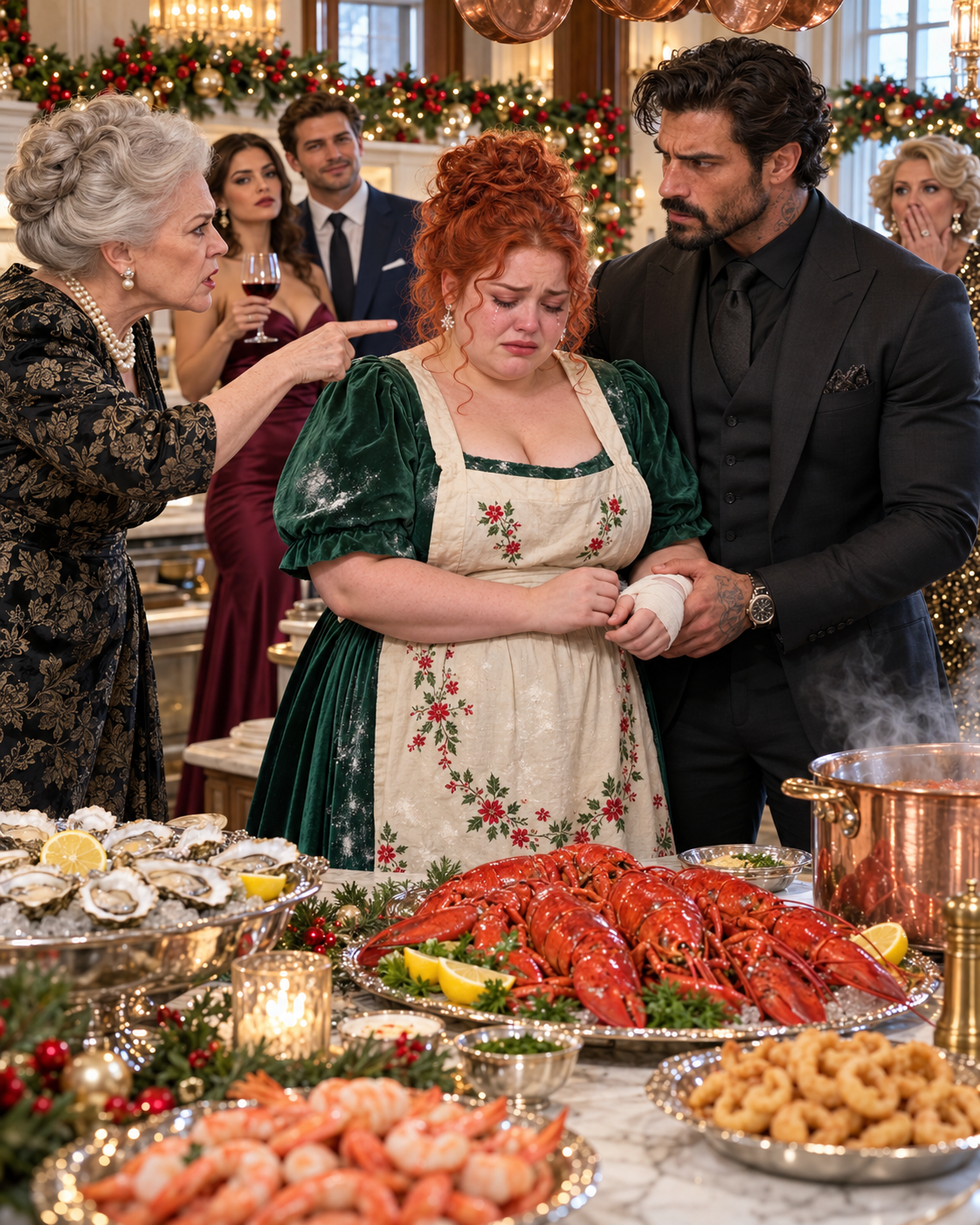
The consequences arrived faster than anyone expected.
By the following Monday, several business associates had heard rumors about Dante’s public confrontation with his mother.
A family-controlled real estate company postponed a major investment meeting.
An attorney requested clarification about ownership agreements.
And a society columnist published a brief report about a Christmas Day dispute involving the prominent Vescari family.
Dante’s phone barely stopped ringing.
For someone who had always controlled every detail of his surroundings, the uncertainty was unfamiliar.
But the hardest part wasn’t the money.
It was watching Ivy blame herself.
Three days after Christmas, he found her sitting beside their apartment window, looking out at Manhattan’s glittering skyline.
They had moved temporarily into a smaller apartment Dante owned independently of the family estate.
She held the newspaper in her lap.
“They’re saying I ruined your family.”
Dante sat beside her.
“People who don’t know us will always find something to say.”
“You spent years building your position.”
“I spent years believing that position defined me.”
She looked at him.
“And now?”
He took her uninjured hand.
“Now I’m learning the difference between having power and knowing what to do with it.”
Ivy leaned against his shoulder.
But she still had one question.
“Do you regret choosing me?”
Dante answered without hesitation.
“I regret making you feel like there was ever a choice.”
She began to cry.
Not because all their problems had disappeared.
But because, for the first time, she believed they could face those problems together.
AN UNEXPECTED OFFER
Two weeks later, Lou called Ivy with troubling news.
The diner’s aging heating system had finally failed.
The repair estimate was enormous.
Worse, the building’s owner had announced plans to increase the rent when the lease expired.
Lou had survived recessions, snowstorms, and forty Christmas seasons.
But this might be the thing that finally closed his doors.
Ivy listened in silence.
Then she looked at Dante.
“There’s something I need to do.”
He smiled.
“Tell me.”
“I want to help save the diner.”
Dante considered her words.
“I could buy the building.”
Ivy shook her head immediately.
“No.”
He blinked.
“No?”
“I don’t want you to solve every problem by writing a check.”
“That’s usually quite effective.”
She smiled faintly.
“I know. But Lou deserves something more lasting than a rescue.”
She explained her idea.
The diner could expand its catering service.
It could offer affordable cooking classes.
It could hire young adults aging out of foster care and give them paid training, stable hours, and practical experience.
People like the girl Ivy had once been.
Dante listened carefully.
Then he asked, “Would you want to run it?”
Ivy hesitated.
“I’ve never managed a business.”
“You’ve managed a kitchen under impossible circumstances.”
“That’s different.”
“Then we’ll find people who can teach you the rest.”
He reached for a notebook.
“And we’ll make sure Lou keeps control of the place he built.”
For the next several weeks, they worked side by side.
Dante handled lease negotiations and introduced Lou to a reputable small-business attorney.
Ivy designed new menus, calculated ingredient costs, and researched local workforce-training partnerships.
Luca quietly helped with financial projections.
And Lou supervised everyone while insisting that no business plan mattered if the pancakes tasted terrible.
They called the new initiative Second Chances Kitchen.
Its purpose was simple.
Give young people who had grown up without stable families the opportunity to build confidence, earn a living, and feel that someone believed in them.
For Ivy, it was more than a business.
It was the childhood she wished someone had offered her.
THE LETTER FROM COSTANZA
By early February, Second Chances Kitchen had enrolled its first five trainees.
One was a nineteen-year-old named Marcus who had spent most of his childhood moving between foster homes in Brooklyn.
Another was a quiet young woman named Sofia who dreamed of becoming a pastry chef but had never been able to afford formal training.
Ivy recognized something familiar in both of them.
The careful way they asked permission before touching anything.
The way they apologized too quickly.
The way they seemed surprised when someone praised their work.
One afternoon, Sofia accidentally dropped an entire tray of freshly baked muffins.
She went pale.
“I’m sorry,” she whispered. “I can pay for them.”
Ivy crouched beside her and began gathering the fallen pastries.
“Nobody’s asking you to pay.”
“But I ruined everything.”
“No, sweetheart. You dropped some muffins.”
Sofia stared at her.
“You’re not angry?”
Ivy smiled.
“Do you know how many things I burned when I first started cooking?”
The girl shook her head.
“Enough to keep a fire department busy.”
Sofia laughed.
And Ivy felt a small piece of her own past finally settle into place.
That evening, a cream-colored envelope arrived at the apartment.
The handwriting on the front was unmistakable.
Costanza.
Dante offered to open it.
Ivy shook her head.
“I’ll read it.”
Inside was a three-page handwritten letter.
Costanza did not ask to be forgiven immediately.
She did not excuse what she had done.
Instead, she described the years she’d spent measuring her worth through perfect dinners, elegant parties, and the approval of people she barely knew.
She admitted that Ivy’s confidence in her own humble background had unsettled her.
It reminded her of everything she had sacrificed to maintain an image.
Then came the words Ivy had never expected to read.
I was cruel to you because you possessed something I had lost: the ability to be proud of who you truly were.
Ivy stopped reading.
Dante watched her carefully.
“Are you all right?”
She nodded slowly.
“There’s more.”
Costanza had contacted several former employees, including Elena.
She was arranging payment for previously documented unpaid wages and had begun correcting public claims about meals and events prepared by others.
She had also resigned from a culinary charity committee where she’d accepted honors she hadn’t earned.
At the bottom of the letter, she wrote:
I cannot undo what happened to you. But I can stop pretending it never happened.
Ivy folded the pages.
She felt neither sudden affection nor complete forgiveness.
Only a cautious sense that something might finally be changing.
“Will you see her?” Dante asked.
“Maybe.”
He nodded.
“When you’re ready.”
ONE YEAR LATER
The following Christmas Eve arrived with heavy snow and bitter winds sweeping across New York City.
But inside Lou’s Diner, everything was warm.
Second Chances Kitchen had grown from five trainees to eighteen.
Several graduates had secured full-time jobs in restaurants across the city.
Sofia was preparing to begin an advanced pastry program.
Marcus had become one of Lou’s most dependable breakfast cooks.
And the diner, once threatened with closure, was thriving.
That evening, Ivy stood in the kitchen wearing a green apron.
Her wrist had healed months earlier.
On the counter sat seven beautiful seafood dishes.
Clams with garlic and white wine.
Baked cod with lemon and herbs.
Shrimp with spicy tomato sauce.
Fried calamari.
Mussels simmered in broth.
A carefully prepared seafood pasta.
And golden baked scallops topped with orange-zest breadcrumbs.
The Feast of the Seven Fishes.
But this time, Ivy wasn’t preparing it alone.
Marcus was stirring sauce.
Sofia was arranging desserts.
Lou was checking the ovens.
And Dante was standing at the sink, washing dishes with surprising competence.
“You’re getting better,” Lou announced.
Dante looked over his shoulder.
“At cooking?”
“No. At listening.”
Everyone laughed.
Then the bell above the diner entrance rang.
Ivy turned.
Costanza Vescari stood in the doorway.
She wore a simple dark coat and carried a small wrapped package.
For a moment, the room grew quiet.
Dante approached her.
“Mother.”
“Merry Christmas, Dante.”
He kissed her cheek.
Their relationship had not returned to what it once was.
Perhaps it never would.
But they had started speaking again.
Slowly.
Carefully.
Without pretending the past had never happened.
Costanza turned toward Ivy.
“Thank you for inviting me.”
Ivy nodded.
“Thank you for coming.”
The older woman glanced around the busy diner.
“I brought something.”
She handed Ivy the package.
Inside was a worn, handwritten recipe book.
Elena Bellini’s name was written on the first page.
Costanza swallowed.
“She gave me permission to make a copy. The original belongs to her.”
Ivy gently turned the pages.
Every recipe included a name.
The person who had created it.
The person who had perfected it.
The person who deserved to be remembered.
Costanza looked down.
“I spent so many years wanting people to admire me that I forgot how much joy there could be in admiring someone else.”
Ivy closed the book carefully.
“Thank you.”
It wasn’t forgiveness.
Not completely.
But it was a beginning.
THE DINNER THAT FINALLY BELONGED TO EVERYONE
At seven o’clock, the diner closed to regular customers.
Tables were pushed together.
Candles were lit.
Christmas music played softly from an old speaker.
The guests included Lou, the trainees, their friends, several former Vescari employees, Luca, Elena Bellini, and a handful of neighbors who had become part of the diner’s extended family.
There were no expensive gowns.
No photographers.
No carefully arranged seating chart.
Just people gathering around food made with love.
Before dinner, Dante stood and raised his glass.
A year earlier, he would have known exactly how to deliver a polished speech at a formal family event.
Tonight, he seemed strangely nervous.
“I used to think success meant having the largest house, the strongest reputation, and the kind of name that made people listen.”
He looked at Ivy.
“But last Christmas, I discovered that I had spent years overlooking the one person whose voice mattered most.”
The room fell silent.
“I watched my wife work until she was hurt because she believed keeping peace meant carrying pain alone.”
Ivy’s eyes began to shine.
“And when I finally understood what was happening, I learned something that changed my life.”
He paused.
“A family isn’t defined by the people who demand your loyalty. It’s defined by the people who make you feel safe enough to be yourself.”
Lou raised his glass.
“Now that’s something worth drinking to.”
Warm laughter filled the diner.
Dante continued.
“Tonight, every dish on this table was prepared by someone who deserves recognition.”
He began naming the cooks.
Marcus.
Sofia.
Lou.
Elena.
And finally, Ivy.
The applause grew louder.
Ivy covered her mouth, overwhelmed.
For so long, she’d worked quietly behind closed doors, hoping that being useful might make her worthy of love.
Now she was surrounded by people who celebrated her simply for being herself.
When the applause faded, Ivy stood.
“I want to say something too.”
She looked at the young trainees seated around the table.
“When I was growing up, I thought family was something other people had.”
Her voice trembled.
“I thought if I worked hard enough, stayed quiet enough, and made myself easy enough to love, someone might finally decide to keep me.”
Dante reached for her hand.
“But I was wrong about what makes someone worthy of belonging.”
She smiled through tears.
“You don’t have to earn the right to be treated with kindness.”
Across the table, Sofia wiped her cheeks.
Ivy continued.
“And you don’t need a famous last name or a perfect past to build a beautiful future.”
She turned toward Lou.
“Sometimes, family is the man who gives you your first job when nobody else believes in you.”
Then toward Elena.
“Sometimes, it’s someone who reminds you that your work deserves to be seen.”
Finally, she looked at Dante.
“And sometimes, it’s someone who realizes that love means standing beside you, even when doing so changes everything.”
Dante kissed her hand.
Nobody noticed that Costanza was crying until Elena quietly passed her a napkin.
The two older women exchanged a long look.
Then Costanza whispered, “I’m sorry, Elena.”
Elena nodded.
“I know.”
There was no dramatic embrace.
No promise that thirty years of hurt had suddenly disappeared.
Only a small, honest moment between two women who finally understood the cost of silence.
And perhaps that was enough for one Christmas night.
THE LAST PLATE
Long after dinner ended, the guests slowly disappeared into the snowy Manhattan streets.
Lou went home carrying enough leftovers to feed himself for a week.
Luca helped Marcus stack chairs.
Elena hugged Ivy and promised to return for the next cooking class.
Even Costanza stayed behind to clear the table.
When she reached for a stack of dirty plates, Ivy instinctively said, “You don’t have to do that.”
Costanza stopped.
Then she smiled faintly.
“I know.”
She picked up the plates anyway.
After everyone had gone, Dante found Ivy standing alone near Booth Seven.
The same booth he’d cleaned on his first day at the diner.
She was looking out at the snow falling beneath the streetlights.
He slipped his arms gently around her waist.
“Tired?”
“A little.”
“Happy?”
She leaned back against him.
“More than I thought I could be.”
He kissed the top of her head.
“Do you miss the mansion?”
Ivy thought for a moment.
She remembered the enormous chandeliers, the polished marble floors, and the beautiful rooms where she’d spent so many nights feeling completely alone.
Then she looked around the diner.
At the scratched tables.
The mismatched mugs.
The handwritten Christmas cards taped to the wall.
And the little photograph Lou had placed beside the cash register.
It showed Dante in his apron, holding a tray of pancakes with the deeply confused expression of a man who had never worked a breakfast shift in his life.
Ivy laughed.
“No,” she answered softly. “I don’t.”
Dante followed her gaze.
“That photograph is never going away, is it?”
“Absolutely not.”
He sighed.
“I negotiated a multimillion-dollar property deal last week. Nobody took a picture.”
“That’s because you weren’t wearing the apron.”
He laughed and pulled her closer.
Outside, snow continued covering the city.
Somewhere beyond the diner windows stood the powerful buildings, wealthy families, and exclusive circles that had once defined Dante Vescari’s world.
He still possessed influence.
He still carried responsibilities.
And his future would never be entirely simple.
But something fundamental had changed.
He no longer confused being respected with being loved.
And Ivy no longer confused being needed with being valued.
She had found the courage to stop shrinking herself to fit inside someone else’s expectations.
Together, they had built something neither money nor reputation could purchase.
A place where people were allowed to make mistakes.
Where hard work was recognized.
Where kindness wasn’t a privilege.
And where nobody had to hide an injured hand to prove they deserved a seat at the table.
Before turning out the lights, Ivy walked back into the kitchen.
On the counter remained one small plate of baked scallops.
She picked up a golden breadcrumb and tasted it.
Garlic.
Herbs.
A delicate hint of orange zest.
The same flavor that had exposed a painful secret one Christmas Eve.
Only now, it carried a different meaning.
Not humiliation.
Not betrayal.
Not years of trying to be enough.
It tasted like freedom.
Dante appeared in the doorway.
“Ready to go home?”
Ivy looked at him.
Then she smiled.
“Yes.”
He offered his hand.
And together, they stepped into the snowy Christmas night.
Not because every wound had healed.
Not because their families had become perfect.
But because they had finally learned the truth that would guide the rest of their lives.
Real love never demands that you become smaller so someone else can feel important.
A true family doesn’t measure your worth by your wealth, your background, or the name you carry.
It recognizes the person you are, honors what you contribute, and gives you the freedom to belong without pretending.
And sometimes, the greatest act of courage isn’t walking away from everything you’ve ever known.
It’s choosing the person who makes you remember who you truly are.
That Christmas, Dante Vescari didn’t lose his family.
He discovered what family was supposed to mean.
And Ivy Harlow, the former foster child who once believed she had to earn every scrap of affection, finally understood something she’d needed to hear all her life.
She had never needed to become worthy of love.
She had always been worthy.
THE END.