My prospective husband humiliated me before everyone at the Cheyenne depot, but when he saw my battered suitcase, his face betrayed a terrible secret.
For seventeen years, I had mourned my father, but now he stood beneath my bedroom window with a gun at his side and a secret that could destroy everything I had built.
I pressed my trembling fingers against the cold windowpane, unable to believe the face staring up at me.
The man was older than the father I remembered, with silver in his beard and deep lines carved around his eyes.
But I knew those eyes.
I had seen them in the little photograph my mother kept beside her bed until the day she died.
“Papa?” I whispered.
The word escaped my lips before I could stop it.
Below, the stranger slowly removed his hat.
“Winnie, sweetheart, please come down.”
Something inside me broke at the sound of his voice.
For seventeen years, I had imagined what I would say if heaven ever gave me another moment with my father.
Now that moment had arrived, and all I felt was terror.
Samuel grabbed my wrist.
“Don’t go near that window.”
I pulled away from him.
“That’s my father.”
Samuel’s face had gone completely white.
“No, Winnie, that’s exactly what they want you to believe.”
His words struck me harder than the thunder outside.
I turned toward him, clutching the documents against my chest.
“You told me my father escaped, and now you’re telling me not to trust him?”
Samuel opened his mouth, but a gunshot shattered the bedroom window.
Glass exploded across the floor.
Eli screamed and dropped beside the bed.
Samuel seized my shoulders and dragged me into the hallway.
“Get down!”
Another shot echoed through the boardinghouse.
I heard men shouting downstairs, followed by the unmistakable crash of the front door being kicked open.
“Where’s the woman?” someone shouted.
“Find the suitcase!”
Samuel pushed Eli toward the servants’ staircase.
“Take Winnie to the freight shed, and don’t let anyone see you.”
“What about you?” Eli demanded.
“I’ll give them something else to worry about.”
Before I could protest, Samuel disappeared into the darkness.
Eli caught my hand and pulled me down the narrow staircase.
We slipped through the back kitchen, where the stove still held a faint orange glow.
Outside, the rain struck my face like freezing needles.
We ran between stacked crates and abandoned wagons, keeping low beneath the windows of the station office.
Behind us, another gunshot rang out.
I stumbled.
Eli caught me before I fell.
“Keep moving, Miss Winnie.”
I wanted to turn around.
Samuel was still inside, facing armed men because of a secret connected to my family.
But Eli tightened his grip.
“He told me to get you somewhere safe.”
We reached the old freight shed and slipped through a broken side door.
Inside, the air smelled of wet wood, hay, and rusted iron.
Eli barred the door with a heavy beam.
Then he turned toward me.
“Miss Winnie, was that really your father?”
I looked down at the photograph trembling in my hands.
“I don’t know anymore.”
For the first time since arriving in Wyoming, I felt like the helpless woman Henry Whitcomb had humiliated at the depot.
Except now the danger was real.
And somewhere outside, a man wearing my father’s face was hunting me.
I sank onto an overturned crate and unfolded the documents.
Most of the pages contained shipment numbers, payment records, and lists of cattle that had supposedly disappeared during transportation.
But the final page was different.
Beneath my father’s warning, someone had added another message in faded blue ink.
“Trust the records, not the faces.”
I stared at those words.
My father had spent his life keeping accounts, just as I had learned to do.
He believed numbers revealed truths that people tried to bury.
Suddenly, I understood something.
The man outside had called me sweetheart.
My father had never called me that.
He always called me Little Sparrow.
It was a foolish childhood nickname, given because I used to steal crumbs from his breakfast plate.
I had forgotten it until that very moment.
My breathing stopped.
“Eli, the man outside isn’t my father.”
A terrible realization settled over me.
He had known my name and recognized my father’s appearance, but he had not known the one thing a real father would remember.
Before Eli could answer, someone knocked softly against the shed door.
Three knocks.
A pause.
Then two more.
Eli raised a heavy iron tool.
“Who’s there?”
“It’s Samuel.”
I recognized his voice immediately.
Eli removed the beam, and Samuel stumbled inside.
Blood soaked the sleeve of his shirt.
“Samuel!”
“It’s only a graze,” he said, though his face suggested otherwise.
He leaned against a wooden post.
“The riders are searching the station, and Henry Whitcomb is with them.”
I felt a surge of anger so fierce it almost steadied my shaking hands.
“Then tell me everything before they find us.”
Samuel looked at the photograph I held.
“The man outside is Daniel Talbot, your father’s younger brother.”
I blinked.
“My father had a brother?”
“A twin brother.”
The room seemed to tilt beneath my feet.
Samuel continued quietly.
“Your uncle Daniel worked with Henry and Charles when the cattle thefts began, and your father discovered what they were doing.”
I remembered my mother’s nervous silence whenever I asked about our relatives in Wyoming.
“Why would my mother keep something like that from me?”
“Because Daniel threatened both of you after your father disappeared.”
I struggled to breathe.
Samuel lowered himself onto a crate, pressing a cloth against his wounded arm.
“Your father collected proof that the men were stealing cattle from small ranchers and selling them under false shipping papers.”
“The fourth signature,” I whispered.
Samuel nodded.
“I signed the original documents because I worked in the shipping office, and I helped approve the transfers before I understood what they were hiding.”
“You helped them steal.”
“Yes.”
There was no excuse in his voice.
Only shame.
“I was young, frightened, and desperate to keep my job.”
I looked away.
The man who had given me shelter and treated me with respect had once helped ruin other families.
“I won’t pretend I was innocent,” Samuel continued.
“But when your father confronted me, I agreed to help him gather enough evidence to expose the whole operation.”
“What happened?”
“Henry discovered our plan, and Daniel arranged an ambush outside Laramie.”
I felt the cold spreading through my body.
“Did they kill him?”
Samuel shook his head.
“Your father survived, but he was badly injured.”
He hesitated.
“Afterward, he believed that disappearing was the only way to keep you and your mother alive.”
My eyes filled with tears.
“He could have come home.”
“I know.”
“He could have written.”
Samuel said nothing.
“He let me bury an empty coffin and spend seventeen years believing I wasn’t worth coming back for.”
My voice cracked on the final words.
For a long moment, nobody moved.
Then Samuel reached inside his coat.
He handed me a small envelope sealed with dark red wax.
“Your father gave me this before he left.”
I stared at it.
“Why didn’t you give it to me before?”
“Because he made me promise to deliver it only if the men came looking for the evidence.”
I broke the seal.
Inside was a single sheet of paper covered in familiar handwriting.
“My Little Sparrow, if this letter reaches you, then the past has finally found its way to your door.”
I covered my mouth.
The words blurred through my tears.
“I have made terrible mistakes, but leaving you was the worst of them.”
My hands shook as I continued reading.
“I thought distance would protect you, but a father should never make his child pay for his fear.”
I pressed the letter against my heart.
For years, I had believed my father died loving me.
Now I understood that he had lived somewhere in the world while I grew up without him.
That knowledge hurt in a way death never had.
At the bottom of the page, he had written one final instruction.
“Look beneath the brass clasp.”
I lowered my eyes toward the suitcase resting beside my feet.
The brass clasp.
The very object that had terrified Henry Whitcomb at the Cheyenne depot.
“Eli, bring me your knife.”
He handed me a small pocketknife.
I pried beneath the tarnished metal until a hidden compartment sprang open.
Inside lay a narrow strip of oilcloth.
Wrapped within it was a second ledger.
Its pages were thin and crowded with names, dates, and payment amounts.
Every stolen shipment was recorded.
Every forged bill was copied.
And beside several entries were the names of men who had lost their ranches after being accused of debts they never owed.
I turned the pages slowly.
There were widows.
Families.
Veterans.
Men who had spent their entire lives raising cattle on land that powerful people wanted to control.
One name made my stomach twist.
Margaret Bell.
I recognized it immediately.
Margaret had run the little boardinghouse where my mother and I lived after my father’s disappearance.
She had lost her ranch shortly before taking us in.
I remembered how she sometimes skipped supper so that I could have enough.
I had never understood why.
Now I did.
These men had stolen more than cattle.
They had stolen whole lives.
I closed the ledger.
“Samuel, this doesn’t belong to me alone.”
He studied my face.
“What are you thinking?”
“I’m thinking that hiding has already cost my family seventeen years.”
I stood.
“And I won’t spend another seventeen running.”
Eli stared at me.
“Miss Winnie, they’ve got guns.”
“And we’ve got something they want badly enough to kill for.”
Samuel shook his head.
“We need the sheriff.”
“Which sheriff?”
My question silenced him.
“The one who ignored the missing cattle, or the one who signed those false inspections?”
Samuel’s expression told me everything.
I looked toward the freight-yard window.
Across the darkness stood Cody Crossing, the station I had spent months rebuilding.
Twenty-five workers depended on that place.
They had trusted me with their meals, their wages, and sometimes their worries.
Now I needed to trust them with something far more dangerous.
“Eli, can you reach the bunkhouse without being seen?”
He nodded.
“Good.”
I leaned closer.
“Wake every man you trust, and tell them to meet us at the loading platform.”
Samuel tried to stand.
“Winnie, this could get people killed.”
I met his eyes.
“People have already been killed by silence.”
For a long moment, he stared at me.
Then he nodded.
“Tell me what you need.”
By dawn, the station had become a trap.
Eli had gathered fourteen workers, including the blacksmith, two experienced cattle drivers, and the night telegraph operator.
They listened without interrupting while I explained what the ledgers contained.
I expected fear.
I expected some of them to leave.
Instead, old Amos, the blacksmith, stepped forward.
“My brother lost his ranch after one of those shipments disappeared.”
His voice was rough.
“He died believing he’d failed his family.”
Another man spoke.
“My father was blamed for cattle he never stole.”
Then another.
And another.
The crimes written in my father’s ledger were no longer distant figures on a page.
They stood before me in worn boots and patched coats.
Real men carrying old wounds.
Amos looked at me.
“What do you want us to do, Miss Winnie?”
I took a breath.
“Help me make sure these papers reach someone who can’t be bought.”
We sent coded telegraph messages to the railroad’s regional superintendent and the United States marshal’s office, reporting evidence of interstate cattle theft and immediate threats against witnesses.
Then we prepared the station.
The loading gates were secured.
The horses were moved away from the main yard.
Every worker took a position where he could watch without being easily seen.
And I returned to my kitchen.
The same kitchen where I had once believed my only purpose was feeding hungry men.
I lit the stove and began making coffee.
Because if Henry Whitcomb wanted the papers, he would have to come to me.
He arrived shortly after sunrise.
His polished boots struck the kitchen floor as though he owned the building.
Charles Voss followed him.
Behind them came Daniel Talbot.
Seeing my uncle in daylight hurt more than I expected.
He looked so much like my father that my heart kept reaching toward him despite everything I knew.
Henry smiled when he saw me.
“Miss Talbot, you’ve caused quite a disturbance.”
I continued pouring coffee.
“You caused it seventeen years ago.”
His smile thinned.
“I suggest you hand over what belongs to us.”
I placed a cup on the table.
“The ledgers don’t belong to thieves.”
Charles stepped forward.
“Careful, woman.”
I looked at him.
“You said that before.”
He glanced around the kitchen.
“Where’s Samuel?”
“Somewhere safe.”
Henry sighed.
“I offered you a respectable marriage, Winnie, and you chose to make trouble.”
I almost laughed.
“You rejected me because I was poor.”
“I rejected you because I recognized the suitcase.”
His words hung in the air.
I watched his expression change as he realized what he had admitted.
“You knew whose daughter I was before I ever boarded that train.”
He said nothing.
“You wrote those letters pretending you wanted a wife.”
Daniel looked away.
Henry finally shrugged.
“I needed you to bring me whatever your father had left behind.”
My chest tightened.
Every kind word in his letters had been bait.
Every promise of a home had been part of a scheme.
But something surprising happened as I looked at him.
The shame I had carried since that morning at the depot simply disappeared.
His cruelty had never measured my worth.
It had only revealed his character.
“You’re a smaller man than I thought, Henry.”
He slammed his hand against the table.
“Give me the ledger.”
I reached beneath my apron.
Charles moved toward me.
Daniel caught his arm.
“Wait.”
For the first time, my uncle spoke directly to me.
“Winnie, your father never meant for any of this to happen.”
I stared into the face that had haunted my childhood.
“Then why did you help destroy him?”
Daniel’s eyes filled with something that looked almost like grief.
“Because I was jealous of everything he had.”
His voice cracked.
“He had a good wife, a little girl who adored him, and a life I thought should have been mine.”
I felt physically sick.
“You could have built your own life.”
“I know that now.”
Henry barked an impatient laugh.
“Enough of this.”
He drew a revolver.
The kitchen seemed to shrink around us.
“Put the papers on the table.”
I slowly withdrew the thin ledger from beneath my apron.
Henry reached for it.
But before his fingers touched the cover, I stepped backward.
“There’s something you should know.”
His eyes narrowed.
“Those aren’t the only records.”
I heard the faint whistle of the telegraph line beyond the window.
“The important entries have already been copied and sent to the authorities.”
Henry’s face darkened.
“You’re lying.”
“You’re welcome to ask the telegraph operator.”
Charles turned toward the door.
A heavy voice stopped him.
“Don’t take another step.”
Amos stood outside with three station workers behind him.
Henry raised his revolver.
Everything happened at once.
Charles lunged toward the back door.
A shot cracked through the kitchen.
The coffee pot shattered, scattering boiling liquid across the floor.
I ducked behind the stove.
Someone screamed.
Then I heard a terrible thud.
When I looked up, Daniel Talbot was lying between Henry and me.
Blood spread across his coat.
Henry stood frozen with the revolver still in his hand.
Daniel had stepped into the path of the bullet.
For several seconds, nobody moved.
Then Amos struck Henry’s wrist with an iron bar.
The revolver clattered across the floor.
The workers rushed forward, overpowering Henry and Charles before either could escape.
I crawled toward Daniel.
His face had turned gray.
“Why?” I whispered.
He looked at me with my father’s eyes.
“Because I couldn’t save your father.”
I pressed both hands against his wound.
“Stay with me.”
Daniel gave a faint, broken smile.
“I thought I could become him by taking everything he loved.”
Tears spilled down my cheeks.
“But all I became was a man nobody could love.”
I didn’t know how to answer.
He gripped my wrist weakly.
“Your father is alive, Winnie.”
My breath caught.
“Where?”
“North of Casper.”
His breathing grew shallow.
“He lives under another name.”
I leaned closer.
“Tell me.”
Daniel whispered an address, then closed his eyes.
I kept pressing against the wound until Eli returned with the doctor.
Daniel survived the morning, but he died before sunset.
I sat beside his bed when the end came.
I didn’t forgive him.
Perhaps I never would.
But I held his hand.
Because I had learned that mercy and forgiveness were not always the same thing.
Three days later, the authorities arrived.
Henry Whitcomb and Charles Voss were taken into custody, along with two railroad officials named in the ledgers.
Investigators collected the records, questioned the workers, and began tracing the missing cattle shipments.
It would take months to determine how many families had been cheated.
Some would never recover what they had lost.
No courtroom could give Margaret Bell back the years she had spent struggling to survive.
But for the first time, the truth was no longer hidden in a suitcase.
It belonged to the people who had paid for those crimes.
Samuel gave his statement voluntarily.
He admitted his role in the original fraud and surrendered the records he had kept.
Before leaving for his hearing, he found me standing outside the kitchen.
“I don’t expect you to forgive me,” he said.
I looked at the man who had helped me rebuild my life.
“You gave me a chance when nobody else would.”
He lowered his head.
“And I kept something important from you.”
“Both things can be true, Samuel.”
His eyes glistened.
“I hope Cody Crossing survives.”
“It will.”
He smiled sadly.
“Then I suppose I hired the right woman.”
After he left, the station felt strangely quiet.
I continued keeping the accounts.
I paid the workers.
I negotiated deliveries.
And when the railroad appointed a temporary superintendent, the crew insisted that I remain in charge of provisions and daily operations.
For the first time, I had enough money to buy new dresses, proper furniture, and a little parcel of land near the station.
But none of those things mattered as much as the letter lying inside my bedroom drawer.
Daniel’s final confession had given me an address.
Somewhere north of Casper, a man who might be my father was still breathing.
For a week, I couldn’t bring myself to go.
I was afraid of finding him.
More than that, I was afraid of discovering that he had built another life without me.
One evening, Eli found me sitting outside the kitchen, staring at the mountains.
“You should go, Miss Winnie.”
I smiled faintly.
“You don’t even know what I’m thinking.”
“You’re thinking about your father.”
He sat beside me.
“My own father left when I was small.”
I looked at him.
“Did he ever come back?”
“No.”
His voice was steady.
“But I spent years wondering what I’d say if he did.”
“What would you say?”
Eli considered the question.
“I’d ask why.”
He looked toward the sunset.
“And then I’d decide whether his answer was worth carrying home.”
The next morning, I packed my suitcase.
I left the kitchen in Eli’s capable hands, handed Amos the station accounts, and boarded the northbound train.
The journey seemed longer than the six hundred miles I had traveled to meet Henry Whitcomb.
Back then, I had been chasing the promise of belonging.
Now I was searching for the truth.
The address led me to a small farm beyond Casper, surrounded by cottonwood trees and miles of open grassland.
A modest house stood beside a weathered barn.
Smoke drifted from the chimney.
I walked up the narrow path with my suitcase in one hand and my father’s letter in the other.
Before I reached the porch, the door opened.
An elderly man stepped outside carrying a bucket.
He was thin, with white hair and a slight limp.
He turned toward me.
And the bucket slipped from his hand.
For a moment, neither of us spoke.
Then he whispered a name I had not heard since childhood.
“Little Sparrow?”
My knees nearly gave way.
There was no doubt this time.
No uncertainty.
No false hope.
Only the terrible recognition of a voice that had lived inside my memory for seventeen years.
“Papa.”
He covered his mouth with a trembling hand.
Then he began to cry.
I had imagined running into his arms.
I had imagined forgiving him before he could speak.
But when he stepped toward me, I remained where I stood.
His face crumpled.
“Winnie, I never thought I’d see you again.”
“Why didn’t you come home?”
The question emerged quietly.
He looked at the ground.
“I thought they would hurt you.”
“For seventeen years?”
He nodded.
I felt tears burning behind my eyes.
“Mother died believing you were gone.”
His shoulders shook.
“I know.”
“She waited for you.”
“I know.”
“And I waited too.”
He reached toward me.
I stepped back.
“Do you know how many nights I thought I’d done something wrong?”
He shook his head, weeping openly.
“I thought if I’d been prettier, quieter, or better behaved, maybe you would have stayed.”
“No, Winnie.”
His voice broke.
“Never.”
“Then why didn’t you tell me?”
He slowly lowered himself onto the porch steps.
“Because every year I waited, coming back became harder.”
I watched him struggle for breath.
“I was afraid the men would find you, but eventually I was more afraid you’d look at me exactly the way you’re looking at me now.”
I sat beside him, leaving a little space between us.
“You were afraid I wouldn’t forgive you.”
“Yes.”
I stared across the grassland.
“Then you made me pay for your fear.”
He nodded.
“Yes, I did.”
There was no excuse.
No attempt to make himself innocent.
And somehow that honesty hurt more than another lie would have.
We sat in silence until the sun began disappearing behind the hills.
Finally, he reached inside his shirt and withdrew a small wooden pendant.
It was shaped like a bird.
One wing was slightly crooked.
I remembered it instantly.
He had carved it for my seventh birthday.
“I carried this every day,” he said.
I touched the worn wood.
“Then why didn’t you carry yourself home?”
He began crying again.
This time, I didn’t move away.
I put my arms around him.
Not because seventeen years of pain had vanished.
Not because one apology could restore the childhood I had lost.
But because the little girl inside me had waited long enough to hold her father.
I stayed at the farm for eleven days.
We talked about my mother.
We talked about the railroad, the cattle, and the long years he had spent living under an assumed name.
Some mornings, I felt close to him.
Other mornings, I woke angry enough to leave without saying goodbye.
He accepted both.
Slowly, I began to understand that rebuilding a relationship was much like rebuilding a neglected station.
The work couldn’t be done with promises.
It required honesty, patience, and the willingness to repair what had been broken.
On my final evening, my father asked if I would stay.
I looked around his little house.
For years, I had imagined that finding him would finally give me somewhere to belong.
But I had already found that place.
“Cody Crossing needs me,” I said.
He nodded, though disappointment flickered across his face.
“And I need Cody Crossing.”
I took his hand.
“That doesn’t mean you can’t visit.”
He looked up.
“Would you really want that?”
“Yes.”
I smiled through my tears.
“But this time, Papa, you have to be the one who makes the journey.”
Six months later, Cody Crossing celebrated its most successful shipping season in years.
The station had settled its outstanding debts, improved its facilities, and earned a reputation for honest accounting.
Several ranching families recovered portions of their stolen property through the investigation.
Henry Whitcomb and Charles Voss eventually faced convictions for their part in the fraud.
Samuel accepted responsibility for his earlier actions, and although our friendship had changed, I never forgot that people could be both capable of kindness and accountable for wrongdoing.
As for me, I no longer lived in the little room above the kitchen.
I bought a white cottage near the station, with a vegetable garden, a broad porch, and enough space for guests.
The men helped build a proper stone walkway leading to my front door.
Eli carved another wooden bird and placed it above the entrance.
Beneath it, he carefully carved three words.
“Winnie’s Own Home.”
I stood looking at the sign for a long time.
Years earlier, Henry Whitcomb had rejected me because I arrived with too little money and a battered suitcase.
He had looked at my worn hands and seen only a servant.
He never imagined those hands could restore a failing business, uncover a criminal scheme, or help broken people find their courage.
But I had learned something even more important.
My life had not begun when a man offered to marry me.
And it had not ended when he decided I wasn’t good enough.
One bright spring morning, I was preparing breakfast when I heard wagon wheels outside.
I stepped onto the porch.
A familiar figure climbed down, carrying a small traveling bag.
My father.
He looked nervous as he approached.
“I hope I’m not too late for breakfast.”
For a moment, I couldn’t speak.
Then I opened the gate.
“You’re right on time, Papa.”
He smiled, and this time there was no fear in his eyes.
Inside, Eli was setting plates on the table.
Amos was arguing about the price of horseshoes.
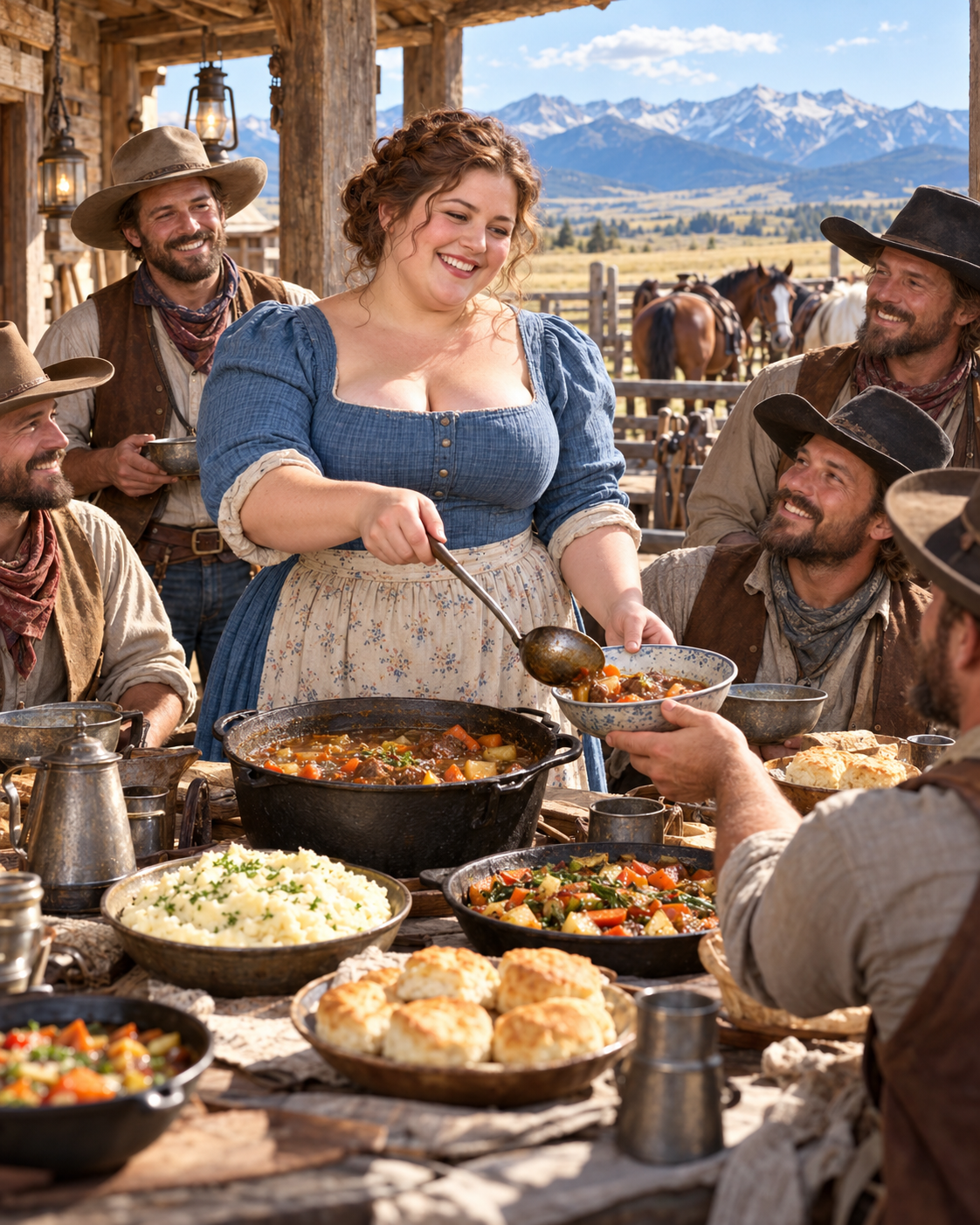
The kitchen smelled of coffee, warm biscuits, and freshly baked apple pie.
My father paused in the doorway, looking at the people gathered around my table.
“Is this your family, Winnie?”
I looked at their familiar faces.
Some were related to me by blood.
Most were not.
But each had helped me become the woman standing in that doorway.
“Yes,” I said softly.
“This is my family.”
Later that evening, after everyone had gone home, I sat on the porch beside my father.
The mountains glowed purple beneath the fading sunlight.
He took my hand.
“I’m proud of you, Little Sparrow.”
I smiled.
For most of my life, I had waited to hear those words.
But now I understood that I hadn’t needed his pride to become worthy of it.
I had already proved my worth to myself.
“I know, Papa.”
He squeezed my hand.
“And I’m grateful you came back.”
A gentle breeze moved through the cottonwood trees.
Somewhere in the distance, a train whistle echoed across the plains.
I thought about the frightened woman who had arrived at the Cheyenne depot carrying everything she owned.
I wished I could reach back through time and hold her hand.
I would tell her that rejection was not always a tragedy.
Sometimes, it was the door closing on a life that would have made her smaller.
Sometimes, the most painful goodbye led to the place where she was meant to stand.
And sometimes, the person who refused to choose you unknowingly gave you the greatest gift of all.
The freedom to choose yourself.
I leaned against my father’s shoulder as the first stars appeared.
For the first time, the past no longer felt like a prison.
It was simply part of the road that had brought me home.
And I knew, with a certainty that needed no promise from anyone, that whatever tomorrow held, I would meet it standing on my own two feet.
Because a woman’s worth was never measured by the man willing to marry her, the money in her suitcase, or the beauty of her face.
It was measured by the courage with which she built her life, the integrity with which she lived it, and the kindness she refused to surrender, even after the world had been cruel.
My name was Winnie Talbot.
I had once arrived in Wyoming as an unwanted bride.
But I stayed as a woman who finally understood that she had always been enough.
THE END.