For ten years, Lydia Fenwick had kept her family’s house from falling apart. The first thing she heard when she finally stopped working was her fiancé telling her sister how much easier life would be without her.
The voice outside the farmhouse belonged to Graham Voss.
Lydia recognized its familiar smoothness, the same measured confidence that had once made every promise sound dependable.
Now, standing in the darkness with her mother’s final letter pressed against her chest, she heard something else beneath it.
Impatience.
Thomas Reed remained beside the kitchen table, his extinguished lantern hanging from one hand.
“Don’t answer him,” he whispered.
Another knock shook the front door.
“Lydia, I know you’re inside. We need to talk before this becomes something neither of us can repair.”
She glanced at the papers scattered across the table.
Bank records. Her mother’s handwriting. Graham’s name appearing on transactions made long before their engagement.
For ten years, she had believed their relationship had begun with an accidental meeting at a charity gathering.
He had offered her his coat when an unexpected rainstorm swept across the garden.
She remembered how gently he had laughed when she refused.
Such a small, ordinary memory.
Now even that seemed to belong to someone else’s life.
“How did he know I was here?” she asked.
Thomas moved toward the narrow window.
A carriage stood beyond the gate, its lamps throwing pale circles across the wet gravel.
“Your father knows the road,” he replied. “And Mr. Voss has been coming to Hazel Creek longer than you have.”
Lydia looked at him.
“How much longer?”
Thomas hesitated.
“Since before your mother died.”
The words settled between them.
Outside, Graham tried the handle.
It held.
“Lydia, open the door.”
She gathered the documents and slipped them into the leather case she had carried from home.
Thomas caught her wrist gently.
“There’s a back entrance through the pantry. I can take you to the stable.”
Lydia looked toward the hallway.
For years, every difficult conversation had ended with her being persuaded to wait, be reasonable, or leave the matter to someone else.
She pulled her wrist free.
“No.”
Thomas frowned.
“They aren’t here to discuss the weather.”
“Then they should have brought better manners.”
Before he could stop her, Lydia crossed the hallway and opened the front door.
Graham stood beneath the dripping porch roof, his dark coat damp at the shoulders.
Behind him waited her father.
Lydia had expected anger.
Instead, her father looked almost relieved.
“There you are,” he said. “You’ve caused quite enough trouble.”
Graham’s eyes moved over her face before settling on the leather case in her hand.
“May we come inside?”
“No.”
Her father stiffened.
“Lydia, this childish behavior must end.”
She stepped onto the porch, closing the door behind her.
“Then perhaps you should stop speaking to me as though I were a child.”
Graham lowered his voice.
“Your father told me you found some old documents. You must understand that financial matters can be misleading without proper explanation.”
“Then explain why your name appears on my mother’s accounts.”
His expression altered almost imperceptibly.
A brief tightening around his mouth.
Her father took a step forward.
“Those records are private.”
“They were hers.”
“And she entrusted me with managing them.”
Lydia watched him beneath the weak porch light.
“Did she?”
For the first time, he looked away.
Graham extended a hand.
“Come home, Lydia. We’ll settle everything quietly.”
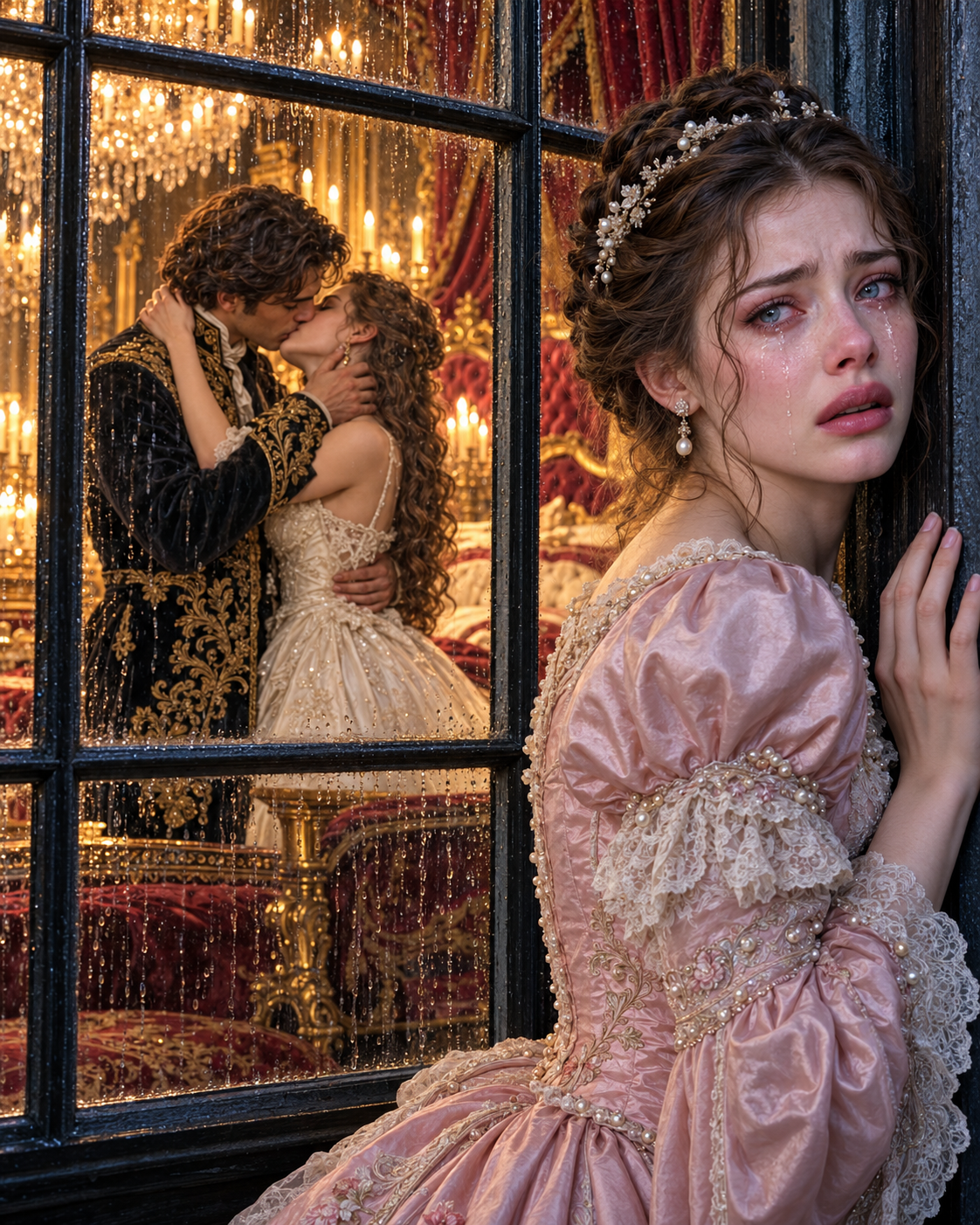
She remembered the drawing room, the untouched tea, and Rosalie’s fingers resting between his.
“There’s no home waiting for me there.”
“Don’t be unreasonable.”
“That word seems to follow me whenever I stop being useful.”
Graham’s hand dropped.
Her father glanced toward the dark windows.
“Enough. Give me the papers.”
“No.”
“Lydia.”
“Good night, Father.”
She stepped backward and closed the door.
For several seconds, nobody moved.
Then her father’s voice came through the wood, stripped of its customary restraint.
“You have no idea what you’re holding.”
Lydia leaned against the door.
“Then I suggest you start worrying about what I’ll discover.”
The carriage remained outside for another ten minutes.
She heard low voices, Graham’s sharper than her father’s, followed by the sound of wheels turning across wet stones.
Only when the lamps disappeared did Thomas relight his lantern.
“You shouldn’t have done that,” he said.
“Perhaps.”
Lydia returned to the kitchen.
“But I’m tired of doing what everyone expects.”
She opened her mother’s statement.
The handwriting was uneven in places, as though the person holding the pen had struggled to keep it steady.
The first page described an arrangement made between her father and Graham’s uncle, Edmund Voss, a financier who had handled several investments belonging to the Fenwick estate.
Lydia read slowly.
Her mother had discovered that portions of her inheritance had been pledged as security against debts she had never authorized.
The signatures on the agreements had been copied from older documents.
The money had disappeared into a private investment company controlled by Edmund Voss.
And Graham, then a young clerk working for his uncle, had witnessed the transfers.
Lydia turned another page.
A sentence had been underlined twice.
If Lydia remains unmarried until her thirtieth birthday, the remaining income from my estate must be transferred into her direct control.
Her birthday was six weeks away.
She looked toward Thomas.
“Why would my marriage matter?”
Thomas placed his cap on the table.
“Your mother established a trust after discovering the missing money. She couldn’t recover everything, but she changed the terms protecting what remained.”
“Protecting it from whom?”
“Your father.”
Lydia studied the document.
Under the terms of the trust, marriage before thirty would permit her husband to assume certain management powers over property settled upon her, unless safeguards were added to the marriage agreement.
Graham had been urging her to marry before winter.
He had insisted there was no reason to delay.
She remembered the annoyance in his voice when she suggested waiting until spring.
“He wasn’t marrying me,” she said.
Thomas said nothing.
“He was marrying the estate.”
The old man pulled out a chair.
“Your mother suspected they would find a way around her arrangements. She couldn’t prove all of it before she fell ill.”
Lydia turned to the final page.
There, beneath her mother’s signature, was a second name.
Dr. Samuel Bell.
Thomas noticed where her eyes had stopped.
“He was the physician who treated her during her last weeks.”
“The one who signed her death certificate?”
“Yes.”
“Where is he now?”
Thomas hesitated.
“Still living in Marlowe, as far as I know.”
Lydia closed the statement carefully.
“Then I’m going to Marlowe.”
Thomas shook his head.
“Your mother tried confronting these men with documents. Look what happened.”
Lydia met his eyes.
“Are you telling me to forget what they did?”
“No, miss.”
His expression softened.
“I’m telling you that evidence matters more than courage when the people you’re facing have already decided what they’re willing to do.”
By morning, the rain had stopped.
The farmhouse looked worse in daylight.
A dark stain spread across the sitting-room ceiling, the pantry shelves sagged, and weeds had invaded the narrow path leading toward the well.
Lydia stood in the kitchen with a pencil and a sheet of paper.
She wrote down the repairs that could not wait.
Roof. Water pump. Stable door. Kitchen stove.
Then she counted her remaining money.
The amount was painfully small.
For the first time in her adult life, she could not solve a problem simply by arranging someone else’s resources.
She would have to earn, negotiate, and decide which necessities could wait.
Thomas watched her calculate.
“The eastern fields can be planted again,” he said. “The soil hasn’t forgotten what it’s for.”
“Can they support the farm?”
“Not immediately.”
“Then we’ll need another source of income.”
He glanced at her.
“You’re serious about staying.”
Lydia folded the paper.
“I didn’t leave one house merely to become a guest in another.”
Over the following days, Hazel Creek began to wake.
Lydia sold two pieces of jewelry to pay for roof repairs and supplies.
She hired a local carpenter, negotiated credit for seed, and cleaned the farmhouse room by room.
Her hands developed blisters.
Her shoulders ached at night.
She discovered that the kitchen stove required patience, the well pump required force, and the farm accounts required a kind of honesty entirely absent from her father’s ledgers.
One afternoon, a young woman arrived carrying a basket of freshly baked bread.
Her name was Clara Whitmore, the daughter of a neighboring tenant farmer.
Thomas introduced her as someone who understood the local market better than most merchants.
Clara looked around the kitchen, where Lydia was struggling with a broken cupboard hinge.
“You’ll need more than a hammer to fix that.”
Lydia examined the tool in her hand.
“I was beginning to suspect.”
Clara smiled.
Within an hour, they were sitting at the kitchen table discussing vegetables, preserves, and the possibility of selling produce in town.
Clara knew which buyers paid fairly and which delayed payment until farmers were desperate.
Lydia knew how to organize inventories and maintain accounts.
By evening, they had outlined a modest business.
For the first time since leaving home, Lydia felt something unfamiliar.
Not relief.
Possibility.
But the past had not finished with her.
Three days later, a letter arrived from Graham.
He apologized for the misunderstanding involving Rosalie.
He insisted that his affection for Lydia had always been genuine.
He offered to arrange a generous settlement if she returned the documents and abandoned any claims against her father.
Lydia read the letter once.
Then she noticed the final sentence.
Certain matters concerning your mother’s final illness are best left undisturbed.
She folded it and placed it beside the statement from the tin box.
Graham had finally written something useful.
The threat was evidence of his concern.
She sent copies of the documents and the letter to a solicitor in Marlowe named Eleanor Mercer, whose firm had once represented a neighboring estate.
Two days later, she received a brief reply.
Come privately. Bring the originals. Do not inform your father.
Lydia traveled to Marlowe the following morning.
Eleanor Mercer worked from a narrow office above a bookseller’s shop.
She was a composed woman in her forties, with silver beginning to appear at her temples and a habit of listening without interrupting.
Lydia explained the trust, the bank records, the engagement, and her mother’s warning.
Eleanor examined each document.
When she reached the payment schedules, she removed her spectacles.
“These transfers are substantial.”
“Can they be recovered?”
“Some may be. But first we must establish which signatures were authorized and which were forged.”
Lydia placed Graham’s letter on the desk.
Eleanor read it slowly.
“Keep the original,” she said. “And don’t answer him.”
“What about Dr. Bell?”
The solicitor’s expression became thoughtful.
“That may be more complicated.”
“Why?”
“Because Dr. Bell retired from practice shortly after your mother’s death. There were rumors about his records being altered.”
Lydia leaned forward.
“Was he investigated?”
“Not publicly.”
Eleanor reached for a fresh sheet of paper.
“But I know someone who may remember why.”
That afternoon, Lydia accompanied Eleanor to a modest house on the outskirts of town.
An elderly nurse named Margaret Ellis lived there with her widowed sister.
When Eleanor mentioned Lydia’s mother, Margaret’s hands stopped moving over the knitting in her lap.
“Mrs. Fenwick,” she whispered.
Lydia sat opposite her.
“You cared for her?”
“During her final month.”
“Was she as ill as my father said?”
Margaret looked toward the window.
“She was weak. Some days worse than others.”
“Did she know she was dying?”
The nurse pressed her lips together.
“She believed she was being made ill.”
The room seemed to grow quieter.
Margaret rose, opened a small drawer, and removed a notebook wrapped in linen.
“I kept records when things didn’t seem right.”
She opened it to a page covered with dates and measurements.
“Your mother’s condition worsened after certain medicines were administered. She would improve slightly when the doses were delayed.”
Lydia studied the careful handwriting.
“Who prescribed them?”
“Dr. Bell.”
“And who gave them to her?”
Margaret’s voice lowered.
“At first, I did. Then your father insisted the household would manage her medicines privately.”
Lydia stared at the notebook.
Margaret reached across the table.
“I asked for an independent physician. Your father dismissed me the following morning.”
“Why didn’t you tell anyone?”
“I tried.”
Her eyes filled, but her voice remained steady.
“Dr. Bell warned me that accusing a respected household without proof would destroy my livelihood. I was supporting my sister and her children.”
Lydia looked at the nurse’s worn hands.
She understood, suddenly, how fear could turn silence into a habit.
“Will you testify now?”
Margaret drew a slow breath.
“Yes.”
Outside, church bells sounded across Marlowe.
Lydia left the house carrying copies of the notebook’s entries and the terrible knowledge that her mother’s death might not have been natural.
But suspicion was not proof.
Eleanor made that clear.
The records could support an inquiry, but they did not establish deliberate poisoning or identify who was responsible.
They needed Dr. Bell.
And Dr. Bell had disappeared.
His former housekeeper claimed he had left town unexpectedly two days earlier.
No forwarding address had been provided.
That evening, Lydia returned to Hazel Creek under a sky heavy with clouds.
Thomas was waiting near the gate.
“There was someone here,” he said.
“Who?”
“A young lady.”
Lydia stepped down from the carriage.
“Rosalie?”
Thomas nodded.
“She wouldn’t give her name, but she looked frightened.”
“Did she leave a message?”
He handed Lydia a folded scrap of paper.
Meet me at the old chapel tomorrow before noon. Please come alone.
Lydia recognized her sister’s handwriting.
For several moments, she stood motionless beside the carriage.
Rosalie had never been particularly brave.
She disliked arguments, avoided unpleasant conversations, and had spent much of her life allowing Lydia to resolve whatever troubled her.
Something must have happened to bring her here.
The next morning, Lydia reached the abandoned chapel shortly before eleven.
Sunlight fell through a broken stained-glass window, scattering fragments of blue and amber across the dusty pews.
Rosalie stood near the altar, twisting a handkerchief between her fingers.
She looked thinner than Lydia remembered.
When she saw her sister, she took a hesitant step forward.
“Lydia.”
“Why are you here?”
Rosalie swallowed.
“Because I made a mistake.”
Lydia remained near the entrance.
“You’ll have to be more specific.”
The words struck harder than she intended.
Rosalie lowered her eyes.
“I thought Graham loved me.”
Lydia said nothing.
“He told me your engagement had become an obligation. That you cared more about managing the household than marrying him.”
“And you believed him.”
Rosalie’s face reddened.
“I wanted to.”
Silence settled between them.
A bird fluttered somewhere in the rafters.
Rosalie wiped her palms against her skirt.
“He promised that once you released him, we could begin again.”
Lydia looked at her sister.
“And?”
“He told Father he would marry me instead.”
Something cold passed through Lydia.
Rosalie continued.
“Father became furious. I heard them arguing in the study. Graham said the agreement would be worthless if he married the wrong daughter.”
Lydia took a step closer.
“What agreement?”
“I didn’t understand at first.”
Rosalie reached into her coat and withdrew a folded document.
“I found this in Father’s desk.”
Lydia opened it.
It was a draft marriage settlement bearing her own name.
The document had been prepared months earlier, with provisions allowing Graham extensive control over income associated with her mother’s estate.
Beside one clause was a handwritten instruction.
Complete before Miss Fenwick attains thirty years.
Lydia looked up.
“Does Graham know you have this?”
Rosalie shook her head.
“Not yet.”
“Then you must leave Father’s house.”
Rosalie stared at her.
“Where would I go?”
The old answer rose instinctively to Lydia’s lips.
I’ll take care of everything.
She stopped herself.
Instead, she asked, “What do you want to do?”
Rosalie looked bewildered.
No one had asked her that question in years.
“I don’t know.”
“Then begin there.”
Rosalie’s eyes filled.
“Lydia, I am sorry.”
Lydia watched a tear slide down her sister’s cheek.
An apology could not undo ten years of being taken for granted.
It could not erase the drawing room.
But neither did Lydia wish to spend the rest of her life carrying the weight of resentment.
“I believe you,” she said.
Rosalie reached for her hand.
Lydia allowed the touch for a moment.
“That doesn’t mean everything is repaired.”
“I know.”
“Then we’ll start with the truth.”
The following weeks brought more trouble than Lydia had imagined.
Her father sent notices challenging her right to occupy Hazel Creek.
A merchant refused further credit after receiving a warning about her supposed financial irresponsibility.
Someone cut the fastening ropes on the farm’s newly repaired stable door.
Then, one night, flames appeared inside the storage shed.
Thomas spotted the fire before it reached the farmhouse.
Lydia and Clara worked beside him, carrying buckets from the well until their arms shook.
By dawn, the flames were extinguished.
Half the stored seed was ruined.
The shed roof had collapsed.
Lydia stood in the damp ashes, soot marking her face.
Clara approached carrying a blanket.
“We can plant later,” she said.
Lydia looked toward the blackened beams.
“If we lose another month, there won’t be enough income to pay the workers.”
“Then we’ll find another way.”
Lydia almost laughed.
She had heard that phrase used carelessly all her life.
But Clara had already begun counting what could be salvaged.
Thomas was examining the damaged doors.
Neither of them was offering empty reassurance.
They were preparing to work.
Something in Lydia steadied.
“All right,” she said. “Let’s see what survived.”
The fire became an unexpected turning point.
When neighboring farmers heard what had happened, several arrived with spare timber and seed.
Clara persuaded a merchant to advance payment on the vegetables they expected to harvest.
Thomas organized the repairs.
Lydia opened her ledgers and recorded every contribution, promising repayment where it was wanted.
Some accepted.
Others refused.
One elderly farmer merely shrugged.
“Your mother helped us through the winter flood. Consider it an old debt.”
Lydia looked across the yard at the people rebuilding her shed.
Her mother’s generosity had survived in ways no estate document could measure.
Three days later, Eleanor arrived at Hazel Creek carrying news.
Dr. Bell had been found living under his sister’s name in a village outside Marlowe.
He was ill, frightened, and unwilling to appear in public.
But he had agreed to speak with Eleanor.
At first, he denied wrongdoing.
Then she showed him Margaret Ellis’s notebook.
His account changed.
He admitted signing medical records without conducting proper examinations during Lydia’s mother’s final illness.
He also acknowledged that her father had pressured him to describe her condition as an inevitable decline.
But when questioned about the medicines, he refused to claim knowledge he did not have.
“I never saw what was placed in those bottles after they left my surgery,” he said.
Eleanor had obtained a signed statement.
It established serious misconduct.
It did not settle the question of murder.
Lydia read the testimony at her kitchen table.
For a long time, she said nothing.
She had imagined that discovering the truth would feel like a door opening.
Instead, every answer revealed another locked room.
Eleanor sat opposite her.
“We have enough to seek an accounting of the estate and challenge the fraudulent documents. We can also ask the authorities to investigate your mother’s medical care.”
“And my father?”
“He may face prosecution if the evidence establishes his involvement. The financial case is already stronger than anything he expects.”
Lydia looked down at the pages.
“Then proceed.”
Her thirtieth birthday arrived on a cold morning in November.
There were no flowers from Graham.
No grand family celebration.
Clara baked a small cake, Thomas repaired the kitchen window, and the farm workers gathered briefly in the yard before returning to their duties.
Lydia stood among them, listening to their laughter.
She had never owned so little.
Yet nothing on the table had been purchased with her silence.
That afternoon, Eleanor delivered the first formal demand for a full accounting of the estate.
Under the trust’s terms, Lydia now held the right to assume direct control of its remaining protected income.
Her father’s position had become considerably weaker.
He responded by requesting a private meeting.
Lydia agreed on one condition.
Eleanor would attend.
They met in the solicitor’s office.
Her father entered wearing the same immaculate coat he had worn for years, though his face had grown noticeably older.
Graham followed him.
Lydia sat across the table with Eleanor beside her.
No one offered tea.
Her father began.
“This has gone far enough.”
Eleanor opened a folder.
“I agree, Mr. Fenwick.”
He ignored her.
“Lydia, think carefully about what you’re doing. Public accusations will destroy the family.”
Lydia folded her hands.
“Which part of the family?”
He frowned.
“What?”
“The property you misused, the daughter you deceived, or the reputation you value more than either?”
Graham leaned forward.
“We can settle this without involving the courts.”
Eleanor slid a document across the table.
“You’ve already been given that opportunity.”
Graham glanced at the figures.
His face drained.
The solicitor continued.
“We have records linking Mr. Voss’s investment company to unauthorized transfers from Mrs. Fenwick’s estate. We also have the proposed marriage settlement and evidence that Mr. Graham Voss was aware of the trust’s restrictions.”
Lydia watched Graham’s hand move toward his pocket, then stop.
Her father looked at him.
“You told me those records were gone.”
The room fell silent.
Graham turned sharply.
“Careful.”
Eleanor’s pen paused.
Lydia looked from one man to the other.
For ten years, they had stood together whenever she questioned a decision.
Now a single folder had placed a crack between them.
Her father lowered his voice.
“You were responsible for the arrangements.”
“And you signed every instruction.”
“Because you assured me—”
“Enough,” Eleanor said.
Both men stopped.
It was the first time Lydia had ever seen her father obey a woman without argument.
Eleanor arranged the documents neatly.
“The financial authorities have already been informed. Any further discussion should take place through legal representatives.”
Graham turned to Lydia.
“Is this what you wanted?”
She studied him.
Once, she had known the shape of his smile, the sound of his footsteps, the precise way he preferred his coffee.
She had mistaken familiarity for intimacy.
“I wanted to know whether any part of our life together was real.”
Graham opened his mouth.
Nothing came.
The answer was sufficient.
Lydia rose.
“Then I believe we’re finished.”
The proceedings that followed lasted several months.
The estate accounts were examined, signatures compared, and witnesses questioned.
The investigation established that Lydia’s father had authorized fraudulent transfers of property income and that Graham had helped conceal the transactions through his uncle’s firm.
Both men eventually faced legal consequences.
Some of the missing money was recovered.
Other sums had vanished into failed ventures and could never be restored.
Edmund Voss attempted to distance himself from the scheme, but his own correspondence tied him to several transactions.
Graham’s carefully cultivated position in society collapsed when the financial findings became public.
He sent Lydia one final letter.
She left it unopened.
The investigation into her mother’s death proved more painful.
Dr. Bell’s testimony exposed the deliberate falsification of medical records.
Margaret Ellis described the unexplained deterioration she had witnessed.
Yet too much time had passed, and too little physical evidence remained to determine with certainty whether Lydia’s mother had been intentionally poisoned.
Her father continued to deny any role in causing her death.
Lydia despised the uncertainty.
Some nights, she sat at the kitchen table rereading her mother’s letters until the candle burned low.
She wanted a sentence that would explain everything.
A confession.
A name.
Something definite enough to quiet the questions.
But the papers could offer no more.
One evening, Thomas found her beside the window with the letters spread across her lap.
“She deserved justice,” Lydia said.
“Yes, miss.”
“And I may never know everything.”
Thomas pulled out a chair.
“No.”
She looked at him.
“How do people live with that?”
He considered the question.
“Poorly, some days.”
Lydia gave a tired, unexpected smile.
Thomas continued.
“But your mother didn’t leave those papers so you’d spend your life inside the room where she died.”
He looked toward the fields beyond the window.
“She left them so you could walk out.”
Spring came slowly to Hazel Creek.
The first shoots appeared along the eastern field while frost still gathered in the shaded corners of the yard.
Lydia and Clara expanded their small business, supplying vegetables, preserves, and eggs to merchants in Marlowe.
When profits finally exceeded expenses, Lydia hired two women from the village who had struggled to find regular work.
She insisted on written agreements and fair wages.
Clara watched her sign the first contracts.
“You might be the only employer in the county who enjoys paperwork.”
Lydia smiled.
“Paperwork is considerably more pleasant when everyone knows what they’re signing.”
They laughed.
It was a small moment, but Lydia carried it with her through the day.
Rosalie came to Hazel Creek in early May.
She arrived without trunks, servants, or the elaborate dresses she had once considered essential.
Instead, she carried a modest bag and a letter of reference.
Lydia met her at the gate.
“What is that?”
Rosalie held up the letter.
“I’ve applied for a position helping at the village school.”
Lydia raised an eyebrow.
“You?”
“I can read, write, and count.”
“I’ve noticed.”
“And Mrs. Alden says she’s willing to teach me the rest.”
Lydia studied her sister.
Rosalie’s hands were bare, and her boots showed signs of actual use.
For once, she had not arrived asking Lydia to solve a problem.
She had come to share a decision already made.
“Are you frightened?” Lydia asked.
“Terribly.”
“Good.”
Rosalie laughed.
Then, after a moment, she said, “I was cruel to you.”
Lydia rested one hand against the gate.
“Yes.”
“I kept telling myself that because you were strong, you didn’t need anything.”
Lydia glanced toward the farmhouse.
“Being dependable isn’t the same as needing nothing.”
Rosalie nodded.
“I know that now.”
They stood together as the wind moved through the new leaves.
Their relationship would not return to what it had been.
Lydia no longer wanted that.
But perhaps something more honest could grow in its place.
Rosalie began visiting every Sunday.
Sometimes she helped Clara pack jars of preserves.
Sometimes she sat with Lydia over tea and spoke about the children she taught.
They learned to disagree without asking the other to disappear.
And slowly, the silences between them became comfortable.
By the end of summer, Hazel Creek had changed almost beyond recognition.
The farmhouse roof no longer leaked.
The garden beds were orderly.
Fresh paint brightened the window frames.
The eastern fields produced their first profitable harvest in years.
Thomas stood beside Lydia one afternoon as workers loaded crates onto a wagon.
“Your mother would have liked seeing this,” he said.
Lydia watched Clara negotiate with the driver over the price of delivery.
“She might have suggested a few improvements.”
Thomas chuckled.
“She certainly would.”
Later that evening, Lydia walked alone toward the small orchard behind the farmhouse.
The trees were old and uneven, their branches bent by years of wind.
Some had begun bearing fruit again after careful pruning.
She stopped beneath the largest tree.
There, on a low stone wall, she opened the final envelope from her mother’s tin box.
She had saved it because the handwriting on its front had been especially faint.
Inside was a short letter, written in the steady hand her mother had possessed before her illness.
My dearest Lydia,
I have spent much of my life being praised for how much I could endure.
I once believed that love meant making myself necessary to everyone around me.
But there is a difference between being needed and being cherished, and I hope you learn it sooner than I did.
There may come a day when choosing yourself feels like abandoning those you love.
It is not.
You are allowed to build a life that does not depend upon your exhaustion.
You are allowed to be loved without earning it through sacrifice.
And if the world tells you that your worth lies in what you can provide, remember that you were precious to me long before you could do anything at all.
Whatever happens, live.
Lydia read the letter twice.
The evening sun slipped between the branches, warming the paper beneath her fingers.
For years, she had searched her mother’s possessions for instructions, explanations, and proof.
This letter contained none of the answers she had once demanded.
Only permission.
She folded it carefully and placed it against her heart.
In the distance, the farmhouse windows glowed with lamplight.
Clara was preparing supper.
Thomas was closing the stable.
Rosalie would arrive the following morning with news from the school.
There were still bills to pay, crops to protect, and decisions that might prove wrong.
There would be difficult winters.
There would be days when Lydia missed the mother whose full story she could never recover.
Her life had not become effortless.
But it was hers.
As she turned toward the house, a familiar carriage appeared on the distant road.
For one brief moment, she stopped.
Then the carriage passed the gate without slowing.
Lydia watched it disappear among the trees.
Once, the sight of an unexpected visitor had been enough to send her hurrying home, already preparing to meet someone else’s needs.
Tonight, she simply continued walking.
At the kitchen door, Clara was waiting with a dish towel over her shoulder.
“Are you coming in? Supper’s getting cold.”
Lydia looked back at the orchard.
Beyond it lay the fields she had worked to restore, the boundary walls she had repaired, and a road that now seemed to lead in more directions than she could count.
“Yes,” she said.
And she went inside.
Years later, people in Marlowe would speak of Lydia Fenwick as the woman who restored Hazel Creek, challenged powerful men, and built a thriving farm from neglected land.
They would admire her business judgment, her independence, and the quiet confidence with which she carried herself.
Some would call her courageous.
Others would say she had been fortunate.
Lydia would never entirely agree with either description.
Courage, she had learned, was often nothing more glamorous than opening a door while afraid.
And fortune had played little part in the long mornings, the unpaid bills, the damaged harvests, or the countless decisions that had brought the farm back to life.
What mattered most was something simpler.
She had stopped mistaking sacrifice for love.
She had stopped believing that keeping everyone else comfortable was the price of belonging.
And she had discovered that a person could lose the life they had spent years maintaining and still find something worth building in its place.
One autumn evening, long after Hazel Creek had become a place of warmth and laughter, Lydia stood at the front gate watching the last wagon return from market.
The sky was turning gold behind the fields.
The workers were calling to one another.
From the open kitchen window came the sound of Rosalie laughing at something Clara had said.
Lydia rested her hand against the gatepost.
Ten years earlier, she had measured a successful day by how little trouble she caused and how many problems she solved before anyone noticed them.
Now she measured it differently.
By the work completed honestly.
By the promises kept.
By the freedom to rest when she was tired.
And by the people who stayed beside her even when she had nothing left to give.
She closed the gate and turned toward the farmhouse.
For the first time in her life, she wasn’t returning to a place where she was needed to hold everything together.
She was returning to a place where she was wanted.
And that, Lydia finally understood, was the difference between spending a lifetime being useful and spending it being loved.
THE END.