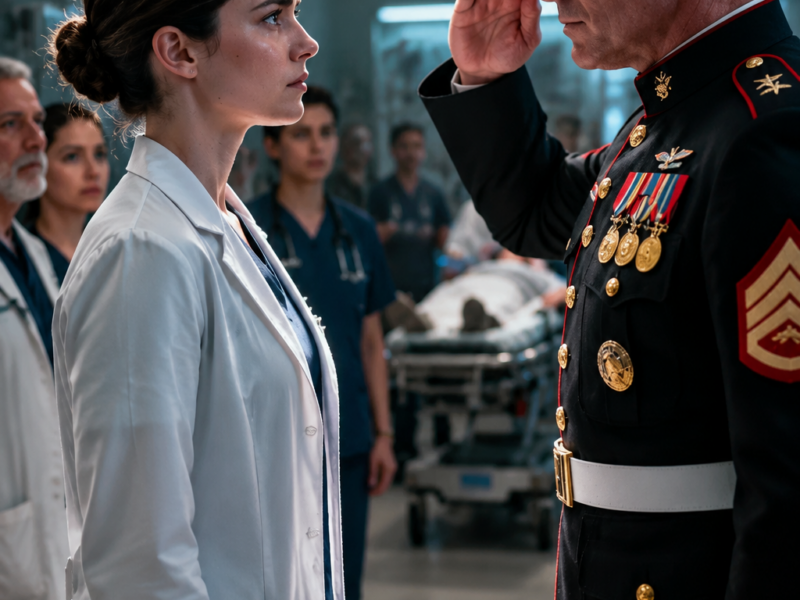
They Mocked the New Trauma Doctor… Then a Marine General Called Her “Legend”
They Mocked the New Trauma Doctor… Then a Marine General Called Her “Legend”
The scalpel did not tremble.
Not even when Dr. Gregory Pierce was screaming directly into her face. Not when the heart monitor beside the operating table began emitting the relentless, terrifying alarm that signaled a patient’s life was slipping away. And certainly not when the chief of trauma surgery threatened to have her escorted out of the hospital for daring to challenge his authority.
Dr. Harper Cole remained perfectly still.
Her eyes were fixed on the young soldier lying beneath the blinding surgical lights. Blood covered his chest, his breathing had become shallow and irregular, and the monitor displayed numbers that were deteriorating by the second. Somewhere beneath the jagged fragments of his fractured ribs, a damaged artery was bleeding into his chest cavity.
Pierce was too busy shouting to notice.
He had already made up his mind about Harper. To him, she was an inexperienced woman who had somehow secured a position she did not deserve. She was an outsider, an embarrassment, and an obstacle to the carefully maintained hierarchy of his department.
But Harper had learned something years ago, in places where mistakes were measured in body bags rather than disciplinary reports.
When someone was dying, pride was a luxury nobody could afford.
Without saying another word, she reached past Pierce, grabbed the necessary instrument, and stopped the bleeding with a movement so fast that several people in the room barely registered what she had done.
Then she glanced at the monitor.
“He’s stabilizing,” she said quietly.
The room fell silent.
For a moment, nobody seemed to understand what had just happened.
The soldier was breathing again. His heartbeat was returning to a more stable rhythm, and the terrifying alarms had stopped.
Pierce stared at the patient, then at Harper.
He had spent the entire morning trying to convince everyone that she was incompetent. Yet, in a matter of seconds, she had accomplished what he could not.
What nobody in that hospital knew was that the quiet blonde doctor standing before them had once performed emergency surgery inside a burning Black Hawk helicopter, using a flashlight, a combat knife, and whatever medical supplies had survived an explosion.
They did not know that she had spent years operating on wounded soldiers in the middle of hostile territory, sometimes with enemy fire landing close enough to shake the ground beneath her knees.
They did not know that classified military records contained a different version of Harper Cole’s life.
And they certainly did not know that, before the day was over, a four-star Marine general would arrive at their hospital, look directly at her, and call her by a name that would change everything.
Her name was Ghost.
But that morning, when the sliding glass doors of St. Sebastian’s Military Medical Center opened, nobody saw a legend walking through them.
They saw an unfamiliar doctor carrying an old canvas bag.
The Virginia morning was humid, and a thin layer of mist still hung over the parking lot. The hospital’s automatic doors slid apart with a soft mechanical hiss, allowing Harper to step inside. She paused briefly to adjust the strap of her worn messenger bag.
At thirty-two, she looked younger than her age. Her petite frame, fair complexion, and blonde hair, pulled tightly into a practical bun, gave her an appearance that many people mistook for someone fresh out of medical school.
Her clothing did little to change that impression. She wore simple navy-blue scrubs, comfortable shoes, and no expensive watch or designer accessories. There was no white coat, no collection of professional badges, and no carefully arranged display of credentials.
She had never been particularly interested in looking important.
She preferred being prepared.
As she approached the reception desk, a woman with tired eyes continued typing without looking up.
“Can I help you?”
“I’m reporting for duty. Dr. Harper Cole, trauma surgery.”
The receptionist finally glanced at her.
“You’re the new attending?”
“Yes.”
The woman looked at the computer, then back at Harper.
“Your badge is printing. Fourth floor. Dr. Pierce’s office.”
Harper nodded.
“Thank you.”
The receptionist hesitated before adding, “One piece of advice. Dr. Pierce hates lateness.”
Harper checked her watch.
“It’s 7:50. My appointment is at eight.”
“He’s the kind of man who believes arriving thirty minutes early is arriving on time.”
Harper offered a faint smile.
“I’ll keep that in mind.”
The receptionist slid the badge across the counter.
“Good luck. You’re going to need it.”
Harper picked it up.
The plastic card carried her name, photograph, and new position: Dr. Harper Cole, Trauma Surgery.
She turned it over once between her fingers.
For reasons she could not entirely explain, the badge felt heavier than it should have. Not physically, but emotionally. It reminded her of another identification card she had once worn beneath a combat uniform, one that had accompanied her through places she had promised herself never to revisit.
She slipped the badge into her pocket and headed toward the elevators.
Near the coffee station, three young residents were talking. Their conversation became noticeably quieter when she passed.
“That’s her,” one whispered.
“The new trauma attending?”
“Yeah. I heard she transferred from some tiny clinic in Alaska.”
Another looked her up and down.
“She looks like she should be working in pediatrics.”
A third laughed.
“Maybe the hospital needed another diversity appointment.”
Harper heard every word.
She did not turn around.
Being underestimated was nothing new. In fact, there had been times when she had deliberately allowed people to underestimate her. It was easier to move through a dangerous situation when nobody was watching closely enough to recognize what you were capable of doing.
The elevator doors closed.
As the floors passed, Harper looked at her reflection in the polished metal.
For one brief moment, she imagined a different reflection: a younger woman in a dusty uniform, a medical bag hanging from one shoulder, her face covered in sand and blood.
Then the elevator chimed.
The doors opened onto the fourth floor.
St. Sebastian’s trauma surgery department occupied an impressive stretch of the hospital. The corridors were spotless, the walls decorated with framed photographs of distinguished surgeons, and the administrative offices furnished with polished wood and expensive leather chairs.
Everything looked orderly.
Everything looked controlled.
Harper knew better than to confuse appearances with competence.
She found the office marked with a gold plaque.
DR. GREGORY PIERCE\
CHIEF OF TRAUMA SURGERY
She knocked once.
“Enter.”
Pierce sat behind a large mahogany desk, reviewing a file. He was a broad-shouldered man in his late fifties, with silvering hair, a carefully maintained appearance, and an expression that suggested he had spent most of his life being obeyed.
He did not stand when she entered.
He did not offer her a seat.
Instead, he dropped the file onto his desk.
“Dr. Cole.”
“Good morning, Dr. Pierce.”
“I’ll be blunt. I didn’t ask for you.”
Harper remained standing.
“The hospital board assigned me to this department.”
“Yes, I’m aware of that. Apparently, the board has decided that we need fresh perspectives.”
He emphasized the last two words with an exaggerated smile.
“This is St. Sebastian’s Military Medical Center. We treat senior government officials, military commanders, intelligence personnel, and some of the most important people in the country. We don’t have the luxury of experimenting with unproven doctors.”
“I understand the responsibility, sir.”
Pierce leaned back.
“Do you?”
He opened her file.
“Johns Hopkins. Impressive enough. Strong academic performance. Excellent recommendations from your earlier supervisors. Then there’s a rather unusual gap.”
Harper said nothing.
“Three years of private contracting, followed by a position at a rural urgent care facility. No major hospital residency listed during that period. No recent publications. No academic appointments. No documented surgical research.”
He tapped the file.
“Four years of your professional history are practically invisible.”
“Some of my previous assignments were confidential.”
“Convenient.”
His expression hardened.
“I’ve seen your résumé, Dr. Cole. It tells me what you’ve studied. It doesn’t tell me whether you can handle a major trauma operation.”
“My surgical skills are current.”
“We’ll see.”
Pierce stood and walked around the desk.
“Until I am satisfied, you will not operate independently. You will not take lead on major trauma cases. You will not communicate with the families of senior patients without my approval. You will observe, assist when instructed, and follow the department’s chain of command.”
Harper met his eyes.
“Understood.”
“And if you make a mistake, I won’t hesitate to send you back to wherever you came from.”
There was something almost amusing about the threat.
Harper had once worked under commanders who could send entire units into situations from which only a handful might return. She had known men who signed their names beneath casualty reports containing people they had personally trained.
Pierce’s anger was uncomfortable.
It was not frightening.
“Anything else, Doctor?” she asked.
He stared at her.
“Rounds begin in five minutes. Try to keep up.”
Harper nodded and left.
When the office door closed behind her, she exhaled slowly.
It was going to be a long assignment.
By lunchtime, the department had already formed an opinion about its newest attending.
The residents thought she was timid. Some of the nurses considered her inexperienced. Pierce had spent the morning testing her with questions that would have been appropriate for a first-year medical student.
He asked her to identify anatomical structures, explain basic trauma protocols, and describe the management of common injuries.
Harper answered every question correctly.
Her responses were concise and unemotional.
That seemed to irritate him even more.
During a break, she stood near the vending machines with a cup of black coffee. Two nurses entered the room, unaware that she was standing partly hidden behind the machine.
“Did you see what Pierce did to her during rounds?” one asked.
The other shook her head.
“Everyone saw it.”
“She didn’t even defend herself.”
“Maybe she can’t.”
The first nurse lowered her voice.
“I heard she’s never handled a real combat evacuation.”
“Then she’s going to have a problem here. This place gets military casualties all the time. If she freezes when things become difficult, someone is going to die.”
Harper took another sip.
The coffee was bitter and slightly burnt.
She preferred it that way.
For a moment, the smell reminded her of the Kuran Gaul Valley. She remembered drinking lukewarm coffee from a metal cup while crouching beside a damaged vehicle. The taste of dust and copper had lingered in her mouth for hours afterward.
She remembered mortar rounds exploding beyond a ridge.
She remembered a young soldier asking whether he was going to die.
And she remembered the terrible silence that followed when another soldier stopped breathing before she could reach him.
Pierce’s shouting was nothing compared with that silence.
Harper stepped out from behind the vending machine.
The two nurses jumped.
“The coffee machine is broken,” she said gently, pointing toward the blinking red light. “It’s not heating the water properly. You might want to call maintenance.”
She threw her empty cup into the trash and walked out.
The nurses exchanged uncomfortable glances.
“Do you think she heard us?”
Sarah, the taller of the two, watched the door.
“I think she heard everything.”
Neither woman knew what to say after that.
The real test arrived at 2:00 in the afternoon.
It began with the emergency radio.
A sharp burst of static cut through the usual hospital noise, followed by the charge nurse’s voice.
“Multiple vehicle collision on Interstate 95. Military convoy involved. Six critical patients, four walking wounded. Two patients recently extricated from their vehicles. ETA three minutes.”
The emergency department changed instantly.
People moved faster. Conversations stopped. Trauma carts were rolled into position. Nurses began preparing blood products, while residents checked equipment and opened sterile packages.
Pierce emerged from his office with his usual commanding expression.
“Miller, take bay two. Richardson, bay three. I’ll handle the most critical patient in bay one. I want full blood panels and crossmatches on everyone. Notify radiology and anesthesia.”
His eyes landed on Harper.
“Cole.”
“Yes, sir?”
“You’re on triage support. Handle the walking wounded and keep them organized. Do not enter my trauma bay unless I specifically ask for you.”
“Understood.”
“If someone needs a bandage, you’re their doctor.”
Harper nodded.
The ambulance doors burst open.
The first stretcher carried a young corporal whose uniform was soaked with blood. His face was pale, and his breathing sounded shallow.
“Twenty-two-year-old male, unrestrained passenger!” the paramedic shouted. “Blunt chest trauma. Blood pressure sixty over forty. Heart rate one-thirty. Oxygen saturation falling.”
“Bay one!” Pierce ordered.
The second stretcher carried a sergeant with a compound fracture of the femur. He was screaming in pain.
The third patient was a civilian driver who remained unconscious.
Harper moved through the incoming group, assessing the less critical injuries and directing patients to available treatment areas.
She checked pulses, pupils, and breathing patterns. Her movements were calm and efficient, almost automatic.
But her attention kept returning to bay one.
Through the glass partition, she could see the young corporal’s monitor.
The numbers were dropping.
She recognized the pattern before anyone said anything.
The soldier’s oxygen level continued falling, and his blood pressure was deteriorating rapidly.
Inside bay one, Pierce was struggling.
“I can’t get an airway!”
His voice carried into the corridor.
The soldier’s throat was badly swollen, and blood was obstructing the view. Pierce attempted another intubation, but the procedure failed.
“Get me a bougie! Where’s anesthesia?”
“Five minutes out, sir!”
“Five minutes? His saturation is at eighty percent!”
Harper finished securing a dressing on another patient’s arm.
“Keep pressure on that wound,” she instructed the nurse. “Don’t let him remove it.”
Then she turned toward bay one.
Pierce was preparing for a cricothyrotomy.
Harper moved closer.
She examined the patient’s neck through the open doorway. His jugular veins were distended. His trachea had shifted slightly, and the right side of his chest was rising differently from the left.
She knew what she was looking at.
“Dr. Pierce.”
He did not turn.
“I told you to stay out!”
“Sir, it’s not an airway obstruction.”
Pierce whipped around.
“Are you questioning me?”
“Look at the jugular distension. Look at the tracheal deviation. His problem is a tension pneumothorax.”
Pierce stared at her.
“Don’t tell me how to manage an airway.”
“The pressure is collapsing his circulation. If you cut his throat, you won’t fix the underlying problem.”
“Get out!”
The monitor began screaming again.
The patient’s heart rate dropped.
A nurse looked at the screen.
“He’s going into cardiac arrest!”
Pierce froze.
For one terrible second, he stared at the patient’s neck, the surgical instrument in his hand, and the monitor displaying a rapidly deteriorating rhythm.
Harper had no intention of allowing another second to pass.
She reached for a fourteen-gauge catheter on the trauma cart.
“Dr. Cole!” Pierce shouted.
She ignored him.
Her hand found the anatomical landmark. She had performed the procedure dozens of times, sometimes in darkness, sometimes while the ground shook from nearby explosions.
She inserted the needle.
A sharp hiss escaped as trapped air rushed out of the chest cavity.
The monitor responded.
The heart rhythm improved.
The oxygen saturation climbed from eighty to eighty-five, then ninety, then ninety-four.
The soldier took a deeper breath.
For the first time since arriving, his chest began moving more normally.
Harper secured the catheter.
“Needle decompression successful. He’s ready for a chest tube. The pressure is releasing.”
Nobody spoke.
The nurses stared at the patient.
One resident looked at Harper as though he had just witnessed something impossible.
Pierce’s face turned red.
“What have you done?”
Harper stepped away from the bed.
“He’s stabilizing.”
“You disobeyed a direct order!”
“His chest was collapsing.”
“You could have punctured his heart!”
“But I didn’t.”
Pierce slammed his instrument onto the tray.
“You’re finished. Do you understand? You are suspended pending a formal investigation. Get out of my trauma bay.”
The charge nurse stepped forward.
“Sir, she saved his life.”
“I don’t care what you think!”
“But his oxygen is improving.”
“Enough!”
Pierce turned toward Harper.
“Leave. Now.”
Harper looked at the young corporal.
His eyes were beginning to open. His breathing was steady, and the panic that had surrounded the room moments earlier was slowly disappearing.
She felt no satisfaction in proving Pierce wrong.
She had not entered the hospital to win an argument.
She had entered because people needed medical care.
“Yes, Dr. Pierce,” she said.
Then she walked out.
She removed her identification badge in the locker room and placed it inside her pocket. Her canvas bag was still hanging from a locker hook.
She collected it and headed toward the exit.
She was almost there when the hospital’s public-address system suddenly activated.
A voice echoed through every corridor.
“Code Black. Helipad. Code Black. VIP inbound. Estimated arrival two minutes.”
Harper stopped.
The announcement repeated.
Code Black was not an ordinary emergency designation. It meant classified personnel, restricted access, and high-level military involvement.
Within seconds, security officers began moving through the corridors.
Hospital director Dr. Aris Thorne hurried into the emergency department, accompanied by two military police officers.
“Pierce!”
The chief of surgery emerged from bay one, still visibly furious.
“What now?”
“Get your best surgical team to the roof. We have an incoming transport from Andrews Air Force Base.”
“Who?”
“General Harrison Halloway.”
Pierce’s expression changed immediately.
“General Halloway? The chairman of the Joint Chiefs?”
“That’s right.”
“What happened?”
“He collapsed during a classified briefing. Massive internal bleeding. His personal medical team requested immediate transfer here.”
Pierce straightened his scrubs.
“Why here? Walter Reed is closer.”
“I don’t know. His aide has been screaming over the radio about a specific doctor. Someone called Ghost.”
Pierce frowned.
“Ghost? We don’t have anyone by that name.”
Harper stood near the elevators.
She had heard the name Halloway.
Her fingers tightened around the strap of her bag.
Four years.
Four years since she had last heard that name in an official setting.
Four years since Operation Sandstorm.
Four years since a burning Humvee, a desert valley, and a man who had nearly died beneath a rain of mortar fire.
General Harrison Halloway.
She could still remember his face.
She remembered the blood soaking through his uniform, the shrapnel embedded near his chest, and the way he had refused to lose consciousness even when his body was shutting down.
She remembered promising him that she would get him out.
She had kept that promise.
Now he was dying again.
Harper looked toward the exit.
She was suspended. She had been ordered to leave the hospital. Technically, she had no reason to become involved.
She could walk away.
She could return to her apartment, take a shower, and let the hospital deal with its own emergency.
But she knew Halloway.
And she knew that when his personal medical team asked for Ghost, they were not asking for a familiar face.
They were asking for the person who knew exactly what had happened to him four years earlier.
Harper closed her eyes briefly.
Then she turned toward the service stairs.
She took them two at a time.
The concrete staircase echoed beneath her shoes. Her breathing quickened, but her thoughts were already moving through a familiar sequence of medical calculations.
Halloway’s previous injuries.
The retained shrapnel.
The location of the original wound.
The possibility of delayed vascular complications.
She reached the rooftop just as the helicopter began its descent.
A massive UH-60 Black Hawk hovered above the hospital, its rotors throwing dust and loose debris across the helipad.
The wind struck Harper’s face.
She stepped forward, shielding her eyes.
Pierce was already waiting with two residents and several nurses. He stood at the center of the team, trying to appear composed.
The helicopter doors opened before the aircraft had fully settled.
Two armed security agents jumped out and scanned the rooftop.
A colonel followed, his uniform damp with sweat.
“Where’s the trauma team?”
Pierce stepped forward.
“I’m Dr. Gregory Pierce, chief of trauma surgery. We have everything prepared.”
“Get the stretcher out!”
The flight medic and two military personnel pulled a stretcher from the aircraft.
General Halloway lay on it.
The man Harper remembered had been enormous, both physically and in presence. He had possessed a voice that could silence a room and an expression that made even experienced officers reconsider their decisions.
Now his skin was gray.
His lips were blue.
A breathing tube had been secured in his mouth, and a portable ventilator hissed beside his head.
His chest was covered with monitoring electrodes and intravenous lines.
He looked frighteningly fragile.
“What’s his history?” Pierce demanded.
The colonel looked at him.
“General Halloway collapsed during a briefing. He began vomiting massive amounts of blood. His blood pressure dropped immediately. We administered two units of O-negative blood during transport, but he’s continuing to lose blood.”
“Where is the bleeding coming from?”
“We don’t know.”
Pierce examined the monitor.
“Get him downstairs. We need a CT scan before opening his abdomen.”
“There’s no time for a CT scan,” the colonel snapped.
“We need imaging to identify the source.”
“He’s dying!”
“I cannot operate without knowing where to cut.”
The colonel looked close to losing his temper.
Then a voice came from behind the stairwell housing.
“It’s not his stomach.”
Everyone turned.
Harper stepped into view.
Pierce’s expression changed instantly.
“Security! Get her off this roof!”
Two military police officers started toward her.
“Dr. Cole, you’re suspended. You’re trespassing during a restricted operation.”
Harper did not look at Pierce.
She looked directly at the colonel.
For a moment, he seemed confused.
Then recognition spread across his face.
His mouth opened slightly.
“Captain?”
Harper gave him a small nod.
“Colonel Patterson.”
“Captain Cole? Is that really you?”
“It’s Dr. Cole now.”
Patterson stared at her.
For a second, the noise of the helicopter seemed to disappear.
“General Halloway has been asking for Ghost since he collapsed.”
“I’m here now.”
Pierce looked between them.
“Colonel, I don’t know what sort of relationship you have with this doctor, but she’s not authorized to participate in this case.”
Patterson turned toward him.
“Shut your mouth.”
The words were so sharp that even the security officers stopped moving.
Patterson looked back at Harper.
“What is happening to him?”
Harper approached the stretcher.
She placed one hand against Halloway’s chest and examined the monitor.
Then she studied the available medical information.
“He’s bleeding from an aortoesophageal fistula.”
Pierce scoffed.
“That’s absurd.”
Harper continued.
“Four years ago, he sustained a penetrating injury near the descending thoracic aorta. There was retained shrapnel. The fragment was too close to the spine to remove safely under battlefield conditions.”
She looked toward Halloway.
“I warned him that the tissue could deteriorate over time.”
Pierce shook his head.
“You’re diagnosing an extremely rare condition without imaging?”
“I’m diagnosing a patient whose history I know better than anyone else here.”
She pointed toward the monitor.
“The fragment has gradually eroded through the vessel wall and into the esophagus. He’s bleeding directly from the aorta into his digestive tract.”
Patterson stared at her.
“How long?”
Harper checked the blood pressure again.
“Four minutes. Possibly less.”
The colonel’s face drained of color.
“Then what do you need?”
“An operating room immediately. Thoracic surgical instruments, vascular clamps, a graft, cell saver, and a massive transfusion protocol. I want at least ten units of blood available.”
Pierce stepped forward.
“You’re not in charge here.”
Patterson turned toward the military police.
“Listen carefully. Dr. Harper Cole is taking command of General Halloway’s medical treatment under direct authorization from the Pentagon. Anyone who interferes with her is interfering with a classified military medical operation.”
He looked directly at Pierce.
“Is that understood?”
The officers snapped to attention.
“Yes, sir.”
Patterson returned his attention to Harper.
“He’s yours, Ghost. Save him again.”
Harper gripped the side of the stretcher.
“Move. Now.”
The medical team rushed toward the elevators.
Pierce remained on the rooftop, staring after them.
For the first time that day, he had no idea what to say.
Operating Room Three was transformed within minutes.
Harper entered with the stretcher and immediately began issuing instructions.
“Raise the room temperature to eighty degrees. He’s severely hypovolemic and at risk of coagulopathy. I want the blood warmers running. Get the rapid infuser connected. Plasma and packed red cells, immediately.”
The anesthesiologist moved into position.
The nurses prepared the instruments.
A scrub technician began opening sterile packages.
Pierce entered several moments later, his expression tight.
He had followed the team downstairs because, regardless of his anger, he was still the chief surgeon.
He stood near the wall.
“You’re planning a thoracotomy for what you believe is a gastrointestinal bleed?”
Harper ignored him.
“Gown and glove me.”
The nurse hesitated.
Her eyes flicked toward Pierce.
Harper looked at her.
“Please.”
The nurse immediately began preparing her.
Patterson’s voice came through the operating room intercom.
“Give Dr. Cole whatever she needs.”
The hesitation disappeared.
Harper approached the table.
General Halloway was already draped, his left chest exposed.
“Scalpel.”
The instrument was placed in her hand.
She made a long incision along the left side of his chest, opening the surgical field beneath his armpit.
“Electrocautery.”
The instrument followed.
“Retractor.”
The ribs were carefully spread.
The anesthesiologist watched the monitor.
“His pressure is dropping again.”
“Keep the blood moving.”
Harper worked through the layers of tissue.
The moment she gained access to the chest cavity, she saw the damage.
Old scar tissue surrounded the descending aorta. The previous battlefield injury had left a complicated web of adhesions.
And there, near the esophagus, was the problem.
A damaged section of the vessel had begun leaking into the surrounding tissue.
Harper’s jaw tightened.
“There’s the fistula.”
Pierce stepped closer.
He could see it now.
He could also see that Harper had been right.
“That’s impossible,” he whispered.
“Nothing is impossible,” Harper replied. “Some things are simply difficult.”
She examined the injury.
“We need proximal and distal control. Two large vascular clamps.”
The instruments were handed to her.
She positioned the first clamp above the damaged section.
“Proximal clamp going on.”
The monitor responded immediately.
The anesthesiologist called out the changing pressure.
“He’s holding.”
Harper moved toward the second position.
“Distal clamp.”
She carefully manipulated the fragile tissue.
Then everything went wrong.
The aortic wall, already weakened by years of inflammation and scar formation, could not withstand the pressure.
A sudden rupture tore through the damaged section.
Blood erupted into the surgical field.
The suction machine began working frantically.
The anesthesiologist shouted.
“Pressure is zero!”
The monitor sounded a continuous alarm.
“Flatline!”
A nurse stepped backward.
Pierce stared at the wound.
“We’ve lost him.”
Harper looked at the monitor.
“No, we haven’t.”
“Dr. Cole, the aorta has ruptured!”
“I can see that.”
“There’s nothing left to repair!”
Harper’s voice rose.
“Keep the blood coming!”
She pushed the instruments aside.
Then, before anyone could stop her, she placed both hands deep into the patient’s chest cavity.
The room went silent.
Her fingers found the damaged vessel.
She pressed the torn section against her palms, applying direct manual pressure to control the bleeding.
“She’s holding the aorta,” someone whispered.
Pierce stared.
He understood immediately.
She was manually controlling the hemorrhage.
It was an extraordinary maneuver, one that demanded immense precision and physical endurance.
Harper’s shoulders tightened.
Her forearms trembled.
Blood covered her gloves.
“I have control,” she said through clenched teeth.
The anesthesiologist looked at the monitor.
A faint rhythm had returned.
“There’s something. I’m getting a pressure.”
“Keep going,” Harper ordered.
“Forty over twenty.”
“Keep the transfusion running.”
“Fifty over thirty.”
Harper took a breath.
“I need a thirty-millimeter graft and four-zero Prolene. Now.”
The scrub nurse passed the instruments.
Harper looked toward Pierce.
“Dr. Pierce.”
He did not respond immediately.
“Pierce, I need you.”
He approached the table.
“I’m holding the vessel. I can’t release it. You’re going to reconstruct the aorta.”
Pierce looked at her hands.
Then at the damaged vessel.
“You’re asking me to sew while you’re maintaining manual control?”
“Yes.”
“That repair is extremely difficult.”
“I know.”
He hesitated.
Harper finally looked up.
“You’re the best vascular surgeon in this hospital. Prove it.”
The words struck him harder than an insult.
For the first time since Harper had arrived, she was not challenging him.
She was trusting him.
Pierce looked toward the patient.
Then he removed his surgical cap, adjusted it, and turned toward the nurse.
“Scrub me.”
Within minutes, he stood opposite Harper.
He looked down into the surgical field.
“Tell me where to begin.”
“Start proximal. I need you to secure the graft while I maintain pressure. Work slowly. Don’t pull on the damaged tissue.”
Pierce nodded.
The operation became a battle of concentration and endurance.
Harper held the vessel in place, adjusting her grip by millimeters whenever Pierce needed access.
Her muscles began to burn.
Her wrists ached.
Sweat ran down her forehead and collected beneath her surgical cap.
She could feel the heartbeat beneath her fingers, weak but persistent.
She refused to release her grip.
Pierce worked with extraordinary precision.
The man who had spent the morning trying to humiliate her had disappeared. In his place was a surgeon completely focused on the patient.
“Need another suture.”
“Here.”
“More suction.”
“Coming.”
“Hold that retractor.”
“Got it.”
Hours passed.
The hospital outside the operating room continued functioning, but inside, time seemed to have stopped.
Harper’s hands began trembling from exhaustion.
She adjusted her position and continued.
Pierce completed the proximal connection.
Then the distal section.
He checked the graft carefully.
“Ready to restore flow.”
Harper examined the repair.
“Proceed.”
Pierce slowly released the clamps.
For several seconds, nothing happened.
Then blood began moving through the reconstructed vessel.
The monitor showed a measurable pressure.
The anesthesiologist leaned forward.
“Sixty over forty.”
Nobody moved.
“Seventy over fifty.”
Harper finally allowed herself to breathe.
“He’s perfusing.”
Pierce looked at the monitor.
Then at the patient.
They had done it.
The damaged aorta had been reconstructed, and the bleeding was controlled.
General Halloway was still alive.
The surgery continued for another hour as the team stabilized his condition and completed the necessary repairs.
When Harper finally stepped away from the table, she nearly stumbled.
A nurse caught her elbow.
“Doctor?”
“I’m fine.”
But she wasn’t.
Her arms were shaking, her shoulders were stiff, and her legs felt as though they might give out.
She removed her gloves.
The blood beneath them had dried in several places.
Pierce stood across the table.
He looked at her for a long moment.
Then he spoke.
“You were right.”
Harper did not answer immediately.
“About the diagnosis,” he continued. “You were right.”
She nodded.
“Thank you for helping with the repair.”
Pierce looked down.
For the first time, he seemed uncomfortable with his own words.
“I thought you were inexperienced.”
“I know.”
“I was wrong.”
Harper studied him.
Then she turned toward the door.
“Make sure he gets to intensive care.”
She left the operating room without waiting for another apology.
Outside the surgical intensive care unit, the sky was beginning to brighten.
The long night had finally given way to morning.
Harper sat on the floor with her back against the wall, still wearing bloodstained scrubs. Her hair had escaped its bun, and dried blood marked one side of her face.
She held a cup of vending-machine coffee.
It was terrible.
She drank it anyway.
Her hands had only recently stopped trembling.
The door opened quietly.
Colonel Patterson stepped out.
He looked exhausted, but the fear that had dominated his expression throughout the night was gone.
He sat beside her on the floor.
“He’s awake.”
Harper looked up.
“Awake?”
“They just removed the breathing tube. He’s groggy, confused, and apparently furious about the catheter.”
A faint smile appeared on her face.
“Sounds like Harrison.”
Patterson chuckled.
“His blood pressure is stable. The graft is functioning. The doctors say he’s going to need a long recovery, but he’s going to make it.”
Harper lowered her eyes toward her coffee.
“Good.”
Patterson studied her.
“You did it again.”
“He did most of the surviving.”
“That’s not what I heard.”
She shrugged.
Patterson leaned his head back against the wall.
“You know, I never thought I’d see you in a civilian hospital.”
“Neither did I.”
“How long were you planning to stay hidden?”
Harper considered the question.
“Long enough.”
Before Patterson could respond, the elevator doors opened.
Dr. Aris Thorne approached them.
The hospital director was impeccably dressed despite the early hour. His expression was a mixture of concern, confusion, and obvious relief.
“Colonel Patterson. Dr. Cole.”
He looked toward Harper.
“I’ve just received the update. An extraordinary operation. Truly extraordinary.”
“General Halloway is stable,” Patterson replied.
“Yes, yes. A remarkable result.”
Thorne cleared his throat.
“However, there’s an issue I need to discuss.”
Harper continued drinking her coffee.
“Dr. Pierce has requested a formal review board. He claims Dr. Cole commandeered his patient, violated hospital protocols, and performed an unauthorized procedure.”
Patterson slowly turned his head.
“Excuse me?”
“He’s concerned about the hospital’s liability.”
Patterson let out a short, disbelieving laugh.
“Liability?”
“Yes.”
“The general is alive.”
“Of course.”
“Because of Dr. Cole.”
“Naturally.”
“Then perhaps you should be more concerned about the doctor who tried to stop her.”
Thorne looked uncomfortable.
“Colonel, this is an internal hospital matter.”
Patterson shook his head.
“Not entirely.”
He turned toward Harper.
“Dr. Thorne, you need to examine her personnel file again. Specifically, the sections that your human resources department probably skipped because they were classified.”
Thorne frowned.
“What sections?”
Patterson’s expression changed.
“Before Harper Cole arrived at this hospital, she wasn’t simply a doctor with an unusual employment history.”
He paused.
“She was a major in the United States Army.”
Thorne looked at Harper.
Patterson continued.
“She spent five years attached to Joint Special Operations Command. She served as a field surgeon for Tier One operational teams in theaters that don’t appear on ordinary military maps.”
The hospital director seemed unable to respond.
“Her operational record is classified, but I can tell you this much. She has received the Distinguished Service Cross, two Silver Stars, and three Purple Hearts.”
Thorne stared.
“Three Purple Hearts?”
“Three.”
Patterson leaned forward.
“People in special operations called her the Ghost of Kandahar. When an extraction went wrong, when a team was pinned down, or when a wounded operator needed surgery before the evacuation aircraft could reach them, Harper was the person they called.”
He glanced toward her.
“She would appear in the middle of a firefight, drag the wounded into cover, stabilize them with whatever equipment remained, and disappear before the enemy could locate her position.”
Harper looked away.
She had never enjoyed hearing stories about herself.
Patterson continued.
“Four years ago, General Halloway’s convoy was destroyed in Syria. His vehicle caught fire after an improvised explosive device detonated beneath it. He had severe injuries, including damage to his femoral artery and a fragment lodged near his aorta.”
Thorne listened without blinking.
“Harper crawled into that burning vehicle under mortar fire. She dragged him out, controlled his bleeding, and kept him alive for twelve hours in hostile territory.”
Patterson’s voice became quieter.
“She saved six other men that day, too.”
He looked directly at Thorne.
“General Halloway is alive today because Major Harper Cole refused to leave him behind.”
Thorne looked at the exhausted woman sitting on the floor.
The quiet doctor who had been mocked, dismissed, and suspended the previous afternoon suddenly seemed like someone entirely different.
“Doctor Cole,” he said carefully. “I had no idea.”
Harper finished her coffee.
“Can I please take a shower?”
Thorne blinked.
“Of course. Absolutely. Whatever you need.”
Harper pushed herself to her feet.
Her muscles protested.
She was halfway toward the elevator when the intensive care unit door opened.
A nurse stepped out.
“Dr. Cole?”
Harper turned.
“Yes?”
“The general is asking for you.”
She sighed.
“Of course he is.”
“He says he won’t speak to anyone else until he sees Ghost.”
Harper handed her empty cup to Thorne.
“Tell him I’ll be there in a minute.”
Then she looked toward the hospital director.
“And tell Dr. Pierce he can finish the paperwork. I’m off the clock at seven.”
For the first time, Thorne did not know how to respond.
Seventy-two hours later, the hospital’s executive boardroom was filled with people.
The emergency review had been scheduled at Pierce’s insistence.
He had spent the previous two days preparing his argument, speaking privately with board members and emphasizing the importance of procedure, institutional responsibility, and medical accountability.
His version of events was carefully constructed.
Harper Cole, he claimed, was an inexperienced doctor who had repeatedly ignored instructions. She had entered a restricted trauma bay, challenged the chief surgeon, performed an unauthorized procedure, and taken control of a high-profile patient without proper approval.
The fact that General Halloway was alive was, in Pierce’s opinion, not enough to justify what she had done.
The boardroom was located on the hospital’s top floor.
A long oak table stretched beneath the windows, overlooking the city.
Harper stood at one end wearing a simple gray suit.
She had not worn it since leaving military service.
The fabric felt unfamiliar, but she preferred it to her bloodstained scrubs.
Her hands were clasped behind her back.
Pierce sat near the head of the table.
He looked confident.
He had spent years building his position at St. Sebastian’s, and he believed that a single extraordinary operation would not undo his authority.
“Let’s begin,” said Mr. Sterling, the chairman of the board.
Pierce stood.
“We are not disputing the outcome of the operation. General Halloway survived, and everyone in this room is grateful.”
He paused.
“But the process was unacceptable.”
He walked slowly around the table.
“Dr. Cole disregarded direct orders. She physically forced her way into a trauma case. She commandeered an operating room without appropriate authorization and performed a major thoracotomy based on a diagnosis that had not been confirmed through imaging.”
He looked toward Harper.
“If the aorta had ruptured earlier, the patient could have died. This hospital could have faced a congressional investigation, federal sanctions, and catastrophic legal consequences.”
Several board members nodded.
Pierce continued.
“We cannot operate a world-class medical institution through improvisation. We cannot allow individual doctors to disregard the chain of command simply because they believe they know better.”
He returned to his seat.
“My recommendation is immediate termination for gross insubordination and malpractice.”
Mr. Sterling looked toward Harper.
“Dr. Cole, do you wish to respond?”
Harper looked around the room.
She could have explained everything.
She could have described the patient’s condition, the urgency of the operation, and the impossibility of waiting for additional imaging.
She could have told them that the general had been losing blood faster than the team could replace it.
She could have reminded them that a physician’s first responsibility was to the patient.
But she was tired.
Not physically.
Something deeper.
She had spent years fighting to keep people alive in places where nobody had the luxury of arguing about whose authority mattered more.
She had thought that returning to civilian medicine would be easier.
She had believed that hospitals would be places where people worked together for a common purpose.
Instead, she had discovered that arrogance could survive even in rooms filled with people whose entire profession was built around caring for others.
“No, sir,” she said quietly.
Mr. Sterling frowned.
“Nothing?”
“I did my job.”
Pierce allowed himself a small smile.
Harper continued.
“If that isn’t enough for this institution, then perhaps I don’t belong here.”
Sterling looked down at the termination documents.
“Very well. Motion to terminate Dr. Harper Cole.”
Before anyone could raise a hand, a voice came from the back of the room.
“I object.”
Every head turned.
The double doors opened.
Two Marines in dress blues stood on either side.
Between them, Colonel Patterson pushed a wheelchair.
Sitting in the chair was General Harrison Halloway.
He was pale, and an intravenous line was still attached to his arm, but his eyes were sharp.
A Marine Corps dress jacket covered his hospital gown. Four stars were visible on the shoulders.
Mr. Sterling stood so quickly that his chair tipped backward.
“General Halloway! You shouldn’t be here. You should be resting.”
Halloway looked at him.
“Sit down.”
Sterling sat.
Patterson pushed the wheelchair toward the head of the table.
Halloway looked directly at Pierce.
“I heard you were holding a hearing.”
Pierce stood.
“General, we’re simply handling an internal personnel matter.”
“Is that what you call it?”
“Dr. Cole violated hospital policy.”
“Safety,” Halloway repeated.
He laughed, although the movement clearly caused him pain.
“Let’s talk about safety, Dr. Pierce.”
He pointed toward Harper.
“Four years ago, my convoy was hit in Syria. We were pinned down for six hours. My vehicle was destroyed, my security team was injured, and I had a piece of shrapnel lodged in my chest.”
The room became completely silent.
“My femoral artery was damaged. My medic was dead. I was losing blood, and there was no immediate evacuation route.”
He looked at Harper.
“That woman came out of a Black Hawk that couldn’t land because of enemy fire. She hit the ground running. She dragged me into a ditch while rounds were striking the dirt around us.”
He paused to catch his breath.
“She controlled my bleeding with whatever equipment she could find. Her medical bag had been destroyed. She used a tourniquet, a piece of metal equipment, and her own hands to keep me alive.”
Pierce opened his mouth.
Halloway raised one finger.
“I’m not finished.”
Pierce closed it.
“She stayed with us for twelve hours. She operated under a poncho liner while mortar rounds landed close enough to shake the ground. She saved six of my men. She took a bullet in the shoulder and didn’t tell anyone until the evacuation was complete.”
Halloway’s voice became stronger.
“That is the woman you are calling incompetent.”
He turned toward the board.
“You speak about liability. You speak about protocol. You speak about protecting this institution.”
He looked back at Pierce.
“The only liability in this room is the man who stood beside a dying patient and tried to prevent the doctor who knew how to save him from doing her job.”
Pierce’s face had become pale.
“General, with all due respect, standard procedure requires—”
“Standard procedure is important,” Halloway interrupted. “But procedure is not a substitute for judgment.”
He leaned forward.
“I was conscious on that operating table before the anesthesia took effect. I heard you telling her the operation was impossible. I heard you trying to stop her.”
Pierce swallowed.
“If she had listened to you, I would be dead. My body would be on its way to Dover Air Force Base, wrapped in a flag.”
Halloway turned toward the chairman.
“Dr. Harper Cole is a recipient of the Distinguished Service Cross. She has earned more respect under enemy fire than most people in this room will ever understand.”
He pointed toward Pierce.
“And you are a bureaucrat in a lab coat.”
The words landed heavily.
Sterling looked down at his papers.
Halloway continued.
“Let me make this simple. If Dr. Cole is terminated, I will recommend that St. Sebastian’s be removed from the list of approved military medical facilities. Every defense contract, every federal grant, and every military referral will be reviewed.”
The chairman’s expression changed.
The hospital relied heavily on government contracts and military partnerships.
Such a decision would have serious financial consequences.
But Halloway was not finished.
“However, I don’t want this hospital destroyed. I want it corrected.”
He turned toward Harper.
“Dr. Cole is not to be fired.”
Then he looked directly at Pierce.
“She is to replace you.”
Pierce stared.
“What?”
“She will become chief of trauma surgery.”
“That’s impossible! I have tenure. I’ve spent twenty years building this department!”
Patterson stepped forward.
“Then you should have spent more time learning how to lead it.”
Pierce looked around the table.
The board members avoided his eyes.
He realized, perhaps for the first time, that the authority he had spent so many years protecting could disappear in a matter of minutes.
He picked up his briefcase.
“This is not over. You’ll be hearing from my lawyers.”
Harper looked at him calmly.
“I’m sure they know where to find me.”
Pierce stormed out.
The doors closed behind him.
For several seconds, nobody spoke.
Then Halloway looked toward Harper.
“Well?”
She raised an eyebrow.
“Well, what?”
“Are you going to accept the job?”
Harper looked at the general.
“I haven’t decided.”
He smiled faintly.
“Good. I wouldn’t want you making a decision without thinking.”
She shook her head.
“You haven’t changed.”
“Neither have you, Ghost.”
The hospital changed quickly after that meeting.
Pierce’s office was cleared within hours.
His nameplate disappeared from the door, and the nurses who had spent years avoiding his temper began speaking more freely.
Everyone expected Harper to move into the large mahogany office.
She refused.
Instead, she turned it into a comfortable waiting room for families.
She ordered couches, a proper coffee machine, and a small refrigerator stocked with water and snacks.
She chose a smaller office near the nurses’ station.
The door remained open.
Her first major decision was to change how the trauma department handled emergency communication.
She introduced regular training sessions, encouraged residents to question decisions respectfully, and made it clear that no nurse or junior physician would be punished for raising a legitimate patient-safety concern.
But she also demanded excellence.
She expected people to know their anatomy, understand their equipment, and take responsibility for their mistakes.
She was not a gentle leader in the sense that she tolerated incompetence.
She simply refused to confuse intimidation with leadership.
Within three weeks, the department began to feel different.
The nurses became more confident.
Residents asked questions without fear.
The trauma bays operated with greater coordination, and the number of avoidable delays began to decrease.
Harper spent much of her time teaching.
She did not teach residents merely how to perform procedures.
She taught them how to think.
She taught them to observe before acting, to recognize patterns, and to understand that every patient represented a human being rather than a collection of numbers.
One Tuesday afternoon, Sarah approached the central station carrying a tray of coffee.
Sarah was the nurse who had once described Harper as weak.
She stopped beside the desk.
“Dr. Cole?”
Harper looked up from a chart.
“Yes, Sarah?”
The nurse shifted uncomfortably.
“The nursing staff wanted to get you something.”
She placed a cup on the desk.
“Black coffee. Two sugars.”
Harper glanced at it.
“Thank you.”
Sarah hesitated.
“We also wanted to apologize.”
Harper looked at her.
“For what?”
“For what we said when you first arrived. We made assumptions. We didn’t know anything about you, and we judged you anyway.”
Harper remembered the conversation behind the vending machine.
She remembered how the nurses had laughed at the idea that she would freeze during a major trauma.
She could have reminded Sarah of those words.
Instead, she took the coffee.
“Thank you, Sarah.”
The nurse looked relieved.
Harper continued.
“And I want to say something about the patient in bay four.”
Sarah straightened.
“The diabetic patient?”
“Yes. You recognized the smell of ketones before the laboratory results came back. You alerted the resident and helped us begin treatment sooner.”
Sarah’s face brightened.
“Thank you, Doctor.”
“That was good work. Keep trusting your observations.”
Sarah smiled.
“I will.”
“Good. Back to work.”
As Sarah walked away, Harper looked around the department.
She saw residents reviewing charts, nurses preparing equipment, and families waiting anxiously for updates.
It was a different kind of battlefield.
But the purpose was the same.
People needed someone willing to stand between them and the worst thing that could happen.
A shadow appeared beside the desk.
Harper looked up.
General Halloway stood there wearing a dark civilian suit. He leaned heavily on a cane, but he looked considerably stronger than he had during the operation.
“Checking up on the troops, General?” Harper asked.
“Just one troop.”
She stood.
“You’re supposed to be resting.”
“I’ve been resting for three weeks. The Pentagon is beginning to think I’ve retired.”
“Perhaps you should.”
He chuckled.
“That’s not going to happen.”
He looked around the emergency department.
“I wanted to say goodbye before I return to Washington.”
“You’re leaving today?”
“Apparently, they need me back.”
Harper nodded.
“Good.”
Halloway studied her.
“They’ve already started asking when you’ll return to military medicine. Walter Reed could use someone with your experience. There are field assignments available, too.”
Harper looked toward the trauma bays.
A young resident was explaining a treatment plan to a nurse. Another doctor was speaking with the family of an injured civilian.
She watched them for a moment.
Then she turned back to Halloway.
“I think my war is over.”
He remained quiet.
“I spent a long time believing that the only place I could make a difference was out there,” she continued. “But these people need help, too. The residents need someone to teach them. The nurses need someone who listens. And the patients need someone who doesn’t give up on them because the situation becomes difficult.”
She smiled faintly.
“I think I’ve found a new mission.”
Halloway nodded.
“They’re lucky to have you.”
“Thank you.”
He looked toward the younger residents.
“Although I heard you made a second-year resident cry yesterday.”
Harper frowned.
“He didn’t know the correct epinephrine dosage.”
“Apparently, you made him repeat it six times.”
“He needed to remember it.”
Halloway laughed.
“Well, I doubt he’ll forget it now.”
Harper folded her arms.
“Next time, I’ll make him repeat it seven times.”
The general shook his head.
“You haven’t changed at all.”
He extended his hand.
Harper took it.
His grip was stronger than she expected.
“Thank you,” he said quietly.
“For what?”
“For Syria. For Virginia. For refusing to leave me behind.”
Harper looked at him.
“Take care of yourself, Harrison.”
He smiled at the use of his first name.
Then he turned toward the exit.
The automatic doors opened, admitting a warm afternoon breeze.
Colonel Patterson stood near the waiting area.
He looked toward the general.
“Attention on deck!”
Every military member in the room immediately stood.
Two military police officers straightened.
A young sailor waiting for an appointment rose from his chair.
But Halloway did not look at them.
He turned around.
His eyes found Harper behind the central station.
For a moment, he stood without moving.
Then he slowly raised his right hand.
A crisp military salute.
It was not directed toward the hospital flag.
It was not directed toward the officers standing around him.
It was directed toward the small blonde doctor who had once crawled through a burning vehicle to save his life.
Harper froze.
Her throat tightened.
For years, she had carried the memories of the people she could not save. She remembered names, faces, and final conversations. She remembered the weight of wounded men in her arms and the terrible feeling of watching a monitor go silent.
She had never considered herself a hero.
She had simply done what she believed was necessary.
But now, standing in the middle of a civilian hospital, she understood that the people she had helped had never forgotten.
Slowly, she straightened her shoulders and returned the salute.
The general held it for another second.
Then he lowered his hand, picked up his cane, and walked through the doors into the sunlight.
Harper remained standing.
The emergency department was unusually quiet.
Sarah watched her from the nurses’ station.
One of the residents lowered his chart.
Nobody spoke.
Harper took a deep breath and adjusted a loose strand of blonde hair behind her ear.
Then the emergency radio crackled.
“Trauma alert. Incoming patient. ETA five minutes.”
The silence disappeared.
Harper turned toward the department.
“All right, everyone. We have five minutes. Let’s prepare trauma bay one. Sarah, I want the blood products ready. Miller, check the airway equipment. Richardson, get the imaging team notified.”
Her voice was clear and firm.
Everyone moved.
The sliding doors opened again, admitting the noise of the city, the sound of an approaching ambulance, and another life that needed saving.
Harper stepped forward to meet it.
She no longer needed to hide behind a false identity or a quiet demeanor. She no longer needed to prove herself to people who judged her by the size of her frame or the appearance of her résumé.
She had learned that respect was not something that could be demanded through shouting.
It was earned through actions.
And leadership was not about making people afraid to question you. It was about creating an environment where everyone had the courage to speak when a life depended on it.
Dr. Gregory Pierce had believed that authority made him powerful.
Harper Cole knew better.
Real strength was the ability to remain calm when everyone else panicked. It was the willingness to act when hesitation meant death. It was the humility to recognize that even the most experienced surgeon could be wrong, and the courage to put a patient’s life above personal pride.
For years, the military had known her as Ghost.
She had appeared in the most dangerous places, saved wounded soldiers, and disappeared before anyone could understand what she had done.
But she was no longer trying to disappear.
She had found a place where her experience could become something more than survival. She could teach others. She could build a team. She could change the way people worked together.
And perhaps, for the first time in many years, she could begin to make peace with the past.
The hospital had welcomed her as an outsider.
It had mocked her, underestimated her, and tried to push her out.
Yet she had never needed revenge.
She had simply needed an opportunity to do what she had always done best.
Save lives.
The woman they had dismissed as inexperienced had become the leader they would remember for years.
The surgeon they had called weak had held a dying general’s aorta together with her bare hands.
And the doctor they had tried to remove from the hospital had become the person everyone trusted when everything was on the line.
Harper Cole had once been a ghost.
Now, she was a legend.
THE END



